
Before I got a chance to see Emerald Fennell’s recent “adaptation” “Wuthering Heights,” I stumbled across this social media post in the wild:
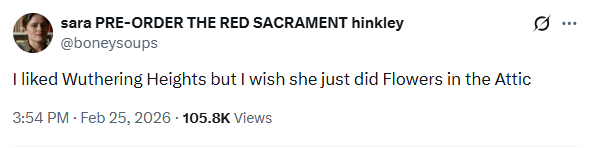
I had just recently completed my own most recent rewatch of 1987’s Flowers in the Attic, and I became fixated on this idea. I’ve been down the Flowers in the Attic rabbit hole more times than I’d care to remember, but at its core, I’ve always been fascinated by the connection between Emily Brontë’s and V.C. Andrews’s novels. I don’t know if there’s any academic discussion of this out there, but I have no doubt in my mind that Andrews drew inspiration from Wuthering Heights, from naming her protagonist “Cathy” to making the implied, sublimated incest of Heights (I’ve always subscribed to the theory that Heathcliff is Earnshaw’s bastard son, meaning he and Catherine are half-siblings) explicit and pervasive in Flowers in the Attic and its sequels.
When I did get around to seeing “Wuthering Heights,” my major criticism of it ended up being that it doesn’t need to, and in fact shouldn’t, be Wuthering Heights at all. The most interesting characters in that film are Alison Oliver’s Isabella and Hong Chau’s Nelly, and one could have done a Rosaline style film about the former or even gone full-tilt into the “Nelly is the villain” concept and made a Cruella style picture about the latter, and either one of them would have been infinitely more interesting than watching “Wuthering Heights” bash two sexy Australian Barbie dolls at each other while reenacting a half-remembered SparkNote. In essence, both Flowers in the Attic and “Wuthering Heights” are both unfaithful mutations of the same source material, which means that Fennell might actually be the perfect person to make a Flowers in the Attic adaptation. Right?
I don’t think so… however, I do think that she would be the ideal person to adapt the first follow-up novel, Petals on the Wind. It would be incorrect to say that Petals is an easier novel to read than Flowers. While it may eschew most of the more taboo elements that made Flowers so salacious, adult Cathy finds herself in just as dire straits in Petals, where she is constantly subject to sexual danger regardless of which of her husbands is exerting force over her. Based on the overall negative reaction to Fennell’s Promising Young Woman (which I didn’t share), I don’t think that she has the sensitivity needed to present Flowers. This is, after all, a director who looked at the same source text that Andrews did and, where Andrews saw both the tenderness and the danger of Heathcliff and Cathy together and the way that it would affect future generations, instead got horned up by imagining them getting off to voyeuristic observation of a couple of servants going at it in a barn. But also, don’t worry, in this version Cathy and Heathcliff definitely aren’t half-siblings, so don’t worry, it’s okay if you get aroused!
For those who are interested, Flowers in the Attic (the novel) doesn’t end in the same way that the ‘87 film does. The latter includes a hastily-shot death scene for Corrine Dollanganger after being confronted by her children during her wedding to Bart Winslow, her late father’s lawyer, as producers felt that the book’s ending, which occurs when the children simply escape the house after learning that their grandfather is dead and Bart and Corrine have been married for over a year. This big confrontation scene seems like it would be right up Fennell’s alley, and the equivalent scene, in which Cathy crashes the Winslow family’s Christmas party at Foxworth Hall to reveal to Corrine that she has (a) seduced Bart and (b) is pregnant by him, is the climax of Petals on the Wind. Of course, this is between her first marriage to an abusive narcissist and her second marriage to the doctor who fostered the children following their escape. Petals also borrows from Brontë, although it’s Charlotte this time, as Paul, the aforementioned doctor, initially pretends that his wife is dead before revealing that she’s actually in an institution, such that his initial overtures toward Cathy when she is of age are much like Rochester’s towards the title character in Jane Eyre. It’s all very, very messy, a true soap opera, and that’s the wheelhouse that Fennell would most bloom in if she took that opportunity.
-Mark “Boomer” Redmond
 Swampflix