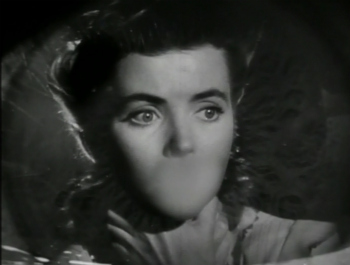

“Why must a movie be ‘good?’ Is it not enough to sit somewhere dark and see a beautiful face, huge?”
That 19-word tweet from Mike Ginn is one of the most concisely insightful pieces of critical writing on cinema in the past decade. It’s also never been so strenuously tested since it was first tweeted in 2018 as it is in Gia Coppola’s latest feature, The Last Showgirl, which relies heavily on the simple pleasure of seeing Pamela Anderson’s beautiful face, huge. The Last Showgirl is not a Good Movie in an artistic sense, or it’s at least too phony & hollow to pass as a well-constructed drama. It’s got a nice visual texture to it, though, which helps make it an effective advertisement for Anderson’s reinvented screen presence as an anxious, fragile Betty Boop. Anderson stars in the film as a traditional Las Vegas showgirl who’s aging out of her decades-long stage act, echoing her real-life career as The 90s Babe who was quietly forgotten after the end of her signature decade. She’s overly delicate & vulnerable here in a way we’ve never seen her in more youthful, forceful titles like Baywatch & Barb-Wire, which is a great benefit to the movie, since it otherwise only shows us things we’ve seen before. If you’ve seen Darren Aronofsky’s The Wrestler or any post-Starlet title from Sean Baker, you’ve already seen The Last Showgirl done better. You just haven’t seen it with Pamela Anderson’s beautiful face on the screen & poster.
Even so, The Last Showgirl doesn’t do entirely right by Anderson, since it allows her more forceful costars to steamroll her daintily sweet performance whenever they want the spotlight. Jamie Lee Curtis is the guiltiest of her scene partners in that respect, playing a too-old-for-this-shit cocktail waitress who still stubbornly carries the self-assured boldness that Anderson left behind in the 90s. Dave Bautista is innocent as the only male member of the central cast and the only costar who tones himself down to match her low-key volatility. Meanwhile, the three actresses that she takes under her wing as daughter figures, only one biological (Kiernan Shipka, Brenda Song, Billie Lourd), each hungrily scrape for single-scene impact that will allow them to stand out in a movie built entirely around an already-famous actor’s persona. The result is a long procession of phony interactions that feel like out-of-context scenes from a longer movie where these personal relationships actually mean something to the audience beyond an acting showcase. The important thing, though, is that Pamela Anderson gets to model gorgeously tacky Vegas showgirl outfits while either whispering or screeching dialogue that no one would have dared to feed her when she was a 20something sexpot. It’s an audition for a better movie that can make full use of what she has to offer, now that we know it’s on the table.
There isn’t much of a story to speak of here, just fragments of one that gradually unravel and dissolve. At the start of the film, Anderson’s titular showgirl is given two-weeks’ notice that her decades-running show of employment, Le Razzle Dazzle, is being closed to make room for more exciting, novel acts. She’s distraught by this professional blow, not only because she’s unlikely to find new stage work but also because no one around her seems especially nostalgic for what’s being lost. Everyone from her fellow dancers (Shipka, Song), her estranged daughter (Lourd), her romantic-interest stage manager (Bautista), and her cocktail-waitress bestie (Curtis) all see Le Razzle Dazzle as just another tits-and-glitter show – a way to pay the bills. In her mind and, presumably, the audience’s, it’s more substantial than that. It’s a moving work of visual art and a relic of Old Vegas kitsch, which Anderson’s showgirl likens to Parisian traditions like shows at The Crazy Horse. That’s a great starting place for a film, but Coppola never finds the way to develop her premise into a plot. Individual scenes from those two depressing weeks in the showgirl’s life clash against each other in gentle, splashing waves, then the whole movie just recedes away from the audience in a low tide, leaving us dry. Of course, though, just because it isn’t any good doesn’t mean it isn’t worth seeing Pamela Anderson’s face in it, huge.
After over a decade of avoiding the evil conveniences of streaming music on Spotify, I have finally given up. I’ve been enjoying the exploitative service for a full year now, contributing fractions of pennies to my favorite artists and turning my head when Belly’s “Delete Spotify” profile-pic message appears while their songs play. As proof of this shame, I’ll share my Spotify Wrapped data for 2024 below. As you might expect, it’s changed my music-listening habits quite a bit, fracturing the full-album sessions I get listening to LPS & cassettes at home to instead rely on shuffling songs on discordant playlists while I’m on the go – something I haven’t experienced since owning iPods in the aughts. That fracturing is not entirely inherent to the digital-listening era, though. There were plenty of artist-showcase compilations that preceded the LimeWire playlist era, and some were even released into movie theaters. I remember being especially blown away by the near-impossible line-up of the 1964 concert film The T.A.M.I. Show, which improbably included performances by Chuck Berry, Smoky Robinson, Marvin Gaye, Lesley Gore, The Beach Boys, The Supremes, James Brown, and The Rolling Stones. That roster is nearly indistinguishable from hitting shuffle on a 1960s playlist on Spotify, and I have since discovered its 1980s punk equivalent in Urgh! A Music War.
Urgh! A Music War is a no-nonsense marathon of live performances from early-80s New Wavers, attempting to document the exact moment when punk got weird. It’s like stumbling into a local Battle of the Bands contest and discovering your all-time-top-10 favorite acts in just a couple hours . . . mixed in with a bunch of other bands that are pretty good too. The MVPs of this live-performance playlist include Devo, Oingo Boingo, The Go-Go’s, Klaus Nomi, Gary Numan, Joan Jett, The Cramps, Gang of Four, Dead Kennedys, Au Pairs, Echo & the Bunnymen, Pere Ubu, Magazine, X, XTC, and I guess The Police, if you’re into that kind of thing. There is no narration or context provided to connect these acts and, unlike the single-event documentation of The T.A.M.I. Show, the performances are split between separate concerts in the US & the UK. Urgh! makes more sense as a live compilation album than as a feature film, which might help explain why it was released on vinyl a full year before the movie version hit theaters, and why it mostly faded into obscurity outside a few cable broadcasts and a subsequent made-on-demand DVD-R release from the Warner Archive. Still, it’s a staggeringly impressive list of new wave & post-punk acts to collect under one label, as long as you’re willing to look past the disconcerting number of white Brits playing reggae in the mix. I even made a couple new-to-me discoveries in the process, adding some tracks from Toyah to my “Liked” playlist on Spotify and finding no results on the app when I searched for the band Invisible Sex.
The major triumph of Urgh! is entirely in the assemblage of its line-up, since most of its filmed performances are straight-forward rock & roll numbers; such is the essence of punk. Only The Police introduce a stadium-rock grandeur at the film’s bookends, concluding this breakneck showcase on a bloated, dubbed-out medley of “Roxanne” and “So Lonely” that’s drained of whatever punk ethos the band might’ve had in them before they blew up. Without the sing-along crowd participation that bolsters The Police, the 27 other bands on the docket have to stand out through pure rock & roll energy, since the camerawork & editing do little to back them up besides occasionally scanning the crowd in the pit and on the curb for streetwear fashion reports. The political reggae band Steelpulse spices things up with a skanking Klansman. Lux Interior from The Cramps enthusiastically fellates his microphone while teasing the exposure of his actual dick, which is barely concealed by sagging leather pants. Spizzenergi vocalist Spizz goes a little overboard trying to add novelty to the band’s performance of their punk-circuit hit “Where’s Captain Kirk?”, putting more energy into spraying the crowd & camera with silly string than into reciting his lyrics. Since the talent on hand is so overwhelming in total, each band’s memorability relies on small moments of novelty. That is, except for Devo, Gary Numan, and Klaus Nomi, who incorporated a keen sense of visual art to their stage craft that translates exceptionally well to this medium.
Urgh! A Music War is glaringly imperfect. As amazing as the line-up is, it’s sorely missing The B-52s, whose Wild Planet-era material would’ve fit in perfectly. Of the acts included, there are a few like X, XTC, and Peru Ubu that appear to be suffering late-in-the-set exhaustion, not quite living up to the energy they bring to their studio recordings. The imperfections and inconsistences frequently account for the appeal of this musical-styles mashup compilation, though; it’s the same appeal in listening to a well-curated Spotify playlist on shuffle. The cut from Gary Numan’s future-synth phantasmagoria to the no-frills rock & roll of Joan Jett and The Blackhearts is especially jarring and says a lot about the precarious identity of punk at the start of its new decade. It’s the same thrill I get when my Spotify “Liked” list jumps from City Girls to Xiu Xiu to Liz Phair, except that it used to be immortalized on vinyl & celluloid instead of relying on the whims of a malfunctioning algorithm.
When questioned on why the lighting & color grading of Wicked: Part 1 was so muted & chalky when compared to the Technicolor wonders of the classic MGM adaptation of The Wizard of Oz, director Jon M. Chu explained that he wanted to “immerse people into Oz, to make it a real place […] Because if it was a fake place, if it was a dream in someone’s mind, then the real relationships and stakes that [the characters] are going through wouldn’t feel real.” Given the immense popularity of the film, I have to assume that most audiences understand the appeal of that desaturated, “real stakes” take on the movie musical and are hungry for more reality-bound singalongs just like it. Luckily, they do not have to wait an entire year for the arrival of Wicked: Part 2 to scratch that itch. Joshua Oppenheimer’s climate-change musical The End has arrived to immediately supply what the people demand: a drab, real-world movie musical with grim, real-world stakes. Set entirely in a single, secluded bunker after our impending global environmental collapse, The End is as grounded in reality as any musical has been since the semi-documentary London Road. The stakes are the continued survival of human life on planet Earth. The relationships are strictly parental or economic. Oppenheimer even has the good sense to luxuriate in a near three-hour runtime, just like the first half of Wicked. With an immersive approach like that, it’s sure to be a hit.
George MacKay stars as a twentysomething brat who’s spent his entire life sheltered from the apocalypse in his family’s luxurious bunker, located inside a salt mine. His only social interaction has been confined to his erudite parents and their small staff: a cook, a doctor, and a butler. Playing the mother, Tilda Swinton frets nervously with her fine-art home decor with the same sense of existential dread that she brought to Memoria. Playing the father, Michael Shannon maintains order & civility while grappling with his first-hand contributions to the environmental disaster as a vaguely defined executive in The Energy Business. The domestic fantasy of their life underground is disrupted by the arrival of a starving, haunted survivor of the world outside, played by Moses Ingram. The newcomer’s only potential place in the house is as a mate for McKay’s poorly socialized, brainwashed rich boy, which is not verbally acknowledged but weighs heavily on her every decision. Helpfully, every character confesses their internal emotional conflicts to the audience in song, which never escalates from patter to barnburner but at least adds a minor note of escapism to an otherwise grim, limited setting. The musical numbers are conversational, recalling the sung-through movie musical style of films like The Umbrellas of Cherbourg (or, more recently, Annette), except they’re much more sparingly deployed among the more traditional, reserved dialogue.
With The End, Oppenheimer has leapt from documentary to the deep end of narrative filmmaking: the movie musical. Or, at least, that’s what the movie musical should be. Jon M. Chu’s quotes about making Oz “a real place” where audiences can “feel the dirt” is entirely antithetical to the pleasures of movie musical filmmaking, a fundamental misunderstanding of the artform. By contrast, Oppenheimer appears to understand the artform but actively seeks to subvert it to make a political point. The End is a movie musical about the economics of surviving climate change; it only cares about the “real relationships” between the ultra-wealthy and their small staff within the terms of economic power & control. It speaks in Old Hollywood musical language but limits its setting to what would traditionally account for one isolated set-piece song & dance, contrasting the grandeur of the salt mine to the smallness of its characters’ hermetic world. I can’t say that he fully manages the discordance between movie magic & political doomsaying with anything near the success of his breakthrough triumph The Act of Killing, but The End is at least occasionally uncanny in an interesting, provocative way, as opposed to uncanny in a cowardly way. Anyone who’s praising Wicked for its political allegories about fascism & repression will surely find their next favorite musical in the new Oppenheimer film . . . unless everyone’s just needlessly making excuses for enjoying assembly-line Hollywood spectacle. Its current state requires many such excuses.
The premise of Heretic is a good one. Two teenage girl missionaries from the Church of Jesus Christ of Latter Day Saints (you know, Mormons) are invited into the home of a potential convert, only to realize he may have a better knowledge of their faith than they do and that his intentions are sinister. As a result, the first act of the film is very strong, as the dyed-in-the-wool believer Sister Paxton (Chloe East) and the more worldly convert Sister Barnes (Sophie Thatcher, of Yellowjackets) bond over the divergent ways that they see the world before becoming trapped in the home of the seemingly harmless Mr. Reed (Hugh Grant). From there, as he starts to ask questions about their beliefs that reveal that he has a strong knowledge of Mormonism and which pokes at the outer edges of their own familiarity with doctrine, the girls become more and more uncomfortable with his familiarity and apparent deception. Where is the wife that he claims is in the house, and upon whose supposed existence the missionaries’ willingness to enter the home is predicated? And why, when they attempt to leave while he is out of the room, do they discover that the door is locked and all of the windows are impossible to open?
I was already familiar with what a strong performer Thatcher was from her excellent portrayal of the younger version of Juliette Lewis’s character in Yellowjackets, and she’s marvelous here in the role of a young woman who was initially raised in a home with no religious affiliation and who became a member of her faith later in childhood. A more obvious route to go with this character would be to make her an overt zealot like many later-life converts often are, or to have Sister Barnes be a non-believer who’s been conscripted into doing mission work because that’s what’s expected of her simply because her mother fell into a faith in the wake of a failed marriage. Instead, she’s an earnest believer, albeit a modern one, and that makes her genuine friendship with lifelong church devotee Sister Paxton feel all the more earnest and sincere. Paxton comes from a large family in which she is one of eight children (gotta keep that quiver full, am I right, elders?), and she’s written with an incredibly accurate understanding of what kind of girl emerges from these families and their religious traditions. She’s sweetly innocent and undersocialized, but she’s also strong under pressure. I spent many unfortunate years in my youth attending a Christian school that was part of an evangelical megachurch, and which also served as the host for at least one annual fundamentalist homeschooling convention. I’ve met many Sister Paxtons in my life, and there’s something very knowing about the way that she’s written on the page here that hints at a similar familiarity with fundamentalist kids on the part of the screenwriters. That they manage to communicate this so well in the film’s opening scene, in which Paxton talks about having seen an amateur hardcore video (which she endearingly refers to as “porno-nography,” which is very fundie-coded) while also showing that she, like Barnes, is finding her way in a modern world as she claims that she saw the truth of God in the porn, even if only for a moment. Both characters are remarkably well-conceived and performed. It’s unfortunate that the film devolves so quickly after the opening minutes of the second act.
I went into this one with little knowledge beyond the basic logline, and I was on the edge of my seat throughout the first thirty minutes. After an incident in which Paxton is humiliated by some secular girls, she’s already slightly ill at ease, and Mr. Reed’s apparent warm, chummy openness to receiving their evangelizing comes right on the heels of it, so it’s easy to understand how getting back into the routine of sharing her faith feels comforting enough that the first signs that his intentions are sinister might fly under the radar. Once it becomes clear that he’s been deceptive about everything and has locked them inside, he lures the girls into a fake chapel behind his living room where he proceeds to give them a lecture about how, as a student, he studied the beliefs of several different faiths, only to come to the conclusion that all of them were false, and thus set out to determine which was the one true faith. There are some great bits in this sequence as well, like how he compares the major Abrahamic religions to various iterations of the same ideology by using versions of the board game Monopoly (and its predecessor, the anti-capitalist Landlord’s Game) and also doing a terrible, terrible impression of Jar Jar Binks. As it turns out, the girls have fallen into his spiderweb where he now seeks to convert them to his faith, and he offers them the choice to pass through one of two doors, one labeled “Belief,” and the other “Disbelief.” Ironically, it’s the convert Sister Barnes who chooses “Belief,” and she attempts to convince Paxton to join her, while Paxton chooses “Disbelief,” based on her understanding of Mr. Reed’s serpentine logic. Ultimately, both doors lead down a set of stairs into the same dungeon, and it’s here that the film starts to fall apart.
Spoilers ahead. There was a portion of this film that I spent believing that this might be one of those plots where a seemingly irrational belief on the part of someone with authority might turn out to be true, with the possibility that Reed was spreading a sincerely-believed gospel that he had somehow received through true divine revelation. The fact that the victims were members of the LDS church, a denomination that traced its existence to a verifiably historical person and whose faith is based on a supposed divine revelation to that person laid some groundwork for this to be the case. I’m thinking of something like 10 Cloverfield Lane, where we see everything through the eyes of a protagonist who has no real reason to believe that the supposed apocalypse above ground is real and not merely the lies of a kidnapper, or the classic Twilight Zone episode “The Howling Man,” in which a lost traveller appears at a monastery and is told that an apparently innocently imprisoned man is a captured devil, only to release the man out of kindness and learn that the monks were telling the truth. I think this would have been a much more interesting place for the narrative to go. Instead, what we get is a Saw variation in which Reed manipulates events to try and convert the girls to the concept of the only true god being “control.” Ironically, it’s his lack of control over all of the circumstances in the dungeon (as well as an oversimplification of certain religious precepts to make them appear more common across multiple belief systems, which doesn’t hold up under scrutiny) that allow for the girls to see through his deception. Instead, this becomes a cut-rate Barbarian that completely fails to stick the landing. Ultimately, the pontification about religion and what that means to Reed’s motivation is a lot of window dressing for some gross-out scenes.
I don’t know how to explain it other than to say this: Heretic feels like it was written by a really, really smart college freshman. Someone who has seen a lot of horror movies and comes from a religious background that they’re now grappling with in their art, creating a film that’s full of Intro to Religious Studies intersections that are ultimately a little shallow. Where it functions best is in its work as a character study of Barnes and Paxton, and one of my viewing companions and I had the same thought about the film when coming out of the screening: this would make for a strong stage play, with the story remaining confined in Reed’s parlor as he plays mind games on the girls to break their faith. As it is, once we go down the stairs into the basement where Reed has supposedly managed to confine his “prophet,” this completely stops working for me. Beyond the stellar performances from both Thatcher and East, there are some notably cinematic moments that deserve to be called out. I love the final moment before the credits roll, when the final girl manages to escape into the snow and a Monarch butterfly alights on her hand, calling back to a prior conversation in which Paxton reveals that if she wanted to let her loved ones know that she was safe on the other side, a butterfly would be the sign. There’s also a really fun transition near the end of the film when one of the girls is fleeing from the depths of Reed’s murder basement and we see her progress through this via an overhead shot of a miniature of the house, which Reed has been using to keep track of all of his moving pieces; the missionary escapes the miniature maze via breaking into the room where the miniature is, so we see her break out in both micro and macro forms. It’s just too bad that this movie’s hard turn into early aughts torture porn aesthetics and late night freshman dormitory religious discussion ruins the overall text.
There was a lot of understandable pushback against the initial wave of “pandemic cinema” that was made during the first couple years of COVID-19, movies that distilled the mood & setting of our global lockdown into the same smartphone video diaries and Zoom meeting windows that we were already submerged in outside of The Movies anyway. A lot of the resistance to that iconography from audiences & critics alike was just fatigue with the cheapness & smallness of that era in image production, but it was always couched in a concern that in the long term even the best pandemic movies were going to be instantly dated and, thus, disposable. Betrand Bonello’s Coma defies that line of criticism by expanding the scope of lockdown-era doldrums as a symptom of a larger global illness, one that’s now persisted a half-decade beyond the initial COVID-19 outbreak. It’s been nearly five years since the earliest COVID lockdowns and the world still feels like it hasn’t broken the spell we fell under then; we’re all still sleeping under the same weighted blanket of dread & futility. That’s bad news for our collective mental health, but it’s great for the thematic shelf life of Coma, which finally went into wide release in 2024 after premiering at European film festivals two long, grueling years earlier.
Coma is a multimedia experiment in which Bonello attempts to relive the early lockdown days of the pandemic through his teenage daughter’s eyes. A five-minute intro directly addresses the teen in subtitles without accompanying audio, urging her to not “surrender to the current mood,” because he believes things will eventually get better if we survive long enough to see it. The drama that follows is mostly confined to a teen girl’s bedroom, with an actress playing a fictionalized version of his child (Louise Labèque, notably of Bonello’s Zombi Child). She reaches out to peers through Zoom & FaceTime calls—at one point organizing a group-chat ranking of history’s greatest serial killers—but for the most part she’s tasked with entertaining herself in isolation. She plays with Barbie dolls the way an 18-year-old would, imagining them in salacious soap opera sex scandals and feeding them outrageous dialogue from internet sources like Trump’s Twitter scroll. She obsesses over the New Age musings of a social media influencer called Patricia Coma (Julia Faure, soon to appear in Bonello’s The Beast), who seems wise & poised until it becomes apparent that she’s suffering the same existential malaise as her followers. The room alternates between rotoscope animation, Blair Witch found-footage nightmares set in a limbo-like “Free Zone” between worlds, paranoiac surveillance footage, and sponcon commercials for a pointless, existential memory game called The Revelator. The entire movie is just the daily toiling of a teenager who passes her time “doing nothing much,” and the oppressive listlessness of it all is suffocating.
Bonello is mostly being playful here, and most of the appeal of the movie is in watching an accomplished filmmaker daydream in internet language, mentally drifting from the boredom of modern life. Still, there is a heartfelt urgency in his appeal to his daughter to remain resilient despite the great Enshitification of everything, to the point where the movie is less about her interior response to the lockdown than it is about his own anxieties about having created a young child in such grim, impotent times. In pandemic cinema terms, the result lands somewhere between the vulnerable earnestness of Bo Burnham’s Inside and the digital-age terror of the screenlife horror Host. It’s the same push-and-pull tension between dread and romantic idealism in Bonello’s follow-up, The Beast, except that this time he’s actively fighting to not let the dread win. Coma finds Bonello desperately searching for hope in an increasingly isolating dead-end world, because he has to believe his child is not going to suffer through The End. The real horror of it all, of course, is that no one ever imagined the apocalypse would be this much of a bore. As a species, we’ve never been lonelier or more useless than we are right now, and the first year of COVID lockdowns was only the start of that cultural decomposition. I wish this movie had aged poorly in the past couple years, but unfortunately it’s still painfully relevant.
It’s likely cliché to describe any movie’s editing style as being similar to jazz, but in the case of Soundtrack to a Coup d’État the descriptor is literal. The anxious sounds & stylish block text of vintage jazz albums overlay news-report propaganda clips for 150 relentless minutes in this essay-style documentary film, which covers the CIA’s efforts to rebrand the Cold War as a “Cool War” by deploying popular jazz musicians to distract from its conspiratorial overthrow of the Congolese government. While political figures of the era as formidable & dissonant as Nikita Khrushchev, Dwight D. Eisenhower, and Malcolm X weigh in on the UN machinations that led to the CIA’s conspiracy to assassinate Congolese leader Patrice Lumumba, the soundtrack to that coup is provided by formidable & dissonant jazz greats of the era: Dizzy Gillespie, Duke Ellington, John Coltrane, Nina Simone, Charles Mingus, and, most improbably, Louis Armstrong. That soundtrack is not a formalistic choice made by director Johan Grimonprez so much as it is the core of his subject. He details how those musicians were manipulated into working as semi-official “jazz ambassadors” for Black American culture in African nations that recently joined the UN, and how those ambassadors of Cool were used to distract from and cover for the planned execution of a newly sovereign foreign leader.
There’s a sharp specificity to this doc’s subject, walking the audience through how African nations newly inducted into the United Nations were seen as a threat to be squashed by paranoid US leadership. Their power within the UN as a young, organized voting block was especially threatening to the US government’s interests, since it relied on those nations remaining colonized so they could be mined for uranium supplies in the ongoing nuclear Cold War against the Communist Bloc. Each subversive maneuver to ensure Belgium’s continued rule over the Congo is thoroughly documented in the onscreen text that interrupts the archival clips, often with page numbers & footnotes to encourage further research on your own time. What Khrushchev describes as the “cacophony” of jazz guides the everything-goes, free-association editing style of that archival footage, so that the film ends up snapshotting the greater context of late-50s & early-60s global culture outside its duty to detail the step-by-step progress of its titular coup. By the time Khrushchev is making jokes about visiting Disney World in a press conference attended by Marilyn Monroe, it plays like an alternate version of Joe Dante’s The Movie Orgy made for lefty academics: an impressive feat of politically fueled editing-room mania that captures & compresses the moral & political rot of an entire era.
Soundtrack to a Coup d’État‘s focus on the CIA’s appropriation & manipulation of Black American artists recalls a few other recent documentaries about the politics of Black artistic life in the US,namely Recorder: The Marion Stokes Project,Going to Mars: The Nikki Giovanni Project, and I Am Not Your Negro. It distinguishes itself from that cluster of radical docs by slightly shifting focus away from Civil Rights clashes of the 1960s to a different form of racist US state violence, but it’s still racist US state violence all the same. Grimonprez uses a key Malcolm X clip to link the two struggles, in which the activist encourages his audience to get angrier about the US’s violence abroad instead of just the Civil Rights struggle at home, emphasizing that foreign governments are dropping American bombs on Americans’ behalf. All efforts to de-colonize are worth supporting, but it’s especially egregious to ignore the ones suppressed by bombs bearing your country’s name. That line of thought has obvious current relevance in the continued bombing of Gaza by the Israeli military—backed by US weapons supplies—resonating just as loudly as the continued cultural racism of the US and the continued, aggressive unpredictability of jazz. It’s a documentary about a very specific political moment in time, but the global fight for post-colonial freedom smashes through that temporal window.
I know it’s gauche to discuss a movie’s marketing instead of its content, but the 1989 adaptation of The Phantom of the Opera is an especially peculiar case. Clearly, the best way to sell the film would be to piggyback off star Robert Englund’s success in the Nightmare on Elm Street franchise, especially since Freddy Kreuger’s make-up designer Kevin Yagher tagged along to apply the exact same make-up to this public-domain franchise. The video store poster for The Phantom of the Opera tiptoes as close as it can to declaring “Freddy Kreuger is the Phantom of the Opera” without getting sued by New Line. It’s not exactly false advertising, either. The entire Phantom story is told as one long dream-sequence journey into the past, where a wisecracking Englund in the gooey Freddy makeup slashes down every fool who gets in the way of the young ingenue he wants to transform into an opera star. What that premise doesn’t convey is that the film also adopts a romantic stage-theatre tone, playing like a throwback to classic Hammer Horror (or, at times, Masterpiece Theatre) that offers a classier, more literary take on the genre. That’s the version of Phantom of the Opera you were sold if you happen to catch the film’s trailer, which shows you all of the period-piece tragic romance of the plot with none of the flayed-alive gorehound grue that frequently interrupts it.
Setting up a modern-day sequel that never came to be (The Phantom of the Opera 2: Terror in Manhattan), our story starts in 1980s New York City, where The Stepfather‘s Jill Schoelen is auditioning to become a professional opera singer. There’s a stage prop accident during her audition that smashes her into a mirror realm so, naturally, she travels back in time to a past life in 19th Century London, again working as a hopeful opera singer. Only, the past version of herself is supported by a mysterious benefactor who skulks around the rafters and dungeons of the theatre, acting as her “angel” (through mentorship and murder) but carefully staying out of the spotlight. According to the title, Englund is strictly playing the Phantom of the Opera here, but his character details are a hodgepodge amalgamation of the Phantom, Faust, Jack the Ripper and, of course, Freddy Kreuger. The theatrical setting offers the film a classy surface aesthetic, like a straight-to-video version of Argento’s Opera. The Phantom’s quipping & mugging in the extreme-gore kill scenes drags it back down to the base pleasures of a by-the-numbers slasher, though, which is a fun contrast to the stately background setting. Then, when the story eventually smashes back through the looking glass to modern-day New York, bringing along Phantom Freddy with it, it’s even more fun to briefly see that dynamic flipped.
I always got the sense that Robert Englund never wanted to be fully pigeonholed as a Horror Guy, much less as Freddy Kreuger. If nothing else, he commiserates with fellow reluctant-horror-icon Wes Craven over that professional disappointment in A New Nightmare, where the actor & director find a way to flex their more erudite offscreen personae under the Freddy Kreuger brand. In The Phantom of the Opera, he’s clearly attempting to stray from the Freddy Krueger schtick into something more literary, but the furthest away he was allowed to get was emulating Vincent Price in The Abominable Dr. Phibes. It doesn’t help that he’s wearing the Freddy makeup beneath his Phantom mask, which is stitched together from harvested patches of discolored human flesh. That dual make-up layering is mirrored in the film’s double-exposure imagery during more surreal moments where the story travels time, echoes Faust, or underlines the Phantom’s extraordinary powers as a supernatural killer. So much of the Phantom plays like a standard BBC adaptation of a literary classic that it’s shocking when an especially beautiful or grotesque image punches through: a vibrant shock of red fabric, a flayed man transformed into a human puppet, the Phantom posed in Mario Bava color-gel artifice, etc. It may not be the career turn that Englund was hoping for, but it does offer a lovely, volatile contrast between the career he wished he had and the career he actually had, violently juxtaposed in real time.
There is no horror subgenre more hideously racist than the Italian cannibal film, and yet I keep tricking myself into watching them every time they appear in the wild on thrift-store DVDs. The 1980 Fulci knockoff Zombi Holocaust was at least more memorably entertaining than the last time I picked up one of these cursed objects about five years ago, when I reviewed Slave of the Cannibal God. I was hoping Zombi Holocaust would be Zombi-style gonzo Italo mayhem while fearing it might be Cannibal Holocaust-style racist Italo bullshit instead. The results were just as evenly mixed as the title suggests. Opening in a New York City med school where cadavers are being ransacked for lunchmeat behind professors’ backs, it at least promises a novel, urban angle on the Italo cannibal movie. Soon enough, though, those unsanctioned organ harvests are revealed to be the work of “primitive savages” from a small Indonesian island, and the white academics set sail to see what’s causing those “Asiatic” brutes to go so violently mad. Once on the island, the movie becomes more traditionally racist in the Mondo Italo style, except that the usual cannibal-tribesmen threat is made worse by the locals worshiping a small gang of rotting zombies who stalk the jungle and occasionally pop by for a human snack. It’s a wild genre mashup between the kind of shameless schlock I love and the kind of shameless shlock I loathe, erratically alternating between them from minute to minute.
What’s fascinating about Zombi Holocaust‘s xenophobia is that the film actively attempts to convey an anti-racist sentiment; it’s just too tone-deaf to pull it off. In a laughable line of faux-profundity, a college professor asks if New York City is really all that different from a society of “primitive savages,” undercutting whatever point they think they’re making with their own racist terminology. There is something to the juxtaposition of the university’s nighttime cannibal raids and its daytime surgery lectures, though, calling into question how medical study is functionally different from mad-scientist butchery. That parallel is confirmed later when it turns out that the reason the islanders have been regressing to crazed cannibal savagery is that they’re being experimented on by the professors’ white academic colleague who has gone mad and gone rogue. It’s a plot wrinkle spoiled by the film’s alternate American title Dr. Butcher M.D., which is a little less descriptive than Zombi Holocaust but a lot less embarrassing to say out loud when someone asks what movie you’re watching. The messaging behind that white villainy reveal is somewhat commendable, even if it is driven by an impulse to shock & entertain rather than an impulse to discourse. It’s also completely undone by the way every single Indonesian character is presented onscreen, since it still gets its thrills by depicting them as cannibalistic humanoids regardless of the reasoning.
It’s foolish to look for any coherent messaging in this vintage zombie cheapie, of course, so it’s ultimately a movie that lives & dies (and comes back to life) by the frequency & brutality of its violence. There are a few mundane stretches wherein characters drive around NYC, change clothes in real time, and struggle to read a map, but for the most part it’s a volatilely entertaining picture. When the island cannibals eat, they disembowel and chow down in swarms while their victims squirm & scream in protest. When the mad doctor performs surgery, he cracks open his nonconsenting patients’ skulls to dig around the goop inside in full view of the camera. There’s even an early giallo-style sequence in the hospital morgue where a gloved maniac meticulously removes a corpse’s hand with a bone saw and then runs off with it, presumably for a midnight snack. For all of my wincing at Zombi Holocaust‘s racial stereotypes and willingness to dawdle, it did make me yell “WHAT?!” at the screen several times, which is invaluable for second-hand horror schlock. I’m still not convinced that the Italo cannibal genre at large has anything of value to offer to cinema or to humanity, but this one example is just crazed enough in its practical-effects hyperviolence that for once I didn’t regret watching it. I’m just a lot more likely to rewatch Burial Ground instead next time I get the itch, since it delivers the same Italo zombie goods without miring them in cannibal muck.
I’m not especially interested in War Films as a genre, but André de Toth’s WWII thriller Play Dirty sneaks past those well-guarded genre biases and hits me where I’m vulnerable. Instead of being guided by the usual narrative maps of WWII stories about the valor of defeating Nazis or the horrors of what those Nazis achieved before defeat, Play Dirty is structured more like a heist picture that happens to be set on the battlefield. It’s a crime picture first and a war movie second, as explained by a British colonel who declares in an early strategy meeting, “War is a criminal enterprise. I fight it with criminals.” Those criminals are the men under his command: a gang of disaffected mercenaries who wear the British uniform but are more motivated by money & personal survival than they are by the prospect of defeating Hitler’s Germany. If it were an American film, it might’ve been received as a reaction to our country’s ongoing, pointless involvement in The Vietnam War, but its pervasive Britishness divorces it from such a strict 1:1 reading, extending its commentary to all war everywhere at every time. In Play Dirty, war is a sprawling, scrappy prison fight wherein you’re just as likely to be shot in the back by your own men as you are to be taken down by the enemy. It deliberately strips all valor from history’s most noble victory over a warring enemy, with the Head Criminal in Charge advising, “Forget the noble sentiments if you want to live.”
A young Michael Caine provides the most familiar face (and voice) here as a clean-cut military officer who naively takes command of this criminal unit. He immediately struggles to exert control over the undisciplined brutes, desperately pulling a gun on them whenever they refuse to obey his orders. Unbeknownst to him, the only reason he survives these altercations is because the most undisciplined brute of all (Nigel Davenport) has been promised a bigger payout for the mission if Caine returns alive, unlike the other officers who’ve preceded him. Their half-Inglorious Basterds, half- Sorcerer mission is to sneak behind enemy lines disguised as Italian soldiers and explode a critical Nazi fuel depot, expediting Hitler’s defeat. The rocky path to victory is high in tension and sparse in dialogue, often with a shaky handheld camera jostling the audience with the uneasy feeling that gunfire or explosions could erupt at any moment; they often do. On a character level, there’s no chance of meeting in the middle for Caine & Davenport, who represent opposing noble & savage philosophies of war. In order to survive the mission, Caine has to cheat & kill just like the heartless criminals under his command, while Davenport just knowingly smiles and scoffs at the supposed differences between “playing dirty” and “playing safe.” It’s by no means the only war picture that posits that “War makes monsters of us all,” but it is one of the only ones I’ve seen that frames that monstrous behavior as a lowly, scrappy crime spree.
Even if this gang of British soldiers weren’t sneaking behind enemy lines disguised as Italians, this would still clearly be the kind of cinematic relic Quentin Tarantino raves about through coke sweats at LA house parties to anyone who’ll listen. It’s got the exact haggard, macho hangout vibe he’s always praising in vintage genre cinema, and I’m sure he could rattle off the professional stats of all the various character actors who pad out the rest of the cast like a little kid who obsesses over baseball cards. The only woman among those macho brutes is a German nurse whose capture raises the tension of the group dynamic for obvious, hideous reasons, which reminded me why I don’t spend much of my personal time perusing this particular video store aisle. Even so, the rougher, confrontational approach to the genre did pique my interest in André de Toth’s directorial career, of which this was shockingly his final film. It’s got the showy, punchy impact of a much younger man with more to prove professionally, which speaks well to de Toth’s late-career enthusiasm behind the camera. I’m looking forward to seeing some of the horror & thriller titles in his catalog that speak more directly to my personal tastes (House of Wax, Crime Wave, Pitfall, etc.) almost as much as I’m looking forward to never picking up a gun on a battlefield, nor having a one-sided conversation with Quentin Tarantino.