The morning of the day on which I’m writing this, Brandon texted me to let me know that our most recent streak of daily posting was coming to an end after forty consecutive days (starting on October 20th). If only I had been productive last night, as I intended, alas! Then I remembered that these streaks are fairly exclusively interesting to us and stopped beating myself up about it. And then I got in an under-the-wire review of Went the Day Well?, which kept the streak alive. What I did instead of being productive last night was—realizing that I had gotten all the way to the end of the month without following up at all on the goal I had announced in my Blue Gardenia review, to celebrate “Noirvember”—I checked out another one of the films featured on the recent Criterion service’s “Black Out Noir” list. I hadn’t realized until watching both The Blue Gardenia and Black Angel that the “black out” referenced in the collection title isn’t just a reference to these being films noir but to actual periods of drunken or drugged lost time that characters experience within the text. In the case of Black Angel, however, it’s almost a bit of a spoiler.
Mavis Marlowe (Constance Dowling) is a torch song singer living in luxury in Los Angeles. Her somewhat estranged, alcoholic husband Marty Blair (Dan Duryea) comes to visit her on their anniversary, but she leaves strict instructions with her doorman that he’s to be prevented from entering the building. Rousted from the lobby, Marty watches as another man (Peter Lorre) approaches and is allowed in to visit her. Sometime later, Kirk Bennet (John Phillips) comes to Mavis’s apartment and finds her dead; a recording of her biggest song “Heartbreak,” composed by Barry, plays on repeat. Kirk lifts the phone to call the police when he hears a noise in the other room and returns to find that a notable piece of jewelry, a heart-shaped ruby brooch, has been taken from her body, before he’s startled by the return of Mavis’s maid, who identifies him to police. Kirk is quickly convicted and sentenced to execution, and it falls to his wife Catherine (June Vincent) to try and clear his name. To that end, she and Marty team up, posing as a musical duo act and infiltrating the club of Lorre’s character, whom we learn is named Marko. They’re convinced that, if they can get into his safe, they’ll find the missing brooch and be able to clear Kirk’s name, but time is quickly running out.
If certain parts of that plot summary sound as familiar to you as they did to me, then you’re probably noticing the similarities in structure to The Phantom Lady, a noir directed by Robert Siodmak that came out just two years prior. The wrongfully convicted killer in Phantom Lady was accused of murdering his wife, with his secretary being the only one to believe in his innocence, while Black Angel’s dead man walking is put away for killing his blackmailer (and perhaps mistress) and only his wife has faith in him. Other than that, the schematic of the film is much the same, with Catherine/Kansas finding her respective police investigators mostly unhelpful until she does his job for him by finding exonerating evidence. Each woman is assisted in this endeavor by someone who seems to fall in love with her a little and who (spoiler alert) turns out to be the actual killer. Each woman successfully manages to secure her husband’s release, just in the nick of time, and everything ends happily ever after. Why are they so similar?
One might assume that the whiff of Black Angel feeling like an off-brand Phantom Lady can be attributed to the fact that both are adaptations of novels by Cornell Woolrich. Black Angel, in particular, was a re-working of a couple of earlier short stories into a longer work, something Woolrich did consistently throughout his career, so it would be logical to assume that this was just one of his variations on a theme. The summaries I have found of the Black Angel novel, however, paint a different picture about its source material, namely that Alberta (as she is named in the text) ends up ruining the lives of the other four male suspects and is changed internally by the lengths that she went to in order to save her husband and the things she saw that she can never forget. That’s not the structure of the film(s), which see the true culprits of the relative plot-instigating murders meet different ends but are identical in their happy reunion between the freed innocent men and the women who saved them. Black Angel the novel is more melancholy and bittersweet. From that, we have to assume that the film was produced with the directive that it ape Phantom Lady as closely as possible while keeping the characters and relationships from Black Angel’s source text, and while that might make this film more enjoyable in isolation, seeing it so soon after the superior Phantom Lady causes this one to suffer in comparison.
What this film does feature in its favor is yet another deliciously slimy performance from Peter Lorre, who is wonderful here as the villainous Marko. He’s got a great scene partner in the form of his “heavy,” Lucky (former boxer Freddie Steele), and the two of them have utterly watchable chemistry as the mastermind and his lunkhead enforcer. As Marko is ultimately revealed to have had no hand in Mavis’s death, one could criticize the narrative cul-de-sac in which Catherine and Marty infiltrate his nightclub as pointless, but despite the amount of screen time that it occupies, the breathless pace of this eighty-minute feature means that the red herring doesn’t feel like time wasted. If Marko were played by an actor with less magnetism than Lorre, it might be a different story. June Vincent is also quite good, but it’s not enough to really carry this one across the finish line. I’m more intrigued now to read the novel than I am to give this one another watch. It’s competent, but not exciting.
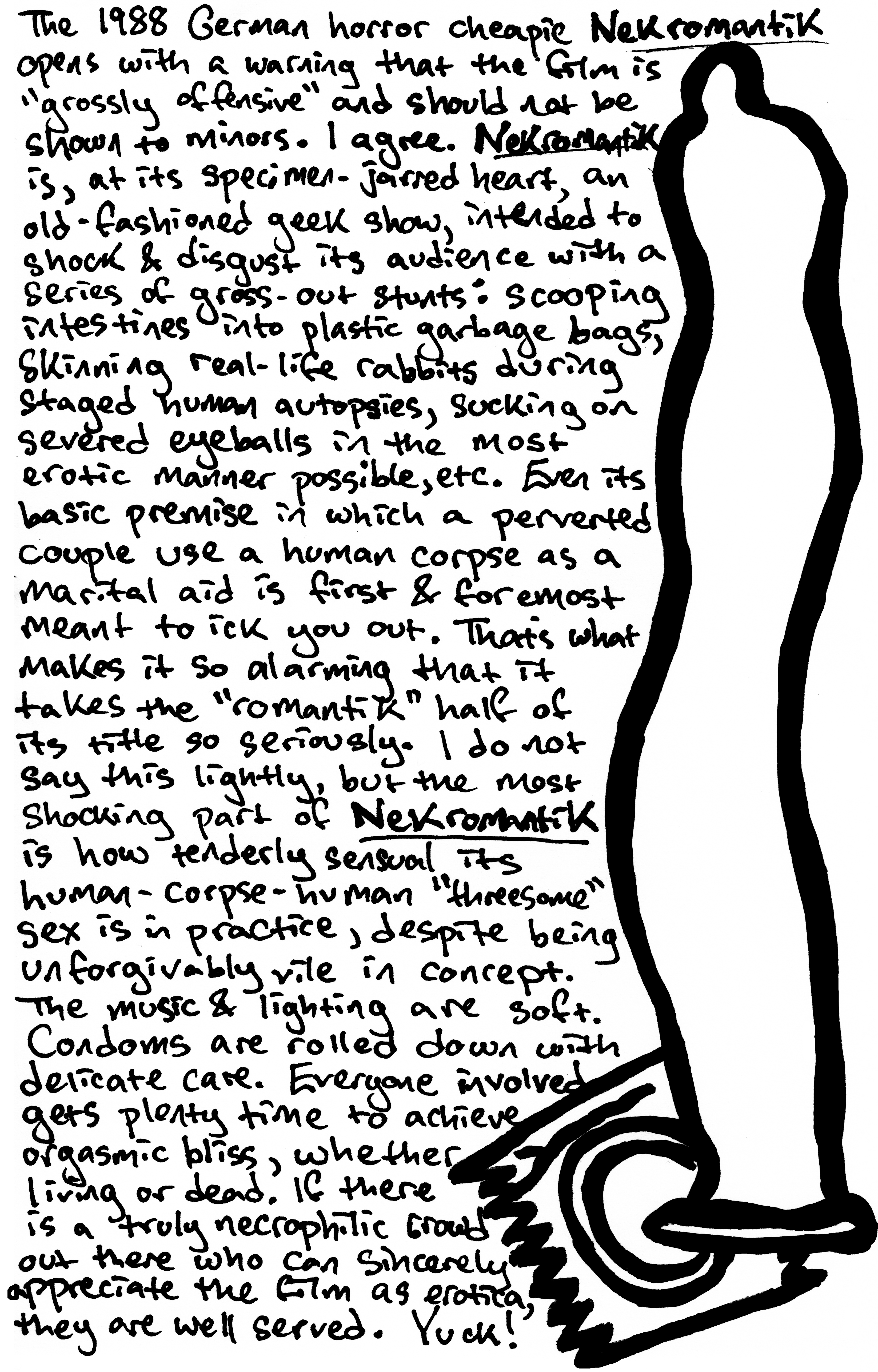
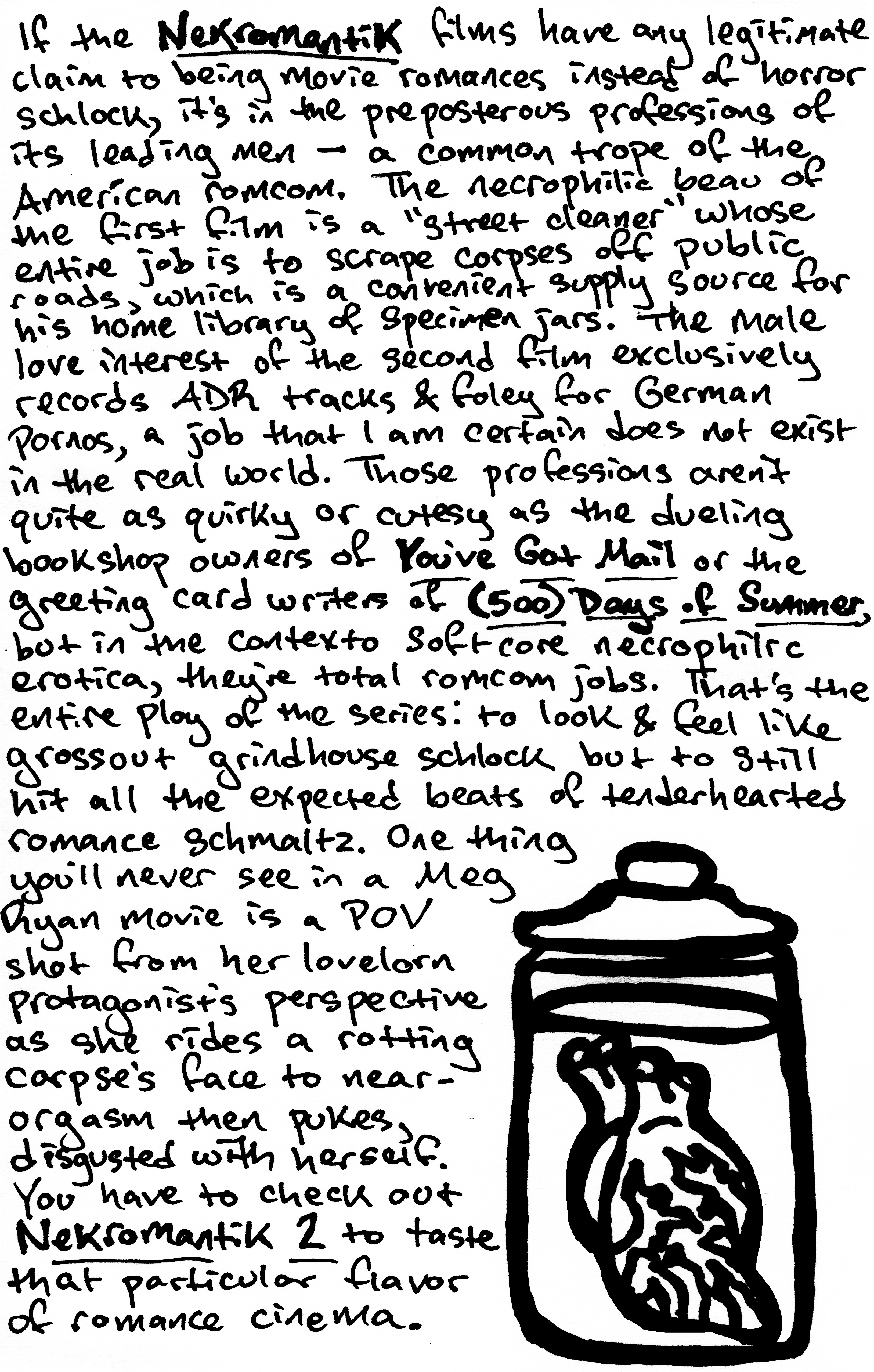
Attention, Swampflix readers in the New Orleans area! Swampflix will be selling zines this Saturday (December 6th) at the 22nd annual New Orleans Bookfair along with a bunch of other super cool book & zine exhibitors. We will be selling the print versions of six Swampflix zines, including a brand-new collection of hand-illustrated sexploitation movie reviews.
The New Orleans Bookfair will take place on Saturday, December 6, from 11am-5pm at The Fred Hampton Free Store (5523 St Claude Ave, New Orleans, LA 70117) in the 9th Ward.
Austin Film Society Cinema is currently programming a series entitled “Nope to Nazis,” consisting of films contemporaneous to Germany’s descent into nationalism and fascism, celebrating “the resilience of spirit deployed in opposition to these monsters” and their “authoritarianism, racism, and fraudulent populism.” The series contains some notable and well-known examples of films of this type, notably 1942’s Casablanca and 1940’s The Great Dictator alongside lesser-known examples, like John Farrow’s 1940 The Hitler Gang, which uses the framing of a gangster picture to show the rise of the titular monster and his ilk. All of these are American productions, but I was most intrigued by a British title that was new to me, Went the Day Well?, from 1942, directed by Alberto Cavalcanti.
The film opens with an introduction and welcome to the quaint British village of Bramley’s End by local Charles Sims (Mervyn Johns), who shows us to a small gravestone in the village’s churchyard, upon which are written several German surnames. They came to claim Bramley’s End, he says, and this small plot of land in which they are buried is all that they managed to hold, with Sims’s narration clearly placing this framing device after the end of the war. From there we go “back” to the film’s contemporary setting of May 1942, which finds the village going about its end-of-week business under all the wartime restrictions, when several lorries (trucks for us on this side of the pond) arrive filled with soldiers who will need to be billeted in the town for exercises. The leader of the soldiers, Major Hammond (Basil Sidney) goes around town and meets the various prominent locals before surreptitiously rendezvousing with Bramley’s End’s local squire, a quisling named Oliver Wilsford (Leslie Banks, of the original The Man Who Knew Too Much). After all of the men, who are secretly German paratroopers, have been placed in homes about the village, the treachery is exposed, and we learn that they are tasked with using some kind of ultimate weapon which, upon Monday morning, will ensure that Hitler’s invasion of England cannot be repelled. Wilsford, as a double agent, is rounded up with the rest of the villagers in the town’s church while the children are taken to Bramley End’s large manor house to be held separately, under the care of Mrs. Fraser (Marie Lohr). Later, when the town’s vicar refuses to go along with the Nazis, telling them to their faces that they are an evil force and an affront to God, he is killed while attempting to ring the church bell to call for help. His daughter Nora (Valerie Taylor), in her “hysteria,” is sent to the manor house to help mind the captive children.
What follows are two days and nights of the villagers finding ways to resist and attempting to get news to the outside world of what is happening in Bramley’s End, with each moment of hope that arrives, those hopes are dashed. In order to prevent the neighboring towns from growing suspicious, the German soldiers force the village’s phone and telegram operators to remain in place, but at gunpoint. When two women manage to write a message on an egg, they manage to get a half dozen to the paperboy from the next town, but he’s run off of the road and his eggs are smashed when Mrs. Fraser’s cousin comes to the village for tea. Mrs. Fraser manages to entertain her cousin and get her back on the road, without the Germans ever seeing that she slipped a note into the visitor’s pocket, but said cousin merely uses the paper she finds in her pocket to try and stop her car window from rattling, and it blows away before it can ever be read. Courageous postmistress Mrs. Collins (Muriel George) manages to kill the guard assigned to her by throwing pepper in his face before attacking him with her kindling hatchet, but the switchboard operators in the next town over are too busy gossiping and badmouthing her to take the call before she’s caught in the act and shown the sharp end of a German bayonet for her troubles.
The message throughout (because make no mistake, this is a propaganda film, even if it’s one where the lecture we get—Nazis are bad—is the morally correct one) is about the moral failures of laxity in wartime, even if you think that you’re far from the warfront. The whole thing could have been over more quickly and with far fewer casualties if it weren’t for the carelessness of individual citizens, multiple times over. The switchboard girls, Mrs. Fraser’s careless cousin (twice!), and even the hometown members of the Home Guard who hear the peal of the church’s bell and shrug it off all share their complicity with the treacherous Wilsford. Even Mrs. Fraser herself laughs off Nora’s concerns when she notices that the “British” soldiers were keeping score in their card game with “Continental” numbers, marked by elongated number fives, and she pays for it with her life, as she bravely grabs a German grenade and runs into the hallway with it to protect the children under her command as the Nazis advance on the manor house. Unusually for the time, the violence is rather explicit and shocking, certainly with the intent of driving home the dangers of failed vigilance. Mrs. Fraser does manage to save the village’s children, but the film does not spare us from seeing another boy shot by Nazi soldiers as he attempts to run to the next village for help. Dozens of men, women, and children are felled in this movie. The Home Guard are gunned down in the street; the father of one of the Home Guard boys is attacked from behind by Wilsford, having tagged along on an escape attempt in order to prevent its success; an old poacher is shot while attempting to help the aforementioned shot boy escape to the next town; Wilsford is shot in cold blood by Nora, who has figured him out and manages to stop him from unbarricading an entry point for the encroaching Nazis. It’s in black and white, but it sure is bloody.
This one was admittedly a bit difficult to get into at first. We’re introduced to what feels like far too many people within the film’s opening minutes: milkmaids and milkmen, constables and vicars, telegraph operators and rabbit hunters. It’s a bit overwhelming, and the sudden appearance of the infiltrating soldiers, some of whom will be important later but who are indistinguishable from the rabble upon first sight, muddies things even further. I assume that there would have been obvious differences to the contemporary viewer between the uniforms of the soldiers needing to be billeted and the Home Guard who were going into the surrounding area for their own exercises, but those differences were lost on me. As a result, we have Germans disguised as British soldiers, all of them coming into Bramley’s End at the same time, while there are also actual British soldiers (technically militiamen), and it confuses some of the early plot points in the film. At the film’s climax, as the Germans attempt to wrest control of the manor house of Bramley’s End back from the locals who have successfully rebelled and holed up there, the cavalry finally arrives in the form of the neighboring villages’ own Home Guard (or maybe they’re proper British soldiers. As we’ve established, my eye is not trained to differentiate between them), but when those two opposing factions are fighting, I couldn’t properly tell you which was which.
Regardless of those weaknesses, this was a very effective thriller, and that’s coming from someone who’s ultimately pretty apathetic to war films. It’s a kind of proto-Red Dawn, and the film is quite tense throughout as one winces over and over again upon seeing yet another failed attempt to call for help. Worth seeking out.
As with most genre films, it’s tempting to discuss Julia Ducournau’s follow-up to her Palme d’Or-winning body horror Titane exclusively through points of comparison. Alpha is Julia Ducournau’s Tideland; it is Julia Ducournau’s Kids; it is Julia Ducournau’s 1990s time machine that only makes pitstops for scenes of vintage misery. The Tideland comparison is directly invited by the film itself, as Alpha is another fantasy-horror tale of a young child haunted by a close family member’s heroin addiction, in which the niece & uncle in that relationship take a beat to watch scenes from Tideland director Terry Gilliam’s better-respected title The Adventures of Baron Munchausen. The Kids comparison is indirectly invited earlier in the story, as we meet the titular 13-year-old-niece-in-peril while she’s unconscious at a high school house party and being tattooed with a dirty needle, exposing her to an illness referred to only as “The Virus.” Whereas Harmony Korine’s misbehaved-teens scare film intended to shock audiences with the seedy details of how HIV/AIDS was actively spreading through children’s unsupervised hedonism, Ducournau’s rearview vision can only grieve the lives lost during the scariest years of that viral spread, when information was as low as the likelihood for death was high. Alpha can’t help but feel a little out of step with the current moment as it dwells on those darkest days of the recent past, but the way it’s haunted by The Virus at least feels specific & personal to its director despite all its convenient points of comparison — especially by the time you do the math to figure out that she would’ve been her protagonist’s age around 1996.
One of the clearest ways Alpha is personal to Julia Ducournau is its visual interpretation of AIDS symptoms through body horror metaphor. In Raw, she depicted a young woman’s coming-of-age struggles through a skin-tearing cannibal transformation. In Titane, she tested the outer limits of familial machismo & gender identity through another monstrous transformation, that time forged in steel. In contrast, the bodily transformations of Alpha are much more solemn & subdued. Victims of The Virus gradually harden into gorgeous marble statues as they perish, coughing up sculptors’ dust in their last breaths before their final, agonized moments are set in stone. It’s a stunning effect that captures both the pain and the beauty of loved ones lost to disease, but it’s also one that deliberately backs away from the confrontational ferocity of Ducornau’s earlier works to instead seek a quiet sorrow. The film’s titular teenager (Mélissa Boros) is the daughter of a doctor (Golshifteh Farahani) who’s been surrounded by the fantastically painful effects of The Virus since its earliest days, most intimately through the slow physical decline of her drug-addict brother (Tahar Rahim). That wayward uncle happens to return home at the exact moment when Alpha is exposed to The Virus via tattoo needle, prompting the mother to worry about the parallels between the two people she loves the most as the family waits for her daughter’s test results. Those results will either foretell Alpha transforming into a human statue, frozen in time, or Alpha surviving long enough to live a full life. It’s a tough couple weeks’ wait, especially for an educated mother in the medical profession.
The worst you could say about Alpha is that it feels stuck in the past on an aesthetic level, somehow landing closer to the de-saturated digital filmmaking of the early 2000s (Tideland, et al.) than the 1990s misery dramas evoked in its themes (Kids, et al.). Ducournau’s earlier films felt like they were giving birth to some new monstrous beast not yet seen onscreen, while her latest finds her lost somewhere in the recent past, dissociated from the current moment. That temporal dissociation is at least appropriate for the film’s longform flashback structure, in which Farahani’s mother figure processes her daughter’s current health scare by reliving memories of her brother’s earlier days with The Virus. At first, those two timelines are clearly differentiated by color grading choices (warm tones for the past; cool, marbled tones for the present) and the respective curliness density of Farahani’s hairdo, but once the prodigal uncle returns to the fold they start to collapse into one simultaneous story. It’s a remarkably confusing narrative structure, but that confusion is somehwat the point. No matter how distanced the doctor gets from the most harrowing days of The Virus, she can’t help but bring the fears & anxieties of those times into the present. Ducournau is very likely making a point there about how survivors & witnesses of the HIV/AIDS epidemic reflexively carry the despair of those years into present-day illness crises (i.e., COVID), and she’s presumably counting herself among them. Whether it’s the point or not, though, the film does feel artistically dated, which is not typically something you can say of her work.
If there’s any current-moment film title Alpha can be easily compared to, it’s this year’s fellow Cannes-premiered oddity The Plague. Ducournau’s latest is paradoxically both more literal and more lyrical than Charlie Pollinger’s knockout debut, but they’re both coming-of-age stories about young nerds stigmatized by their peers for coming in direct contact with a fantastical virus that transforms their bodies. The influence of Ducournau’s own debut, Raw, visibly seeps into the waters of The Plague as the latter film’s fictional virus also manifests in itchy skin that victims habitually shred in an anxious reaction to social isolation. The overlap between Ducournau & Pollinger’s films then becomes uncanny in a pivotal moment when Alpha is bullied in her school’s swimming pool, mirroring the water polo camp setting of The Plague. Whereas The Plague conveys a sharpness in intent & execution, however, Alpha gets lost in its own made-up world & metaphor. In an early scene, Alpha’s classmates struggle to interpret the classic Poe poem “A Dream Within a Dream,” just as Ducournau invites her audience to struggle interpreting the linear timeline between her characters’ past & present through dream-within-a-dream storytelling logic. That temporal muddling ends up relegating the marbled body transformations of The Virus to the background as the character drama it threatens takes precedence, which is a letdown for anyone excited to see one of body horror’s best working auteurs once again do her thing. Instead, we find her searching for something in the haze of the past, making baffling aesthetic choices from scene to scene (not least of all in a few disastrously distracting needle drops) as she stumbles through a foggy memory. I suppose I should be celebrating Ducournau for retreating further into personal preoccupation rather than delivering Titane 2.0 to dedicated fans, but I also can’t pretend that the result is as rewarding as her previous triumphs. Alpha is more satisfying to think about than it is to actually watch, which I can’t say about Raw, Titane or, for that matter, The Plague.
As I’ve previously mentioned in recent reviews of The Night of the Juggler, Highest 2 Lowest, and every podcast topic I can shoehorn it into, I’ve been watching a lot of Law & Order lately. I had never seen a full episode of the criminal-justice procedural before this summer, and I’m now roughly 200 episodes deep into its original run, both facts to my shame. Part of the attraction in early seasons of the show is how pristine their current HD scans look on Hulu, especially in the initial stretch where most episodes were shot by all-star cinematographer Ernest Dickerson. Now that I’m halfway into the ninth season, that attention to visual craft has mostly faded, and I’m more addicted to the storytelling format than I am impressed by the imagery. So it goes. However, I have recently found, hidden in those Hulu uploads, a made-for-TV Law & Order movie that aired in November of 1998 and makes a conscious effort to return to the cinematic slickness of the show’s early style. The only problem with Exiled: A Law & Order Movie, really, is that it’s all law and no order, deviating from the show’s bifurcated format to only focus on the police work that leads to a suspect’s arrest, skipping over the courtroom litigation that follows. That choice undercuts the set-up, punchline rhythms that make the show so routinely satisfying, but I suppose movies have a lot more leeway to leave an audience hanging. As someone currently invested in the show’s season-to-season quality shifts, it was an illustrative reminder of how much the show has changed over its first decade on air, dialing the clock back to where it started in 1990. I can’t imagine it’s especially useful to anyone who’s not currently nursing a Law & Order addiction, though, since it just barely works as a by-the-numbers cop thriller without its connection to the show.
Exiled is first & foremost a vanity parade for actor (and credibly alleged sexual abuser) Chris Noth, likely intended to capitalize on his then-recent premiere as Mr. Big on the hit HBO Show Sex and the City. Noth even gets a partial “Story By” credit, indicating that he got to shape how his original-cast Law & Order character, Detective Mike Logan, would return for his two-hour victory lap. For those who haven’t seen or thought about Detective Mike Logan since the 1990s, I will remind you that his character left the show in disgrace after punching a homophobic politician in front of TV news cameras, finally letting his hothead temperament get away from him in front of the wrong people. The “exile” of the title refers to his reassignment after that incident, having been shipped off to work domestic calls on Staten Island instead of homicide cases in Manhattan. At the start of the movie, he recovers a drowned corpse in the bay between his old life and his new one, shrewdly deciding to angle for his old job back by claiming jurisdiction over a homicide that clearly belongs to the other side. From there, Logan immediately returns to his old ways. He whores around Manhattan, shamelessly hitting on both the victim’s twin sister and his new partner, while interrogating suspects in his old favorite strip joints up & down 42nd Street (the kind that only exist on broadcast television, where strippers conspicuously dance in their bras & panties instead of fully nude). Like all “very special episodes” of Law & Order, the investigation inevitably leads to the mafia and a major corruption scandal, except now the TV-movie budget can afford a couple car chases & shootouts that the show never splurges on. Because Logan isn’t slated to return to the main cast of the show (as he quickly becomes busy tormenting Carrie Bradshaw elsewhere in the city), the movie then has to return him to where he starts in this story: an ambitious hothead loser with a barely manageable sex addiction, eternally imprisoned on Staten Island. It digs him back up just to bury him all over again.
Exiled is most interesting as an outlier curio for longtime Law & Order fans, an extended side-quest episode packed with trivial tidbits. It’s the only entry in the Law & Order canon I can name that doesn’t feature the iconic theme song or gavel-bang sound effects. Dana Ekleson’s casting as Logan’s Staten Island partner marks the first female detective in the show’s main cast. Ice-T also makes his first appearance here, although in this instance he’s playing a pimp named Kingston, not his detective character from Law & Order: SVU. It’s also the last time Mike Logan appears in the main cast of the flagship show, only returning later in recurring cameos on Law & Order: Criminal Intent. Speaking of its infinite spin-off series, 1998 was the very last year that Law & Order remained a singular, standalone show and not a franchise brand. To that end, Noth’s return to the series here is a naked effort to tie together all the loose threads of the original show’s casts before they fray beyond repair. Hilariously, that move makes the movie double as both a vanity project for Noth and also a tearful goodbye to John Forie’s background player Detective Tony Profaci, who hangs around the first eight seasons of the show doing nothing in particular except handing reports to the characters who matter. If the name “Profaci” means nothing to you, then there’s nothing to see here, but I found it amusing to see him get the Main Player treatment in Exiled while fan favorites Jerry Orbach & Sam Waterston are relegated to his usual background role. Also, Dabney Coleman fills in the Special Guest Star slot to maintain some continuity in the show’s usual format, even if the courtroom drama half is skipped entirely. Exiled is a snapshot of where the Law & Order of old (1990) intersects with the Law & Order of “now” (1998), captured just before the show mutated into a new, unmanageable beast. Now that this is out of my system, I will do my best not to clutter up this movie blog with too many more dispatches from my series watch-through in the second half of the show’s run, but I can’t make any promises. I’m already in too deep.
Welcome to Episode #252 of The Swampflix Podcast. For this episode, Brandon, James, and Britnee test the murky waters of made-for-Tubi movies, starting with the star-packed cult horror Hellblazers (2022).
In the lead up to the release of last year’s Wicked—which surprised no one by turning out to be an adaptation of only the first half of the hit Broadway musical inspired by Gregory Maguire’s revisionist novel of the same name—I saw a spectrum of positive to negative press from legitimate outlets and fawning praise from musical fans and Ariana Grande devotees. My thoughts were mostly positive, finding it a perfectly pleasant, if incomplete, story with passable-to-admirable performances. I didn’t understand then why people seemed so upset about the film’s visual stylings; it wasn’t perfect, but I went into that film expecting to hate it and came out pleasantly surprised. It didn’t end up on my end of the year list, however, despite my positive review; I had a good time, but it didn’t stick with me. As early as the days following the premiere of 2024’s Wicked, those most familiar with the Wicked musical cited that it infamously has a weaker second half than its first and that this downward momentum would not serve the second film well. Their foresight was mostly true. Early reviews of Wicked: For Good moved the needle in an even more negative direction, as those who came without the foreknowledge of the overall quality of the back half of stage production were underwhelmed by this concluding outing. The reception has been mixed at best, so I once again went into this film expecting that I wouldn’t have a very good time, but once again, I enjoyed myself. Not as thoroughly as last time, and I expect this one to stick with me even less, but less enchantment didn’t mean I wasn’t charmed at all.
The film picks up five years after Elphaba (Cynthia Erivo) oooh-wa-ah-ah-aaaaah’d off into the western sky. In the interim, her sister Nessarose (Marissa Bode) has taken over their late father’s position as governor of Munchkinland, with Munchkin Boq (Ethan Slater) as her primary attendant. The Wizard (Jeff Goldblum) is continuing his wholesale prosecution of the talking Animal community while winning the public relations war on two fronts: the impending completion of a major public works project, The Yellow Brick Road (which was built with enslaved Animal labor), and—via Madame Morrible (Michelle Yeoh)—a constant output of propaganda painting Elphaba as the terroristic “Wicked Witch of the West.” The opposite of wickedness is goodness, and to that end, Morrible and the Wizard have created a cult of personality around Galinda (Ariana Grande), who has now taken the name “Glinda” and accepted the title “the Good.” It’s so like a modern P.R. campaign that they even throw in a sudden celebrity marriage between Glinda and Prince Fiyero (official sexiest man alive Jonathan Bailey), who has been appointed to the Emerald City’s special “Gale Force” (get it?) tasked with taking down the Wicked Witch.
There’s a big love pentagon going on here. Nessarose is in love with Boq, who was encouraged by Glinda to show Nessarose attention and affection in their college days, and who is ready to move on but has been hesitant to do so because she’s still grieving her father (and Elphaba, in a different way). Boq is in love with Glinda and has been since they were all in school together, and learning of her impending wedding to Fiyero causes him to try and depart for the Emerald City, only for Nessarose to go full fascist and shut down Munchkinland’s borders to keep him from leaving her. Glinda, despite still being a bit of an airhead, is deep enough to know that the lack of happiness she feels despite public adoration and supposed romantic fulfillment means that it’s all hollow underneath; nevertheless, she genuinely loves Fiyero. For his part, Fiyero is taken aback by the sudden announcement of his wedding (no proposal was made by either party) and feigns positive feelings about this development, continuing to hide his pining for Elphaba. She feels that same love in return, but all she can see from her vantage is the Emerald City-propagated public image of him as a righteous crusader against the vile Wicked Witch.
These interpersonal relationships are more integral to the story than the supposed greater political situation, the subjugation of the sentient Animals, although there’s more here than in the stage musical. The film opens with an action sequence in which Elphaba disrupts the building of the yellow brick road by freeing the Animals being used as slave labor, and she later interacts with a group of animals who are fleeing Oz via a tunnel under the road, begging them not to give up. Later still, she discusses a truce with the Wizard, with her final demand being that he release the flying monkeys, to which he agrees, only for her to discover an entire second chamber full of abducted Animals in cages, including her goat professor from Shiz University. She releases the animals, which stampede through Glinda and Fiyero’s wedding, and then this subplot is mostly forgotten about as the film moves on to putting all the pieces on the board in the place that they need to be for the events of The Wonderful Wizard of Oz (the book) and perhaps more importantly The Wizard of Oz (the movie) to occur, getting only a moment of lip service in the conclusion as Glinda gives her big speech.
That table-setting is this film’s biggest hindrance, and why the back half of this story feels less organic and emotional than the first part. Nessarose has to decide to take advantage of the ancient spell book being open to try and use magic to make Boq stay with her, causing him to lose his heart. Elphaba has to try additional magic to save him, which means turning him into the Tin Woodsman, because eventually turning into the Tin Man is the only reason Boq is here in the first place. Madame Morrible wants to lure Elphaba out of hiding, so she sets out to hurt her sister. In order to do so, she creates the tornado that brings Dorothy’s house to Oz and crushes her in the street, because that’s where this story has always been going. The Cowardly Lion stuff is borderline irrelevant, other than his accusation that she was responsible for creating the winged monkeys rattling the Animals’ faith in her, but it’s here because that’s where this story has always been going. The most egregious is the fate of Fiyero. After holding his own ex-fiancee at gunpoint in order to get the Gale Force to release Elphaba, he doesn’t go with her, citing that it would be “too dangerous.” What? More dangerous than them dragging him off to torture him? Moments later, in “No Good Deed,” Elphaba sings that she presumes that they are in the process of beating him to death, if they haven’t already; I’m not really sure how that’s better than going on the run together? There’s absolutely no reason within this narrative for Fiyero not to run off with Elphaba in that very moment, but because we have to move the pieces into place for the story of The Wonderful Wizard of Oz to happen, he has to stay behind so that Elphaba’s concern for him can drive her to cast a spell that—surprise!—turns him into the Scarecrow we all know and love. It’s a necessary evil, but it doesn’t exactly flow the way that last year’s release does.
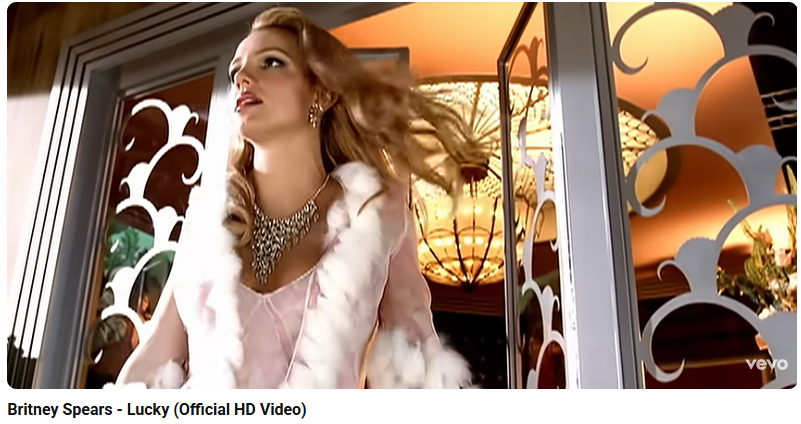
This film is also goofier than the first, and it feels like it comes from carelessness, except when it’s audaciously borrowing elements from the MGM film. Elphaba levitates her paraplegic sister by enchanting their late mother’s silver (as they were in the book) slippers, but her power makes them glow red so that Universal Pictures can skirt MGM’s copyright for Judy Garland’s ruby slippers. Two of the songs featured in the film are new to the adaptation; one of them is Ariana Grande as Glinda as Britney Spears in the “Lucky” video. I’m serious.
The second is a new song for Elphaba when she tries to inspire the Animals to stay and fight, and it’s called “No Place Like Home.” That’s trying too hard. It’s difficult not to notice since this film wraps up the narrative threads of everyone but the little girl whose fate is left unknown, given that Glinda is a witch with no magic (which is a miserable creature indeed) and can’t send her back to Kansas. Admittedly, this does lead to a funny background bit where the Wizard takes off in his balloon and leaves Dorothy behind, this viewpoint implying that he was running for his life before Glinda decides to turn his exile into imprisonment. About half of the laughs I had in the theater were clearly intentional on the film’s part; the other half … I’m not so sure. After Elphaba’s disruption of the road construction, the film’s title suddenly appears over an image of a government overseer fleeing through fields of flowers as tense, dramatic music plays, and it’s so jarring it feels like an intentional joke. When Elphaba confronts the Wizard for the first time in this film, he playfully bonks himself with a yellow brick, which he then demonstrates as being light and bouncy before tossing it away. Was that a bit that Goldblum did on set with a prop brick that they decided to keep in? It’s bizarre. At other times, I merely groaned as the film forced in references, or when we had to make a hard right in a given character’s storyline so that they can get railroaded on track for their respective stations of the canon.
I’m being pretty negative about a film that I had a pretty decent time watching, so it’s worth noting that there’s still a lot to enjoy, even if it’s rushed in some places and sluggish in others as it chugs toward its inevitable conclusion. Erivo’s pipes are still masterful, and the songs are sufficiently rousing even if they’re not as inspired as the last time we were all here. It has come, it will go, and by this time next year we’ll have mostly forgotten about it. Once its theatrical run is completed, the overwhelming tie-in advertising (Bowen Yang and Bronwyn James put in two brief appearances as their sycophant characters from the first film in order to justify their appearances in For Good-themed ads for Secret Clinical deodorant) will come to an end, and people will mostly remember the first film fondly, and this one little if at all. Don’t take it too seriously, have a good time, and perhaps see it late enough in the evening that there will be a minimal number of children in your audience (trust me).
Excluding the AMC multiplexes out in the suburbs, the Zeitgeist outpost in Arabi, and the backroom microcinemas in-between, there are exactly two regularly operational cinema hubs in Orleans Parish: The Prytania and The Broad. Both of these cultural epicenters work hard to make full use of their relatively limited screen space, finding the right balance between the arthouse titles that keep their die-hard regulars hooked and the big-ticket Disney products that actually keep the lights on. The most noble service The Prytania and The Broad provide is making room for regular, weekly repertory programming in the schedule gaps between new releases. Not too long ago, the Sunday morning Classic Movies slot at The Prytania Uptown was the only reliable spot to catch older titles in a proper theater around here, but the New Orleans repertory scene has gradually bulked up in recent years. The Broad has a classic horror movie slot every Monday night through ScreamFest NOLA (who’ve recently screened classics like Ginger Snaps, Frankenhooker, and Day of the Dead), an arthouse repertory slot every Wednesday night via Gap Tooth Cinema (who’ve recently screened once-in-a-lifetime obscurities like The Idiots, Supervixens, and Adua and Her Friends), and frequent specialty screenings at their neighboring outdoor venue The Broadside. Meanwhile, Rene Brunet’s Classic Movie Series is still going strong at The Prytania (recent standout titles: The Conversation, Dial ‘M’ for Murder, and 13 Ghosts in Illusion-O), and they’ve recently collaborated with the folks at Overlook Film Fest to program classic horror titles as well (Frankenstein, The Exorcist, and Interview with the Vampire, among others, during this year’s in-house “Kill-O-Rama” festival). Between these two businesses’ four locations, you can also routinely find specialty one-off screenings & re-releases on the weekly schedules (recently, Battle Royale & Linda Linda Linda at The Prytania’s Canal Place theaters and Night of the Juggler & Leila and the Wolves at The Broad).
All in all, our local rep scene is still too small to compete with larger cities like Los Angeles, New York, Austin, Chicago, Toronto, and San Francisco, where audiences seemingly get to see an older “new-to-you” title projected on the big screen every day of the week. New Orleans rep screenings are out there, though, and they are easily accessible if you know where to look. As evidence that this scene exists, here are a few quick short-form reviews of the repertory screenings I happened to catch around the city over the past couple weeks, along with notes on where I found them. I’ve also recently started a Letterboxd list to track what classic titles we’ve been able to cover on Swampflix over the years thanks to this growing scene, which seems to have only gotten more robust since I last filed one of these reports in 2023.
The Asphalt Jungle (1950)
The original Uptown location of The Prytania is still the most consistent local venue for seeing repertory titles on the big screen, as it has been for as long as I can remember. The only catch is that their Classic Movies program is almost entirely restricted to Hollywood productions, the kinds of titles you expect to see on TCM’s weekly broadcast schedule. As limited in range as that may sound, it’s an excellent resource for catching up with the works of luminary greats like Kubrick, Welles, and Hitchcock that you might’ve missed (especially Hitchcock, their house-favorite auteur), big & loud in an environment where you’re unlikely to get distracted by your phone. To that end, I recently saw John Huston’s foundational diamond-heist thriller The Asphalt Jungle for the first time as part of that series, after having previously seen Huston’s foundational noir The Maltese Falcon there several years earlier. Within the heist-thriller genre, there’s nothing especially surprising about The Asphalt Jungle‘s scene-to-scene plot beats, as it is an immeasurably influential work that helped establish that genre’s basic story structure in the first place. Where it does manage to surprise is in the little details of the character quirks, as it gradually becomes a story about the unlikely friendship between the elderly mastermind and the young hooligan muscle at opposite ends of the criminal hierarchy, both of whom are equally doomed. The framing compositions are also top-notch; that John Huston kid is a name to watch, I tell you what.
It would be disingenuous to call The Asphalt Jungle a hangout film, as there is plenty of urgent thriller tension in its textbook bank heist plot. The four factions vying for victory are clearly defined: the heist crew hastily assembled by a recently-paroled criminal mastermind (Sam Jaffe), the crooked lawyer who intends to steal away that crew’s loot for himself (Louis Calhern), the corrupt cop who pretends to be on their case while taking bribes beneath the table (Barry Kelley), and the by-the-books police commissioner who still believes in the nobility of obeying the law (John McIntire). The cops’ involvement in the diamond-heist fallout is mostly present as a background inevitability, something that makes the crooked lawyer sweat as he schemes to rip off his own accomplices. The real heart of the story is in the way the bank robbers pass their time between the heist and getting caught, recalling the crime-thriller hangouts of Quentin Tarantino’s oeuvre. There’s something sweet in the simple, pleasure-seeking worldviews of the mastermind and the hothead muscle (Sterling Hayden) in particular — one of whom meets his end while taking the time to watch a teen girl dance to a roadside diner jukebox and the other meeting his own end while indulging in homesick nostalgia, feebly returning to his family farm while he slowly bleeds to death from a gunshot wound. A baby-faced Marilyn Monroe also makes a huge impression in the couple scenes afforded to her as the crooked lawyer’s age-gap mistress, exclaiming “Yipe!” whenever she gets excited, and referring to her much older lover by pet names like “Uncle” and “Banana Head.” The editing rhythms of The Asphalt Jungle are not especially hurried or thrilling, but Huston arranges his performers in the Academy-ratio frame with consistently adept blocking, and he constantly feeds them all-timer lines of dialogue like, “Experience has taught me never to trust a policeman. Just when you think one’s all right, he turns legit.” It’s a great mood to sit in, especially once its noir-archetype characters start making unlikely friends & foes in the hours after the plot-catalyst heist.
Black Narcissus (1947)
Curiously, my most recent dip into the Gap Tooth Cinema program at The Broad was also a classic title you could expect to catch in TCM’s broadcast line-up, whereas the series is generally more unique for its “Where else would you ever see this?” selections (On the Silver Globe,Entertaining Mr. Sloane,Coonskin, etc.). 1947’s Black Narcissus is as core of a text to nuns-in-crisis cinema as The Asphalt Jungle is to bank heist thrillers. If it’s not the most often seen & referenced convent drama, that’s only because The Sound of Music has a more iconic sing-a-long soundtrack, whereas most of the sound design in Black Narcissus is overpowered by howling, ominous winds. It was hearing those winds in immersive theatrical surround sound that made this first-time watch so memorably intense for me, though, whereas Powell & Pressburger’s follow-up ballet industry melodrama The Red Shoes is more striking for its three-strip Technicolor fantasia. While there are flashes of Technicolor brilliance throughout Black Narcissus, the combination of its doomed nuns’ white habits & skin is so uniformly pale the film often registers as monochrome. It’s the constant roar of the cold winds that gradually break those nuns’ minds along with the audience’s, eventually triggering the passionate, color-saturated violence of the third act. I know it’s gauche to describe anything as “Lynchian” these days, but those howling winds are maddening in a distinctly Lynchian way, and it turns out the production was filmed the same year Lynch himself was born. Coincidence? I think not.
The sinful evil those winds summon is mostly the seduction of nostalgia & memory. Deborah Kerr stars as a remarkably young Mother Superior who’s assigned to start a new convent in a former cliffside harem in the Himalayas, offering medicine and education to the Indian locals who don’t need or want the nuns’ presence. The isolation of the newly repurposed “house of women” on that mountaintop weighs on the sisters who are assigned there, as the ominous winds and dizzying altitude invite their minds to drift to memories from before they took their holy vows. Since it’s a British studio picture made in the 1940s, the nuns never express the transgression directly, but they specifically start to doubt their commitment to Christ because they’ve become desperately horny & lonely, to the point of madness. The burly presence of a blowhard macho handyman onsite is especially tempting for the women, and their repressed desire for him explodes into expressionistically violent acts that can only lead to death, never actual sex. It’s in those climactic violent acts that Black Narcissus most directly recalls the dark fantasy gestures of The Red Shoes, especially in the sisters’ extreme, wild-eyed close-ups. The winds that push them towards the matte-painting cliffsides outside the convent are much more consistently surreal throughout, however, recalling much later, freer works like David Lynch’s Twin Peaks: The Return or Hiroshi Teshigahara’s Woman in the Dunes.
Mr. Melvin (1989, 2025)
While The Prytania’s Classic Movies and The Broad’s Gap Tooth series are dependable workhorse repertory programs, you have to walk next door from The Broad to their outdoor sister venue The Broadside to catch the more extravagant specialty screenings. For instance, it’s where I caught Lamberto Bava’s classic Italo meta-horror Demons with a live score from Goblin’s Claudio Simonetti and, more recently, it’s where I caught the new remix of The Toxic Avenger Parts II & III (1989), now Frankensteined together and retitled as Mr. Melvin (2025). That Mr. Melvin screening was supposed to be accompanied with a Lloyd Kaufman meet & greet, but the recently injured Kaufman couldn’t travel so he appeared only via video message, sending Troma regular Lisa Gaye to act as his brand ambassador instead. The movie was also accompanied with an opening punk rock set from The Pallbearers, making for a much rowdier setting than is typical for movie-nerd rep screenings around the city. The general party atmosphere at The Broadside can be distracting if you’ve never seen the film they’re screening before (I remember being especially distracted by the circus-act antics of Gap Tooth’s showing of Carny there), but it’s perfect for celebrating a VHS-era classic that you’re used to watching alone at home. The timing of this Mr. Melvin cut was personally serendipitous for me, then, as I had just watched every Toxic Avenger film for a podcast episode the previous month.
Since I had already exorcised all my demonic opinions about Toxie’s big-screen journey so recently on the podcast, I don’t have much new to say about Mr. Melvin except in pinpointing where it ranks among other titles in the series. Objectively, the best Toxic Avenger film is likely either the bad-taste original from 1984 or Macon Blair’s punching-up revision that was also released this year, and yet I can’t help but admire Mr. Melvin as a completionist’s timesaver. It’s all the best parts of the official Toxie sequels (the Japanese travelogue from Toxic Avenger II, the Toxie-goes-yuppie satire of Toxic Avenger III, not a single frame from Toxic Avenger IV) with at least 70 minutes of time-wasting junk erased from the public record. Mathematically speaking, it’s the most efficiently entertaining Toxic Avenger film to date, which technically qualifies it as public service — something to be considered by Lloyd Kaufman’s parole board. And since the original, in-tact sequels were rotting so close to the forefront of my mind, I was able to step away during the screening to grab another beer without missing anything, which is essential to appreciating any Troma release. You go to The Prytania to watch Old Hollywood classics in a historic setting, sipping morning coffee to the vintage Looney Tunes shorts that precede the feature. You go to Gap Tooth screenings at The Broad to challenge yourself with some daringly curated arthouse obscurities, chatting with friends afterwards to parse through complex feelings & ideas. In contrast, the repertory programming next door at The Broadside is for pounding beers and whooping along to a personal fav you’ve already seen a couple dozen times with likeminded freaks. Plan your repertory outings accordingly.
I’ve been living in Austin for over a decade now, and there’s still a goodly number of famous locals that I have yet to encounter or even learn about. Most recently, some friends hosted a backyard cookout/projector movie night at their home in East Austin, as they had acquired a VHS copy of the locally-produced 2022 comedy Erica’s First Holy Sh!t, starring “Very Famous [Austin Specific] Fitness Guru” Erica Nix. I was fairly certain that night that I had never heard of Erica Nix before, but the very next morning I went to the same local coffee shop where I had hosted my recent Halloween film screenings and there on the bar was a flyer for one of her workout classes:
This past weekend was also the second weekend of the Austin Art Crawl/Studio Tour, and I asked some friends that I ran into at Canopy Studios if they had ever heard of her; some had, some hadn’t, and one had made out with her once. It also turns out that she’s participated in some of the same Austin Public TV sketch stuff that I occasionally do (although we’ve never worked in a scene together), so maybe the problem is just that I don’t pay enough attention. Upon further reflection, I did remember her brief run for Austin mayor, which features as a plot point in Holy Sh!t, but didn’t connect her name to the one that I recalled from reading that story in the newspaper years ago. Regardless, Erica’s First Holy Sh!t is a stunning piece of art for someone whose extreme fame is so geographically fixed.
In the midst of the pandemic lockdown, Erica Nix hosts a queer virtual orgy of mostly witches before settling in for some self care via a long soak with a Lush beauty mask. Realizing that the mask contains molly, meth, and more, she flashes back to purchasing the goop in the days leading up to the lockdown, then goes on a psychedelic journey that takes her to her childhood bedroom to interrupt her pubescent self (P1Nkstar)’s pillow-humping session, a Zoom call with God (Nikki DaVaughn), an erotic encounter with Mother Nature (Christeene), a quick sidebar with Satan herself (Andie Flores) while exploring the inside of Mother Nature’s anus like Lemmiwinks, and a wellness session with Gwyneth Paltrow (Lynn Metcalf) in which Erica learns to forgive herself. She also runs the gauntlet of several of her personal issues, American Gladiators style, facing off against personifications of her nemeses/weaknesses: Olestra, Xanax, Prolapse, and Buzzfeed, all of it hosted by the Effie Trinket-esque Edie Teflon and her co-host, Problematic.
It’s all great fun, but it’s also one of those films that’s a deeply revelatory exploration of its creator’s soul. Erica bares it all—literally and figuratively—many times. Some of the things that she’s concerned about are so specific that they transcend the personal and become universal; one standout is a scene during one of the gauntlet challenges where Erica has to vibrate herself to climax while ignoring increasingly mounting concerns, and another is the fact that she’s supposed to be feeding a friend’s cat but she suddenly can’t remember the last time she checked in on the pet. It’s a small thing, but in microcosm represents so much about the tendency to prioritize self care, which is something that Erica tackles over and over again throughout the movie. There’s also a great bit where Erica has her Zoom call with God, represented here by a Black actress, who chides Erica for calling her real-life counterpart (each of the people Erica encounters were also part of her Zoom orgy at the beginning, to ensure we get one last Oz allusion in at the end with the “And you were there, and you were there . . .” scene) after the death of George Floyd, as if her Black friend was now going to be somehow responsible for helping Erica navigate the social and political situations that were to follow. This is followed up on again later, when Erica has to face off against one of the Gladiators, who is shooting lasers at her as she navigates a literalized obstacle course of allyship, activism, and insecurities about being perceived as being merely performative. It’s self-reflective without being too self-forgiving, and it makes for an interesting film.
This is also a production that clearly managed to navigate COVID restrictions and still create something special. Aside from the big outdoor dance number at the end, I’m hard pressed to think of many scenes in which two actors are physically in the same space; there’s Erica and her younger self, the two hosts of the American Gladiators spoof are together in the same room, and the outdoor sequence in which Erica meets Gwyneth Paltrow and learns to forgive herself for her flaws. Almost everything else is green screened and edited together into shot/reverse-shot compositions, but it’s pretty seamless. Speaking of, Metcalf’s performance as Paltrow is alongside DaVaughn’s as God, Flores’s as Satan, and Christeene’s as Mother Nature as one of the best in the film; she doesn’t even superficially resemble the GOOP “guru,” but her vocal impersonation is spot on. It’s quite good.
I would recommend this film pretty highly, and although it’s not streaming for free anywhere, you can find it for rent on Vimeo here. Or, if you’re local to Austin, you can always rent a VHS copy from WeLuvVideo on North Loop Blvd, presuming you’ve got a membership of sufficient tenure. It won’t be for everyone, but if it’s for you, you know who you are.

















 Swampflix