Welcome to Episode #240 of The Swampflix Podcast. For this episode, Brandon, James, and Hanna discuss the few films that have been adapted from William S. Burroughs’s prose, starting with David Cronenberg’s 1991 adaptation of Naked Lunch.
00:00 Welcome
01:20 Friendship (2025) 03:10 Bring Her Back (2025) 09:34 Premonition (2007) 13:37 Mulan (1998) 16:53 Ghidorah, the Three-Headed Monster (1964) 20:02 Ebirah, Horror of the Deep (1966)
23:08 Naked Lunch (1991) 41:30 Burroughs – The Movie (1983) 55:41 The Junky’s Christmas (1993) 59:56 Ah Pook is Here (1994) 1:03:21 Queer (2024)
I went into my viewing of Final Destination: Bloodlines not having seen a single frame of any of the franchise entries in over twenty years, only being familiar with the first one from early high school sleepovers and having seen the opening (and only the opening) of the first sequel when it first hit Blockbuster shelves. Watching this one prompted me to go down a rabbit hole of watching the entire series over the course of a week, and although I wouldn’t say that binge retroactively gave me more appreciation for this one necessarily, I do think that it moved up in my rankings for a latecomer entry into an almost abandoned franchise.
Back in the 1960s, young Iris (Brec Bassinger) has just learned that she’s pregnant, on the eve of a big date with her boyfriend Paul, who has managed to score reservations for a night at a recently completed Space Needle-style restaurant. Despite some difficulties getting in, the two still have a romantic time together, and Paul proposes to her while the two stand on an outdoor observation deck. Things quickly take a turn for the worse when a penny tossed over the side of the building by an unattended child gets sucked into the restaurant’s vents, creating a chain reaction that cascades from a shattered glass dance floor to an explosion of various gases to an elevator collapse to the destruction of the stairs. It’s bad. Iris manages to be the second to last to die, protecting herself and the young son of the venue’s lounge singer until the very last moment, when she dies (followed, presumably, by the kid). This turns out to be a premonition, however, and she manages to save a huge number of people from dying by getting them off of the dance floor before it collapses, and getting everyone evacuated.
If you’re familiar with this film franchise’s (very loose) mythology, then you know that this means that Death personified is now pissed that its “design” was cheated, and it will now seek out and kill everyone who survived, in the order they “should” have died. This film adds a new wrinkle, however. Due to the large number of survivors, many of them went on to have children and start families, all of whom only exist because the plan was diverted, which means that Death has to prune the entire family tree of each survivor before moving to the next person on its list. It’s taken decades to tick off every box, and now the last remaining branches from the Space Needle survivors are Iris’s children and grandchildren, which is where we pick up in the present. College student Stefani Reyes (Kaitlyn Santa Juana) keeps having the same nightmare, about a woman named Iris saving dozens of people from a building collapse. Theorizing that the woman in her visions may be her estranged grandmother, she goes home to her father and brother, Charlie (Teo Briones), and while the reception from her father is warm, Charlie gives her the cold shoulder, clearly seeing a similarity in Stefani’s distance from her family and their earlier abandonment by their mother, Darlene (Rya Kihlstedt). Stefani’s father tries to warn her not to start asking questions about Iris, citing that she had made the lives of both her children, Darlene and Howard, miserable. Although she adjusted to her life after the near disaster initially, she later became obsessed with seeing “patterns” and was preoccupied with thoughts of death, and her seemingly unhinged protectiveness warped both of her kids.
Ignoring him, Stefani immediately goes to the home of Uncle Harold, where we meet the cousins. Erik (Richard Harmon) is the eldest, a tattoo artist with his own extensive body art and piercings, with prim high school athlete Julia in the middle and fully grown adult man Bobby (Owen Patrick Joyner) rounding them out as the apparent youngest despite being, as noted, a grown ass man (they put him in a lot of oversized sweaters and backwards caps, but the effect isn’t convincing so much as it is confusing). I think we’re supposed to believe that Charlie and Bobby are about the same age, but it doesn’t work. When Uncle Harold kindly but firmly rejects Stefani’s questions, her aunt indirectly points her in the direction of a box of family records, which Stefani uses to locate the last known location of Iris, a bizarre fortress that Iris has constructed for herself and meets her grandmother. She learns about the family history and is given a book that traces the history of all of the restaurant disaster survivors and their descendants, revealing that Iris is apparently the last, and that once she’s dead Death will track down Howard and his progeny in order, followed by Darlene and her two kids. As is always the case, no one believes Stefani at first, but as more deaths occur around them, the remaining Campbells must try and work together to see if there’s a way to get off of Death’s list.
Where the film is weak is in its main character. Stefani is kind of boring, and you’re never really all that invested in her success. I don’t normally like to denigrate performers in these reviews, but Santa Juana brings very little to the table. Looking at her filmography, she’s only ever been in a couple of episodes of The Flash and the few film credits she has are for movies that aren’t even notable enough to have Wikipedia pages. On stage, she was the understudy for a role in a Canadian production of Dear Evan Hansen, and “understudy” is exactly how I would describe her performance. It’s like the studio saw the success of the two most recent Scream sequels and said, “Get us a Melissa Cabrera type,” and she just happened to fit the visual mold that they were seeking. I’m not trying to be mean, but it’s hard to believe that she auditioned for this role rather than being selected based solely on her headshot. It doesn’t help that Stefani is one of the more underwritten characters from this franchise. For the first time, our main character isn’t the person who had the death premonition at the top of the screenplay, but is just related to them, so she never even gets to have any establishing character moments of her own as she tries to save people from disaster. Everything happens to her, not because of her, and it would have taken a stronger performer to wring a little more pathos out of a character who seems to have been underwritten on the page from the start. Compare her to Briones, playing her younger brother, and although he isn’t given much more to do than huff teenagerly when his big sis comes home after what feels like a long time away and doesn’t even seem to care that much about catching up, he’s giving a solid performance even when the material is underwhelming.
Overall, though, this one is pretty fun. In my overview of the previous installments, I noted that my friend called Final Destination a franchise where “You get exactly what you expect in a nice way,” and this one is no exception. The things that you want from a Final Destination movie are present: a harrowing opening scene, a bunch of people being snuffed out via Death’s contrived coincidences, an appearance from Tony Todd to explain the rules, a last-minute aversion of death that lulls the remaining survivors into a false sense of security, and a mean ending. If it ain’t broke, don’t fix it. What this film does, like Final Destination 5, is introduce some new elements to the lore that work in its favor. That all of Death’s victims here are the descendants of previous intended victims who were able to stay out of harm’s way for a time is interesting, and there’s a particularly fun twist with regards to a character who seems utterly screwed but who ends up being fine because they were never actually on Death’s list in the first place. It works.
Brandon texted me a couple of weeks ago to ask if I would be interested in writing about Final Destination: Bloodlines, and I admitted that I hadn’t even planned on seeing it, as I had only seen the first movie years and years ago at a sleepover and hadn’t seen any of them since (although I, like almost everyone on Earth, was familiar with the log-truck opening of the first sequel). This surprised him, as my fondness for Screamand my almost academic interest in the post-Scream teen horror boom is something that has come up often around these parts. Looking back at the franchise, the release years perfectly overlap with the most academically rigorous years of my life, which explains why I never paid much attention to the franchise. I have a very good friend who was very interested in seeing Bloodlines, however, and I did ultimately see it in theaters after several attempts to plan an outing. I’ll be doing a full review of that one, but I didn’t feel fully qualified to do a write-up on it with so little familiarity with the series (despite its largely self-contained nature), since I also didn’t really foresee that I would get the chance to binge all of the others in order to make the most informed review possible. But something else bigger than me had a plan all along … and within six days of seeing Bloodlines, I had seen all five of the previous Final Destination entries. And I have thoughts.
Final Destination (2000)
There’s something legitimately special about this one. I already knew before going into it that this began life as an X-Files spec script, with Alex (Devon Sawa)’s character having initially been planned to be the younger brother of FBI agent Dana Scully. On the show, Scully is specifically noted to have three siblings: sister Melissa and older brother Bill Jr., both of whom appeared in four episodes in the present and a few others in flashbacks, and Melissa is mentioned frequently outside of her actual appearances. Younger brother Charles never appears in the present and, in Jeffrey Reddick’s initial script, occupied the role that would become Alex. The narrative of the film follows Alex as he has a premonition of a terrible air disaster occurring on his class trip to Paris, and his pursuant panic results in him being kicked off of the flight with several other students and a teacher: his nondescript best friend Tod, orphaned sculptor Clear Rivers (Ali Larter), class bully Carter (Kerr Smith) and his girlfriend, goofball Billy (Seann William Scott), and Miss Lewton (Kristen Cloke). As a result of this, he and the others are stated to have “cheated Death’s design,” which means that Death is now coming for all of them, as Alex tries to figure out if there is a way to get off of Death’s list permanently.
I watched this one last during my binge, as my buddy who wanted to watch the movies with me said we should skip to the second as we had both already seen the first, which ended up working out well, since Final Destination 5 is actually a stealth prequel that leads into the the events of this one. It also meant that I had already seen where the franchise was going before returning to the original text, which gave some insight into how this formula would be adapted and recycled. The film franchise that most came to mind as a result was not another horror series but the Mission: Impossible movies. As with those movies, this initial outing is in a genre that the other films aren’t necessarily. The first M:Iis a spy thriller that focuses mostly on spycraft and espionage but which happens to include a couple of major action sequences, notably the Langley heist (where Tom Cruise’s Ethan Hunt descends into a computer room to steal information) and the big train-set finale that includes a helicopter crashing into a tunnel. The later M:I films are really only spy movies in the broadest sense of the term, and could be more accurately defined as action adventure films that happen to include international intrigue. Every film after the first exists first and foremost as a vehicle to deliver high-octane stunt spectacle, with the “spy” elements only being present to the extent that they are needed to provide a scaffolding on which the action hangs. Likewise, Final Destination is structured as a mystery with the trappings of a horror movie, one that happens to have a singular Rube Goldbergian death in it (Miss Lewton’s), and which is more interested in the question of why these people are marked for death and acting as a somber meditation (as much as a mainstream horror film from the turn of the millennium could be) on survivor’s guilt. It’s not a top-tier Scream-era teen horror, but it’s solidly second rung given the care that went into it. As a franchise, the following Final Destination movies are structurally identical; the lead character has a vision of horrible death, they manage to save others from impending doom, and the survivors then find themselves marked for death and die off in a particular order while they try to figure out a way to avoid dying, all of their deaths being horrific. Like the M:I sequels, the FD sequels take the most memorable element from the first film—Ethan Hunt doing something nearly superhuman in the former and the complicated domino-falling deaths of the survivors in the latter—and then make that gimmick the primary selling point. The stories in the films that follow put more effort into the complexity of the deaths than into the narrative drive or character motivation … and that’s fine, honestly. The “Every movie is essentially the same but come see how complicated the machinery of death is” approach is a perfectly legitimate marketing strategy, since, as a friend of mine put it, “You get exactly what you expect in a nice way.”
The fingerprints of The X-Files are still all over this thing, if you’re familiar enough with the series. First time director James Wong was a producer on the series and wrote seventeen episodes of it (most, if not all, with writing partner Glen Morgan), largely within the first couple of seasons (including “Beyond the Sea,” the episode that first introduced Scully’s family). Coincidentally (or not?), I caught a rerun of the season two episode “Die Hand Die Verletzt” on Comet a couple of weeks ago and there were a lot of elements of it that I saw in Final Destination. That episode focused on teenagers at a high school dealing with a tragedy, a dark force that was claiming them and other members of the community, and a lot of Vancouver forest night shoots that featured lightning almost-but-not-quite killing people. I suppose I shouldn’t have been surprised that this one was one of many episodes co-written by Wong and Morgan. There are also moments scattered throughout the film in which I could detect the influence of characters from the series speaking through the characters in the film, with Daniel Roebuck’s FBI character reciting dialogue that I could hear Scully saying. The overall somberness of the proceedings is really what makes this one both stand out as a film and feel like part of the X-mythos.
Opening Disaster: Despite being the original, this is not the best opening sequence, but it’s still a strong start. I’ve seen parts of this sequence an uncountable number of times, given the number of movies I’ve seen over the years that were released on DVDs that loved pitching the idea of expanding your home media collection based on the presence of special features. I’m fairly certain that every single New Line Cinema release had the same advertisement, that promised “behind the scenes looks” at special effects, playing over clips from this scene. With air disasters being relatively low in the two decades following the film, this one became less scary over time before the recent ongoing spate of crashes and other issues in the past few years make this one frighteningly plausible once again. We’re all watching The Rehearsal, right?
Best Death: It has to be Miss Lewton, although this could be considered the franchise’s “original sin” as far as what the series would devolve into. Special mention has to go to Tammy getting flattened by a bus mid-sentence as well.
Worst Death: Billy Hitchcock is barely a presence in this film, only appearing when a scene needs Carter to bully someone other than Alex for a while. His death is also the most forgettable, as he’s decapitated by a shard of debris after a train smashes Carter’s car.
MVP: Devon Sawa is undoubtedly giving this his all, and I really like him here. He was trying to distance himself from his image as a teen heartthrob at the time by taking on “weirder” roles, as in this and in Idle Hands. Special mention has to be made of Tony Todd, however, as he makes his first appearance here as Bludworth, the mortician who “explains” the rules of Death’s design, such as they are.
Spot the Battle “Star”: In a break from my normal Star Trek obsession, it’s worth mentioning that I noticed an actor from Battlestar Galactica in (practically) every one of these films. Alessandro Juliani appears in an extremely minor role as a street musician in Paris in the film’s epilogue scene. He’s been in tons of stuff, but I know him best as Lt. Felix Gaeta. I met Juliani at a GalaxyCon in 2023 and he was very nice!
Final Destination 2 (2003)
Right off the bat, this film feels cheaper than its predecessor. The opening credits of all of these movies range from good to excellent, with later entries going into full-blown 3D glass breaking and x-ray recreations of the films’ various fatalities. This one opens in the bedroom of Kimberly (A.J. Cook) as the camera pans around in the semi-darkness, occasionally settling on the TV that’s playing an interview with a conspiracy theorist obsessed with the previous film’s Flight 180. This got a theatrical release, but from the first frame, it feels like a sequel in a franchise making its leap from cinemas to the direct-to-video market; it’s all very Lifetime. Luckily, from there, we move fairly quickly to the franchise’s defining scene, Kimberly’s premonition of a massive highway pile-up that occurs as the result of an unsecured load on a log truck. This was the only part of this movie that I had seen prior to this big rewatch, and it has stuck with me forever, as it probably has for an entire generation of moviegoers. Not to spoil too much, but while I thought this movie was pretty mediocre overall, I have to credit Final Destination 2 for a horror sequence that is, in its own way, responsible for altering human behavior to the same extent that Jaws did.
It’s unfortunate that after such a strong opening premonition, what follows is the first instance of using the Final Destination plot mold as straightforwardly and ho-humly as possible. Kimberly’s fellow survivors are a cop (Thomas Burke), a kid and his mom, a workaholic (Keegan Connor Tracy), a recent lottery winner (David Paetkau), a motorcycle-riding high school teacher (T.C. Carson), a pregnant delivery driver (Justina Machado), and a burnout (Rory Peters). The lottery winner dies first, and we’re starting out by jumping into the Goldbergian deaths for everyone, every time now that will henceforth be the defining trait of these films. He throws some old pasta out of a window and then proceeds to experience a series of implausible chain reactions: a magnet falls off of the fridge into his takeout, which then goes into the microwave; he spills oil while preparing a skillet to fry up some frozen snacks; his new Rolex gets caught in the sink, trapping him. We in the audience ask ourselves: Will the oil start a fire? Will the garbage disposal in the sink suddenly click on and mangle him? Will he have to turn on the disposal to get free? It’s not necessarily a bad thing that this will be all that there is to these movies from here on out (see above, re: “You get exactly what you expect in a nice way”), and it’s also good that the first of these survivor offings is one of the better ones. Unfortunately, this once again means that FD2 is front-loaded with the best stuff with a much weaker second half.
My friend that I watched FDs 2-4 with said that this one was his favorite, because there are some impressive deaths here, and that’s what he likes best. In addition to the aforementioned lottery winner (who meets his death when he manages to escape a fiery explosion in his apartment but slips on the spaghetti he threw out earlier and is impaled when the sticky fire escape ladder finally descends all the way), teenager Tim is flattened by a pane of glass that falls from a crane outside of his dentist’s office, his mother is killed due to broken failsafes in an elevator, and the burnout is bisected by a flying barbed wire fence. That’s what you’re probably here for, and you get what you want. Another positive is that Larter reprises her role as Clear Rivers from the first film, and we get two contributions to the (convoluted) lore: she’s managed to stay alive by committing herself to an institution where she finds safety in a padded cell and additional precautions, and we’re also introduced to the concept that Death ties up its loose ends, as each of the survivors in this one should have died sometime in the past year, but for various reasons, Alex’s actions aboard Flight 180 led to their survival. One woman was headed to a bed and breakfast where everyone else died in a gas leak, but she missed her flight because she was on the bus that hit Tammy in the first film; the teacher missed a fatal stabbing that happened to one of his colleagues instead because the school district transferred him to replace Miss Lewton; and so on and so forth.
This is all well and good, but I couldn’t shake the overall sense of cheapness that cast a pall over this one. The set-ups for the Goldbergian deaths is a high water mark for some, but for me, the difference in production quality and overall directorial cleverness between this and the next film was stark, so it ranks a little low for me. In conclusion: strong death sequences, shoddy character and framework.
Opening Disaster: Speaking of high water marks, this is the highest for the entire series. Iconic, socially influential, and twenty years later the marketing for Bloodlines directly invoked people’s decades-long fears that were instilled by the log truck pile-up. Impeccable and unimpeachable.
Best Death: Although Tim’s death is one of the more memorable (since the film had the guts, no pun intended, to kill off a child), the unexpected postscript death by barbecue explosion of a farm kid who happened to be saved by one of the survivors in an earlier scene may be the best part of the film other than the opening sequence. The workaholic’s death via being impaled not during a car crash but after when the airbag is deployed due to first responders’ use of the jaws of life is a neat little subversion as well.
Worst Death: Eugene and Clear’s hospital fireball is pretty goofy, and an ignominious end for Clear after her survival of the first film.
MVP: Despite minimal screen time, it’s definitely Tony Todd.
Spot the Battle “Star”: This time we’ve got a two-fer. I adore Keegan Connor Tracy; she’s been in a million things that I enjoy, with one-off and recurring characters on virtually every show shot in Vancouver: the Blue Fairy in Once Upon a Time, Professor Lipson in The Magicians, Norman’s first onscreen victim in Bates Motel, not to mention appearances on Supernatural, SG-1, First Wave, the list goes on. I even have a particular affection for her “sleep stories” in the Calm app. She plays a major role in this one as one of the survivors, and I almost completely forgot that she was in nine episodes of Battlestar. This film also features an appearance from Aaron Douglas as a frazzled deputy who rushes the pregnant survivor to the hospital; he was the Galactica’s deck chief, Tyrol.
Final Destination 3 (2006)
From the very first moments of FD3, I was immediately more impressed with this one than with its direct predecessor. The credits are well rendered, playing out over images of carnival rides and activities, and the text graphics pattern matches it; it’s a minor thing, but really sets the tone for what followed. Wendy (Mary Elizabeth Winstead) is at a senior night at the local amusement park with her boyfriend, best friend, and the best friend’s boyfriend Kevin (Ryan Merriman) when she foresees the derailment of the park’s roller coaster and the deaths of everyone aboard. She demands to be let off of the ride, and the operators release all of the seats in her section and they deboard: goth shithead Ian McKinley (Kris Lemche), his girlfriend Erin (Alexz Johnson), football jock Lewis (Texas Battle), a couple of people whose identities are hidden and form part of the mystery, plus two airheaded stereotypes and the creep who won’t stop trying to film them. The accident happens as Wendy foresaw, and Death comes for the survivors one by one, because that’s the Final Destination formula.
The extent to which this means that these films run together also means that when you talk to other people about these movies, the questions that they ask show you what parts of them had memorable staying power. Final Destination 3? Is that the one with the log truck? (No, that’s 2.) Is that the one with the bridge collapse? (No, that’s 5.) Is that the one with the racecars? (No, that’s 4.) Is that the one with the mall? (No, that’s 4 again.) Sorry, folks; the questions we were looking for were “Is that the one with the roller coaster?” and “Is that the one with the tanning beds?” The two airheads, Ashley and Ashlyn, could slot right into any openings in Daria’s younger sister Quinn’s Fashion Club with ease, and their deaths by being cooked alive while trying to bronze up are two of the more memorable kills that Death racks up. Just as importantly, there’s a match cut between their two tanning beds to their side-by-side caskets at the funeral that shows that there’s a bit more thought being put into the direction and editing of this one. It’s not just about following a trail of little contributions that create a big problem, but has some real interest in creating something visually interesting and well-composed outside of simply watching how Death tips the dominoes. That’s the James Wong touch, as he’s back to direct this installment.
That said, the rest of the fatalities in this one are nothing too special, until the climax at the town’s tricentennial. The sequence in the hardware store runs a little too long, and closing with the death-by-nailgun of Erin borders on trite. Similarly, Lewis’s fatal workout is also nothing to write home about. By the time the fireworks start going off and spooking horses into galloping through crowds of people while dragging a rope with a heavy stake at the end, you’ll be grateful that someone decided to put their foot on the gas a little. It’s also worth noting that although the metaphorical scaffolding of this one is stronger than FD2’s, the script itself is a little undercooked. A great deal of hay is made about Wendy’s supposed need to be in control, but this never really amounts to anything more than telling us that this is her Primary Character Trait, and it never really gets around to showing it. I did like the new twist that all of Wendy’s (terrible) photographs taken the night of the roller coaster incident provided clues about how the survivors would be picked off one by one, and it’s good that the film can find some new wrinkle to add despite being, skeletally, exactly the same as the movies that came before it. I also appreciated that the film included a human antagonist, as it did with Carter in the first one, as it gives the characters something more tangible and real to fight against than just a spooky wind. This one is in the top half of my rankings, if for no other reason than that it’s trying harder than FD2, and mostly succeeding.
Opening Disaster: A pretty solid opener, all things considered. There’s a bit more work put into introducing the characters and their various motivations, and the fact that Wendy’s best friend was planning on dumping Kevin, a secret that only Wendy knows (and plans to take to her grave) lends the whole thing a bittersweet quality. Where the log truck sequence succeeds is in making something completely mundane feel like it has the potential for massive death. On planes and rollercoasters, people already feel a certain (and usually normal) amount of uncertainty and anxiety, so it’s less surprising when something goes awry. The maulings are pretty brutal, though, if that’s what you’re into.
Best Death: There’s a reason that people still talk about the tanning beds.
Worst Death: It’s Ian getting smashed by a cherry picker, easily.
MVP: I really wish it was Mary Elizabeth Winstead/Wendy here, but that underbaked element to her “control freak” characterization leaves her feeling less fleshed out than she could have been. I think I’m actually going to have to give it to sleazeball Frankie Cheeks. He captures the 2006 vibe more than anything else, and his pervy nature makes his death decently satisfying. A little bit of air gets let out of the balloon when he’s no longer part of the story.
Spot the Battle “Star”: Patrick Gallagher is one of those “Hey it’s that guy” actors, having guested in a million things. He’s here as the carnival employee who escorts the survivors off of the ride, and he had a memorable appearance as a terrorist in the first season BSG episode “Colonial Day.” Weirdly, I know him best from his appearance in the Rapture flick Revelation.
The Final Destination, aka Final Destination 4 (2009)
People say that this is the worst one, and they’re right. The Final Destination was shot to make the most out of the (at the time) most recent attempt to foist the gimmick of 3D movies on the public, and as such there’s a lot of stuff flying at you. Final Destination is, admittedly, the perfect franchise to translate to the “Here comes something fast!!” experience, but the models used are just bafflingly awful. The main character’s visions appear as giant, poorly-rendered low-res images of scissors, tow chains, and a truly laughable snake that wraps around a pole before morphing into a caduceus. It’s a universally agreed upon low point, and it shouldn’t come as a surprise that it features the return of FD2’s creative team of David R. Ellis as director and Eric Bress as writer. In between that film and this one, Bress wrote The Butterfly Effect and Ellis directed Snakes on a Plane; this information is presented without comment. Even the things that worked about that one are absent here, and the film’s very short 82 minute runtime speaks to just how little inspiration there existed to fill out the scaffolding of this premise. It’s barely a movie.
At a race track, Nick (Bobby Campo) foresees a blowout on the track that results in an escalating accident that will take the life of a huge number of the attendees. He creates enough of a ruckus that his girlfriend Lori (Shantel VanSanten), her friend Janet (Haley Webb), and his bro-y bud Hunt (Nick Zano) are escorted out by security guard George (Mykelti Wiliamson). George also ejects a racist asshole, and the commotion also ends up saving the life of a mother of two young brats, who was trampled to death in the original vision. The racetrack disaster then unfolds, and, you know the drill by now, Death is tracking down each of the survivors one by one in the order that they would have died before. By this point, the scene in which the person with the vision presents their research/theories to the others is old hat, and the recap itself just keeps getting longer since each previous film’s disaster is added to the list of historical instances each time. The random deductions that characters make to reason out Death’s plan are always like the non sequitur trains of thought that would pop up in the old Adam West Batman, but it’s particularly tedious this time around. It also doesn’t help that this is the least developed or interesting group of characters, with even the shallow characterizations of the folks back in FD2 feeling like people with rich backstory in comparison. Presumably to suit the 3D conversion, everything has flat, boring, TV style lighting that calls back to the cheap-feeling nature of Ellis and Bress’s previous collaboration.
My friend who loved FD2 hated this one. At about halfway into the movie, he stood up to leave the group screening, since he was bored, but decided to sit back down to try and see at least “one good death scene” (this was after the racist was burned alive and dragged behind his own tow truck while trying to light a cross on George’s lawn, which would turn out to be the best that the film had to offer). He ended up staying all the way through the end—a man getting sliced into pieces by a chain-link fence (what we around here refer to as getting Cube-d), another man getting his guts sucked out through his rectum by an overpowered pool filter, and a man getting hit by an ambulance—not a one of them was good enough to satisfy the particular craving for creative gore that the film-going public has come to expect from a series that’s branded itself so strongly at this point. Part of what makes these so effective is when people can see tragedy befall the characters in a convoluted but not impossible way and recognize the potential for things to go horribly wrong in their own life. The most tragic things that occur at the racetrack are the things that could happen in any public setting when something awful is going down and people stampede or otherwise panic, and in that way it has an admitted kind of universal applicability. But I don’t see a man getting his asshole stuck on a pool filter or watch another man get shot into a fence by a gas canister so hard that he gets smooshed through it like he was secretly made of cake and think “That could happen to me.” Really and truly not worth the time.
Opening Disaster: It’s fine.
Best Death: The most cathartic death is watching the racist asshole get dragged/burned to death while “Why Can’t We Be Friends?” plays over his radio. But the best death is probably the one that Lori has in the second premonition, in which she gets mauled to death by an elevator that has been busted by architectural damage. It’s marred by the fact that she starts coughing up blood when she’s only in the gears up to her shins, but it’s still the only thing that happened in this movie that reflects any real life anxieties that I have.
MVP: I really only enjoyed two sequences in this, which were the scenes in which Janet almost drowns in a car wash and the part of the film in which George attempts to kill himself over and over again to get on with it, but his attempts keep failing since he’s not the next person on the list. Although his backstory basically blends that of Eugene (who tried and failed to kill himself to choose his death rather than let Death choose him) and Mrs. Carpenter (who was resigned to death and looked forward to meeting her spouse and child on the other side) from FD2, it doesn’t feel like a retreading of the same ground. That’s owed all to Wiliamson’s performance; he’s the best thing here.
Spot the Battle “Star”: There is no overlap between Battlestar and this, the worst Final Destination film. Take from that what you will, although it’s probably simply because this was the only one shot in New Orleans instead of Vancouver. There is still a connection, however, as actress Shantel VanSanten had a major role as Karen on For All Mankind, Battlestar creator Ronald D. Moore’s current series.
Final Destination 5 (2011)
So, Final Destination 5 is actually … great? Although this one doesn’t lean as hard into comedy as Bloodlines would after it, it’s still the first time that this one went for as many jokes as it does scares. I also found the characters in this one to be some of the most likable; I really appreciated that several of the characters were making ends meet by working multiple jobs, just like I was around the same time. Sam (Nicholas D’Agosto) spends his days as a salesman alongside with his buddy Peter (Miles Fisher) at Presage Paper, and at nights he works for the local branch of Le Cáfe Miro 81, where he’s impressed the head chef so much that he’s been nominated to apprentice at the flagship location in Paris. This complicates his relationship with Molly (Emma Bell), who also works at Presage, as does Peter’s girlfriend Candice (Ellen Wroe), a competitive gymnast. Candice’s work enemy is Olivia (Jacqueline MacInnes Wood), the extremely nearsighted office hottie, although office IT guy Isaac (P.J. Byrne) is indiscriminate with his pervy flirtation with every woman in the office (and outside of it). All of them are being taken on a company retreat by bus by their boss, Lapman (David Koechner), and when the bus stops on a bridge that’s under construction, Sam has a vision of it collapsing, managing to prevent the deaths of the named characters above as well as new factory foreman Nathan (Arlen Escarpeta). You know the drill by now; this means that they’re all on Death’s list … except for Molly, who survived even in the original vision.
It was a pretty widely revealed spoiler at the time that this film was a stealth prequel to the original Final Destination, and it’s hard for me to imagine that this wasn’t obvious to anyone paying attention, even without that knowledge. There’s a noticeable backward technological step in all of the cell phones that people use, and there are some visible dates (like on the massage coupon that Isaac steals out of a dead co-worker’s desk, leading him to the very parlor in which he would meet his fare) that show that this is pre-2001. As in the original Final Destination, the main character is initially interrogated by federal agents under suspicion of committing an act of extremism, and they are pursued by a member of the FBI (Courtney B. Vance here), but the use of “extremist” instead of “terrorist” feels very 90s. And as soon as you realize that the job opportunity that Sam has means that he would be working at the same Paris cafe where Carter died in the epilogue of the first film, you get the inkling that he’s never going to make it to France. None of these movies has a happy ending (except perhaps 2), as the great cosmic joke of the series is that Death can never be cheated, and no matter what steps the characters take, they’re going to die just before the credits roll when they finally think that they’re safe. Despite this happening every single time, it’s always a little bit of a shock, and the way this one winds around and dovetails with the franchise’s beginning is nicely done. I watched 2–5 in order, then looped back around to the first, and the effect was seamless.
Tony Todd has his largest presence in any of these films in this one, where Bludworth reappears after a two film absence, once again a creepy figure at the scenes of the deaths of the bridge collapse survivors. Sam thinks he’s involved, but it’s revealed that he’s only the coroner (which isn’t exactly the same as a mortician, as Alex and Clear broke into a funeral home in the first one, not a morgue, but I’m quibbling), although he does clue them in on the whole “Death’s design” thing. There’s a fresh new wrinkle in this one for the first time in a while, as Bludworth mentions a theory that one could “steal” another person’s time by killing them directly, as kind of a sacrifice. When Nathan spots an accident about to happen while arguing with antagonistic union rep Roy, he tries to get both of them out of the way of a falling piece of industrial equipment, but Roy grapples with him instead and, when Nathan breaks free by pushing Roy away, Roy ends up impaled on a giant hook. When this does seem to cause Nathan’s death on the list to be skipped, Peter, already grieving the loss of Candice (who was the first survivor to die), goes a little off the deep end. Final Destination 5 doesn’t deviate too far from the formula, but it finally does something different and fresh, introducing a bit of a slasher element. Although he’s found a way to profit off of his resemblance to Tom Cruise, Fisher’s hairstyling and wardrobe as Peter give him a distinctively Patrick Bateman-esque aura, and it’s a lot of fun to watch him deteriorate into a willingness to kill to save himself.
Fundamentally, I think that I may simply be out of alignment with the audience that these are made for, with the biggest example of this being that I think these movies are at their best when there are other antagonists beyond simple, amorphous Death. If you’re into watching those dominoes fall, then you get what you want every time, and that’s what these movies exist for, so I’m the odd man out here. I’m much more invested when there’s something tangible for the heroes to grapple with, even if I know that they’re ultimately doomed and we’re all just killing time (no pun intended) before Death crashes a plain, train, or other automobile in (or around) which all of the so-happy-to-be-alive survivors will meet their inevitable gory deaths. Making one of the main characters devolve from friend to attempted murderer that the leads have to fight directly adds a level of complication, if not complexity, to the proceedings. This is the one I’m looking forward to watching again.
Opening Disaster: Ranks second behind the log truck pile-up in FD2. There may be a bit of geographical bias going on here as, being from Louisiana, I’ve spent a lot of my life driving over many, many somewhat scary bridges. The Mississippi River bridge between East and West Baton Rouge Parishes, the Morganza Spillway bridge, the Atchafalaya Spillway bridge, the Sunshine Bridge, and especially the structurally deficient Calcasieu River Bridge; I’ve travelled them all, countless times. And yet in all my anxious bridge crossings, I never considered that there were so many harrowing ways to die in a bridge collapse. Lapman is doused in hot road tar, Candice falls and is eviscerated by the mast of a sailboat passing below, Peter gets impaled by falling rebar, and Olivia manages to survive the fall into the water only to be crushed by a car. Horrifying.
Best Death: To reveal the cause and circumstances of Nathan’s death would give away too much after I’ve already said enough, but it’s classic stuff. Candice’s death in a gymnastics accident is certainly one of the more gruesome, and watching her do flips and spins on the bar while juuuust barely avoiding stepping on the screw that’s waiting to set off the chain of events is one of the most effectively tense set-ups. I have to give it to Isaac, though, as he really makes you groan with disgust at his whole deal before he bites it, comically.
Worst Death: Like FD4, this one was shot for 3D, but it’s much less obtrusive than in its predecessor. The credits feature lots of glass breaking at the audience, but I didn’t think much of it. When I read that this was the case, I could remember certain shots that, with that knowledge, were clearly throwing things at the camera, but I hadn’t given them a second thought. The only one that feels really out of place is Lapman getting beamed in the head by a heavy duty wrench that was shot out by machinery. It’s the least interesting by far.
MVP: I never really understood why Nick D’Agosto’s career wasn’t more successful. I remember first seeing him as West in the second season of Heroes, where he played Hayden Panettiere’s love interest that year before disappearing after the 2007 writer’s strike resulted in an abbreviated season. He got some exposure on The Office, where he played Jan’s handsome young assistant who spurred Michael’s jealousy, and then he was in that movie Fired Up, where he and Eric Christian Olsen con their way into attending cheerleading camp so that they can hook up. It was a flop, but somewhere in a box in my closet I still have a mini football from the movie’s marketing campaign, since we used to get a lot of that kind of stuff at KLSU, so it’s never all that far from my mind. I find him very charming here, and he has the precise amount of boy-next-door charisma to pull this role off.
Spot the Battle “Star”: The head chef at the restaurant where Isaac works is played by Mike Dopud, who played Specialist Gage (a crewman from the Battlestar Pegasus who later joined in the Season 4 mutiny) on Battlestar Galactica, and appeared again in the prequel webseries Blood & Chrome.
Final Destination: Bloodlines (2025)
A full review of this one is coming soon! Some initial thoughts on Bloodlines is that it’s a strong entry overall. It’s got a great opening sequence, manages to subvert expectations in several places, and goes full tilt into being more comedic, which made it feel very fresh.
Opening Disaster: One of the best. This one tapped into my primal fear of heights and pumped me for every ounce of adrenaline I had in my body. The rooftop restaurant that collapsed filled me with abject terror; I was sick for the entire first fifteen minutes.
Best Death: After such a long absence, it’s great that the film goes for broke with one of its earliest death sequences, for Uncle Howard. The dominoes in this one feel perfectly calibrated for maximum physical repulsion and suspense. It would have only been topped by one that followed, except that one was actually a fake-out, so I can’t count it officially.
Worst Death: Darlene kicking it mid-sentence when a light pole falls on her was a bit of a let down.
MVP: Tony Todd is the obvious choice once again, especially as the younger actors in this one are probably offering some of the least interesting performances. I think I have to give it up for Richard Harmons’s Erik Campbell here, however, as he has the most dynamic performance, delivers some pretty great lines (and, according to press releases, had a lot of great alternates for some of the ad libs that made it to the final print), and is overall one of the more endearing characters to come out of the series, even if he’s too obnoxious to get along with in real life. He’s the goth guy from FD3 done correctly.
Spot the Battle “Star”: I immediately recognized Vancouverian actor Richard Harmon, who plays major character Erik in this one, from his appearances in many of the shows shot there. He has a notable face, and the first time I saw him in something was in his appearance on Fringe, in the very important episode “White Tulip.” The next time I remember seeing him on screen was in two episodes of the Battlestar spinoff Caprica, and was going to use that as a slight cheat since he was never technically on BSG. But I also recognized Gabrielle Rose for her many TV movie and genre television appearances, having otherwise completely forgotten that she was in the BSG episode “The Woman King” until I was perusing her IMDb profile, so we’re in the clear! To be fair, “The Woman King” is a pretty forgettable episode.
Final (heh) ranking, from worst to best:
6.The Final Destination (aka 4): Absolute bottom of the barrel. Bad kills, unlikable or incomplete characters, hard to believe that this was released as a finished film.
5. Final Destination 2: Shoddy narrative framework, nothing to speak of in terms of cinematography, paper-thin character work, but good death sequences. Best opening sequence, though.
4./3. Final Destination 3 and Final Destination: Bloodlines (tie): Both very solid entries that have an equal balance of scares, character work, and narrative throughline.
2. Final Destination: The first and one of the best; strong work from X-Files alums.
1. Final Destination 5: Strongest overall, most consistent; brings something fresh to the table by introducing the slasher/human antagonist angle.
I recently enjoyed a weeklong vacation in Mexico City with my family, my first time traveling abroad. It was an indulgent trip that mostly consisted of visiting art museums, shopping for vintage clothes, and eating piles of delicious food. Those may not sound like especially strenuous activities, but they did require long hours strolling in the sunshine, which meant a lot of afternoon downtime for my fellow travelers to recover with a traditional siesta. While everyone else smartly took the opportunity to nap between major-event excursions to the lucha libre show or to Diego Rivera’s studio, I instead ventured out of our apartment on solo adventures to survey the local cinema scene. In total, I visited three of CDMX’s local theaters that week for three unique moviegoing experiences. The films I saw were English-language productions subtitled in Spanish, so the only language barrier was figuring out how to order tickets without totally embarrassing myself; I like to think I failed admirably. Here’s a quick recap of the titles & venues I was able to squeeze into the trip.
Goodbye Horses: The Many Lives of Q Lazzarus (2025) @ Cine Tonalá
The one hip English-language film that screened at every indie CDMX cinema the week I happened to visit was the portrait-of-an-artist documentary Goodbye Horses: The Many Lives of Q Lazzarus. Like most audiences, I was previously only aware of its titular one-hit-wonder through her association with Jonathan Demme soundtracks. It turns out that was for a very obvious reason: racism. After running through about a dozen or so Q Lazzarus in the usual style of more famous artists’ docs, a title card in this new career recap reveals that she’s never had an official record release besides her contributions to movie soundtracks, because contemporary producers decided she was too “difficult to market.” It dropped my jaw. As a rise-to-near-fame story, Goodbye Horses gets intensely friendly & intimate with Q herself as she gets to know documentarian Eva Aridjis on a personal level. The most incredible part of her story, really, is the happenstance of meeting the two directors who’ve popularized her music through cinema—Aridjis & Demme—by picking them up as a cabbie working the streets of NYC, decades apart. For his part, Demme made an all-time classic out of “Goodbye Horses” by placing it in two separate films (Married to the Mob and, more infamously, Silence of the Lambs). Aridjis’s contribution is no less significant, though, since her new documentary includes a 21-track collection of Q Lazzarus songs that have been previously left unpublished.
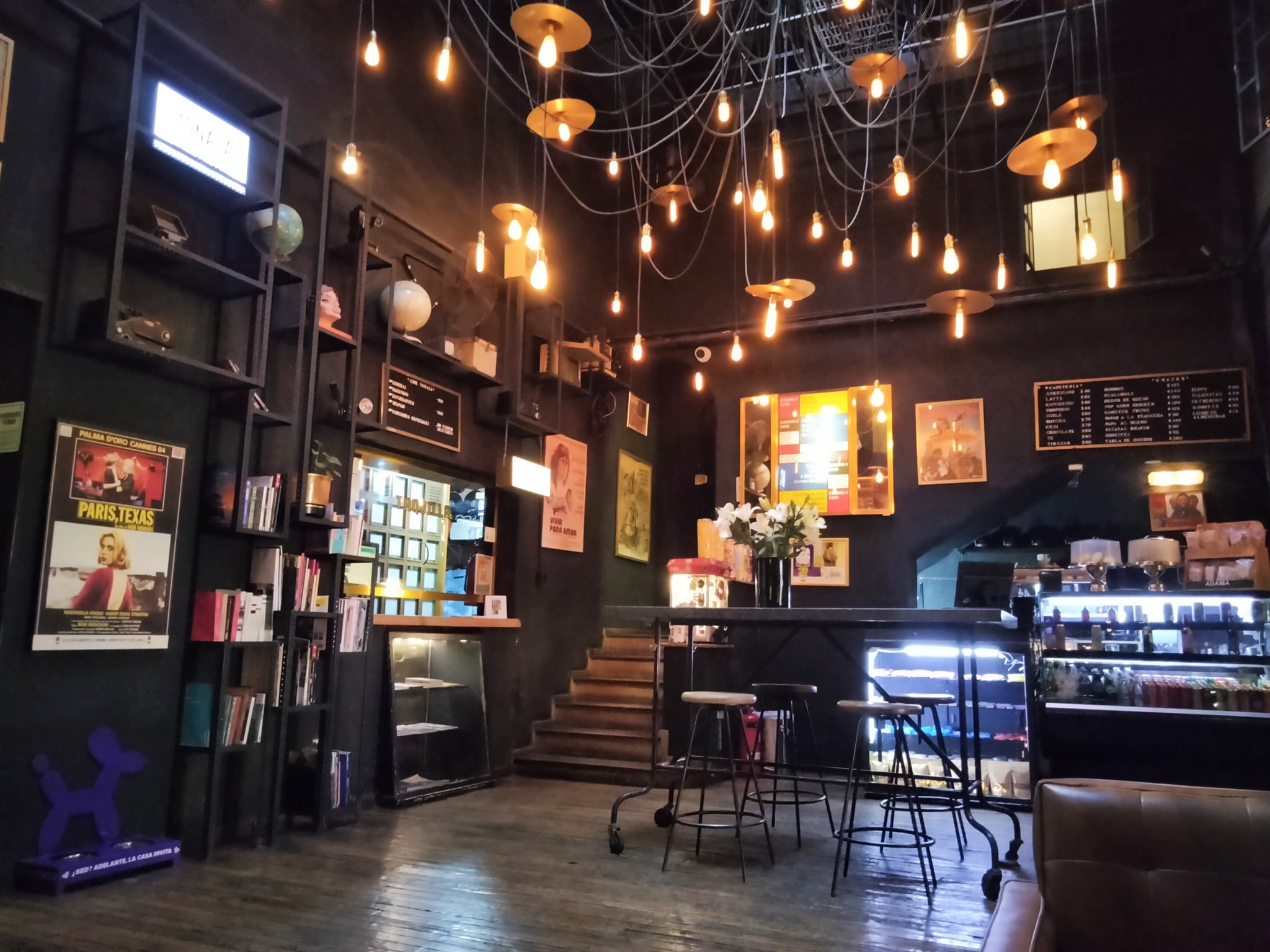
Just as I knew little of Q Lazzarus’s personal or professional life before watching this new documentary, I also had no idea the documentary itself existed until I traveled to Mexico City, where it was playing relatively wide (partially because it’s director Eva Aridjis’s home town). That widespread distribution gave me plenty of options for cinemas to visit, and I settled on Cine Tonalá in the La Roma neighborhood. The single-screen theater is attached to a proudly laidback cocktail bar & performance venue, functioning as a multi-purpose arts space rather than a popcorn-shoveling corporate multiplex. Its closest local equivalent in New Orleans would be The Broad Theater, except with steeper incline seating and more lounging-around space in the lobby. It’s the kind of cozy spot with thoughtful programming that I would visit every week if I lived in the neighborhood (speaking from experience with The Broad).
The Cineteca Nacional museum in the Coyoacán neighborhood is anything but laidback. Built in the 1970s as a temple to celebrate & preserve the artform, it’s an impressively large & lively venue that was swarmed with visitors on the Saturday evening when I dropped by to see 1963’s The Haunted Palace. The 12-screen cinema was showing an eclectic mix of both repertory titles (including selections from Hayao Miyazaki & Agnieszka Holland) and new releases (including Goodbye Horses), but its public cinema is only one facet of the sprawling facility. The massive complex had a college campus feel, complete with museum exhibitions, appointment-only archives, multiple cafés & vendors, an outdoor market, and a quad area where young cineastes were chilling & chatting. I arrived at least a half-hour early, which allowed me enough time to go DVD shopping, picking up a copy of the Mexican horror staple El Vampiro. If I ever return, I’ll make sure to arrive a half-day early instead, since there was plenty more to explore elsewhere on-site.
Among the few repertory titles being offered that week, I of course went for the one directed by Roger Corman and starring Vincent Price, since that’s squarely in my comfort zone. The Haunted Palace is an odd outlier in the Corman-Poe cycle that actor-director duo is best known for, since it only recites a few lines from an Edgar Allan Poe poem and mostly pulls its inspiration from Lovecraft instead. It’s also out of step with the typical payoffs of a classic Roger Corman creature feature, since its central monster doesn’t move an inch and Lon Chaney Jr. gets all of the best jump scares in a supporting role just by . . . hanging around. It’s only a pleasure for audiences who enjoy lounging in spooky castles and fog-machined graveyards while flipping through pages of the Necronomicon (or listening to its Vincent Price audiobook version), not in a rush to get anywhere. That is to say that I very much enjoyed seeing it screened big & loud with an enthusiastic crowd, even if there are far better titles in the Corman-Poe cycle that would’ve been a better use of the time & space (primarily, The Masque of the Red Death). In local terms, the experience was comparable to The Prytania’s recent afternoon screening of The Fall of the House of Usher, except the venue was a half-century newer and the audience was much fuller.
Mission: Impossible – The Final Reckoning (2025) @ Cinemex
If Cine Tonalá is the Mexico City equivalent of The Broad and Cineteca Nacional is the Mexico City equivalent of The Prytania, then Cinemex is the local equivalent of an AMC palace. I must’ve passed by a half-dozen locations of the corporate franchise while exploring different parts of the city, so it was hilarious that the one located closest to our apartment was called Casa de Arte, as if it were an independent arthouse. It’s the same way that AMC arbitrarily labels some of its offerings as “Artisan Films” even though they’re wide-release, major-studio productions with massive budgets (no offense meant to the artistry behind AMC Artisan titles like Sinners & The Phoenician Scheme). Cinemex does not offer a one-of-a-kind arthouse experience. It offers the same-as-it-is-everywhere multiplex experience, which is a different flavor that sometimes tastes just as good. It’s about as artisan as a cup of Coca-Cola.
It was in that downtown multiplex that I caught the latest (and possibly last) installment in the Misión: Imposible franchise, The Final Reckoning. Perhaps due to the lack of enthusiasm with the previous entry in that franchise, DeadReckoning, the three-hour epic does a lot of sweaty scrambling to connect its story to the larger, decades-spanning Mission: Impossible narrative arc before then settling into the tension of two lengthy Tom Cruise stunts: one in which he raids a sinking submarine and one in which he pilots an upside-down airplane with his foot. The resulting picture is one hour of aggressively incomprehensible crosscutting & flashbacks followed by two hours of old-school movie magic. I would say that it’s the kind of classic movie magic that you can only find in Hollywood, except the movie was mostly shot in England and I personally watched in it Mexico. There really isn’t anything especially recommendable about it beyond the excuse it offers to escape the summer sun for a few hours with a lapful of overpriced junk food, which is the only reason anyone would visit an AMC or a Cinemex anyway.
I was delighted to be able to request “Two tickets to Friendship, please!” at my local box office last weekend, which may have been the most fun I’ve had ordering movie tickets since requesting “Two tickets to the Moon, please!” in 2009. Part of the fun in this case was seeing the movie with my own best friend, as part of a leisurely Saturday afternoon enjoying movies & cocktails in the French Quarter. According to general online punditry, that kind of easy-going male friendship is a modern anomaly. We are reportedly in the middle of a “Male Loneliness Epidemic” that I’ve luckily avoided by A. occasionally leaving my house and B. maintaining a semi-social hobby (movies! movies! movies!). Having to restart my ongoing friendships from scratch in middle age does sound like a total nightmare scenario, though, as painfully illustrated by the Tim Robinson & Paul Rudd buddy comedy we watched that afternoon. In Friendship, Robinson stars as a lonely office worker who relies on his wife & son for the entirety of his social life until he’s encouraged to leave the house & make friends with the new neighbor, played by Rudd. Robinson’s mental health delicately balances on this new friendship going well, which makes for great comedic tension as he repeatedly, spectacularly fucks it up. By the end, it’s clear that his Male Loneliness affliction is entirely self-inflicted, making Friendship a cautionary tale for anyone who tends to overthink low-pressure hangouts into high-tension social bomb scares. It’s got all the raw-nerve social tension of an I Think You Should Leave sketch, sustained for 100 minutes of top-volume cringe.
Friendship is consistently funny in the exact way you’d expect a Tim Robinson vehicle to be, with three or four standout gags that had me laughing to the point of temporary mania. To avoid spoiling those gags, I will simply highlight them with single-syllable prompts: soap, sewer, toad, Jimp. The humor is immediate as soon as you lay your eyes on Robinson’s milquetoast narcissist, dressed head to toe in a harshly limited range of beiges & browns. He needlessly fills his coffee mug to the very brim, precariously carrying it down the hallways of his office with constant warnings that his hot coffee is in danger of spilling & scalding with any minor swerve. It’s an entirely self-created problem, which carries over to how he fumbles the easy, low-stakes social heist of being friendly with his new neighbor. Like Mr. Bean walking into a crowded antiques store, the laughter starts well before he fucks up, since I Think You Should Leave audiences are already familiar with the ways Robinson’s characters escalate low-stakes social interactions into acts of communal terrorism. Surprisingly, though, the title of the picture is not entirely ironic. In the chaos of Robinson burning down his marriage, his rapport with his teenage son, and his social standing with the much cooler, more popular Rudd, he does manage to make a genuinely friendly, intimate connection with the other man over a shared secret, communicated with a wink. Rudd can’t socially afford to acknowledge that connection in public, since Robinson is so disastrously inept at being around other people, but the connection is there, and it’s oddly sweet.
As a post-Tim & Eric anti-comedy of manners, Friendship speaks to an acquired taste for which I happen to be in the exact right demographic. If you belong in the bracket of irony-poisoned weirdos who know Conner O’Malley by name and would be delighted to see a film soundtracked by SlipKnot and Ghost Town DJs, you already know this is a comedy you’ll enjoy. If any one of those pop culture references mean nothing to you, congratulations on not being a maladjusted Millennial ghoul; you’re likely better off. All I can report at this point without recounting my favorite individual gags in the style of “The Chris Farley Show” is to say that I had a lot of fun laughing throughout the movie with my friend. Then we left the theater for another round. It’s not that serious if you don’t put pressure on it to be serious.
As recently as a few years ago, the gold standard for an actress performing a full mental breakdown onscreen was the late, great Gena Rowlands’s starring role in Cassavettes’s A Woman Under the Influence. It has since been surpassed—at least in terms of press-junket citations—by Isabelle Adjani’s equally astonishing turn in Żuławski’s Possession. Whether it’s due to the overall cultural warming to Genre Cinema as a respectable artform or it’s due to the wider home video distribution of Possession in particular, Adjani’s horrific mid-film freakout is now cited as artistic inspo for actresses as wide ranging as Sidney Sweeney (in her self-produced nunsploitation film Immaculate) and Reinate Reinsve (in the much classier schoolboard-meeting drama Armand). Even Rowlands’s recent passing hasn’t lessened Adjani’s ascent in influence. In either case, it might be nice to hear a few other performances from those immensely talented actors’ oeuvres cited as influences from time to time, so that Adjani is not only remembered for smashing her groceries against a tunnel wall and Rowlands is not only honored for coming up with that thumbs-up raspberry tic.
Luckily, Isabelle Adjani does have at least one other major role in which she’s tasked to perform manic mental anguish to great success. She does such a stellar job embodying the violent psychosis of unrequited love in the 1975 classic The Story of Adele H. that it often feels as if she’s being directed by Ken Russell instead of François Truffaut. The French New Waver mostly behaved himself behind the camera, shooting the anti-romance period piece with the made-for-TV aesthetics of a Masterpiece Theatre episode – complete with TV-friendly screen wipes. Adjani initially appears to be on her best behavior as well, arriving on the scene as a lovelorn romantic tracking down the traveling soldier who once proposed marriage to her against her family’s wishes. However, the more we come to understand just how obsessed she is with making this romantic connection happen (and just how little affection the soldier has expressed in return), it quickly becomes apparent that she’s a woman possessed. Then she gets worse, scarily so. Adjani’s ecstatic performance as a globetrotting stalker gone mad works in direct contrast to her director’s muted browns-and-greys historical aesthetics, so that all you can focus on is the immense power she wields as a screen presence. It was an incredible feat for the still-teenage actress, and it’s admittedly even more incredible that she somehow pushed her craft even further in Possession.
For his part, Truffaut is seemingly more preoccupied with the real-life historical spectacle of the story he’s telling than he is by the filmmaking mechanics of telling it. Stepping away from the more obvious visual & artistic trickery of his preceding film Day for Night, he instead reassures his audience with onscreen text, archival photographs, and vocalized diary excerpts that the events depicted are real things that happened to real people. The only overt trickery of the picture is hiding the full name of his subject from the audience, as the titular Adele H. is better known to the public as Adele Hugo, daughter of the famous French novelist Victor Hugo. As in the film’s narrative, the real-life Adele Hugo did travel to Canada & Barbados against her father’s commands to chase an unlikely romance with a fuckboy soldier who spurned her. It was a passionate, one-sided obsession that eventually drove her to the madhouse just as performed by Adjani in her first starting role – often expressed in the exact words of her personal letters & diary. Outside a couple double-exposure sequences in Adele’s sweaty nightmares, however, Truffaut never matches the mania of his subject in the film’s visual palette. He instead leaves that task entirely in Adjani’s scarily capable hands, which she uses to feverishly scribble endless love letters in her cramped Nova Scotian apartment instead of resting her mind with sleep.
Just in case the connection to Adjani’s now career-defining performance in Possession wasn’t already top-of-mind, Adele H. does include a brief scene in which the actor performs a manic episode against the brick walls of an urban tunnel – this time while being attacked by a wild dog. It’s just one of many jaw-dropping moments of ecstatic physical performance in the film, but it is still a visual reminder that Adjani’s one of the best to have ever performed that total breakdown routine in the history of the medium. Before Rowlands was the go-to citation for that manic extreme of the craft, I’m sure Catherine Deneuve’s performance in Repulsionmade the publicity rounds in the same way. Maybe someday Elizabeth Moss’s work in titles like Queen of the Earth, The Invisible Man, and Her Smell will get its turn. For now, though, Isabelle Adjani is the reigning queen of melting down onscreen, and that icon status is well earned (in more films than one).
Golden Harvest’s 1988 rape revenge thriller Her Vengeance is reportedly a remake of fellow Hong Kong exploitation flick Kiss of Death, released by the rival Shaw Brothers studio in 1974. However, sometime between those two productions the most notorious American landmark of the genre, I Spit on Your Grave, left its permanent mark on the rape revenge template, so citing its primary influence becomes a little muddled. Her Vengeance does adhere to the exact plot structure of Kiss of Death, following the training-and-payback saga of a sexually assaulted woman who learns her martial arts skills from a physically disabled wheelchair user before getting her titular vengeance. Something about the continued violation of that initial assault following her well after the inciting incident screams I Spit on Your Grave to me, though. The frustrating, traumatizing thing about I Spit on Your Grave is that its vengeful antiheroine is assaulted multiple times before she flips the power dynamic of the film’s violence, restarting the 1st-act violation several times over without letting the audience move on to something less vile. In Her Vengeance, the initial assault continues in less literal ways, but persists nonetheless. Our assaulted antiheroine contracts gonorrhea, which exponentially worsens even as she trains her body for combat. She reveals her assault to her blind sister (and, by extension to the audience) by explaining that the gang who jumped her were also the same five scumbags who killed their father and left both the sister and the sister’s fiancée physically disabled. Then, her vengeful warpath accidentally puts the last few living people she cares about in their own mortal danger as innocent bystanders, so that she’s repeatedly traumatized every time the gang goes tit-for-tat with her assassinations. It’s relentlessly, exhaustingly bleak.
Thankfully, the dependably entertaining director Lam Nai-Chou lightens up the mood where he can, bringing some of the cartoonish hijinks from his better-known classics The Seventh Curse & Riki-Oh to a genre not typically known for its goofball amusements. As nightmarishly vicious as the gangsters are in every scene, they do initiate an armored truck heist by sticking a banana in the tailpipe, a classic gag. Frequent Sammo Hung collaborator Lam Ching-ying performs most of the more outlandish antics as our heroine’s wheelchair-using martial arts trainer, using his chair as a weapon and a constant inspiration for over-the-top stunts. Seemingly overwhelmed by the pure evil emanating from the worst of the surviving gangsters, he also rigs his nightclub with lethal boobytraps for a spectacularly violent climax, like a Home Alone precursor for convicted murderers. These outrageous “Triad Spring Cleaning” sequences are especially fun to watch due to the film’s Category III rating, which allows it to indulge in the most grotesque practical gore details imaginable. That freedom to indulge cuts both ways, though, making for an excruciating first-act assault as the gang members take turns abusing our antiheroine in a graveyard nightscape. Lam mercifully does not fixate on actor Pauline Wong Siu-Fung’s naked, abused body during that sequence, which helps diffuse any potential dirtbag eroticism seen elsewhere in this disreputable genre. Instead, he catalogs the cartoonishly evil Dick-Tracy-villain faces of her attackers, each with names like Salty, Long Legs, and Rooster. He also finds some sly humor in her eventual revenge on those C.H.U.D.s, having her cut off one of their ears with a pair of scissors, then later featuring a Vincent Van Gogh portrait as a background detail. Her Vengeance is not the Steel & Lace-level absurd escalation of the rape revenge template you’d expect from the director of The Seventh Curse, but Lam still finds a few occasions to have his usual fun, so it’s not a total dirge.
Curiously, the recent Vinegar Syndrome release includes a longer-running alternate Category IIB cut of the film that averts its lens from some of the more violent details but adds in additional scenes of dramatic context that overcorrects their lost length. Apparently, Golden Harvest produced five different cuts of the film in total, mostly as a preemptive measure to avoid its inevitable censorship by the Hong Kong government. If I were a more diligent cinema scholar I might’ve watched the IIB cut of the film for comparison’s sake before writing this review, or revisited I Spit on Your Grave, or sought out Kiss of Death. Since this is such a deeply, deliberately unpleasant genre, however, I can’t imagine wanting to suffer through this story a second time, no matter how softened or warped. The only reason I watched Her Vengeance in the first place is because it was packaged with my recent purchase of fellow Category III grotesquerie Devil Fetus, and I had some light familiarity with the director’s name. I do not regret the discomfort at all. Pauline Wong Siu-Fung gives a heartbreaking performance as a sweetheart nightclub employee who’s embittered & radicalized by her Triad gang-assault, emerging as a vicious killer herself on the other side. Lam Ching-ying makes spectacular use of his wheelchair prop, delivering some of the coolest, most badass disability representation I’ve ever seen in a martial arts film. Lam Nai-Chou crafts some memorably bizarre action-cinema payoffs typical to his most eccentric works. Still, I don’t think I’ll be making this particular journey into rape-revenge Hell again anytime soon. Once was plenty, thank you. I’ll stick to the relatively wholesome safety of Devil Fetus until these psychic wounds have healed.
I remember seeing previews for the Sci-Fi Channel premiere of Gregory Widen’s directorial debut The Prophecy (which, as of this writing, is his only feature director credit, although he did an episode of Tales from the Crypt) in the late 90s. It scared me a little, and I also remember being a little freaked out by the VHS cover, with Christopher Walken looming over figures in the desert, yellow eyes shining. He’s great in this, and when the movie works, it’s usually because of the inhumanity of his Archangel Gabriel, a kind of body language and erratic emphasis that’s one of the actor’s many specialties. Widen also wrote the film, having previously garnered some success for penning 1986’s Highlander as well as 1991’s firefighter action thriller Backdraft. As a horror fantasy, The Prophecy obviously borrows more from the former than the latter, once again featuring battles between immortal beings, ancient texts, and the grappling between Good and Evil.
The film opens with narration from Simon (Eric Stoltz), an angel, as he recounts the events of the First War in Heaven, the story that we all know about a third of the angels being struck down from heaven because Lucifer rebelled in an attempt to become a god himself. What we don’t know is that there was a Second War, one that’s been in a stalemate since the first one, between those angels loyal to the Almighty and those led by Gabriel (Walken, as noted), who are throwing a cosmic temper tantrum over God’s preference for humans, as demonstrated by the latter’s possession of souls. In fact, because of this cold war, no soul has ever reached heaven in the history of mankind. As Gabriel later reveals, humans are much more skilled than angels in the areas of “war and treachery of the spirit,” and thus he and his lackeys are seeking out a deeply evil soul of a recently deceased war criminal, as his talent for warmaking could tip the scales in the balance of the rebels. Caught up in all of this is Thomas Dagget, a detective who, years earlier, saw a vision of angels at war during his final confirmation for the priesthood, causing him to abandon the faith. He’s called in when the body of one of Gabriel’s lieutenants, slain in an altercation with Simon, is found and autopsied, with strange results. For instance, when humans grow, their bones have natural striations that can be used to determine the age of a body, but this man’s bones have no such markings, as if they were created spontaneously in their current form; he also has the blood chemistry of an aborted fetus.
Simon and Thomas meet briefly before the angel takes off to Arizona to dig up the grave of the recently deceased Colonel Hawthorne, from whose corpse he inhales the man’s dark soul. Knowing that Gabriel is hot on his trail, Simon sticks the soul inside of a young girl named Mary (Moriah Shining Dove Snyder) at the local reservation school, shortly before Gabriel arrives and kills him. Mary’s teacher Katherine (Virginia Madsen) starts to notice a change in the girl’s disposition as well as her declining health. Meanwhile, Gabriel searches for the soul hiding spot with the help of two undead lackeys: Jeffrey (Adam Goldberg), whose life was suspended by Gabriel in the moment of his suicide, and later Rachael (Amanda Plummer), who is caught in the moment of her death by cancer. The film makes its most interesting turn with the appearance of Lucifer (Viggo Mortenson), who doesn’t care all that much for the people caught in the middle but knows that a victory on Gabriel’s part will turn Heaven into Hell which, as he says, “is one hell too many.”
This movie is messy. Widen has a strong eye for composition and the film has a style that’s unique, and he manages to craft some truly horrifying images, most notably quick flashes of the grisly results of the heavenly war with angels impaled on spears and rotting through Thomas’s visions (think the very brief splices of the terrors that had to be cut from Event Horizon to secure its R rating). There are also some fun things that he does with the mythology that, since he was basically crafting his own Bible fanfic and could make up the rules as he went along, can likely be accredited to him all the way. In particular, I love the way that every angel that we meet has a habit of “perching” on things — road barriers, fence posts, the backs of chairs. It’s like an unconscious habit for them to sit on their feet with their legs folded beneath them like birds, and it’s a clever bit of storytelling through body language. I also really liked the angel autopsy, as each of the things that’s revealed about the corpse is something that makes sense as a scientific oddity that would befuddle a coroner in the way that it’s similar to but not exactly like a human body.
For the most part, the toying with of fantasy elements works. Lucifer’s reluctant (and ultimately self-interested) investment in preventing the villainous Gabriel from getting his way is good stuff. Although the inclusion of Jeffrey and Rachael is a bit superfluous (Jeffrey mostly serves the in-universe function of driving Gabriel around and handling all the human stuff and the narrative purpose of receiving exposition, and Rachael just replaces for the last fifteen minutes after Jeffrey when he dies), the whole slowly dying puppets angle is interesting. The conflict between Gabriel and the loyal heavenly guard is also clear. What doesn’t work is where it gets bogged down in all of Hawthorne’s soul stuff. We spend too much of the film with Thomas investigating who Hawthorne was (a Korean War general, war criminal, and apparent cannibal) just to establish that he has a truly awful talent for suffering and war, and it really doesn’t make a lot of sense that Simon would stick this McGuffin into a little girl other than because the narrative says he has to. It’s lucky that Lucifer turns up at the end to claim the soul once it’s exorcised from Mary via a Native American ritual (no tribe is ever named, nor is the ritual given a title either; it’s just the typical nineties “Magical Native American” trope), because otherwise I’m not really sure what his endgame was. It’s all a bit convoluted, to the film’s detriment. Its other problem is that, well, it’s just not very good. No one is giving a bad performance, there are some decently unique visual choices and interesting tableaux, but this is a 90s destined-for-VHS-cult-status movie that will forever be playing third banana to Candyman (which also featured Madsen) and The Crow, the sleepover flick for you and your goth best friend when those two (or The Craft, which released the following year) were already rented out on a Friday night. It’s available for streaming right now on Tubi … but only in Spanish.














 Swampflix