Asteroid City (2023)

There’s something about the way that people have been reacting to the sudden appearance of A.I.-generated “art” that makes me sad. Not because I think that it’s “coming for my job” or because I think it can replace art made by human beings (it definitely can’t, no matter how many attempts your preferred media monopoly makes in order to try to make that happen), but because it once again reveals just how unbelievably stupid a lot of people are, or perhaps how lacking they are in that ineffable quality we might call “a soul.” Specifically, I’m talking any person who looked at any of the A.I.-generated trailers for movies within the past couple of months and then reposted it on social media. Some did it with a dire warning that this braying abomination heralded the death of artistic careers, others relished in the lizard brain delight of watching an algorithm shuffle a deck of Star Wars images into a deck of almost-but-not-quite-accurate Wes Anderson references and create a nightmare. To take a quick diversion, think about all of the fairy tales that you read as a kid in which some clever boy or girl defeated something wicked posing as a human because they recognize the villain’s otherworldly bizarreness and think out a method to outwit them. What I’m trying to say is that there were a lot of eyeballs on these monstrosities and an awful lot of people failed to recognize the fundamental inhumanity of the image with which they were presented. Nothing is real, nothing is convincing, and it’s like people have no real interest in being convinced. 

Into all of this comes a real Wes Anderson film, and one which plays with the concept of narrative and nesting stories. It also deals with the nature of separation, distance, and isolation. Software can’t do that because software doesn’t get lonely; software is never tempted to give their ex-boyfriend another chance; software never had to figure out how to deliver bad news. Software doesn’t have to go into quarantine for a time that ends up stretching to the horizon, and software doesn’t understand how that kind of thing might make one lose their grip on reality, and software really, really can’t grasp why people might come out of the other side of that with a song in their heart and a spring in their step. 

Asteroid City is a play, being performed for a broadcast over the air in the days of pre-color TV. It’s also the name of the tiny desert settlement in which the play takes place. The TV program host (Bryan Cranston) introduces us to this setting through the use of stage directions, which include a hand-painted mountain backdrop, an eternally incomplete elevated highway on-ramp as a permanent testament to the apparent insignificance of the place, a diner, a mechanic, a motor court with individual cabins, and, most importantly, a meteorite (and its attendant scientific complex). Each of these elements is first presented as stage dressing before we enter the full color world of the narrative itself, complete with proportion shift in addition to the Wizard of Oz-esque transition between the world of the artificial mundane and the imaginative sublime … which is somewhere that shouldn’t be that interesting, and yet it is. That is, perhaps, the point. Asteroid City the place shouldn’t be anything special; it’s the tiny little nowhere that, in a film with broader, more mainstream appeal, we would only see as a crane or drone shot as our protagonist dashes through it so that we can see that they are leaving everything behind through the visual language of them speeding away from the last outcropping of civilization into a desert of the unknown. For Anderson, this isn’t fly-over (or drive-through) country; this inhospitable specimen is made hospitable, and fascinating. 

Within the play, Augie Steenbeck (Jason Schwartzman) is, like Chas Tenenbaum before him, a widower who has not yet figured out how to tell his children that their mother has died. He and his four kids—teen genius Woodrow (Jake Ryan) and girl triplets Andromeda, Pandora, and Cassiopeia—find themselves stranded in Asteroid City when their car breaks down, and Augie calls his father-in-law Stanley (Tom Hanks) to collect the girls. The town was already the final destination for Augie and Woodrow, however, as the boy is a finalist for a scholarship prize in the Junior Stargazer convention, as a result of his invention of a device that allows one to project an image onto the moon. There, he falls in puppy love with another finalist, Dinah (Grace Edwards), whose mother happens to be famous actress Midge Campbell (Scarlett Johansson), with whom the emotionally raw Augie finds some connection and solace. The play itself has a huge cast, including an entire class of children on a field trip with their teacher (Maya Hawke), a singing cowboy who seeks to woo her, three other finalists with their own strange inventions (including death rays, jet packs, and brand new elemental particles), the meteor science team leader Dr. Hickenlooper (Tilda Swinton) – honestly, too many names to name without essentially reciting the IMDb page. And that doesn’t include the “outer” layer of “reality,” which features not only the aforementioned host, but also stage director Schubert Green (Adrien Brody), his wife Polly (Hong Chau in a brief but memorable scene), and the actress who would have played Augie’s wife in a flashback if that scene hadn’t been cut in the final draft (Margot Robbie). And that’s not even the half of them. 

Asteroid City is a matryoshka doll of stories, like a few of Anderson’s recent works. He’s always had an obvious talent for creating a sort of tableau within itself and an intentionality in his evocation of stage elements for the purpose of drawing attention to the artificiality of the form. There’s an escalation of it here that I really love, because the inherent staginess of Asteroid City and the way that it gives way to the vibrant “real” Asteroid City is a beautiful externalization of what we mean when we talk about the suspension of disbelief. I recently ranted in my There’s Something Wrong with the Children review about how far (that is, not very) most modern audiences are willing to extend their patience for narratives that require more than 25% attentiveness, and along comes this movie with imagery that illustrates this exact idea. Art can sometimes merely be evocative and then transport you to some distant place; it’s your choice to stay trapped in the Platonic cave staring at the set decoration, or you can choose to transcend the limited ability of painted flats to stand in for an open sky and just see the sky. Any text with which we interact must put in some of the work to meet us halfway, of course, but it’s on us to let go a little and embrace the opportunity to slip these surly bonds and let our spirits soar. 

And soar you will, or at least I did. There is a distinct loneliness that flows out of the screen, and even if Anderson hadn’t confirmed in an interview that the story was informed by COVID, the fact that the play’s third act (and therefore the film’s final act as well) takes place in quarantine makes this all but explicit. There are many scenes in which Augie and Midge talk to each other between cabins, sitting at their respective windows, at once so close that they don’t have to raise their voices to be heard while nonetheless separated by a distinct barrier – a tableau that calls to mind the imagery of early quarantine when these sorts of six-feet-apart casual visitations were the temporary norm. Every character, like every human being on earth, is lonely in his or her own way; Stanley has lost his beloved only daughter, Augie his wife, his children their mother, the schoolteacher her certainty about the order of the cosmos, Schubert his own wife, and the world a brilliant playwright with the death of Asteroid City‘s author, Conrad Earp (Edward Norton). Even quarantined on top of one another in a tiny town, we are all alone, but that’s okay, because we’re all alone together. 

-Mark “Boomer” Redmond

See How They Run (2022)

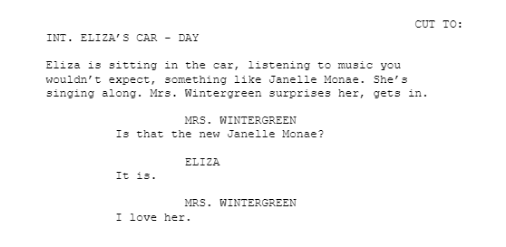
I recently talked on the podcast about my dear friend Ana Reyes’s astounding and well-deserved success surrounding her first novel, The House in the Pines (still #2 on the NYT bestseller list for hardback fiction as of this writing!). When we were all having drinks after the launch party back on January 3, her husband, who is also a writer and friend, mentioned to me that he and Ana had recently been talking about how ahead of the “cozy mystery” curve I was when I put together my pitch document/series bible for the as-yet-undiscovered project Mrs. Wintergreen. As I smiled a toothless grin that belied my bitterness that fate has not seen fit to bring Mrs. Wintergreen to life, I didn’t even point out that not only was that the case, but also that I had even included a scene in which my protagonist, 108-year-old semi-pro sleuth Constance Wintergreen, expressed an appreciation for Glass Onion star Janelle Monae:

Anyway. 

Agatha Christie is very in vogue, as evidenced by not only the aforementioned Christe-adjacent 2022 release Glass Onion, but also the Christie-containing See How They Run, a confident first feature from director Tom George penned by Mark Chappell, who is perhaps best known for his writing for the David Cross vehicle The Increasingly Poor Decisions of Todd Margaret. A period piece, the film begins on the night of the hundredth performance of The Mousetrap, a Christie-authored play which is infamous for two things: first, that there is a twist ending that the audience is encouraged not to reveal to others, resulting in the play’s ending remaining largely unknown to this day, and second, that the contract for the play forbids any adaptation of the source material to film (or the short story on which it was based from being published) until at least six months have passed since its final performance at London’s West End. This was a particularly long-sighted bit of legal play, as the show has run continuously (other than a COVID-caused pause) since its opening night in October of 1952, seventy years ago. In fact, I have some suspicion that this film exists solely for that reason, as it is the closest we can get to a Mousetrap adaptation for the foreseeable future. 

Leo Köpernick (Adrien Brody) is a sleazy slimeball of an American film director (redundant, I know) who has his sights set on turning The Mousetrap into a hit motion picture. That previously noted clause about the show being forced to close before this can even be a possibility is at the forefront of the minds of many involved, but theatre producer Petula Spencer (Ruth Wilson) assures him that the play has already reached its 100th performance and surely it will run out of steam soon, espousing the idea that a narrative with a whodunit at its core will, by its nature, see few repeat visitors and will necessitate closure sooner than later. Although we the viewers are sufficiently distant from this event that this is an historical irony for us, the contemporary American studio system is so confident that they already have Mervyn Cocker-Norris (David Oyelowo) working on a screenplay. Cocker-Norris’s English sensibilities and sense of adaptational faithfulness brings him into conflict with the flashy Köpernick, although the former is not alone in his distaste for the latter: British film producer John Woolf (Reece Shearsmith) is also protecting a scandalous secret about which Köpernick is blackmailing him; Köpernick is rude to all members of waitstaff everywhere, which includes the put-upon usher Dennis Corrigan (Charlie Cooper); and, mere moments before his murder at the ten minute mark, he is decked by Richard “John ‘Spared no expense’ Hammond” Attenborough (Harris Dickinson), who portrays the lead in The Mousetrap, for flirting with his co-star and wife Ann Saville (Pippa Bennett-Warner). The investigation of his death necessitates the appearance of Inspector Stoppard (Sam Rockwell), the archetype of the drunken detective who plays fast and loose with the rules; due to a shortage of available partners, he is paired with Constable Stalker (Saoirse Ronan), a plucky, energetic up-and-comer who is mere months away from being the first woman to take the sergeant’s exams. 

This is a neat little movie that makes sense in and of itself but also functions as a love letter to Christie and to her longtime fans, a body of which I consider myself to be a member. For instance: a scene in which the excitable Stalker asks a hotelier what part of France he is from based on the fact that he speaks French only to receive a deadpan response that he is Belgian is a fun comic bit in and of itself, but it’s also a nod to fans of Christie’s Belgian detective Hercule Poirot, who often finds himself on the receiving end of this exact misunderstanding. There’s also a good running gag about Hamlet: Early on, Attenborough says of The Mousetrap “It’s not exactly Hamlet.” Later, Stoppard half-quotes Act II Scene II’s famous ending line “The play’s the thing” [“Wherein I’ll catch the conscience of the King”], spoken when Hamlet commits himself to obtaining evidence of his uncle Claudius’s guilt through an elicitation of a confession upon seeing a fictionalization of Hamlet’s father’s murder. This is itself a circular reference, as not only does it reveal that Stoddard has realized that the connection between the murder of Köpernick may actually have to do with the play’s content, not its performance as initially suspected, but the word “mousetrap” likely comes from Hamlet in the first place as Hamlet refers to the play as a mousetrap in Act III Scene II (line 2131), in what may be the invention of the term. Your mileage is likely to vary on certain comic elements, of course; whether or not you find it clever that Cocker-Norris disdains screenplays that include flashbacks as crass and artless moments before one occurs in his narration is going to be left up to the individual viewer. I find his asking of “Whatever next? A caption that says, ‘Three weeks later’?” juxtaposed with that very caption to be charming and fun, but I know that others will find it to be more of a moment of bathos. 

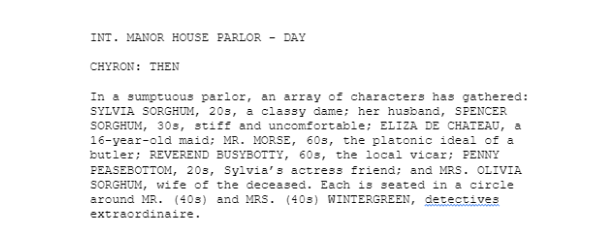
My favorite gag, however, cribs neither from Shakespeare or Christie, but Adaptation: in a flashback, much to the chagrin of Cocker-Norris, we get to see a little bit of how Köpernick’s mind works as he shows a series of storyboards that he put together for the climax of the film version of The Mousetrap. The images are quick cuts between detailed insets: gloved hands at a power box, a revolver being cocked by an unknown person, a fire breaking out in the middle of a tense standoff with a hostage—all of it very un-Christie and extremely Hollywood. This is Köpernick’s attempt to “jazz up” the very un-Hollywood and extremely Christie ending of the play, which uses one of her most well-known and genre-defining tropes: the end-of-the-story summation gathering, in which the detective gets everyone together in a parlor to explain their investigation and conclusion. In fact, not that it matters, but it’s so very much part of the genre that a parody of this type of scene is the very first thing that happens in the script for the Mrs. Wintergreen pilot, “Mrs. Wintergreen and the Thorny Dilemma” 

See How They Run turns this on its ear by playing both sides in the same way that Adaptation does, by mocking the hand that feeds it via denigrating comments about the formulaic nature of Hollywood adaptations, and then doing each and every one of the things that it mocks. The climax of the film takes place in a parlor that has the exact same layout, dimension, and decorations as the final set of the play, although this is obscured until the last possible moment to reveal it. The revolver, the fire, the standoff, the power box—the whole thing plays out in exactly the same way that Köpernick’s storyboard does. It’s a lot of fun to watch. (So would Mrs. Wintergreen be, I think, but I digress.) 

I was engaging with some essay or other this week and was taken aback when the author noted that, for all of his extremely large body of literary work, Isaac Asimov’s oeuvre rarely sees film adaptations, with only a handful ever being produced: Konets Vechnosti from 1987, based on The End of Eternity, which I assume must have had a subtitled release in the U.S. at some point but I can find no evidence of; the Robin Williams vehicle Bicentennial Man; two separate adaptations of the 1941 short story “Nightfall;” and, theoretically at least, I, Robot. In general, the world does not lack for Christie adaptations; they are so numerous that films based on And Then They Were None alone have their own Wikipedia subpage. The Mirror Crack’d from Side to Side was adapted as an episode of Miss Marple and Agatha Christie’s Marple, which are two separate television shows, as well as a film version in 1980 starring Angela Lansbury as Marple. When it comes to Christie media, we are the lilies of the field, neither toiling nor spinning, nevertheless arrayed in splendor. But we don’t have an adaptation of The Mousetrap, and we likely never will. Even if that day comes, there’s a risk it will be as dull and uninteresting as 2017’s Crooked House, which even Glenn Close and Gillian Anderson couldn’t save. What we do have is See How They Run, which is more than good enough; it’s great. 

-Mark “Boomer” Redmond

Giallo (2009)

EPSON MFP image

three star

I don’t know if it’s fair to detract from this movie’s score based on what I learned about it after viewing it. I’m not talking about Adrien Brody’s high-profile lawsuit against the production company to block distribution of Giallo in the U.S. until he received the remainder of his paycheck; that sort of thing shouldn’t (and doesn’t) really affect an interpretation of the film’s quality. What I am talking about is the fact that I honestly thought Dario Argento had gone out and hired someone with an unusual, potentially deformed facial structure to portray the killer, much like he had hired an elderly prostitute to portray the briefly corporeal Helena Markos in the final moments of Suspiria, and it turns out I was very, very wrong. The prosthetics applied to the killer are hideous if you accept that this is the face of a real person, but, once their falsity is pointed out, they are embarrassingly obvious—in the sense that I’m embarrassed by the fact that I made it through the whole film without realizing that it was actually Brody under all that bulbous latex. So, completely outside the world of the film itself, I have to admit that this has the overall effect of making the film goofier in retrospect.

Following the kidnapping of a beautiful tourist, Linda (Emmanuelle Seigner) arrives in Turin to visit her sister, fashion model Celine (Elsa Pataky). When Celine doesn’t come home when expected, Linda goes to the police, who direct her to Inspector Enzo Avolfi (Adrien Brody), an antisocial detective who is on the trail of a serial kidnapper and murderer (also Brody) who uses his unlicensed taxi as a cover in his abductions. Linda forces her way into his investigation, and they learn from a not-quite-dead victim that her assailant is literally yellow, a fact which they use to determine that the killer, now nicknamed “Giallo,” has jaundice as a result of kidney problems and track him to a clinic. Meanwhile, Enzo reveals that his dedication to the job arose from the fact that he saw his mother murdered by a serial killer when he was a child, a butcher whom he later encountered and killed in revenge as a teenager. Giallo realizes that Linda and Enzo are closing in and takes Linda hostage, promising to tell her where Celine is hidden once he gets away.

When I hit the midpoint of this Dario Argento project, I decided to start keeping track of which of his recurring motifs were used most often and then, when we got to the end, I planned to use this info to determine which Argento was the most Argento of all the Argentos. Strangely, within the first few minutes of this film, it seemed like Giallo was aiming to be the most motif-heavy, as there was a brief scene where a character attended an opera, then a scene of running in the rain, the killer’s eyes being reflected in a mirror, and other elements that had already appeared in four or more films. And then it occurred to me: if The Black Cat was Argento doing Poe and Do You Like Hitchcock? was Argento doing Hitchcock, then Giallo is Argento doing Argento, and it works in some ways but fails in too many others.

The all-too-brief sequences of Enzo’s youth, which are shot to be stylistically similar to Argento’s movies of the late seventies and early eighties, are the most interesting part of the film. These shots are beautiful, and they really make me want to see the aging director craft a giallo period piece set during the era of his greatest successes, perhaps as the last project of his career before retirement. There’s also a return to form with regards to his cinematic eye here; the use of color throughout is particularly well done, especially as this element has been absent from his work for over a decade at this point (a chase sequence that makes its way down a giant yellow spiral staircase is notably both fun and visually appealing). I also appreciated that Enzo and Linda learned the name of the killer fairly early in the film’s run time and tracked down his location, prompting Giallo to be more proactive in a way that none of Argento’s previous antagonists had been. There’s even a fake-out downer ending with an ambiguous epilogue, which is another departure from some of Argento’s more tired ending tropes. Brody seems to be phoning in his performance as Enzo, perhaps to counterbalance his performance as the more striking Giallo, but Seigner is likable and sympathetic as a woman who refuses to give up on her sister, and she makes the character’s decision to acquiesce to the killer’s hostage taking believable.

On the other hand, the original ideas here serve to highlight just how much of this movie isn’t fresh or clever. While Seigner plays her role with understated franticness, Brody poorly acts each of his roles in a different way. The inspector is an interpretation of a hard-boiled NYC cop (it is explained that Enzo spent some time in the states growing up after the death of his mother) with a chip on his shoulder that prevents him from forming emotional relationships; Giallo is a grotesque Quasimodo who shrieks back at his victims and gets off on stealing women’s beauty by mutilating them. Both characters are too broad to leave much of an impression, and the revelation of Enzo’s backstory is more interesting in its execution than in the material revealed. Alternatively, the backstory of Giallo–that his junkie mother abandoned her jaundiced, hepatitis-infected baby to be raised by the church, where he was isolated by his yellow skin–is too maudlin to be taken completely seriously. That the film takes an unusual turn in its final third is interesting, but not interesting enough to save it.

-Mark “Boomer” Redmond