The Legend of Ochi (2025)

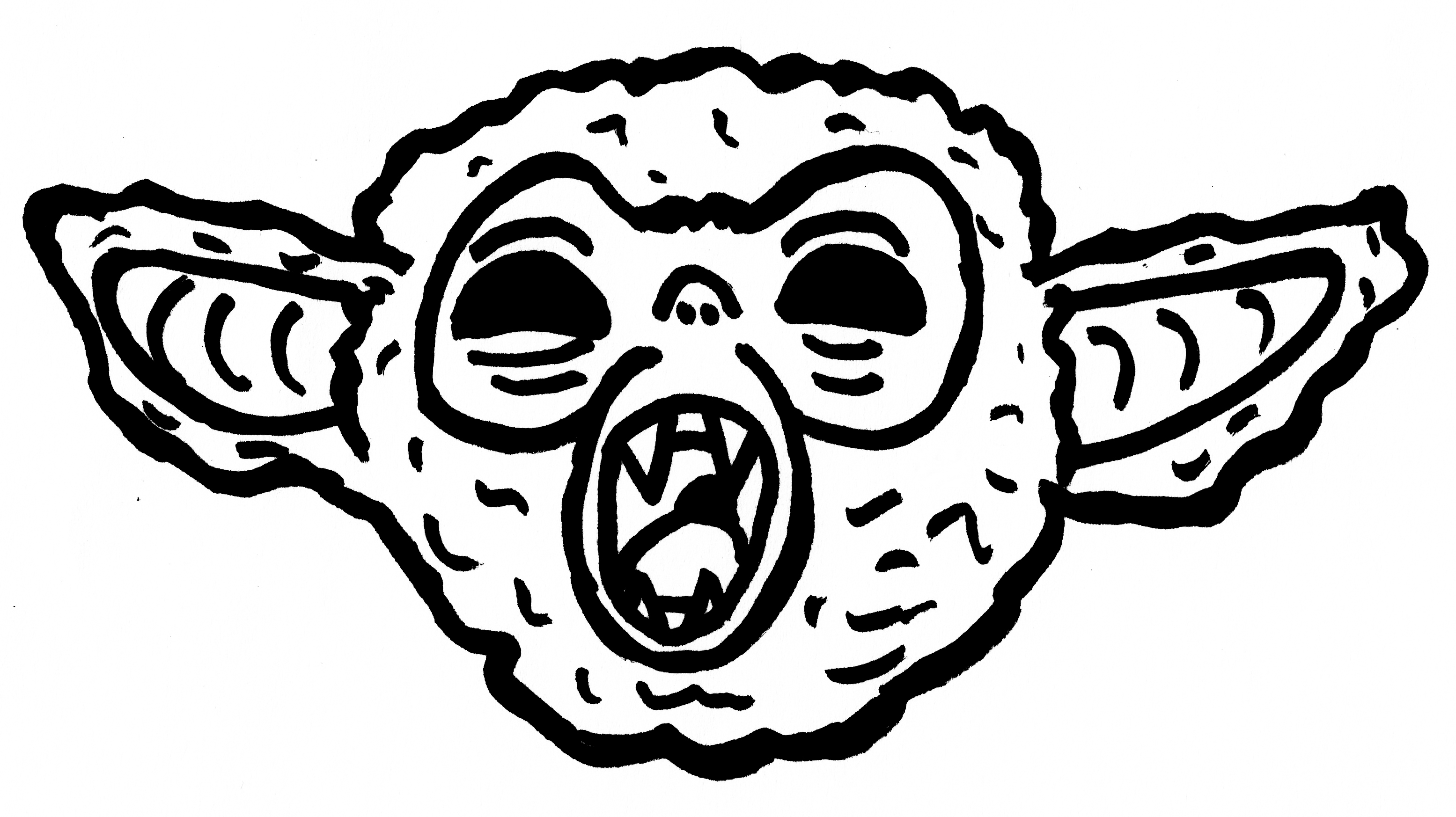
For decades, whenever someone cited the “uncanny valley” effect of modern filmmaking, they were referring to the off-putting resemblance of CGI to real-life humanity. As computer technology inches nearer to photographic accuracy, the ways in which the images are still just slightly off become monstrously horrific, especially when rendering human faces. As a result, movie nerds tend to fetishize the practical effects of yesteryear, preferring the blatant artifice of movie-magic techniques like stop-motion, animatronics, and latex makeup transformations to the uncanny computer effects of our current corporate hellscape. Ironically, that fetishism has recently led to an entirely new uncanny valley forming between advanced practical effects and the CG graphics they’re meant to counteract. For instance, when the stop-motion Wallace & Gromit shorts were mostly made by Nick Park’s hands in the early 90s, you could see the lumpy imperfections of his fingerprints in the characters’ clay bodies, unmistakably marking them with evidence of human touch. Now that Wallace & Gromit features like Vengeance Most Fowl are being produced by hundreds of collaborators for major studios like Netflix, those fingerprints have to be artificially applied, intentionally warping the clay so the machine-printed faces can’t be mistaken for computer animation. Likewise, the new children’s fantasy-adventure The Legend of Ochi features an animatronic puppet so perfect in construction & operation that it uncannily resembles its CGI equivalents in movies from less discerning filmmakers. Music video director Isaiah Saxon has spent years perfecting the puppetry & matte paintings of his feature-film debut to revive an industry overrun by computer-generated tedium with some old-world movie magic and old-fashioned awe. He didn’t think to artificially muck up the final product like Aardman Animations, though, and the result is so uncannily similar to CGI that you have to wonder why he even bothered.

The titular Ochi are magical creatures brought to life via animatronic puppetry. The species largely resembles the golden snub-nosed monkeys of China, except that its bites are poisonous and its children are adorned with Mogwai ears for maximum cuteness. The Ochi are introduced to the audience in a scientific text titled Carpathian Beasts & Demons to help distinguish them from the real-life primates they resemble. Their presence on the fictional, Romania-adjacent island of Carpathia is treated as vampiric & monstrous, with a crazed patriarch played by Willem Dafoe training a new generation of boys to hunt & kill the supposedly demonic beasts on sight. His daughter is not so convinced of the nobility in this mission, and she quickly befriends a baby Ochi left behind by one of her father’s hunts. The rest of the movie is an E.T.-inspired children’s adventure, in which the sullen teenager runs away from home to safely return the Ochi to his fleeing family in a coming-of-age act of rebellion. If there’s any modern update to that familiar formula, it’s in Dafoe’s mockery of Jordan Peterson-style manosphere philosophy, which he preaches to impressionable young boys while driving around his monster-truck chariot in antique battlefield armor. He has no particular interest in his daughter beyond her value as “a father’s greatest treasure,” while she rejects her extremely gendered role in the house by donning costume vampire fangs and cranking heavy metal tunes from the fictional band Hell Throne. The goodbye note she leaves when she runs away proudly declares, “I am strong and cool and don’t believe anything you say,” speaking for all teenage rebels everywhere in their universal language of sass. As a result, the movie should spiritually speak to any depressed loner children who resent their bloviating fathers—of which there is always an infinite supply—regardless of whether they’ve already seen an E.T. riff or three.

The Legend of Ochi evokes all of the childlike wonder and sarcastic teen humor needed to make this genre formula work, but neither of those elements are entirely convincing. Its teenage characters (Helena Zengel as the Ochi’s bestie and Finn Wolfhard as a burgeoning fuckboy who’s “only nice when no one’s looking”) mumble their lines under mops of greasy hair to the point of near indecipherability. They aim for deadpan comedy but overshoot to land at dead-eyed monotony instead. There are also long stretches of the adventure to Ochi territory that have no dialogue at all, which would test audiences’ patience at any age and suggests that Saxon isn’t used to filling up a feature-length runtime with his writing. The real disappointment is that the psychedelic magic of his past music video work for artists like Björk & Panda Bear fall short of inspiring awe here. His puppetry & matte-painting visual tricks, while admirably old-fashioned, are too technically perfect to convey their construction by human hands. When the trailer for the film first dropped, social media C.H.U.D.s baselessly accused Saxon of boosting his budget with A.I.-generated imagery, which had to be heartbreaking for an artist who spent multiple years fighting to render this passion-project fantasy world through the most practical, tactile methods possible. Still, the final result is a little too machine-perfect to inspire genuine awe, and you can easily see what stoked those accusations. There’s an uncanny valley effect in how close its state-of-the-art puppets resemble computer-generated images, leaving them a little off-putting & soulless despite the passionate craft behind them. Saxon technically did everything right here. The aesthetic is distinct; the puppets are cute and smoothly operated; the gender politics are pointed and relevant to the moment; the kids are authentically mopey & rebellious. That’s what makes it so frustrating that the movie never fully sings, even if it can demonstrably hit all the right notes in perfect pitch.

-Brandon Ledet

Indiana Jones and the Dial of Destiny (2023)

Is nostalgia a disease? If you ask the internet (which one should rarely or, perhaps, never do), there are vigorous discussions about whether the fact that the term “nostalgia” was created to describe a disease of the mind is relevant or not. To wit: “a psychopathological condition affecting individuals who are uprooted, whose social contacts are fragmented, who are isolated and who feel totally frustrated and alienated” (source). I think that, depending upon its gravity, it can be either a harmless diversion or a sign of actual disordered thinking. There should never be any confusion about certain things, and one of them is this: within the narrative of Western history, our current host of problems are generally better than they have ever been in the past. We’ve tainted every bit of progress with nonsense, of course — what benefit is it to a society that can save lives a hundredfold more successfully than three centuries ago if the law allows for the use of such lifesaving measures to act as a middle-class bankruptcy manufacturing system? What good has it done to raise generations to see the consumption of meat at every meal as a sign of financial security and an unquestioned right, when it means that we’ve sausaged ourselves into a climate collapse? Still, in general, things are better than they were one, two, and three hundred years ago (at least until the last few years, jeez). Cutting your foot on a rock in a river isn’t a death sentence, and even though your dumb relatives who think climate change is a hoax think that crime is out of control because of shoplifting, crime is actually going down, with violent crime on a decline for a while now — with stories as far back as 2000 citing constant decline year after year that we’ve only seen more of since. 

Nostalgia for a time when things were “simpler” is a normal part of the human experience, because people (who didn’t experience daily and consistent traumas as a child) look back on that period of their life as having a simplicity that they do not recognize as false. Failing to acknowledge the inaccuracies of their recollection is the danger; in so doing, one fails to recall the banal wickednesses of the past and learn from them. Each generation remembers the simplicity of their childhood when the time period about which they reminisce saw the AIDS crisis in full bloom, or the quotidian threat of nuclear death sending an entire generation of kids cowering for cover underneath their desks, or every class had several kids who had lost relatives in Vietnam or Korea or Normandy, or undisguised bigotry was 9/10ths of the law, or people were trapped in abusive relationships because of the draconic nature of divorce laws, or … you get the picture. The difference between that kind of nostalgia, which leaves one open to being manipulated into thinking that reversion to the values of a bygone era simply because of coercive aesthetic or ideation (while ignoring its attendant prejudices), and the kind that pumps out something like, I don’t know, Turbo Kid, can be imperceptible when you’re caught up in the moment. Recent years have shown us that appealing to the nostalgia of the masses in order to draw them to the banner of political hatred in the name of their lionization of a false past can be effective. The algorithm can take your dad from watching reruns of Barney Miller straight into Kyle Rittenhouse apologism pretty damn fast, so there’s not not a reason to be concerned about, say, a 15-years-later sequel to a 19-years-later sequel to a trilogy of classics (your mileage may vary). Of course, when that nostalgia trip has the cathartic element of watching Nazis get absolutely fucking wrecked for two and a half hours, who am I to say that it’s wrong? 

It’s summer 1969, and the now elderly Indiana Jones (Harrison Ford) is a professor of archaeology at Hunter College in New York. His days of dashing adventures against the footsoldiers of the Third Reich and defying death in search of ancient treasures to unearth are long over, and in a world whose focus is on the future (embodied in the presence of a ticker tape parade for the returning Apollo 11 astronauts and counterposed by the apathy of his students for his historical lectures), he’s a man stuck in the past. His personal life is also rocky, as he’s estranged from wife Marion (Karen Allen) for reasons that become clear later, and his seemingly forced retirement from Hunter College means he will no longer have academia to fill his empty days. Enter Helena Shaw (Phoebe Waller-Bridge), Indy’s godchild and daughter of heretofore unmentioned friend Basil Shaw (Tobey Jones). At the tail end of WWII, the elder Shaw and a digitally de-aged Indy had an encounter with Jürgen Voller (Mads Mikkelsen) during which they came into possession of half of Archimedes’s Antikythera, a kind of orrery that was theorized to be capable of charting rifts in time. Helena’s reappearance in Jones’s life is to acquire the artifact, and hot on her trail is the still-living Voller, having presumably made his way to the U.S. as a part of Operation Paperclip. Thus ensues several multi-party chases and races against time to reach the other half of the dial before Voller and his henchmen (Olivier Richters and Boyd Holbrook) can use it to change the outcome of WWII. Indy is aided in this by help from old friends that we know like Sallah (John Rhys-Davies) and those we don’t like Renaldo (Antonio Banderas), while Helena has her own Short Round-style sidekick in Teddy Kumar (Ethann Isidore), and all are pursued by CIA agent Mason (Shaunette Renée Wilson). 

I was looking forward to a real treat when Indiana Jones and the Kingdom of the Crystal Skull came out. I grew up watching the original movies, but some of my earliest memories are also of watching not only the now largely forgotten Young Indiana Jones Chronicles but also the enduring image of Kermit as Indiana Jones in The Muppet Babies. When that Crystal Skull trailer came out, I was naively exhilarated for what I thought was to come, and when I went to see it, on my birthday, it was perhaps one of the great media-related disappointments of my life. (I know that film has had some late-stage revisionist reappraisal in recent years, but not from me.) Having been burned on that stove before, I was more reticent about this one, especially with septuagenarian Ford being called back into service to perform a duty in which, from all appearances in Crystal Skull, he had no interest. There were no weeks of anticipation, just a realization that it had been released and a midday holiday weekend expectation of a moderate amount of thrills. Perhaps this says more about how low my expectations were than about the quality of the film overall, but I was pleasantly surprised overall. The opening sequence in 1944 is a bit prolonged, but I was less put-off by the uncanny nature of the de-aged Ford to play a younger Jones than by other recent abominations, and I appreciated the grafting of Waller-Bridge’s character into the story quite a lot. I’m sure that many of the reviews popping up online are already spouting all the usual aphorisms and cliches that every manchild says about a self-possessed woman in a movie (here’s a tip: if you hear someone say that she’s annoying and that person is also the most annoying person you know, those things are not as disconnected as they may seem). I find her rather likable, and she adds a bit of flair to the proceedings as someone who is solely concerned with opportunities to cash in on her father’s research and no regard for history as anything other than a means to an economic end. This could go too far, but the inclusion of Teddy humanizes her and makes her seem more impishly roguish than her initial monetary focus makes her seem. Even the child actor is pretty good, and that’s rare praise from me. 

If there are any complaints, it’s that the film runs a little long. Every chase scene is, frankly, excellent, with the only real set-piece that felt like “too much” being the swarm of eels that Indie must face while diving for a map on the floor of the Aegean Sea, and even that is, at the very least, visually distinctive from any other action sequence seen before in this franchise. It feels true to the spirit of the franchise and the character in a way that Crystal Skull barely attempts; one would expect there to be more fanservice-y elements present, but all the nostalgia factor was largely used up in the last movie, meaning that this one had to do some real lifting, and it does. The CGI on Ford’s face is apparent, but all of the other sequences feel real and practical (other than the horse chase through the subway, admittedly). The sins of Crystal Skull may never be fully painted over, but this one does a pretty good job, and even has a truly ludicrous final action sequence that strides up to the line of cartoonish but falls back at the perfect second, which is a lot of fun. I don’t know that you need to rush out and see it since the current timeline of theater-to-home-release is so short now, but if you need to get out of the heat and into a cold, air-conditioned vehicle for a while, at 154 minutes that never get boring, this one’s a pretty solid choice. 

-Mark “Boomer” Redmond