Death on the Nile (1978)

I really, really wanted to love Death on the Nile. I first acquired a copy of it shortly after the death of the late Angela Lansbury, my love for whom is widely advertised all over this site. Unfortunately, her role in this is one of the smaller ones from among the ensemble, and the overall tone and extended length of this one was a bit of a letdown. It’s not bad; I quite enjoyed it, but I didn’t love it. 

As the film opens, we meet Jackie de Bellefort (Mia Farrow), who practically begs her heiress friend Linnet Ridgeway (Lois Chiles) to hire Jackie’s fiance Simon (Simon MacCorkindale) for a position at Ridgeway’s estate. She relents, and then we jump forward a year to find Simon on a honeymoon with his wife, except he hasn’t married Jackie, and is instead now wedded to Linnet. That doesn’t stop Jackie from being a thorn in their side, however, as she shows up at their most recent romantic rendezvous atop a Giza pyramid to recite facts about its dimensions, with Linnet and Simon both expressing frustration that she has appeared at every destination on their post-wedding trip. (As a side note, I loved this; if my best friend stole my betrothed, I would also be so petty that neither of them would know a moment’s peace for the rest of their lives, and there would be no corner of the earth in which I could not find a way to be a nuisance.) They attempt to give her the slip before the next leg of their trip, and appear to have been successful, as they board a steamboat travelling down, as the title would suggest, the Nile River. 

As it turns out, not only are they not alone on this journey, but many of the passengers, like Jackie, are in the vicinity because of their desire to cause trouble for the newlyweds. There’s Linnet’s maidservant, Louise (Jane Birkin), who was promised a dowry for her service to Linnet so that she could marry a man she loves, but which Linnet continues to delay paying, possibly with the intention of completely reneging on their deal. Miss Bowers (Maggie Smith)’s formerly noble family lost their fortune at the machinations of Linnet’s father, forcing her into taking a thankless job as the companion of Marie Van Schuyler (Bette Davis), whose own aristocratic status does not stop her from having kleptomaniacal inclinations, especially with regards to Linnet’s pearls. Linnet has also publicly denounced the practices of Dr. Bessner (Jack Warden), as her friend died under his “care,” which includes treating patients with intravenous armadillo urine, and his career is in the balance. Then there’s Andrew Pennington (George Kennedy), who manages Linnet’s stateside business and who is set on preventing her from finding out that he’s been skimming, while Colonel Race (David Niven) is there surreptitiously acting on behalf of her English lawyers, who want to bring this to her attention. Nebulously, there is a young communist aboard named James (Jon Finch), who bears hatred for Linnet as a representative of class striation, and, last but not least, the ship is also carrying Salome Otterbourne (Lansbury) and her daughter Rosalie (Olivia Hussey); Salome is a romance novelist currently embroiled in a libel lawsuit over one of her recent books, which was partially based on Linnet’s real life and may have insufficiently differentiated the main character from the inspiration. And, of course, Hercule Poirot (Peter Ustinov) is there, because someone has to use their little grey cells to figure out who did it when Linnet turns up dead, and the only ironclad alibi is Jackie’s. 

The oddest thing about this adaptation is that it decides to play the story for light comedy; that’s not that strange in and of itself (yours truly was in a Christie parody entitled And Then There Was One in high school—it’s a common way to present her work), but it’s curious how intermittently the comedy works. Where this least was least successful was when the humor went very broad, most notably in regards to Lansbury’s perpetually intoxicated (and horned up) Salome, who is possibly the most obnoxious character in the whole thing. You know that if I’m looking at Lady Angela and having a bad time, then we’re really in trouble. Shortly before a failed attempt on Linnet’s life at the Temple of Karnak, we’re treated to a scene of all of the passengers disembarking the ship and setting out to ride up to the site; I suppose we’re supposed to laugh at the sight gag of George Kennedy struggling to mount a donkey while the others get on camels, but it certainly failed to get a mirthless smile out of me, let alone a chuckle. There’s also an overlong gag when the group first boards the ship and I. S. Johar’s captain character does an extended bit about trying to guess which guest is which, and I can’t quite put my finger on it, but it’s possibly racist and at the very least undignified. On the other hand, the biggest laugh I did get was from one of Lansbury’s scenes, in which Salome is recounting how she managed to witness the killer flee from the stateroom, her voiceover explaining that a deckhand was showing her something on the shore, while the flashback itself reveals her buying several large liquor bottles from the man instead. At least I can say that the film got funnier for me as it went along, with more of the jokes landing in the back half than in the front. 

On a purely visual level, the film is much more notable. As a period piece, all of the clothing is gorgeous; the only Academy Award for which it was nominated was Best Costume Design, and it won that Oscar as well as the BAFTA in the same category. Special attention should be drawn to Smith’s outfitting as Miss Bowers. Throughout the film, she’s consistently dressed in tightly tailored men’s tuxedos and other formalwear, and she looks great in every one of them. Her silhouette is stunning, and she works the slightly transgressive look quite well. I was also struck by the various gowns in which Farrow is costumed. When most people think about her, I assume that they all have the same first mental image that I do, which is of her emaciated, shaven-headed prisoner in a nightgown in Rosemary’s Baby. Everything else I’ve ever seen her in was during (or after) her marriage to Woody Allen, during which time she was, to put it lightly, not doing well. I don’t think that I ever realized before that she’s a beautiful woman, and getting to see her slink about in dresses that won costuming awards on both sides of the Atlantic was a thrill. I loved her angry, vengeful energy, and she ended up being one of the movie’s highlights. 

This is somewhat condensed from the 1937 novel on which it was based, as usually must be done when making a Christie adaptation. Characters are removed, motives are swapped around or condensed, and you’re still likely to end up creating something that’s over two hours long, with this particular film clocking in at 134 minutes (Kenneth Branagh’s 2022 version was 127 minutes long, and I can’t imagine how the David Suchet adaptation manages to get the plot resolved in 97 minutes). That’s a decent time for a good mystery, but it errs quite long for a comedy, so it ends up succeeding more as one than the other. It’s not bad, but it almost feels like it would work better broken up into two parts for Masterpiece Theatre. And, frankly, I didn’t enjoy seeing Angela Lansbury take a bullet during these trying times. Embark (or don’t) with that in mind. 

-Mark “Boomer” Redmond

Glass Onion (2022)

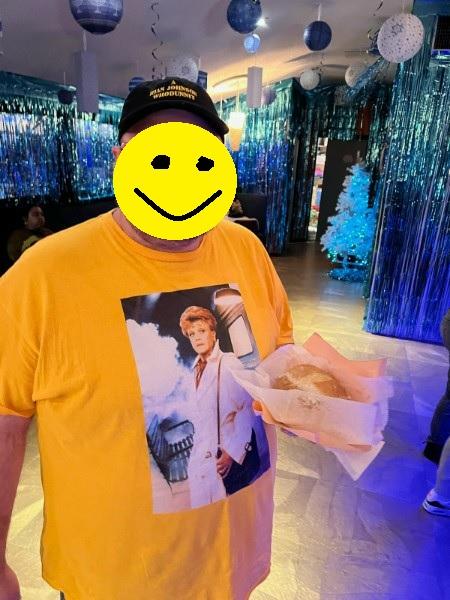
“It hides not behind complexity but behind mind numbing, obvious clarity!” So Daniel Craig’s Glass Onion character Benoit Blanc, called by Google “the world’s greatest detective,” says to much-vaunted “inventor” Miles Bron (Edward Norton) toward the end of this Knives Out sequel. I was a big fan of Knives Out when it premiered a few years ago. Brandon got a screener copy of its sequel along with some fun swag, and he was kind enough to both let me wait until the film fell into my greedy little clutches to publish a review, but also send along some of said swag, which includes the fantastic “A Rian Johnson Whodunnit” hat which you can see me wearing below while also clothed in one of my Angela Lansbury shirts: 

For Glass Onion, Benoit Blanc once again finds himself insulated from the world among a smaller world of morons, ingrates, and moronic ingrates as well as hucksters, snake oil salesman, and politicians. This time, he has ostensibly received an invitation to a murder mystery weekend at the home of the aforementioned Bron, who is an amalgamation of various rich douchebag stereotypes (and truths) but who most closely resembles Elon Musk due to his involvement in various companies and businesses which work together to create an impression of a wise ubermensch, when he is in fact a little weirdo who obsesses over getting approval from others. Also invited to the island were several of Bron’s friends, each of whom received a puzzle box that required them to work together to solve and receive their invitation. There’s Birdie (Kate Hudson), the ignorant socialite whose put-upon assistant Peg (Jessica Henwick) has the full time responsibility of not letting her tweet something racist and dumb that could get her cancelled for good; there’s also sad MRA Duke (Dave Bautista) who lives in his mother’s basement while hawking various products that promise to make his viewers “alphas” like he presents himself to be, while his social-climber girlfriend Whiskey (Madelyn Cline) plays along with his internet image. On the smarter end of the scale of Bron’s friends is Lionel Toussaint (Leslie Odom, Jr.), one of the lead scientists at Alpha who liaises with upper management about Bron’s ideas; and the gang is rounded out by Claire Debella (Kathryn Hahn), former governor of Connecticut who is now campaigning for a senatorial run. Finally and apparently unexpectedly, also in attendance is Andi Brand (Janelle Monáe), a former business partner of Bron’s who was unsuccessful in preventing him from pushing her out of the business and exposing his questionable business practices. It’s May 2020, and they have gathered at Bron’s Grecian estate, which is topped with an ostentatious lúkovichnaya glava made of transparent glass, from which the film partially takes its name. 

Of course, the title could mean a lot of things. For instance, it’s the name of the bar where all of the main characters (sans Blanc) gathered in their pre-wealth days, when Andi first brought them all together and before they all stabbed her in the back. It’s also, famously, the title of a track from what we colloquially call The White Album, although it’s properly titled The Beatles. Following all of the fan speculation about the meanings of some of the more psychedelic and impenetrable lyrics on their 1967 album Sgt. Pepper’s Lonely Hearts Club Band, John Lennon opted to pen a song that was intentionally antagonistic to anyone attempting to find a deeper meaning in the words; even if you don’t know the song title, you’re familiar with the Paul is dead conspiracy theory that’s now 55 years strong because of the lyrics “the Walrus is Paul.” Or, as Blanc says at one point: “I like the glass onion as a metaphor, an object that seems densely layered, but in reality the center is in plain sight.” From title to exposition, everything is a clue here, just as it was in Knives Out in 2019, and although the social criticism is a little shallower and more obvious than it was last time, I’m still here for the very fun ride. 

Of course, that’s one of the things that makes films this elegantly constructed difficult to write about. You’re either going to end up recapitulating all of the fun and foreshadowing how it pays off, which ruins the ride for first-time viewers (hell, I’m already worried I might have given away who the killer is just from my little gags in this review so far) or you’re stuck trying to explicate on something in which the pleasure of the viewer lies in running alongside the narrative and having the revelations to the audience coincide with those to the characters. It’s tricky to pull off, and I’ve often cited how I feel comedy and mystery exist in and evoke neurochemical pleasure in the same parts of the mind: it’s all very specific planting and payoff, and if your audience gets to the solution/punchline too far in advance of the flow of the narrative, it can be death for both genres. Melding them together is a perfect idea (I’ve got more than one work in progress right now that does precisely that) that also doubles the potential for the film to crash and burn like, I don’t know, a SpaceX Falcon 1 launch. Both the previous Knives Out film and this one manage to pull it off. Every reveal makes total sense and falls perfectly in line with what we’ve already seen and what we already know while still allowing us to feel some sense of accomplishment in “figuring it out” along with the characters. It’s an effect you can only find in great examples of the genre, like Murder, She Wrote, which gets a loving reference here in the form of several celebrity cameos playing Among Us with Blanc during his quarantine blues before his invitation to the Onion, most notably and most wonderfully the divine, magical Dame Lansbury.

If I have any complaints about the film, they are few and far between. Blanc is bigger and bolder here than he was in the last film, which matches the zanier plot of this one but also makes it feel like the character isn’t quite consistent. This one doesn’t straddle the line of mocking conservatism and neoliberalism from a slightly left position as well as the last one did, which makes this one feel more “Hollywood” than the last one as well, despite both featuring a cast full of legitimate movie stars. It has a little bit of the Trump SNL taint on it (alternatively we could call it the There’s Someone Inside Your House problem), where just because something happens to align with my belief system doesn’t mean that it automatically makes it a better or more worthwhile piece of art. Most of its barbs are sharp, though. In particular, I love the detail that Birdie, who has already been shown to have zero concern about hosting a superspreader event in her apartment, arrives to the dock on the way to Bron’s island in what the script describes as a “fashionable but totally useless lace mask”. Some of them land a little more loudly or call more attention to themselves than they should, when I don’t remember the first film having any issues with this at all, but maybe that’s the nature of political satire now. There are elements of the plot, setting, and choices here that seem eerily prescient given how long the film took to make, like that it was in theaters at the time that Elon Musk had his bluff legally called and was forced to complete his purchase of Twitter, or that there is a giant mural in Bron’s house depicting Kanye West as Jesus Christ, which is both funny and depressing given the nature of West’s current public persona entirely revolving around spouting Anti-Semitic rhetoric with his whole chest. It recalls how there was an entire garden industry on the internet for a while of pointing out things that The Simpsons “predicted,” when the simpler and more depressing reality is that, with a few notable exceptions, there hasn’t been much of an improvement in most people’s lives since 1989. Glass Onion didn’t predict anything either, but it certainly has a talent to reflect how bleak things are at the moment. 

At the end of the day, this is the kind of movie that I can only recommend you watch it or not, given that saying more than I’ve already said runs the risk of spoiling too much. If you’ve already got Netflix, you really have no reason not to, and I think that you’ll really enjoy the twists and turns along the way if you have the patience. And you’re at home, where you can pause and create your own intermission to go to the bathroom or make a cocktail, so why not? If nothing else, every person who watches this movie pushes Ben Shapiro closer and closer to having an epiphanic moment about what his actual place in the world is, and isn’t that a dream we should all strive towards? 

-Mark “Boomer” Redmond

Lagniappe Podcast: The Company of Wolves (1984)

For this lagniappe episode of the podcast, Boomer, Brandon, and Alli continue their celebration of Angela Lansbury by discussing the coming-of-age werewolf anthology horror The Company of Wolves (1984).

00:00 Welcome

00:55 Knife+Heart (2018)
03:52 The Menu (2022)
05:00 Marcel the Shell with Shoes On (2022)
08:20 Andor
09:58 Weird (2022)
13:50 Fire of Love (2022)
16:10 Barbarian (2022)
17:25 Fifty Shades
20:07 Do Revenge (2022)
22:14 Don’t Worry Darling (2022)
25:25 Bones and All (2022)
29:10 The Eternal Daughter (2022)

32:48 The Company of Wolves (1984)

You can stay up to date with our podcast through SoundCloudSpotifyiTunesStitcherTuneIn, or by following the links on this page.

-The Lagniappe Podcast Crew

Mrs. Harris, Mrs. ‘Arris, and Their Trips to Paris

Even as someone who’s only casually familiar with Angela Lansbury’s career, I was saddened to hear of her recent passing.  I’ve never successfully watched an entire episode of Murder, She Wrote without drifting off to sleep or off to another channel; the most experience I have with her prestigious singing career is hearing her voice a cartoon teapot; and yet the TV interview clips memorializing Lansbury on local news broadcasts last week had me instantly crying for reasons I can’t fully articulate.  She just seemed like such a kind, thoughtful, talented person that the world was lucky to have around – a very particular, gentle flavor of sweet that’s been draining from our cultural palate.  Online posthumous praise for Lansbury has also helped me see new, nuanced shades to her persona, since I had only previously seen her typecast as a lovely old biddy for all of my life.  Between reading John Waters’s real-life anecdote of bumping into Lansbury at an NYC fetish club to watching her bratty debut in Gaslight and listening to her get gruesome in Sweeney Todd, I now have a better rounded appreciation of who she was a person & a performer; and I feel like crying all over again.

Getting acquainted with the tougher, saucier side of Angela Lansbury has only enhanced my appreciation of her frothier performances as well.  I’m particularly thinking of her turn as the Cockney-accented Mrs. ‘Arris in the 1992 made-for-television adaptation of Mrs. Harris Goes to Paris, a novel that was adapted again for a much lusher production this year.  The 2022 version of Mrs. Harris is played by Lesley Manville, who I’m used to seeing as a heartless hardass in projects like Harlots & Phantom Thread.  She’s a big-ol’ softie in her new starring vehicle, though, leaving all of the ice-queen viciousness to her villainous co-star Isabelle Huppert.  Manville delivers the exact sugary sweet, kill-em-with-kindness defiance you’d expect from Lansbury in the role, playing Mrs. Harris as a human doormat who gradually learns to stand up for herself without ever stooping to the cruelty of the world she seeks to change.  What’s hilarious is that Lansbury’s Mrs. ‘Arris is a much tougher customer.  You get the sense that she could easily drink & swear Manville’s Harris under the table, tinging the role with a touch of the Cockney sass that kickstarted her career as a teenager in Gaslight.  She’s still a total sweetheart, but there’s a sharpened edge to her character that’s missing from the newer, higher profile adaptation.

While Lansbury got to play Mrs. ‘Arris with a little grit & gristle (reflected right there in the accented title), Manville got to be in the better movie.  Both adaptations maintain the novel’s basic premise that a kindly British housekeeper splurges her life savings on a couture Dior gown in Paris, much to the frustration of couture’s snootiest gatekeepers.  That premise is just all there is to the made-for-TV version, which wouldn’t be much of a movie without Lansbury’s loveable screen-presence babysitting the audience between commercial breaks.  Meanwhile, Manville’s Mrs. Harris essentially becomes a union organizer—inspired by an ongoing trash strike that’s only mentioned as a traffic obstacle in the Lansbury version—radicalizing both the workers at Dior and herself.  Both versions of Mrs. Harris are lauded for being kind in a cruel world, but only Manville gets to learn to prioritize herself in the face of oppressive class & gender politics; she’s in a drama, while Lansbury is in a sitcom.  The most telling difference between the two films is when a Parisian love interest warmly refers to Mrs. Harris as “Mrs. Mops” in honor of the maid that cleaned his room at British boarding school.  In the made-for-TV version, it’s played as a sweet gesture; in the theatrical version it breaks her heart, and you desperately want to see her punch the cad’s throat.

I don’t want to exalt the 2022 version of Mrs. Harris Goes to Paris as some high standard of artful cinema that the made-for-TV version can’t live up to.  Both adaptations are the exact kind of passive British entertainment meant to be enjoyed under a giant blanket with an empty mind & a nice cuppa.  Only the theatrical version has a true emotional hook to it, though.  When Mrs. Harris inevitably gets the pretty dress she wants, the movie just works on a level that the 90s one can’t – joining “Paddington wishes Aunt Lucy a happy birthday” and “The Girlhood girls dance to Rhianna” on the list of scenes I can think back to when I need a quick cry.  Lansbury doesn’t need a good movie to hit that emotional trigger, though.  I can apparently watch 30 seconds of her doing a press junket interview with Entertainment Tonight and well up with tears in the same way.  Her Mrs. Harris movie didn’t need to be especially “good” to be worthwhile; her sweet-but-secretly-tough presence was enough.  All that said, there’s a much wider, brighter world of Lansbury projects out there I should have prioritized before watching her pretty-dress movie, especially now that I have a better handle on who she was.  And maybe I should start with forcing myself to fall in love with detective-novelist Jessica Fletcher, who was likely an even tougher customer than Mrs. ‘Arris; I just have to stay awake long enough to get to know her.

-Brandon Ledet

Lagniappe Podcast: Gaslight (1944)

For this lagniappe episode of the podcast, Boomer, Brandon, and Alli celebrate Angela Lansbury’s career by looking back to her big-screen debut in the psychological thriller Gaslight (1944).

00:00 Welcome

00:30 Slumber Party Massacre (1982)
02:00 Halloween costumes & candy
14:45 Creepshow 2 (1987)
22:00 Valentine (2001)
31:50 Táriangle of Sadness (2022)
35:55 Mrs ‘Arris Goes to Paris (1992, 2022)

43:35 Gaslight (1944)

You can stay up to date with our podcast through SoundCloudSpotifyiTunesStitcherTuneIn, or by following the links on this page.

-The Lagniappe Podcast Crew

The Manchurian Candidate (1962)

The Manchurian Candidate is a masterpiece of Cold War paranoia and pro-American propaganda, visually stunning and chilling.  It was talked about a lot these past four years, since during the Trump presidency people were experiencing increased Russophobia and witnessing Eastern European scandals and intrigue.  However, given the film’s message about patriotism and military force, I don’t think it’s the safest comparison to modern events.  Centering around the struggles of two soldiers, Major Marco (Frank Sinatra) and Raymond Shaw (Laurence Harvey) after being kidnapped and brainwashed by Communists, the film mainly concerns the American military and political handling of The Red Scare, taking an inherently critically flawed and culturally problematic viewpoint.  That being said, it has an amazing handle on the psychological power of editing and features wonderful performances by everyone involved.

The film opens with the company of Marco and Shaw at the Chinese/Korean border during the Korean War.  They are a gang of rough and tough men, the typical everymen of the 1960s, cutting loose during wartime: drinking, gambling, and objectifying and exotifying the local women.  However, their leader, Shaw, is a wet blanket.  He is a cold and prim rich boy who thinks they’re all lowly trash. Of course, his fellow soldiers find him intolerable.  During a mission they are deceived and captured by a group of sinister Communist scientists who intensely brainwash them.  Without revealing too much of the plot’s twist and turns, I’ll say that they are returned home suddenly with warm feelings for Raymond Shaw.  Marco gains a high-up position in the military and Shaw works for a newspaper relishing in writing smear pieces against his simpleton presidential-hopeful Conservative stepfather (James Gregory), who is merely a pawn for the domineering Mrs. Shaw Iselin (Angela Lansbury).  Marco is tasked with deprogramming Shaw, who lives a sad and lonely life haunted by his mother’s overbearing shadow.  Eventually, we realize that his mommy issues are the key.

One of the most effective scenes in the film is the demonstration of brainwashing by the Communist scientist.  It cuts back and forth from what the soldiers see (a boring talk from a ladies’ garden club) to the panel of red leaders from all of the world in an amphitheater decorated with huge portraits of Stalin and Moa in the background, in case you forgot what side this sinister cabal was on.  There’s a jarring effect created by the juxtaposition of the mundane droning on of the women’s club and the scientific enthusiasm and twisted plotting.  The clash of the mundane and “the evil” is a chilling way to set us up for constant doubt and paranoia for the rest of the film.

Now, let me get to my real issue with this movie: it reeks of misogyny.  The mother is set up to be the ultimate villain.  The idea that an ambitious woman is more dangerous than world powers that have extreme scientific advances in the realm of psychology is, quite frankly, sickening.  I have no sympathy for Mrs. Iselin.  Angela Lansbury delivers a performance that renders the character utterly reprehensible and unforgivable.  That said, the whole idea of a mother’s failures being the downfall of the country is a special kind of good old fashioned American woman-hating.  It’s really drilled home with the idea that the only way any of this is uncovered is through a team of highly trained military personnel. It just feels a little overkill.  But there is only one thing that pro-military rhetoric in the USA wants to kill, torture, and demean more than a Communist: a powerful woman Communist.  There’s enough analysis of the treatment of women during these wars and missions “to spread democracy” to inspire entire dissertations so I’ll leave that to more skilled folks than I.  Suffice to say, there are serious consequences to this line of thinking.  The only sympathetic women in the film are those who stay on the sidelines being supportive and nurturing.  This includes one whom gets killed off, in an example of an ambitious woman trampling a traditional, attractive feminine figure.  A true 1960s man’s nightmare and the nightmare of many contemporary men as well.

In a political vacuum, I’d say that this is a spectacularly made film, a real classic.  It is technically wonderful, with extremely talented performances.  But we are not in a vacuum.  As a country, if this is the narrative we turn to again and again, we will probably never get over gender disparity.  The Manchurian Candidate is a chilling piece of paranoid propaganda.  It upholds the rhetoric of the status quo: xenophobia, misogyny, and a hyperbolic love and trust of the troops.  It’s an entertaining and effective film, but culturally we need better narrative touchstones.

-Alli Hobbs