

Piaffe (2023)

Piaffe is a post-adolescence coming of age story about a shy adult shut-in who musters up the courage to learn new things about her desires, her body, and her self outside her cloistered home.  In doing so, she grows a horse tail, has masochistic sex with a perverted botanist, and takes on a new trade as a commercial foley artist.  Most of the events that transform her life & body are a natural matter of course rather than a deliberate, personal choice.  The foley artist job falls in her lap when her nonbinary mystic sibling is unexpectedly institutionalized, leaving her to complete their work providing horse-riding sound effects for a TV commercial advertising a mood stabilizer called Equili.  She gets into character as the horses she soundtracks by clopping dress shoes onto wooden dresser drawers, which causes her very own horse tail to grow from the base of her spine. Her sexual relationship with the botanist is more of a personal choice than something that happens to her, but it’s a choice she can only make after truly getting to know herself as a literal horsegirl with increasingly specific sexual desires – mostly involving getting her tail hair brushed.  Falling somewhere between the stern kink dynamics of the dark 2000s office romance Secretary and the flippant, prurient surrealism of the 1970s dark fantasy piece The Beast, Piaffe is funny, sexy, cool, and inexplicable, but never in an especially showy way.

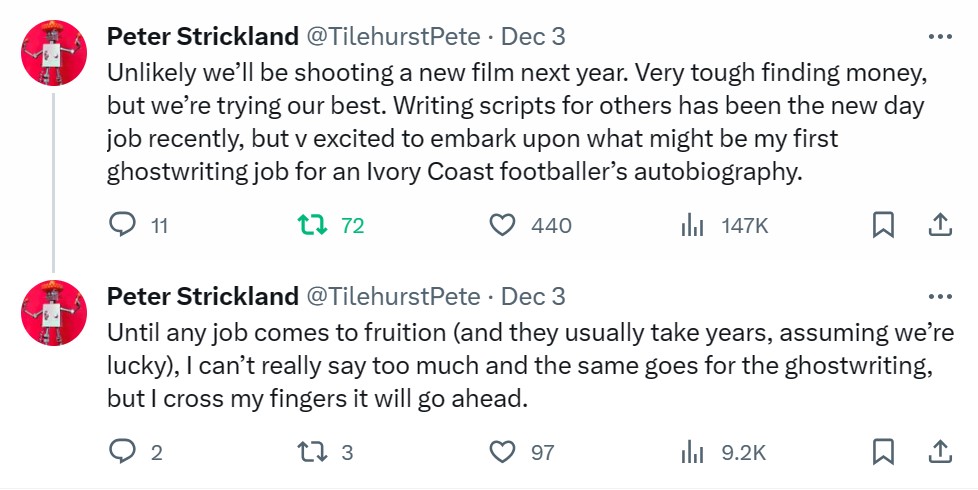
It isn’t the movie’s fault, but there was something grim about watching Piaffe the same week that England’s premiere auteur fetishist Peter Strickland was stress-tweeting about struggling to find funding for his next project.  One of our greatest working directors can’t get a new movie off the ground, and yet he’s formidable enough that younger artists are out there making (pretty great, possibly unaware) pastiches of his work.  Piaffe plays as just as much of a career-retrospective overview of Peter Strickland’s style as his recent music industry satire Flux Gourmet, which likewise combined his foley-art giallo throwback Berberian Sound Studio with his kink-dynamic relationship drama The Duke of Burgundy into a single, self-spoofing work.  The ASMR phone sex of Piaffe, wherein our equestrian protagonist brushes her tail hair over a telephone receiver to excite her lover, feels like a gag pulled directly from a Strickland film that doesn’t yet exist.  And given that Strickland is struggling to land funding for his next project, maybe it never will.  What Piaffe offers is a sturdy Strickland substitute that proves he’s not the only filmmaker who can reliably deliver weird-for-weird’s-sake fetish comedies for the midnight movie crowd; in that context, it’s maybe the best of its kind since The Berlin Bride.  I can still only take it as a consolation prize, though, as I’d unquestionably list Strickland among the most exciting artists working in cinema right now (alongside Amanda Kramer & Bertrand Mandico), so I’m bummed to hear he’s not currently working on anything at all.
For all I know, Piaffe director Ann Oren has never seen a Peter Strickland film, and their parallel sensibilities are entirely coincidental.  My only previous exposure to Oren is in her outsider-art Hatsune Miku cosplay documentary The World is Mine, which is specifically about the erosion and erasure of identity within a digital-age fandom “community.”  I will refrain from assuming anything about her based on this high-art horsegirl cosplay erotica follow-up, except maybe that experimentation with new, fabricated identities & personae is an artistic preoccupation of hers – something that can only be confirmed as she establishes a larger body of work.  I have hopes that, in time, Oren will prove to be just as formidable a prankster artist as Strickland.  It’s something I already felt in this film’s fetishistic fixation on the mechanical tools of filmmaking & horseback riding, grazing its fingertips over leather harnesses and the rusty metal gears of an ancient zoetrope.  I just need to see more of her work to know what to anticipate in the next picture.  Meanwhile, I already know what I want & get out of Strickland’s films, and I’m stuck looking for those qualities elsewhere while he’s twiddling his thumbs waiting for someone to sign the checks. 

-Brandon Ledet

The World is Mine (2017)

Truth is elusive & reality is a bore. Many modern, post-Herzog documentaries feel free to distort & subvert the “real life” facts of the stories they capture once they accept those basic tenants of their craft, which requires them to make a tidy, exciting story out of an untidy & frequently mundane existence. Ann Oren’s cosplay “documentary” The World is Mine is fully committed to this distortion, to the point where its presentation of a simulated, heightened reality is essential to both its form and its subject. As Oren appears onscreen herself, crafting a conspicuously false version of who she is and how she relates to the cosplay fandom she invades, she reflects the artificial, simulated existence of the pop culture character she dresses as throughout. Hatsune Miku is a “vocaloid,” a computerized simulation of a Japanese pop music diva who can be programmed to perform any song her democratized collaborators/devotees can conceive. Miku is a conduit, a non-person simulated as a human form only so she can fulfil the fantasies of as many people as possible. In The World is Mine, Oren attempts to serve the same function by dressing in Miku’s stylized persona & garb, hiding the truth of her own existence behind the false, fantastic shield of cosplay. As a documentary, her story has little interest in the truth of “real” life, instead searching for an eerie, distorted truth in a life that’s artificial by design. The results aren’t exactly informative in a traditional documentarian sense, but they are effectively uncomfortable and, at times, deeply sad.

As a documentary subject, I have no idea who Ann Oren is, where she’s from, or how she makes a living. I’m not even certain of whether or not she even speaks Japanese (she often smiles & nods silently to subtitled dialogue). She just appears as a conspicuous Westerner on a popular Tokyo street corner, already dressed as the Hatsune Miku character in search for strangers’ attention. We will never see her outside the costume. We learn slightly more about Miku “herself,” but only through incrementally-detailed interactions with the vocaloid’s rabid fandom. Oren presents herself to Miku’s fans and to the audience as an in-the-flesh extension of the anime-style simulated character who sings lost-in-translation pop music lyrics about “deciding to become a god” & “the homecoming of our future” in a roboticized voice throughout. Her camera infiltrates cosplay meetups whether pop culture obsessives dress as Miku & the like and, more surprisingly, “concerts” where hundreds of fans crowd to cheer for Miku’s onstage performances via a projection screen. Her drift through this obsessive fandom occasionally strays into the kawaii territory of aggressive, meticulous cuteness, but the ambient horror of the film’s score, the disjointed poetry of Miku’s song lyrics, and Oren’s own shaking hands as she pretends cosplay affords her confidence & contentment convey something much more sinister. Suggestions of BDSM-leaning age play & unspoken asexuality color her attempts to find romance as a human extension of Miku. Obsessive fans’ collections of Miku ephemera and Miku-adorned apartments & vehicles vaguely touch on the empty consumerism of obsessive fandom. Mostly, though, The World is Mine explores the alienation of living without a sense of self-identity, finding an awkward, upsetting tone of discomfort as its director & subject takes on an artificial life in a foreign culture with little use for who she “really” is.

It would be easy to imagine a more traditional, informative documentary about Hatsune Miku’s history as a cultural phenomenon or Westerner cosplay as an act of cultural appropriation, but The World is Mine isn’t especially interest in either line of thought. Instead, Oren implies a simulated identity crisis performed for the camera through the guise of an already simulated character. Lines like “The problem with reality is that fairy tales are full of frauds,” don’t help much in illuminating what Oren’s learned as a living doll modeled after a popular computer program. She’s just one physical copy of Hatsune Miku among many and the eeriness of her lack of a distinct personality is only amplified in the Miku fandom visually approaching a kind of ecstatic singularity. I don’t know how much of The World Is Mine to accept as true or personal to Oren, but I also don’t believe documenting real life was chief among her concerns while making the film. There’s an awkward, isolating eeriness to the film’s estimation of Hatsune Miku fandom that Oren’s much more enthusiastic about documenting than any kind of factual, historical, personal, or cultural reality. As long as you don’t need documentaries to be traditionally informative to be worthwhile and an evocation of a discomforting feeling is enough to satisfy with what you want from the picture, The World is Mine is an effective little chiller with a strong sense of eeriness in its mood.

-Brandon Ledet
