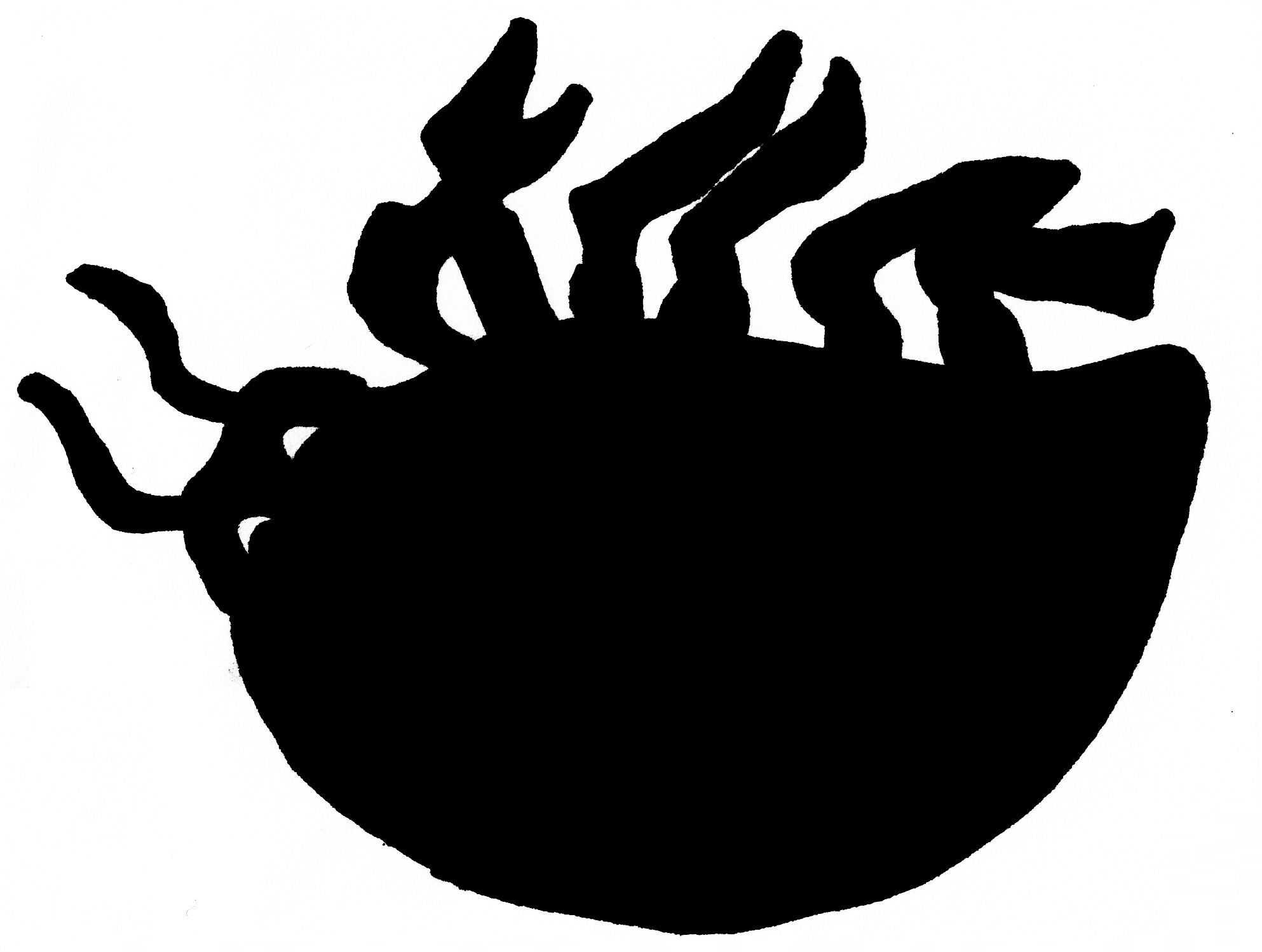
A good friend recently lent me a DVD compilation of experimental short films from animator Caroline Leaf, titled Out on a Limb. He kept excitingly telling me that Leaf primarily works with a “sand on glass” animation technique, which I struggled to understand in the abstract. In retrospect, the term is pretty self-explanatory. Instead of working with the ink-on-paper or clay-on-wire or code-on-computer techniques of more popular animation styles (hand-drawn, stop-motion, and CG, respectively), Leaf made a name for herself on the 1970s art scene by producing short films entirely animated in beach sand. She’d spread her collected sand across an illuminated table, shaping it to represent all figures & settings captured by the camera. The technique was not entirely novel to her heyday, having been used as a texturing effect at least as far back as Lotte Reiniger’s 1926 landmark The Adventures of Prince Achmed (largely cited as the oldest surviving animated feature film). Leaf was among the first animators to utilize sand-on-glass animation as her primary medium, however, like a chef who only cooks potatoes or a guitarist who works only in arpeggio; it was an experiment in technical limitation.
It turns out, you can do a lot with the simple manipulation of light & sand. In her early experiments “Peter and the Wolf” (1969) & “The Owl Who Married a Goose” (1976), Leaf finds a freedom from the tyranny of setting & geography in her animated sandscapes. Those folktales are retold in a white, boundaryless void where figures transform from one animal to another as the story demands. The wolves, owls, geese, and children drawn in fine-grain beach sand often lose any & all distinctions between their differing animal bodies, turning into and maneuvering around each other in surreal configurations that would be impossible in any other medium. However, her sand-on-glass project didn’t reach its apotheosis until she adapted Franz Kafka’s most famous novella in the 1977 short “The Metamorphosis of Mr. Samsa.” Her Metamorphosis adaptation is the exact existential bug-transformation crisis you know & love, with the same anything-can-transform-into-anything surrealism of her previous shorts, except with the added limitation of having to actually depict a physical, closed-off setting. It’s her most claustrophobic work in sand-on-glass animation as a result, but its claustrophobic tension is entirely appropriate to the text it illustrates. There’s a muddied, charcoal-drawing style smear to her technique that emphasizes the story’s inherent grime while drawing comparisons between the artist’s solitary production style and her character’s pathetic, socially isolating plight. You cannot fully lose yourself in the story of The Metamorphosis, since the literal fingerprints of the artist conveying it are visible in every gritty frame.
While Leaf did explore other animation techniques, her most recognizable & influential works were rendered in beach sand, to the point where her name is near synonymous with the technique. At least, she was on my mind when diving into the collection of short films animated by Suzan Pitt that are currently hosted on The Criterion Channel. In Pitt’s 2006 short “El Doctor,” her titular hand-drawn doctor ends a drunken bender by hallucinating in the driver’s seat of his car outside a Mexican pub. His blurred vision is overpowered by a gigantic sea creature chasing a man in his impossibly bright windshield, an image illustrated in Leaf’s signature sand-on-glass technique. Later, when the same doctor is visited by an angel, Leaf illustrates the supernatural encounter by scratching that angel directly into the celluloid to accentuate the uncanniness of its image. Notably, this scratching technique was also a favorite got-to for Caroline Leaf’s later career, after she had abandoned beach sand as her primary medium of choice. It’s unclear whether Caroline Leaf was on Suzan Pitt’s mind when making “El Doctor,” but she was certainly on the top of mine while watching it.
Like Caroline Leaf, Suzan Pitt started her animation career with a distinct trademark style before moving on to experiment with other techniques & textures in later works. Her most formidable shorts “Crocus” (1971), “Asparagus” (1979), and “Joy Street” (1995) all reflect her fine-art background as a painter, literalizing the “every frame a painting” cinematic cliché. Pitt would paint her figures on traditional transparent animation cells against a black velvet-style backdrop, but the level of color & detail in her psychedelic fantasy realms far outpaced what you’ll find in the commercial end of the medium. She’s also unconventionally morose for an animator, centering all three of those works on the madness, loneliness, and despair of women isolated in dissatisfying domestic spaces, staring out their windows at the big, scary world outside. In “Crocus,” a woman performs mundane domestic duties like child-rearing, self-primping, and marital sex while occasionally taking breaks to stare out the window and dream of a freer life. In “Asparagus,” a woman struggles to make sense of the alien world outside her window but finds a way to repackage it as a psychedelic stage act for the delight of a bewildered theatre audience. In “Joy Street,” a woman stares at the desolate street life below her window before slitting her own wrists, and is then revived by Fleischer style cartoon characters who relocate her limp body to a Technicolor jungle outside city. All three films feel like funhouse mirror distortions of a lonely, dissatisfied artist’s diary, just as confessional as they are inscrutable, grotesque, and beautiful.
These experiments in form are most compelling in a multimedia approach, something Pitt was aware of early in her career. When her faceless onscreen surrogate puts on a surreal theatrical performance at the climax of “Asparagus,” her audience is rendered in a crude Claymation technique, further alienating the artist from the rest of her fellow citizenry. By the time she incorporated the sand-on-glass and scratched celluloid techniques from Leaf’s work in “El Doctor,” Pitt had already established an anything-goes approach to her animations, incorporating paper dolls, magazine collage, and live actors into her signature fine-art painting style. While Leaf is best known for her work with sand, she also reached her greatest artistic heights when expanding her approach to multimedia techniques — most notably in “Interview,” a short film collaboration with fellow animator Veronika Soul. “Interview” is a dual portrait of the two artists at work, vulnerably gushing about each other and confessing their own personal insecurities while excitedly jumping from one experimental animation technique to the next. It’s the closest I’ve ever seen any filmmaker come to approximating Agnès Varda’s free-flowing autofictional documentary style with any convincing success, and it took two filmmakers working in tandem to accomplish it. It’s also the most I feel like I got to know Caroline Leaf through the content her films, since so much of her most prominent work is more about technique than about personal expression. In contrast, Suzan Pitt lays bare the ugliest, most intimate parts of her own psyche in her signature animations, daring the audience not to look away. Both artists have trapped themselves in an isolating, labor-intensive medium that requires them to work alone in a dark room for untold hours; the difference is largely in whether the proverbial door to that room is locked shut or left open for the audience peer in.
-Brandon Ledet

