She is Conann (2024)

Bertrand Mandico is the greatest filmmaker currently alive & working.  Across three features and dozens of shorts, he’s gradually established a cinematic language all of his own that feels simultaneously ancient & futuristic.  His debut feature The Wild Boys voyages into the past to obliterate gender for a more liberated, libertine future.  His follow-up After Blue sought alien worlds prophesized by the likes of James Bidgood & Kate Bush.  Now, his third feature reshapes the Conan the Barbarian myth into a lesbian fantasia built on ego death and the cruelty of having to make art in a decaying world.  No one has dared to hijack the movie-making dream machine for their own perverse pleasure in the way Mandico has.  He’s perfectly attuned to the medium’s ability to evoke powerful ideas & feelings out of pure, hand-crafted imagery.  There are allusions to luminary provocateur directors in She is Conann that indicate Mandico thinks of himself as the modern equivalent of a Kenneth Anger or a Rainer Werner Fassbinder, but he’s actually our modern Méliès: an illusionist who’s pushing the form more than he’s subverting norms.

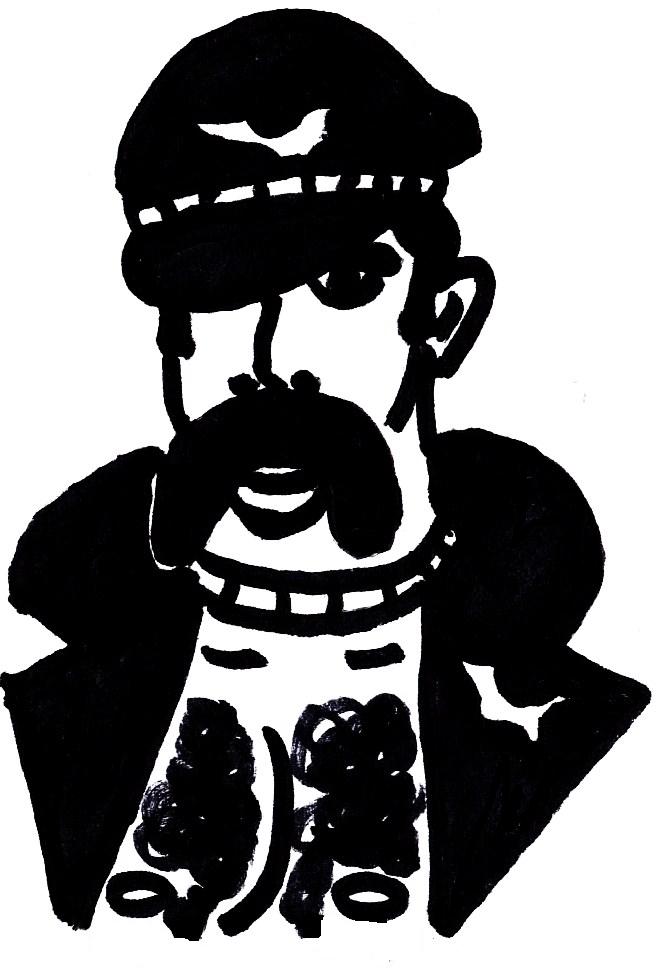
Specifically, the Anger & Fassbinder allusions are contained in a single leather jacket worn by Mandico’s longtime muse & collaborator Elina Löwensohn.  The jacket is modeled after the title-card fashion centerpiece of Anger’s Scorpio Rising, but instead spells “Rainer” in metal studs.  Löwensohn plays the jacket’s owner, Rainer, as an on-screen avatar for Mandico.  Rainer’s a photographer who orchestrates and documents the brutal violence around him, eventually shouting for his camera’s subjects to be “Sexier! Crazier! More barbaric!” out of frustration that he cannot reach the lofty artistic ideal envisioned in his head.  Löwensohn previously played a very similar role as the pornographer Joy D’Amato (a reference to real-life pornographer Joe D’Amato) in Mandico’s Apocalypse After, but this time she shakes it up by switching genders and hiding under a prosthetic dog mask.  Rainer’s houndish loyalty to the titular, similarly-genderflipped warrior Conann is both as an opportunist and as a hedonist.  Rainer adores Conann’s capability of bone-crunching, head-severing violence more than he adores her personally, and he’s eager to follow at her heels as she swings her sword through the gushing bodies of her enemies across centuries of reincarnation, translating her violence into art.

The role of Conann is filled by a lineage of six actresses, all of whom kill their predecessor to claim her sword & identity.  As a violent brute who lives in the moment, fueled by revenge against the ugly world that shaped her, Conann refuses to accept the normal patterns of aging & death.  Instead of growing and maturing naturally, she instead reaches into the past to assassinate her younger self in a ritualistically violent act of self-reinvention.  Her warpath leads the audience through the violence of Medieval fantasy realms, a 1980s music video interpretation of The Bronx, Europe’s crumbling under Nazi fascism, and a post-human future made almost entirely of glitter.  She’s briefly distracted along the way by love & romance, but her essential barbarism eventually takes over and the body count continues to pile.  Each generation’s bloodlust directly feeds into the next, until Mandico concludes the saga with a punchline about that human impulse transforming into art instead of violence.  He appears to believe that the long history of humanity’s selfishness & viciousness has been concentrated into the work of careerist, self-obsessed artists who do not realize they’re also barbarian brutes.  Or he at least thinks that’s a funny conclusion to make.

I could be totally wrong about Mandico’s thematic intent here.  He is foremost a visual stylist, pushing for imagistic extremes in every frame through outrageous fashion, rear projection, strobe lighting, practical gore, and more glitter than any production has seen since Ridley Scott’s Legend.  His allusions to previous works are all on the surface but oddly refracted through a postmodern lens, from the misspelling of the title to the leather Rainer jacket to the background billboard that simply reads “naked lunch” in lowercase letters for no discernible reason in particular.  Finding coherent meaning in Mandico’s work is a personal journey.  The only guarantee is that he will immerse you in a fanatically vicious world you’ve never seen before; what you make of that world while you visit is entirely up to you.  There just aren’t enough people around me who’ve seen his films to tell me I’m reading too much into his metatextual commentary on art & hedonism.  Maybe one day he’ll become widely beloved enough for me to finally see his work in a proper, packed cinema instead of subjecting a small batch of friends to it on my living room couch.  For now, I’m perfectly happy gazing into his glitter-slathered hellscapes at home, unchallenged about the immense passion & beauty I find in his horny tableaux.

-Brandon Ledet

Apocalypse After: Films by Bertrand Mandico (1998 – 2018)

Only two feature films into his career, I’m already comfortable thinking of Bertrand Mandico as my favorite working director, even though only his debut was a total stunner.  Mandico’s The Wild Boys is my favorite film released within my lifetime – a Bidgoodian wet nightmare about gender dysphoria and, ultimately, gender obliteration.  His follow-up, After Blue (Dirty Paradise), is more of a flippant prank, using the same sensory intoxication & erotic menace for a much sillier purpose: worshipping the almighty Kate Bush in the rubble of our fallen civilization.  Although it’s seemingly shot in a muted black & white that sidesteps the cosmic blues & purples that make his other features so vivid & vibrant, I’m dying to see his third feature, Conann, which appears to be a gender-subverted riff on the pulp fantasy character Conan the Barbarian. It’s going to take a while for that latest dispatch from Mandico’s id to reach American screens (it just premiered at Cannes this summer), so I decided to placate my curiosity as best as I could by digging into his back catalog of short films.  Altered Innocence has consistently been Mandico’s home distributor since the company’s inception; it’s even arguable that Mandico’s films have been a brand-defining cornerstone for the Vinegar Syndrome partner label, along with the similar dreamlike genre throwbacks of Knife+Heart director Yann Gonzalez.  Given that close affiliation, their publishing a collection of Mandico’s short films on a single Blu-ray disc, titled Apocalypse After, was a total no-brainer.  Given my own personal obsession with The Wild Boys, the only surprising thing is that I didn’t jump on this disc the second it was released last year.  I guess I needed to get worked up about a new feature from Mandico dangling just outside my reach to seek out his already-available shorts I hadn’t yet seen.  Well, that and if I immediately jumped on every new Altered Innocence release I wanted to see I’d struggle to pay my energy bill, and I wouldn’t be able to watch them anyway.

The titular short on this disc, “Apocalypse After (Ultra Pulpe)”, is a calling-card submersion in the subliminal perversions of cinema, consciously transforming “science fiction” into “science titillation” while shouting in frustration that the images still aren’t erotic enough for the director’s liking.  Longtime Mandico collaborator & muse Elina Löwensohn stars as the director’s avatar, an arthouse pornographer named Joy d’Amato (in cheeky reference to real-life pornographer Joe d’Amato).  Mandico’s films are full of sarcastic allusions to real-life artists he admires in this way: Kate Bush, Henry Darger, Jean Cocteau, Walerian Borowczyk, etc.  Curiously, he has yet to name-drop the three filmmakers he most reminds me of—Kenneth Anger, Guy Maddin, and James Bidgood—likely because their influence is already blatantly apparent in the text.  Joy d’Amato is more Bertrand Mandico than she is Joe d’Amato, though, shooting a live-action version of paperback sci-fi cover art with the same vintage porno sensibility you can find in all of Mandico’s recent work.  In a way, the film shoot setting positions “Apocalypse After” as Mandico’s Knife+Heart (a movie he acted in as a porno cinematographer), but it’s even less of a coherent, linear story and even more of an expression of its director’s fascinations & frustrations with his artform.  Dialogue that declares details of the film shoot “magnificently hideous” or complain, “It’s beautiful, but at the same time I don’t know what he means,” function as meta commentary on the achievements & shortcomings of Mandico’s art.  No dialogue feels more essential to the piece than an actor’s monologue recalling watching forbidden, adult films as a child – compelled & mesmerized by the images on the screen but too young to fully comprehend them.  Mandico has a way of turning pornographic indulgence into transcendent visual art, and even then he directs his avatar in Löwensohn to shout that the images are still not erotic enough.  Nothing ever could be.

The “Apocalypse After” short is a thematically cohesive but logically incoherent collection of all the stylistic flourishes & quirks sketched out in Mandico’s first two features: the plant life molestations of The Wild Boys, the hollow geode-face zombies of After Blue, and the practically achieved glamour that merges their aesthetics – gel lights, rear projections, body glitter, smoke, prosthetic nipples, etc.  The presentation of Mandico’s previous shorts on the Apocalypse After disc is strictly chronological, so you can watch the director arrive at that personal aesthetic over decades of obsessive tinkering.  Over three full hours of his two decades of short-form experiments, Mandico Heads get to watch the filth maestro develop his cosmic visual language in ten preceding works.  In that context, “After Apocalypse” is less of a jumbled collection of Mandico pet obsessions than it is a natural crescendo of a clear pattern in methodology.  His seemingly weird-for-weird’s sake indulgences become more recognizably thoughtful & designed in retrospect, the same way the “Magick Lantern Cycle” packaging of Kenneth Anger’s shorts makes “Lucifer Rising” feel like the most obvious place his art could lead him, not an out-of-nowhere novelty.  The Apocalypse After disc starts with Mandico imitating Jan Švankmajer’s stop-motion nightmares in antiqued sepia tone, then seeking the same ancient artifice in short-form magical realist dramas.  He hits a breakthrough mid-career with the mid-length film “Boro in the Box”, which playfully reimagines filmmaker Walerian Borowczyk’s life in the style of Au Hazard Balthazar (a prototype for the more recent Balthazar riff EO).  By the time Mandico returns to stop-motion in his post-“Boro” short “Living Still Life” (this time animating taxidermized animals), his style is distinctly of his own.  As a result, all of the essential Mandico bangers arrive late on the disc, after he finds his distinct voice as a filmmaker: the Cronenbergian colonoscopy sideshow act “Prehistoric Cabaret,” the fairy tale creature feature “Our Lady of Hormones,” the unlikely Enys Men sister film “Depressive Cop” and, of course, the aforementioned self-portrait in heat “Apocalypse After.”

There are certainly other current filmmakers whose every feature I anticipate with the same gusto as Mandico’s, namely Peter Strickland and Amanda Kramer. None in that unholy trio of perverts gets the critical respect they deserve as playful subverters of the artform.  The academic interest critics used to have in similarly perverse, cerebral genre filmmakers like Cronenberg, Lynch, and Jodorowsky has more recently shifted to formally muted & restrained works of slow cinema auteurs instead.  A lot of the leeway we used to give venerated genre freaks of the past hasn’t trickled down to the unvenerated genre freaks of today, at least not for anyone who hasn’t struck a distribution deal with A24.  Altered Innocence appears to be committed to the cause at least, offering a step-by-step study of Mandico’s work for anyone who cares to learn how he arrived at something as wildly baffling as The Wild Boys.  The only other comparable presentation of a current director’s shorts that I can name is the The Islands of Yann Gonzalez, which I will leave to your imagination what is covered and who handled the distro.

-Brandon Ledet

Gender Repeal Party

In the back of my mind, I’ve been saving a couple slots on my personal Best of 2022 list for two titles that never screened theatrically in New Orleans: Amanda Kramer’s Please Baby Please and Bertrand Mandico’s After Blue (Dirty Paradise).  Having now rented both films for an especially lurid double feature, it turns out those reserved parking spots were totally justified. Both films hammered the exact personal pleasure centers I’m always looking to hit when seeking out new releases, exactly as expected.  What I didn’t expect was that they would be so sympatico in their dreamlike deconstructions of gender, nor that they would be thematic mirror opposites of their respective directors’ previous works.  I was introduced to Kramer through her apocalyptic meditation on the vicious, combative impulses of femininity in Ladyworld; I was introduced to Mandico through his wet nightmare vision of the vicious, combative impulses of masculinity in The Wild Boys.  With their latest features, they’ve swapped topics (i.e., swapped genders), which makes After Blue & Please Baby Please a rewarding, fascinating double feature beyond their momentary value as last-minute best-of-the-year contenders.

In Ladyworld, Amanda Kramer immerses her audience in a never-ending Buñuelian house party where a group of young women eternally, ritualistically tear each other apart in the darkest corners of feminine bloodlust.  In Please Baby Please, she reflects on the performative brutality of masculinity instead, abstracting & eroticizing the violence of traditional machismo.  After a seemingly cis-hetero 1950s couple falls in lust with a gang of leather-clad ruffians (the wife out of gender envy, the husband out of closeted homosexuality), they separately explore their own relationships with masculinity as a social power & as a fetish aesthetic.  As the couple unravels & retangles, Kramer ponders the question “What is a man, anyway?” through lofty academic discussions of how masculinity is socially engineered and through kinky fetishization of 1950s kitsch. Andrea Riseborough gives the performance of the year as the beatnik housewife turned Tom of Finland brute, approximating what it would be like if an especially rabid Jerri Blank had a Marlon Brando drag-king impersonation act.  Harry Meulling’s crisis of masculinity is much more internal & philosophical, interrupting every friend group conversation with off-topic questions about why he must perform a gender at all, much less one arbitrarily assigned at birth. The film is overflowing with queer menace, artifice, and excellence, all achieved on a community theatre budget. 

Bertrand Mandico’s The Wild Boys is my favorite film released in my lifetime, a complete gender meltdown that erodes all of the traditional characteristics & boundaries of masculinity in its titular group of nihilist ruffians but does not reform their vicious misbehavior when they emerge as women on the other end.  Mandico’s second feature is just as gorgeous, grotesque, and wonderfully genderfucked as that debut, but goddamn that’s a tough act to follow.  After Blue (Dirty Paradise) starts with feminine violence as its thematic anchor, dreaming of a far-out lesbian orgy planet that cowers in fear of a demonic, almighty serial killer named Kate Bush.  As a disgraced hairdresser and her horndog daughter hunt down the elusive Kate Bush in the alien wilderness and fall in lust with other bizarre women they meet along the way, After Blue proves to be just as visually & thematically daring as The Wild Boys, just on the opposite end of the gender spectrum.  The hallmarks of its sci-fi acid Western subgenre weighs heavily on its momentum & pacing, but it also constantly fills the frame with the most exciting, glitter-slathered nightmare imagery you’re likely to see this year.  It plays like someone fed “James Bidgood’s Dune movie” into one of those AI art generators, and the results are intoxicating, even if a little exhausting.

Anyone who has already tasted “the rotten fruit of [Mandico’s] imagination” knows what to expect from After Blue, but that’s more of a sign of his out-the-gate fervor as a fully formed auteur than a sign that he’s repeating himself.  By contrast, Kramer’s ideas & imagery appear to vary more from film to film, aiming for a fluorescent-trash version of John Waters’s aesthetic in Please Baby Please that I don’t believe was present in her previous work.  As a pair, they’re among the most exciting artists currently working in the medium of queer filmmaking, not least of all because of their respective indulgences in over-the-top visual style and their shared philosophical hostility towards rigid gender boundaries.  I have no idea where their careers are going (especially Kramer’s), but I’m confident in saying they’re already making some of the best movies out there on the new release calendar, and it’s a shame these two titles aren’t being published on more critics’ Best of the Year lists.

-Brandon Ledet