Kokomo City is one of the most visually stunning documentaries I’ve seen in a long while, composed entirely of black & white images so stark in contrast they recall old-world nitrate celluloid; it’s practically filmed in black & silver. It’s also one of the most awkwardly edited docs I’ve seen in a long while, to the point where it’s difficult to believe it was shot & edited by the same person. First-time filmmaker D. Smith started the project largely as a one-woman show, interviewing a small cast of transgender sex workers about their lives & labor while she was on the verge of choosing between the trade and homelessness herself. Her total control over the project as a director, cinematographer, and editor speaks to its qualities as an intimate, personal work that makes space for its subjects to speak candidly about their lives without hesitation or filter. It also speaks to Smith’s comedic sensibilities, often undercutting those confessional interviews’ darker turns with the boi-oi-oing sound effects & slide whistles of a vaudevillian cartoon. Maybe that choice was necessary to prevent the film from becoming one-dimensional miserabilist poverty porn about Black trans women’s lives, but its flippant soundtrack choices and shot-to-shot rhythms still distract from how gorgeous its individual images are in isolation. It’s continually frustrating that these same raw materials could easily be re-edited into something timelessly cool instead of something needlessly frantic.
This is likely a silly complaint to make about a project that’s entire point is to just listen to four women tell their own stories in their own environments. In conversation, the subjects redefine sex work as “survival work”, making it clear that even in the best circumstances their lives are in the hands of their (often closeted, often married) clients. There’s a morbid humor to their interviews even without the Looney Tunes sound cues; the movie opens with a near-death experience involving a john with a handgun that’s recited as if it were a cocktail party anecdote instead of a traumatic memory. Smith is determined to communicate that the women’s lives are not joyless, which comes through clearly enough in its fish-eye lens music video skits and stylistic callbacks to classic She’s Gotta Have It-era NYC indie filmmaking. There’s just something about those anecdotes’ sequencing that feels over-fussed in the edit. It’s jazzy in a 30 Rock kind of way instead of jazzy in a Tribe Called Quest kind of way, which distracts from the individual stories being recorded. The four women interviewed—Daniella Carter, Koko Da Doll, Liyah Mitchell, Dominique Silver—get much-deserved “Starring …” title cards in the opening credits, which is a testament to how much the movie hangs off their every word. It’s very much worth rolling your eyes at a couple corny needle drops and morning-radio shock jock sound effects to hear what they have to say, especially since they all look so incredible saying it.
I’m being a little overly critical here, especially for a movie made with so few resources. Kokomo City is clearly a cut above the kinds of poverty-line trans life documentaries I’m used to seeing at film festivals – titles like Pier Kids,Kiki, and Check It!. It’s only frustrating because a few small tweaks in the editing style could’ve elevated it to something much more substantial, landing it among all-time queer classics like Paris is Burning, The Queen, and Dressed in Blue. I’m likely being shortsighted on this point; time will likely be kind to Kokomo City both as an aesthetic object and as a cultural time capsule. Its Instagram-inspired art direction, rap skit comedic antics, and gaudy onscreen text might cheapen its more immediately satisfying choices to my old-man eyes & ears right now, but in time might make it indispensable as a document of a specific moment in outsider queer culture. Maybe this was what watching the video-art experimentation of Marlon Riggs’s Tongues Untied felt like thirty years ago. It certainly carries the same sense of communal grief, political fury, and defiant humor. I might just need a little time & distance to fully appreciate how those impulses are warped by the tools of modern digital filmmaking.
It would be impossible to discuss the British whodunnit Medusa Deluxe without comparing it against the recent Irish crime comedy Deadly Cuts. That is, if you’re one of the few people who’ve happened to see both pictures, which feels statistically improbable for anyone living outside the UK. Still, I’m not sure how many dark comedies there are about murders behind the scenes at hairstyling competitions; I’ve personally seen exactly two, and they were released just a year apart in the US. Sticking to the phoropter binary device I’ve set up for myself here, I’ll say that Medusa Deluxe is a lot more stylish than Deadly Cuts, spending most of its 100 minutes on a single, seemingly unbroken shot that investigates an off-screen murder in real time. On the other hand, it’s also a lot less funny than Deadly Cuts, so as a head-to-head contest it’s kind of a wash (and rise). To continue my mixed metaphor, it’s like the fine-tuning portion of an optometrist visit where you’re no longer sure which image is sharper, and you’re mostly just impatient to get the trivial comparisons over with.
Medusa Deluxe sets up unfair expectations of greatness by opening with its best scene, in which actor Clare Perkins runs circles around her costars talking shit about a rival hairdresser who’s just been killed & scalped hours before their regional competition. Perkins continues to steal every scene she’s in as a rawly genuine, scrappy artist who’s ready to throw punches at anyone who challenges or disrespects her work. It’s almost a shame that the movie isn’t a Rye Lane style walk-and-talk about her character’s daily routine running a salon instead of a real-time investigation of her rival’s murder, since no one else ever lives up to her performance. As someone who doesn’t know their “poofs” from their “fontages”, I can’t report exactly what’s going on with her colleagues’ outrageous hairstyles as they wait around backstage to be interviewed by the cops, but I do know they’re beautiful works of art. I also admire the way that the hairdressers’ usual salon gossip adapts so well to speculation of who amongst them might be The Killer, just as a lot of recent real-world salon gossip has devolved to speculation over true-crime tabloid stories of abductions & murders. Only Perkins stands out as a memorable player in the stage-play drama of their predicament, though; everyone else is just chattering in gorgeous weaves, wigs, and hair sculptures.
First-time director Thomas Hardiman is showy here in the way first-time directors often are, following his small cast of characters around a labyrinth of tiny dressing rooms with the same handheld virtuosity that Friedkin used to shoot his early stage play adaptations. If it were released in the 90s, it would likely be lumped in with the wave of Tarantino knockoffs that flooded video stores, detailing the stylists’ lives outside of competition instead of focusing on the crime that holds them captive, the same way that Reservoir Dogs is about the events around a botched bank heist instead of the heist itself. Only, the competitive hairstyling world it depicts is more of a recent Instagram-era phenomenon, so it couldn’t have been made at all back then, leaving the much sillier Deadly Cuts as its only useful comparison point. Both films are smart for choosing this specific subcultural setting, because of the opportunity for eye candy & sight gags (at one point, Perkins is “maced” with Tresemmé by a competitor) and because it’s the kind of insular community that fosters years of long-simmering resentments, which can turn violent. Both also choose to conclude on a Bollywood-inspired dance video, which only intensifies the urge to compare them. Medusa Deluxe is the more ambitious film of the two, but that also means it’s the one that asks you to take it more seriously, which both dulls its humor and opens it to more critical scrutiny. Deadly Cuts gets away being with being the low-key charmer that’s good to have around for a laugh, like a pair of novelty sunglasses you don’t actually need vs. the regular prescription glasses you wear every day.
Welcome to Episode #202 of The Swampflix Podcast. For this episode, Brandon is joined by Pete Moran of the We Love to Watch podcast to discuss Christmas horror films about miniature killers, starting with the Yuletide Nazisploitation novelty Elves (1989).
Unsurprisingly, a lot of this year’s major Awards Frontrunners are solemn biopics of men who committed some of the worst sins in human history: the invention of the atom bomb, the daily operation of concentration camps, the genocide of an Indigenous nation. As much as The Academy has attempted to reconfigure what qualifies as an Oscar-Worthy movie, it’s clear that the Oscar-friendly template of Important Men directing history lessons about Important Men is still an effective one; all that’s really changed is that those portraits of Important Men have become more critical than celebratory. Further down the power rankings of this FYC season’s major players, there’s also a curious pair of historical biopics about Important Men who operated in a much smaller arena than the frontrunners’ global politics stomping grounds: the regional pro wrestling circuit of 1980s Texas. The men depicted in these pro wrasslin’ biopics are of much smaller historical importance than a J. Robert Oppenheimer or a Rudolf Höss; the tearjerking melodrama of their lives is less about the moral sins of their own actions than it is about how cruelly unfair the world was to them, and whether they survived the trauma. However, in a big picture sense, they echo the same criticism of the rigid machismo and the hypocrisy in Family Values conservatism that drove the Important Men of Oppenheimer, Killers of the Flowers Moon, and The Zone of Interest to commit humanity’s greatest. They just work through that cultural tragedy within the walls of their small family homes and within the rubber-padded ropes of the wrestling ring. It’s more contained.
If this season’s pro wrestling dramas are being contextualized as awards-hopefuls, they’re most overtly engineering FYC attention for their male stars. In that way, pro wrestling is the perfect cinematic subject, since it offers such a familiar, convenient storytelling template to help get male performers over with the crowd. Even when a wrasslin’ pictures’s in-movie drama feels minor in comparison to more historically important works, their in-ring drama carries the audience through, highlighting an actors’ talents with the emotional histrionics of a soap opera or a Greek tragedy. Nobody benefits from that dramatic bolstering this year more than Gabriel García Bernal, who stars as the titular lead in the lucha libre history lesson Cassandro. This by-the-numbers biopic isn’t half as stylistically daring as the Cassandro, el Exótico! documentary on the same subject, nor as fabulously glamorous as the luchador himself, but it’s an inherently cinematic story and García Bernal shines in the central role. The real-life Cassandro is credited for changing the artform of lucha libre by subverting the homophobic trope of the “exótico.” When he entered the business wrestling on both sides of the Texas-Mexico border, exóticos were a purely homophobic stereotype: heels who would earn cheap heat by flirting with their more traditionally macho opponents, then get immediately crushed in the ring to the crowd’s enthusiastic cheers. It was gaybashing as ceremonial pageantry. Cassandro flipped the script by genuinely getting over with the crowd through the artistry of his wrestling, to the point where promoters saw potential profits in letting an exótico win for a change; or, that’s at least how the story goes, according to kayfabe. The beyond-the-mat drama of his struggles with a loving but homophobic mother and with sex-partner colleagues who are willing to fuck him in private but renounce him in public can feel a little phony & cliche to anyone who’s seen their share of queer indie dramas in the past few decades. The nonstop montage of Cassandro’s career in the ring is still emotionally compelling in a succinct, celebratory, wrasslin’-specific way that makes up for those broad cliches, though, and by the time the credits roll it’s hard to tell whether you’re rooting for Cassandro or rooting for García Bernal – an FYC publicist’s dream.
The Von Erich family drama The Iron Claw spreads the FYC wealth to many more potential nominees than Cassandro‘s fixed spotlight on Gabriel García Bernal. The improbable true story of the supposedly “cursed” family of professional wrestlers has plenty of star-making tragedy to spread around its four central brothers: Zac Efron as Kevin Von Erich, Jeremy Allen White as Kerry Von Erich, Harris Dickinson as David Von Erich, and Stanley Simons as David Von Erich. Efron is the most obvious awards play of the group, transforming himself into a human He-Man action figure for the role in a grotesque way that awards bodies love to celebrate. Each of the Von Erich brothers get their moment to bring the audience to tears, though, as they’re each pushed to the brink of what their hearts and bodies can handle by their toxically macho father Fritz Von Erich, played with monstrous villainy by Holt McCallany. The first half of the movie recalls the laidback nostalgic cool of Dazed and Confused as the four central brothers lean on each other for warmth & validation in the happiest times of their lives, working together as up & coming wrestlers who have yet to be fully poisoned by their father’s insistence they compete amongst themselves for his scraps of praise. The second half disrupts that momentary bliss with the heightened violence of a Greek tragedy, with each brother meeting improbably horrific ends in a rapid, relentless procession. The Iron Claw‘s reliance on the in-ring drama of pro wrestling is heaviest in the early stretch, as the Von Erichs’ prominence in pre-WWF regional wrasslin’ circuits is mapped out in montage & dramatic recreations of select, pivotal matches. The back half is a much more straightforward drama that could have befallen any sports-family household, since cataloging the parade of traumas that crushed the Von Erichs leaves very little time to show them actually doing the work. Besides, the movie isn’t really about their wrestling careers anyway; it’s more about the love they shared as brothers, and how important that bond was in a home run by a man incapable of expressing affection. If it were any less successful as a sincere family drama, the men’s frequent repetition of the word “Brother” would play as a joke, the same way audiences now laugh every time Vin Diesel says “Family” in the Fast & Furious movies.
If this were a one-on-one, three-count fight, it would be a squash match. Cassandro is dramatically and stylistically outperformed by The Iron Claw by practically every metric – except, maybe, in the vintage-glam detail of Cassandro’s gemstoned ring gear. Neither film is an exceptional work of great artistic importance, though; they’re both just FYC acting showcases for their above-the-line talents, who utilize pro-wrestling’s played-to-the-cheap-seats pageantry to add some emotional heft to otherwise traditional sports dramas. If they have any standing in discussion with the Oscar-hopefuls who’ve risen to the top of the Vegas-odds rankings over the course of this FYC season, it’s in their shared skepticism over the effects of stoic masculinity and conservative Family Values in recent generational history. Cassandro finds a way to offer a triumphant rejection of those traditional values, while The Iron Claw drags our battered hearts through their most miserable consequences. In either case, their performers are never more powerful nor more beautiful than they are on the wrestling mat, and both films are excellent examples of acting as full-body physical artistry. If I have to watch straightforward, mediocre melodramas to keep up with the buzziest titles in the Oscars Cycle every year, I’d be more than happy if they’d continually return to the wrestling ring for easy crowd work and promotion. It gives us something easy to root for, which is honestly something I’d rather put myself through than yet another war atrocity drama about the worst things that have ever happened in the history of the human species.
Swampflix’s official coverage of the best films of 2023 won’t start until January 2024, but listmaking season is already in full swing elsewhere. General consensus on the best films of the year is starting to take shape as regional film critic associations are publishing their collective Best of the Year lists, and I’m proud to say I was once again able to take a small part in that annual ritual. I voted in the Southeastern Film Critics Association poll for the best films of 2023, representing a consensus opinion among 89 critics across nine states in the American South. Winners were announced this morning, and it’s a pretty solid list. At the very least, it’s cool to see Lily Gladstone get recognition for her star-making work in Killers of the Flower Moon and to see Justine Triet’s Anatomy of a Fall take the prize for Best Foreign-Language Film after winning the Palme d’Or at this year’s Cannes.
The biggest story of last year’s SEFCA list was the total dominance of the Daniels’ big-hearted sci-fi comedy Everything Everywhere All at Once, which went on to be named Swampflix’s Movie of the Year as well. This year, the list was dominated by Christopher Nolan’s nuclear science bio-epic Oppenheimer, which was awarded Best Picture, Best Actor (Cillian Murphy), Best Supporting Actor (Robert Downey, Jr.), Best Ensemble, Best Director, Best Adapted Screenplay, Best Cinematography and Best Score. To quote SEFCA President Scott Phillips in today’s press release, “This fall featured three big films from three grandmasters of cinema. Martin Scorsese released Killers of the Flower Moon. Ridley Scott brought Napoleon to the big screen and Michael Mann hits theaters next week with Ferrari. Despite this bumper crop from heavy-hitting auteurs, Christopher Nolan’s film from six months ago is walking away with eight SEFCA awards. Oppenheimer is a stunning cinematic achievement. Our members recognized that in July, and they are rewarding it in December.”
If you’re a particular kind of self-serious cinephile, every new Jonathan Glazer movie is a Cultural Event, largely because of scarcity. The director only has four features to his name, stretched across two decades, with half of that time passing since his previous film Under the Skin arrived in 2013. Glazer has been “a name to watch” since his early 2000s stunners Birth & Sexy Beast (if not since his iconic 1990s music videos like “Virtual Insanity” & “Karma Police”). Every project is so carefully planned & crafted that there’s always intense anticipation of what shape his career is going to take overall. He makes too few films for anyone to predict the big-picture trajectory of his art; there just isn’t enough data. So, I have to admit that I was a little disappointed by the announcement of his latest project, The Zone of Interest, because it doesn’t fit the shape I personally wanted for his career. I would’ve much preferred that Glazer dove deeper into the uncanny surrealism of films like Birth & Under the Skin than where he chose to go: sinking further into ice-cold Hanekean cruelty instead. Still, The Zone of Interest is a title of interest by default, regardless of subject or approach, and Glazer at least makes the misery meaningful & worthwhile.
The Zone of Interest is the rare war atrocity drama that doesn’t let its audience off the hook for not being as bad as literal Nazis, but instead prompts us to dwell on the ways all modern life & labor echoes that specific moment in normalized Evil. Sandra Hüller (Toni Erdmann, Anatomy of a Fall) stars as the doting housewife of the Nazi officer who runs Auschwitz (Rudolf Höss, played by Christian Friedel). The couple’s idyllic home shares an external wall with the concentration camp, which soundtracks their daily domestic routines with the excruciating sounds of torture & genocide. The wife raises children, hosts parties, and tends to the garden. The husband works tirelessly to invent more efficient ways to gas & incinerate Jews. Both are separated from the tactile details of the violence that makes their lovely home possible, except in stark reminders when the busy work of the day is over and all that is left is the quiet of their conscience: lounging in a calm river polluted with the ashes of their victims, struggling to sleep in a house lit by the orange glow of the crematoriums, etc. It’s a slowly escalating, dehumanizing horror that they’ve deliberately numbed themselves enough to not even notice, but it deeply sickens outsiders who briefly visit their home to smell the flowers or play with the kids.
If Glazer were a lesser artist, he would have firmly anchored his WWII drama to the tools & tones of the past, comforting his audience with the emotional distance of time. Instead, he shoots The Zone of Interest in the style of a modern reality show, documenting the domestic busyness of his central couple on continuously running security cameras like an especially horrific episode of Big Brother. There are even night-vision sequences that catch small acts of subversion the cameras aren’t supposed to see – good deeds that eventually go brutally punished. Later, he interrupts the 1940s timeline with images of concentration camps’ current function as history museums, again finding a way to frame them as sites of heinous banality. The automated-home modernization of this historical drama might initially register as a formalistic novelty, but the constant reminder that the movie is being made now with today’s technology gradually has a clear thematic purpose. Anyone with a smartphone should be familiar with the feeling of becoming numb to grand-scale injustice & genocide as background noise while we busy ourselves with the meaningless tasks of the day. Anyone who’s ever been lucratively employed should recognize the feeling that our jobs & lifestyles are causing active harm to people we cannot see. We’ve all seen too many Holocaust dramas to truly feel the emotional sting of another one as if it were out first; Glazer does his best to shake us out of that numbness by making one specifically rooted in the doomscroller era.
Everything is tastefully, technically on-point here. I was initially distracted by the automated security camera editing style, which had me looking for visible cameras in every frame, but the approach eventually proved itself thematically justified. Mica Levi’s thunderous, minimalist score is maybe their sparsest work to date, but it’s effective in its restraint. A24 has been well-behaved in their marketing & distribution of the film, refraining from selling boutique Nazi merch or leaning into trite FYC awards campaigning. Glazer has again taken his time to deliver something thoughtfully crafted but not overfussed, proving himself to be one of our most patient auteurs. I likely would not have watched The Zone of Interest if his name were not attached, since I’m generally skeptical of what yet another wartime genocide drama could possibly illuminate about history that audiences don’t already know (and have learned to ignore). Glazer sidesteps that tedium by stating the historical facts of the narrative in plain terms – illuminating the dull, background evils of modern living instead of safely retreating to the past. It’s not the project I would’ve greenlit if I were signing his checks, but it’s a worthy entry in his small canon of thorny, alienating features. All I can do now is sit in the tension of what he’ll make next, likely until sometime in the 2030s.
Piaffe is a post-adolescence coming of age story about a shy adult shut-in who musters up the courage to learn new things about her desires, her body, and her self outside her cloistered home. In doing so, she grows a horse tail, has masochistic sex with a perverted botanist, and takes on a new trade as a commercial foley artist. Most of the events that transform her life & body are a natural matter of course rather than a deliberate, personal choice. The foley artist job falls in her lap when her nonbinary mystic sibling is unexpectedly institutionalized, leaving her to complete their work providing horse-riding sound effects for a TV commercial advertising a mood stabilizer called Equili. She gets into character as the horses she soundtracks by clopping dress shoes onto wooden dresser drawers, which causes her very own horse tail to grow from the base of her spine. Her sexual relationship with the botanist is more of a personal choice than something that happens to her, but it’s a choice she can only make after truly getting to know herself as a literal horsegirl with increasingly specific sexual desires – mostly involving getting her tail hair brushed. Falling somewhere between the stern kink dynamics of the dark 2000s office romance Secretary and the flippant, prurient surrealism of the 1970s dark fantasy piece The Beast, Piaffe is funny, sexy, cool, and inexplicable, but never in an especially showy way.
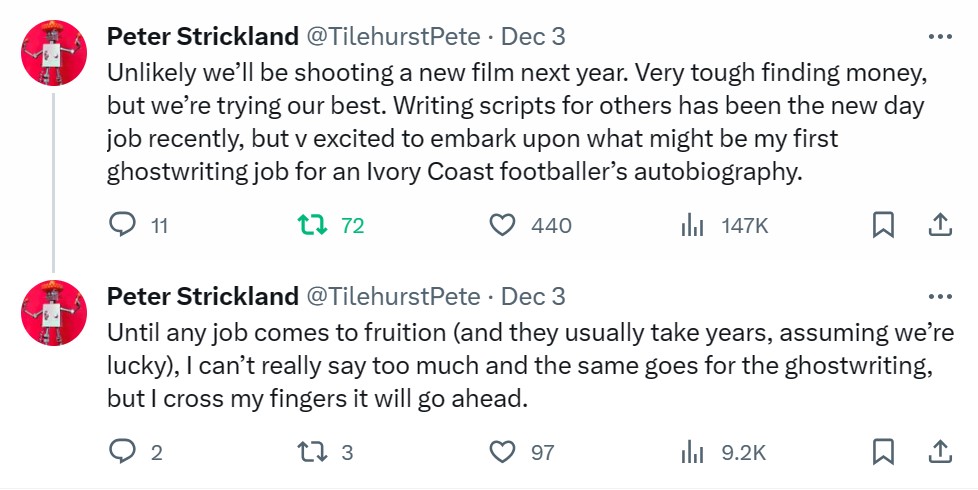
It isn’t the movie’s fault, but there was something grim about watching Piaffe the same week that England’s premiere auteur fetishist Peter Strickland was stress-tweeting about struggling to find funding for his next project. One of our greatest working directors can’t get a new movie off the ground, and yet he’s formidable enough that younger artists are out there making (pretty great, possibly unaware) pastiches of his work. Piaffe plays as just as much of a career-retrospective overview of Peter Strickland’s style as his recent music industry satire Flux Gourmet, which likewise combined his foley-art giallo throwback Berberian Sound Studio with his kink-dynamic relationship drama The Duke of Burgundy into a single, self-spoofing work. The ASMR phone sex of Piaffe, wherein our equestrian protagonist brushes her tail hair over a telephone receiver to excite her lover, feels like a gag pulled directly from a Strickland film that doesn’t yet exist. And given that Strickland is struggling to land funding for his next project, maybe it never will. What Piaffe offers is a sturdy Strickland substitute that proves he’s not the only filmmaker who can reliably deliver weird-for-weird’s-sake fetish comedies for the midnight movie crowd; in that context, it’s maybe the best of its kind since The Berlin Bride. I can still only take it as a consolation prize, though, as I’d unquestionably list Strickland among the most exciting artists working in cinema right now (alongside Amanda Kramer & Bertrand Mandico), so I’m bummed to hear he’s not currently working on anything at all.
For all I know, Piaffe director Ann Oren has never seen a Peter Strickland film, and their parallel sensibilities are entirely coincidental. My only previous exposure to Oren is in her outsider-art Hatsune Miku cosplay documentary The World is Mine, which is specifically about the erosion and erasure of identity within a digital-age fandom “community.” I will refrain from assuming anything about her based on this high-art horsegirl cosplay erotica follow-up, except maybe that experimentation with new, fabricated identities & personae is an artistic preoccupation of hers – something that can only be confirmed as she establishes a larger body of work. I have hopes that, in time, Oren will prove to be just as formidable a prankster artist as Strickland. It’s something I already felt in this film’s fetishistic fixation on the mechanical tools of filmmaking & horseback riding, grazing its fingertips over leather harnesses and the rusty metal gears of an ancient zoetrope. I just need to see more of her work to know what to anticipate in the next picture. Meanwhile, I already know what I want & get out of Strickland’s films, and I’m stuck looking for those qualities elsewhere while he’s twiddling his thumbs waiting for someone to sign the checks.








 Swampflix