Flesh and Fantasy (1943)

Most scholars cite the 1945 British “portmanteau” film Dead of Night as popularizing the horror anthology genre.  No one would claim it was the first horror anthology film, since the storytelling format is almost as old as the cinematic medium itself, but it is credited for establishing the rules & tones of the genre that would eventually be codified in anthologies from Amicus, EC Comics adaptations, and the like.  That horror-history milestone puts the 1943 anthology film Flesh and Fantasy in a unique position.  Since the Universal Horror production precedes Dead of Night by a couple years, it avoids a lot of the typical trappings of a by-the-numbers portmanteau, delivering something so far outside the expectations of the horror anthology format that it almost doesn’t qualify as horror at all.  It’s a lot more handsomely staged and a lot less macabre than what most anthologies would become in its wake, often transforming its characters through supernatural phenomena instead of punishing them for their moral transgressions.  More genre-faithful titles like Asylum, Creepshow, and Tales from the Crypt introduce selfish, amoral assholes who get their cosmic comeuppance at the hands of otherworldly ghouls, while Flesh and Fantasy plays its horror with a softer touch.  We have immense sympathy for each of its hopeless protagonists, rooting for them to make it out of their darkly fantastic crises alive & improved.  The movie is not vicious enough to be chilling, but it is beautifully eerie throughout, and its three tales of “dreams and fortune tellers” each land with genuine dramatic impact (which is then somewhat undercut by a racist punchline in the final seconds because, again, it was the 1940s).

The first tale (read from a spooky short story collection over a nightcap between businessmen in the hotel-lobby wraparound) immediately sidesteps genre expectations in its chosen setting.  While there are countless horror stories set on the thin-veil-between-worlds holidays of Halloween, Christmas, and New Year’s Eve, Flesh and Fantasy finds its own thin-veil fantasy realm in the final few hours of Mardi Gras night, just before the Christian calendar transitions from hedonism to Lent.  The story starts with the discovery of a dead body pulled from the banks of the Mississippi River, a victim of suicide by drowning.  Drunken, costumed revelers briefly sober up while gathering around the unidentified corpse, but then quickly return to partying the last few hours of Carnival away before midnight ends the fun.  Only one woman stays behind, sympathizing with the suicide victim a little too intimately and considering joining him in death.  She sees herself as too ugly to be loved or to even party with the rest of her community, as represented by harsh low-angle lighting that accentuates strange, scowling curves on actor Betty Field’s otherwise pretty face.  Just before she drowns herself, a mysterious mask shop owner offers her an It’s a Wonderful Life-style perspective shift on her miserable life, allowing her to be beautiful for the last few hours of Mardi Gras thanks to a yassified plaster mask.  She, of course, subsequently learns a Twilight Zone-style lesson about how beauty comes from within, but the enchantment of the mask and the magical costume shop that provides it still hangs over her all-in-one-night journey like a heavy, eerie fog.  The only death in the segment happens before the story even starts, and all of its supernatural imagery is derived from the Mardi Gras floats & costumes parading in the background.

Legendary noir actor Edward G. Robinson has a much rougher time in his segment, in which he plays a wealthy lawyer who’s told by a palm reader that he’s going to become a murderer in the near future, to his shock.  This, of course becomes a story about self-fulfilling prophecies, as Robinson’s obsession over his fate to become a murderer against his will is the exact catalyst that drives him to becoming a murderer.  It’s like a noir variation on The Hands of Orlac in that way, with Robinson having heated debates with his own reflection & shadow about who in his life would be most ethical to kill, just to get the weight of the prophecy off his shoulders.  The argument is rendered in creepy, hushed whispers, which are echoed in the clouds of urban steam that pour in from every corner of the frame.  Likewise, the third & final segment of the film involves a self-fulfilling prophecy about a tightrope walker (Charles Boyer, of Gaslight fame) who envisions his own death in a nightmare featuring a cameo from (Robinson’s Double Indemnity co-star) Barbara Stanwyck.  Only, he doesn’t actually meet Stanwyck’s noir-archetype femme fatale until after he sees her in his dream, and he ignores the déjà vu feeling in pursuit of romance, ensuring that the dream will eventually come true.  It’s the most surreal segment of the trio, featuring psychedelic double-exposure compositions in its multiple dream sequences that provide the only true effects shots in the film, give or take the rear projection of Tarnished Angels-style Mardi Gras parade float footage in the opening vignette or Robinson’s onscreen doubling in the second.  It’s also the gentlest in its horror elements, though, offering a much kinder fate to Boyer’s helplessly smitten tightrope walker than what Robinson suffers after his own doom & gloom vision of the future.

In one of the stranger deviations from typical horror anthology formatting, there’s no wraparound buffer between the second and third segments, which bleed right into each other.  Edward G. Robinson reaches the end of his rope outside the very circus where Charles Boyer is walking his rope, so that the two stories are daisy-chained together.  That narrative conjunction feels excitingly ahead of its time, but it also leaves the opening Mardi Gras segment feeling isolated & insular in comparison.  The thematic & narrative connections between the tightrope & palm reading segments are crystal clear, which leaves a haze over how they relate to the opener.  What’s really important, though, is that all three segments are solidly satisfying and entertaining on their own terms, so that even if the audience might walk away with a personal favorite, it’s unlikely that one would stand out as the stinker of the bunch.  That might be the biggest deviation from horror anthology tradition, since even the best examples of the genre usually include a throwaway story that provides convenient bathroom-break time between the bangers.  The only throwaway segments of Flesh and Fantasy are its wraparound story which, again, concludes on a casually racist quip about superstitious “gypsies”.  If a horror anthology is going to whiff on any of its individual segments, the wraparound is the ideal place to do so, since it doesn’t tend to linger in the memory as much as the stories it scaffolds.  As a result, Flesh and Fantasy does register as one of the all-time greats of its genre, often by virtue of not falling victim to that genre’s worst, yet-to-be-established tropes.

-Brandon Ledet
The Cassandra Cat (1963) 

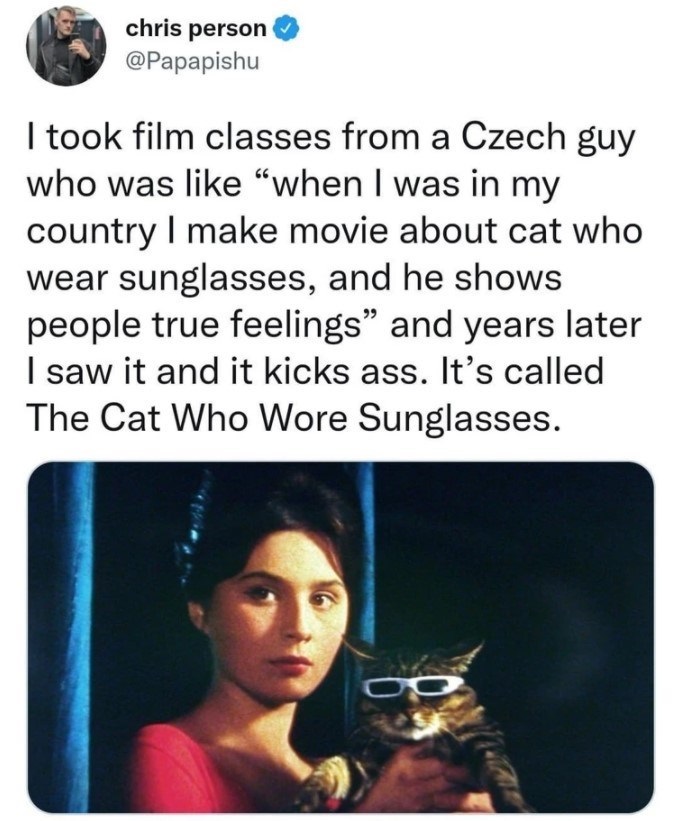
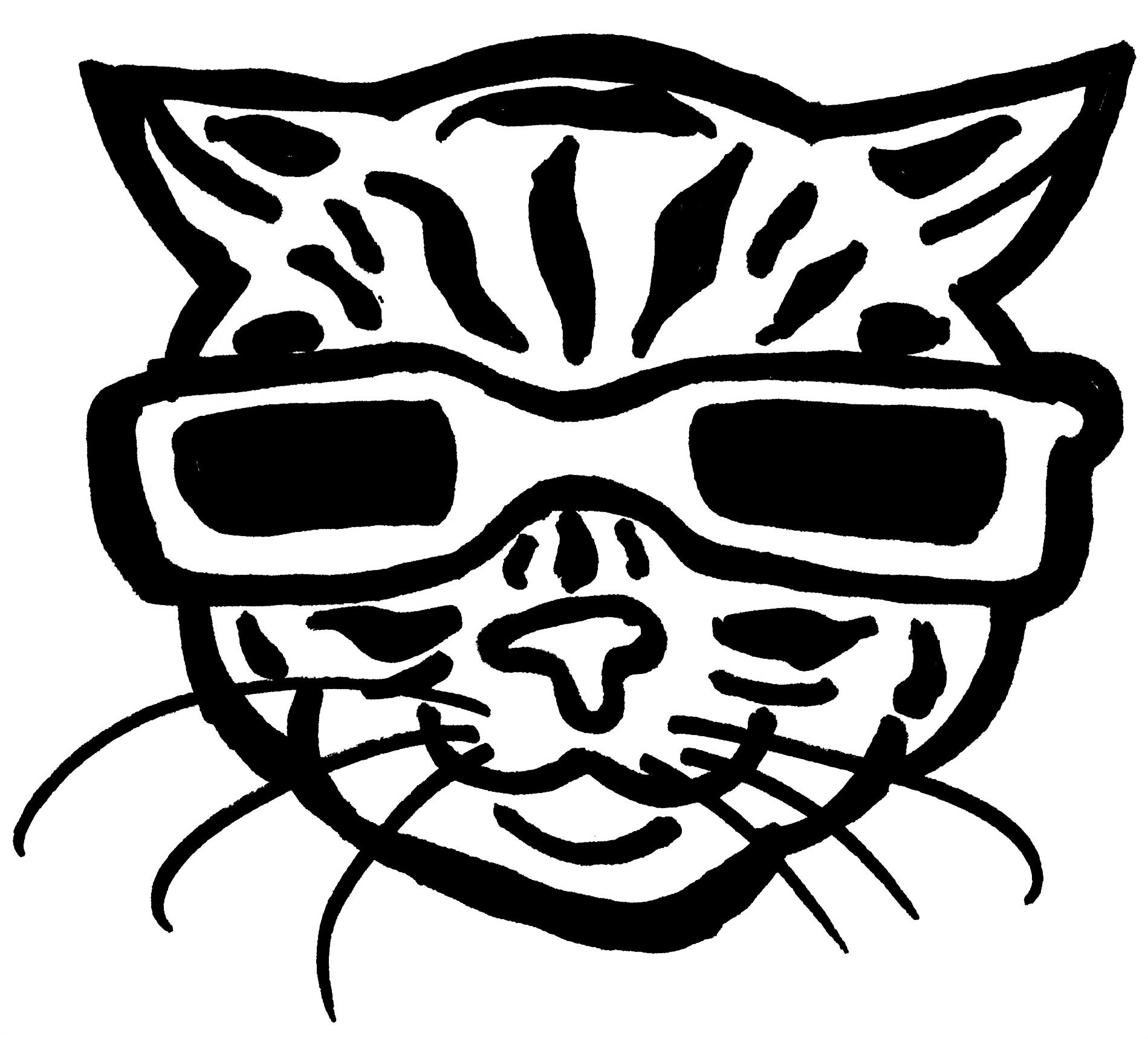
One of the sharpest reminders that the Internet is not real life that I’ve gotten recently was the sparse attendance at a local screening of The Cassandra Cat.  Also distributed under the English titles When the Cat Comes and That Cat, The Cassandra Cat is best known (to me) as the subject of a viral tweet, recommended by a film student whose Czech professor bragged about making a movie about a cat who wore sunglasses called The Cat Who Wore Sunglasses.  I certainly didn’t expect that one tweet would exalt The Cassandra Cat up to the level of household Czech New Wave standards like Daisies or Valerie and Her Week of Wonders, but it is one of those tweets that rattle around in the back of my mind the same way serious film scholars can quote lines of criticism by Kael, Sarris, and Godard.  So, when there were fewer than ten people in attendance for The Prytania’s afternoon screening of its recent restoration, I was shocked.  I could not believe so few people showed up to see a half-century-old Czech film about a magical cat that I’ve only ever heard about via Viral Tweet.  So weird.

Y’all missed out.  The Cassandra Cat is a wonderfully imaginative children’s film about collective action, holding adults accountable for being liars & cheats, and about how cats are excellent judges of character.  The titular cat is a trained circus performer who arrives to a small Czech village with an army of talented coworkers: a ringleader magician, a gorgeous trapeze artist, and a legion of faceless, supernatural puppeteers.  Their act initially goes over well with the townspeople until the final routine, in which the trapezist takes off the cat’s sunglasses so he can stare his naked cat eyes into the audience.  It turns out that the cat’s direct gaze has the magical power to expose people’s true nature by making them glow like mood rings (an effect achieved through body paint & gel lights).  Adulterers glow yellow, revealing secret affairs hidden from their spouses.  Selfish careerists glow violet, exposing their greed to higher-minded comrades.  Lovers glow red, revealing their pure, earnest hearts as artists & true friends among their careerist counterparts.  This, of course, causes a riot among the adults, who spend the rest of the film attempting to banish & discredit the cat in front of the children who witnessed their secret selves.

There is some political allegory to The Cassandra Cat that might not entirely translate to modern audiences unfamiliar with the day-to-day complexities of the Czech Republic pre-Prague Spring.  Mostly, though, it’s fairly easy to follow as the Czech New Wave version of “The Harper Valley PTA”.  That’s what makes it such a great children’s film, especially once the magical cat is weaponized by the town’s schoolchildren, who stage a mass classroom walkout until he’s surrendered to their care & use.  It’s also a great children’s film because of its vintage sense of magic & whimsy, recalling other psychedelic children’s media of bygone eras like H.R. Pufnstuf, The Peanut Butter Solution, and The 5,000 Fingers of Dr. T.  There were no actual children present at that afternoon screening at The Prytania, just a few stray adult weirdos who had nothing better to do in the breezy sunshine outside.  At this point, The Cassandra Cat is a film exclusively for weirdo shut-ins, the kid who file away hit tweets in the back of their minds in case the forgotten Czech films referenced therein happen to pop up on the local repertory schedule.  Maybe that makes us losers, but if like to think that if a cat stared at us that day we’d at least glow red.

– Brandon Ledet

Invincible (2001)

“Why do I watch WrestleMania?  My answer is that the poet must not avert his eyes from what’s going on in the world.  In order to understand, you have to face it.”

“Our sense of the real world today is massively challenged; I include here reality television, breast enhancement, and the carefully choreographed, fake drama of WrestleMania, populated by larger-than-life characters with muscles that nature doesn’t normally provide us with and who take pleasure in telling everyone how unbelievably evil they are.”

“What is fascinating about WrestleMania is the stories around it: the dramas between the owner of the whole show and his son, who are feuding, and his wife in the wheelchair who is blind, and he is then showing up in the ring with girls who have huge, fake boobs, and he is fondling them.  This is almost sort of an ancient Greek drama – evil uninterrupted by commercials.”

These are just a choice few Werner Herzog quotes about the cultural & literary virtues of professional wrestling, pulled from the 2019 GQ listicle “Werner Herzog Cannot Stop Talking About WrestleMania” – a masterpiece of modern clickbait publication that I return to often.  Herzog was promoting his work as an actor on the Star Wars television series The Mandalorian around the time those various press junket quotes were assembled, a time when his familiarity as a household name was bridging the gap between art cinema snobs and their sworn enemies, “Disney Adults.”  His public perception has since been bifurcated in recent years, split between his well-earned designation as a world-class auteur and his more recent evolution into a Nic Cagian human meme who pontificates about supposedly low-brow subjects like WrestleMania & Ana Nicole Smith in a severe German accent.  Unlike Nic Cage, though, Herzog has not allowed his YouTube Era reputation as a human meme affect the tone or content of his work as a serious filmmaker, give or take a few over-the-top scenes in his collaboration with Cage in Bad Lieutenant: Port of Call, New Orleans.  As often as you hear Herzog explain the grotesque poetry of reality TV & pro wrestling in interviews, it’s difficult to detect their influence on his actual work.  That is, unless you happen to be one of the few people who remember his 2001 historical fantasy drama Invincible, which presents an academic-level understanding of the historic origins of wrasslin’, as well as its modern mutation into mass, crass populist entertainment.

Invincible stars real-life strongman Jouko Ahola as historical strongman Zishe Breitbart, a young Jewish blacksmith from a small Polish village who grew to fame as “The Strongest Man in the World” in 1920s Germany.  Herzog takes a pro wrestling-style truthiness approach to the material, moving Breitbart’s story to the early stirrings of Nazi Germany a decade later, playing up the significance of his Jewish heritage in a heightened, more satisfying kayfabe version of his life’s story.  In the film, Breitbart enters the entertainment industry through the strongman circus acts that sparked pro wrestling as an artform.  He challenges a traveling strongman for prize money in what is supposed to be a rigged wrestling bout and easily defeats the brute in a Goliath vs Goliath matchup.  Word of his incredible strength quickly spreads, and he’s summoned to work as a regular stage act in a Berlin cabaret, ringmastered by a Nazi-friendly psychic played by Tim Roth.  Roth’s conman mystic is quick to use Breitbart’s Jewish heritage as a race-baiting point of division between the Nazi officers and Jewish citizens in the cabaret audience, which is perfectly in tune with how hot-topic political divisions are exploited for cheap heat in modern pro wrestling programs.  Breitbart is the underdog hero for the Jewish people, who feel increasingly hopeless as the Nazis rise to political power.  The carnie mystic MC is a hero to the Nazis, pretending to summon supernatural strength from The Dark Arts to overpower the strongman’s brute force (a “skill” he can sell as a war-winning weapon for Hitler’s army).  In truth, they’re working together as a scripted act, putting on a show to stoke their divided audience’s Us vs Them bloodlust; it’s wrestling in a nutshell.

Aesthetically, Invincible is worlds away from the reality-TV crassness of what Herzog refers to as “WrestleMania”.  In its best moments, there’s an ancient cinematic quality to the director’s visual storytelling, effectively remaking Bob Fosse’s Cabaret as if he were Tod Browning adapting a fairy tale.  In its worst moments, it plays like standard-issue Oscar bait of its era, bolstered by a prestige-desperate Hans Zimmer score that tells the audience exactly how to feel at every second of runtime.  Its Oscar chances were self-sabotaged by Herzog’s choice to have his European actors speak phonetic English in post-production dubs instead of performing naturally in their various native languages.  That might have been a deliberate attempt to evoke a Bressonian style of performance, but it just comes across as bizarre & confused, and only the established professional actors Tim Roth & Udo Kier come across as capable performers.  The camerawork can come across as bizarre & confused as well, alternating between a handheld documentary style and a Hollywood-schmaltz fantasy & artifice that attempts to (in Ross’s showman wording) “[articulate the audience’s] collective dreams”.  Its moments of visual lyricism make sense to me as a historically set fairy tale about Nazi obsession with mysticism clashing against a Freaks vs. The Reich style superhero.  They’re especially effective when Herzog gazes at the sea-life bodies of jellyfish & crabs as if he were a space alien considering their otherworldly beauty for the very first time.  He’s really good at articulating the uncanniness of everyday life & pop media in that way, which is how he’s gotten famous as an interviewee outside of art cinema circles.  It’s amusing, then, that he can’t convincingly translate that wonder with the world into an Oscar-friendly movie for normies; he’s too much of a genuine weirdo.

Around the time of Invincible, Herzog was essentially directing one feature film a year at a consistent pace, and he’s only gotten more prolific in the two decades since.  While some of his 2000s titles like Grizzly Man, Encounters at the End of the World, and the aforementioned Bad Lieutenant have endured with a certain cultural cachet, many like Invincible have fallen through the cultural cracks; they can’t all be stunners.  If you’re going to excavate this one Herzog title out of relative obscurity within that massive catalog, I do think it’s worth considering as a bizarre, failed attempt to reach for Awards Season prestige beyond the usual, routine boundaries of his critical accolades.  He has found wider public recognition in the years since, but mostly as a weirdo public persona (an extension of the first-person narration style he developed in his 2000s-era documentaries).  Invincible does recall one very specific aspect of that public persona, at least: his inability to stop talking about WrestleMania.  Whether that’s enough of a reason to dig this one particular discarded Herzog DVD out of the Goodwill pile is up to your completionist interest in his career, I guess, as well as your personal fascination with the Greek tragedy & grotesque poetry of wrasslin’ as an artform.

-Brandon Ledet

Freaks vs. The Reich (2023)

I’ve been struggling to find much to get excited about in theaters lately, now that “Summer” Blockbuster Season has encroached well into Spring, and multiplex marquees are once again all superheroes all of the time.  The general vibe among moviegoing audiences is that the superhero era is winding down post-Endgame, but it’s going to take a long time for Hollywood studios to adjust to that dwindling enthusiasm, since these billion-dollar behemoths take years to produce & market.  Personally, I’m so deeply, incurably bored by American superhero media that I’m avoiding all four-quadrant crowd-pleasers out there, not just the usual suspects like the new Guardians, the new Ant-Man, and the new Shazam.  If I stare at the poster or trailer for any tentpole blockbuster above a 6-figure production budget for long enough, they all appear to follow the same MCU superhero action template.  Super Mario Bros, Dungeons & Dragons, and Fast X are all essentially superhero movies to me, each with their own invincible, quippy gods among men who save the day by extending their IP.  I can’t hide from the new release calendar forever, though, so I need to re-learn how to enjoy a superhero movie or two until Hollywood fully moves onto the next money-printing fad.  Given that there are already dozens of Marvel & DC movies slated for release over the next few summers, it’s likely going to take a long time for this lumbering industry to correct course.  So, it’s somewhat fortuitous that the Italian supernatural action epic Freaks vs. The Reich finally landed a US release in this dire time of need, after years of stumbling over international distribution hurdles.  It’s the most convincing evidence I’ve seen in a while that there is still some juice left in the superhero genre, despite Hollywood’s determination to squeeze it dry and pummel the rind.

If there’s anything more frustratingly slow than Hollywood’s response to public appetite, it’s the distribution of international art films, which often fall into a years-long limbo between their initial festival runs and their wide US premieres.  I’ve been waiting to see Freaks vs. The Reich for so long that its earliest roadblocks were COVID related, and its original title has since been changed to give it a fresher, more recognizable appeal.  I suppose rebranding the film from Freaks Out to its new, more descriptive title is a useful warning for the shocking amount of Nazi imagery you’ll find in this supernatural circus sideshow fantasy.  It also helps explain why it’s so easy to cheer on the titular, superpowered freaks who take those Nazis down.  I wonder if some of its distribution delays had to do with clearing song rights, since the main Nazi supervillain in question abuses ether to mentally time-travel into the future, returning to the battlefields of WWII with visions of smartphones, video game controllers, and old-timey renditions of Radiohead’s “Creep” & Guns N’ Roses’ “Sweet Child o’ Mine.”  The inclusion of “Creep” is important to note there, since the song also happens to be featured in the more traditional, straightforward superhero epic Guardians of the Galaxy Vol. 3, which is currently eating up a grotesque amount of American screen space.  Whether you think it’s more interesting to hear that song played on a Spotify algorithm mixtape to evoke easy nostalgia points or performed by a drugged-out, time-traveling Nazi supervillain is a question of taste, but I can at least personally attest to appreciating a sense of variety within this oppressively omnipresent genre template.

Freaks vs. The Reich opens with a full circus sideshow act, introducing our Italian superhero freaks one at a time as they show off their individual talents – a magnetic dwarf, an electric ballerina, a real-life wolf-man, etc.  Before they can bow for audience applause, however, their tent is blown to shreds by Nazi warplanes, and they spend the rest of the movie rebuilding the team so they can end the war themselves.  Caught up in concentration camp processing, Italian militia resistance, and general wartime disorientation, they are all eventually reunited by the ether-huffing, time-travelling Nazi who’s convinced he can win the war for Hitler if he assembles the freaks to fight for Deutschland.  This all culminates in a grand superpowers battle in an open field (the way most superhero epics do), and I will admit that the journey to get to that predetermined conclusion can be a little overlong & draining (the way most superhero epics are).  There’s at least some novelty in the film’s antique circus sideshow aesthetic and WWII historical contexts, though, and novelty is a precious commodity for a genre that’s been so prevalent over the past decade.  It’s like watching the cast of Miss Peregrine’s Home for Peculiar Children act out the plot of Guillermo del Toro’s stop-motion Pinocchio on the leftover sets of Matteo Garrone’s live-action Pinocchio – an antique Italo horror show.  You won’t find that kind of aesthetic deviance in the upcoming Flash or Captain Marvel sequels, which you can pretty much already picture start to end in your head sight-unseen.  These superhero freaks are flawed, messy, and they fuck, including the wolfman archetype in what has to be the hairiest sex scene since The Howling Part II: Your Sister is a Werewolf.  Meanwhile, Marvel & DC are still stubbornly stuck in a chaste, sanitized universe where “everyone is beautiful and no one is horny.”  They also murder Nazis, a universally agreeable target that hasn’t been attacked with such sincere patriotism since Marvel peaked in 2011 with Captain America: The First Avenger.

I’m probably doing this movie no favors by comparing it against American superhero media, since everyone’s starting to feel the same way about the genre as we felt about zombie media 17 seasons into The Walking Dead: numbly apathetic.  Within that context, though, it’s a breath of fresh ether – one of the strangest, most upsetting superhero stories since James Gunn made Super, at least five James Gunn superhero movies ago.  Maybe Freaks vs. The Reich would have fared better before our culture-wide superhero fatigue fully settled (it was initially set to be released less than a year after Endgame), but I personally needed it now more than ever, just so something in this genre didn’t look like a total snooze.

-Brandon Ledet

The Greatest Showman (2017)

“Does it bother you that everything you’re selling is fake?”
“Do these smiles look fake?”

One of my favorite recurring SNL characters in recent years was Andy Samberg’s portrayal of Hugh Jackman: The Man with Two Sides. The joke was essentially that Jackman’s public persona was bizarrely bifurcated between his gruff performances as a muscled-out action star and his more delicate, fanciful performances as a man of the stage. 2017 might have been the year when the Two Sides of Hugh Jackman both reached their most absurd extremes. Early in the year, Jackman’s long-running lone wolf/tough guy act as Wolverine in the X-Men franchise got so somber & manly in Logan that the film could easily pass as an adaptation of a late-career Johnny Cash ballad. Jackman then followed that grizzled performance up in December with the silliest, most frothy performance in his entire musical theatre career. Jackman stars in the movie musical biopic The Greatest Showman as an eternally chipper P.T. Barnum, whom the movie posits as the inventor of modern showbusiness. The Greatest Showman is less remarkable for contrasting Logan as an exercise in pure, unembarrassed musical theatre than it is for contrasting it as a disingenuous, 100-minute-long commercial where the product being sold is joy. Just as I cried a solitary, manly tear as Logan toyed with political exploitation & deep-seated daddy issues, I also totally bought into the joyful, bullshit product Jackman peddles in The Greatest Showman. He’s a very talented salesman, no matter which one of his Two Sides is doing the talking.

Calling The Greatest Showman a biopic is a little misleading. I’m not sure Jackman’s portrayal of P.T. Barnum shares much in common with the real-life showman outside a name and an affiliation with the popularization of the traveling circus. The revisionist narrative the film peddles is just as surreally artificial as its nonstop barrage of green-screened backdrops. Barnum begins the film as a working-class upstart whose belief in the American dream (and skills at lying to bank lenders) catapults his family from rags to riches as he unknowingly “invents” modern show business (think Vegas variety show). His “aha!” moment that transforms a failing wax museum packed with dusty curios to a lucrative enterprise of populist entertainment is a decision to exploit the local outcasts & physically disabled as tourist attractions, essentially inventing the profession of “circus freak.” The Greatest Showman often attempts to posit Barnum’s relationship with his disenfranchised employees as tenderly familial, but it’s much more convincing in the stretches where he profits off their labor, yet locks them out of the visibility of the high-society circles they afford him access to. The film’s moral lies somewhere in celebrating your inner (and outer) weirdness instead of desperately wanting to be accepted by the snobbish hegemony, a lesson Barnum supposedly learns several times throughout (by way of gaudy, pop-minded showtunes, of course).

There are dual romance storylines that distract from The Greatest Showman’s Let Your Freak Flag Fly messaging and overall value as a crassly populist spectacle. One involves Barnum repeatedly ignoring his wife (Michelle Williams) and children in his blind pursuit of high society respectability, something that falls a little flat if not only because his wife’s inner desires are left vague & unclear. Early on, Barnum sings passionately about his dream of creating the ultimate form of entertainment, while his wife’s only expressed desire is that he share that dream with her and allow her to tag along. A second, interracial romance among Barnum’s employees (Disney Channel vets Zack Effron & Zendaya) is a little clearer in its place in the story, though it’s ultimately just as inconsequential. Neither romance is nearly as satisfying as the time spent with Barnum’s stable of “freaks,” whose determination to be visible & respected while being themselves is the most convincing thread in the film’s overall sentimentality. I’ll admit that even as crass & silly as this movie is in every single frame, I got a little teary-eyed at the circus performers (especially the bearded lady) singing about how they’re “Not scared to be seen” in the Oscar-nominated tune “This is Me.” The characterizations of the circus performers can be just as insultingly artificial as the romances and the revision of Barnum’s exploitative history and everything else in the film (the bizarre vocal dubbing of the cast’s sole little person is especially egregious), but that’s all part of The Greatest Showman’s tacky sense of proto-Vegas fun. It also does little to distract from the endearing, all-accepting, freaks-are-people-too messaging.

The debut film from director Michael Gracey, The Greatest Showman was likely a movie-by-committee proposition, very much in the tradition of blatantly commercial movie musicals like Moulin Rouge & Xanadu. It proudly wears that populism on its ruffled sleeve, though, directly calling out potential critics as “prigs & snobs” before they even have a chance to file a negative review. Barnum goes even further by calling the entire profession of entertainment criticism inherently hypocritical, as he becomes morbidly fixated on a “critic who can’t find joy in the theatre.” That insult stuck with me, not because it was especially insightful as a look into the practice of art criticism, but because it made clear exactly what product this obnoxious, crass, overlong, deeply silly advertisement was trying to sell me: joy. I greatly respect The Greatest Showman for the honesty of its populist spectacle & out-in-the-open commitment to artifice. I also believe that, besides maybe Barnum himself, there are few hucksters who could have sold its joy-product more convincingly than Jackman, even if he was outshined by the circus performers’ storyline and could only employ one of his distinct Two Sides in the task.

-Brandon Ledet

The Horrors of Self-Contradiction in Tod Browning’s Freaks (1932)

The 1932 exploitation horror Freaks has always had a reputation for controversy, even losing a third of its original runtime to drastic edits meant to soften its abrasive effect. After the wild success of the Bela Lugosi-starring Dracula for Universal, director Tod Browning was given total freedom to jumpstart MGM’s own horror brand in a project of his choice. Urged by little person performer (and future member of The Lollipop Guild) Harry Earles to adapt the Tod Robbins short story “Spurs” for the screen, Browning chose to draw on his own past as a circus performer for a film that ultimately ruined his career. As a historic, pre-Code horror relic, Freaks has a fascinating cultural cache that only improves every passing year. It’s a film that’s just divisive now as it was over eight decades ago, however, largely because it’s divided in its own dual nature. Freaks is both a deeply empathetic call to arms against the social stigmas that surround its disabled “circus freak” performers and a horrifically exploitative “Get a load of these monsters!” sideshow that defeats its own point. Which side of these warring, self-contradicting intents ultimately overpowers the other is a question largely of genre, for which horror might not have been Browning’s wisest option.

As David Lynch later proved with The Elephant Man, it’s entirely possible to tell a heartfelt, empathetic story about real life sideshow performers through a Universal Monsters aesthetic. In the younger, less nimble days of horror cinema, Browning was a lot less confident about the technique. The majority of Freaks is not a horror film at all, but rather a comedic melodrama that happens to be set in the insular community of a traveling circus. With the campy, braying line deliveries of a John Waters production, the little people, conjoined twins, amputees, and microcephalics of Browning’s cast pal around in what’s essentially a hangout comedy. In a typical joke, two men remark on the intersex performer Josephine Joseph, “Don’t get her sore or he’ll punch you in the face,” and then maniacally laugh as if it’s the funniest thing that’s ever been said. An opening scroll & a carnival barker preface this comedy with a plea for the audience to empathize with its “ABNORMAL” & “UNWANTED” societal castoffs, stressing that they are only human beings whose “lot is truly a heartbreaking one.” As we watch the titular “freaks” live, laugh, and love in the film’s first act, the only detectable trace of horror is in the way they’re treated by able-bodied outsiders. Harry Earles falls for an erotic dancer who plans to marry & poison him in a plot to rob him of his inheritance. She & her strongman secret lover are grotesquely cruel to their “circus freak” co-workers, whom they openly mock for their disabilities. The comedic melodrama of the film’s opening concludes with the two wicked souls making out in front of Earles & laughing in his face on their wedding night. When hiws fello circus performers famously chant, “One of us! One of us! We accept her!” to welcome the new bride into the fold, she shrieks “Freaks!” in their faces and violently rejects the offer, campily revealing who the True Monsters are.

The self-contradiction at the core of Freaks kicks in immediately after that wedding celebration. The film shifts focus from the horrors of social cruelty to the supposed horrors of its disabled cast as they exact revenge on the erotic dancer who is gradually poisoning their “circus freak” brethren. Although Browning’s script makes a point to stress the humanity of his characters in the film’s opening half, he leans in heavily on the exploitation of their physical appearances as “living monstrosities” in the film’s final act. What was once an unconventional hangout comedy with a tragic mean streak reverts to the Universal Monsters model of Browning’s roots, reducing the “freaks” to silent, wordless monsters who stalk their erotic dancer prey from the shadows until it’s time to maim. In a mood-setting rainstorm, the circus performers crawl towards her with knives wedged in their teeth, all of their pre-established humanity now replaced with the supposedly grotesque image they strike as onscreen monsters. It’s arguable that without this conclusion Freaks would not technically qualify as a horror film, but by backsliding into the exploitative nature of horror as a genre, the movie effectively undoes a lot of its argument for empathy. Essentially, if the story Browning truly wanted to tell was that the performers were ordinary people who happened to have abnormal bodies, he should not have told that story through a genre that requires them to be visually shocking monsters.

As a visual achievement, a cultural time capsule, and a one of a kind novelty, Freaks has more than earned its place in the Important Cinema canon, if not only for inspiring the masterful The Elephant Man to accentuate its virtues & undo its faults. As a horror genre entertainment, however, it’s too self-defeating to qualify as a creative success. Browning asks his audience to think twice about treating his disabled circus performers like inhuman monstrosities and then marches them through genre conventions that require them to be exactly that. You could generously argue that societal cruelty & bigotry is what leads the film’s disabled characters to inhuman violence at the climax, but the film concluding on that violence for exploitative effect is too much of a self-contradiction to brush off entirely. Freaks‘s most effective mode of horror is in presenting a moral discomfort in the disconnect between its words & its actions, especially as its story gradually shifts genres while it reaches for an inevitably tragic conclusion.

-Brandon Ledet