Feels Good Man (2020)

The first few weeks of Donald Trump’s second presidential term have surprisingly been defined more by the daily stunts & shenanigans of unelected government official Elon Musk than they have been by the actions of the president himself. Sure, Trump is signing a relentless barrage of hateful, unconstitutional Executive Orders that are threatening to crumble decades of social & economic progress in a matter of days. That was fully expected, though, especially if you paid any attention to the “Project 2025” agenda advertised during his election campaign. Musk’s overt, oligarchic influence on these Executive Branch actions have been just as nefarious but much more bizarre, especially as an extension of the failed meme humor of his current reign as the Villain King of Twitter. It’s not enough that Trump & Musk are wielding institutional power to reshape America with a straight-up Nazi agenda; they’re also irony-washing that Nazi ideology through several layers of internet meme humor, so that their above-board, bought-and-paid-for coup is read as a humorous prank meant to “trigger the libs,” not to welcome in a new, shameless era of American fascism. Between Musk’s “DOGE” branding, his juvenile obsession with the numbers 69 & 420, and the bar now being so low that his executing a Nazi salute at Trump’s inauguration now qualifies as a “dog whistle,” it’s clear that we’re living through America’s first 4chan presidency. Evil has never been so inane.

If you catch yourself wondering how, exactly, we got here over the last few years, I’ve seen no better explainer than the 2020 documentary Feels Good Man. A 90-minute history lesson on the memeification of a cartoon stoner frog may sound trivial in the context of America’s Nazi takeover, but Feels Good Man somehow does a better job explaining & contextualizing that far-right political shift than any other film I’ve seen – predating and overriding all of those QAnon docs that auto-populated on every streaming service in the years following the January 6 coup attempt of 2021. The stoner frog in question is, of course, Pepe the Frog, the breakout character from alt-comics artist Matt Furie’s cult series Boys Club. A soft-spoken San Francisco stoner who’s been drawing goofy frog doodles his entire life, Furie confides that Pepe is the Boys Club character he most personally identifies with . . . which is a brave thing to admit given the character’s eventual perversion and radicalization in the Hell pits of 4chan once it escaped the pages of his comic book. A single frame of Boys Club in which Pepe explains to his burnout roommates that he urinates with his pants completely lowered to his ankles because it “feels good man” was a funny enough image that it started getting shared on the internet outside the context of its source material and, as the movie argues, somehow snowballed into Donald Trump becoming the 45th President of the United States.

I have a general affection for Anthropology of the Internet documentaries that immortalize disposable online ephemera for cinematic prosperity, especially when they capture the sinister atmosphere of the Internet’s dankest dungeons (see also: the Russian dashcam compilation The Road Movie, the evil-clown sightings doc Wrinkles the Clown, and Jane Schoenbrun’s Slenderman doc A Self-Induced Hallucination). Even so, Feels Good Man does a better job than most at explaining how its own subject’s online virality led to real-world consequences outside niche meme forums. It chronicles Pepe the Frog’s transformation in the hellfires of 4chan from loveable frog to “the new swastika”, explaining how users who identified with Pepe as much as its creator had to force the frog to “go dark” to protect him from “normies” (i.e., women) who might identify with him as well. Because 4chan is an attention-economy culture that mostly traffics in “ironic” racism, this effort manifested as Pepe becoming a mouthpiece for Nazi rhetoric and an online dog whistle for alt-right C.H.U.D.s. Making Pepe as bigoted as possible became a kind of online game, and it gave real-world Right Wing ghouls a way to signal to the keyboard Nazis at home that the Trump-led establishment shared their values without abandoning their more buttoned-up, traditional voter base. That co-opting seems a little quaint now that Elon Musk is Sieg Heiling on an official government stage, but it was a major stepping stone that led us here.

The half of Feels Good Man that explains how 4chan memes created a new Nazi America is populated with all the expected demons of 2010s alt-right ascension. Pepe’s Nazi radicalization was directly inspired by Steve Bannon’s political strategy to “flood the zone with shit,” which has become the go-to playbook for the Trump-led Republican Party. During the infamous street interview when Richard Spencer is punched in the face by a protester, he’s explaining his Pepe the Frog lapel pin to a reporter at the moment the fist connects with his jaw (which the movie graciously repeats in several loops for our viewing pleasure). Pepe is even transformed into a direct stand-in for Trump himself, outfitted with a new smug facial expression and a Trumpian wig. Most critically, former Infowars blowhard Alex Jones is sued for copyright infringement by Matt Furie after using Pepe’s image on a fundraising campaign poster, marking Furie’s too-little-too-late attempt to reclaim his intellectual property from the worst people alive. The half of the film that’s about Furie’s astonishment & unpreparedness for the Internet’s hateful perversion of Pepe is adorably naive and populated with fellow alt-comics artists who are sad to see their friend suffer in this exponentially shitty shithole of a world: Lisa Hanawalt, Johnny Ryan, Aiyana Udesen, etc. Their attempt to reclaim Pepe and save his reputation was heavily outgunned, though, since the opposition included literal White House occupants.

It’s easy to roll your eyes at the twee preciousness of Furie’s pleas for good vibes and kindness as opposition against the hateful scum who’ve stolen & desecrated his art, but I appreciate the sentiment. I could not have sat through an exhaustive recounting of how 4chan “elected a meme as a president” and ushered in a Fourth Reich for the LOLs without a little kindness & levity. Being reminded that there are still sweet, reasonable people in the world who are oblivious to the deep well of evil on the other side of their computer screens was a calming counterbalance to the infuriating co-opting of meme culture to enact real-world fascism detailed elsewhere in the film. Five years later, it’s clear which side of that divide is winning the Culture War, but it’s also clear that they cannot create anything substantial themselves worthy of sharing & celebrating; they can only pervert, corrupt, and drain the humor & life out of previously existing art & language (which explains their more recent fondness for generative A.I.). As evidenced by the interstitial animations that imagine what it might be like if Boys Club had been adapted into a psychedelic Adult Swim sitcom instead of a Nazi dog whistle, Pepe deserved so much better than the hell-world we live in. He’s a cool frog.

-Brandon Ledet

The Not-So-New 52: Justice League vs. The Fatal Five (2019)

Welcome to The Not-So-New 52, your digital Swampflix comic book (adaptation) newsstand! Starting in 2007, DC Comics and Warner Premiere entered the direct-to-home-video market with animated features, mostly in the form of adaptations of well-received event comics or notable arcs. This Swampflix feature takes its name from the 2011 DC relaunch event “The New 52,” and since there are (roughly) fifty-two of these animated features as of the start of 2024, Boomer is watching them in order from the beginning with weekly reviews of each. So, get out your longboxes and mylar sleeves and get ready for weekly doses of grousing, praise, befuddlement, recommendations, and occasional onomatopoeia as we get animated for over fifteen years of not-so-new comic cartoons. 

At the end of my review of Reign of the Supermen, I mentioned that, given DC’s tendency to milk every udder until it bleeds, it’s possible that the “DCAMU” may one day return following the yet-to-be-reviewed Justice League Dark: Apokalips War that serves as the mini-franchise’s finale. After all, who would have thought that, nearly thirteen years after the 2006 finale of Justice League Unlimited, there would be another installment in the DC Animated Universe that we all knew and loved (I have decided that I must align myself with the camp that does not count that other thing). In 2019, Warner Animation released Justice League vs. The Fatal Five, a continuation of sorts from JLU, and honestly? I love it. 

We open in the 31st Century, where some members of the Legion of Superheroes attempt to hold off several villains as they attempt to steal a bubble-shaped time machine. A future, heroic version of Brainiac attempts to upload a virus to the time craft so that even if they fail to stop the bad guys, they won’t be able to get aboard and get up to their temporal shenanigans. The trio of villains gets past him just as the upload hits 99%, and they are able to get away, although not without a stowaway, Thomas “Star Boy” Kallor (Elyes Gabel), who travels on the outside of the time sphere and manages to get the upload complete, imprisoning the villains within as the sphere falls to earth in the 21st Century, as does Star Boy. While Superman (George Newbern) and Wonder Woman (Susan Eisenberg) save civilians from the falling ship, Star Boy lands and realizes that his supply of medication, which he needs to take periodically to stabilize his thoughts and clear his mind, has been destroyed. He goes in search of a replacement at a nearby pharmacy only to realize too late that there is no equivalent in this time period; in the process of attempting to get help, he disrobes because he thinks that the pharmacist is frightened by his costume. As one would expect when a naked man appears in a pharmacy in the middle of the night demanding a medication that does not exist and talking about being from a different time, the authorities become involved, and Batman (Kevin Conroy) ultimately appears on the scene, too, taking the temporally displaced babbler to Arkham, while the locked sphere is taken to Justice League headquarters for analysis. 

After a ten month time jump, we meet our new additions to the League since we last saw them, lo these many years ago. At JL HQ, Mr. Terrific (Kevin Michael Richardson), a supergenius gadgeteer hero is working to unlock the mysterious sphere. In the field, Batman is training/testing Miss Martian (Daniela Bobadilla), niece of team member Martian Manhunter, to see if she’s ready to join the team. Finally and most interestingly, we meet Jessica Cruz (Diane Guerrero), a woman who, while hiking with some friends in the Pacific Northwest, stumbled upon a mafia burial; her friends were executed in front of her and she managed to escape, but now suffers from extreme agoraphobia. She also happens to be Earth’s most recent recruit into the Green Lantern Corps, and it’s her that the villains from the future are after. You see, the titular Fatal Five were defeated in their own time, ten centuries hence, and the heroes of the future could think of no way to properly incarcerate their most powerful member except to send her into the past, when the Green Lantern Corps still existed, so that they could lock her up there. When Terrific and Superman finally crack the enigma of the time sphere, the three freed villains can now seek out Jessica to use her as the key to free their incarcerated companions and become the Fatal Five once more. 

Within the first five minutes of the movie, as I mentioned above, we get to see the power trio of the Justice League again, and I have to tell you, I was not expecting to have the emotional reaction to this that I did. I imprinted on the nineties animated Batman at a very young age (I have very distinct memories of running down our very long driveway from the bus after kindergarten to watch it on Baton Rouge’s FOX affiliate, WGMB, and can even remember specific images and episodes), and I grew up with that franchise and its associated media like Justice League and Justice League Unlimited. I was nineteen when JLU ended, so this version of these characters were very formative for me. When Superman saves a child from being obliterated by the falling time ship and commends the kid for his courage but tells him that it’s okay to run sometimes, and then Wonder Woman appears next to him, and they play that electric guitar riff (you know, the one from like fifteen seconds into the JLU opening theme), I actually got a little verklempt. 

I also really like that the group we know and love is still together, and still gaining new members, and that this expanded runtime allows the story to center in on Jessica, to deal straightforwardly with her PTSD and her agoraphobia, and to allow her to bond with this timelost hero of the future over their dual psychological issues. Although it would have been nice to see Flash, Manhunter, or some of the other characters that we haven’t seen in a long time, the absence of John Stewart, the Green Lantern from the TV show (an absence that is explained by the fact that Lanterns are dealing with a major issue in deep space, which also handily explains why the prison break on their headquarters world meets such little resistance) means that we get to spend a lot of time with Jessica, and I really liked her. She’s ultimately this film’s main character, as she is the one who undergoes dynamic change and growth over the course of the narrative, up to and including facing her fears in her darkest hour and ultimately forging herself into something stronger as a result. To a lesser extent, we get to spend some time with Miss Martian, a character who was still largely unknown at the time that JLU went off the air (she would become more prominent after the character was one of the main cast in Young Justice), and it’s fun to see her in this animation style; she’s very cute, and I like her characterization in this narrative. 

On an extratextual note, this one is also special because it’s the last time that the late Kevin Conroy voiced his iconic role. After JLU’s conclusion, he voiced the character in several of these animated releases: Gotham Knight, Public Enemies, Apocalypse, Doom, Flashpoint Paradox, Assault on Arkham, and The Killing Joke, but this was the first time that he was reprising this Batman, with this design, the one that I grew up with and the one that I love most. Conroy passed away in 2022 after a private battle with cancer, and although archive audio (I assume) was used in one of these animated films that was released just this year, this 2019 release is the last time that he really got to play this part. It’s made all the more touching that there is a sequence in which Batman, Jessica, and Miss Martian enter Star Boy’s mind and see the future there, which includes a museum dedicated to the founders of the Justice League (and in which Jessica sees a statue of herself, which helps her to understand her place in all of this and gives her the confidence that she needs to keep picking herself up again). Here, Batman gazes upon a memorial to himself, some hundred decades into the future, and although there’s no change in his attitude, it’s a loving (if coincidental) tribute to Conroy as well, who will forever be my Batman. May he rest in peace. 

-Mark “Boomer” Redmond

The Not-So-New 52: Reign of the Supermen (2019)

Welcome to The Not-So-New 52, your digital Swampflix comic book (adaptation) newsstand! Starting in 2007, DC Comics and Warner Premiere entered the direct-to-home-video market with animated features, mostly in the form of adaptations of well-received event comics or notable arcs. This Swampflix feature takes its name from the 2011 DC relaunch event “The New 52,” and since there are (roughly) fifty-two of these animated features as of the start of 2024, Boomer is watching them in order from the beginning with weekly reviews of each. So, get out your longboxes and mylar sleeves and get ready for weekly doses of grousing, praise, befuddlement, recommendations, and occasional onomatopoeia as we get animated for over fifteen years of not-so-new comic cartoons. 

Following on the heels of The Death of Superman, this film picks up six months later. Despite the appearance of four heirs apparent to the mantle of the Man of Steel, crime in Metropolis is on the rise. Who are these mystery men? There’s the youthful “Metropolis Kid” (who insists he is the new Superman but is nicknamed “Superboy”), a teen with Superman’s powers; there’s the more “energy projection” less “physical punching” Last Son of Krypton (who is later dubbed “The Eradicator” because of his catchphrase that “[X] must be eradicated”), who practices a less nuanced view of morality and justice than the Superman we knew and loved; there’s a new Man of Steel as embodied by super-scientist John Henry Irons in a mech suit (you know him as “Steel”); and finally, claiming to be the real Superman reanimated and undergoing ongoing repair by Kryptonian technology, there’s a half-mechanical Man of Tomorrow, a “Cyborg Superman,” if you will. In the midst of all of this, Lois and the Kents are forced to veil their grief, as “Clark” is simply “missing,” while they alone know that Superman and Clark were buried in the same coffin, although that resting place has been disturbed and the body of the late Kryptonian is missing . . .

I was surprised how much I ended up enjoying this one. The last film was little more than set-up for this one, and to be honest, there was more foreshadowing in that one that paid off here than even I realized. For instance, I did mention that there was a tour that Lois took of the lab where Kal-El’s ship was being stored and that there were holograms that were part of that ship’s records, but I didn’t imagine at the time that this was laying the groundwork for one of the false heirs, Eradicator, to actually be a hologram from the ship, one that we got to see in the first film. It had also been a while since we saw Kal-El and Diana dating, so the reminder in Death that they had a past not only contributed to the reality of their close friendship in that film, but also laid groundwork for some really nice interaction between Diana and Lois. That’s a level of detail I didn’t expect to see, and was pleasantly surprised by. These movies usually run half the length of their MCU “counterparts,” so there’s a lot less of the casual hanging out that characterizes those films and which were such an important component in that series becoming as popular as it did at its height. They run leaner and sparser, but the decision to split this overarching story into two films serves both but does this one a lot of good (that this one is 87 minutes, one of the longer of these animated features, also helps). There’s room to breathe, and there came a moment in the film where I thought to myself “Wow, a lot sure has happened in this one,” which is not something that often crosses my mind during these screenings. 

There are a lot of touches here that I really like. Superboy is initially pretty obnoxious, but the revelation that he picks up his cringeworthy slang from nineties sitcoms makes it a little more tolerable, and there’s an unusually subtle animation choice that works as a nice piece of foreshadowing; the supposed clone of Superman does not share the hero’s blue eyes, and his eyes are instead grey, like Luthor’s, which makes sense when we later learn that Lex’s DNA was added to the mix. That’s an uncommon level of attention to detail for these movies, and it did not go unnoticed in this household. The misdirect regarding the Fortress of Solitude caretaker robots referring to “Kal-El” absorbing energy while the camera pans past Eradicator is a nice one too; although we in the audience know that he’s not the real Superman, it still creates an air of mystery as to why his robots would think that Eradicator was, until it’s revealed that this was the audience’s confusion, not theirs. The scenes between Lois and Irons are also a lot of fun as she, a woman infamous for not seeing through the thinnest of disguises, says that his civilian cover isn’t very good. As the most straightforwardly heroic of the potential new Supermen, he feels like a good addition to this universe, alongside Superboy, who is a lot more fun once the narrative stops making him such a horndog. 

Within the narrative, there’s a really nice escalation of stakes when a visit from the president (who bears a marked resemblance to Hillary Clinton, which, um) to the site of the launch of the Justice League’s new Watchtower satellite. The Cyborg Superman, who has just spent some time trying to convince Lois that he’s the real Supes—just with really extensive prosthetics and some memory loss—mostly stands by when a boom tube portal opens and several of Darkseid’s minions, called “parademons,” exit and start to attack the site. Although the combined forces of the League and the Supermen are enough to fight off the parademons, the portal through which they arrived “falls” to the earth and appears to kill the League, leaving only a crater. From there, it’s revealed that the Cyborg Superman is none other than Hank Henshaw, the presumed dead astronaut from part one, who was “rescued” by Darkseid so that he could be an emissary. He begins to hand out devices that give normal people superpowers, although this is a feint intended to use the newly empowered individuals to help bring Darkseid’s forces to earth. And, of course, the real Superman, who has been slowly recovering inside of his pod, emerges just in time to resume the fight, although he’s initially too weak to do much fighting, until the Watchtower is launched and the sun rises, and … well, the rest is history. 

Everyone gets a moment to shine here, which is nice. I was surprised by how emotionally invested I had become by the time of this film’s climax, and the moment when Steel and Superboy team up to distract the assimilated Darkseid army was surprisingly potent; I didn’t pump my fist in the air, but I did get a big smile on my face, despite the fact that the fight scenes in these movies are rarely that exciting to me. Lois gets to have her face-off with the man who claimed to be her dead lover, and even Lex gets a rare moment of heroism when he manages to activate a portal that allows the Justice League to return from the purgatory dimension they were stuck in and act as the cavalry in the final battle. The fight scenes themselves are some of the best that these movies have had to offer, too, with more fluid and dynamic motion than these films have mustered, giving a slightly anime-esque feel that I appreciated. I was ultimately pretty taken aback at just how well this one worked, both as a film unto itself and as a part of this subfranchise, and it really stands out. If I had to make a complaint, it’s that there’s an extratextual piece of information that makes this feel somewhat abortive. There are only three of these “DCAMU” films left, one of which is a Batman feature (of course), one of which is a Wonder Woman movie (the first since 2009’s Wonder Woman, ten years and thirty-three films prior), and a Justice League Dark sequel to serve as the finale. It doesn’t really feel like there’s going to be another chance to check in on Superboy and Steel, which is a bit of a bummer, as they really helped with the feeling that this franchise still had a lot of room to grow and expand, and they were fun characters with the potential for some really fascinating storytelling. Of course, if there’s anything about DC that’s proven to be true over the years, it’s that they will squeeze every last drop out of their IP and then grind the dust to make break if they can, so it’s possible that these last three won’t be the last three, but I won’t be holding my breath. This is a high note for one of the last few installments, and I’d give it a chance, especially if you can combine it as a double feature with its predecessor. 

-Mark “Boomer” Redmond

The Not-So-New 52: The Death of Superman (2018)

Welcome to The Not-So-New 52, your digital Swampflix comic book (adaptation) newsstand! Starting in 2007, DC Comics and Warner Premiere entered the direct-to-home-video market with animated features, mostly in the form of adaptations of well-received event comics or notable arcs. This Swampflix feature takes its name from the 2011 DC relaunch event “The New 52,” and since there are (roughly) fifty-two of these animated features as of the start of 2024, Boomer is watching them in order from the beginning with weekly reviews of each. So, get out your longboxes and mylar sleeves and get ready for weekly doses of grousing, praise, befuddlement, recommendations, and occasional onomatopoeia as we get animated for over fifteen years of not-so-new comic cartoons. 

When I first heard that DC animated had released a film titled The Death of Superman, I wasn’t that surprised. I had, at the time, only recently attempted to watch Suicide Squad: Hell to Pay and had, as I noted in the review of that film, found the opening to be rather tasteless. As a result, when hearing that a new adaptation of Superman’s death was about to be released, I thought, “Didn’t they already do that?” and then thought, “Oh, I guess they’re really just out of ideas.” Now that I’ve watched all of these (so far) in order, I have to say that it was more that this was where an adaptation of that story best slotted into this sub-franchise of the DCAMU, the eleventh of these films overall. It’s a little thin, all things considered, but that’s really because it’s more about setting up the next film than it is about the actual narrative that this adaptation covers. A little comic history: back in the nineties, DC was getting ready to marry Lois and Clark/Superman. However, at the time, the ABC series Lois and Clark: The New Adventures of Superman, was currently airing, and they wanted to marry the two characters to one another, but not for at least another season. So, ABC called in a favor and DC came up with a plan to delay the comic marriage of Clark and Lois until it was time for it to happen in the show as well, for synergy. As a result, they came up with the idea to “kill” Superman temporarily and then have a yearlong series of stories in which various characters attempt to fill the void that his death created, before the real deal triumphantly returns to reassume his place. That one little decision on behalf of a mostly forgotten Superman-adjacent primetime TV show is why we’re here today. 

Despite their previous appearances together showing them enjoying one another’s company on a few dates, Superman (Jerry O’Connell) and Wonder Woman (Rosario Dawson) are now merely good friends and colleagues, and Superman has taken up dating his beloved Lois Lane (Rebecca Romijn) in his civilian identity as Clark Kent, although he has not yet come out to her as being Superman. Wonder Woman encourages him to do so, and his need to make a decision sooner than later is exacerbated when a meeting of the Justice League reveals that The Flash (Christopher Gorham) is getting married soon, and when Kal-El asks Barry if Iris “knows,” Barry tells him that he revealed his identity to her “ages ago.” Shortly after Superman gives Lois a tour of S.T.A.R. Labs, which houses the spacepod that brought him to earth and which contains holographic records that include an image of his parents, his other family, the Kents, arrive in town and want to meet Lois. Over the course of their dinner, Lois comes to realize that she actually knows almost nothing about her beau, for the first time recognizing how guarded he is around her and wondering what the cause is. She leaves him for the night, and he has a heart to heart with his mother wherein she admits that, at her age, it doesn’t seem like keeping secrets is really all that important anymore. 

On the less domestic, more superheroic side of things, we learn that Lex Luthor (Rainn Wilson) has found a way to circumvent his house arrest and is still up to nefarious doings, including attempting to create a clone version of Superman which he can control as well as merging earth and Apokoliptian technology to sell to criminals. Seemingly coincidentally, a “boom tube” wormhole opens not far from the earth, spitting out a misshapen asteroid that starts to fall toward the planet, crashing into the ocean. Several of Aquaman (Matt Lanter)’s guards converge on the undersea crash site at the same time as a Lexcorp submersible. All are slain by a monster that emerges from the wreckage, who then makes his way to land and toward Metropolis, killing every living thing in his path. In the meantime, Clark reveals his secret to Lois, only to be called away to deal with the monster after it takes out the entire rest of the Justice League, although Wonder Woman goes down last and hardest. Clark leaves a note for Lois with his last secret (“I love you”) and then heads out to defeat the monster, while also having to deal with interference from Luthor, who gets involved both because of his ego and because he believes that the monster’s genetics will help him to stabilize the unstable makeup of all the deformed clones he’s hiding in the basement of Lexcorp. 

While 2007’s Superman: Doomsday served to condense both the “Death of Superman” and the “Reign of the Supermen” comic arcs into a single movie, this one covers only the former and gives that original narrative some breathing room. I’m torn about the ongoing expansion of the Justice League as it seems to continue to happen largely offscreen and/or in the background. Justice League: Dark showed Hawkman and Martian Manhunter hanging around the League’s headquarters in non-speaking roles, and while Manhunter gets a line this film (voiced by Nyambi Nyambi), it’s strange that we don’t get a sense of camaraderie between the characters in the way that the earliest of these movies did. The relationship between Clark and Diana is strong, but the fact that Superman didn’t even know that the Flash was getting married makes it seem like, although this team is growing in number between movies when we’re not getting to see it, they’re not growing in friendship, and that’s the only reason that anyone would have to remain emotionally invested in this series as it advances. At least this one, since Batman is really and truly powerless against an unstoppable killing machine with no weak points, he gets out of the way and lets Superman take center stage here, although Wonder Woman is no slouch either. That inclusion of the whole League, however, allows for a consistent heightening of the stakes that appropriately ratchets the tension, even if we already know Superman is headed for his death because, you know, the title is at the beginning. 

Of course, there are the seeds of the Supermen to come in this one. We see a young super clone being grown in a vat like a Venture brother; we meet Dr. John Henry Irons, who will eventually become Steel; we even get to see a hopeful astronaut named Hank Henshaw remain optimistic that Superman will save his crew even as their ship is pelted by debris from the asteroid’s incursion, killing his wife and their other companions, and even if you don’t know where that’s going, it’s successful as foreshadowing. Those are fun little seeds being planted. As for other things I really like, having O’Connell’s real life spouse voice Lois is a cute little treat, and their great natural chemistry comes through in the performance. Romijn is an underappreciated star, in my opinion, but she’s not given the same potency of material here that Anne Heche had on her plate in Doomsday. The best parts of that movie come after the fight with Doomsday that take up only Act I of that film (and which serves as the final climax of this one), wherein Lois grieves in secret because while the whole world mourns Superman she’s mourning Clark, struggles with her conflicting feelings about seeking comfort with the Kents, who are (as in this one) strangers to her, is initially delighted that Superman seems to have been resurrected only to be devastated by his reserved treatment of her. Romijn’s Lois isn’t given as much to do; the story focuses more on Clark’s internal struggle with whether to tell her his secret than it does on her learning the truth and puzzling out all the implications. When she thinks Clark is going to break up with her, she tells him that she’s absolutely not going to stop coming into the office, as if this eighties-ass Kate & Allie punchline is supposed to be empowering, when instead it besmirches the entire script. Hepburn and Tracy it ain’t. 
This one is fine. It’s not predictable that some fringe film critic is going to sit down and watch all of these movies week after week; it’s logical to assume that the decade plus between the release of Doomsday and this movie would mean that you probably forgot most of the story beats for this even before they changed up other plot elements, or that Doomsday came out when you were too young to notice these things and now you’re a sophomore or a junior and thus the primary audience for this. (We should never really be under any illusion about that, and recognize that these movies rise above mediocrity at any point is kind of a miracle, to be honest.) This one is above the average for this overall franchise, but it’s missing something special that would push it into a more memorable state. It’s a necessary step in this film series, and thus can’t really be skipped, but it’s one that there’s no real reason to recommend other than for that reason, so take from that what you will.

-Mark “Boomer” Redmond

The Not-So-New 52: Son of Batman (2014)

Welcome to The Not-So-New 52, your digital Swampflix comic book (adaptation) newsstand! Starting in 2007, DC Comics and Warner Premiere entered the direct-to-home-video market with animated features, mostly in the form of adaptations of well-received event comics or notable arcs. This Swampflix feature takes its name from the 2011 DC relaunch event “The New 52,” and since there are (roughly) fifty-two of these animated features as of the start of 2024, Boomer is watching them in order from the beginning with weekly reviews of each. So, get out your longboxes and mylar sleeves and get ready for weekly doses of grousing, praise, befuddlement, recommendations, and occasional onomatopoeia as we get animated for over fifteen years of not-so-new comic cartoons. 

Canon is a funny thing. I think that for a lot of people and within a lot of media, what’s “real” in any long-running piece of fiction is whatever was the normal state of affairs when you entered the fandom. Whatever happens moving forward from there is just new stuff to enjoy or not. When something is added retroactively (usually referred to as “retcon,” as in “retroactive continuity”), it can be something really fun and new and interesting, or it might end up being a big pile of steaming garbage. For the former, my favorite comic book character of all time, Jessica Jones, was completely retconned out of nothing for the series Alias (no relation) because Brian Michael Bendis wasn’t allowed to use Jessica “Spider-Woman” Drew for his noir detective series, so he had to make someone up. For the latter, my go-to example is the 2003 retcon that Chuck Austen introduced in an X-Men storyline entitled “The Draco.” This arc “revealed” that beloved character Nightcrawler was actually half-demon and his entire years-long arc of coming to terms with his faith and becoming a member of the clergy was actually a manipulation on the part of a group that sought to “unveil” his “demonic” form in concurrence with a technologically-induced rapture once they were able to elevate him to pope. Everybody hated it, no one accepts it as canon, and we’ve probably had two or three more retcons since then. As an example of changes that have gone back and forth for better and for worse, there are the characters of Quicksilver and the Scarlet Witch, who were initially introduced merely as members of Magento’s Brotherhood of Evil Mutants before being revealed to be his children (good), before they were again retconned to not only not be his children, but to also not be mutants at all. Why? Because the characters had been members of the Avengers at one point, and thus were shared between Disney’s ownership of MCU-related film rights and Fox’s then-independent ownership of X-Men-related film rights, and Disney, like a toxic parent in a shared custody situation, flexed their muscles to get the source material to change. 

I have to admit that I struggle with this myself, with the particular way that my brain functions meaning that I’m in conflict between being (a) resistant to big changes, (b) appreciative of new angles that make for a more interesting story even if it’s not in alignment with what I’ve believed before, and (c) annoyed by changes that conflicts with what we already knew. Where I was worst about this (and where I’ve been forced to grow the most in how I approach the material) is in the Star Trek franchise. My weird little prepubescent brain accepted the aesthetic differences between my contemporary present and the original series without question, but by the time Enterprise rolled around, I was of just the right age to take offense at and get too caught up in complaining about its “too modern” look for a prequel series. It’s been over two decades since, and the large and amorphous continuity of Star Trek has just gotten bigger and more difficult to contain in the intervening years, and at this point, I don’t care how neurodivergent you (and by “you” I mean “we”) are, sometimes you just have to let go. 

This is all a long-winded introduction to talk about my feelings about the ways that the story of Batman changed over the course of my life. When I was a kid, Batman: The Animated Series was Batman, with the occasional sighting of an episode of the Adam West sixties series when I was at the home of a relative who had cable. All of the things that are “Batman” to me are caught up in that series: the faithful loyalty and acerbic wit of Alfred, the partnership of a Robin, the unresolved romantic/sexual tension with Catwoman, the rivalry with the Joker, the presence of a large, consistent rogues gallery (Mr. Freeze, The Riddler, Penguin, Poison Ivy, Two-Face, and second-stringers like Clayface, Scarecrow, and Mad Hatter), and an eventual Batgirl. But when you’re talking about a story continuity that was already six decades old at that point, all of those elements had to have been introduced as new at some point, and, as it was ongoing, it was never going to remain static and unchanging at that point. In fact, the character of Harley Quinn, who is now one of the most recognizable and well-known DC characters in the mainstream, was created for and introduced within BTAS, and although she’s beloved by now, I’m sure that there were cranky gatekeepers at the time who hated her introduction. New live action films continued to be made, and their effect on the landscape of the comics and their affiliated media would echo across the narrative topography, and those reverberations would then end up in the new adaptations, symbiotically. It’s impossible to know which ones are going to be a flash in the pan before being rejected and never referenced again (see above re: demon Nightcrawler) and which ones will “take” and stick around. When the whole “Court of Owls” thing (a secret society of rich Gothamites going back generations who influenced the city) was introduced in 2012, I didn’t think it would stick around, but given that it’s now associated with Bat-lore in the public consciousness because of Fox’s Gotham, it’s probably here to stay. Even before that when Damian Wayne, Batman’s son via Talia al Ghul, was first introduced in comics in 2006, the obvious expectation was that he would prove so unpopular that he would be written out as a character and written off as a failed ploy, but here we are, nearly twenty years later, and it looks like he’s here to stay, too. 

Son of Batman opens on the island fortress headquarters of the League of Assassins, headed by Ra’s al Ghul (Giancarlo Esposito). Under his grandfather’s tutelage, young Damian (Stuart Allan) is being trained to one day replace Ra’s, all under the watchful eye of his mother, Talia (Morena Baccarin). Under the cover of night, spurned pupil Deathstroke (Thomas Gibson), who was previously being groomed to become the new leader of the League before Damian’s birth, has returned for revenge. Ra’s is critically injured and, unable to make it to the Lazarus Pit that has so prolonged his life, dies. In order to seek out her father’s killer and find her revenge, Talia leaves her son with his father, whom she knows is both Bruce Wayne and Batman (Jason O’Mara), under the care of the hero and his butler, Alfred (David McCallum). Gotham is less of a safe haven than expected, however, as this is also the home of Dr. Kirk Langstrom (Xander Berkeley), a scientist who has been working on a serum that will turn League assassins into bat hybrid creatures known as “Manbats.” When Langstrom and Talia are both captured by Deathstroke, it’s up to Batman and former protege turned independent hero Dick “Nightwing” Grayson (Sean Maher) to find them and stop Deathstroke, with young Damian as the newer, less morally clear Robin.

This is a good one. The animation is crisp, the designs are clean, the contrast is extremely well done. Scenes in the day are suffused with light, and the more frequent night scenes have a slight moonlight glow to them. It’s carried over from Justice League: War, of course, but it’s nice that it’s consistent here, and this slots into the same art style as that film without looking identical to it, which is a nicer touch than I was expecting from this ongoing series. The fact that this is supposed to be a new timeline that’s still in the early days of the emergence of heroes continues to be a bit of sand in the shoe, as the previous film made it seem like Batman had only been on the scene for a couple of years at the most, while this one now establishes that he’s been at this long enough that he’s already had one young sidekick graduate to start his own enterprise. It’s also strange that this series would decide to kill off Ra’s al Ghul so early into this franchise (only the third film now if we count Flashpoint Paradox, and the first to focus on Batman primarily), it seems very sudden and early to get rid of one of the Bat’s most important foes, and means that any attempts to graft other adaptations of stories into this continuity may have to compensate for his absence. 

Still, that’s not this film’s problem. It’s good! Not special, really, but good, definitely above the median of quality in this overall franchise so far. I ended up making yet another long-winded introduction and a comparison to Star Trek (two of my specialties!) all up top because, really, there’s not that much to say. I’ve listed what I didn’t like above, and it’s mostly minor stuff that relates to continuity, and which most people probably wouldn’t care too much about. What there is to like isn’t so groundbreaking that it requires description, either; the fight choreography is very good, and the more ninja-style action is a real standout when most of these fights are all about punching while flying, eye beams, and occasional Amazonian hand-to-hand content. Damian has a lot of potential for his petulance to be extremely annoying, especially when he has a nepo baby’s sense of smug entitlement coupled with no real qualms about committing straight up murder because of how he was raised. Instead, he’s not only tolerable, but occasionally even likable, when he isn’t being a twerp about how effeminate the original Robin costume was. 

I might have been wrong about this new continuity within the larger franchise. I’ve seen a few of the others and although I don’t remember disliking them, I don’t remember them being particularly memorable, either. I guess we’ll just have to wait and see.

-Mark “Boomer” Redmond

The Not-So-New 52: Justice League — War (2014)

Welcome to The Not-So-New 52, your digital Swampflix comic book (adaptation) newsstand! Starting in 2007, DC Comics and Warner Premiere entered the direct-to-home-video market with animated features, mostly in the form of adaptations of well-received event comics or notable arcs. This Swampflix feature takes its name from the 2011 DC relaunch event “The New 52,” and since there are (roughly) fifty-two of these animated features as of the start of 2024, Boomer is watching them in order from the beginning with weekly reviews of each. So, get out your longboxes and mylar sleeves and get ready for weekly doses of grousing, praise, befuddlement, recommendations, and occasional onomatopoeia as we get animated for over fifteen years of not-so-new comic cartoons. 

Right off the bat, this one starts out a lot stronger than its predecessor, although its differences from it only further ask the question of why Flashpoint Paradox was made in the first place. The art design is miles better, with the character models looking much more slick and complete, and it has a pretty strong opening. Right off the bat (no pun intended), we are introduced to Green Lantern (Justin Kirk) as he pursues an apparent kidnapper that has been construed with the supposed Batman, who most believe to be an urban legend. Rescuing the kidnapping victim from her would-be captor, he unmasks what turns out to be some kind of alien monster, only to be joined by the real Batman (Jason O’Mara). The scene counterbalances exposition with some fun new character work as these two meet for the first time, showcasing Hal’s brashness and sarcasm while allowing him to demonstrate his powers and explain their function and form to Batman, who in turn demonstrates his own newly-playful mystique and the deftness that allows him to play in the same league (pun intended this time) as people with superpowers, when he manages to lift the Green Lantern ring without Hal’s knowledge. 

Elsewhere, we get our character introductions to others, some of which are intertwined. Young Billy Batson (Zach Callison) sneaks into a football game to see his hero, Vic Stone (Shemar Moore), ending up sitting in the seat reserved for Stone’s scientist father, Silas (Rocky Carroll). Dr. Stone, as usual, is too preoccupied with his work to take any interest in his son’s athletic achievements; his most recent object of obsession is a seemingly alien device that was delivered to him by the Flash (Christopher Gorham) sometime before the movie began. The device is identical to the one that Batman and Green Lantern were able to obtain from the alien that they pursued in the film’s opening, and which they have taken to Metropolis in order to get more information from the only other alien they know of, Superman (Alan Tudyk). Meanwhile, unconnected to anyone else, Wonder Woman (Michelle Monaghan) finds herself in Washington en route to meet the U.S. President when her motorcade encounters protesters; she initially offers to lend her support in taking action against the person that they are chanting about, only to discover they are carrying an effigy of her. Using her lasso, she compels the leader of the protest to explain why he really hates her, and he is forced to admit that he dresses up as her in lingerie to make himself feel powerful. After she tries some ice cream, she learns that the President will not be able to see her. 

This seems as good a time as any to point out that this film has a pretty decent sense of humor, and I appreciated that. Most of the time, when these movies have succeeded, it’s been because of the depth of their dramatic elements, and rarely because they were able to make me laugh. It’s interesting that this was the first real attempt by the DC animation division to create an MCU-style interconnected franchise and came out a few years prior to the 2017 cut of Justice League, and it shares some plot elements with that one – notably, that the villain is fromApokalips, uses Parademons as foot soldiers and Mother Boxes for his plans, and that we see Victor Stone turn into Cyborg over the course of the film as fallout from said Mother Box. Also like that film, it’s also attempting to echo some of that MCU-style jokey dialogue, but to much better effect than the live action adaptation. Not all the jokes land, and the ones that really don’t are mostly references to contemporary pop culture, like Green Lantern initially japing/probing to see if Batman is a vampire by referencing the in-universe product from which True Blood took its title. There are even references to TMZ and World of Warcraft, with the latter invoked in order to tease Darkseid, the film’s villain, for his silly name. 

What does work are the interpersonal touches. Batman and GL get off on the wrong foot at the beginning of the movie, and their sniping at each other as they work together usually features the latter moaning about having to deal with the former. Later, when they are joined by Flash, GL immediately tries to ingratiate himself with the speedster, attempting to do an awkward series of secret handshake segments that Flash could not give less of a shit about. When Flash then fanboys upon learning that Batman is real, Lantern tries to play off that the guy is a tool, only for Batman to recognize Flash as a peer, telling him that he does “tight, efficient work” and that shaking his hand, much to GL’s consternation. It’s not groundbreaking intercharacter work, but it is fun. Cyborg’s puzzlement over why the Shazam (Sean Astin) is so interested in partnering with him, in conjunction with Shazam’s apparently adult form fawning over his child alter ego’s hero, also makes for a nice dynamic. There’s also a fair amount of decent physical comedy as well, with one particular standout being the sequence in which an overzealous Lantern is backhanded by an unimpressed Darkseid, then is immediately jumped by a couple of Parademons, who just start kicking him like he went down in a schoolyard fight. 

And now for a few one-off notes that I took while watching this one. It’s funny to think of this one as being considered to be a direct continuation of Flashpoint Paradox, taking place in the new timeline created by all the tiny ripple effects left over after Barry tried to fix the timeline in that one. For one thing, Barack Obama was definitively the POTUS in the timeline where Atlantis and the Amazons were at war, with the implication he was president before Flash went back in time, but in this new timeline, he’s replaced by a generic white prez. It’s also funny to me that Diana gets so bored of waiting to meet him that she decides to just bail and get ice cream, given the current president’s fondness for it (he loves it almost as much as genocide and rolling over to show the GOP his soft underbelly). I also really enjoyed the way that Superman and Batman first meet here, with their fight being about as one-sided as you’d expect before the latter stops his god-tier opponent by simply whispering “Clark,” showing immediately that he’s not to be trifled with. 

Overall, I enjoyed this one a lot more than I was expecting to. There are parts of it that are so familiar that I can’t help but wonder if I already saw this one or just consumed the comic it adapts or the movie with which it shares so many narrative elements. I can say that I don’t love that the threat that they team up to defeat is Darkseid. I know that’s an artifact of Justice League: Origin, the comic on which this is based, but hitting the ground running with Darkseid as your primary villain still doesn’t quite sit right with me. That’s the kind of thing that you should build up to. Still, this one was actually quite a lot of fun, which was a nice surprise after Flashpoint Paradox. I’m hoping the quality holds.

-Mark “Boomer” Redmond

The Not-So-New 52: Justice League — The Flashpoint Paradox (2013)

Welcome to The Not-So-New 52, your digital Swampflix comic book (adaptation) newsstand! Starting in 2007, DC Comics and Warner Premiere entered the direct-to-home-video market with animated features, mostly in the form of adaptations of well-received event comics or notable arcs. This Swampflix feature takes its name from the 2011 DC relaunch event “The New 52,” and since there are (roughly) fifty-two of these animated features as of the start of 2024, Boomer is watching them in order from the beginning with weekly reviews of each. So, get out your longboxes and mylar sleeves and get ready for weekly doses of grousing, praise, befuddlement, recommendations, and occasional onomatopoeia as we get animated for over fifteen years of not-so-new comic cartoons. 

Well … it’s come to this. This feature takes its name from the 2011 reboot of DC comics, The New 52, and if you’ve learned anything from reading these “issues,” it’s that each reboot of the comics requires a “crisis” event in order to reset everything and create a new, “fresh” jumping on point. For The New 52, that crisis was called Flashpoint, and it involved Barry Allen’s version of The Flash traveling back in time to prevent the death of his mother, only to return to a present so altered from his experience that things are worse for everyone else. Sure, his mom is alive in the present, but his wife is married to and has had children with another man, he is without his powers, and several key players in the ongoing preservation of mankind are absent or so altered that they are barely recognizable. If this sounds familiar to you, then maybe you read this comic, or maybe you watched the third season of CW’s The Flash, which adapted parts of this story, or you saw the disastrous Warner Bros release of The Flash last year, which also featured parts of this plot. For something so recent, it’s been picked apart and reused in quite a few adaptational ways. And hey – that’s fine! The source material isn’t the problem with this movie, it’s just that I hate the animation in this one, and I really despise that this was the first step in DC’s attempt to create a more interconnected universe (sigh) among these DTV features, which had heretofore been standalones or duologies. You see, this is the first film in the “DC Animated Movie Universe™,” and that series will encompass sixteen of the next twenty-four of these movies, with up to three or four of them being released in succession before they throw in the occasional standalone to break things up. I have a feeling we’ll be desperate for them when the time comes. On your mark, get set, I guess. 

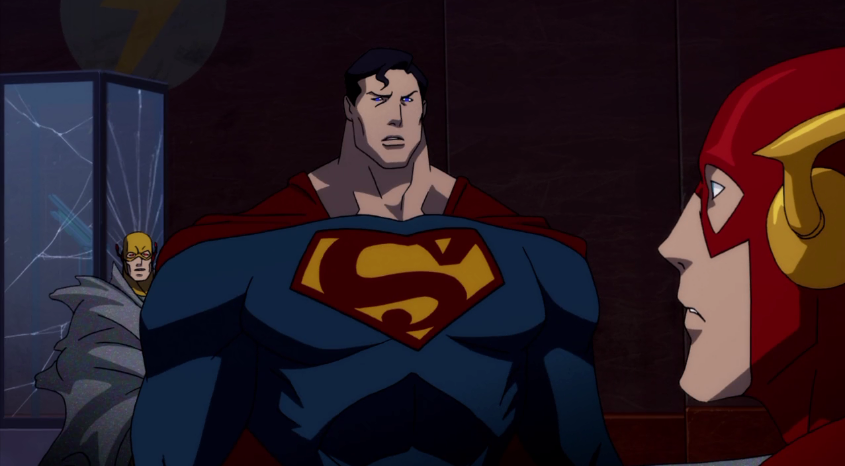
We open with a brief prologue in which we establish the relationship between child Barry Allen and his mother, including her teaching him the so-called “serenity prayer” as a kind of proverb, followed by him discovering her murdered body after school one day. From this, we transition to present day, where Barry (Justin Chambers), accompanied by his wife Iris (Jennifer Hale), leaves flowers on his mother’s grave and says that he wishes he could have been fast enough to save her that day; Iris reminds him that he was only a boy, and if he had gotten home any earlier, it’s likely that he would have been murdered as well. This discussion is interrupted by news that several of Flash’s rogues have gathered at the Flash Museum in order to destroy his legacy; he arrives to face off against the Top, Mirror Master, Heat Wave, and Captains Boomerang and Cold. He handles them all with relative ease until the arrival of Eobard Thawne (C. Thomas Howell), aka the Reverse Flash, who manages to cement him onto a wall and attach a bomb to him. He also reveals that he’s put bombs on all of the other rogues present, and that’s when the rest of the Justice League arrive, and boy oh boy, are they ugly as shit. Their proportions are all out of whack in a way that I think is aiming to be anime-esque but is really just hideous. I mean, look at Superman here: 

His insignia is three times the width of his face, and his shoulders are 8.5 times as wide as the widest part of his jawline. For comparison, when drawing the human figure in proportion, most artistic instruction tells the artist to draw the shoulder line as twice the length of the height of the head, or three times as wide. Superman’s shoulders here are almost double that, at 3.75 times his head height and 6.92 times his head width. I know that some of this is a matter of artistic license or preference, but I would prefer not to look at this; it’s fucking hideous. If we’re being charitable, we can say that this is probably to provide greater contrast to how emaciated and weak his alternate self will appear in the other timeline (spoiler alert), but I hate it, and it puts as much of a sour taste in my mouth about his new film “series” right from the get-go, both the first time I saw it and this time as well. 

Anyway, after they disarm the bombs and Thawne is taken into custody, he says some creepy shit and we head into the opening credits. When we re-emerge into the film proper, Barry wakes up at his desk to find that things are not quite as he remembered them; his boss asks him for an update on the case of the Elongated Kid being murdered rather than the Elongated Man, a TV news report shows a “Citizen” Cold fighting off Captain Boomerang at the Cold Museum, and oh, yeah, he doesn’t have his powers, and his mother is alive. He tries to tell his mom that he’s the Flash, but she doesn’t have any idea what he’s talking about. Elsewhere, a more grizzled Batman (Kevin McKidd) has no problem using guns or throwing his enemies off of buildings to their deaths, although his attempted murder of a villainess is interrupted by Cyborg (Michael B. Jordan, wasted in this role). The younger hero attempts to recruit the Bat into joining the squad that the former is attempting to put together—and in so doing exposits the greater context of what’s happening in this new reality—in order to end the war between Atlantis, as led by Aquaman (Cary Elwes) and the Amazons, with Queen Diana (Vanessa Marshall) as their leader. These two plotlines intersect when Barry, desperate to find someone to help him figure everything out, slips into Wayne Manor, where he finds that this world’s Batman is Thomas Wayne, who became a vigilante when his young son was gunned down in an alley, rather than the other way around. From here, it’s all about figuring out how to get Barry’s powers back and set right what once went wrong. 

There’s fun to be wrung here from some of the little twists of fate and characterization on the darker side of the mirror. It’s so corny that Martha Wayne becomes the Joker in the same moment that Thomas decides to become Batman that it loops all the way back around to being kind of cool, actually. The idea of the “Shazam Kids,” a group of kids to all merge into one hero in the form of Captain Marvel/Shazam is also a neat little touch. Otherwise, though this is a real slog to get through. My problem with the animation isn’t just that the new character designs are awful (although they are, just terrible, really), but also that some of the designs that are clearly reused from other projects look bizarre alongside these bulging hulks; this is most noticeable with the contingent of Atlanteans who are clearly just copied over from Young Justice (Kaldur is especially obvious), who look like carefully carved Greek statues next to the blown-out Aquaman. It also looks cheap, and it has the unfortunate problem of looking cheaper the longer the movie goes on, as if they were running out of budget with every minute. The seams show most close to the end when a newly-repowered Barry is running at superspeed, and the figure of him running on screen looks like an incompletely rendered animatic, like they didn’t actually bother to give the animation team time to finish rendering the CG elements for the final release. One would think that, with the launch of a new ongoing film franchise following this movie that some of the budget would be spent on creating, for instance, a CGI running Flash that looks top-notch, so that they could then use that same model for future films in the series, but this just looks like shit. Furthermore, although it isn’t this film’s fault, both other adaptations of this story for TV and film include the fact that Barry sets out to save his mother from being killed as the catalyst for the plot, meaning that the mystery in this adaptation—who changed the past and why—is utterly moot if you’re coming to this film after interacting with either of those pieces of media. 

I hate this one, and it doesn’t even really need to exist. In a meta sense, I understand the impulse to make one last movie under the Warner Premier label (which dissolved in 2013 and was absorbed into Warner Bros Home Entertainment and Warner Bros Animation; the next film will be released with solely the latter in its production logos), and to find it clever to do a rebooting crisis as the finale. That doesn’t make me feel more fondly toward it, however. Almost all of these movies so far have been completely standalone, with no connection to one another. So what continuity do you need to reboot in order to start telling a new story from the ground up? None! Just start your DTV interconnected franchise with the next movie! There was no tract of land here that needed to be cleared to build a new house, just open space, and they stuck this hideous movie in here for no good reason.

-Mark “Boomer” Redmond

The Not-So-New 52: Green Lantern — Emerald Knights (2011)

Welcome to The Not-So-New 52, your digital Swampflix comic book (adaptation) newsstand! Starting in 2007, DC Comics and Warner Premiere entered the direct-to-home-video market with animated features, mostly in the form of adaptations of well-received event comics or notable arcs. This Swampflix feature takes its name from the 2011 DC relaunch event “The New 52,” and since there are (roughly) fifty-two of these animated features as of the start of 2024, Boomer is watching them in order from the beginning with weekly reviews of each. So, get out your longboxes and mylar sleeves and get ready for weekly doses of grousing, praise, befuddlement, recommendations, and occasional onomatopoeia as we get animated for over fifteen years of not-so-new comic cartoons. 

This one … it’s fine. Ok? It’s fine. This is an anthology film that centers around the first days of training of the Green Lantern Corps’ newest recruit, Arisia Rrab (Elisabeth Moss), with her induction into the group coinciding with a major crisis—naturally—that threatens the Corps’ founders, the Guardians, and the planet on which the organization is based, Oa. Things start out easy enough, as she meets her mentor Hal Jordan (Nathan Fillion, in the first of many portrayals of the character), learns about some of the Corps’ most legendary heroes of past and present, and ultimately proves her mettle by figuring out how to defeat the wraparound story’s big bad. And it’s fine! 

The meat of the story lies in its vignettes, which are perfectly suitable. Together, both we and Arisia learn about the origins of the Green Lanterns, the forging of their rings and those rings’ selection of the first four bearers, including one unlikely candidate in the form of the Guardians’ scribe, who—naturally—winds up defying all expectations. When Arisia worries about how her boot camp with the hulking Kilowog (Henry Rollins) will go, Hal recounts Kilowog’s own brutal training under a previous veteran, who came to see the potential in his pupil when the younger man demonstrated exceptional heroism. When Hal and Arisia encounter Laira (Kelly Hu) and she delivers a prophecy to them, we learn about Laira’s backstory as a princess whose father was saved from death at the hands of an army by the sacrifice of their area’s Green Lantern, and how his ring chose Laira as his successor; years later, she is forced to intervene when her father seeks revenge against his previous oppressors. The following recitation is the best of the bunch, which is fitting, as it’s an adaptation of one of the best stories in the extended GL universe, “Mogo Doesn’t Socialize,” and although it’s a pretty famous one, I won’t spoil it here on the off chance that you’d have any interest in this movie without already having read it. Finally, the still-a-Green-Lantern Sinestro (Jason Isaacs) reveals that his late friend Abin Sur (Arnold Vosloo) was a great believer in fate, unlike Sinestro, until he learned of a prophecy that Sinestro would fall to the dark side and create a Corps that was powered by fear, and rejected the concept of destiny. All that having been wrapped up, the framing device gets wrapped up when the combined might of the Green Lanterns are able to enact Arisia’s crazy/inspired plan and defeat the film’s villain, and a new era dawns. 

This movie is fine. It’s a little thin, which is ironic considering that this one is actually the longest of these films to date, clocking in at 83 minutes; the franchise wouldn’t break the 80 minute mark again for six years, and that’s not even taking into consideration that the title sequence for Emerald Knights is the shortest of them so far as well, not counting Wonder Woman, which consisted solely of a title card. Public Enemies, for example, had a 2:10 title sequence, First Flight’s was two minutes long, and Doomsday clocked in with a whopping three minutes, which is a lot of screen time for something that’s barely more than 75 minutes long. This one is more packed with story than any of the others have been, but that’s not a huge mark in its favor. Although every single one of these things is a corporate product, this one feels the most like it was made with its brand name in mind. This came out the same year as the ill-fated live action Green Lantern starring Ryan Reynolds, and Emerald Knights positively smacks of an attempt to coax some easy money out of a gullible public through synergistic marketing. It’s not badly made—Lauren Montgomery and the other directors on the project are doing good work—but none of these segments are better than the stories from which they’re adapted. Only the first vignette (and the wraparound) is new material, and while it’s fine, that’s all that it is. That same sense of corporate oversight and aftertaste is present in how this film mostly pulls its punches. Compare any of the scenes of action in this one to, for instance, the casual cruelty of Sinestro and the brutal violence of Boodikka’s death in First Flight, or the Amazon battles of Wonder Woman, or even the threat of death by immolation at the hands of the Joker in Under the Red Hood, and this one has more of a Saturday morning feel. It has to if we’re going to be able to package it in a multi-disc set alongside the surefire hit live action feature in time for Christmas! Except it didn’t happen that way, and this film suffers for having been destined (haha) to not only be forgotten because of that movie, but worse because of it, too. 

In its defense, none of these are bad stories. They’re just not as interesting here as they are in the comics, and none of them stands out as an adaptation that improves upon the original text. I can see David Gibbons’s art for “Mogo Doesn’t Socialize” so clearly in my mind (and, at least at the time of writing, you can find it here in its entirety), and although this film does dabble in different art styles for each segment like Gotham Knight, the differences between vignettes is not as extreme, so this one isn’t as exciting as the original comic story. As an intro to the greater Green Lantern mythos for newbies, this one might be perfectly suitable, but it’s very middle of the road for this direct-to-video project, and a little too much of a Green Lantern-shaped corporate project to really lose oneself in.

-Mark “Boomer” Redmond

The Not-So-New 52: Superman/Batman — Apocalypse (2010)

Welcome to The Not-So-New 52, your digital Swampflix comic book (adaptation) newsstand! Starting in 2007, DC Comics and Warner Premiere entered the direct-to-home-video market with animated features, mostly in the form of adaptations of well-received event comics or notable arcs. This Swampflix feature takes its name from the 2011 DC relaunch event “The New 52,” and since there are (roughly) fifty-two of these animated features as of the start of 2024, Boomer is watching them in order from the beginning with weekly reviews of each. So, get out your longboxes and mylar sleeves and get ready for weekly doses of grousing, praise, befuddlement, recommendations, and occasional onomatopoeia as we get animated for over fifteen years of not-so-new comic cartoons. 

I love Supergirl. Kara Zor-El is such a favorite character of mine that, even when I sold almost all of my comics half a decade ago, I couldn’t bear to part with the Supergirl issues that I had bought way back when I was a college freshman, the ones written by Jeph Loeb, penciled by Ian Churchill, and inked by Norm Rapmund (among others; for those who are interested in the minutiae, I’m talking about Volume 5). I spent hours practicing my own art by redrawing panels from that comic book run, and was completely fascinated by the comic run’s upending of the Supergirl narrative. Ever since her inception, Kara had always been treated as Clark/Kal/Superman’s younger cousin, who had been born on (essentially) a refugee colony before finding her way to Earth to meet the older relative who had so inspired her; that Kara (in)famously not only died but was retconned out of existence as part of the major 1986 comic event Crisis on Infinite Earths. I’ve never seen this discussed anywhere, but I have a feeling that part of that decision was the fact that the 1984 Supergirl film starring Helen Slater bombed so hard critically and commercially (calling it “not great” is charitable, but for a Supergirl fan like me it’s not without its charms). 

This Kara was a bold and fresh new direction for the character in the new millennium: instead of being the younger of the last two survivors of Krypton, the Kara introduced in 2005 was the older of the pair, at least chronologically, as she was already a teenager when their planet was destroyed. In fact, she had been sent specifically to become the guardian and caretaker for her baby cousin, but because her pod was caught up in a chunk of Kryptonian debris, she remained in suspended animation for several decades, arriving on Earth to meet a Kal who had already grown into an adult and become Superman. Now she was not only one of the last children of Krypton, but she was specifically more of a fish out of water, alienated both from the new world on which she found herself but also from the only person she could have reasonably expected to have an automatic connection to, as he had been raised in a completely different culture. Without a mission, without an anchor, Kara was a brand new character with a brand new angle to explore. Before the launch of her own title, the character was reintroduced in the Superman/Batman storyline “The Supergirl from Krypton,” which itself came on the heels of that same comic’s “Public Enemies” arc, which featured the titular duo having to stop an asteroid of Kryptonite from crashing into the Earth. If that sounds familiar, it should! That comic was adapted into Public Enemies, which we’ve already discussed. That means that we’ve come to the first direct sequel within this project, Superman/Batman: Apocalypse

The plot here adheres pretty closely to the source material. The kryptonite asteroid that Lex Luthor spent the previous film/arc underplaying has been destroyed, but not without leaving behind some debris, which includes a Kryptonian pod containing a young woman. She lands in Gotham Bay and is rescued by Batman before being taken under the wing of her cousin, whom she is surprised to learn is an adult and a hero, but he relinquishes custody of her to Wonder Woman and the Amazons when they arrive in Metropolis and insist that Kara is too powerful to live in such a populous location and “offer” to train her on Paradise Island. While there, Kara develops a close friendship with the precognitive blonde Lyla, who is wracked by visions of Clark pulling Kara’s lifeless corpse out of a body of water. Elsewhere, on the planet Apokolips, imperialist dictator Darkseid has decided that the girl who fell to Earth is the perfect candidate to become the new leader of his honor guard after the abdication and defection of his previous lieutenant, Big Barda. He arranges for the kidnapping of Kara from Themyscira, with the crossfire resulting in Lyla’s death, her vision fulfilled as we see it was her body that Superman cradles on the beach after the attack, not Kara’s. The trio of Superman, Batman, and Wonder Woman (joined by Big Barda) take the fight to Darkseid in order to retrieve the Girl of Steel and bring her home. 

One of the things that people mock most about the ‘84 Supergirl is that it’s not content to really be a story about Kara Zor-El the way that the preceding Christopher Reeve movies (the good ones, anyway) were stories about Superman. What I mean by that is that Supergirl isn’t just about a fish out of water superhero who happens to be a young woman, it’s about a young woman who occasionally gets involved in magical/superheroing shenanigans. It feels very much like what a board room full of men think young girls would want to see in a movie about a super girl: girls boarding school hooliganism, flying around horses, trying on a bunch of outfits, etc. Instead of Gene Hackman’s Lex Luthor hatching a giant real estate plot that will result in cataclysmic death as collateral, Faye Dunaway’s Serena almost destroys a small town (and its Popeyes) because she’s obsessed with a groundskeeper who goes on a couple of dates with Kara and she saw him first (no offense to the actor, he’s a reasonably attractive man, but not exactly fight-an-alien hot). The problem with Apocalypse is that this film far too closely resembles that earlier film about Supergirl, up to and including the fact that her first interaction with humans is that a couple of blue-collar men make threatening sexual comments and then get their asses handed to them—these movies are twenty-five years apart, and that’s still the best that there is on offer here. Plus, this one has the addition of an extremely typical shopping montage that starts with Kara saying “Teach me everything there is to know about being an Earth girl!” and ends with “I think I’m going to love being an Earth girl!” It’s just so … I hate to use the word “uninspired,” but it really is. By the time the film tries to wring some pathos out of Kara’s concerns about whether her brief time as a villain in Darkseid’s employ was because of some darkness within her, it’s too little, too late; compared to the similar ambiguity about whether her darkness was internal or brought about through outside manipulation that we just saw in Under the Red Hood, this one falls very flat. 

That having been said, this movie is a major improvement over some parts of the previous installment in other ways. Gone are the ugly character designs that made Public Enemies an anti-aesthetic experience, replaced with the beautiful designs seen in Mike Turner’s on-page work, the same art that was so inspirational to me lo these many years ago. Although the relegation of Batman to more of a supporting role (despite what the title of the movie might suggest) means that the positive element of the easy friendship between him and Supes is absent, there’s still a lot to love here. Summer Glau was the adoration object of straight male nerds of the late aughts and early ‘10s, coming in hot off of her roles in Firefly and The Sarah Connor Chronicles, and she does good work here, and the late Andre Braugher is fantastic as Darkseid. And although I normally find my mind wandering during a lot of the action sequences in these movies, this one has several good ones, with the final showstopper battle with Darkseid at the Kent farm in Smallville being a real standout, not just in this movie, but for all of them. It’s brutal, and although it’s much smaller scale than most of the “urban population center” fights that populate this franchise, it has real punch. 

The first time I saw this one, back when it was released, I had no idea that it was a sequel to Public Enemies, a movie that I hadn’t seen, and I appreciated it for no other reason than because my (super)girl was in it. It functions just fine in that regard, even if it is middling in a lot of ways. When Supergirl was reintroduced in comics back in 2005, it had been nineteen years since the character was last seen, which seemed like such a triumphant return after an incredibly long time. It’s now been nineteen years since then, which is a nice piece of symmetry, but I wish that I had more to say about that other than express how much I loved those comics compared to how lukewarm I am on this adaptation. Really only of interest to fans of Kara Zor-El, and even then, it’s not the most interesting story with her that you can find. 

-Mark “Boomer” Redmond

The Not-So-New 52: Batman — Under the Red Hood (2010)

Welcome to The Not-So-New 52, your digital Swampflix comic book (adaptation) newsstand! Starting in 2007, DC Comics and Warner Premiere entered the direct-to-home-video market with animated features, mostly in the form of adaptations of well-received event comics or notable arcs. This Swampflix feature takes its name from the 2011 DC relaunch event “The New 52,” and since there are (roughly) fifty-two of these animated features as of the start of 2024, Boomer is watching them in order from the beginning with weekly reviews of each. So, get out your longboxes and mylar sleeves and get ready for weekly doses of grousing, praise, befuddlement, recommendations, and occasional onomatopoeia as we get animated for over fifteen years of not-so-new comic cartoons. 

I wasn’t totally sure that I would have something new to say about this movie. Of all of the movies in this project, this is the one that I’ve seen the most (I think; Crisis on Two Earths is another that I watched over and over again during a time when I didn’t have the internet at home), and we’ve already discussed it here on Swampflix as a Movie of the Month, alllll the way back in May of 2018. What I said in my intro there, that this is my favorite Batman movie—not just in animation, but in general—remains true. There’s nothing quite like it, and although there was a very brief moment when I considered skipping over this one since it had already been a subject here, I immediately realized that I would be depriving myself of a reason to watch one of my favorites again, so I dove right in. 

In case you don’t care to read our MotM about it (how dare you), the plot is this: after the bloody death of Jason Todd (Jensen Ackles), the second boy to wear the Robin costume, the lives of everyone involved are forever changed. Joker (John DiMaggio), who delivered the beating that clipped the Boy Wonder’s wings, is in jail; Batman (Bruce Greenwood) has taken on no new proteges and is even averse to teaming up with the first Robin, Dick Grayson, who now works on his own as the hero Nightwing (Neil Patrick Harris); and Ra’s al Ghul (Jason Isaacs), who initially teamed with the Joker so that the clown would distract Batman while he went about his world-changing shenanigans, was so disgusted by the sheer brutality of what happened that he has stopped minding the Caped Crusader’s business altogether, and attempted to make things right in a way that only served to make things worse. It’s now been several years, and a mysterious new vigilante has appeared in Gotham City, one who—unlike Batman—has no rule against killing his enemies and is more than willing to become a de facto crime boss in his pursuit of toppling the criminal empire of Black Mask (Wade Williams). Who is this new player, the Red Hood, and what does he want? 

There have been so many attempts to make comic book movies that are “darker,” or “edgier,” or “grittier,” but they almost universally go about this in ways that are aimed at seeming more dark to a certain demographic. Perhaps the most well known example of this was in one of the earliest trailers for the 2018 DC series Titans, which featured God’s prettiest angel Brenton Thwaites as Dick “Robin” Grayson growling “fuck Batman” (it’s at 0:55, if you’re interested), which immediately became the subject of much mockery online; for my money, it’s not nearly as cringe-inducing as every single thing about Jared Leto’s Joker, but that’s neither here nor there. Under the Red Hood manages to be the more adult story that people are always saying that they want, not through sheer violence (although there definitely is that) or nonsensical swearing (there’s nothing more blue than the occasional “damn” here), but just by honestly and earnestly portraying the loneliness and grief of loss and the resistance to accepting that someone you loved could return to you, transmogrified into a monster that you don’t recognize. This isn’t a story about a Batman who, at his core, is a scared little boy lashing out at the darkness that took his family from him; this is a story about a Batman who was a father, who saw that there was darkness in his son and tried to encourage him to refocus that energy into something that could affect positive change and then losing that son, twice. 

There’s a moment in this where Batman delivers one, six word line that floats to the top of my mind every time I think about this movie. It comes at the end of an exchange that Bruce has with Alfred over the radio:

Alfred: Sir, please take this to heart. Who Jason was before, how we lost him, and this dark miracle or curse that has brought about his return… it is not your fault. l know you view his death as your greatest failure but–

Bruce: His life and his death are my greatest failure. Do you remember how he was when I found him?

Alfred: Of course, sir.

Bruce: Fearless, arrogant, brash and gifted. Different [from] Dick in so many ways, but still so full of potential and power.But I knew, even from the beginning, he was dangerous. lf I hadn’t made him into Robin, he would have grown to do wrong. Then I got him killed.

And then—

Bruce: My partner. My soldier. My fault.

There’s no one who can hold a candle to Kevin Conroy when it comes to portrayals of Batman, but Greenwood comes very close here, infusing those simple words with meaning that far exceed the silliness of this whole animated endeavor. Greenwood’s Bruce is carrying the weight of the world in a way that only someone who recognizes the extent of the devastation that he has wrought can convey, the gravitas that can only be mustered by someone who suddenly finds themselves at the gates of Hell only to look back and see how much of highway they’ve paved with their good intentions. It’s stunning; I would honestly pay good money to watch ten seconds of footage of Bruce Greenwood delivering this brief monologue. He’s haunted, quite literally—at its core, this is a ghost story. Everywhere he goes, Bruce sees the echoes of the past, his occasional moments of joy but most often his failures and regrets: the flashback to the night that the Joker was born, a shadowplay of the day that he first met Jason as a street kid in the process of trying to boost the tires off of the Batmobile, a recollection of one of the many fights in which Jason’s aggression ran counter to their mission and which, in retrospect, question whether Jason’s fall to the dark side was inevitable. 

Of course Red Hood is Jason—who else could he be? No DC property treats this like a spoiler anymore; when the aforementioned Titans did a variation on the Red Hood plot in its third season, the fact that Jason was under the helmet was a kind of internal reveal, but wasn’t played for shock for the audience, and now that the character has appeared in video games without any attempts to keep his identity a secret. I’m not even sure that this film intends to obscure this fact, given that the law of conservation of detail means that anyone who’s ever seen a movie before has already done the math long before Bruce figures it out. Reading the film this way, the lengths that Bruce goes to in order to try and convince himself that his adopted son can’t possibly be the murdering psychopath stalking the streets are all the more heartbreaking. He knows that Red Hood is Jason the moment that he hears Jason’s voice saying his name, but he still has to try and disprove it, even going so far as to dig up the boy’s (supposed) grave, all while we all already know the truth. He’s already lost Jason once, and now he has to grieve for him again, not because his son is dead, but because he’s too far gone to be saved. The hits don’t stop coming even when the two are face to face, when Jason tells Bruce that he doesn’t blame the older man for failing to save him, but he can’t stand living with the fact that Bruce let Joker live afterward. And why? “Because he took me away from you,” Jason says, softly. At the core of his grief, and his rage, is the belief that his father didn’t love him enough to avenge him. It’s devastating. 

Even though I like the brows on my culture to be both high and low in equal measure, I would never pretend that anything I’ve watched so far in this project would be adequately described as “cinema” even when the elements themselves can be cinematic (I’m still thinking about Anne Heche’s performance in Doomsday, even all these weeks later), but this one is really a cut above. If you were to watch only one of these movies, this is the one.

-Mark “Boomer” Redmond