The first few weeks of Donald Trump’s second presidential term have surprisingly been defined more by the daily stunts & shenanigans of unelected government official Elon Musk than they have been by the actions of the president himself. Sure, Trump is signing a relentless barrage of hateful, unconstitutional Executive Orders that are threatening to crumble decades of social & economic progress in a matter of days. That was fully expected, though, especially if you paid any attention to the “Project 2025” agenda advertised during his election campaign. Musk’s overt, oligarchic influence on these Executive Branch actions have been just as nefarious but much more bizarre, especially as an extension of the failed meme humor of his current reign as the Villain King of Twitter. It’s not enough that Trump & Musk are wielding institutional power to reshape America with a straight-up Nazi agenda; they’re also irony-washing that Nazi ideology through several layers of internet meme humor, so that their above-board, bought-and-paid-for coup is read as a humorous prank meant to “trigger the libs,” not to welcome in a new, shameless era of American fascism. Between Musk’s “DOGE” branding, his juvenile obsession with the numbers 69 & 420, and the bar now being so low that his executing a Nazi salute at Trump’s inauguration now qualifies as a “dog whistle,” it’s clear that we’re living through America’s first 4chan presidency. Evil has never been so inane.
If you catch yourself wondering how, exactly, we got here over the last few years, I’ve seen no better explainer than the 2020 documentary Feels Good Man. A 90-minute history lesson on the memeification of a cartoon stoner frog may sound trivial in the context of America’s Nazi takeover, but Feels Good Man somehow does a better job explaining & contextualizing that far-right political shift than any other film I’ve seen – predating and overriding all of those QAnon docs that auto-populated on every streaming service in the years following the January 6 coup attempt of 2021. The stoner frog in question is, of course, Pepe the Frog, the breakout character from alt-comics artist Matt Furie’s cult series Boys Club. A soft-spoken San Francisco stoner who’s been drawing goofy frog doodles his entire life, Furie confides that Pepe is the Boys Club character he most personally identifies with . . . which is a brave thing to admit given the character’s eventual perversion and radicalization in the Hell pits of 4chan once it escaped the pages of his comic book. A single frame of Boys Club in which Pepe explains to his burnout roommates that he urinates with his pants completely lowered to his ankles because it “feels good man” was a funny enough image that it started getting shared on the internet outside the context of its source material and, as the movie argues, somehow snowballed into Donald Trump becoming the 45th President of the United States.
I have a general affection for Anthropology of the Internet documentaries that immortalize disposable online ephemera for cinematic prosperity, especially when they capture the sinister atmosphere of the Internet’s dankest dungeons (see also: the Russian dashcam compilation The Road Movie, the evil-clown sightings doc Wrinkles the Clown, and Jane Schoenbrun’s Slenderman doc A Self-Induced Hallucination). Even so, Feels Good Man does a better job than most at explaining how its own subject’s online virality led to real-world consequences outside niche meme forums. It chronicles Pepe the Frog’s transformation in the hellfires of 4chan from loveable frog to “the new swastika”, explaining how users who identified with Pepe as much as its creator had to force the frog to “go dark” to protect him from “normies” (i.e., women) who might identify with him as well. Because 4chan is an attention-economy culture that mostly traffics in “ironic” racism, this effort manifested as Pepe becoming a mouthpiece for Nazi rhetoric and an online dog whistle for alt-right C.H.U.D.s. Making Pepe as bigoted as possible became a kind of online game, and it gave real-world Right Wing ghouls a way to signal to the keyboard Nazis at home that the Trump-led establishment shared their values without abandoning their more buttoned-up, traditional voter base. That co-opting seems a little quaint now that Elon Musk is Sieg Heiling on an official government stage, but it was a major stepping stone that led us here.
The half of Feels Good Man that explains how 4chan memes created a new Nazi America is populated with all the expected demons of 2010s alt-right ascension. Pepe’s Nazi radicalization was directly inspired by Steve Bannon’s political strategy to “flood the zone with shit,” which has become the go-to playbook for the Trump-led Republican Party. During the infamous street interview when Richard Spencer is punched in the face by a protester, he’s explaining his Pepe the Frog lapel pin to a reporter at the moment the fist connects with his jaw (which the movie graciously repeats in several loops for our viewing pleasure). Pepe is even transformed into a direct stand-in for Trump himself, outfitted with a new smug facial expression and a Trumpian wig. Most critically, former Infowars blowhard Alex Jones is sued for copyright infringement by Matt Furie after using Pepe’s image on a fundraising campaign poster, marking Furie’s too-little-too-late attempt to reclaim his intellectual property from the worst people alive. The half of the film that’s about Furie’s astonishment & unpreparedness for the Internet’s hateful perversion of Pepe is adorably naive and populated with fellow alt-comics artists who are sad to see their friend suffer in this exponentially shitty shithole of a world: Lisa Hanawalt, Johnny Ryan, Aiyana Udesen, etc. Their attempt to reclaim Pepe and save his reputation was heavily outgunned, though, since the opposition included literal White House occupants.
It’s easy to roll your eyes at the twee preciousness of Furie’s pleas for good vibes and kindness as opposition against the hateful scum who’ve stolen & desecrated his art, but I appreciate the sentiment. I could not have sat through an exhaustive recounting of how 4chan “elected a meme as a president” and ushered in a Fourth Reich for the LOLs without a little kindness & levity. Being reminded that there are still sweet, reasonable people in the world who are oblivious to the deep well of evil on the other side of their computer screens was a calming counterbalance to the infuriating co-opting of meme culture to enact real-world fascism detailed elsewhere in the film. Five years later, it’s clear which side of that divide is winning the Culture War, but it’s also clear that they cannot create anything substantial themselves worthy of sharing & celebrating; they can only pervert, corrupt, and drain the humor & life out of previously existing art & language (which explains their more recent fondness for generative A.I.). As evidenced by the interstitial animations that imagine what it might be like if Boys Club had been adapted into a psychedelic Adult Swim sitcom instead of a Nazi dog whistle, Pepe deserved so much better than the hell-world we live in. He’s a cool frog.
A Glitch in the Matrix is a (purported) documentary about people who believe in some form of what’s known as the simulation hypothesis, which essentially postulates that existence—as we perceive, experience, measure, and know it—is an artificially created simulation. The film was directed by Rodney Ascher, and if that name is familiar to you, it’s likely because he also helmed the 2012 documentary Room 237, (a film that purported itself as) an academic and scholarly deconstruction of Stanley Kubrick’s horror classic The Shining, creating a lens through which the film could be viewed as both Kubrick’s confession and his exegesis. Although you may not have seen Room 237, you’ve still probably born witness to its reverberations in the pop culture discourse; for instance, if you’ve ever seen a tweet or a listicle that references Kubrick’s involvement in creating false footage of the moon landing or read an article about how The Shining is really about the collision of American imperialism with Native Americans, you’ve seen the cultural impact of Room 237.
For the first hour of Glitch, the film assumes an editorial tone that could charitably be described as “negligent.” The simulation hypothesis itself is laid out for the presumably unfamiliar viewer using clips from films that feature characters awakening to an understanding that their reality is somehow falsified or otherwise unreal: The Truman Show, Brazil, They Live!, and, of course, The Matrix. Interspersed with this exposition are excised-from-context clips from various respectable (if problematic) academics and intellectuals like Neil DeGrasse Tyson, using soundbytes that overemphasize their concessions about the possibility that the simulation hypothesis reflects an accurate understanding of our reality (for the record, that’s not what he said). For some reason, there are also a lot of longer, non-excised clips of non-scientist and former trust fund kid turned insouciant, nascent Bond villain Elon Musk, in which he talks about his own ideas about the simulation hypothesis, which we will definitely be circling back to. Additionally, there are long clips taken from noted speculative fiction author Philip K. Dick’s infamous appearance at a conference in Metz, France. For the uninitiated, much (if not all) of Dick’s prose focuses upon protagonists whose lives are somehow unreal, either because the character prioritizes a fictive inner life which is demonstrably oppositional to their lived experience, or because the character exists in a fiction within a fiction before realizing the falseness of their presumed reality. In that rare public appearance, a post-psychotic break Dick elaborated on the idea that his novels were not fiction, but were in fact true, and that his writing of them was his way of exploring his “realization” that he had personally experienced multiple different timelines, and in so doing unintentionally elaborated upon and outlined the psychological delusion that we now call the “Mandela effect.”
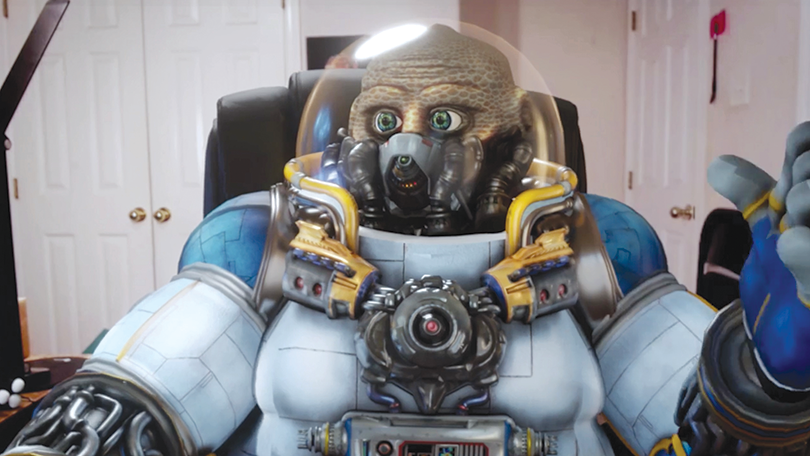
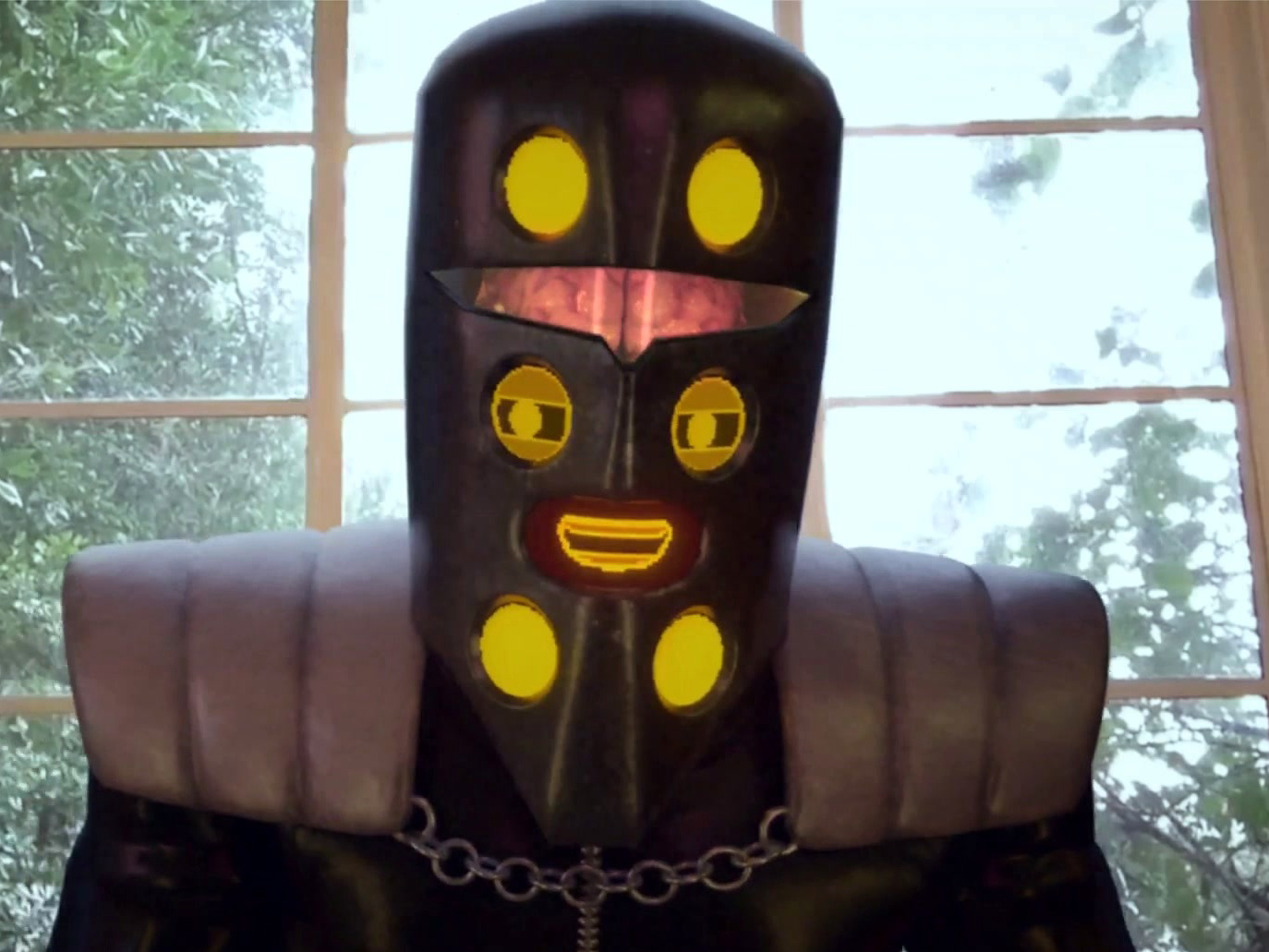
Among these irresponsibly arranged sound bytes and film clips, we also get to meet several of the documentary’s subjects, most of whom were interviewed via some kind of video conference software, and who appear on screen as video game-esque avatars. There’s Jesse Orion, a special education teacher who dreams of being an illustrator full time; we get to see some of his work, which includes a skull drawn in a Mike Mignola style as well as pages from his redrawing of an entire volume of Jean “Moebius” Giraud’s work using characters from the Peanuts comic strip. There’s also Leao Mystwood, who appears as a kind of high-tech Anubis; his time spent in a sensory deprivation chamber convinced him that his perception of himself as having or being a physical form is false, and that he is instead composed of code. There’s Alex Levine, whose avatar looks like a cross between the classic “brain in a jar” image that accompanies many discussions of simulation hypothesis and 790 from Lexx. But the interviewee we spend the most time with, and who in fact the film opens on and who deliberately “set[s] the tenor” of the piece as a whole is Paul Gude, who portrays (and perhaps perceives) himself as leonine. Paul opens with a story about attending a lecture while at university, in which his instructor discussed the genealogy of neurological epistemology as understood by theorists who were bound by the horizons of their knowledge; that is to say, when the highest level of technology was the aqueduct, the human understanding of neuroscience was perceived as and delineated through the use of fluids/humors, and then the rise of telegraphy altered that perception and description to instead treat the nervous system as a series of wires and impulses. From there, the rise of sophisticated computing technology lead to the contemporary understanding of the mind as a kind of CPU informs our current understanding of reality and the perception thereof; Gude then posits that since we now have technology capable of replicating reality virtually, we should then not only have the ability to conceive of our perception of reality as virtual, but to an extent, we must concede that it is so.
Gude notes that he was adopted, and that his adoptive father was a clergyman, and talks at length about his childhood proddings at the concepts of what constitutes reality. Some of this is familiar to me, although I wouldn’t go so far as to presume the universality of those experiences. One anecdote revolves around his childhood move to an area with a much smaller population than the city in which he previously resided, and his internal mental justification of this was that this was the result of the need for “them” to use less processing power to render fewer people and objects; the long drive to and from other areas was therefore the result of the need for “them” to change the surroundings and set up the next location. Although he doesn’t come straight out and use this analogy, it could be more simply explained that he conceived of car trips with his father as the equivalent of a loading screen between sections of a video game that show up while the next area is rendered. Another instance of his worldview being altered occurs while he is sitting in church, listening to his fellow congregants sing a hymn in unison, and his subsequent “realization” that what he is perceiving as a musical harmony and the assumption that it is produced by air forced through internal human flesh must be false, that it in fact could not possibly be the case. His story is presented without commentary, creating (through the language of documentary filmmaking) the impression that the documentarian concurs with this analysis and sees no issue with arriving at the conclusion that reality is a simulation because it’s “impossible” that the sounds of people singing are created by the vibration of larynxes. This is what I’m talking about when I say that the editorial tone is questionable; these are not intercut with psychologists elaborating upon common delusions and their physiological origins, but are simply presented as completely rational ideas.
Gude is not the only subject here for whom a history of teleological theology clearly underpins their perception (and associative distrust of the parameters) of reality. Leao Mystwood, whose introductory chyron provides the appellation “Brother,” also notes that he himself is an ordained minister. Textually, the film itself draws a comparison between the simulation hypothesis and many religious teachings, specifically citing Luke 7:21, in which Jesus, upon being asked about the Kingdom of Heaven, notes that the kingdom is “within” the questioners, existing both inside and outside of them. For someone for whom the concept that we reside in a simulation is an a priori assumption about the nature of existence, this statement, taken through that lens, seems to be that of an Avatar (defined traditionally, e.g., a divine being made flesh in our world) describing an external, “truer” world to beings who can only perceive the simulation that is “housed” within that truer world. And, despite the fact that Jesus also described the Kingdom of Heaven as a place of feasting with Abraham, Isaac and Jacob, a man who sowed good seed in his field, treasure hidden in a field, a net, and yeast, I think that interpreting the concept of “heaven” as a “truer” outer world within which our world is but a shadow on a wall is completely legitimate—and therein lies the rub of this film as a whole. After all, what is the simulation hypothesis if not a kind of creationism? I put “them” in quotations earlier when discussing Paul Gude’s ideas because he never names these actors and artificers who are exterior to the simulation, and neither does anyone else who was interviewed for this documentary; who are “they?” What could “they” possibly be other than the divine, or some secularized recontextualization of the concept of divine beings?
I find A Glitch in the Matrix troubling. That’s not because its “revelations” shock me to my core or make me re-evaluate the reality of, well, my reality. To be quite frank, the “simulation hypothesis” is essentially what I was raised to believe, as elaborated upon here, simply with a different name and an overlayment of scientific buzzwords and bizarre fetishization of Elon Musk (I haven’t forgotten about that part) over it to make it seem not only plausible but undeniable, when in reality it comes down to one of the oldest human concepts of them all: faith. One of the core tenets of faith is that this mortal, decaying flesh is not all that we are. That there is something external, that there is something higher, that there is a consciousness or consciousnesses which supersede and exist beyond ourselves which exert authority over our existence. Regardless of whether or not I personally think that interpretation of existence is valid, whether that concept comes in the form of a deity in heaven above or a programmer of the simulation, both require the same rejection of empirical reality as it can be measured, tasted, and observed and embrace an unfalsifiable concept of existence. That’s fine! But to present a text that defines existence this way as a documentary, to treat the belief system as fact instead of a chronicle about the people who believe it as fact isn’t documentation at all; it’s proselytization. It’s the same as when the VHS box for Future Tenseproclaims that it’s a “true story” that just “hasn’t happened… yet,” except that, unlike that production, this one doesn’t advertise itself as an evangelical tool. This presents itself as a factual document of record, which is both disingenuous and dangerous.
To give credit where it’s due, the second half of the film delves further into the dark potential of this way of thinking. In the first half, more than one of the interview subjects notes that there are people with whom they have interacted whose personal tendencies toward antisocial behavior and violence were only curbed by the belief that reality is real and therefore there are consequences to violence. This smacks of the logical fallacy that many people express, that we must maintain a society-wide belief in a higher power/metaphysical consequence in order for the populace to inhibit their darker impulses; you see this in the way that many people can’t wrap their heads around the proven validity of redistributing police and carceral punishment funds to preventative social safety nets as a method of preventing (instead of punishing) crime. There are a great many people (including, in my opinion, most of the people who appear in this movie) who need psychological therapy and/or pharmaceutical assistance to reach a baseline of empathetic civility. That the belief that others are less “real” than oneself creates a space for violence in its very core; it’s the foundational basis of white supremacy and other forms of antisocial ideologies that often result in violence in the public and private spheres. The film does denounce this potentiality, at least, and does so through a recorded phone call with Joshua Cooke.
That name, too, may sound familiar; nearly two decades ago, Cooke murdered his parents in the basement of their home with a shotgun. Infamously, his lawyers considered pleading insanity on his behalf, citing that Cooke “harbored a bona fide belief that he was living in [a] virtual reality,” which became known as the “Matrix defense” (Cooke eventually pled guilty). The possibility that the rejection of the fundamentals of reality could lead to violence is also referred to as the “school shooter” mentality within the film, but the film fails to provide a truly robust condemnation of violence within its text, and I think that’s rather telling. The proliferation of a multitude of people who take to the internet to share photoshopped images of cereal boxes and TV Guide typos to use as visual aids to the recapitulation of their experience of the so-called Mandela Effect isn’t just harmless shenaniganry; it’s a demonstration of the larger parts of society’s growing unwillingness to reexamine their precepts and beliefs, even in the face of evidence against it. We are living in an era in which people are more likely to believe that they’re sliding through parallel universes like Quinn Mallory rather than consider that their memory might fail to be 100% accurate, simply because Reddit told them so; we’re seeing the consequences of that now, politically and globally. To paraphrase another giant of speculative fiction, Isaac Asimov, there is a growing contingent of Americans who legitimately believe that their ignorance (and misremembrance) is just as valid as scientific knowledge and evidence, and it’s that which I find truly deplorable about A Glitch in the Matrix’s text—it will only add more fuel to that fire which threatens to consume our world. Blink and you’ll miss it, but one of the interviewees notes that they think large scale disasters, including those like recent California wildfires that are exacerbated by climate change, are the result of programming errors; every day in every way they’re coming up with new reasons to denigrate the need for immediate action to mitigate and prepare for climate change.
Although the second portion of the film attempts to cover the failures of the film’s first hour, its bizarre fetishization of Musk extends beyond the questionable first half into the second. And make no mistake—some of these people come within a hair’s breadth of literally worshipping Musk. Taking into consideration that the simulation hypothesis is just creationism with extra steps, at least one of the interviewees essentially likens Musk to a god. While explicating on the idea that some people are player characters and others are non-player/playable characters (or NPCs), one of the interviewees speculates that Musk might be not only a player character, but someone from outside the simulation who “descended” into our reality as an avatar in order to try and awaken us and to a recognition that the simulation as false. That is to say: this person believes that it’s possible Musk is an extra-simulation messiah. At the risk of editorializing, I’ll say this: if god were one of us, I’d accept that they were a slob like one of us or a stranger on the bus, but they sure as hell wouldn’t be a guest on Joe fucking Rogan’s podcast. I get that for many neurodivergent people, Musk’s accomplishments (such as they are) are encouraging and demonstrate that people with Asperger’s shouldn’t be dismissed out of hand, but I won’t make any apologies for failing to be impressed that the heir to an apartheid emerald mine leveraged obscene and objectively amoral wealth into a business empire that’s largely dysfunctional. You’d be hard pressed to find someone more interested in living on the moon than I am, but I’m not gonna work for Mr. Grimes’s scrip and I’m not going to live in one of his lunar debtor’s prisons/company towns; you can fucking forget that.
I mean no disrespect to those who work in the service industry, but when someone says “For two years, all I did was work at Chili’s and then come home and play video games,” and then uses that as the basis for their claim that they then “realized” that reality was also just a video game, that’s a person who needs counseling and therapy to manage their addiction. I’m not mocking this guy: addiction is a disease, it takes many forms, and it warps your reality. What it doesn’t do is make you an expert on that reality. The two works that this most reminded me of were the film What the #$*! Do We Know!? and the book Supergods by Grant Morrison. In the case of the former, Glitch is similar in that it presents pseudoscientific ideas not as a possible interpretation of existence, but as decidedly true (and, although I am aware that this verges on ad hominem, it’s worth noting that it was created by NXIVM cultists). In the case of the latter, I find the use of footage from Philip K. Dick’s mental breakdown to be both heartbreaking and cruel; it reminded me of Morrison’s book, which for the first 2/3rds is a loving, jubilant history of superhero comics and that artform’s various wonders, before the final third descends into a bizarre scripture of Morrison’s personal beliefs. I won’t try to summarize them here, but here’s a sample (from p. 277 of the 2012 Spiegel & Grau paperback edition): “The interior of our skulls contains a portal to infinity [….] Could fertile wet planets like our Earth really be nurseries where omni-anemones fed and grew to become quicksilver angels in a timeless AllNow?” For the sake of my future hypothetical political career I won’t get into specifics, but I’ve personally spent a not-insignificant amount of time communing with the fractals, if you catch my drift; that doesn’t mean that I would ever consider that experience to be revelatory about the nature of reality, and if I did, and I tried to start spreading the Gospel of Boomer, and that Gospel also incorporated depersonalization that is analogous to that which is part of evil ideologies, I’d hope no one would follow me. I also hope no one takes this documentary to heart, and in the meantime I’ll be looking forward to a different documentary about the simulation hypothesis someday, one which is more scientifically, spiritually, and ethically considered.




 Swampflix