I’ve brought up in previous reviews that, for many of my teenage years, Douglas Brode’s Edge of Your Seat: The 100 Greatest Movie Thrillers was a treasury of knowledge for me. I’ve had the book for decades, making notes in it that go back to 2003 about when I watched a film on the list, what my personal rating was, that sort of thing. I’m still working my way through it, having seen about half of them. Some of these were fairly recent, like The Conversation (#60) and The Last of Sheila (#88), with my Roger Corman Poe adaptation journey meaning that The Pit and the Pendulum (#61) soon to be added to that list. Just ahead of that one and The Conversation, at #59, is 1946’s The Spiral Staircase, and I’m delighted to report that it does not disappoint. Just as a forewarning to anyone who may be interested and has access to Brode’s book, however, please note that the film’s synopsis does spoil the identity of the killer, so make sure to view the film before reading that section.
Set some years before the film’s actual production date (more on that later), the film opens on Helen (Dorothy McGuire) attending a screening of the silent 1896 film The Kiss, although the movie treats this as a feature rather than the 18 second featurette that it really is. The screening is being held just off of the lobby of a hotel, and upstairs, a woman is strangled to death. The constable (James Bell) arrives and speaks with Dr. Parry (Kent Smith), a relative newcomer in town who wishes to offer his opinion, even though the town’s primary physician is already on-site. Parry then offers to give Helen a ride home in his horse-and-buggy, and it becomes apparent that Helen is mute, and Parry regards her with some affection and has attempted to interest her in seeing a Bostonian doctor friend of his about treatment for her condition. He’s pulled away by a medical emergency before getting her all the way home, but she’s fine to walk the rest of the way, at least until a sudden thunderstorm occurs. As Helen races back to the mansion in which she is employed as a servant, we see that she is being watched by a rain-drenched man in a slicker and hat. There’s great concern that Helen may be the killer’s next victim, as each of the previous killings were of women with some kind of disability.
The mansion itself is a great set, with the spiral staircase that Helen ascends and descends throughout taking center stage. Even though we spend an unbroken hour within its walls, the house’s expansiveness means that it never becomes boring visually, and we learn the place’s general layout fairly quickly, which makes the breakneck pace of the final act easy to follow as Helen rushes about, pursued by her would-be killer. It also means that there’s plenty of room for a smorgasbord of characters, any one of which could be the murderer. There’s Dr. Parry, of course, whose recent arrival to the community marks him as a kind of outsider, and whose interest in Helen could be more than merely medical or social. The house’s matriarch is Mrs. Warren (Ethel Barrymore), apparently bedridden and requiring nursing care, but who prefers the ministrations of Helen, although she warns the girl several times that she should flee the house and never come back, if she can. The house is also occupied by Professor Albert Warren (George Brent), Mrs. Warren’s stepson, an upstanding member of the community who nonetheless has some resentment for his stepbrother Steven (Gordon Oliver), who has all but abandoned his mother to Albert’s care while he lives prodigally on the family’s money, only taking time from philandering around Europe with loose women when he needs to return home to refresh his accounts. This means that he, too, has only recently returned, and his arrival’s overlap with the sudden rash of killings makes him suspicious, and although he tells the constable that he didn’t leave the house the whole of that day, Professor Warren notes that his shoes are muddied, and questions why he would lie. Of course, one wonders when he would have time to get away when he’s so smitten with Blanche (Rhonda Fleming), the professor’s assistant/secretary. For the most part, the women are above suspicion, except for Mrs. Warren’s nurse, Barker (Sara Allgood, just a few years after her Best Support Actress win for How Green Was My Valley), whom one character refers to as being just as good as a man in a fight. Also not a likely suspect is Mrs. Oates (the Bride of Frankenstein herself Elsa Lanchester), the housekeeper, although her groundskeeper husband, Mr. Oates has suspicion cast upon him from the moment he appears, as he enters the house wearing a raincoat and hat just like the person stalking Helen in the yard.
It’s a decent cast for a mystery that takes place over the course of a single evening in a single locale, creating a great sense of suspense. Clues are planted throughout (like the early foreshadowing of the use of ether as a medicine for Mrs. Warren), doubts are raised about everyone’s activities (like who has the missing ether), and characters are given good reasons to be leave the vicinity just long enough to be suspicious (like Mr. Oates being sent to the next town over to get more ether; it’s a rather ether heavy plot). We learn fairly early on that Mrs. Warren is a crack shot and may be less enfeebled than she lets on, as she keeps a gun next to her bed that Helen is unable to wrest from her grasp, and she boasts about having slain the tiger that gave its life for her bedroom rug. She even notes that her late husband used to tell her that although she was not as pretty as his first wife, she was a much better shot. That late Mr. Warren, though long passed, cast a pall over the house that is still very much in effect. A man of much machismo, he resented that neither of his sons had much interest in sport or riflery as he did, and thought little of both of them as they instead chose academia and ribaldry as their passions instead. That paternal disappointment is at play in the behavior of both living Warren men, and a revelation that a woman was murdered at the house years before casts further suspicion on them both. It’s great character work that effectively keeps you guessing until the moment that the killer is revealed.
We often talk about Psycho as the sort of decades-early prototype of the slasher genre, but there are a lot of novel, modern elements here that are also clearly part of that same genealogy, and even earlier to boot. Images of the slicker-wearing killer hiding just where Helen cannot see him, framed from the back, have a very slasher vibe, with the first image that comes to mind being the hook-wielding killer in exactly the same outfit in I Know What You Did Last Summer. As Dario Argento later would, director Robert Siodmak used himself to represent the killer before the reveal, most notably in several moments where there is an extreme close up of the killer’s eye. Sometimes, we get to see the reflection of a victim in said eye, which is not something I expected to see in a film produced in 1945. It’s so modern that it feels almost too far ahead of its time. We even get several first-person shots from the killer as he snuffs out his victims. In the first, they attack the woman when she’s changing clothes and is halfway through getting her dress on, her arms pinned in an overhead position, her long-nailed hands grasping at the air as she struggles; in the second, the victim plays the old “Oh! It’s you! You scared me!” routine until the killer lunges and strangles her in a chiaroscuro-lit cellar, with the actual murder happening in the darkened, unlit center of the frame, her seemingly disembodied hands likewise clawing at nothing from opposite sides of the image.
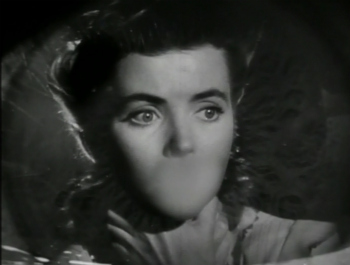
The imagery is potent, and the film isn’t afraid to occasionally go for the surreal. When Helen first returns to the Warren estate and is making her way up the grand central staircase, she stops for a moment to look into the mirror mounted on the landing (which will later make for some very cool angles in the chase scenes), and the camera crawls along the floor of the upstairs to reveal a pair of feet, letting us know that the killer is already in the house and is watching. As the killer watches, we see from their perspective that Helen has no mouth, and although the effect is rather limited, it’s still very creepy. Later still, when Parry has convinced Helen to run away with him, we get to see her imagine a brief, sweet courtship that leads right up to a wedding, the daydream turning into a nightmare when she is unable to say “I do,” as even in her fantasy she is unable to speak.
Helen is a very cool final girl, and McGuire imbues a character who has no lines before the film’s final moment with a great deal of life and vivaciousness, conveying a lot through her body language and expressions. In one of the film’s most exciting moments, Helen is alone in the house with the killer as everyone else is dead, gone, imprisoned, or bedbound, and the constable comes to relay that Dr. Parry will not be returning that evening as he is attending a medical emergency, and Helen, in an upstairs room, beats against the window to get the lawman’s attention to no avail, and her desperation and frustration as he leaves are palpable. We see her playfulness with Mrs. Warren, her professionalism with Professor Warren, and her warmth and affection with Mr. and Mrs. Oates, and there’s a tangible difference in the way that she “speaks” to each of them. It’s damn fine acting work. The two best on-screen pairings are McGuire with Barrymore and McGuire with Lanchester. For the former, there’s an authentic sense of maternal warmth and protectiveness that Mrs. Warren has for Helen, and Helen seems to be the only person in the house whose company Mrs. Warren genuinely enjoys. With the latter, a lot of that is simply that Mrs. Oates is my favorite character here, and she was a delight every moment that she was present. Her rambling to Helen when she first returns home is quite fun, as is her antipathy toward her husband’s lazy dog. There’s a very fun bit in which she goes for her hidden brandy and finds it empty, to which Mr. Oates replies that he got rid of it because of her temperament. Later, when Professor Warren needs her help retrieving a bottle of brandy from the cellar, she fakes dropping the candle in order to steal another bottle for herself. It’s a helpful addition of some physical comedy to the proceedings while also setting up a scene later in which Helen locks her potential killer in the same underground room (and also a scene in which Helen is unable to rouse Mrs. Oates to help her with the killer as the older woman is passed out drunk).
One thing that seems to be a point of contention is exactly when the film is supposed to be set. It’s clearly some time before the actual production date, as there is not a single automobile in sight, with characters riding around in horses and buggies. There’s no on-screen confirmation of an exact year, but Wikipedia lists it as 1906, as does TVTropes (although I assume the latter gets this from the former). Brode’s book lists it as 1916, and in fact makes some hay with the fact that this would have been right in the middle of the Great War, at a time when Freudian theory was becoming somewhat mainstream and that the film’s text is about Freudian themes of suppression and desire. It doesn’t really matter in the end, but thought it was worth mentioning, as I sometimes wonder where we get these “facts” about movies, and the way that something you might only learn in a now long-lost press kit have somehow been passed down as paratext and become unclear over time.
-Mark “Boomer” Redmond


 Swampflix