
The Paradine Case is often considered a lesser Alfred Hitchcock picture. The director himself practically disowned the completed product, which was heavily interfered with by producer (and screenwriter) David O. Selznick, who had produced Hitch’s first Hollywood film, Rebecca, and had Hitchcock under contract for the next seven years, which ended with the difficult production of this picture. It was also a financial failure, recouping only half of its budget. It’s mostly left out of the conversation of the director’s successes, but The Paradine Case, despite lacking some of the more exciting features of Hitchcock’s work, proves that even when the man was half-assing it (and fighting the execs), he could still make a damn fine feature.
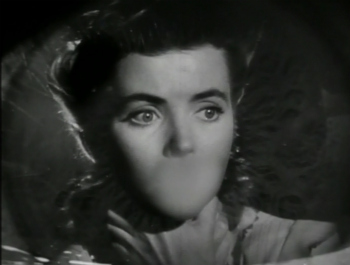
The film opens in London with the arrest of beautiful widow Maddalena Anna Paradine (Alida Valli, who would later appear as Miss Tanner in Suspiria) on suspicion of poisoning her husband, a wealthy, blind, retired colonel. The family lawyer, Sir Simon (Charles Coburn), enlists defense attorney Tony Keane (Gregory Peck in his second and final Hitchcock collaboration following Spellbound) to represent her in the Crown’s case against her. Sir Simon’s clever daughter Judy (Joan Tetzel) also happens to be best friends with Tony’s wife Gay (Ann Todd), but Simon insists that his selection of Keane has everything to do with providing the best counsel for Mrs. Paradine, although he admits that Keane has a tendency to lean more on playing to jurors’ sympathies than practicing purely legalistic law. With regards to Keane’s weakness, Sir Simon warns him that he won’t be able to pull off his normal emotional appeals if they happen to argue the case before Judge Thomas Horfield (Charles Laughton, who had previously appeared in the director’s Jamaica Inn and would later go on to direct Night of the Hunter). At a dinner at the Hortfields’, the judge reveals himself to be an utter cad, belittling his wife, the Lady Sophie (Ethel Barrymore), taunting Keane about his upcoming defense, and sexually harassing Gay when the others aren’t looking.
Matters become complicated when Keane and Mrs. Paradine, despite the latter’s professed love for her late husband and the former’s heretofore happy marriage, find themselves drawn to one another romantically while working on her case. As rumors begin to spread, Gay’s concerns about her husband’s potential for infidelity bloom, and although Keane offers to give up the case, she can see that asking him to do so would only make the tension worse and so spurs him on to see the case through to its end and save Mrs. Paradine from conviction. Keane latches onto the idea of convincing the jury that Colonel Paradine took his own life and goes so far as to suggest that suspicion be diverted to the late colonel’s valet, a French-Canadian man named André Latour (Louis Jourdan), for assisting in said suicide, but Mrs. Paradine refuses to allow Keane to involve him. Convinced of his client’s innocence and desperate for something that might exonerate her, Keane goes to the Paradines’ country estate, where he learns that Latour is still in residence, and is somewhat shocked to find that the man’s room is on the same hallway as the separate suites of both the mistress and the late master of the house, rather than residing in the servants’ quarters. He attempts to make contact with Latour by posing as someone simply looking to rent the house, but Latour evades him, only to come to his inn later that night and tell him that Mrs. Paradine cannot be trusted. Keane refuses to believe this, and returns to London, where he goes to the prison to visit Mrs. Paradine before going home and checking in with his wife.
The film is essentially bifurcated right down the middle between Keane’s playing detective and the trial of Mrs. Paradine, with the audience heading into the trial without a clear idea of whether or not the accused is guilty of killing her husband. Old Hitchcock stalwart Leo G. Carroll appears for his fourth of sixth collaborations with the director as prosecuting counsel Sir Joseph, and although he only appears in the back half, he leaves quite an impression, and the repartee between the somewhat showboaty Keane, his more staid counterpart on the other side of the courtroom, and Lord Horfield, who does end up presiding over the Paradine trial, is quite a lot of fun to watch. As secrets are revealed over the course of several days of trial, the whole thing unravels, and by the end, Keane is a broken man, uncertain about his future.
I’m not sure why this didn’t connect with contemporary audiences. In his movie guide, Leonard Maltin wrote of the film that it was “talk, talk, talk in complicated, stagy courtroom drama,” and a more contemporary review from The Nation’s James Agee in 1948 called Paradine Case “the wordiest script since the death of [18th Century ‘father of conservatism’] Edmund Burke.” Courtroom dramas were nothing new at this point, so I’m not entirely certain what could be expected otherwise, and the cheeky dialogue between the three verbal combatants in the courtroom is often much more wickedly funny than either of the aforementioned critics gave it credit for. Like Sam Waterston, Gregory Peck is one of those actors who was born to play a lawyer, and this film was made at the height of his marketability as a star; he got his third Best Actor nomination for Gentleman’s Agreement the same year that The Paradine Case was released, although he wouldn’t win until his fifth nom, for To Kill a Mockingbird. He gets to play a wide range here, from the confident barrister who thinks he can win any case, to a man who’s guilty about the emotional affair he’s fallen into, to an infuriated defender of a woman’s besmirched honor, and finally a determined man driven to excessive rhetoric while trying to save a woman from being hanged. He’s doing excellent work, and it’s a shame that this performance has fallen through the cracks as the film’s overall reputation has remained middling.
Outside of Peck, the film largely revolves around the performances of Todd, Valli, and Tetzel, who are likewise excellent. Todd manages to invest Gay, who is clearly the less exciting character of the two women between whom Keane finds himself torn, with a lot of pathos. Her standout scene is one in which she acknowledges to her husband that she isn’t happy with the way things are going, but that she would rather Mrs. Paradine get the best possible defense, which she knows Keane is best suited to provide, than let her be sentenced to death and ascend to the point of becoming Keane’s lost Lenore. As she says, it will be easier to fight a free woman for her husband than the woman’s unimpeachable ghost. Valli does great work playing both sides of Mrs. Paradine; she freely admits that her life before she met the colonel was one in which she supported herself by latching onto wealthy men, but that when she met Paradine, she decided she could “be his eyes.” She convinces Keane that her love for the late colonel was genuine, but Valli gives Mrs. Paradine just enough ambiguity to make us wonder if she’s more cold and calculating than she appears, especially after Latour delivers his warning to Keane. Overall, however, I was most taken with Joan Tetzel, whose Judy is, despite being very much a supporting character, connected to all of the events and serves the important purpose of explaining the implications of the various court proceedings to Gay, and thus to us. The relationship between Judy and her father, Sir Simon, was quite an endearing one, with several scenes in which it’s apparent that the old man is consternated by his daughter because she’s already as clever and observant as he is and will only become more so with time. She reaches the same conclusions that he does even as he professes something else entirely, and it’s fun to watch him become flustered that his daughter is just like him. Even as he pontificates that her behavior is unladylike, you can tell that he’s having the time of his life having raised a daughter that he can spar with. Ultimately, the duo serves as the stable, warm heart that helps anchor the film while Keane’s wandering affection affects everything else.
As previously mentioned, this film is lacking some of Hitchcock’s trademark touches. The Paradine Case does not include any major spectacles or showdowns on or around exciting landmarks, unless one counts the trial itself and its location in an exact duplicate of a real courtroom in London’s Old Bailey. The set took nearly three months to complete and cost $80K (approximately a whopping $1.2M adjusted for inflation), and, since so many of the scenes filmed there would be shot at low angles, it included a ceiling. This no doubt was a technical and logistical nightmare, but even in these circumstances, Hitch was trying something new by running up to four cameras in different locations with each take, which (according to a now-dead link on the film’s Wikipedia page) served as trial runs for Rope and Under Capricorn. It’s not always effective. In many scenes in which Keane is speaking to the court, Sir Simon and another man are sitting in front of him, and it appears that they were superimposed into the shot, which is rather distracting. There are some other attempts at tricky camera work that don’t succeed, with the worst composition being the moment when Latour first enters the courtroom and the camera keeps Mrs. Paradine’s in center frame while it rotates to follow Latour’s entire walk around the cell in which she’s seated. As with Sir Simon, this is portrayed through superimposition of one image on the other, capturing a similar effect to a split diopter shot, but messier and uglier.
That isn’t to say that there isn’t beautiful filmic storytelling or composition throughout. Although they’re as brief as they are pointless, we get several gorgeous shots of the English countryside when Keane visits the Paradine country home. Once he arrives, Latour’s face is kept in shadow for his entire introduction, and after that he is still seen only at a distance or otherwise unclearly for the entire time that Keane is present, fully revealing himself only when he confronts Keane at the latter’s inn. In that scene, the light fixture in the room, which features several dangling crystals like metaphorical swords waiting to fall, is always framed over Keane’s head. Several scenes find characters facing each other from one or the other side of a set of bars, whether they be the literal ones at the prison in which Mrs. Paradine is incarcerated or various room dividers or lattices. It’s not the most exciting camera work, but it rises far above being merely functional.
One of the advantages that we have over the contemporary audience is that we have the director’s entire oeuvre to dissect and analyze while they did not. I wouldn’t be surprised if some of the pushback at the time, in addition to a lack of confidence in the film from the general public as a result of behind-the-scenes squabbling, was that this is another one of Hitchcock’s forays into the psychosexual, pushing the envelope to see what he can get away with. Keane’s fascination with Mrs. Paradine seems to be at least somewhat stoked by her inaccessibility to him; they never have a moment of true privacy, as every meeting they hold to discuss her defense is in full view of a watchful guard. There’s some intersection of withholding and voyeurism there that deserves to be unpacked by someone who’s better versed in either of those prurient interests than I. When Keane goes to the country estate, he makes his way into Mrs. Paradine’s room, with the housekeeper apologizing for the mess, noting that she was in the process of packing the lady of the house’s things. Inside, Keane finds an intricately carved headboard with an inlaid portrait of the woman herself, and the soundtrack throws in a scare chord when the tracking shot that represents his perspective lands on an open case of her undergarments. Keane grows so uncomfortable that he has to move to a position where the portrait can’t see him. Following dinner at the Hortfields’, when the men in attendance emerge from the dining room after the requisite men’s only, cigar-smoking time, Lord Hortfield is so utterly overwhelmed by the sight of Gay’s bare shoulder that he immediately moves in to sit too close to her on the sofa and move her hand to his thigh under the pretense of admiring a piece of her jewelry. It almost feels like a set-up to have him be more antagonistic to Keane in the trial segment that is to come later, but it’s quickly glossed over instead and makes no reappearance as a plot driver in the second half. Maybe that plot thread was continued in the copious lost footage (the rough cut was three hours long, while the only extant version is 114 minutes), but there’s no way we can ever know. What we do know is that this film has a fair amount of grappling with one’s (and others’) raging sexuality that did make it to the final cut, and it might have been alienating to an audience that didn’t have decades of the director’s work to slot this into as a recurring creative fascination. All in all, however, I think a modern audience will find much more to enjoy here than the film’s reputation might imply.
-Mark “Boomer” Redmond