The Legend of Ochi (2025)

For decades, whenever someone cited the “uncanny valley” effect of modern filmmaking, they were referring to the off-putting resemblance of CGI to real-life humanity. As computer technology inches nearer to photographic accuracy, the ways in which the images are still just slightly off become monstrously horrific, especially when rendering human faces. As a result, movie nerds tend to fetishize the practical effects of yesteryear, preferring the blatant artifice of movie-magic techniques like stop-motion, animatronics, and latex makeup transformations to the uncanny computer effects of our current corporate hellscape. Ironically, that fetishism has recently led to an entirely new uncanny valley forming between advanced practical effects and the CG graphics they’re meant to counteract. For instance, when the stop-motion Wallace & Gromit shorts were mostly made by Nick Park’s hands in the early 90s, you could see the lumpy imperfections of his fingerprints in the characters’ clay bodies, unmistakably marking them with evidence of human touch. Now that Wallace & Gromit features like Vengeance Most Fowl are being produced by hundreds of collaborators for major studios like Netflix, those fingerprints have to be artificially applied, intentionally warping the clay so the machine-printed faces can’t be mistaken for computer animation. Likewise, the new children’s fantasy-adventure The Legend of Ochi features an animatronic puppet so perfect in construction & operation that it uncannily resembles its CGI equivalents in movies from less discerning filmmakers. Music video director Isaiah Saxon has spent years perfecting the puppetry & matte paintings of his feature-film debut to revive an industry overrun by computer-generated tedium with some old-world movie magic and old-fashioned awe. He didn’t think to artificially muck up the final product like Aardman Animations, though, and the result is so uncannily similar to CGI that you have to wonder why he even bothered.

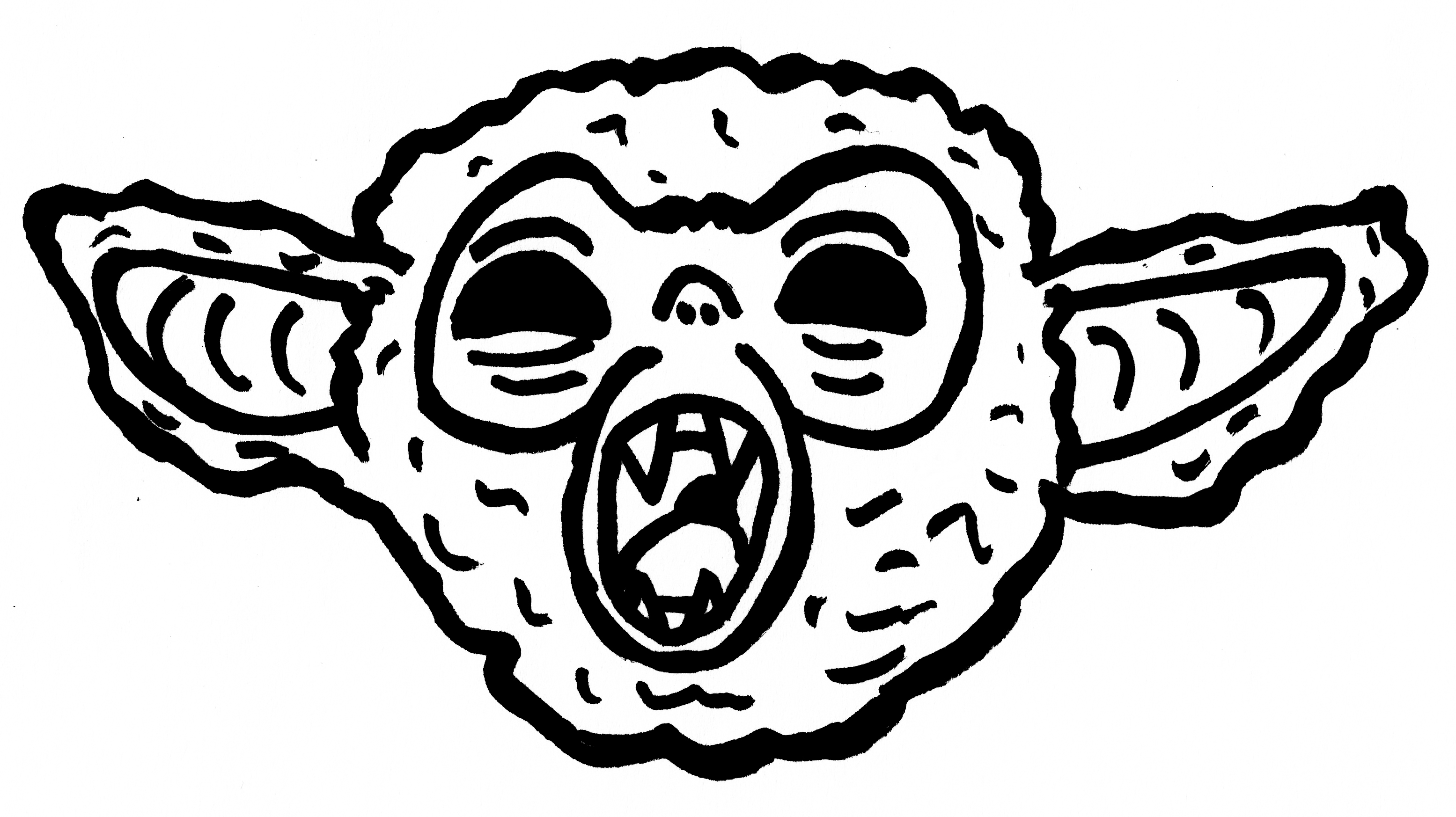
The titular Ochi are magical creatures brought to life via animatronic puppetry. The species largely resembles the golden snub-nosed monkeys of China, except that its bites are poisonous and its children are adorned with Mogwai ears for maximum cuteness. The Ochi are introduced to the audience in a scientific text titled Carpathian Beasts & Demons to help distinguish them from the real-life primates they resemble. Their presence on the fictional, Romania-adjacent island of Carpathia is treated as vampiric & monstrous, with a crazed patriarch played by Willem Dafoe training a new generation of boys to hunt & kill the supposedly demonic beasts on sight. His daughter is not so convinced of the nobility in this mission, and she quickly befriends a baby Ochi left behind by one of her father’s hunts. The rest of the movie is an E.T.-inspired children’s adventure, in which the sullen teenager runs away from home to safely return the Ochi to his fleeing family in a coming-of-age act of rebellion. If there’s any modern update to that familiar formula, it’s in Dafoe’s mockery of Jordan Peterson-style manosphere philosophy, which he preaches to impressionable young boys while driving around his monster-truck chariot in antique battlefield armor. He has no particular interest in his daughter beyond her value as “a father’s greatest treasure,” while she rejects her extremely gendered role in the house by donning costume vampire fangs and cranking heavy metal tunes from the fictional band Hell Throne. The goodbye note she leaves when she runs away proudly declares, “I am strong and cool and don’t believe anything you say,” speaking for all teenage rebels everywhere in their universal language of sass. As a result, the movie should spiritually speak to any depressed loner children who resent their bloviating fathers—of which there is always an infinite supply—regardless of whether they’ve already seen an E.T. riff or three.

The Legend of Ochi evokes all of the childlike wonder and sarcastic teen humor needed to make this genre formula work, but neither of those elements are entirely convincing. Its teenage characters (Helena Zengel as the Ochi’s bestie and Finn Wolfhard as a burgeoning fuckboy who’s “only nice when no one’s looking”) mumble their lines under mops of greasy hair to the point of near indecipherability. They aim for deadpan comedy but overshoot to land at dead-eyed monotony instead. There are also long stretches of the adventure to Ochi territory that have no dialogue at all, which would test audiences’ patience at any age and suggests that Saxon isn’t used to filling up a feature-length runtime with his writing. The real disappointment is that the psychedelic magic of his past music video work for artists like Björk & Panda Bear fall short of inspiring awe here. His puppetry & matte-painting visual tricks, while admirably old-fashioned, are too technically perfect to convey their construction by human hands. When the trailer for the film first dropped, social media C.H.U.D.s baselessly accused Saxon of boosting his budget with A.I.-generated imagery, which had to be heartbreaking for an artist who spent multiple years fighting to render this passion-project fantasy world through the most practical, tactile methods possible. Still, the final result is a little too machine-perfect to inspire genuine awe, and you can easily see what stoked those accusations. There’s an uncanny valley effect in how close its state-of-the-art puppets resemble computer-generated images, leaving them a little off-putting & soulless despite the passionate craft behind them. Saxon technically did everything right here. The aesthetic is distinct; the puppets are cute and smoothly operated; the gender politics are pointed and relevant to the moment; the kids are authentically mopey & rebellious. That’s what makes it so frustrating that the movie never fully sings, even if it can demonstrably hit all the right notes in perfect pitch.

-Brandon Ledet

Gwen and the Book of Sand (1985)

Gwen et le livre de sable (Gwen and the Book of Sand) is a 1985 animated feature directed by Jean-François Laguionie, with its illustrations and animations done in gouache, giving the whole film a very watercolor texture. The plot concerns Gwen, a teenage girl who is adopted into a nomadic tribe who live in a post-apocalyptic desert. One member of the tribe, Roseline, is identified as a witch, and is said to be over 170 years old, and it is through her we get what little knowledge we have of this world and how it came to be. She tells us that the gods destroyed the civilizations of the past, and that now the world is stalked by an Eldritch abomination called Makou, which periodically roams the desert and spews out reproductions of various household objects from the sky, usually of a gigantic variety. Of course, Roseline also believes that the walled city she and her people avoid and from which the Makou seems to originate is the afterlife and that those within it are spirits, but when we learn more about them later, it becomes clear that Roseline’s wisdom is incomplete and thus many of her concepts of the universe’s function are inaccurate. In Gwen, Roseline sees a girl who has never known fear and respects this about her, but when Gwen and Roseline’s grandson Nokmoon sneak out one night to make love and fall asleep in a giant chest of drawers, Nokmoon ends up taken by the Makou. As the rest of the tribe moves on, Roseline and Nokmoon journey to the “afterlife” to try and rescue him. 

This film, like The Tragedy of Man, is currently available in a remastered edition from boutique home video retailer Deaf Crocodile. I got to see it on the big screen at my local arthouse, and it was absolutely gorgeous. Although the motion of the animation is limited at times, that minimal movement lends the whole thing a storybook quality, rendering Gwen as a post-apocalyptic fairytale. It’s a fairly short feature, clocking in at under 70 minutes, but it feels no less fully realized than a film that was twice its length. The desert features fantastical creatures that feel like revisitations of earlier French animation experiments in design; there’s nothing as strange here as what you might see in La Planète sauvage or Les Maîtres du temps, but they are of a kind. The desert nomads live solely off of a diet of feathers harvested from a mutant ostrich, and the only light that they have at night comes from a bioluminescent scorpion. Where the film gets its most surreal visual elements is in the “gifts” of the Makou, as giant watering cans reign from the sky and Gwen and Roseline navigate a labyrinth of doors or summit a mountain range of clocks. We eventually learn that these items are generated by the Makou is response to religious supplication from the people who dwell within the walled city, where religion has dissolved into a unified cargo cult centered around the titular book of sand, which is in actuality a home goods catalogue from before the collapse of civilization. Their hymns consist of recitations of product descriptions, which then prompt the Makou into creating them. The leaders of this “faith” are two twin brothers who observe the captive Nokmoon’s psychically projected dreams and hope that this can help them to prompt the Makou to create something “alive” rather than the inanimate objects that it normally produces. 

The mechanics of all of this are mostly irrelevant. The world-building exists solely to allow for the visuals, and that’s where the film shines. Gwen is able to rescue Nokmoon because this is that kind of fable, and it’s mostly an accident. The twin priests observe that a spiral image in Nokmoon’s dream resembles the product image of a particular firework, and prompt their faithful throng into singing it into existence via the Makou, which backfires when the people below are terrified by the suddenly bright, loud heavens. Gwen’s presence in the climax has no real bearing on the events there, except that she is able to bring Nokmoon home. She knows a bit more about the world now than Roseline does, but she lets the old woman continue to believe as she always has. Even if that story is a little confusing for the audience (and there are certainly some things left up to interpretation and conjecture, which is why I would recommend watching this one with a friend), it’s the sumptuous use of a non-standard artistic technique that makes this one worth finding and checking out. 

-Mark “Boomer” Redmond

Dreamchild (1985)

Just one year after the classic fairy tale “Little Red Riding Hood” got a post-modern feminist reexamination in The Company of Wolves, the classic children’s novel Alice’s Adventures in Wonderland got the same treatment in the less-seen, less-discussed Dreamchild. Both films juxtapose real-life sexual predation against its warped fantasy-realm mirror reflections, picking at the gender politics of their selected works to find surprising, uncomfortable nuance. For its part, The Company of Wolves asks how much tales like “Little Red Riding Hood” were meant to protect young women from the sexual predation of older men vs. how much they were meant to scare them off from participating in their own sexual development & pleasure. Likewise, Dreamchild revisits the sexual predation behind the writing of Alice’s Adventures in Wonderland and Through the Looking Glass to question just how diabolical Lewis Carroll’s relationship with his young muse was, or if there’s room to find his fixation on her empathetically tragic. The main difference between these two literary autopsies is that “Little Red Riding Hood” is a stand-in for all young women everywhere, while “Alice” was a real-life victim with her own name and her own internal life, which makes for a much more delicate, dangerous balancing act.

Carol Browne stars as the real-life Alice Hargreaves in her twilight years, summoned to a Depression Era NYC to commemorate the 100th birthday of the deceased author who made her famous as a child. American journalists hound the prim & elderly English woman the second she hits the shore, desperate for whimsical pull-quotes from The Real Alice to fluff up their human-interest columns. The barrage of questions about her childhood family acquaintance Reverend Charles L. Dodgson (pen name Lewis Carroll) sends her into a tailspin of repressed memories & demented hallucinations, effectively re-traumatizing the poor woman for the sake of a disposable puff piece. Preparing for an upcoming Columbia University speech to celebrate Dodgson’s birthday, she becomes unmoored in time, reliving both traumatic moments as her childhood self and fantastic moments as her famous literary avatar. It quickly becomes apparent in flashback that Alice’s Adventures in Wonderland was written as an elaborate grooming tactic, with the middle-aged Dodgson hoping to woo the 10-year-old Hargreaves into being his eventual bride. That toxic dynamic has soured her lifelong relationship with the Wonderland books in a way that the American press is entirely uninterested in interrogating, so she has to work through it isolated in her own dreams & memories. The nuance of that discomfort arises in recalling her own active participation & manipulation of the author-muse dynamic as a child, something she does not care to remember.

A less thoughtful version of this story might’ve characterized Alice Hargreaves as a victim first and a victim only, but Dreamchild puts a lot of work into fleshing her out as a thorny, complicated human being. She’s a hard-ass social tyrant in both her 80s & her adolescence, and she was too sharp as a child not to notice the unseemly power she had over Dodgson as her much-older admirer. Ian Holm does an incredible job invoking both menace and pity as the lonely, nerdy Dodgson, pining after a child in a way even he knows is wrong. The young Alice pretends not to catch on, but plays games with the older man’s heart in a way that recalls the cruelty of a school-age bully. Meanwhile, the 1930s NYC segments draw a parallel between their delicate power imbalance and the normal, socially accepted rhythms of heterosexual courtship, with a fuckboy reporter (played by Peter Gallagher) hounding the elderly Hargreaves’s teenage assistant for romantic connection so he can exploit her access for personal profit. The fully grown men are fully aware how vulnerable the younger women they pursue are to their gendered power & privilege, and they choose to cross the line anyway. What seems to haunt Hargreaves in her final days is how aware she was of that one-sided romantic dynamic as a child, and the ways in which manipulated it for her own amusement. It’s a difficult topic to discuss without slipping into blaming victims or excusing abuse, but the movie pulls it off.

Dreamchild was the brainchild of screenwriter Dennis Potter, whose name is all over the credits as a producer who self-funded the project. All of the visual panache of the fantasy sequences arrive courtesy of the Jim Henson Creature Shop, who illustrate several key characters from the Wonderland & Looking Glass canon as nightmarish ghouls who haunt Alice Hargreaves in her old age. Those sequences are relatively sparse, though, and most of the runtime reflects Potter’s background as a journalist and television writer, staging lengthy exchanges of dialogue in hotel rooms & press offices. In those conversations, Potter pokes at the differences between American & British cultures’ respective relationships with money and, more bravely, the differences between 19th & 20th Century cultures’ respective relationships with age-gap courtship. As depicted in the film, Alice Hargreaves suffered self-conflicted feelings on both subjects and her own personal participation in them. She is, undoubtedly, Lewis Carroll’s victim, in that her entire life is unfairly shaped by his immoral yearning for her as a child. However, Potter finds enough grey-area nuance in her victimhood to allow her to appear onscreen as a fully realized human being instead of a historic symbol of trauma and abuse. Lewis Carroll himself is even extended that grace, regardless of whether he deserves it.

-Brandon Ledet

Leila and the Wolves (1984)

Leila and the Wolves is a 1984 docu-drama that took over half a decade to make, premiering at the Mannheim-Heidelberg International Film Festival in West Germany and then going underground for decades at a time. It got a re-release in the U.K. twenty-four years later at an event called “Women’s Cinema from Tangiers to Tehran” in 2008, then disappeared again for some time after that before popping up in various European festivals before getting proper stateside screenings this year with limited releases in the U.S. and Canada. Ten years prior to its first release, the film’s Lebanese director Heiny Srour (Leila has no credited writer, as many of the stories of which it is comprised were real experiences Srour collected) was the first Arab woman to have a film considered at Cannes, with her 1974 documentary The Hour of Liberation Has Arrived. Leila tackles a similar subject matter, focusing on the forgotten/erased role of women in the liberation movements of Lebanon and Palestine in the twentieth century. 

The film isn’t invested in recounting the broader history prior to the 1920 British occupation, and some familiarity with the region is helpful. Prior to its dissolution in 1922, the Ottoman Empire controlled portions of the Middle East that are now occupied, in whole or in part, by Iraq, Syria, Palestine, and Egypt. Beginning in 1915, the government of the U.K., represented by Britain’s senior ambassador to Egypt, Henry McMahon, and Hussein bin Ali of the Kingdom of Hejaz (the western coast of the Arabian Peninsula which is now partitioned into parts of Saudi Arabia and Jordan) exchanged a series of letters. Called the McMahon–Hussein correspondence, this exchange committed Britain to recognition of an independent Arab state in the Middle East in exchange for assistance in fighting the Ottomans as part of the Middle Eastern theatre of WWI. This prompted the Arab Revolt (1916-1918), which ultimately led to the end of Ottoman control of the area; in combination with the Turkish War of Independence (1919-1923), the Ottoman Empire was, as they say, history. 

Britain, as it is wont to do, reneged on this promise, and secretly signed the Sykes–Picot Agreement with the French Third Republic, which set forth the terms under which Britain and France would partition the remains of the Ottoman Empire. This led to the League of Nations’ Mandate for Palestine, which placed Palestine (and an area called Transjordan which now comprises parts of Jordan, Saudi Arabia, and Iraq) under British rule, meaning that the Palestinians had essentially assisted in their liberation from one foreign power only to be stabbed in the back by their supposed allies, who became their new occupiers in 1920. “Mandatory Palestine” existed as a geopolitical extension of British rule for just shy of three decades, until 1948. If you’ve paid attention to the news at all during the time that you’ve been alive, then you know the rest. 

In Leila and the Wolves, Nabila Zeitouni is Leila, a modern Lebanese woman currently residing in London. Her friend, a man played by Rafik Ali Ahmad, is planning a showcase of photographs depicting various acts of resistance against Western occupying forces. Leila protests that all of the photographs depict only what the men of the region did to resist occupation, asking where the evidence of women’s contribution to the efforts are. Her friend laughs her off, saying that women “weren’t involved with politics at the time.” Following this, Leila goes on an extended out of body experience/astral journey through and into the photographs and the events depicted therein. After encountering a group of women in black burqas and niqab in a semicircle on a beach, watching men splash about in the surf without a care in the world, Leila moves through time, with mostly newly shot recreations but also incorporating archive footage where available. 

In a photo of men resisting British soldiers (in their ridiculous little imperial uniform shorts) and driving them down an alley, we pan out to see the women in the adjacent homes standing on their balconies, ready to pour boiling water down on the retreating occupiers. In a time of greater lockdown and restriction, the resistance takes advantage of the fact that women planning a wedding will be regarded as being beneath suspicion to use them as information couriers to organize activity (humorously, in this sequence, Ali Ahmad plays a quisling translator for the Brits, consciously intertwining this role with that of the dismissive curator). Later still, women are more actively engaged in the fighting, including participation in the exchange of gunfire. We also travel through Leila’s subconscious as well, as there are a few overt fantasy sequences. The first sees Leila as she might be if she accepts the narrative of female pacificity and political disengagement, a glimpse into an imagined future in which she sits in a room surrounded by her daughters and their daughters’ daughters. The questions that she asks of them are banal and concerned only about familial relations. Which daughter are you? Married? Kids yet? Only one? Are you my granddaughter? Are you married yet? Towards the film’s end, Leila finds herself in another fantasy sequence amidst the wreckage of ancient buildings, dancing with nearly a dozen skeletons in black garb. 

Across the spectrum of reviews I read, I don’t think I ever saw any of them connect the film to what stands out to me the most about it, which is its punk sensibility. Leila is clearly anti-establishment in its views, as there’s never a question about the film’s certitude of the morality of resisting foreign occupation, and it instead focuses on the necessity of remembering all the fallen. During my viewing, I was struck by the way that there was a disjointedness to the narrative; this is not entirely to its detriment, as this made the experience somewhat trancelike and thus all the more immersive, but it’s not what one would call seamless. In this way, it brought to mind one of Brandon’s favorites, Born in Flames, which can also be characterized by its piecemeal construction, but which, to quote him, is a “work of radical politics that transcends its jumbled narrative.” Because our discussion of it on the podcast was so fresh in my mind, I also kept thinking of how he described the punk ethos of Times Square as well; I think that it’s the DIY effect of the film’s use of recreations, although this one is also technically impressive in all that it accomplishes in ways that most punk films are not. Regardless, it’s an important and informative document of its past and our present, connected across time and as relevant as ever. 

-Mark “Boomer” Redmond

The Doll (1919)

There’s a naive impulse in modern audiences to look back to the early, silent days of cinema as harmless & quaint. Something about the stage-bound sets, for-the-back-rows vaudevillian performances, and hand-cranked camera speeds leads people to dismiss the early decades of cinema as being out of date to the point of total irrelevance. When you actually watch those movies in full, however, you’ll find they often deal in spectacle, politics, and humor with the same sharpness as any modern work (the good ones, anyway). For instance, one of the better Hollywood studio pictures of the year so far is the technophobic horror romcom Companion, starring Sophie Thatcher as an AI sexbot who’s unaware that she’s not a fully autonomous human being. Her artificiality is a major point of attraction for the tech-bro incel who purchased her (for selfish schemes not worth fully outlining here), raising questions about how the misogynist radicalization of young men has corrupted modern gender dynamics to the point where true, genuine love is a cultural impossibility. The political arguments & technological details of that premise may sound like they could only belong to a movie from the 2020s, but they’re also present in Ernst Lubitsch’s silent comedy The Doll, made in Germany over a century ago.

In The Doll, a pampered young man is pressured by his dying baron uncle to get married, so that he can properly claim his noble inheritance. The fop responds to this request with revulsion, as he is both afraid & spiteful of women. After being chased around his little German village—Scooby-Doo style—by every marriageable maiden in shouting distance, he finds sanctuary among monks in a local monastery, where finds the comforts of things he loves almost as much as he loathes women: meat, beer, and men. While in hiding he is handed an advertisement for a mad-scientist dollmaker (named Hilarius) who makes lifelike automatons resembling flesh-and-blood women, marketed to “bachelors, widows, and misogynists.” He answers the ad in a scheme to pass off the automaton as his fiancée and fool his uncle so that he doesn’t have to interact with any actual women. Things immediately go awry when the doll is broken before purchase and replaced with the dollmaker’s anarchically bratty daughter, who’s more prone to misbehave than any of the maidens he was in danger of marrying in the first place. As the dandy misogynist attempts to treat his new, control-operated bride like a piece of furniture, she finds ways to undermine his caddish behavior and stand up for herself as a fellow human being, with her own needs & desires, all while keeping up the ruse that she’s a wind-up doll.

It would be foolish to assume that Lubitsch was somehow unaware of the political or sexual implications in this antique relic, which is just as much of a high-style gender warfare comedy as Companion. True to the sex-positive mayhem of the more famous farces he’d later make in Hollywood (Trouble in Paradise, Design for Living, To Be Or Not to Be, etc.), The Doll‘s human-posing-as-an-automaton conceit leads to a myriad of sex gags in which “the doll” is placed in men’s intimate spaces within the monastery where no proper woman would ever be allowed unsupervised. The comedian playing that doll, Ossi Oswalda, also starred in a Lubitsch picture the previous year titled I Don’t Want to be a Man! that features her in drag, drunkenly making out with a fellow man at an all-night ball in some proto-Victor/Victoria genderfuckery. In both cases, it’s clear to me that sneaking those sex jokes past moralistic censorship was Lubitsch’s primary goal, but he justified those jokes by couching them in the general political gender commentary that afford the films their social value (beyond just being funny). In I Don’t Want to be a Man, that commentary is mostly about how men’s societal privileges come with their own set of stressful societal pressures, while The Doll is about those privileged men’s bone-deep misogyny — identifying it as a rightful target for mockery.

I’m used to Lubitsch’s comedies being sexually & politically pointed in this way, but I’m not used to them being as outright fantastical as The Doll. He’s practically doing a George Méliès impersonation here, leaning into the illusionary magic of early, inventive cinema with color-tinted frames and hand-built fantasy sets. The very first scene features Lubitsch himself constructing a dollhouse set for the audience’s entertainment, which he then populates with two inanimate dolls. From there, we’re immersed inside that artificial dollhouse world, with the dolls from the opening replaced by real-life human actors. Cardboard cutouts of the sun, the moon, trees, and clouds decorate the backdrops of every exterior scene with hand-illustrated detail. Horses are never actually horses; they’re humans in a shared costume, complete with the tacked-on tail of a stuffed animal. This artificiality is wonderfully carried over to Oswalda’s performance as the non-automaton feminist, as she moves in jerky, robotic obedience whenever her husband is looking but immediately switches to wild, animalistic behavior whenever on her own. It’s a gorgeous, imaginative work of visual art that’s been echoed in modern films from directors like Wes Anderson, Michel Gondry, and—in the case of Beau is Afraid—Ari Aster. Once you look past the technical markers of its era, there’s nothing outdated or quaint about it.

-Brandon Ledet

Lagniappe Podcast: Buddha’s Palm (1982)

For this lagniappe episode of The Swampflix Podcast, Boomer & Brandon discuss the Shaw Brothers’ laser-wizards martial arts actioner Buddha’s Palm (1982).

00:00 Welcome

01:37 Eephus (2025)
04:45 Looney Tunes – The Day The Earth Blew Up (2025)
09:03 Black Bag (2025)
15:40 Misericordia (2025)
21:16 The Shrouds (2025)
27:47 Ash (2025)
34:32 The Premature Burial (1962)
39:38 The Masque of the Red Death (1964)
48:20 Dark Intruder (1965)
50:26 Imitation of Life (1959)
57:01 The Unbelievable Truth (1989)
1:00:43 Secret Mall Apartment (2025)
1:05:27 Perfect Blue (1997)
1:12:11 In Fabric (2019)

1:19:00 Buddha’s Palm (1982)

You can stay up to date with our podcast through SoundCloudSpotifyiTunesTuneIn, or by following the links on this page.

– The Lagniappe Podcast Crew

Juliet of the Spirits (1965)

The standout sequence in Juliet of the Spirits that dropped my jaw lowest in the theater was its ugliest & most mundane. The 2015 restoration of the 1960s Fellini classic is, for the most part, a gorgeous swirl of vibrant color. It’s a dark fantasy movie in which the Italian master invents the cinematic language for later texts as disparate & monumental as Lynch’s dream sequences, Jodorowsky’s circuses, and Friedkin’s exorcisms, all rendered in sinfully lurid Technicolor. That was all expected, though. What really caught me off guard is when Fellini pauses his gaudy reverie to also invent the cinematic language for the television program Cheaters. It happens in the sequence where his real-life wife & muse Giuletta Masina visits the private detective agency that’s been trailing her husband, and they play back to her a full week of documented adulterous behavior. The way the head dick in charge narrates the sepia-tone surveillance footage with time stamps and sneering innuendo is so specific to the Joey Greco era of Cheaters that I now understand that reality TV show to be a loving homage to the film’s legacy. Such is the power of Fellini.

Much like an episode of Cheaters, watching Juliet of the Spirits feels like intruding on a private domestic dispute that’s really none of our business. Our director is working through his real-life conflicts with his wife by illustrating his own adulterous behavior onscreen, through the avatar of actor Mario Pisu. Giuletta Masina stars as Giuletta Boldrini, a wealthy but lonely housewife who’s increasingly isolated by the extramarital indulgences of her husband Giorgio, played by Pisu. As Giorgio spends increasingly long stretches away with his latest fling, Giuletta seeks spiritual advice from the dark arts, meeting with a series of psychics & mystics in search of a calmer, wiser perspective on her broken marriage. This pursuit opens her mind to a loud circus of perverted spirits & ghosts that constantly parade through her head, pulling her out of her Catholic comfort zone towards a larger religious truth: pleasure is the true religion, and she should be cheating too. The whole thing plays like a plea from Fellini to his wife to start cheating on him to help balance things out and to take her mind off the marital injustice he initiated.

Unlearning Catholic guilt is easier said than done. The proto-Exorcist imagery results from a childhood memory in which Giuletta starred as a martyred saint in a church play, burned alive for the transgression of accepting Christ in her heart. Anytime the adult Giuletta considers indulging in an extramarital affair (with a handsome ghost, demon, or otherwise), her mind flashes back to this scarring memory, which has taught her to associate Earthly pleasure with guilt & pain. Everyone around her is fully enjoying what being alive has to offer—especially in the pleasures of the flesh—and yet Giuletta continues to fret, unable to let go and enjoy herself as much as her wandering husband. Buried somewhere in the film’s increasingly dreamlike imagery, there’s eventually a healing moment in which she frees her flaming inner child from her Catholic shackles and comforts her with a motherly embrace, but it’s still not enough to fully make up for what Giorgio has done to their marriage. Maybe Fellini’s admitting personal guilt there more than he’s attempting to shake his wife loose from her own self-limiting Catholic guilt. Again, it’s not really any of our business.

For all of its messy offscreen domestic drama and the deep psychological pain caused by religious repression, Juliet of the Spirits is often a light confection. Snazzy jazz scores the backyard wanderings of a mystic housecat and the Italo-fashion beachwear modeling of Giulietta’s fabulously amoral neighbor with no attempt to underline the dark-fantasy elements of the plot with any palpable menace. Fellini feels just as preoccupied with injecting eye-searing beauty into every frame of his first in-color picture as he is with working out his domestic issues with his wife. Even the candlesticks in the couple’s home are tinted lavender instead of the typical white, just to squeeze more color into the frame. It is, without question, the most gorgeous, surreal episode of Cheaters in the history of the show; and yes I am including the one where Joey Greco got stabbed on a boat.

-Brandon Ledet

Lagniappe Podcast: Sirocco and the Kingdom of the Winds (2024)

For this lagniappe episode of The Swampflix Podcast, Boomer, Brandon, and Alli discuss the Belgian-French animated fantasy adventure Sirocco and the Kingdom of the Winds (2024).

00:00 SEFCA’s Top 10 Films of 2024

07:49 Strangers on a Train (1951)
13:13 Laufey’s A Night at the Symphony (2024)
19:46 The Not-So-New 52
24:05 My Neighbor Totoro (1988)
30:09 Soundtrack to a Coup d’Etat (2024)
35:43 Nosferatu (2024)
40:14 Holding Back the Tide (2024)
43:45 Nickel Boys (2024)
48:50 Daaaaaalí! (2024)
52:04 Yannick (2024)
57:17 Wicked Part 1 (2024)
59:46 Flow (2024)

1:00:42 Sirocco and the Kingdom of the Winds (2024)

You can stay up to date with our podcast through SoundCloudSpotifyiTunesTuneIn, or by following the links on this page.

– The Lagniappe Podcast Crew

Flesh and Fantasy (1943)

Most scholars cite the 1945 British “portmanteau” film Dead of Night as popularizing the horror anthology genre.  No one would claim it was the first horror anthology film, since the storytelling format is almost as old as the cinematic medium itself, but it is credited for establishing the rules & tones of the genre that would eventually be codified in anthologies from Amicus, EC Comics adaptations, and the like.  That horror-history milestone puts the 1943 anthology film Flesh and Fantasy in a unique position.  Since the Universal Horror production precedes Dead of Night by a couple years, it avoids a lot of the typical trappings of a by-the-numbers portmanteau, delivering something so far outside the expectations of the horror anthology format that it almost doesn’t qualify as horror at all.  It’s a lot more handsomely staged and a lot less macabre than what most anthologies would become in its wake, often transforming its characters through supernatural phenomena instead of punishing them for their moral transgressions.  More genre-faithful titles like Asylum, Creepshow, and Tales from the Crypt introduce selfish, amoral assholes who get their cosmic comeuppance at the hands of otherworldly ghouls, while Flesh and Fantasy plays its horror with a softer touch.  We have immense sympathy for each of its hopeless protagonists, rooting for them to make it out of their darkly fantastic crises alive & improved.  The movie is not vicious enough to be chilling, but it is beautifully eerie throughout, and its three tales of “dreams and fortune tellers” each land with genuine dramatic impact (which is then somewhat undercut by a racist punchline in the final seconds because, again, it was the 1940s).

The first tale (read from a spooky short story collection over a nightcap between businessmen in the hotel-lobby wraparound) immediately sidesteps genre expectations in its chosen setting.  While there are countless horror stories set on the thin-veil-between-worlds holidays of Halloween, Christmas, and New Year’s Eve, Flesh and Fantasy finds its own thin-veil fantasy realm in the final few hours of Mardi Gras night, just before the Christian calendar transitions from hedonism to Lent.  The story starts with the discovery of a dead body pulled from the banks of the Mississippi River, a victim of suicide by drowning.  Drunken, costumed revelers briefly sober up while gathering around the unidentified corpse, but then quickly return to partying the last few hours of Carnival away before midnight ends the fun.  Only one woman stays behind, sympathizing with the suicide victim a little too intimately and considering joining him in death.  She sees herself as too ugly to be loved or to even party with the rest of her community, as represented by harsh low-angle lighting that accentuates strange, scowling curves on actor Betty Field’s otherwise pretty face.  Just before she drowns herself, a mysterious mask shop owner offers her an It’s a Wonderful Life-style perspective shift on her miserable life, allowing her to be beautiful for the last few hours of Mardi Gras thanks to a yassified plaster mask.  She, of course, subsequently learns a Twilight Zone-style lesson about how beauty comes from within, but the enchantment of the mask and the magical costume shop that provides it still hangs over her all-in-one-night journey like a heavy, eerie fog.  The only death in the segment happens before the story even starts, and all of its supernatural imagery is derived from the Mardi Gras floats & costumes parading in the background.

Legendary noir actor Edward G. Robinson has a much rougher time in his segment, in which he plays a wealthy lawyer who’s told by a palm reader that he’s going to become a murderer in the near future, to his shock.  This, of course becomes a story about self-fulfilling prophecies, as Robinson’s obsession over his fate to become a murderer against his will is the exact catalyst that drives him to becoming a murderer.  It’s like a noir variation on The Hands of Orlac in that way, with Robinson having heated debates with his own reflection & shadow about who in his life would be most ethical to kill, just to get the weight of the prophecy off his shoulders.  The argument is rendered in creepy, hushed whispers, which are echoed in the clouds of urban steam that pour in from every corner of the frame.  Likewise, the third & final segment of the film involves a self-fulfilling prophecy about a tightrope walker (Charles Boyer, of Gaslight fame) who envisions his own death in a nightmare featuring a cameo from (Robinson’s Double Indemnity co-star) Barbara Stanwyck.  Only, he doesn’t actually meet Stanwyck’s noir-archetype femme fatale until after he sees her in his dream, and he ignores the déjà vu feeling in pursuit of romance, ensuring that the dream will eventually come true.  It’s the most surreal segment of the trio, featuring psychedelic double-exposure compositions in its multiple dream sequences that provide the only true effects shots in the film, give or take the rear projection of Tarnished Angels-style Mardi Gras parade float footage in the opening vignette or Robinson’s onscreen doubling in the second.  It’s also the gentlest in its horror elements, though, offering a much kinder fate to Boyer’s helplessly smitten tightrope walker than what Robinson suffers after his own doom & gloom vision of the future.

In one of the stranger deviations from typical horror anthology formatting, there’s no wraparound buffer between the second and third segments, which bleed right into each other.  Edward G. Robinson reaches the end of his rope outside the very circus where Charles Boyer is walking his rope, so that the two stories are daisy-chained together.  That narrative conjunction feels excitingly ahead of its time, but it also leaves the opening Mardi Gras segment feeling isolated & insular in comparison.  The thematic & narrative connections between the tightrope & palm reading segments are crystal clear, which leaves a haze over how they relate to the opener.  What’s really important, though, is that all three segments are solidly satisfying and entertaining on their own terms, so that even if the audience might walk away with a personal favorite, it’s unlikely that one would stand out as the stinker of the bunch.  That might be the biggest deviation from horror anthology tradition, since even the best examples of the genre usually include a throwaway story that provides convenient bathroom-break time between the bangers.  The only throwaway segments of Flesh and Fantasy are its wraparound story which, again, concludes on a casually racist quip about superstitious “gypsies”.  If a horror anthology is going to whiff on any of its individual segments, the wraparound is the ideal place to do so, since it doesn’t tend to linger in the memory as much as the stories it scaffolds.  As a result, Flesh and Fantasy does register as one of the all-time greats of its genre, often by virtue of not falling victim to that genre’s worst, yet-to-be-established tropes.

-Brandon Ledet

Lagniappe Podcast: The Maidens of Heavenly Mountains (1994)

For this lagniappe episode of The Swampflix Podcast, Boomer, Brandon, and Alli discuss the sapphic wuxia action fantasy The Dragon Chronicles: The Maidens of Heavenly Mountains (1994), as suggested by ascalaphid’s Letterboxd list Wuxia Wizard Wars.

00:00 Wuxia Wizard Wars

03:14 Last Things (2024)
08:35 I Saw the TV Glow (2024)
16:55 Civil War (2024)
22:30 Sweeney Todd – The Demon Barber of Fleet Street (1982)
25:38 MaXXXine (2024)
32:30 Kingsman – The Secret Service (2014)
37:15 Psycho (1960)
45:28 The Front Room (2024)
51:43 Cure (1997)
57:00 Fresh Kill (1994)
1:03:18 The Substance (2024)

1:07:22 The Maidens of Heavenly Mountains (1994)

You can stay up to date with our podcast through SoundCloudSpotifyiTunesTuneIn, or by following the links on this page.

– The Lagniappe Podcast Crew