Son of Godzilla (1967)

Godzilla’s titular offspring in the 1967 kaiju comedy Son of Godzilla doesn’t officially have a name, or at least he didn’t yet. Between the film’s release and the character’s return in the following year’s Destroy All Monsters, Toho held a contest for Godzilla fans to name the reptilian tyke, and the world settled on the name “Minilla,” a portmanteau of “Mini” and “Godzilla”. In his initial appearance, however, he’s only referred to as “Baby Godzilla” by the humans on the ground gazing up at his towering, toddling glory. Minilla has gone on to become a viciously hated name within the larger, ongoing Godzilla fandom. He’s cited in online sources as Godzilla’s “adopted son,” but I’m not sure that his initial appearance backs that detail up either. In Son of Godzilla, Baby Godzilla is prematurely hatched from a mysterious egg when his nest is discovered by gigantic mantises (Kamakuras) looking for an easy meal. Before he can gather the strength to flee, he is immediately rescued by Godzilla, who is summoned by his pathetic cries for help. There is no appearance or mention of a mother figure who might have laid that egg, but the scientists & freelance reporter watching from the ground all immediately refer to Godzilla as the pitiful creature’s father. The King of Monsters takes on that responsibility with enough gusto that the question of their biological relation is beside the point. Godzilla teaches Baby Godzilla how to breathe fire and how to rule over the giant bugs that infest the small island where he hatched, like a dad teaching his son how to play catch or how to change a car’s engine oil. It’s all very cute, assuming that you can stand looking directly at the mini-Godzilla’s craggly face.

Baby Godzilla is cute in the exact way that a pathetically ugly rescue dog is cute. Every bumbling minute spent with him is a gift, since it’s a miracle he wasn’t immediately put down. When the giant mantises poke at his freshly hatched body, all he can do is roll around in the dirt like a waterlogged roast turkey that fell off the kitchen table. Minilla has neither a name nor a neck in his first appearance, the latter of which presumably develops during puberty for his species. He falls down constantly, he squawks like an injured donkey, and his every movement is scored as if he were an overweight clown trying to squeeze himself into an impossibly tiny car. I love him. The great thing about Godzilla movies is that they are, at their very least, 2-for-1 creature features that double the number of rubber-suited monsters you’d expect to see in an equivalent Roger Corman cheapie. Whether Godzilla’s fighting a three-headed hell beast, a giant crawfish, or a sentient pile of trash, you’re getting at least two monsters for the price of one. For its part, Son of Godzilla offers you four giant beasts: Godzilla himself (who graciously appears less than a minute into the opening scene), the aforementioned glowing-eyed Kamakura mantises, a giant spider named Kumonga and, the most unholy abomination of all, Baby Godzilla. That’s a lot of bang for your buck, so it’s a little silly that dedicated fans of the series waste so much energy complaining about this outing just because they have to babysit Godzilla’s uggo offspring to get to the good stuff. Not even Godzilla bodyslamming Kamakuras to death and then lighting their mantis corpses on fire is enough to overcome the film’s reputation as Kiddie Junk, à la Godzilla vs Megalon. Pity.

As always, the human drama in the periphery of these kaiju battles is mostly an afterthought. Director Jun Fukuda continues the fun island hangout vibe he previously established in Ebirah, Horror of the Deep, putting in a bare-minimum effort to connect the kaiju shenanigans to an obligatory environmental message. A secret collective of environmental scientists has taken over a small island off the Japanese coast to conduct experiments in controlling the weather, in preparation for future climate change & overpopulation crises. Mysterious machines whir in the background while the scientists float balloons full of experimental chemical compounds into the atmosphere that can adjust the local temperature on demand. A freelance journalist crashes the party but ultimately doesn’t find these experiments nefarious, so he casually joins the crew as a cook (and a potential lover for the island’s sole resident, who lurks in the nearby jungle). The weather machine business does eventually come in handy in two ways, though. It offers Godzilla some miniature structures to knock down, as is his wont, and it sets up a graphically beautiful conclusion in which the scientists trigger a snowstorm that freezes Godzilla & Baby Godzilla into forced hibernation. The final image is of the parent & child huddling for warmth as they’re buried alive in snow, while the scientists escape the island via raft and congratulate themselves on a humane resolution to the monster attacks. Admittedly, they do find a way to escape without killing Godzilla’s baby, but I still found the image to be hauntingly sad. Baby Godzilla has a fucked up little face that only a parent could love, and Son of Godzilla vividly illustrates that cold isolation from an otherwise unkind world in its final minute. It’s almost enough to make you cry.

-Brandon Ledet

Ebirah, Horror of the Deep (1966)

There are many ways in which the Louisiana education system is an embarrassing disaster. We often rank at the stank-ass bottom of US states in our education metrics, with a long history of political corruption, racial segregation, and religious privatization getting in the way of any progress towards improvement. So, I feel it’s totally legitimate to blame that system for the fact that I have been living in Louisiana for four decades and have never once seen the movie where Godzilla fights a giant crawfish. There should be annual screenings of Ebirah, Horror of the Deep in every local middle school. It should be as integral to Southeast Louisiana culture as The Blue Dog, “You Are My Sunshine,” and “They All Ask’d for You.” Godzilla fights a giant crawfish in it, for God’s sake. The school system has failed us yet again.

Part of the reason why Ebirah is missing from local syllabi is that the exact species of its titular crustaceous monster is up for debate. Most kaiju scholarship cites Ebirah as the middle ground between a shrimp and a lobster, citing that the “ebi” section of its name is interchangeable in reference to either shrimp or lobster in Japanese. It’s a compelling aural argument, but I also have eyes and, as a lifelong Louisiana resident, I know a crawfish when I see one. Ebirah enters Horror of the Deep claw first, smashing a fishing boat with its dominant limb to tease the mystery of what kind of giant crustacean it could possibly be: shrimp, crab, lobster, etc. As soon as its body emerges from the water to reveal its full form, however, the question is firmly, definitively answered. That’s a dang crawfish.

The kaiju saviors summoned to de-claw and dispense of this monster crawfish are Godzilla & Mothra, who spend most of the movie enjoying a nap. Returning to her winged moth form after spending a couple battles against King Ghidorah as a silk-spewing grub, Mothra is getting her beauty sleep on Infant Island, while the indigenous people she protects pray for her to wake up and save the day. Meanwhile, Godzilla is thought to be dead while he takes an angry-nap under a pile of rocks in a oceanside cave. He’s awoken Frankenstein-style via electric shock, channeling lightning through a sword and a trail of copper wire rigged to ruin his nap. Pissed, Godzilla immediately springs into action and destroys everything in striking distance, a rampage that includes ripping Ebirah’s claws off and kicking him back into the ocean depths.

Because the kaiju fights are delayed by siesta, Horror of the Deep leaves plenty of room for humans-on-the-ground drama, which it only takes semi-seriously. The story centers on a young man who’s desperate to reunite with a brother lost at sea, since he was told by a psychic that his brother is still alive. His schemes to engineer the family reunion improbably involve a televised dance contest, a stolen yacht, and a fugitive bank robber, only for both brothers to be shipwrecked on a small island overrun with militant fascists, thanks to Ebirah’s boat-smashing claw. You see, a vicious militia known as The Red Bamboo have forced the indigenous people of Infant Island to work as slaves in order to produce a fruit-based chemical that repels & controls the mighty Ebirah, and the only way to stop them is cause a little chaos by waking both Godzilla & Mothra — a scheme even more harebrained than saving the day via dance contest.

Once all of the skyscraper combatants are awake and engaged, Horror of the Deep proves to be one of the more fun, lively entries in the early Godzilla canon — the most playful since King Kong vs Godzilla. Director Jun Fukuda takes over from Godzilla mastermind Ishirō Honda here, and he loosens up the tone with some fun novelty additions to the format. Ebirah’s attacks are often filmed from a 1st-person perspective, shot in Crawvision. Godzilla also fights the crawbeast underwater, a precursor to the zombie vs shark fight of Lucio Fulci’s Zombi 2. His reluctant face-turn to heroism is jubilantly scored to surf rock, a soundtrack that seemingly inspires Godzilla to dance. The biggest laugh of the movie, however, is the dialogue exchange where our yacht-stealing hero answers the insult, “Your brother’s crazy!” with the deadpan retort, “Yeah, crazy about helping those in need.” That’s good stuff.

Regardless of your personal Louisiana residency status, Ebirah, Horror of the Deep lands as an especially fun, light-on-its-feet Godzilla outing. I was surprised to learn that its American dub, Godzilla vs The Sea Monster, was given the robo-heckling treatment on an early episode of MST3k, which means the show was ironically mocking a movie that was already clearly intended to be an unserious hoot. That’s not the only American institution that let the film down, though, or even the most egregious. It’s time that Louisianans write their  senators to petition for Ebirah, Horror of the Deep to be screened in all local grade school classrooms (assuming that Louisiana schools can even still afford the AV carts of yesteryear). The kids need to know about the giant crawfish movie.

-Brandon Ledet

Enter King Ghidorah

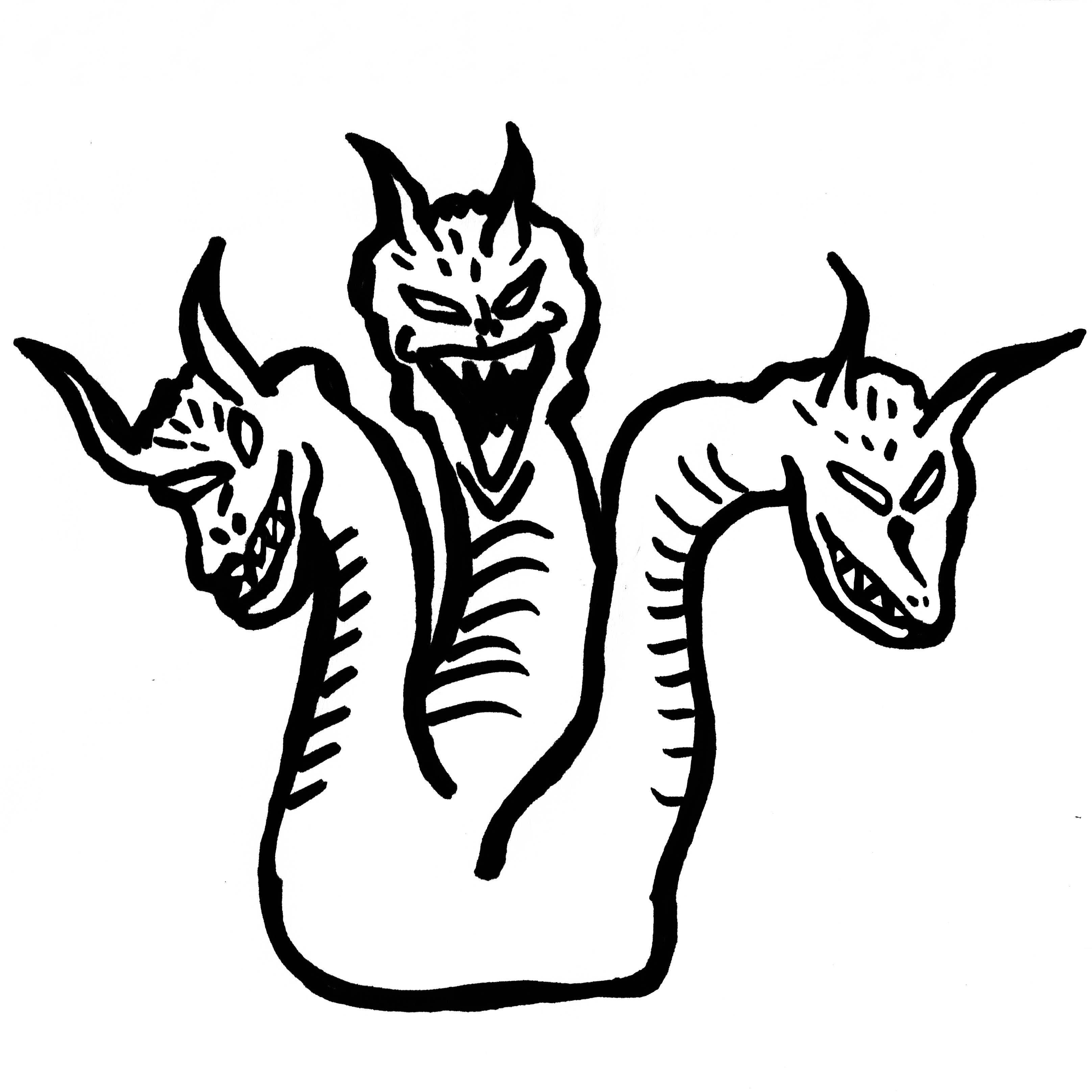
There’s just no way around it; King Ghidorah is the most heavy metal monster in movie history. I mean that in the literal sense, since the supreme kaiju being is seemingly armored by a layer of gold scales, making his “heavy metal” designation as matter-of-fact as Mechagodzilla‘s. Of course, I also mean it in the colloquial sense. The three-headed dragon beast is loudly & proudly metal as fuck on a cellular level. When Ghidorah flies into the frame to take down Godzilla and his fellow skyscraper flunkies, the image conjures the crushing sounds of heavy-metal guitar riffs in audiences’ brains, even in the 1960s pictures that were produced well before Black Sabbath had a record deal. Ghidorah is so metal, in fact, that it takes at least three other Toho-brand monsters to muscle him out of the pit, one for each lightning-spewing head. 🤘

The first time I encountered King Ghidorah was in the 1968 kaiju crossover picture Destroy All Monsters, in which the space-alien bio weapon was unleashed to union-bust a gang of kaiju that included Godzilla, Mothra, and Rodan (among the less-famous monsters Minilla, Gorosaurus, Anguirus, Kumonga, and Varan). Seen out of order in my winding journey through Criterion’s Godzilla box set, this appeared to be an especially grand ego-boost for the giant beast, like when WWE puts over their biggest, brawniest wrestler by having them eliminate every other competitor on the roster during the Royal Rumble. As it turns out, that was Ghidora’s exact funciton from the very beginning, and his debut entrance into the Toho kaiju ring marked the very first time Godzilla felt compelled to team up with other monsters to fight on humanity’s behalf. That Godzilla face-turn was in 1963’s Ghidorah, The Three-Headed Monster, in which evil space aliens declare interplanetary warfare by launching Ghidorah at Planet Earth, threatening to take over. It’s then up to Mothra, in her squirming grub form, to convince Godzilla & the pterodactyl-like Rodan to stop throwing rocks at each other like schoolyard children and instead join forces to fight off this existential, heavy-metal threat. They’re both petty assholes about it, but they eventually relent and team up to repel the flying hell-beast before going their separate ways.

The reluctant tag team of Godzilla & Rodan reforms when King Ghidorah returns in 1965’s Invasion of the Astro-monster. Rebranded with his new wrestler gimmick as Monster Zero, Ghidorah is once again deployed as an interplanetary weapon of mass destruction, one that can only be disarmed by the collective power of multiple kaiju opponents. His inevitable 2-on-1 battle with Godzilla & Rodan is delayed until the climactic 15 minutes of the runtime, though, as the invading Xiliens from Planet X smartly abduct Godzilla & Rodan with UFO tractor beams and imprison them for as long as possible so Ghidorah can do maximum damage, unchecked. Without the large-scale monster battles to fill up the runtime, Invasion of the Astro-monster spins its wheels with lengthy indulgences in political espionage and The X From Outer Space-style extraterrestrial cocktail parties. It’s maybe not the most thrilling approach to making a monster movie, but it does lead to some gorgeous 60s-kitch imagery. It’s impossible to decide what the most striking image of the film is in retrospect, but I’ve narrowed it down to two options: literalizing the Cold War aspect of the Space Race by putting a gun in the flag-planting astronaut’s free hand or Godzilla being abducted by a UFO. Then, Ghidorah soars into the frame to battle Godzilla & Rodan once again, erasing such questions entirely with heavy-metal bursts of lightning.

If there’s one detail of Ghidorah’s design that makes his metal-as-fuck majesty immediately obvious, it’s that each of his individual dragon heads moves independently, which is especially impressive when combined with his suitmation power of flight. It’s a lot like watching Kermit the Frog ride a bicycle for the first time in The Muppet Movie, adding an entire new dimension to kaiju suitmation spectacle audiences previously did not dream was possible. The suit was reportedly exceedingly difficult to operate as a result, often leading to longer shooting schedules as his operators struggled to keep his long, golden necks from tangling like noodles. Like headbanging to thrash riffs, it was well worth the headache. Everything else that makes Ghidorah so thunderously badass is immediately, visually obvious. He is the essence of metal, skyborne and beautiful. Godzilla mastermind Ishirō Honda’s impulse to bulk up the monster’s reputation by making him undefeatable unless several other kaiju attack in unison was a smart one, but it was also necessary. Look at him. No one would buy into the kayfabe otherwise.

-Brandon Ledet

Lagniappe Podcast: Destroy All Monsters (1968)

For this lagniappe episode of The Swampflix Podcast, Boomer, Brandon, and Alli discuss the kaiju battle royal Destroy All Monsters (1968), featuring Godzilla and all his best frenemies.

00:00 Welcome

01:09 The Craft (1996)
04:20 The Shining (1980)
07:26 Fight Club (1999)
14:47 Malignant (2021)
18:17 Civil War (2024)
19:36 It’s What’s Inside (2024)
28:52 Megalopolis (2024)
40:41 Look What Happened to Rosemary’s Baby (1976)
49:00 Christine (1983)
52:07 They (2002)
56:45 The Grudge (2019)
1:00:25 Mr. Crocket (2024)
1:05:17 Sex Demon (1975)
1:12:47 Flesh and Fantasy (1943)

1:19:13 Destroy All Monsters (1968)

You can stay up to date with our podcast through SoundCloudSpotifyiTunesTuneIn, or by following the links on this page.

– The Lagniappe Podcast Crew

Godzilla x Kong: The New Empire (2024)

The current run of American Godzilla movies so badly, nakedly want what Marvel Studios had in its Avengers era that they’re often referred to as The MonsterVerse, named of course after the Marvel Cinematic Universe.  We’re now at a point where the MCU’s glory days are quickly fading in the rearview, but the Marvelification of Godzilla has just been completed.  After a few standalone stylistic experiments that mired Godzilla in grim-grey CGI drudgery and drafted his longtime frenemy King Kong into the Vietnam War, the two towering kaiju have been teamed up by their own Avengers Initiative in a couple dumb-fun action blockbusters designed to sell some opening-weekend popcorn and to tease the next popcorn-seller down the line, whenever another one inevitably arrives.  2021’s Godzilla vs Kong at least maintained some of the colorful cartoon spectacle of classic kaiju battles like 1963’s King Kong vs. Godzilla, arriving as a much-needed return to grand-scale filmmaking in those early years of COVID precautions.  In their second shared title, Godzilla x Kong: The New Empire, that classic Toho spirit has instead been completely replaced by the quippy, zippy action comedy of a Guardians of the Galaxy sequel.  Immensely talented actors Rebecca Hall, Dan Stevens, and Brian Tyree Henry stand around spewing exposition and inane “Well, that just happened” punchlines while CGI gods fight to start or stop the apocalypse in the sky above.  1980s pop tunes loop continuously on old school tape decks as contrast to the rest of the film’s future tech (including a giant mechanical arm built to enhance King Kong’s already mighty super-strength).  All that’s missing, really, is a talking raccoon, but hey you gotta leave something on the table for the next one.

The New Empire is much more flattering as a King Kong sequel than it is as a Godzilla one, mostly because that series has so many fewer, lower points of comparison.  Godzilla currently has 38 films to his name, while Kong only has 12 – most of which are not tied to the 1933 original.  Within that lineage, The New Empire works best as a stealth remake of 1933’s rushed-to-market Son of Kong.  Most of the best scenes involve Kong taking a young, violent, childlike ape under his tutelage as a mentor.  In an early fight, Kong uses him as a weapon, beating back other, meaner apes with the bitey little bastard’s limp body.  Later, they fully team up as a makeshift father-son duo to take down a Richard III-style mad king and free the enslaved apes who live in the even hollower Earth beneath Kong’s Hollow Earth stomping grounds.  By contrast, Godzilla doesn’t get nearly as much to do.  He mostly just swims to an underwater gender clinic to charge up from blue to pink, emerges to join the fight against the mad king in the final act, and then takes an angry cat nap once everything calms down.  Other surprise kaiju combatants join the battle in the back half, but none are as surprising as the Mechagodzilla reveal in the previous picture.  Mostly, the monsters just follow the same patterns of CGI superheroics we’ve already seen countless times in the past decade, just scaled up to skyscraper size for a false sense of escalation.  Meanwhile, the humans on the ground hang out in CSI-style tech labs, narrating the action like WWE announcers.  Director Adam Wingard does his best to add some style & personality to the proceedings, flinging fluorescent goop at the non-existent camera’s “lens” every time a monster is defeated, but style & personality is mostly just window-dressing when it comes to this kind of four-quadrant blockbuster filmmaking.

If there’s any clear artistic path forward for the American Godzilla picture, it might be in more sincerely tackling the POV of the fictional Indigenous tribes who worship & manage the kaiju of Hollow Earth.  So far in the MonsterVerse, the Indigenous peoples associated with each creature have been exoticized with the same old-school Indiana Jones adventurism that’s persisted in both the King Kong & Godzilla series since their respective 1930s & 50s origins.  There’s an unexplored angle in telling a story from their perspective instead of framing it through outsiders’ eyes, an approach already forged by the recent Predator prequel Prey. Of course, despite including the word “new” in its title, The New Empire isn’t much interested in new ideas or in unexplored angles on old ones.  It’s content to repeat what’s worked previously for another easy payout, whether repeating the cartoonish CGI smash-em-ups of Godzilla vs Kong or repeating the crossover superhero team-ups of the Avengers films.  There isn’t much awe or novelty in that approach to sure-thing, big-budget filmmaking, but there is some joy to be found in its familiarity – however minor.

-Brandon Ledet

King Kong vs. Godzilla (1962)

There’s a new Godzilla & King Kong wrestling match in multiplexes right now: a tag team formation of the legendary monsters just three years after their last onscreen battle in the American production Godzilla vs Kong.  Do you know what’s never reached American theaters, though?  The original 1962 crossover film King Kong vs Godzilla – at least not in any wholly intact, wholly legal form.  It wasn’t until the mid-2000s that the 1954 Japanese cut of the original Godzilla officially reached American audiences, with the only widely available version being a warped American edit featuring awkward post-production inserts of actor Raymond Burr.  Twenty years later, that film’s second sequel, King Kong vs Godzilla, has still not yet been made wholly available for American audiences … but we’ve gotten damn close.  In 2019, The Criterion Collection released a gorgeous box set of digitally restored Showa Era Godzilla films, with every title dutifully de-Americanized except for King Kong vs Godzilla.  The original Japanese edit of that film is included in the set, but it’s stashed away among the supplementary Bonus Features on the final disc, not listed in sequence.  It’s also not fully restored to the image quality standards of the rest of the set; only the scenes left untouched by the American edit are in Blu-ray quality, while the reintegrated Japanese-only scenes switch to a jarring standard-definition DVD scan.  The reason for this choppy, half-complete restoration is somewhat mysterious to anyone who’s not an employee of Criterion, Toho, or Warner Bros, but I can at least say I’m grateful that it was included in the set at all, compromised or not.

The only reason King Kong vs Godzilla‘s muddled distribution history is worth noting in the first place is that the film was a significant creative swerve for both of its overlapping franchises.  If nothing else, it marks the first time either Kong or Godzilla were featured in color or in widescreen, three entries into both respective series.  The monsters’ onscreen crossover match being billed like a boxing PPV was a big deal, as it set the template for dozens of sequels to come: Godzilla vs. Hedorah, Godzilla vs. Mothra, Mothra vs. Godzilla, Godzilla vs. Megalon, Godzilla vs. Mechagodzilla … all the way to the aforementioned Godzilla vs. Kong.  More importantly, it was a major change in course for its titular monsters in terms of its intent & tone.  The original Godzilla film has obvious, deep roots in the cultural & historical contexts of 1950s Japan, but it also pulled a lot of narrative influence from the monster-movie template established by the 1930s American classic King Kong.  Kong’s second outing in 1933’s Son of Kong and Godzilla’s second outing in 1955’s Godzilla Raids Again—both rushed to market mere months after the success of their predecessors—were mostly just pathetic cash-in imitators of former glories.  Of the pair, Godzilla Raids Again feels especially superfluous, since it can only offer the novelty of seeing the pro-wrestling style kaiju battles of later Godzilla sequels filtered through the relatively elegant aesthetics of the original (through Godzilla’s fights with the dinosaur-like Anguirus, again recalling plot details from the original King Kong) with no other notable deviations.  Son of Kong is likewise shameless in its willingness to repeat the exact tones & events of its predecessor, but it at least introduces the adorably useless Little Kong of its title to keep the rote proceedings novel.  Together, they make for convincing evidence that both series would have to get goofy to keep going, which is where King Kong vs. Godzilla comes to the rescue.

1962’s King Kong vs. Godzilla is a wonderfully goofy corporate satire that feels like it has less in common with previous Kong or Godzilla pictures than it has in common with more cartoonish titles like Giants & Toys and Will Success Spoil Rock Hunter?.  A lot of the early stirrings of my beloved Godzilla vs Hedorah seem to have originated here, from the psychedelic pop-art color palette to the tangential indulgences in Looney Tunes goofballery.  Our two skyscraper combatants are unleashed upon the modern world in ways that feel true to their origin stories but are heightened for comedic effect.  When an American nuclear submarine gets wedged on an iceberg in Japanese waters, a slumbering Godzilla explodes out of the ice to attack the crew onboard.  Meanwhile, Kong is once again collected from his island home to participate in low-brow vaudevillian entertainment, but this time it’s to boost the ratings for a television program that promotes the Japanese company Pacific Pharmaceuticals.  Shockingly, the island extraction sequence that sets Kong loose somehow feels even more racist than the 1930s film that inspired it (a sequence the original Godzilla copied with much more tact & grace), but if you can stomach the blackface humor long enough to get past it, the rewards are worthwhile.  Pacific Pharmaceuticals quickly establishes itself as the villain of the piece, exploiting their bungled extraction of Kong and the simultaneous emergence of Godzilla to craft the ultimate ratings booster: the world’s first televised kaiju battle.  Instead of nuclear proliferation or the exploitation of Nature, a novelty television program advertising Big Pharma drives the horror of the plot, damning capitalistic greed and bloodthirsty quests for increased ratings.  That theme can’t help but feel a little silly by comparison, and the movie smartly leans into the humor of its villains being incompetently evil in their selfishness instead of being knowingly evil in some grand mastermind scheme.  The world suffers for their folly regardless.

Of course, all of this plot detail and background context ceases to matter during the final act, when Godzilla & Kong finally start going at it in earnest.  I won’t spoil who wins that fight, but I will say that the result is bullshit.  There’s some great monster action throughout, though, including a sequence where a lightning-powered Kong fights an especially slimy octopus and one where Godzilla survives miniature missile fire from an army of toy tanks.  The most notable dynamic to the monsters’ one-on-one match-up is the difference in the care put into their respective looks.  Godzilla looks just as great as ever here, while Kong looks like his costume was left to melt on some forgetful production assistant’s dashboard on a summer afternoon.  I could not get over the bizarre, lumpy proportions of Kong’s hairy, apish body; it felt like I was standing naked in front of a full-length mirror, my exact body type finally represented onscreen.  The half-SD, half-HD lumpiness of the movie’s presentation had a similar kind of misshapen charm to it as well.  In truth, it was no worse than watching a movie on a streaming platform that frequently buffered down to a lower quality due to internet bandwidth constraints, which isn’t ideal for a Blu-ray purchase but also isn’t a total deal breaker.  However, it did have the unintended benefit of highlighting just how much of the original Japanese version of the film had been removed from its American cut, denoted by alternatingly crisped & blurred visual details.  It’s obviously a wonderful thing that Criterion was able to officially present King Kong vs Godzilla to an American audience for the first time in the half-century since it premiered in Japan, regardless of lumpiness.  It’s been so long since the film first came out that its titular combatants have since become tag team partners in fights against other, lesser monsters, so it’s somewhat embarrassing that their original outing together is still partially stuck in a distribution limbo.  King Kong vs. Godzilla is a deeply silly film, but it’s also a historically important one, and it should be treated as such.

-Brandon Ledet

Lagniappe Podcast: Godzilla (1954)

For this lagniappe episode of The Swampflix Podcast, Boomer, Brandon, and Alli celebrate Godzilla’s 70th birthday (and first Oscar win) by looking back to the monster’s 1954 debut.

00:00 SXSW

04:31 How to Build a Truth Engine (2024)
06:42 Last Things (2024)
09:30 Bottoms (2023)
11:11 Dune: Part Two (2024)
14:52 Mishima: A Life in Four Chapters (1985)
21:30 Love Lies Bleeding (2024)
29:07 Theodore Rex (1994)
32:42 Brief Encounter (1945)
37:44 Throw Momma from the Train (1987)
40:43 Twins (1988)
43:31 Wise Guys (1986)

45:43 Godzilla (1954)

You can stay up to date with our podcast through SoundCloudSpotifyiTunesTuneIn, or by following the links on this page.

– The Podcast Crew

Godzilla Minus One (2023)

As I’m piecing together my personal Best Films of 2023 list in these last few weeks of the year, I’m becoming increasingly self-conscious of how many of my favorite new releases are shamelessly nostalgic for the toys & kitsch collectibles of my youth.  Even without a new Godzilla film juicing the numbers, it’s been a great year for films about Furbies, Barbie dolls, Ninja Turtles, and tokusatsu superheroes like Ultraman, Kamen Rider, and The Power Rangers.  My Best of the Year list is starting to look like a 1998 Toys”R”Us TV commercial, which is somewhat embarrassing for a man of my age.  I am approaching 40 years old, and I still don’t wanna grow up.  Thankfully, Godzilla Minus One‘s inclusion in this year’s throwback-toy-commercial canon is at least helping to class up the list a little, as it’s a much more sincere, severe drama than most movies that have excited me lately.  It’s just as openly nostalgic for vintage tokusatsu media as Shin Ultraman, Shin Kamen Rider, and Smoking Causes Coughing, announcing itself as an official 70th anniversary celebration of the original 1954 Godzilla film that started it all.  However, it’s the only film in this year’s crop to hit the same notes of deep communal hurt as the ’54 Godzilla, which is a much more ambitious aim than reviving the goofball slapstick antics of the child-friendly kaiju & superhero media that followed in its wake.  Godzilla Minus One‘s sincerity is incredibly rewarding in that contrast, to the point where it’s the only Godzilla movie I can remember making me cry.

To commemorate that 70th anniversary, Godzilla Minus One dials the clock back to the widescale destruction of post-WWII Japan, covering the first few years of national rebuilding after nuclear devastation.  The giant primordial lizard of the title is once again shaken awake by the human folly of the atomic bomb, a great sin against Nature echoed in the creature’s flamethrower-style “atomic breath.”  The film’s limited budget means that Godzilla gets limited screentime, but the monster is deployed wisely as an unstoppable, unfathomable horror whose atomic power is so great that it burns away the flesh of its own towering body.  Godzilla is scary again, more of a harrowing extension of war survivors’ PTSD than a rollicking hero to children everywhere.  The cleverest move the movie makes, then, is by limiting the scope of its drama to match the limited scope of its monster attacks.  We feel the fear Godzilla stirs in just a few cowering citizens’ lives, even though both the monster and its victims represent large-scale national grief in metaphor.  It’s a small-cast wartime melodrama that’s occasionally interrupted by kaiju-scale mayhem, the same way a soldier who survives war is supposed to go through the motions of normal life in peacetime despite frequent, violent reminders & memories of the atrocities they’ve witnessed or participated in.  The “Minus One” of the title refers to people struggling to rebuild their lives from Ground Zero, only to be reset even further back by the grand-scale cruelties of life & Nature, through the monster.  It’s tough to watch.

The drama gets even more intimate & insular from there.  Most Godzilla movies dwell on the city-wide chaos of the monster attacks, depicting thousands of victims scattering away from Godzilla’s path like helpless insects.  In contrast, Godzilla Minus One zooms in to assess the value of just one, individual life in that mayhem.  Its mournful protagonist (Ryunosuke Kamiki) is a kamikaze pilot who dodged his suicidal mission during the war and now suffers intense survivor’s guilt, convinced that he morally failed in his duty to serve his nation.  The sudden appearance of Godzilla offers the self-hating young man a second attempt at wartime valor, to the point where he’s disturbingly excited by the prospect of facing off against the monster instead of experiencing healthier responses like fear & grief.  In a more proudly nationalistic action thriller, this sentiment would go unchallenged, and his self-assigned self-sacrifice would be celebrated as traditional macho heroism.  Instead, Godzilla Minus One is about the community of people around the pilot—each having survived their own war atrocities & personal shortcomings—convincing him that his life is worth living, that he has value beyond the damage he can cause as a lone soldier in a war that’s officially over.  The honor of serving his country through death is no nobler than risking his life de-activating leftover explosive mines to put food on his family’s table; it’s sad & disgraceful, and it should be treated as a worst-case scenario.

The dramatic beats of Godzilla Minus One are just as predictable as the rhythm of its monster attacks, and just as devastatingly effective.  I cried with surprising frequency during the final twenty-minute stretch, even though I saw each dramatic reveal coming from a nautical mile away.  Maybe it’s because I vaguely related to the communal struggle to rebuild after multiple unfathomable catastrophes, having remained in New Orleans through a series of floods & hurricanes.  Maybe it’s because I more personally related to the pilot’s struggle to learn a foundational sense of self-worth, the toughest aspect of adult life.  Maybe it’s because composer Naoki Satō’s gargantuan score drummed those sentimental feelings out of me through intense physical vibration.  Who’s to say?  All I can confidently report is that the drama is just thunderously affecting as Godzilla’s roars, which is a rarity in the series.

-Brandon Ledet

Godzilla vs Mechagodzilla (1974)

I was initially careful not to divulge too many third-act details when reviewing Godzilla vs Kong, but it’s been an entire year since it first premiered so I don’t mind spoiling it now.  The only reason Adam Wingard’s kaiju smash-em-up is the best American Godzilla film to date is that the monster fights promised in its title felt exceptionally tactile & novel for a modern CG blockbuster.  And what really launched those fights over the top was the WrestleMania-style surprise entrance of Godzilla’s mechanized doppelgänger Mechagodzilla in the third act, injecting an excessive rush of adrenaline into a movie was already plenty entertaining before the bionic monster’s arrival.  The delight of that last-minute surprise really leaves audiences on a fist-pumping high, forgiving all the mundane humans-on-the-ground storytelling it takes to get there.

Looking back at the delightful surprise of Mechagodzilla’s most recent onscreen appearance, I can’t help but wonder if the robo-monster should always be presented as a last-minute swerve.  At the very least, I can say for certain that its first franchise appearance in 1974’s Godzilla vs Mechagodzilla would’ve been greatly improved if its existence weren’t teased in the title & poster.  There’s a brief, glorious moment in the film when Godzilla is being framed for mayhem he didn’t commit by the mechanized imposter, frustrated that other kaiju and the citizens below believe he has turned heel.  The film could have been an all-time classic if that conflict was allowed to drive the plot, delaying the reveal of the “space titanium” under the faux-Godzilla’s “skin” as late in the runtime as possible instead of immediately degloving it.  Basically, I wish Mechagodzilla was the Gene Parmesan of the series.

There is plenty of novelty to be found elsewhere in Godzilla vs Mechagodzilla without that surprise reveal.  While Mechagodzilla is almost always a manmade weapon in subsequent films (including in Godzilla vs Kong), it arrives on Earth as space alien tech in its first appearance.  The sub-James Bond espionage antics that thwart that alien plot can be a little dull (an unfortunate holdover from the previous entry in the franchise, Godzilla vs Megalon).  The aliens themselves are amusing knockoffs of the Planet of the Apes creature designs, though, which adds a post-modern mash-up quality to the premise.  The film also doesn’t entirely rely on the novelty of Mechagodzilla to freshen up its monster roster.  It also features appearances from Anguirus (a spiky armadillo) and King Caesar (a personified Shisa statue) in its Royal Rumble rollout of surprise combatants.  It’s a fun picture as is, even if it had much greater potential as a kaiju whodunnit.

To be fair, I’m not sure Godzilla vs Mechagodzilla needed to be especially novel to be worthwhile, considering that it was already arriving fourteen films deep into the Godzilla canon.  Fifty years and twenty-two Godzilla movies later, there have been plenty of boring, uninspired kaiju duds with way less to offer than this standard-issue monster flick.  At the very least, it attempts to establish its own playful sense of style between the kaiju battles in its cave-painting illustrations, Brady Bunch news-report grids, and double-exposure shots of religious prophecies.  It’s no Godzilla vs Hedorah in that respect, but few movies are.  Most importantly, Godzilla vs. Mechagodzilla gets by on the exact same merits that made Godzilla vs Kong such a delight: the inherent entertainment value of its pro-wrestling style kaiju fights (which are often shockingly bloody in this case, imagery that was often softened in its American edits).  I just can’t help but wish that it also held back Mechagodzilla for as long as possible in the same way Godzilla vs Kong did, though. It could have been an all-timer instead of just another good’n.

-Brandon Ledet

The Photocopied Mayhem of Monster Island Entertainment

I’ve been long-overdue for a nostalgia-check rewatch of the 1998 Godzilla film, directed by notorious Hollywood dingus Roland Emmerich.  Since it was the first fully American Godzilla production, the hype leading up to that film’s release was immense and—a child at the time—I bought into all of it: the tie-in Saturday morning cartoon, the rap-rock soundtrack CD, the Taco Bell-exclusive merchandise, all of it.  The film was a critical flop and a commercial disappointment, but I was young enough (and offline enough) to remain blissfully unaware of its reputation as the biggest embarrassment to-date in Godzilla’s 30+ film franchise.  That tainted rep has been difficult to ignore in recent years, though, as other 90s Kid™ nostalgia traps like Mortal Kombat, Space Jam, and Spice World have enjoyed retroactive critical appraisal from goofball Millennials (myself included, on all three counts) while Godzilla ’98 has maintained its cultural standing as one of the worst blockbuster misfires of all time.  I had to revisit the film to see for myself whether it was the monstrously entertaining creature feature I remembered watching as a kid or the putrid, bloated travesty everyone else reports it to be.  As per usual, the truth is that it falls somewhere between those two extremes.

The 1998 Godzilla isn’t especially horrendous nor especially great by any particular metric; it’s passably entertaining for a goofball blockbuster spectacle marketed almost exclusively to children.  I honestly believe that the film would’ve been remembered fondly if it had just been a dinosaurs-attacking-NYC movie instead of dragging Godzilla’s name into its CGI buffoonery, since the creature’s legendary run with Toho set an expectation it was never going to meet.  A $100mil Roland Emmerich production was never going to sincerely grapple with the post-nuclear emotional devastation of the original 1954 Godzilla, nor was it ever going to indulge in the wildly imaginative free-for-all of weirdo outliers like 1971’s Godzilla vs. Hedorah.  It basically just uses the Godzilla name as an excuse to stage one-off, city-crushing gags with a square-jawed T-Rex that has practically nothing to do with the creature’s post-War Japanese origins.  I can see how that half-hearted appropriation of the Godzilla legacy was insulting to adult fans of the original Toho series, but I can also personally report that it did not matter at all to the dipshit 12-year-olds the movie was marketed to, at least not while we enjoyed watching a CGI NYC get smashed up real good by a giant dino.  In retrospect, both sides of that level-headed critical divide were likely exaggerated responses to what the film could and did deliver.

The reason I’m suggesting that Godzilla ’98 might’ve fared better as a dino invasion movie is because that’s where it’s heart clearly was anyway.  It borrows practically all its ideas, images, and musical cues from the first two Jurassic Park movies, announcing its intention to outdo the iconic Spielberg series in an early teaser ad that showed Godzilla’s gigantic foot crushing the museum-residing skeleton of a T-Rex.  It recreates the first Jurassic Park‘s raptors-in-the-kitchen sequence, its street race T-Rex chase, and even its gender-reveal pregnancy twist – all ported over to the city-invasion context of The Lost World.  Tri-Star Pictures could’ve saved a lot of money and a lot of critical grief if it had just set gigantic dinosaurs loose in modern Manhattan instead of bothering to license the Godzilla name.  The film is basically an overly expensive mockbuster version of what Jurassic Park had already accomplished, except with a novelty urban setting that adds a fun new bubblegum flavor to the mayhem (like the gag where the central group of heroic New Yorkers drive a Yellow Taxi cab directly out of Godzilla’s mouth onto the Brooklyn Bridge).  What’s amusing about Godzilla‘s function as a shameless Jurassic Park knockoff is that it was a big enough production to inspire its own parasitic mockbusters – copies of a copy.

Enter notorious schlockteur Charles Band, whose long-running exploitation enterprise Full Moon Features was no stranger to producing straight-to-VHS, proto-Asylum mockbusters of legitimate Hollywood films.  Smelling chum in the water as soon as Godzilla‘s production was announced in the mid-90s, Full Moon rushed to establish a kaiju-themed sub-label called Monster Island Pictures, offering kid-friendly, straight-to-VHS alternatives to the incoming Roland Emmerich behemoth.  As the major-studio Godzilla film failed to produce its own sequels, Full Moon’s Monster Island Entertainment also failed to sustain itself long-term – throwing in the towel after just two films.  It’s safe to say that neither 1996’s Zarkorr! The Invader nor 1998’s Kraa! The Sea Monster had much of an impact of the pop culture landscape at large, only registering with the naive, kaiju-hungry children who happened to rent them from video stores at the height of Godzilla fever.  In retrospect, however, they hold a kind of vintage kitsch appeal as lost 90s Kids™ relics.  They’re the exact kind of real-deal VHS schlock ephemera that now gets ironically spoofed in retro throwbacks like PG: Psycho Goreman but rarely get revisited in earnest.  I couldn’t help but fall further down that Godzilla mockbuster rabbit hole myself, though, especially since they’re also the exact kind of cultural runoff that’s readily streaming for free on Tubi.

Although Kraa! The Sea Monster was the Monster Island Entertainment title released the same year as Roland Emmerich’s Godzilla, Zarkorr! The Invader is the one that feels like its direct knockoff.  The titular Zarkorr is a gigantic reptile with magical fire breath and metal-on-metal roars, which makes him pretty indistinct as a Godzilla alternative.  All the film’s city-crushing monster action is fairly limp as a result, despite the inherent cuteness of a rubber-suit dragon creature stomping down a dinky miniature of Newark, NJ.  Thankfully, the film does indulge in plenty of goofy Charles Bandian bullshit outside of those tedious monster attacks, even if it’s not quite enough to make up for the giant-reptile mediocrity.  Its on-the-ground humans plot involves a gone-postal mailman who’s selected by an invading alien race for a kaiju-themed experiment specifically because he’s the most Average man alive.  As a test of humanity’s collective wit & resolve, its most unremarkable specimen is alone tasked with the destruction of the dragonlike Zarkorr, who’s stomping his way to the man’s shitty New Jersey apartment for an inevitable showdown.  The Charles Band-specific novelty of that set-up is in the presentation of the aliens’ message, which is delivered by a doll-sized Valley Girl teenager on a set with jumbo-scaled prop kitchenware.  That familiar Full Moon obsession with dolls & miniatures doesn’t do much to jazz up Zarkorr’s mediocre kaiju mayhem, but it’s at least a momentary distraction from the tedium.

Monster Island Entertainment didn’t really go off the rails with its Godzilla mockbusters until 1998’s Kraa! The Sea Monster, which feels more like a pilot for a Power Rangers-style action series than it does a proper kaiju film.  Its plotting is deliciously, deliriously inane.  A space warmonger named Lord Doom (costumed to look like Marvel Comics’ Doctor Doom, naturally) sends the kaiju-scale fish monster “Kraa The Warbeast” to Earth to steal the planet’s warmth so his own homeworld doesn’t freeze into oblivion.  Earth’s only protectors are a small crew of Power Rangers-style space cops who lurk just outside of orbit but cannot reach the planet’s surface due to a malfunctioning spaceship.  They have no choice but to enlist on-the-ground help from a wisecracking crab creature with an obnoxious Italian accent, their only nearby agent who can pitch in to stop Kraa before it’s too late.  The kid-friendly punchlines and visual gags are just as eyeroll-worthy in Kraa! as they are in Zarkorr!, but the fanged-fish kaiju design and deranged Full Moonian plotting go much further in distinguishing it as a stand-alone novelty.  If it weren’t for its rushed-to-market 1998 release date and its Monster Island Entertainment production title, you might not even recognize it as a Godzilla mockbuster; it’s its own uniquely goofy thing, which is more than you can say about Emmerich’s extensively market-tested Jurassic Park knockoff.

The most sublime moment in this entire trio of photocopied kaiju novelties can, of course, be found in Kraa! The Sea Monster.  During the first monster attack, Kraa takes the time to destroy a building that prominently features a billboard advertisement for the 1998 Godzilla, starting with a close-up shot of the better-funded film’s iconic logo before it’s ripped to shreds by the rubber-suited fish monster.  In another meta-referential visual gag, Kraa! The Sea Monster spotlights a theatre marquee advertising a screening of Zarkorr! The Invader.  The best any of these three films could hope to accomplish is as a memorably goofy byproduct of corporate synergy.  I had fun revisiting a few individual gags in the 1998 Godzilla film, but none are as fun to think about or revisit as the film’s extratextual tie-in marketing, where Godzilla squares off against the likes of Puff Daddy, Charles Barkley, or the Taco Bell chihuahua to cash in on the momentary kaiju craze it stirred up in American pop culture.  As a shameless exploitation filmmaker of the lowest order, Charles Band inherently understood the novelty value of that kind of pop culture cross-over synergy, something his Monster Island Entertainment sub-label pushed to its goofiest extreme with Kraa! The Sea Monster.  None of these movies are essential viewing, but Kraa! is the one that’s the most honest & playful with its kaiju mockbuster appeal.  To match those dubious creative heights, Godzilla ’98 would’ve had to fully commit to a Jurassic Central Park premise it was too timid to openly indulge.

-Brandon Ledet