Babygirl (2024)

After hearing early reports that it was not included in the pre-show package, there was a perverse thrill in seeing Nicole Kidman’s infamous AMC ad precede my local screening of her new erotic melodrama Babygirl.  It felt like getting away with something, much like how her CEO character in the film gets a thrill out of sleeping with a much younger intern.  However, no matter how much “heartbreak feels good” in a place like the corporate multiplex, it’s never felt nearly as good as the mind-shattering orgasms Kidman simulates in the film’s corporate skyscraper offices. I say “simulate” with some uncertainty, given the actor’s pull-quote confessions that she occasionally had to pause production because she didn’t “want to orgasm anymore,” an intimate experience that left her feeling “ragged” by the time the shoot had reached completion. All of this extratextual Nicole Kidman press is clouding my mind as I try to write about this movie because it’s a movie that’s partially about the actor’s icy real-world persona. Her frustrated CEO character is constantly coached by a PR team about how to present herself to the public, like an actor prepping for a press junket. During one crucial sequence, she’s plucked, injected, and flash-frozen to sculpt her already-gorgeous body into fighting shape, so she can be the public face of an upcoming, all-important product launch. The movie would mean significantly less if Kidman had not been cast as its titular babygirl, since it constantly invites you to import details from her real-life public persona into her character’s fragile ferocity as a public figure. That’s what makes its steamy, taboo sex scenes feel like genuinely vulnerable exposure for the actor – not necessarily their vulgarity.

The source & authenticity of orgasms are very important in Babygirl. The movie opens with Kidman having traditional Movie Sex with her hot, age-appropriate husband (a salt-and-pepper Antonio Banderas), simulating orgasm in their luxury-apartment marital bed. When the husband rolls over, Kidman sneaks off to her private home office to achieve the real orgasm he warmed her up for but was otherwise unable to assist. Notably, she finishes herself off to BDSM pornography, making it clear at the start of the film that she already knows exactly what she wants in her sex life; she just doesn’t have the courage to voice it. This status quo is interrupted by the hiring of a young, tall, strapping intern played by Harris Dickinson, in whom Kidman immediately detects a Dominant Vibe. It’s immediately clear that the high-powered CEO and the bratty, fresh-out-of-college bro beneath her will be having a torrid office affair, but Kidman’s inability to voice exactly what she wants from him delays the consummation of their mutual lust. Babygirl is not the usual self-discovery kink story wherein a dormant submissive discovers a newfound sexual appetite, à la Secretary or Fifty Shades of Grey. It also goes out of its way to not pathologize Kidman’s interest in the kink-play power dynamic of simulating submissiveness when she’s truthfully a high-powered Business Bitch. It’s more of a kink coming-out story, wherein Kidman knows exactly wants but has to work up the courage to ask for it. Too bad she has to have dirty motel room sex with a confused, vulnerable employee to break out of her vanilla rut, since she’s already married to a hot Daddy type who directs stage plays for a living; the irony is that he’s extremely well suited for the job but remains an untapped resource.

All of this dramatic tension is released (and released and released) through a series of successfully thrilling sex scenes between Kidman & Dickinson, who establish a convincing sexual rapport as well-matched but poorly trained kinksters. Unfortunately, the impact of those scenes does not reverberate through Babygirl‘s attempts at corporate & familial drama elsewhere. When Kidman & Dickinson negotiate power dynamics in seedy nightclubs & motel rooms the vibes are electric; when attempting the same negotiations in empty offices & apartment hallways half of their lines feel coldly ADR’d, registering more as a ventriloquist act than a dramatic performance. I kept leaning towards the screen, straining to see if their mouths are actually moving. However, any time I found myself questioning the thematic choices to link Kidman’s kink journey to her religious-cult upbringing, her rebellious daughter’s queerness, her sympatico relation to a wild dog in need of training, to Girlboss cultural politics, or to the soundtrack’s absurdly on-the-nose needle drops, the movie would pause for another fantastic sex scene that felt alive, authentic, and rich with nonverbal power negotiations. It’s a wobbly balancing act that director Halina “Bodies Bodies Bodies” Reijn only gets away with because the actors she cast are extremely hot. Kidman & Dickinson’s undeniable hotness are just as important to the text of Babygirl as the alien impersonablility of Kidman’s AMC ad, the audience-teasing hints at her on-set orgasms, and the obscure, high-end cosmetic work that presumably goes into keeping her physically preserved and camera-ready. The movie works best when it vaguely gestures at these things—not when it makes declarative statements about sexual & corporate power—letting Kidman & Dickinson’s physical chemistry do the talking.

-Brandon Ledet

FYC 2023: Wrasslin’ Weepies

Unsurprisingly, a lot of this year’s major Awards Frontrunners are solemn biopics of men who committed some of the worst sins in human history: the invention of the atom bomb, the daily operation of concentration camps, the genocide of an Indigenous nation.  As much as The Academy has attempted to reconfigure what qualifies as an Oscar-Worthy movie, it’s clear that the Oscar-friendly template of Important Men directing history lessons about Important Men is still an effective one; all that’s really changed is that those portraits of Important Men have become more critical than celebratory.  Further down the power rankings of this FYC season’s major players, there’s also a curious pair of historical biopics about Important Men who operated in a much smaller arena than the frontrunners’ global politics stomping grounds: the regional pro wrestling circuit of 1980s Texas.  The men depicted in these pro wrasslin’ biopics are of much smaller historical importance than a J. Robert Oppenheimer or a Rudolf Höss; the tearjerking melodrama of their lives is less about the moral sins of their own actions than it is about how cruelly unfair the world was to them, and whether they survived the trauma.  However, in a big picture sense, they echo the same criticism of the rigid machismo and the hypocrisy in Family Values conservatism that drove the Important Men of Oppenheimer, Killers of the Flowers Moon, and The Zone of Interest to commit humanity’s greatest.  They just work through that cultural tragedy within the walls of their small family homes and within the rubber-padded ropes of the wrestling ring.  It’s more contained.

If this season’s pro wrestling dramas are being contextualized as awards-hopefuls, they’re most overtly engineering FYC attention for their male stars.  In that way, pro wrestling is the perfect cinematic subject, since it offers such a familiar, convenient storytelling template to help get male performers over with the crowd.  Even when a wrasslin’ pictures’s in-movie drama feels minor in comparison to more historically important works, their in-ring drama carries the audience through, highlighting an actors’ talents with the emotional histrionics of a soap opera or a Greek tragedy.  Nobody benefits from that dramatic bolstering this year more than Gabriel García Bernal, who stars as the titular lead in the lucha libre history lesson Cassandro.  This by-the-numbers biopic isn’t half as stylistically daring as the Cassandro, el Exótico! documentary on the same subject, nor as fabulously glamorous as the luchador himself, but it’s an inherently cinematic story and García Bernal shines in the central role.  The real-life Cassandro is credited for changing the artform of lucha libre by subverting the homophobic trope of the “exótico.”  When he entered the business wrestling on both sides of the Texas-Mexico border, exóticos were a purely homophobic stereotype: heels who would earn cheap heat by flirting with their more traditionally macho opponents, then get immediately crushed in the ring to the crowd’s enthusiastic cheers.  It was gaybashing as ceremonial pageantry.  Cassandro flipped the script by genuinely getting over with the crowd through the artistry of his wrestling, to the point where promoters saw potential profits in letting an exótico win for a change; or, that’s at least how the story goes, according to kayfabe.  The beyond-the-mat drama of his struggles with a loving but homophobic mother and with sex-partner colleagues who are willing to fuck him in private but renounce him in public can feel a little phony & cliche to anyone who’s seen their share of queer indie dramas in the past few decades.  The nonstop montage of Cassandro’s career in the ring is still emotionally compelling in a succinct, celebratory, wrasslin’-specific way that makes up for those broad cliches, though, and by the time the credits roll it’s hard to tell whether you’re rooting for Cassandro or rooting for García Bernal – an FYC publicist’s dream.

The Von Erich family drama The Iron Claw spreads the FYC wealth to many more potential nominees than Cassandro‘s fixed spotlight on Gabriel García Bernal.  The improbable true story of the supposedly “cursed” family of professional wrestlers has plenty of star-making tragedy to spread around its four central brothers: Zac Efron as Kevin Von Erich, Jeremy Allen White as Kerry Von Erich, Harris Dickinson as David Von Erich, and Stanley Simons as David Von Erich.  Efron is the most obvious awards play of the group, transforming himself into a human He-Man action figure for the role in a grotesque way that awards bodies love to celebrate.  Each of the Von Erich brothers get their moment to bring the audience to tears, though, as they’re each pushed to the brink of what their hearts and bodies can handle by their toxically macho father Fritz Von Erich, played with monstrous villainy by Holt McCallany.  The first half of the movie recalls the laidback nostalgic cool of Dazed and Confused as the four central brothers lean on each other for warmth & validation in the happiest times of their lives, working together as up & coming wrestlers who have yet to be fully poisoned by their father’s insistence they compete amongst themselves for his scraps of praise.  The second half disrupts that momentary bliss with the heightened violence of a Greek tragedy, with each brother meeting improbably horrific ends in a rapid, relentless procession.  The Iron Claw‘s reliance on the in-ring drama of pro wrestling is heaviest in the early stretch, as the Von Erichs’ prominence in pre-WWF regional wrasslin’ circuits is mapped out in montage & dramatic recreations of select, pivotal matches.  The back half is a much more straightforward drama that could have befallen any sports-family household, since cataloging the parade of traumas that crushed the Von Erichs leaves very little time to show them actually doing the work.  Besides, the movie isn’t really about their wrestling careers anyway; it’s more about the love they shared as brothers, and how important that bond was in a home run by a man incapable of expressing affection.  If it were any less successful as a sincere family drama, the men’s frequent repetition of the word “Brother” would play as a joke, the same way audiences now laugh every time Vin Diesel says “Family” in the Fast & Furious movies.

If this were a one-on-one, three-count fight, it would be a squash match.  Cassandro is dramatically and stylistically outperformed by The Iron Claw by practically every metric – except, maybe, in the vintage-glam detail of Cassandro’s gemstoned ring gear.  Neither film is an exceptional work of great artistic importance, though; they’re both just FYC acting showcases for their above-the-line talents, who utilize pro-wrestling’s played-to-the-cheap-seats pageantry to add some emotional heft to otherwise traditional sports dramas.  If they have any standing in discussion with the Oscar-hopefuls who’ve risen to the top of the Vegas-odds rankings over the course of this FYC season, it’s in their shared skepticism over the effects of stoic masculinity and conservative Family Values in recent generational history.  Cassandro finds a way to offer a triumphant rejection of those traditional values, while The Iron Claw drags our battered hearts through their most miserable consequences.  In either case, their performers are never more powerful nor more beautiful than they are on the wrestling mat, and both films are excellent examples of acting as full-body physical artistry.  If I have to watch straightforward, mediocre melodramas to keep up with the buzziest titles in the Oscars Cycle every year, I’d be more than happy if they’d continually return to the wrestling ring for easy crowd work and promotion.  It gives us something easy to root for, which is honestly something I’d rather put myself through than yet another war atrocity drama about the worst things that have ever happened in the history of the human species.

-Brandon Ledet

See How They Run (2022)

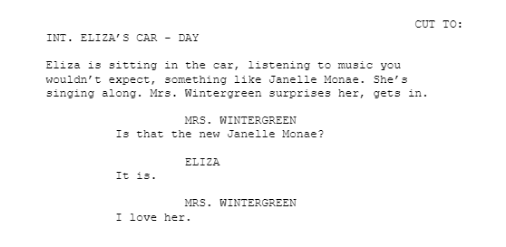
I recently talked on the podcast about my dear friend Ana Reyes’s astounding and well-deserved success surrounding her first novel, The House in the Pines (still #2 on the NYT bestseller list for hardback fiction as of this writing!). When we were all having drinks after the launch party back on January 3, her husband, who is also a writer and friend, mentioned to me that he and Ana had recently been talking about how ahead of the “cozy mystery” curve I was when I put together my pitch document/series bible for the as-yet-undiscovered project Mrs. Wintergreen. As I smiled a toothless grin that belied my bitterness that fate has not seen fit to bring Mrs. Wintergreen to life, I didn’t even point out that not only was that the case, but also that I had even included a scene in which my protagonist, 108-year-old semi-pro sleuth Constance Wintergreen, expressed an appreciation for Glass Onion star Janelle Monae:

Anyway. 

Agatha Christie is very in vogue, as evidenced by not only the aforementioned Christe-adjacent 2022 release Glass Onion, but also the Christie-containing See How They Run, a confident first feature from director Tom George penned by Mark Chappell, who is perhaps best known for his writing for the David Cross vehicle The Increasingly Poor Decisions of Todd Margaret. A period piece, the film begins on the night of the hundredth performance of The Mousetrap, a Christie-authored play which is infamous for two things: first, that there is a twist ending that the audience is encouraged not to reveal to others, resulting in the play’s ending remaining largely unknown to this day, and second, that the contract for the play forbids any adaptation of the source material to film (or the short story on which it was based from being published) until at least six months have passed since its final performance at London’s West End. This was a particularly long-sighted bit of legal play, as the show has run continuously (other than a COVID-caused pause) since its opening night in October of 1952, seventy years ago. In fact, I have some suspicion that this film exists solely for that reason, as it is the closest we can get to a Mousetrap adaptation for the foreseeable future. 

Leo Köpernick (Adrien Brody) is a sleazy slimeball of an American film director (redundant, I know) who has his sights set on turning The Mousetrap into a hit motion picture. That previously noted clause about the show being forced to close before this can even be a possibility is at the forefront of the minds of many involved, but theatre producer Petula Spencer (Ruth Wilson) assures him that the play has already reached its 100th performance and surely it will run out of steam soon, espousing the idea that a narrative with a whodunit at its core will, by its nature, see few repeat visitors and will necessitate closure sooner than later. Although we the viewers are sufficiently distant from this event that this is an historical irony for us, the contemporary American studio system is so confident that they already have Mervyn Cocker-Norris (David Oyelowo) working on a screenplay. Cocker-Norris’s English sensibilities and sense of adaptational faithfulness brings him into conflict with the flashy Köpernick, although the former is not alone in his distaste for the latter: British film producer John Woolf (Reece Shearsmith) is also protecting a scandalous secret about which Köpernick is blackmailing him; Köpernick is rude to all members of waitstaff everywhere, which includes the put-upon usher Dennis Corrigan (Charlie Cooper); and, mere moments before his murder at the ten minute mark, he is decked by Richard “John ‘Spared no expense’ Hammond” Attenborough (Harris Dickinson), who portrays the lead in The Mousetrap, for flirting with his co-star and wife Ann Saville (Pippa Bennett-Warner). The investigation of his death necessitates the appearance of Inspector Stoppard (Sam Rockwell), the archetype of the drunken detective who plays fast and loose with the rules; due to a shortage of available partners, he is paired with Constable Stalker (Saoirse Ronan), a plucky, energetic up-and-comer who is mere months away from being the first woman to take the sergeant’s exams. 

This is a neat little movie that makes sense in and of itself but also functions as a love letter to Christie and to her longtime fans, a body of which I consider myself to be a member. For instance: a scene in which the excitable Stalker asks a hotelier what part of France he is from based on the fact that he speaks French only to receive a deadpan response that he is Belgian is a fun comic bit in and of itself, but it’s also a nod to fans of Christie’s Belgian detective Hercule Poirot, who often finds himself on the receiving end of this exact misunderstanding. There’s also a good running gag about Hamlet: Early on, Attenborough says of The Mousetrap “It’s not exactly Hamlet.” Later, Stoppard half-quotes Act II Scene II’s famous ending line “The play’s the thing” [“Wherein I’ll catch the conscience of the King”], spoken when Hamlet commits himself to obtaining evidence of his uncle Claudius’s guilt through an elicitation of a confession upon seeing a fictionalization of Hamlet’s father’s murder. This is itself a circular reference, as not only does it reveal that Stoddard has realized that the connection between the murder of Köpernick may actually have to do with the play’s content, not its performance as initially suspected, but the word “mousetrap” likely comes from Hamlet in the first place as Hamlet refers to the play as a mousetrap in Act III Scene II (line 2131), in what may be the invention of the term. Your mileage is likely to vary on certain comic elements, of course; whether or not you find it clever that Cocker-Norris disdains screenplays that include flashbacks as crass and artless moments before one occurs in his narration is going to be left up to the individual viewer. I find his asking of “Whatever next? A caption that says, ‘Three weeks later’?” juxtaposed with that very caption to be charming and fun, but I know that others will find it to be more of a moment of bathos. 

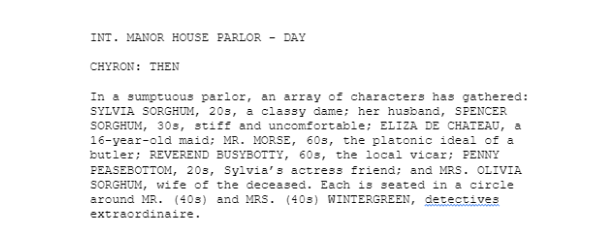
My favorite gag, however, cribs neither from Shakespeare or Christie, but Adaptation: in a flashback, much to the chagrin of Cocker-Norris, we get to see a little bit of how Köpernick’s mind works as he shows a series of storyboards that he put together for the climax of the film version of The Mousetrap. The images are quick cuts between detailed insets: gloved hands at a power box, a revolver being cocked by an unknown person, a fire breaking out in the middle of a tense standoff with a hostage—all of it very un-Christie and extremely Hollywood. This is Köpernick’s attempt to “jazz up” the very un-Hollywood and extremely Christie ending of the play, which uses one of her most well-known and genre-defining tropes: the end-of-the-story summation gathering, in which the detective gets everyone together in a parlor to explain their investigation and conclusion. In fact, not that it matters, but it’s so very much part of the genre that a parody of this type of scene is the very first thing that happens in the script for the Mrs. Wintergreen pilot, “Mrs. Wintergreen and the Thorny Dilemma” 

See How They Run turns this on its ear by playing both sides in the same way that Adaptation does, by mocking the hand that feeds it via denigrating comments about the formulaic nature of Hollywood adaptations, and then doing each and every one of the things that it mocks. The climax of the film takes place in a parlor that has the exact same layout, dimension, and decorations as the final set of the play, although this is obscured until the last possible moment to reveal it. The revolver, the fire, the standoff, the power box—the whole thing plays out in exactly the same way that Köpernick’s storyboard does. It’s a lot of fun to watch. (So would Mrs. Wintergreen be, I think, but I digress.) 

I was engaging with some essay or other this week and was taken aback when the author noted that, for all of his extremely large body of literary work, Isaac Asimov’s oeuvre rarely sees film adaptations, with only a handful ever being produced: Konets Vechnosti from 1987, based on The End of Eternity, which I assume must have had a subtitled release in the U.S. at some point but I can find no evidence of; the Robin Williams vehicle Bicentennial Man; two separate adaptations of the 1941 short story “Nightfall;” and, theoretically at least, I, Robot. In general, the world does not lack for Christie adaptations; they are so numerous that films based on And Then They Were None alone have their own Wikipedia subpage. The Mirror Crack’d from Side to Side was adapted as an episode of Miss Marple and Agatha Christie’s Marple, which are two separate television shows, as well as a film version in 1980 starring Angela Lansbury as Marple. When it comes to Christie media, we are the lilies of the field, neither toiling nor spinning, nevertheless arrayed in splendor. But we don’t have an adaptation of The Mousetrap, and we likely never will. Even if that day comes, there’s a risk it will be as dull and uninteresting as 2017’s Crooked House, which even Glenn Close and Gillian Anderson couldn’t save. What we do have is See How They Run, which is more than good enough; it’s great. 

-Mark “Boomer” Redmond