Nanny (2022)

In Nikyatu Jusu’s debut feature Nanny, a Senegalese domestic worker struggles to maintain her sanity while caring for the white child of a wealthy NYC family and scraping together money to emigrate her own son to her new home.  It’s essentially an atmospheric horror update to Ousmane Sembène’s Black Girl, the second one I’ve seen this year after the South African apartheid horror Good Madam.  I personally preferred Good Madam, but Nanny earned better reviews and the Grand Jury Prize at Sundance, so I’m out of sync with the consensus.  I suspect that’s because Nanny is less of a proper Horror Movie, landing the same accolades as an important “social thriller” that Get Out earned outside of horror circles in 2017 (in a way no other Blumhouse productions have in the years since, until now).  It’s an immigration story first & foremost, neatly containing all of its supernatural menace in its frequent nightmare & hallucination sequences in a way that the more straight-forward body possession story Good Madam does not.  Whichever spooky revision of Black Girl you prefer, it’s undeniably cool that they both exist, and remarkable that their distribution paths converged on the festival circuit this year – Nanny premiering locally at New Orleans Film Fest and Good Madam premiering at Overlook.

Comparisons aside, Nanny mostly holds together as a sharply tense, surprisingly funny domestic drama about working class exploitation, with plenty of spooky window dressing to maintain an eerie mood.  Heavily referencing African folklore figures like the arachnid trickster-god Anansi and the alluring water spirit Mami Wata, Jusu easily establishes a dense visual language in the film’s plentiful nightmare sequences & daytime hallucinations.  Spiders, mirrors, snakes, and mermaids creep into the frame at almost every turn, disrupting the labor exploitation story at the film’s core in violent jolts of surrealist imagery.  Highlighting that labor exploitation is the main point, though, and whatever supernatural scares accompany it are only there to provide texture.  With a few scattered edits, Nanny could easily be reconfigured into a standard Sundance drama about an undocumented worker’s grim daily routine sacrificing her own familial bonds to hold a wealthy family together for petty cash.  If anything, removing the supernatural horror elements might have left more room to dwell in the moments of discomfort, heartbreak, and rebirth in the film’s rushed ending, which would’ve been much more emotionally effective if the audience were allowed to fully sink into it.

Speaking generally, I’m happy that horror movies are starting to earn festival prestige & awards-season accolades instead of being siphoned off as disposable straight-to-streaming #content (which accounts for a lot of Blumhouse’s output these days).  Nanny winning the Grand Jury Prize at Sundance feels a little like Silence of the Lambs winning Best Picture at the Oscars, though.  Technically, it’s an industry win for horror, but it’s such a safe, cleaned-up, presentable version of horror that it doesn’t leave much room for the victory to be repeated.  I would need an actual, physical intrusion of a devious spider-god or killer mermaid into the “real world” to get excited about what this movie’s success means for the prominence of the genre on awards ballots & festival red carpets.  As is, I get the sense that Jusu is much more interested in the Dardennes-style economic drama she gets to tell outside those horror elements, which were more of a funding & marketing hook than the main purpose of her story.  Thankfully, the horror industry is booming right now with or without festival accolades, so I can find what I’m personally looking for in stories like these plenty other places: Good Madam, Good Manners, His House, Zombi Child, I Am Not a Witch, etc., etc., etc.

-Brandon Ledet

Sissy (2022)

I saw a good number of my favorite movies of the year (so far) at Overlook Film Fest in June, which is usually the case.  The programming at that annual horror festival is unmatched by any other local fest I can name, as long as you’re a fully committed genre nerd who doesn’t pay much attention to the Awards Prestige dramas of the fall.  It’s also condensed to a single weekend in early summer, which means it’s impossible for me to catch every movie I want to see in the program. So, I often spend the half-year after Overlook catching up with titles I missed during the festival (which almost invariably pop up on the streaming platform Shudder at one time or another).  Often, I feel validated in which movies I opted to skip at the fest (i.e., She Will), but every now and then there’s a fun little novelty like Sissy that I wish I had seen with a crowd.  It’s always hard to tell how much of an enthusiasm boost I’m giving to movies based on the horror-nerd fervor of the festival, but I do suspect that Sissy killed in the room at Overlook, and I would have loved to share in that joy.

In micro-subgenre terms, Sissy offers an Australian splatstick comedy version of the modern social media thriller. Let’s call it Heavenly Tweetures, Ingrid Goes Down Under, Aussies Aussies Aussies, whatever you like.  It references cult sitcom Kath & Kim in its opening minutes, so you immediately know that it’s filling an Australia-specific niche.  At the same time, its story of a “mental health” social media influencer who becomes a homicidal maniac when she reunites with her childhood bully is a fairly standard-issue template for its genre.  Sissy only Aussifies that template in its irreverent tone & practical-effects gore.  There’s a Dead Alive tinge to its head-crunching kills that makes for a good, goofy time even when the movie is at its most brutal.  That buoyancy seeps through its ironic Disney princess musical score, its Blood Brilliant Tampons™ visual jokes, and its adoring Love Island reality TV parodies; but it’s the gore gags I most would’ve wanted to experience with a crowd.  They’re delighfully vicious, and they’re ultimately what makes the movie special.

There really isn’t much to Sissy‘s social media satire that you can’t find elsewhere.  The titular killer’s addiction to the endorphin rush of notification chimes and her sociopathic ability to alternate between self-care rhetoric & spon-con abuse of her self-appointed position as a mental health authority are familiar to anyone who’s drawn to this kind of material.  I’d even argue that the other notable social media satire at this year’s Overlook, Deadstream, did a much better job of squeezing laughs out of that exact Youtuber brain-rot persona.  There’s a sincerity to Sissy‘s central drama that you won’t find in Deadstream, though, from its nostalgia for childhood BFF kinship to the anxiety-inducing horrors of joining an established adult friend group midstream.  If there’s any incisive social commentary to be found here, it might be in the #terminallyonline understanding of morality where everyone falls into one of two categories: “A Good Person” or “Cancelled.”  It’s when Sissy desperately, violently strikes out to avoid becoming “Cancelled” that the movie evolves into its ideal form: a flippantly funny slasher, not a thoughtful social treatise.

If watching a mental wellness YouTuber become Jokerfied at the first threat of getting cancelled appeals to you, Sissy is a hoot.  That premise is very appealing to me, so I’m not sure why I didn’t prioritize it at Overlook the way I did with Deadstream.  Frankly, I should be cancelled for the offense.

-Brandon Ledet

Valentine (2001)

It probably hasn’t escaped your attention that I like to talk about Scream. Like, a lot. Scre4m was my 59th favorite movie of the 2010s, I mentioned the franchise nine times in Part II of my favorite horror movies by year list, and I talked about how Sidney Prescott is my favorite final girl in my review of 5cream. I’ve mentioned it on our Lagniappe episodes of the podcast too many times to count, but in our Cherry Falls episode in particular, we talked about the 4-5 year glut of what I like to call “the post-Scream slashers,” which broadly fall into three categories: 

  • Movies that copied Scream‘s self-awareness and setting while adapting and updating classic horror: The Faculty as Invasion of the Body Snatchers – in a high school! Disturbing Behavior is The Stepford Wives – in a high school! Joy Ride is The Hitcher – on a road trip home from college (sorta)!
  • Movies that didn’t seem to understand that what made Scream different was how it commented upon the genre, and so simply copied the setting, the teen cast, the shadowy killer with an inexpensive outfit, and the non-supernatural horror, and just made slasher flicks with high school (and occasionally college) students being tracked down by someone on a mundane vengeance spree: I Know What You Did Last Summer, Urban Legend, and, of course, I Still Know What You Did Last Summer
  • Movies that copied the teens-in-danger trope but didn’t bother to keep it grounded and instead went all-in on the supernatural, like Final Destination and Jeepers Creepers. 

Of course, we cited Cherry Falls as the anti-Scream (and if you want more details, you can listen to the episode), but there was one movie that was accidentally left off of that list, and definitely deserves to be mentioned: Valentine, directed by Urban Legend-helmer Jamie Blanks. I won’t call myself an Urban Legend apologist because that would imply the movie needs to apologize for something (other than the presence of Jared Leto), but I will say that I find it much more entertaining that the critical consensus does, and it’s not just because Loretta Devine is divine. I always wondered if Valentine, which has the prestige of being based on a novel like I Know… and Killing Mr. Griffin, was really as bad as its reputation lets on. It breaks my heart to tell you that, unfortunately, Valentine isn’t a bad movie, it’s just … only 66.7% of a great movie. I don’t know if a lot of it ended up on the cutting room floor (as infamously happened with Disturbing Behavior, which also feels similarly disjointed) or what, but man, I’ve rarely seen a movie that feels like so much of it is missing, and I’ve seen On the Silver Globe

There’s really no other way to talk about why without getting into the entire film, so spoilers ahead, as much as something that was in theaters before 9/11 can be spoiled. 

The film opens with a promising, frenetically cut scene in a middle school Valentine’s dance in 1988, as pipsqueak Jeremy Melton (Joel Palmer) asks five different girls to dance with him: Shelley, Lily, Paige, Kate, and Dorothy. The first three are rude and cruel in the way that children often are, while Kate rejects Jeremy softly with a “maybe in a little while” and Dorothy, who is pudgier than the other girls, accepts his advances. The two of them kiss beneath the bleachers but are discovered by a pack of bullies, who mock them. Dorothy, embarrassed, quickly agrees when the bullies joke about the sixty-pound “pervert” Jeremy “attacking” her, and the bullies pour red punch over him like he’s Carrie White at the prom before stripping him out of his wet clothes and beating him up, while several of the students who are looking on wear uncanny Cupid/cherub masks . Thirteen years later, Shelley (Katherine Heigl, post-Bride of Chucky and right in the middle of Roswell) is a medical student who, after a terrible first date with a man named Jason Marquette (Adam Harrington) who continuously refers to himself in the third person and makes Shelley pay for her portion of the dinner once he realizes she’s not going to sleep with him, is pulling a midnight study session involving an autopsy.  After a jump scare, she receives a Valentine’s card with a macabre inscription before being murdered by the Cupid-masked killer. 

Elsewhere, Paige (Denise Richards) drags Kate (Marley Shelton) to a speed dating event, despite the fact that Kate hasn’t broken things off with boyfriend Adam (David Boreanaz), who is noted to have a drinking problem, hence the two of them being on the outs. they receive news of Shelley’s death and the two women, along with Lily (Jessica Cauffiel) and the now-svelte Dorothy (Jessica Capshaw), meet the detective investigating the murder, Vaughn (Fulvio Cecere). Each begins to receive creepy notes and valentines signed “J.M.,” up to and including a box of chocolates filled with maggots, and we also meet our cavalcade of other love interests/ineffective red herrings: Lily’s boyfriend Max, a video media artist who has built a maze of images of disembodied mouths and sexy torsos talking about love and sex and whatever (no one in the movie seems to like it; I think it’s terribly pretentious but I would also go and have a very good time, for what it’s worth); Dorothy’s new boyfriend Campbell, who’s wormed his way into a guest room at the giant mansion her father owns and keeps talking about NFTs his new start-up and how his money is all tied up therein; Brian, a hot guy that Kate was starting to connect with at speed dating before Paige stole him away; and Gary, Kate’s creepy neighbor, who perpetually pitches unwelcome woo at her in sentences that rhyme with her name and whom she suspects of stealing her underwear in the laundry room. 

The police remain focused on trying to locate Jason Marquette because of the “J.M.” thing and that he was the last person to see Shelley alive. There’s also a subplot about Ruthie (Hedy Burress), a woman who shows up and accuses Campbell of having bled her bank account and warning Dorothy that she’s probably being used for the same scam. The surviving women discuss whether it’s possible that any of the men in their lives could actually be Jeremy Melton, all grown up after hitting the gym and possibly getting plastic surgery, throwing around accusations and various levels of cattiness that reflect deep, unspoken grievances from childhood. Dorothy even admits to having falsely accused Jeremy, which led to him being sent to a reform school, which led to juvenile hall and so on, before he dropped off of the map. Leading up to the climactic house party at Dorothy’s, most of these are whittled away as characters are murdered: the Cupid killer shoots Lily with arrows at Max’s show (her disappearance is unremarked upon by her friends as her having simply gone on her planned business trip), Gary is discovered in Kate’s bedroom trying on her underwear by Cupid and is bludgeoned with an iron, Campbell gets an axe to the back while relighting the pilot light at Dorothy’s, etc., and Ruthie is later killed shortly after discovering his body. It’s also worth noting that in most of these scenes, the Cupid mask is seen bleeding from its right nostril, just as Jeremy did at the dance all those years ago. People leave the party in droves following a power outage that results from the method by which Cupid kills Paige—in the film’s most memorable scene, which we’ll come back to—and when Kate tries to call Lieutenant Vaughn, she discovers his corpse along with a note that she had earlier given to Adam, cementing that he’s Jeremy, come round at last to get his revenge. She goes back to the house, where Adam behaves creepily but could also just be talking about falling off of the wagon, and Kate then fights Cupid, who is unmasked as … Dorothy. However, as Adam cradles her in his arms while they wait for the police to arrive, his nose is bleeding, before we cut to credits. 

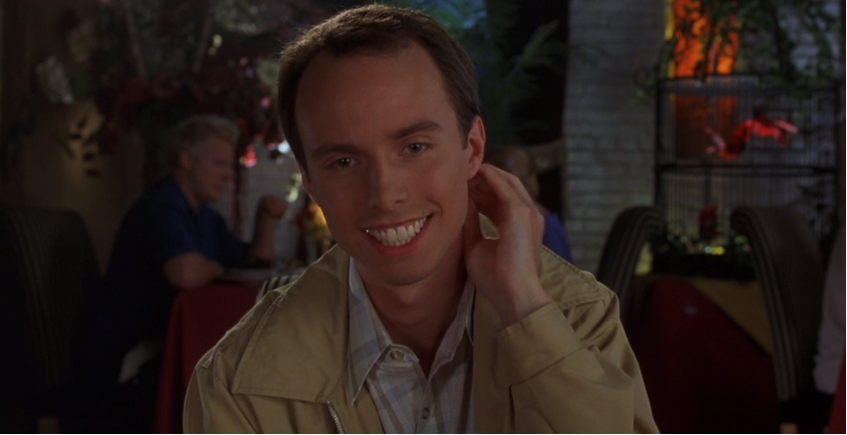
There’s a lot that’s fun and good here, but I’m more fascinated by what isn’t here than what is. Just to start us off with a visual example, one of the men that Kate meets on the speed date is a smiling goon who’s too awkward to work up the nerve to actually say something to her: 

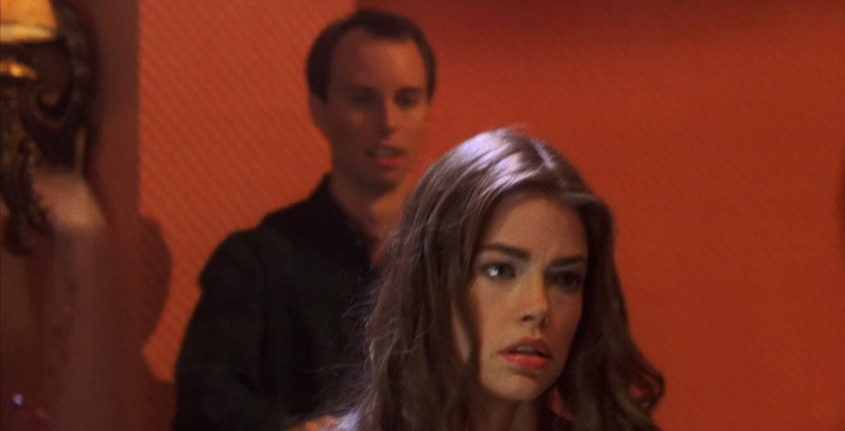
After fifty minutes, this guy shows up again, standing in the stairwell behind Paige when she comes downstairs at Dorothy’s party: 

That’s far too long between scenes for a red herring character to appear and be effective, and so little attention is drawn to him in this second appearance. It’s hard to explain but it just makes it feel like there was or should have been an intervening scene in the film’s second act, where he reappeared briefly and the film could have hinted that he was Jeremy, but it’s simply not present. In fact, there are several large group shots at Max’s art exhibition where it would make perfect sense for him to appear in the background, but I went back and watched that sequence in its entirety and he doesn’t appear in any of the crowd shots, foregrounded or otherwise; it almost makes more sense that he did appear here and was cut. 

And that’s not the only thing that’s narratively unfulfilling or otherwise doesn’t make sense in the language of film. Cameron is one of the film’s more involved red herrings, and he’s used more effectively than some of the others as well given that he is clearly up to no good, but it’s merely criminal, not homicidal.  Unfortunately, however, he is killed mere moments after we’re given the biggest hints that he might be the killer: he is unable to sexually perform for Dorothy, indicating that he’s not as into her as his cover story requires, then he gives her a necklace with a cherubic Cupid on it as a Valentine’s/apology gift, and then he goes down to one of the house’s spa areas and unsuccessfully tries to transfer her father’s money over the phone while scratching at the right side of his nose in agitation. This would be really effective if there were a scene or two in between them that left the house, creating some tension about whether Dorothy was safe or not, then cut back to Cameron trying to transfer funds. To digress for a moment, when Vaughn questions the women about boyfriends who might be behind the scary valentines and such, Kate claims that Adam simply can’t be Jeremy since she’s known him for a couple of years and even rattles off a series of facts about where he’s from and what his parents do for a living. It’s not my practice to review the movie I wish we were presented with or give feedback like this very often (I don’t never have some armchair directing feedback, but it’s not common), but this film almost begs for it, especially because the gaps are conspicuous in their absence; it’s not just that there’s something ephemeral that’s “missing,” it’s like there’s a specific shape that’s been cut out, like when a cartoon character leaves their outline after running through a wall. Right here is the perfect place for a scene where Kate, her certainty about Adam shaken, should have tried to do a little digging about Adam’s past; maybe she’s never actually met these parents and she casually asks Adam about them in a way that makes him react oddly, or she tries to look up the law firm where his mother works only to discover it doesn’t exist or contact the school where Adam’s father supposedly works only to learn there’s no “Mr. Carr” teaching there. Instead, we get two back-to-back scenes (six minutes of screentime) with Cameron and Dorothy in which no tension is built. This is pretty basic stuff, where the audience leaves one scene now assured that Cameron is the killer, then they have that determination undermined by Adam’s behavior or the discovery of lies in his personal history. 

Let’s talk about Scream for a second. I haven’t read the book on which it was based in its entirety, only the first two chapters that are available on certain websites as a preview, but there are enough differences in what I read versus what I saw to say that there were major revisions: Kate’s character is named Jill and is a mystery writer, Paige is called Tara and is an actress, and it is Adam’s character, called Nate here, who is the artist, not Max to bring the film more in line with the Scream narrative. The book opens just after the killer has committed his first revenge murder, and it happened in a bedroom, not a medical school morgue like in the film. The first victim in the novel is already dead at the time of the first line, but Valentine the film goes out of its way to evoke the opening of Scream instead, spending a lot of time with a character getting to know her before she’s killed, and utilizing one of the bigger names in the cast for this scene for shock value. Heigl didn’t have the superstar power that Knocked Up and Grey’s Anatomy would give her in the coming years and certainly wasn’t as famous as Drew Barrymore, but she was one of the big leads in a show that was aimed at and popular with the film’s demographic, and the ongoing staying power of Wish Upon a Star says a lot about how effectively it lodged itself in viewers’ minds. As in Scream, there is police involvement, and the primary red herring (Jason Marquette/Cotton Mather) is arrested for a time while the killings continue unabated, but the killer covers his tracks sufficiently that no one realizes this. And, just like Scream, the movie ends with a giant house party, and it’s this that I want to focus on for a minute. 

Dorothy’s big Valentine’s Day house party takes up far, far too much of this film’s runtime. Valentine is 93 minutes without credits, and the last 35 minutes, nearly 40% of the run time, all take place during this party. Worse that that, remember when I mentioned that nothing happens between the scene with Cameron acting suspiciously with his limp dick and Cupid necklace and the scene of him trying to defraud Dorothy’s father’s bank and then getting murdered? Nothing happens between those two scenes and the party, meaning that we spend the last 41 minutes of the movie at Dorothy’s house. The only time we leave there is when there is a quick cutaway to Lt. Vaughn calling Kate from his car to tell her that Jason Marquette was released and that he might show up at the party. Now, compare this to Scream, which likewise spent a huge part of its runtime (48 minutes) in its final act house party, but we don’t spend that entire time in Stu’s house. There are memorable scenes in the news van and down the road where Gale and Dewey take a walk that function to break up the visual monotony of spending too much screen time in one location. Once again, the outline of something missing is just as present in the narrative as the things that are actually there. To give credit where it’s due, this is where the film’s most interesting kill happens, wherein the killer manages to trap Paige in the hot tub under a clear plastic cover and starts drilling holes in it as she swims around evading the drill bit while having to keep her mouth and nose in the very small space between the cover and the water. It lasts longer than many of the other killing sequences (more on that below) and is very tense, unlike many of the others. 

One of the major things that Valentine, like a lot of Scream imitators, is missing is the characters’ attempts to fight back and survive, which often makes these scenes very brief and lacking in audience investment. In the original, Casey Beckett tries to flee the house and call for help from her parents and Tatum throws bottles of beer at Ghostface and fights for her life before getting stuck in the garage door that breaks her back; in Scream 2, which was released four years before Valentine, Maureen begs the audience to realize she’s not acting and help her, and Cici manages to do some real damage to Ghostface before being thrown off of the sorority house’s roof. And of course, in all of them, Gale and Sidney are pretty banged up at the end because they are badasses who refuse to die. Here, the murders are brief and, insofar as the characters have any agency at all, they mostly just try to hide (ineffectively): Shelley’s is the closest to a real attempt to fight back, but she still ends up hiding in a body bag, which is where the killer finds her; creepy Gary is beaten to death while cowering, moments after being discovered in Kate’s apartment by the killer and is never mentioned again; Lily gets shot to death by arrows from a distance and then falls down the center of a stairwell into a dumpster; Campbell takes an axe to the spine without ever seeing the killer coming for him. I actually saw more of this movie while testing this: from first arrow wound to dumpster fall, Lily’s death takes up 31 seconds of screen time. In comparison, Tatum’s death scene in Scream, from the moment she sees Ghostface to the moment her spine cracks, is 94 seconds, and that’s not counting the 90 seconds before that where she enters the spooky garage, struggles with the beers, and finds herself locked out of the house while tension rises. What’s more, this is one of the few areas in the movie where it feels like the failure is in the film itself, not the editing or the ostentatiously absent footage; there’s nothing missing here, the scenes simply aren’t that good. I also want to point out that some of the murders happen offscreen and it seems like it’s an actual stylistic choice, like Lt. Vaughn’s death being kept secret until Kate discovers his body, while some threads are simply left hanging, like Brian being left tied to the bed by Paige, implying that he might still be upstairs blindfolded and naked while the climax of the movie takes place. 

One thing that Valentine has that Scream doesn’t is opening credits. Stick with me here! Valentine‘s credits are intercut with its opening scene, and like I mentioned earlier, that opening is very effective and the film’s intersplicing of it all means that Valentine can have its cake and eat it, too, having old school long credits but making them interesting enough that the audience doesn’t mind. Unfortunately, this is also the film’s drawback, as the format of the titles spoils who the killer is. David Boreanaz was four years into playing his iconic role of Angel, two seasons of which were on his own show as the title character. That may have only made him a household name in households that watched Buffy, but for those households which also tolerated network series about quirky not-quite-a-cop investigators, his—wait, this math can’t be right. 245 episodes over 12 seasons? Ok, but jeezum petes—uh so yeah, Boreanaz’s turn as Booth on over a decade of Fox’s Bones also contributed to his fame. His is also the only man’s name in the movie that appears on its own during the credits. Richards is credited first, then Boreanaz, then Shelton, Capshaw, and “with” Heigl. The other men are listed in the opening, but always with other names, so you, the audience member who presumably knows who Boreanaz is, are subtly already clued in that he will be the killer, because if it’s not him, who would it be? Surely not one of these other comparative no-names (no offense), most of which, again, don’t effectively function as red herrings because they appear too infrequently. Gary is in two scenes; Brian is in two scenes. Every red herring is only 2/3 of the way there for them to work. The grinning goober who couldn’t talk at the speed dating event is only in two scenes, and all of it feels like a lot of the middle was cut out, where we would get that second scene before the final act that would lead us to believe that any one of them might be the masked killer. There’s even the tiniest bit of a hint that Vaughn might be the killer, since he’s not present at Max’s gallery opening but does mention that he’s seen Max’s work, as well as the sinister way that he isolates Paige and is a creepy lecher about it. Instead, because something is missing about the actual language of film, the viewer spends the whole rest of the movie waiting for the other shoe to drop and Adam to be unmasked as Jeremy. Imagine if Scream had opening credits and Skeet Ulrich was listed second while the rest of the male cast, including David Arquette and Jamie Kennedy, were relegated to tenth and eleventh billing; there would never be a moment of mystery, and there isn’t here, either. 

But that’s just it. The biggest empty hole that’s identifiable here is the lack of a second killer. That’s a foundational part of what made Scream work and is also present in its sequels (other than Scream 3, where it was cut at the last minute) but not its imitators (other than I Still Know…, which almost makes it the better of the two). Except—hear me out here—I think that Valentine did have a second killer, and the removal of that was one of the linchpins that made the rest of the story work. I mentioned before that the Cupid mask has nosebleeds, just like Jeremy, but it doesn’t happen every time. After Kate struggles with the Cupid-masked killer, Adam suddenly appears and kills them, with the unmasking revealing that Dorothy was under there. The Adam-is-Jeremy bloody nose reveal would have us believe that this was all part of Adam’s plan, that he somehow attacked Kate as Cupid and then dressed the disabled Dorothy (perhaps crushing her windpipe so that she couldn’t call out to Kate and reveal the deception) as Cupid so that he could then shoot Dorothy, have her revealed as the killer, and then get back together with Kate with no one to interfere and his vengeance sated. But what if that’s not what was supposed to happen? What if Dorothy and Adam were supposed to be in on it together. Some parts of the film actually make more sense this way, as Adam seems ideologically driven but Dorothy also harbors a lot of bitterness about being the “fat girl” of the group when they were younger. Further, there are some kills that, due to the editing, only make sense if this is the case, and it feels like the fact that the Cupid mask only bleeds sometimes is supposed to be a clue to this reveal, and that re-viewings of the movie with that in mind would reveal who was behind the mask during certain scenes. Adam wants to kill the women who spurned him, but has no reason to kill Cameron, and it’s notable that we don’t see the mask bleed during that scene, and that the timeline would seem to indicate that, since this was a few hours before Dorothy’s party, it was happening at roughly the same time that Adam was across town giving Kate her lollipop valentine. Although Dorothy is the reason that Jeremy went away and took a downward turn, it’s not a completely unrealistic twist that her bitterness toward her richer, smarter, prettier (in her eyes) friends led her to team up with Jeremy to take them down, only for him to fall for Kate and end up betraying her in order to have her be the scapegoat and let him have his dream future with Kate. 

However, for whatever reason, that ending didn’t sit well with test audiences, or perhaps studio executives. Maybe someone thought it was a little dated and fatphobic (which it would have been) and decided to course correct too late to fill in the gaps with it removed. Or maybe this is just a bad movie and I’m too invested in the parts of it that are good to let it go at that and insist on finding ways to close loopholes and fix bad editing with my projected fix-fic to turn this into a better film. But I don’t think so. I think that this was a movie with great promise that fell apart under its own weight with too much supporting material removed, even if I’m wrong about Dorothy. 

-Mark “Boomer” Redmond
Lagniappe Podcast: Gaslight (1944)

For this lagniappe episode of the podcast, Boomer, Brandon, and Alli celebrate Angela Lansbury’s career by looking back to her big-screen debut in the psychological thriller Gaslight (1944).

00:00 Welcome

00:30 Slumber Party Massacre (1982)
02:00 Halloween costumes & candy
14:45 Creepshow 2 (1987)
22:00 Valentine (2001)
31:50 Táriangle of Sadness (2022)
35:55 Mrs ‘Arris Goes to Paris (1992, 2022)

43:35 Gaslight (1944)

You can stay up to date with our podcast through SoundCloudSpotifyiTunesStitcherTuneIn, or by following the links on this page.

-The Lagniappe Podcast Crew

Vesper (2022)

I was a few minutes late to my screening of the dystopian sci-fi cheapie Vesper, so I missed the opening scroll that explained exactly which doomsday scenario its few scattered characters had survived.  According to Wikipedia, the film is set in “The New Dark Ages,” triggered by bio-engineered plants & viruses that escaped from the lab and into the wild, mutating the Natural world that scientists were attempting to save from Climate Change.  Basically, in the near future we take the “Hack the planet!” messaging from Hackers a little too literally.  Whatever table-setting paragraph I missed at the start of the film didn’t end up mattering too much, though, since its interest in old-fashioned sci-fi worldbuilding does not stop there.  Vesper is essentially a feature-length worldbuilding exercise, one that invests all of its energy in exploring the lush, biohacked landscapes of its Apocalyptic Vegetation futureworld, with little attention left for the characters who have to hack their way through it.  And for a certain type of hardline sci-fi nerd, that escape to an intricately detailed otherworld is going to be immensely satisfying no matter what happens there.

Plot-wise, this is a Young Women in STEM story. The titular Vesper is a plucky teen who’s incredibly gifted at biochemistry, stubbornly determined to biohack her way out of the Biohack Apocalypse.  Camping in the woods between a petty-dictatorship barter town run by her creepy uncle and an aristocratic “citadel” with a “No Poors Allowed” sign posted to its gates, Vesper is a fairly typical YA heroine: the only freethinker who’s ruggedly independent & smart enough to rescue her dystopian world from its downward spiral.  She’s more of a video game avatar than a fully formed character, since her main function is to lead us through the overgrown vegetation and crumbling urban infrastructure of the “world of shit” she calls home.  There are plenty of contemporaries to Vesper‘s style of low-key, lived-in sci-fi, from the surreal vegetative mutations of Annihilation to the violent Natural reclamation of urban spaces in The Girl with all the Gifts to the analog sci-fi throwback of Prospect.  Only this movie exists in this specific world, though, so it’s more important that Vesper give us the full guided tour of her far-out greenhouse creations than it is for her to stir up meaningful drama with her dying father, her creepy uncle, or her fellow scrappy rebels.

Vesper can feel a little humorless and drawn out at times, but it’s shrewd about inspiring awe & disgust with limited resources.  This French-Lithuanian production was shot in an uncanny English dialect as a bid for wide international appeal, but I’m not sure that it ever had a chance to make it beyond a few festival raves & VOD streaming deals. Its detailed worldbuilding impulses are tied to such a literary sci-fi tradition that it was never going to fully break out of its nerdy niche, at least not without giving its Wilson volleyball drone sidekick a bunch of James Corden-voiced one-liners (as opposed to the defeated wheezings of Vesper’s dying father).  Its ambitions are super admirable, though, and it accomplishes a lot creatively even if its distribution has been limited.  Shot without artificial green screen environments, Vesper explores a lived-in, tactile dystopian world that should be a major draw for anyone who’s at all nerdy about world-building and practical effects.  It feels vibrantly alive – brimming with mutated plant tendrils, radioactive glow worms, and A.I. creatures made of vintage medical equipment.  You just won’t find much of that vibrant life in the drama or dialogue.

-Brandon Ledet

Quick Takes: Halloween Hangover

Every October, I sit on the sidelines while more dedicated movie nerds cram in 31 new-to-them horror films, one for every day of the month. I’m usually too busy with New Orleans Film Fest screenings, podcast homework, NOCAZ prep, and other personal movie-watching rituals to keep up with that schedule.  A lot of those priorities have shifted in recent years, though. NOCAZ, for instance, doesn’t even exist anymore.  So, in the past couple years I’ve gotten the closest I ever have to properly celebrating Spooktober alongside my buddies, watching 32 horror films in October 2021 and 30 in October 2022.  These numbers are puny when you realize they’re boosted by rewatches. They’re even punier when you compare them to the triple-digit anomalies more voracious viewers like the hosts of We Love to Watch are racking up, but it’s at least a stride in the right direction.  When I grow up, I want to be a proper Spooktoberer.  One day, one day.

This Spooktober, my pen could not keep up with my eyes, and I didn’t find time to write or podcast about all of the horror movies I watched before Halloween Night.  I’m willing to write proper reviews of this year’s new horror releases that I watched last month, but I’m a less eager to let the older titles clog up my Drafts box.  So, here are a few quick mini-reviews of new-to-me, old-to-the-world horror movies I watched in the lead up to Halloween.

Evilspeak (1981)

After watching Clint Howard slum it in the all-around lazy kindertrauma slasher Ice Cream Man earlier this month, it was wonderful to see him shine as the lead in a Great horror movie for a change – although one with an equally goofy premise.  In Evilspeak, a young, baby-faced Howard stars as a military academy misfit who summons Satan to smite his bullies using the Latin translation software on the school computer.  It’s a dual-novelty horror that cashes in on the personal desktop computer & Satanic Panic trends of its era, combining badass practical gore spectacles with proto-Lawnmower Man computer graphics.  It isn’t long before the prematurely-bald Baby Clint graduates from translating Latin phrases from a Satanic priest’s diary to asking the computer dangerous questions like “What elements do I need for a Black Mass?” and “What are the keys to Satan’s magic?”, stoking parents’ technological and religious fears with full aggression.  And the third-act gore spectacle he unleashes with those questions is gorgeously disgusting.

There are two notable endorsements of Evilspeak‘s quality from infamously disreputable sources: Anton LaVey publicly praised the film’s Satanic powers, and British censors listed it among the initial Video Nasties list of banned home video titles.  Evilspeak starts off goofy & unassuming enough for audiences to expect a safe & subdued resolution to Clint’s schoolday woes.  Once he gets his cathartic Carrie payback scene in the school chapel, though, it quickly devolves into a gruesome gore fest, with Clint soaring above his tormenters while wielding a gigantic sword and an army of feral, flesh-starved hogs.  The only thing you can really fault the movie for is casting someone who was already bald to play a picked-on high school student (hiding under a thin, combed-over toupee), but hey, I had a very good friend at that age who started balding before we graduated, and it’s a pretty convincing reason why he was such a target for bullying.

Santo and Blue Demon vs. Dracula and the Wolf Man (1973)

The title pretty much says it all.  Santo and Blue Demon vs. Dracula and the Wolf Man is one of the 53 lucha libre films starring masked pro wrestler El Santo, nine of which featured him teaming up with his in-ring rival Demonio Azul.  From what I can tell, a significant portion of that filmography is horror-related too.  At least, the only other Santo movie I’ve seen to date, Santo vs. The Vampire Women, is essentially a Hammer horror film that happens to include some wrestling.  There’s no reason to be intimidated by the seemingly daunting number of Santo films that are out there, though.  Watching these two out of order—released a decade apart—I can confirm that they work a lot like real-life pro wrestling in that you can jump in at any time and still get into the drama of the match at hand pretty quickly: Santo good, Dracula bad, etc.

What really took me aback about this particular Santo horror was its pristine presentation on the free-with-ads streamer Tubi, which I’m forever struggling to wrap my mind around.  Tubi has this tag-team lucha horror presented in the pristine HD condition you’d expect from a Powell & Pressburger restoration on The Criterion Channel . . . give or take a few Geico ads and a goofball English dub.  The Eastman Color palette is shockingly vivid, to the point where watching Santo & The Blue Demon blow off steam with a friendly game of chess is just as gorgeous to behold as the film’s haunted-house bats, gargoyles, and cobwebbed torture dungeons.  The simplicity of Dracula’s plan to “turn the world into vampires & werewolves” makes this a relatively predictable novelty, but some truly wonderful Dracula & luchador imagery results from that set-up (as long as you can push past the embarrassingly lazy vocal dub).

Murders in the Rue Morgue (1932)

It’s a shame Bela Lugosi didn’t live long enough to play Dr. Acula in Ed Wood’s Night of the Ghouls, but at least his first mad scientist role was as Dr. Mirakle in the Universal picture Murders in the Rue Morgue.  Dr. Mirakle is a carnival sideshow murderer who experiments mixing women’s blood with his pet ape Eric’s in a disastrous attempt to prove the theory of Evolution.  When he’s frustrated with the results of “experimenting on” (i.e., murdering) prostitutes, he moves onto the women of Proper Society, so Parisians take notice and drive him to his doom.  The movie was heavily edited before release to downplay its shocks of violence, sexuality, and Evolutionary theory, leaving behind a short, chopped-to-pieces mess.  Lugosi looks great in his unibrow & tuxedo combo, though, and it’s easy to tell why they expanded his role as the central villain to the point where the story held very little—if any—resemblance to its Edgar Allen Poe source material.

Lugosi’s Dracula film has been slipping out of public favor in recent years for being “boring” (something I think a musical score easily fixes), while the Poverty Row slapstick comedy Bela Lugosi Meets a Brooklyn Gorilla has gradually been building a cult – to the point where it was screened at this year’s Overlook Film Festival as a horror “classic.”  Murders in the Rue Morgue is far from Lugosi’s best, but it’s amusing as unlikely middle ground between the Universal Horror prestige and ape-on-the-loose goofballery of those two pictures.  His performance is fully committed, there are some shocking moments of pre-Code violence, and the gorgeous Expressionist photography smooths over a lot of the scatterbrained plotting.  You can find all of those elements put to much, much better use in other Poe-adjacent Lugosi pictures of the era like The Black Cat & The Raven, but they’re still charming here.

House (1986)

House II: The Second Story (1987)

It’s a shame that the 80s haunted house horror comedy House has to share its title with the 70s Nobuhiko Obayashi masterpiece of the same name & sub-genre, since being compared against one of the greatest films of all time doesn’t do it any favors.  This isn’t a Cronenberg vs 2006-Best-Picture-Winner Crash situation, though.  The 80s House is too endearing to be an embarrassment, even if it struggles to stand out on its own.  Not only does it share its title with a far superior haunted house horror comedy with similar war-atrocity themes; it also lands as a goofy midpoint between the better-funded special effects showcase of Poltergeist and the eerie Vietnam PTSD horror of Jacob’s LadderHouse has no chance to match the euphoric highs of either comparison point, but it’s still a fun dark-ride attraction of its own merit.  Its story of a Vietnam veteran facing his inner demons while writing a memoir in a haunted house is restrictively straightforward & contained, but its rubber-mask monsters are adorably grotesque, and they pop out of the most surprising places – which is sometimes all you need from a Halloween-season spookfest.

Despite its all-timer of a title, House II: The Second Story is an embarrassment.  I enjoyed the goofball humor that underlines the carnival-ride scares & Vietnam flashbacks of the first House, but The Second Story tips a little too far into Porky’s era frat boy comedy and the whole thing kinda unravels.  The monsters are deliberately cute instead of scary, which means that the most frightening moment is when Bill Maher shows up as a Reaganite record exec.  And since the jokes aren’t funny, there really isn’t much to do except appreciate the occasional bursts stop-motion animation and rubber-suited monsters – things that were much more plentiful & satisfying in the original.  The best I can say about The Second Story is that its title is great, and that I appreciated it as my last new-to-me watch of the month, since it’s the only title in this batch that features a Halloween dance party.

Party Line (1988)

If you’re only going to watch one 1988 sleazoid slasher about the phone sex hotline craze, you might as well watch the one where Divine appears out of drag as a police detective alongside Lust in the Dust co-stars Tab Hunter, Lainie Kazan, and Paul Bartel – Out of the Dark.  If you’re going to watch two, I guess there’s also Party Line, ya freak. 

In Party Line, a pair of wealthy, mutually obsessed siblings use a phone-sex party line as a recruitment tool for vulnerably horny victims.  Leif Garret stars as the requisite Norman Bates crossdresser killer in this watered-down De Palma knockoff, joined by Miss Universe beauty queen Shawn Weatherly as his honeytrap partner and Richard “Shaft” Roundtree as the police chief who busts their (barely covert) schemes.  Without question, the movie is a hotbed for terrible politics, especially in its overt suggestion that rape victims & crossdressers are predisposed to become homicidal maniacs.  It’s an amusing relic of its era, though, especially in its exploitation of the party line dirty talk fad and its stylistic combination of MTV & Skinemax aesthetics.  As long as you’re prepared to feel queasy about the story it’s telling, the only major drawback, really, is that its novelty is undercut by Out of the Dark doing a slightly better job with the same fad the very same year.

-Brandon Ledet

Blood Sick Psychosis (2022)

There’s nothing punks and metalheads love to debate more than authenticity and scene cred, so that’s the only critical lens I could think to apply to the no-budget slasher Blood Sick Psychosis. Set in Philadelphia’s D.I.Y. metal scene, Blood Sick Psychosis is a dual throwback to SOV camcorder horrors and the earlier metalsploitation trend of the Satanic Panic era. So, I’d argue it loses a few punk authenticity points for indulging in retro genre pastiche instead of being true to its era.  It clearly admires no-budget horror “classics” like the Canuxploitation slasher Things, Tina Krause’s surrealist headscratcher Limbo, and the Paloma Brothers’ home video gross-out Hallucinations, only modernizing its feature-length homage to that era with an updated crust-metal soundtrack and a few stray shots of cellphones.  It’s a loving copy of a pre-set SOV slasher template, presented in the exact way most of the movies it emulates are seen by modern audiences: frequently interrupted by ad breaks on subscription-free streamers like Plex.  Whether you find that style of pastiche charming is a question of taste, but the movie opens with its villainous lead having a Crispin Glover-sized emotional breakdown while wearing a River’s Edge promotional t-shirt, so you can’t say you were not warned.

Where Blood Sick Psychosis racks up its punk-cred authenticity points is in the way it continues the true mission of retro SOV slashers: documentation of its filmmakers having a good, wholesome time.  Like all great regional, no-budget horrors, it’s basically community theatre.  Blood Sick Psychosis drags its audience through a guided tour of the drive-in movie theaters, squat basement music venues, and cheesesteak shops of modern Philadelphia, all presented through the prism of VHS tape warp.  No detail in its plot about a depressed metalhead loner who goes on a senseless killing spree with his acid dealer matters as much as its survey of a local D.I.Y. show starring the Philly-based black metal band Spiter, who encourage their audience “to kill yourself for Satan” before serenading them with the mantra “Suicidal bloodfucker, vampiric bloodsucker”.  This is an on-the-ground document of a scene and, even though I’ve never been, I’ve always gotten the impression that Philly is the exact performatively cold & cruel D.I.Y. subculture captured in this gnarly self-portrait.  Even when the camera cuts away from reality to indulge in LSD vampirism, paranoid rants about bodily mutations, and the ritualistic slaughter of animals, it still plays like a charming little caricature of the City of Brotherly Love.

Punk infighting about posers & stolen valor has always been incredibly tedious, and I don’t mean to participate in it with any sincerity.  I just thought it would be fun to pick at this movie from that angle, since it’s about the exact scene-obsessed dipshits who would care about that kind of thing.  In its most telling scene, our two LSD-crazed serial killers chat outside the Spiter show about how annoying it is that punk screenings of Extreme Cinema are all tagged with trigger warnings now, both voicing a genuine frustration with modern punk culture sensitivity and, by the time the conversation reaches its punchline, mocking the reprobates who would oppose that sensitivity.  Its playdough claymation credits, Jackass-style “creepy crawl” home invasion pranks, and spectacularly lazy Dave “The Rock” Nelson cameo (seemingly a direct homage to legendary pornstar Amber Lynn’s half-hearted participation in Things) are all overt signals to the audience that it’s just having a laugh, often at its own expense.  That willingness to self-satirize really helps smooth over the overtly retro genre nostalgia and slasher-standard misogyny that creeps in at its weakest points.  Personally, I’d be more interested in a version of this movie that actually reflects the tools & textures of its digital-video times, but this movie wasn’t made for me.  It was made for the cold-hearted metalhead brutes of Philly, who appear to be having a lot of fun.

-Brandon Ledet

Podcast #172: Body Parts (1991) & Surgical Horror

Welcome to the Swampflix Podcast Halloween Special. For this episode, Brandon, James, Britnee, and Hanna discuss a grab bag of horror movies about evil surgeons, starting with the major studio body horror Body Parts (1991).

0:00 Welcome

01:51 Fascination (1979)
04:20 See for Me (2022)
09:05 Blood Sick Psychosis (2022)
12:40 The Night Porter (1974)

16:44 Body Parts (1991)
33:45 The Man Who Could Cheat Death (1959)
46:33 Scalpel (1977)
59:25 The Skin I Live In (2011)

You can stay up to date with our podcast through SoundCloudSpotifyiTunesStitcherTuneIn, or by following the links on this page.

-The Podcast Crew

David Gordon Ween

Just like all other major entries in decades-running horror franchises, David Gordon Green’s Halloween was sharply divisive among genre fans as soon as it hit theaters in 2018.  Even so, its reputation has only declined in the five years since, especially as it has become the go-to, defining example of mainstream horror’s current “legacy sequel” trend.  Not only does the Halloween reboot have to answer for its own revisions of Laurie Strode & Michael Myers lore, but it also now carries the weight of horror nerd complaints against more recent offenses like 2019’s Child’s Play, 2021’s Candyman, and this year’s Texas Chainsaw Massacre.  It’s also been reduced to a scapegoat trendsetter for the Trauma Metaphor Horror wave that has followed in its wake, while artsier, standalone titles like Hereditary & The Babadook have maintained much steadier, more prestigious reputations in the same context.  It doesn’t help, of course, that Green has diluted his Halloween legacyquel with two follow-up films that have only alienated the Michael Myers purists even further as the series stumbled along.  I opted out of the David Gordon Ween discourse when Halloween Kills opened to white-hot angry reviews last year, but now that his theatrical mini-series is over and the online vitriol has been directed elsewhere (mostly at Olivia Wilde’s Don’t Worry Darling, which is practically a legacy sequel to Stepford Wives), it finally felt safe to return to Haddonfield to see how his take on Halloween has evolved.

Personally, I was really impressed with Green’s “original” Halloween in 2018, and I still think it holds up well when considered in isolation.  Regardless of its role as a harbinger for the next five years of mainstream horror trends, it still a really scary movie about self-fulfilling prophecies and obsessive thought spirals.  Okay, yes, Laurie Strode is haunted by the same metaphorical Trauma Monster that stalks most modern horror heroines (this time in a road-worn William Shatner mask), but that doesn’t mean there isn’t any dramatic complexity to how that internal battle with trauma plays out.  We’re told that in the 40 years since Laurie was hunted by the infamous killer Michael Myers in the John Carpenter original, she’s been mentally stuck in the events of that one night in a way that has defined & limited every other minute of her life.  Faced with senseless violence from a heartless, near-catatonic killer, Laurie has attempted to make sense of her life’s story by convincing herself it’s fate that she will have a final showdown with Michael once he inevitably escapes captivity.  It’s the same way that doomsday preppers always appear to be looking forward to the apocalypse they supposedly fear.  So, when Michael does escape, Laurie (along with other Michael-obsessed weirdos like “The New Dr. Loomis”) does everything in her power to make sure she & Michael have their “final” showdown in her D.I.Y. death-trap compound at the outskirts of Haddonfield, even though that’s exactly what she’s been dreading for decades.  Michael just mindlessly kills whatever’s in striking distance; Laurie is the one that makes the confrontation happen, totally unaware that she’s willing the fight into existence.  It’s chilling.

Green’s Halloween trilogy loses its way in the 2021 sequel Halloween Kills, which zooms out the scope of Michael’s function as a Trauma Monster from his effect on Laurie to his effect on Haddonfield as a community.  I choose to interpret the word “kills” as a noun here, since this second entry is a feature-length montage of Michael slashing his way through the streets, homes, and pubs of Haddonfield while Laurie recovers from their “final” showdown on a hospital bed, listening in from the sidelines.  Michael proves the point of the 2018 film’s self-fulfilling prophecy arc by making no effort to visit Laurie’s hospital room; he just lumbers from kill to kill in the most mindless fashion ever seen from a slasher villain.  If Halloween Kills is “about” anything outside the monotonous rhythm of those murders, it’s in how the community of Haddonfield tries to make sense of Michael’s senseless violence by making themselves the collective hero of the “story.”  I very much appreciate Halloween Kills‘s disgust with small-town America’s fetish for gun-toting vigilantism, given how many ordinary, ill-equipped Haddonfieldians approach Michael with deadly weapons—the same way real-life gun freaks dream of personally intervening in active-shooter crises—and are immediately destroyed for their trouble, either by Michael’s knife or their own petard.  It’s just a shame the movie is spread too thin across Michael’s hometown to ever truly feel scary.  Its larger scope means that it keeps intercutting between the tension of individual scenes so that we’re never properly immersed in any one of them.  It doesn’t really matter that its political assessments of small-town America are goofily unsubtle; it could have easily gotten away with that if it weren’t so scatterbrained.

After the frantic scrambling of Kills, the more sincere, dramatic approach of Halloween Ends can’t help but feel like a relief.  With his final entry in the series, Green returns to the low-key indie dramas that first earned him name recognition before he started making major studio slasher sequels & stoner comedies.  Halloween Ends may not be as Great as the first film in its trilogy, but it’s at least coherently structured and (mostly) functions as its own standalone movie, which is an embarrassingly low bar that Halloween Kills does not clear.  It’s also custom-designed to alienate & infuriate die-hard horror fans the same way that Halloween III: Season of the Witch was when Carpenter was still actively involved in the franchise, since it also does not focus on the senseless killings of Michael “The Shape” Myers.  Instead, we follow an equally iconic horror villain: Cory, the lonely mechanic with a troubled past.  Cory is dubbed “the new Michael” by the surviving citizens of Haddonfield, who essentially radicalize him into becoming a mass murderer in their continued attempts to make a clear, sensical narrative out of Michael’s mindless violence.  Meanwhile, Cory keeps The Old Michael as a pet in the sewers below Haddonfield and “feeds” his bullies to the hibernating killer the same way little Jamie feeds his bullies to the “tra-la-logs” of The Pit.  I’m sure there are plenty of people who are frustrated by the tonal & narrative inconsistencies between each of Green’s Halloweens, but I do love that there’s still room in a post-MCU world for individual movies in a big-budget franchise to take unique directions from each other – even if it’s strange to get that from a series with a consistent creative team at its core.  Cory’s story isn’t nearly as compelling nor as scary as Laurie’s, but at least Green & company found a way to make Halloween intimately personable again after the aimlessness of Kills.

The bigger problem is not the inconsistency across this series; it’s that it didn’t need to be a series at all.  Laurie Strode’s story is so neatly contained & emotionally impactful in the 2018 Halloween that there’s no reason for her to return for two more entries.  Kills feels lost by comparison, aimlessly wandering the streets of Haddonfield in search of a new emotional hook.  To its credit, Ends finds that new hook (by conjuring a new central character out of thin air), but it has no chance of fully standing on its own, since Laurie is still hanging around Haddonfield, distracting from its new sense of purpose.  After Cory’s own storyline is neatly wrapped up, Laurie steps back in for another “final” showdown with Michael, as if they’re ultimate fight to the death was meant to be, undoing all the good work of Green’s “original” Halloween.  After two entire films of Laurie hanging around a hospital room (Kills) and absentmindedly narrating her memoir (Ends), that last minute return to her vendetta with Michael can’t help but feel like an afterthought that dilutes the impact of both her story and Cory’s.  That’s largely what makes Halloween ’18 a great film and Halloween Ends an okay one.  And the purposeless ambling of Kills only makes them both look stronger by comparison.

-Brandon Ledet

Lagniappe Podcast: The Beyond (1981)

For this lagniappe episode of the podcast, Boomer, Brandon, and Alli discuss Lucio Fulci’s surrealist horror whatsit The Beyond (1981), set at the gates of Hell just outside New Orleans.

0:00 Welcome

02:22 Halloween Ends (2022)
09:14 Halloween II (1981)
14:10 Nightmare on Elm Street (1984)
16:22 Hellraiser (2022)
19:10 Bride of the Re-Animator (1989)
24:38 Smile (2022)
29:09 The Ballad of Buster Scruggs (2018)
33:20 Dark Glasses (2022)

46:09 The Beyond (1981)

You can stay up to date with our podcast through SoundCloudSpotifyiTunesStitcherTuneIn, or by following the links on this page.

-The Lagniappe Podcast Crew