Enter King Ghidorah

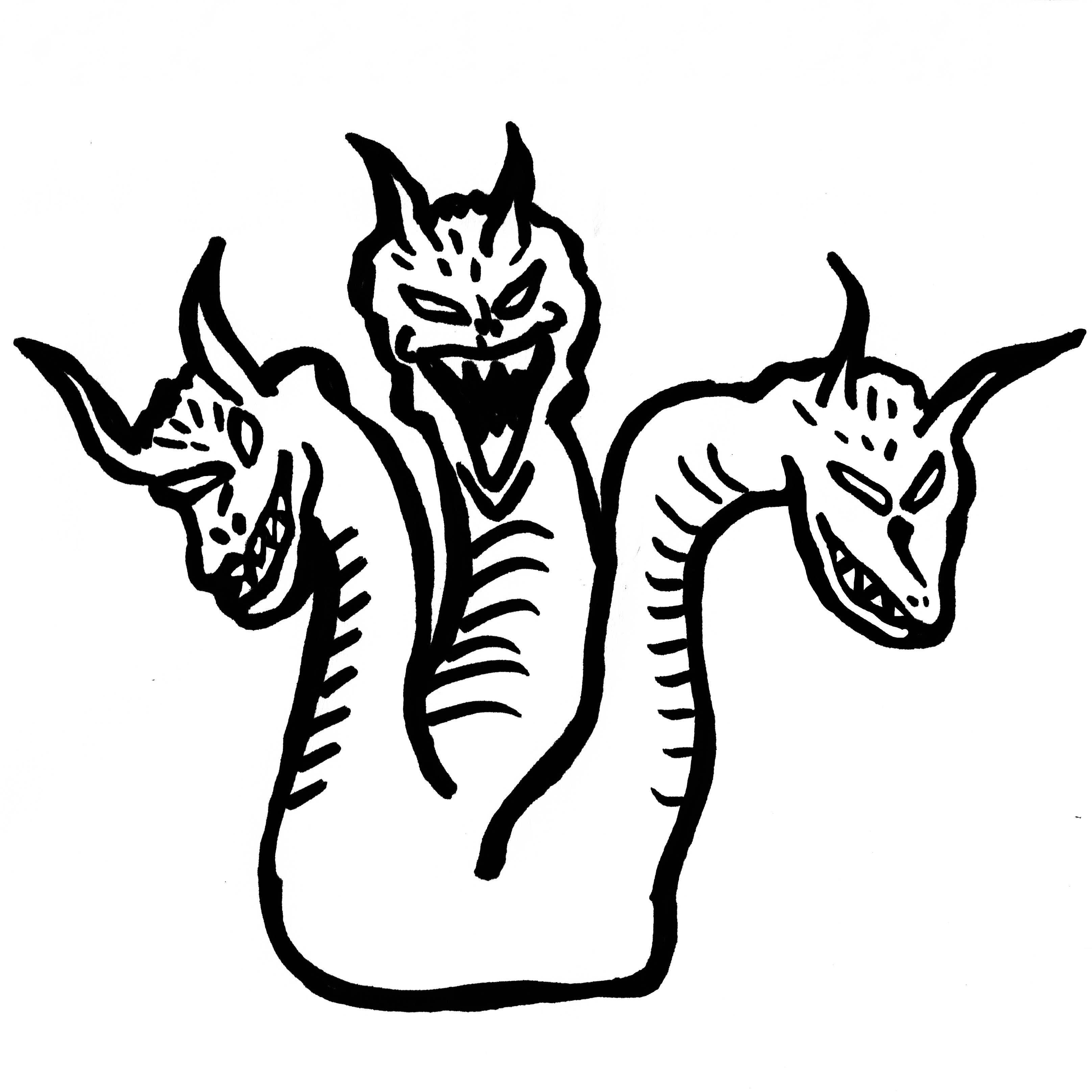
There’s just no way around it; King Ghidorah is the most heavy metal monster in movie history. I mean that in the literal sense, since the supreme kaiju being is seemingly armored by a layer of gold scales, making his “heavy metal” designation as matter-of-fact as Mechagodzilla‘s. Of course, I also mean it in the colloquial sense. The three-headed dragon beast is loudly & proudly metal as fuck on a cellular level. When Ghidorah flies into the frame to take down Godzilla and his fellow skyscraper flunkies, the image conjures the crushing sounds of heavy-metal guitar riffs in audiences’ brains, even in the 1960s pictures that were produced well before Black Sabbath had a record deal. Ghidorah is so metal, in fact, that it takes at least three other Toho-brand monsters to muscle him out of the pit, one for each lightning-spewing head. 🤘

The first time I encountered King Ghidorah was in the 1968 kaiju crossover picture Destroy All Monsters, in which the space-alien bio weapon was unleashed to union-bust a gang of kaiju that included Godzilla, Mothra, and Rodan (among the less-famous monsters Minilla, Gorosaurus, Anguirus, Kumonga, and Varan). Seen out of order in my winding journey through Criterion’s Godzilla box set, this appeared to be an especially grand ego-boost for the giant beast, like when WWE puts over their biggest, brawniest wrestler by having them eliminate every other competitor on the roster during the Royal Rumble. As it turns out, that was Ghidora’s exact funciton from the very beginning, and his debut entrance into the Toho kaiju ring marked the very first time Godzilla felt compelled to team up with other monsters to fight on humanity’s behalf. That Godzilla face-turn was in 1963’s Ghidorah, The Three-Headed Monster, in which evil space aliens declare interplanetary warfare by launching Ghidorah at Planet Earth, threatening to take over. It’s then up to Mothra, in her squirming grub form, to convince Godzilla & the pterodactyl-like Rodan to stop throwing rocks at each other like schoolyard children and instead join forces to fight off this existential, heavy-metal threat. They’re both petty assholes about it, but they eventually relent and team up to repel the flying hell-beast before going their separate ways.

The reluctant tag team of Godzilla & Rodan reforms when King Ghidorah returns in 1965’s Invasion of the Astro-monster. Rebranded with his new wrestler gimmick as Monster Zero, Ghidorah is once again deployed as an interplanetary weapon of mass destruction, one that can only be disarmed by the collective power of multiple kaiju opponents. His inevitable 2-on-1 battle with Godzilla & Rodan is delayed until the climactic 15 minutes of the runtime, though, as the invading Xiliens from Planet X smartly abduct Godzilla & Rodan with UFO tractor beams and imprison them for as long as possible so Ghidorah can do maximum damage, unchecked. Without the large-scale monster battles to fill up the runtime, Invasion of the Astro-monster spins its wheels with lengthy indulgences in political espionage and The X From Outer Space-style extraterrestrial cocktail parties. It’s maybe not the most thrilling approach to making a monster movie, but it does lead to some gorgeous 60s-kitch imagery. It’s impossible to decide what the most striking image of the film is in retrospect, but I’ve narrowed it down to two options: literalizing the Cold War aspect of the Space Race by putting a gun in the flag-planting astronaut’s free hand or Godzilla being abducted by a UFO. Then, Ghidorah soars into the frame to battle Godzilla & Rodan once again, erasing such questions entirely with heavy-metal bursts of lightning.

If there’s one detail of Ghidorah’s design that makes his metal-as-fuck majesty immediately obvious, it’s that each of his individual dragon heads moves independently, which is especially impressive when combined with his suitmation power of flight. It’s a lot like watching Kermit the Frog ride a bicycle for the first time in The Muppet Movie, adding an entire new dimension to kaiju suitmation spectacle audiences previously did not dream was possible. The suit was reportedly exceedingly difficult to operate as a result, often leading to longer shooting schedules as his operators struggled to keep his long, golden necks from tangling like noodles. Like headbanging to thrash riffs, it was well worth the headache. Everything else that makes Ghidorah so thunderously badass is immediately, visually obvious. He is the essence of metal, skyborne and beautiful. Godzilla mastermind Ishirō Honda’s impulse to bulk up the monster’s reputation by making him undefeatable unless several other kaiju attack in unison was a smart one, but it was also necessary. Look at him. No one would buy into the kayfabe otherwise.

-Brandon Ledet

Lagniappe Podcast: Destroy All Monsters (1968)

For this lagniappe episode of The Swampflix Podcast, Boomer, Brandon, and Alli discuss the kaiju battle royal Destroy All Monsters (1968), featuring Godzilla and all his best frenemies.

00:00 Welcome

01:09 The Craft (1996)
04:20 The Shining (1980)
07:26 Fight Club (1999)
14:47 Malignant (2021)
18:17 Civil War (2024)
19:36 It’s What’s Inside (2024)
28:52 Megalopolis (2024)
40:41 Look What Happened to Rosemary’s Baby (1976)
49:00 Christine (1983)
52:07 They (2002)
56:45 The Grudge (2019)
1:00:25 Mr. Crocket (2024)
1:05:17 Sex Demon (1975)
1:12:47 Flesh and Fantasy (1943)

1:19:13 Destroy All Monsters (1968)

You can stay up to date with our podcast through SoundCloudSpotifyiTunesTuneIn, or by following the links on this page.

– The Lagniappe Podcast Crew

Rodan (1956)

Most children grow up with innate knowledge of the main-cast monsters in the Godzilla series, regardless of whether they’ve ever seen a Godzilla film.  Names like Mothra, Ghidorah, Mechagodzilla, and Jet Jaguar really mean something to children, who extend their fascination with real-world dinosaurs to the fantastic monsters of classic Toho tokusatsu as if they were interchangeable.  It isn’t until you’re older and learn the names of second-tier kaiju that the absurdity of that knowledge becomes apparent.  The names Dogora, Atragon, Matango, Varan, and Gorath sound like AI-generated nonsense to anyone not obsessed enough with the genre to collect those lesser monsters’ action figures, but it’s only their general unfamiliarity that makes them ridiculous.  Or that was at least my thought when I sat down to watch 1964’s Ghidorah, the Three Headed Monster for the first time and had to back away because I didn’t recognize one of the monsters billed on the poster.  Godzilla, Mothra, Ghidorah . . . these names all mean something to me, but Rodan the Pteranodon (speaking of the fuzzy border between fictional kaiju and real-world dinosaurs) was entirely foreign.  So, I took the time to get to know the winged beast before watching his official entry into the Godzilla canon.

Appropriately enough, the introduction of Rodan is as an Unidentified Flying Object that attacks jet fighter pilots who have no idea who he is either.  The flying dinosaur travels at supersonic speeds and leaves sky trails in his path, playing into 1950s sci-fi audiences’ fascination with contemporary reports of UFOs.  The answer to the mystery of his body is fairly straightforward; he’s an unearthed pterosaur who’s mutated to kaiju scale through radiation exposure – Godzilla-style.  His mutant abilities can be surprisingly devastating, though, as he can flap his wings with enough force to create shockwaves & wind gusts that level entire cities in a manner of minutes.  Since the monster design is a little unimaginative, it’s clear he needs help to carry the film along, so he’s joined in his debut by a race of giant bug larva with sword-sharp claws that slice people to death on the ground while Rodan attacks from the sky.  The bugs are identified as mutated dragonfly larvae and assigned their own official kaiju name Meganulon, which is well-earned, given than they carry the first half of the movie on their exoskeletal backs before the mystery of Rodan is fully revealed to the audience.  It turns out that even in his titular debut, Rodan was already presented as a second-tier monster and no threat to Godzilla’s reign as King to them all.

You obviously don’t need to know Rodan or Meganulon’s names to fully enjoy the Godzilla series.  Only hopelessly nerdy completists would feel compelled to Do The Homework for a genre that’s mostly just pro wrestling matches in novelty rubber costumes.  The only name you really need to know is Ishirō Honda, Toho’s go-to director for most of its tokusatsu classics.  From the sincere post-war devastation of the original Godzilla to the groovy psychedelia of Space Amoeba, Honda was central to the invention & evolution of kaiju filmmaking in his three decades as a director.  With Rodan, he hit the milestone of directing Toho’s first in-color kaiju picture, which makes for beautiful vintage pop art in its modern HD presentations, especially as the tactile monster costumes clash against the matte-painting vistas of the background.  More importantly, Rodan is interesting as a tonal middle ground in Honda’s kaiju oeuvre.  If you put aside the giant-bug attacks in the first hour, it’s a surprisingly grounded mining labor drama that’s just as grim as the original Godzilla.  Mining-town workers are drowned, crushed, and sliced while their widows wail in agony, making the movie just as much of a political piece about working conditions as it is a pollution allegory.  That dramatic sincerity can slow down the monster-action payoffs in the first hour, but it does make for a fascinating contrast with the screen presence of Rodan and his insect frenemies, who are too goofy to take 100% seriously. 

I am choosing to accept Rodan‘s self-conflicting tone as a feature and not a, uh, bug.  If it were made a decade later, it would’ve been pushed to a more cartoonish extreme to fully appeal to children, which might have robbed it of its interest as a volatile battleground for the sincere vs. silly sensibilities of early kaiju movies.  Arriving just a couple years after the 1954 Godzilla, it’s an early sign of the goofier direction Honda and the rest of the genre would go while still maintaining the brutality and harsh political messaging of that original text.  The least interesting aspect of Rodan, then, is likely Rodan himself, who only earns top bill by default.  I doubt the film would’ve lost all that much if it were just about miners being attacked on the job by Meganulon, so it’s somewhat a shame that their name was pushed to the back pages kaiju history books alongside the likes of Ebirah, Baragon, Destroyah, etc.  I’m never going to complain about getting a chance to see a flying dinosaur attack a miniature city, though, so count me among the dozens of nerds who are glad that Rodan was given his momentary spotlight.

-Brandon Ledet