Glass Onion (2022)

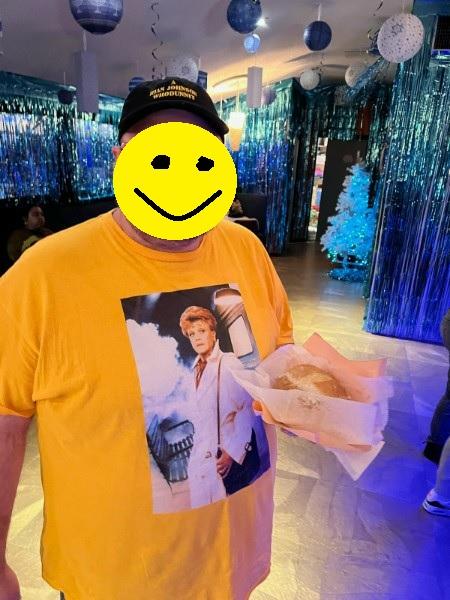
“It hides not behind complexity but behind mind numbing, obvious clarity!” So Daniel Craig’s Glass Onion character Benoit Blanc, called by Google “the world’s greatest detective,” says to much-vaunted “inventor” Miles Bron (Edward Norton) toward the end of this Knives Out sequel. I was a big fan of Knives Out when it premiered a few years ago. Brandon got a screener copy of its sequel along with some fun swag, and he was kind enough to both let me wait until the film fell into my greedy little clutches to publish a review, but also send along some of said swag, which includes the fantastic “A Rian Johnson Whodunnit” hat which you can see me wearing below while also clothed in one of my Angela Lansbury shirts: 
For Glass Onion, Benoit Blanc once again finds himself insulated from the world among a smaller world of morons, ingrates, and moronic ingrates as well as hucksters, snake oil salesman, and politicians. This time, he has ostensibly received an invitation to a murder mystery weekend at the home of the aforementioned Bron, who is an amalgamation of various rich douchebag stereotypes (and truths) but who most closely resembles Elon Musk due to his involvement in various companies and businesses which work together to create an impression of a wise ubermensch, when he is in fact a little weirdo who obsesses over getting approval from others. Also invited to the island were several of Bron’s friends, each of whom received a puzzle box that required them to work together to solve and receive their invitation. There’s Birdie (Kate Hudson), the ignorant socialite whose put-upon assistant Peg (Jessica Henwick) has the full time responsibility of not letting her tweet something racist and dumb that could get her cancelled for good; there’s also sad MRA Duke (Dave Bautista) who lives in his mother’s basement while hawking various products that promise to make his viewers “alphas” like he presents himself to be, while his social-climber girlfriend Whiskey (Madelyn Cline) plays along with his internet image. On the smarter end of the scale of Bron’s friends is Lionel Toussaint (Leslie Odom, Jr.), one of the lead scientists at Alpha who liaises with upper management about Bron’s ideas; and the gang is rounded out by Claire Debella (Kathryn Hahn), former governor of Connecticut who is now campaigning for a senatorial run. Finally and apparently unexpectedly, also in attendance is Andi Brand (Janelle Monáe), a former business partner of Bron’s who was unsuccessful in preventing him from pushing her out of the business and exposing his questionable business practices. It’s May 2020, and they have gathered at Bron’s Grecian estate, which is topped with an ostentatious lúkovichnaya glava made of transparent glass, from which the film partially takes its name. 

Of course, the title could mean a lot of things. For instance, it’s the name of the bar where all of the main characters (sans Blanc) gathered in their pre-wealth days, when Andi first brought them all together and before they all stabbed her in the back. It’s also, famously, the title of a track from what we colloquially call The White Album, although it’s properly titled The Beatles. Following all of the fan speculation about the meanings of some of the more psychedelic and impenetrable lyrics on their 1967 album Sgt. Pepper’s Lonely Hearts Club Band, John Lennon opted to pen a song that was intentionally antagonistic to anyone attempting to find a deeper meaning in the words; even if you don’t know the song title, you’re familiar with the Paul is dead conspiracy theory that’s now 55 years strong because of the lyrics “the Walrus is Paul.” Or, as Blanc says at one point: “I like the glass onion as a metaphor, an object that seems densely layered, but in reality the center is in plain sight.” From title to exposition, everything is a clue here, just as it was in Knives Out in 2019, and although the social criticism is a little shallower and more obvious than it was last time, I’m still here for the very fun ride. 

Of course, that’s one of the things that makes films this elegantly constructed difficult to write about. You’re either going to end up recapitulating all of the fun and foreshadowing how it pays off, which ruins the ride for first-time viewers (hell, I’m already worried I might have given away who the killer is just from my little gags in this review so far) or you’re stuck trying to explicate on something in which the pleasure of the viewer lies in running alongside the narrative and having the revelations to the audience coincide with those to the characters. It’s tricky to pull off, and I’ve often cited how I feel comedy and mystery exist in and evoke neurochemical pleasure in the same parts of the mind: it’s all very specific planting and payoff, and if your audience gets to the solution/punchline too far in advance of the flow of the narrative, it can be death for both genres. Melding them together is a perfect idea (I’ve got more than one work in progress right now that does precisely that) that also doubles the potential for the film to crash and burn like, I don’t know, a SpaceX Falcon 1 launch. Both the previous Knives Out film and this one manage to pull it off. Every reveal makes total sense and falls perfectly in line with what we’ve already seen and what we already know while still allowing us to feel some sense of accomplishment in “figuring it out” along with the characters. It’s an effect you can only find in great examples of the genre, like Murder, She Wrote, which gets a loving reference here in the form of several celebrity cameos playing Among Us with Blanc during his quarantine blues before his invitation to the Onion, most notably and most wonderfully the divine, magical Dame Lansbury.

If I have any complaints about the film, they are few and far between. Blanc is bigger and bolder here than he was in the last film, which matches the zanier plot of this one but also makes it feel like the character isn’t quite consistent. This one doesn’t straddle the line of mocking conservatism and neoliberalism from a slightly left position as well as the last one did, which makes this one feel more “Hollywood” than the last one as well, despite both featuring a cast full of legitimate movie stars. It has a little bit of the Trump SNL taint on it (alternatively we could call it the There’s Someone Inside Your House problem), where just because something happens to align with my belief system doesn’t mean that it automatically makes it a better or more worthwhile piece of art. Most of its barbs are sharp, though. In particular, I love the detail that Birdie, who has already been shown to have zero concern about hosting a superspreader event in her apartment, arrives to the dock on the way to Bron’s island in what the script describes as a “fashionable but totally useless lace mask”. Some of them land a little more loudly or call more attention to themselves than they should, when I don’t remember the first film having any issues with this at all, but maybe that’s the nature of political satire now. There are elements of the plot, setting, and choices here that seem eerily prescient given how long the film took to make, like that it was in theaters at the time that Elon Musk had his bluff legally called and was forced to complete his purchase of Twitter, or that there is a giant mural in Bron’s house depicting Kanye West as Jesus Christ, which is both funny and depressing given the nature of West’s current public persona entirely revolving around spouting Anti-Semitic rhetoric with his whole chest. It recalls how there was an entire garden industry on the internet for a while of pointing out things that The Simpsons “predicted,” when the simpler and more depressing reality is that, with a few notable exceptions, there hasn’t been much of an improvement in most people’s lives since 1989. Glass Onion didn’t predict anything either, but it certainly has a talent to reflect how bleak things are at the moment. 

At the end of the day, this is the kind of movie that I can only recommend you watch it or not, given that saying more than I’ve already said runs the risk of spoiling too much. If you’ve already got Netflix, you really have no reason not to, and I think that you’ll really enjoy the twists and turns along the way if you have the patience. And you’re at home, where you can pause and create your own intermission to go to the bathroom or make a cocktail, so why not? If nothing else, every person who watches this movie pushes Ben Shapiro closer and closer to having an epiphanic moment about what his actual place in the world is, and isn’t that a dream we should all strive towards? 

-Mark “Boomer” Redmond
Dirty Computer: An Emotion Picture (2018)

I had honestly given up on Janelle Monáe’s potential as a popstar a few years back when I first heard her single “Yoga” on the radio. She’s proven to be a talented screen actor since, via roles in Moonlight & Hidden Figures, but there was something dispiriting about “Yoga” that made me lose interest in her music career. It’s not an especially horrendous pop song or anything. I even mildly enjoy it. It was just disappointing to hear a persona once tied up in the weirdo A.I. sci-fi themes of early releases like 2007’s Metropolis: Suite I (The Chase) deliver an anonymous pop song about letting your booty “do that yoga,” an adequate tune that could’ve been sung by anyone. I imagine it was the equivalent of longtime David Bowie fans feeling alienated by the relatively personality-free stylings of the objectively-enjoyable “Let’s Dance” in 1983. Like those disenchanted Bowie devotees before me, I was wrong to lose faith in Monáe so easily. Not only did the sci-fi themes of her early career eventually reemerge in her work, they came back louder, brighter, and more undeniably fun than ever. And as a wonderful bit of lagniappe, they also came back queer as fuck.

Janelle Monáe publicly came out as pansexual in a recent interview with Rolling Stone magazine. This announcement coincided with the release of her latest record, Dirty Computer, and its accompanying visual album, Dirty Computer: An Emotion Picture. A fifty-minute narrative film stringing together an anthology of music videos with a dystopian sci-fi wraparound, the Dirty Computer “emotion picture” delivers on the genre film undertones promised in Monáe’s early pop music career while also advancing the visual album as a medium to a new modern high. We already litigated the value of the long-form music video as cinema here when we covered Girl Walk//All Day as a Movie of the Month selection in the wake of Lemonade’s release in 2016. Dirty Computer easily earns its place among the best examples of that visual album medium by both adapting it to a clearly discernible narrative that unifies its anthology template and by feeling exceptionally personal to the artist behind it. There are seven different directors listed as having collaborated on individual segments of Dirty Computer, but Monáe clearly stands out as the auteur of the project. It’s even billed as “an emotion picture by Janelle Monáe” on the poster. A large part of that auteuism is how the film works as an expression of Monáe’s newly public identity as a queer black woman navigating an increasingly hostile world that targets Others in her position.

Monáe stars as Jane 57821 (not to be confused with THX 1138), a bisexual rebel whose group of friends & lovers have been abducted by a tyrannical future-government for conformity-encouraging brainwashing. In a cruel twist of pure malice, it’s her own previously-brainwashed girlfriend (played by longtime Monáe collaborator and all-around talent Tessa Thompson) who’s tasked with walking her through the mysterious, scientific process that drains her of her vitality & sexuality, essentially leaving her a living robot. This scenario reads like a sci-fi expression of conversion therapy anxiety, to a point where the tyrannical government facility, The House of the New Dawn, is literally draining the gay out of her in tubes of rainbow ooze. The music video tangents featured in the film are presented as memories that the facility is deleting one at a time. Through these stylized flashbacks we see a harsh contrast between the lifeless, oppressed world the government offers and the gorgeous, nonstop party Jane was living with a community of outsiders before they were broken up & captured by police drones. The world’s rebel Others appear to be a Warriors-style collection of varied factions: Bowies, punks, Holy Mountain freaks, Beetlegeese, etc. They party in a swirl of heavy leather, drag makeup, and glittered-up naked flesh that calls into question what’s memory and what’s fantasy. The drone-equipped future-police intrude in each vignette, along with Tessa Thompson’s character (and the couple’s masculine third), to establish a clearly discernible narrative through-line with a Blade Runner/Logan’s Run sci-fi throwback bent.

Like many examples of classic sci-fi, Dirty Computer gets a lot of mileage out of establishing its own futuristic terminology. In the evil future-government’s parlance, social Others are “dirty,” while all people are “computers,” devices that can be “cleaned” and made more useful. Monáe is clearly invested in challenging this kind of constrictive labeling through the film’s conversion therapy metaphor. The music videos read as aggressive challenges to the societal & governmental oppression that she faces as a queer black woman (from the South no less). She sings of being “highly melanated’ and of how “Everything is sex except sex, which is power.” Some tracks include studio collaborations with the since-deceased Prince, which can be heard just as clearly in the synths & guitars as it can be seen in Monáe’s weaponized, politicized expressions of race & sexuality. (At one point she appears in floral vagina pants that would make Georgia O’Keeffe blush; this film is anything but subtle.) I don’t know if I’ve seen or heard such a clear Prince descendant in a major pop star since Beyoncé’s fabulously filthy music video for “Blow.” I was a fool for giving up on Monáe so easily after a brief experience with hearing “Yoga” on the radio. With the recent losses of both Bowie and Prince, her mainstream exposure as a neon-lit queer icon feels like a beacon of hope in the grimmest times Western culture’s seen in decades. The fact that she chose to broadcast that beacon through a long-form, sci-fi themed music video about queer rebels who like to party might just be my favorite thing she’s done in her career to date, even with the awkward “emotion picture” branding.

-Brandon Ledet

Hidden Figures (2016)

fourhalfstar

Although it’s a fairly paint-by-numbers historical pic, Hidden Figures stands out as a moving and impressive film, and the Academy has taken notice: Figures has picked up multiple Oscar nods this year in both behind-the-scenes and before-the-camera categories. This is important for a number of reasons, not least of all that it demonstrates that the #OscarsSoWhite backlash has put the old guard on notice. Additionally, it’s worth noting that the current political climate is anti-science, anti-progress, anti-women, and anti-minority, and while this film doesn’t exactly stand in that gap and hold the door, it does serve as a reminder of how far we’ve come and how far we have left to go.

The film follows the story of three real black women who worked for NASA in the 1950s and 1960s as “computers,” numerical analysts who performed and checked the calculations needed to put satellites into orbit, and later to send the first men into the cold vacuum that lies between the stars and bring them down to earth again. Janelle Monáe plays Mary Jackson, a mathematician who becomes an engineer, alongside Octavia Spencer’s Dorothy Vaughn, who leads the “colored women” computing group as a de facto supervisor despite being denied the prestige, title, and remuneration of that position. The cast is largely led by Empire‘s Taraji P. Henson, who plays Katherine Goble (later Johnson), a mathematical and physics genius who is instrumental in the calculations that are used to launch John Glenn (Glen Powell) into orbit and save him from destruction on re-entry. Rounding out the cast are Kirsten Dunst as Dorothy’s foil, an obstructionist gatekeeper, Jim Parsons as Paul Stafford, the head engineer of the Space Task Group, Kevin Costner as Al Harrison, the director to whom both Stafford and Katherine Goble report, Mahershala Ali as Katherine’s love interest Jim Johnson, and Aldis Hodge (so good to see you, Aldis, I’ve missed you so much since Leverage went off the air) as Mary’s husband Levi.

As with all historical films, it’s not wholly clear how precise Hidden Figures is in its details (I must admit that I haven’t read the book on which the film is based), but that’s largely irrelevant to the film’s message. Does it matter whether or not the real-life Al Harrison took a crowbar to the “Colored Ladies Room” sign and declared that “Here at NASA, we all pee the same color,” after learning that his best mathematician had to run a mile to the only such lavatory on the program’s campus every time she needed to relieve herself? Not really. What matters is showing young people (especially young girls) of color that although barriers exist, they can be surmounted. It also reminds the white audience that is, unfortunately, less likely to seek this film out that the barriers that lie in place for minorities to succeed do exist despite their perception of a lack of said barriers. What Harrison initially perceives as a failure in his subordinate’s work ethic is, in reality, a fact of her existence to which he is blind because of his privilege; in fact, his position of power has rendered him so above and outside of this concern that the fact it exists is a shock to him. It’s not exactly subtle, but when the truth has to still be dropped like an anvil from the sky fifty years after the fact, there’s no room for subtlety.

Characters like Stafford and Vivian Mitchell could easily be construed as caricatures, but Hidden Figures reminds us that this same kind of oppression is still ongoing. Post-bathroom-desegregation, Vivian and Dorothy both emerge from bathroom stalls and Vivian (who at this point has blocked Dorothy from a promotion to supervisor and taken no small satisfaction in the way that the goalposts have been moved for Mary’s transition to engineer) tells Dorothy that she has “nothing against [her] kind,” she just does her job. Dorothy gives her the only answer that she can: “I know . . . that you probably believe that.” It’s a stark reminder that “following orders” to maintain an immoral status quo isn’t just used as self-justification for the enablers and perpetrators of genocide in a distant past, it’s something that happens every day, hindering progress at every half-step.

There’s a lot to parse in this film, straightforward though it may seem, certainly far more than can be contained in this review (and, it goes without saying but I’ll say it anyway, this discourse is limited by the horizons of my privilege as a white cisman), but Hidden Figures gets a strong recommendation from me. Catch it in theaters if you can; and, if you can’t, make sure to rent it somehow to show to your ignorant friends and family next holiday. Just be prepared to admit that maybe it is hard to buy Glen “Chad Radwell” Powell as American hero John Glenn.

-Mark “Boomer” Redmond