How Many Cigarettes? is the dirtbag slacker equivalent of fellow movie-metric website Does the Dog Die?. Instead of measuring movies by their tally of potential trauma-triggers (such as gratuitous canine deaths), How Many Cigarettes? tallies the number of cigarettes smoked onscreen. If its characters rip enough cigs to reach a one-smoke-every-5-minutes runtime ratio, a movie automatically qualifies as “A Real Smoker Movie,” since its audience could conceivably chainsmoke throughout it without ever having to smoke alone. How Many Cigarettes? is a decidedly tongue-in-cheek project, one my friend Leigh started as an ex-smoker who still recognizes the allure of a cinematic cigarette and a life-pausing smoke break. The project is even more thorough than it is silly, though, capturing dozens of screengrabs each from hundreds of movies so people can get a quick glimpse of how many cigarettes are smoked in classics like Jurassic Park (7), GoodFellas (53), Mulholland Drive (7), and Casablanca (124!). As arbitrary as that metric may seem at first, it has forever altered how I watch movies. Once you start looking for cigarettes, it’s hard to stop. I remember sitting next to Leigh at a local screening of Almodóvar’s High Heels and had to ask if the pregnant woman smoking onscreeen counted as two cigarettes, since she was technically smoking for two. He seemed amused by the question, but my guess is that the hardline answer is it only counted as one cig. When you’re collecting raw data for “Real Smoker Movie” metrics, these distinctions really matter.
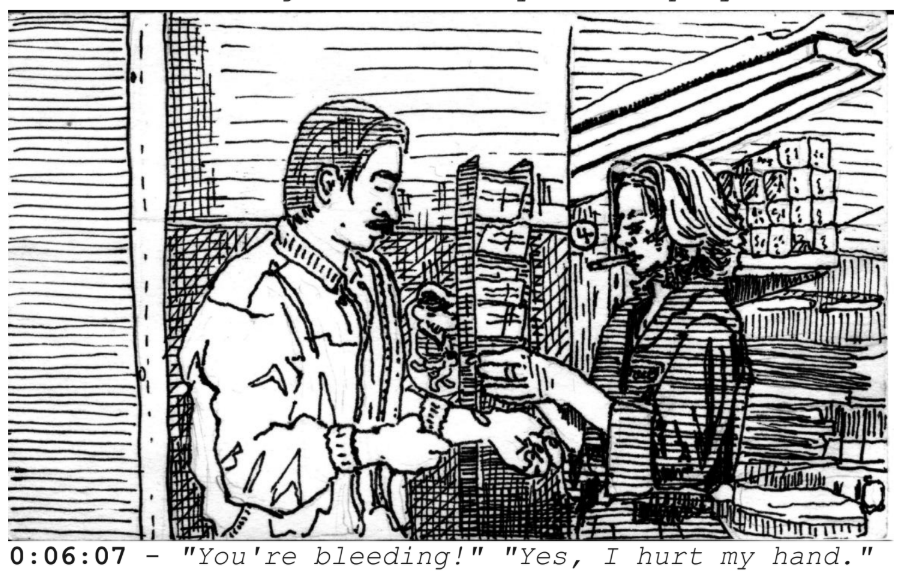
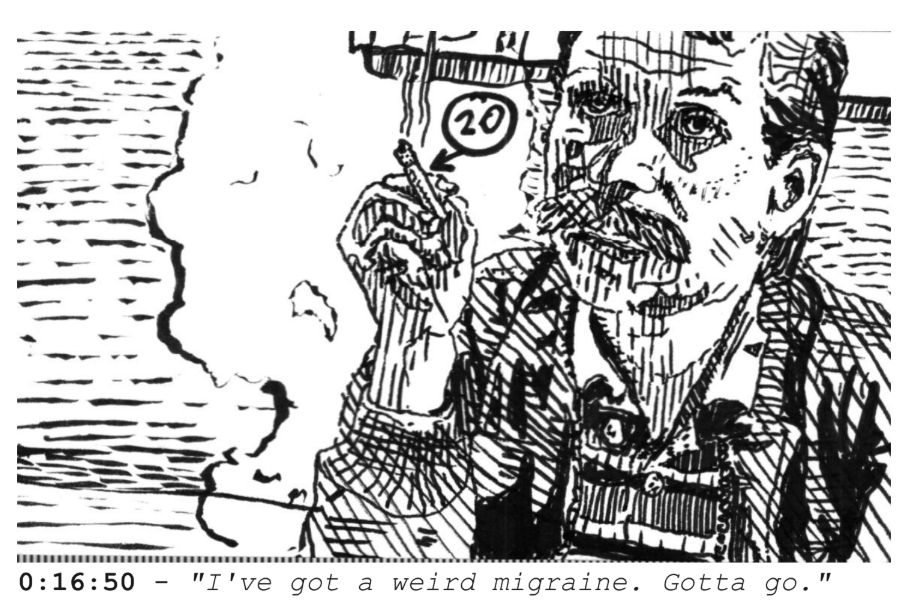
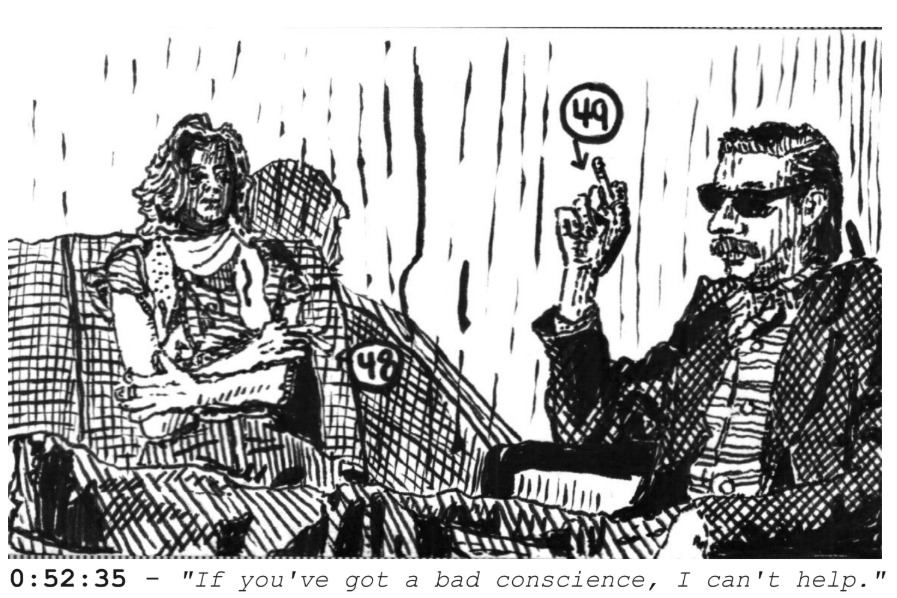
The How Many Cigarettes? project reached its natural zenith this week when Leigh presented a Gap Tooth screening of Aki Kaurismäki’s dead-eyed 1986 romcom Shadows in Paradise at The Broad. He introduced the film—Kaurismäki’s finest work, from what I’ve seen—as a core title in the Real Smoker Movie canon, citing it as the movie that first inspired him to start counting cigs in the first place. There are 71 cigarettes smoked in Shadows in Paradise, which is impressive for a film only 74 minutes in length. In the hand-illustrated zine he produced to accompany the screening, Leigh writes, “The number of cigarettes smoked here seems like a joke. Almost every scene has between 1 and 9 people smoking cigarettes.” He’s right. Once you start counting, the rate of cigarettes being lit from scene to scene becomes outright comical. Every single conversation is punctuated with the flick of a lighter, pulls on a filter, and the stamping of a cherry. And yet, it’s honestly something I didn’t notice the first time I watched the film back in 2021, alongside the other Kaurismäki classics The Match Factory Girl, The Man Without a Past, and The Other Side of Hope. Growing up in the 80s & 90s, chainsmoking just seemed like a normal, everyday part of adulthood, back when my dad would smoke entire packs of Marlboro Golds indoors, as if he were enjoying a snack or a soda. So, watching the despondent, lovelorn characters of Kaurismäki’s Helsinki chat over a constant procession of smoke breaks just felt natural to the movie’s time & place. Rewatching the movie through the How Many Cigarettes? filter, though, some of the cigarette-specific images do feel intentionally comical, like when Matti Pellonpää appears smoking while wearing sunglasses indoors, hiding his romantic heartbreak behind a costumey idea of vintage rock ‘n’ roll cool. The cigarettes are both artificial movie props and natural urban decor. They are essential to the movie’s mise-en-scène.
Something I did notice about Shadows in Paradise the first time I watched it was all the trash. There are enough standalone shots of wet garbage in the film to inspire a How Many Cigarettes? sister site that measures movies by their literal trashiness, per-pound. Pellonpää stars as a lonely garbage man who slowly, carefully sparks a romance with a jaded grocery store clerk, played by fellow Kaurismäki regular Kati Outinen. In genre terms, it’s an awkwardly stilted romcom, delivered in a proto-Wes Anderson flat affect as the blue-collar pair gradually earn equal footing in each other’s esteem one smoke break at a time. From a broader view, it offers stray documentary glimpses into 1980 Finnish waste treatment processes, trailing Pellonpää from dumpster to dumpster as he hauls away endless heaps of trash. His social status as a garbage man directly plays into his dateability too, as his only viable romantic foil is a middle-manager yuppie dipshit who lords over a trendy clothing store. Outinen seems a little embarrassed to be dating a garbage collector, but it’s still instantly obvious that she won’t be able to make it last with the yuppie, because it’s impossible to picture her sharing a cigarette with him behind a grocery store dumpster. Pellonpää knows his way around an ashtray, though, and his social status as a trash-hauling beer guzzler can be adorable in its own way, once you get past the smell. There’s a pitch-black urban despair to Shadows in Paradise that echoes throughout Kaurismäki’s other works, but it’s mostly one of set dressing & social circumstance, as typified by its empty beer bottles and crushed cigarette butts. It’s ultimately a very sweet love story, though, a romcom that deals exclusively in deadpan whimsy.
If there’s anything direct Kaurismäki was attempting to signal to his audience through all of the onscreen trash & cigarettes, it’s that Shadows in Paradise is meant to be a love story for The People. He even went as far as to group it with The Match Factory Girl & Ariel as his official “Proletariat Trilogy.” It probably means something, for instance, that when Pellonpää & Outinen exit the film via cruise ship for a makeshift honeymoon, the vessel is decorated with the Communist hammer & sickle. Likewise, How Many Cigarettes? is a movie database for The People, decidedly unpretentious in its selections and open for collaboration with its patrons. Leigh has opened the database up for volunteer contributions, which you can find information about on the site’s About page. Even more generously, he has uploaded a printable copy of the “Every Cigarette Smoked in Aki Kaurismäki’s Shadows in Paradise” zine, which includes a brush-pen illustration of every cigarette smoked in the movie, along with a leaderboard of some Real Smoker Movie heavy-hitters like The Bikeriders (104), Road House (71), The French Dispatch (86), and Smithereens (37). Print yourself a copy and poke around the website the next time you’re bored on a smoke break or just looking for your next Movie Night selection, to be determined by one absurdly specific metric.
-Brandon Ledet