One Battle After Another (2025)

The 2023 political thriller How to Blow Up a Pipeline was a small production with no household-name movie stars and limited theatrical distribution. It vocalized leftist politics within the visual language of a mainstream heist thriller, often pausing its most explosive moments to explain the political motivations of its young domestic-terrorist dissidents, who actively disrupt the industrial processing of oil as a desperate act of global self-defense in the face of Climate Change. Despite all of its populist genre markers and its traditional Dad Movie rhythms, it didn’t make much of a cultural impact outside the usual cinephile circles. What it did accomplish, though, was presenting a rudimentary prototype for a kind of politically daring Hollywood blockbuster that a major studio would never actually touch, dreaming of a better world for the American moviegoer and the American political discourse. And now, somehow, one of the last few Hollywood studios standing has put some real money behind making the real thing. Paul Thomas Anderson’s One Battle After Another is the finished action-blockbuster product that How to Blow Up a Pipeline only sketched out in blueprint, one with real Hollywood money and recognizable Hollywood celebrities vocalizing revolutionary politics within the structure of a 4-quadrant crowdpleaser. It’s in no more danger of transforming the real-life American political landscape than its low-budget indie prototype was a couple years ago, but it does have a much better chance of provoking substantial political conversations among a wide, mainstream audience, because it’s got major studio muscle behind its production & distribution — improbably.

If there’s any glaring deviation from the traditional Hollywood studio action thriller here, it’s in One Battle‘s choice to de-center its archetypal lone hero to instead give credit to the heroic work of political collectives. Much like Joaquin Phoenix’s bumbling stoner detective in Anderson’s previous Thomas Pynchon adaptation, 2014’s Inherent Vice, Leonardo DiCaprio’s revolutionary burnout is continually ineffective in his attempts to save the day; he’s mostly just thrashed about by political systems larger than him as he drinks & smokes his way through the pain. At the start of the picture, he’s a young bombmaker who’s joined a political resistance collective called The French 75, helping them destroy property and free prisoners of the state in the name of a future America with “free borders, free bodies, free choices, and [freedom] from fucking fear.” However, after he fathers a child with the most erratic radical in the crew (Teyana Taylor), his politics become secondary to his domestic duties as a parent. His girlfriend splits the scene and the French 75 fall apart spectacularly under the pressure of a militant fascist named Lockjaw (Sean Penn), leaving DiCaprio’s stoner dad raising his daughter alone under a stolen identity, separated from any meaningful political resistance in his middle age. He’s only dragged back into action by the abduction of the mostly oblivious teen in his care (relative newcomer Chase Infiniti), who becomes a pawn in a three-way battle between an ICE-like immigration taskforce run by Lockjaw, the remnant scraps of the surviving French 75ers, and a secret white nationalist cabal that wields more political power than anyone else involved.

A lot of the humor in One Battle After Another‘s action sequences is a result of its would-be hero’s complete lack of heroic skills. He’s long scorched away the political rhetoric & secret passcodes from his early revolutionary days with decades of bong rips, and the countless gallons of beer have left him too sluggish to keep up in the endless string of chase sequences. When tasked to attempt small parkour maneuvers following skaters to safety during a police chase, for instance, he falls 40 feet to the ground and is immediately tasered unconscious. All of the meaningful political action in the film is executed by underground networks of revolutionaries working as a collective, including one run by a karate dojo owner played by Benicio del Toro, who helps him limp along for much longer than he possibly could otherwise. At his age, DiCaprio’s revolutionary is mostly a dad who’s mission is to retrieve his daughter before she’s harmed by a fascistic government he failed to change for the better in his own youth. Even in that context, he has little effect on the outcome, pathetically so. That’s largely because the right-wing forces he’s racing to keep up with are so absurdly evil and well-funded that a paunchy, middle-aged stoner has no chance to make a dent in their armor. Sean Penn is especially grotesque as Lockjaw, continually finding new, inhuman ways to hold his body & mouth that are just as worthy of laughter as they are of disgust. The racist cabal that calls the shots above Lockjaw’s head are also presented as a hilarious punchline despite their vicious cruelty, as they’re characterized as a Christmas cult that chants, “Hail, St. Nick!” with the same ecstatic fervor that their imagined enemies chant, “Hail, Satan!”

I don’t personally care too much about Hollywood studio spectacle at this point in my life; the most potent images & ideas in modern cinema are lurking in microbudget indies that would be lucky to secure 1% of One Battle‘s speculated budget. Still, it’s encouraging to know the modern studio picture can be thrilling & meaningful when the funding flows to the right people. Paul Thomas Anderson announced himself as a skilled craftsman as soon as he debuted with Hard Eight & Boogie Nights in the 1990s. His immediate Altmanesque control on large ensemble casts and his Scorsese-inspired tension between humor & violence have only become more personal to his own name & style as his work has sprawled over the decades since. Here, he acknowledges that the revolution will not be televised (going as far as to reduce that infamous Gil Scott-Heron piece to call center hold music), but he also argues that the revolution can be sexy & fun anyway. For all of the sparse piano-key tension of Jonny Greenwood’s score and the restless kineticism of Michael Bauman’s bulky VistaVision camerawork, the tone remains remarkably light. These revolutionaries cut up, they fuck, and they celebrate their minor victories with wild, infectious abandon. Before Anderson funnels all of the plot’s political warfare into a single highway chase on an open desert road, the audience would be forgiven for forgetting that we’re watching an action thriller and not an ensemble-cast character comedy. What’s most impressive about the movie is that it credibly succeeds in both genres while making time to clearly define the nation’s current political factions: our cartoonishly racist overlords, their pathetically naive servants who hope to join their ranks, the largely disorganized leftist resistance, and the ill-equipped everyday people struggling to just take care of their own despite the boots pressing on all of our necks.

-Brandon Ledet

The Aviator (2004)

I’ve been slowly but surely working my way through Martin Scorsese’s filmography; I gave a rundown of what I’ve been up to in my Cape Fear review here, and I’ve worked my way from having only previously seen Shutter Island, Alice Doesn’t Live Here Anymore, and The Last Waltz as of last year to now also having seen Taxi Driver, Goodfellas, Cape Fear (obviously), Casino, and now The Aviator. At about halfway into the film’s staggering 171-minute runtime, I turned to my friend and stated that, although I understand that this might be a heretical opinion, I thought it was so far Scorsese’s best work that I had seen. After viewing the film’s more meandering and slow-moving second half, I’m not so sure that’s the case, but it may still very well be my favorite. All cards on the table, however, almost all of that enjoyment comes in the form of an absolutely marvelous performance from Cate Blanchett as Katharine Hepburn, which having just watched Suddenly Last Summer, it’s pitch-perfect and an utter joy to watch. That the film becomes less interesting when Hepburn moves on from being courted by the playboy Howard Hughes (Leonardo DiCaprio) to starting her affair with the still-married Spencer Tracy, as she did in real life, is not a surprise. 

The Aviator is the story of one Howard Hughes, whose Houston-based family business made a fortune in drill bits for oil wells, and the film opens on Hughes engaging in his two great passions: aviation (naturally) and movies. He hires Noah Dietrich (John C. Reilly) to manage his business so that he can put all of his attention into the completion of his war picture Hell’s Angels, a cause which ultimately takes him over three years and costs $4M ($77.3M in 2025, adjusted for inflation), nearly bankrupting him, but catapulting him into the public consciousness as the archetypal 20th Century Renaissance Man: a brilliant engineer, a playboy with the most beautiful women in Hollywood, and an artist. He also completely seizes up under any kind of greater attention, represented by him having a “whiteout” as the frame fills with light. Hepburn is immediately drawn to him, and the couple’s romance is quite a lot of fun, as she’s an unconventional woman who’s drawn to him, dazzled but not blinded, and she helps to ground him. His ongoing filmmaking career leads him to dalliances with other actresses while his oversight of Hughes Aircraft demands more of his attention, and after a disastrous visit to the Hepburn family compound, the two split up. All of this is intercut with Hughes continuing to design and engineer various aircraft, with one such plane making him, at the time, the fastest man who had ever lived. 

When we did our podcast episode about Boogie Nights, Brandon drew a connection between it and Goodfellas, specifically in both films’ bifurcation into a “fuck around” half and a “find out” half, with 1980 as the dividing line. Casino has that same symmetrical structure, and The Aviator does too, among some other Scorsese-isms that I’ve started to notice, like federal agents being used for petty retaliation and planes running out of fuel while flying over golf courses. Unlike in Casino and Goodfellas, however, the main character’s downfall in the “find out” back half are a result of Hughes’s mental illnesses, rather than a more traditional tragic flaw, like Sam Rothstein’s need to be envied or Henry Hill’s inability to break free from the allure of the power that organized crime gave him. The film essentially shouts at you through a bullhorn that Scorsese sees himself in Hughes and although he doesn’t shy away from portraying Hughes’s outlandish behavior like extremely precise eating habits, obsessive handwashing (to the point of causing himself to bleed), and paranoid wiretapping of his girlfriend Ava Gardner (Kate Beckinsale)’s phones, it’s not those things that bring Hughes down. Scorsese’s Hughes is a Randian achievement of infamy by merit, precision, and perfectionism, and his failures have to be that he’s too much of a perfectionist and he pushes himself past his limits — the kinds of things that you would disingenuously call weaknesses in a job interview. The appearance of an antagonizing force in the form of PanAm president Juan Trippe (Alec Baldwin) and his senator patsy Ralph Owen Brewster (Alan Alda) moves the narrative along but it’s not really Trippe or Brewster that Hughes is ever really fighting; it’s himself and his increasingly severe compulsive acts. Once he overcomes the agoraphobia he develops following the latest of several experimental aircraft crashes and delivers a Mr. Smith Goes to Washington-style speech to Brewster’s subcommittee, the narrative thrust has hit its climax. Hughes was an ubermensch, albeit an eccentric one, and Scorsese is the Hughes of the film world. 

I’ll admit that this is an easy leap to make when interacting with any text, but there’s a special focus on Hughes’s tenderness in his approach to the machines that he creates. Hughes doesn’t do “test pilots”; he gets out there and he flies the thing himself, and the fact that his cockpit and his director’s chair are the same seat is made very literal early on when he flies around amidst the pilots shooting Hell’s Angels. When something doesn’t work, he keeps trying, even when the need for it has passed. He first dreams up the “Hercules” air carrier as a means to help the troops in WWII, but despite taking government development money, he doesn’t get the thing completed until after the war is over because it has to be perfect, just like a film has to be perfected before it gets sent out to the general public, even if doing so means that it misses its cultural moment. I have to admit that none of that is all that interesting to me, just like I’m not really all that interested in any of the film’s various historical inaccuracies (the film presents Hughes as making his firebrand subcommittee speech after coming out of his reclusive “locked in a movie theater and pissing in jars” period, when in fact the committee hearings were 1947, a solid ten years prior to his 1957 isolation). What is interesting to me is that this is a film that I don’t think could be made today.

The Aviator was released during what was probably the last time the general public was willing to accept an epic narrative about a real life “hero” of public stature. Contemporary figures of equivalent wealth, status, and public identity are far too accessible to the general public, and the extent to which some of the most powerful people in the world have sacrificed their mystery and allure on the altar of social media (not to mention their morals and ethics) and flat-out embarrassed themselves on an international stage means that they’ve forsaken any awe or reverence that they might have otherwise had. The pursuit of being the most liked boy by a vocal minority of people who are overrepresented online has shattered any opportunity for a contemporary millionaire inventor to be respected, for better or worse, not to mention that it’s fundamentally broken many of our critical institutions. Retroactively, it makes this entire genre seem like propaganda, and it probably always was, intentionally or not. That’s just the way of the future. 
Finally, I found this one a fun experiment in seeing what Scorsese would do with a more family-oriented picture. Most of his films are R-rated and notoriously so, with Goodfellas setting the record for the most uses of the word “fuck” in a movie at 300, a record that was broken five years later with 422 uses in Casino, and when the upper records started getting a little crowded, The Wolf of Wall Street had 569 uses in 2013. I’m no moral guardian, but I will say that there’s something to be said for playing around with moderation as The Aviator, as a PG-13 film, got exactly one “fuck” and it hit a lot harder than any single or cumulative use in the other Scorsese pictures I’ve seen. Part of this is the nature of the setting, which allows for Blanchett’s Hepburn to gush out “Golly!” and many other early period accurate transatlanticisms (and it’s a hoot every time). Scorsese usually goes for broke by leaning into the extremes, and it was interesting to see him do something different. This wasn’t his first non-R film, of course, as Alice Doesn’t Live Here Anymore, New York, New York, and The King of Comedy were all rated PG (albeit they predate the PG-13 rating), as is The Age of Innocence, and his Dali Lama picture Kundun was PG-13, but this feels like his first movie that you could catch on cable on a Saturday afternoon during a family get together and reasonably expect most of the people present to enjoy it.

-Mark “Boomer” Redmond

Killers of the Flower Moon (2023)

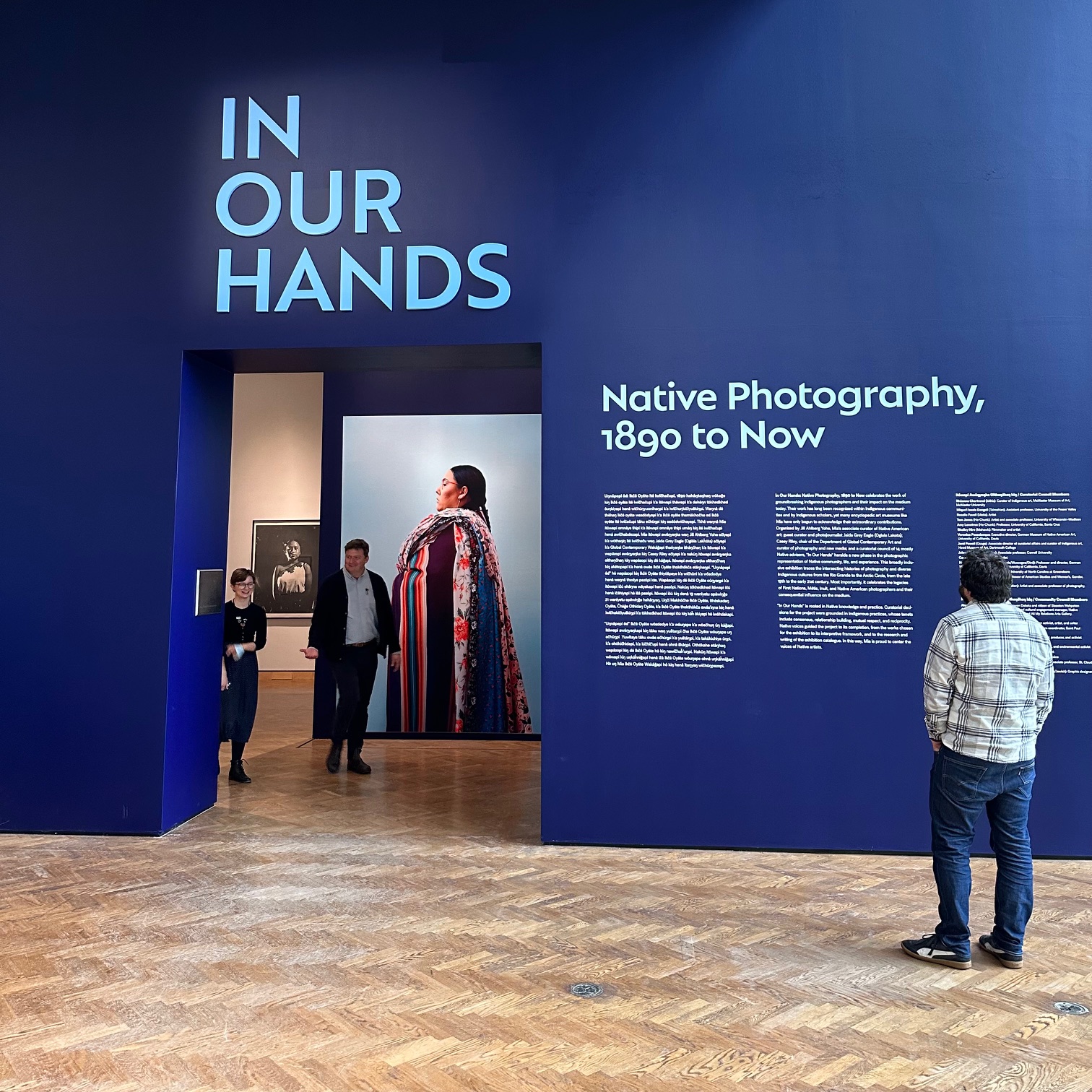
On a recent vacation in the Twin Cities, I spent an afternoon at the Minneapolis Institute of Art, which is currently exhibiting “150 photographs of, by, and for Indigenous people” in a photography collection titled “In Our Hands”.  It was during that same vacation when I watched Martin Scorsese’s Indigenous genocide drama Killers of the Flower Moon, which is also a series of photographs grappling with the medium’s representation & othering of Indigenous peoples.  Because I’m a movie obsessive, the photographs featured in “In Our Hands” that spoke to me loudest were the ones about misrepresentations of “American Indians” in American pop media.  Cara Romero’s 2017 photograph “TV Indians” pairs living Indigenous figures with vintage images of fictional Indigenous stereotypes, displayed on cathode-ray televisions in the colonized & decimated landscape of New Mexico.  Sarah Sense’s 2018 mixed-media piece “Custer and the Cowgirl with Her Gun” combines images of vintage Indigenous stereotypes in media with personal photographs & historical writing from her Chitimacha & Choctaw homeland through a traditional basket weaving technique that transforms & reclaims the medium of photography for a culture it has been historically weaponized against.  Killers of the Flower Moon also addresses the fraught history of Indigenous representation in American media, to the point where its theatrical exhibition opens with Scorsese explaining his “authentic” behind-the-scenes collaboration with the Osage communities the story depicts. The film also concludes with a second onscreen appearance from the director effectively apologizing for his participation in the tradition of speaking for & about Indigenous people from a white American perspective.

To his credit, Scorsese does limit the amount of time & space he spends speaking for the Osage tribe, smartly focusing instead on the people he’s built an entire artistic career around understanding: white thugs.  Killers of the Flower Moon is a typical Scorsese crime picture in that it details the step-by-step villainy of greedy American brutes who commit heinous, organized acts of violence in order to squeeze a few petty dollars out of their neighbors.  He acknowledges this continuation of his pet themes by casting his two go-to muses in central roles: Leonardo DiCaprio as a slack-jawed goon and Robert De Niro as the criminal mastermind who puppeteers him.  The dastardly duo conspires to become friends, family, heirs, and murderers to the Osage people, who have stumbled upon immense wealth when their government-assigned strip of land proves to be a viable source of crude oil.  DiCaprio’s assigned mark is a lonely but stoic young woman played by Lily Gladstone, whom he seduces, marries, creates children with, and then slowly poisons while murdering members of her family under the direction of De Niro’s whims & schemes.  Gladstone’s performance is formidable within that central trio, and she stands to benefit the most from this collaboration with Old Uncle Marty.  Still, it’s the slimy, bottomless cruelty of De Niro & DiCaprio’s characters that drives most of the scene-to-scene drama, so that Scorsese is telling his own people’s story more than he is speaking for the Osage.  Watching the movie in conjunction with visiting the M.I.A.’s “In Our Hands” exhibit raises questions of why these same film production resources can’t be put in the hands of Indigenous artists as well, but that question does little to unravel the specific story Scorsese chose to tell here.

Where the question of authenticity & representation really comes into play is in the film’s coda, delivered after De Niro & DiCaprio’s thugs have already been arrested for their crimes by the Baby’s First Steps version of the FBI.  Where lesser Awards Season historical dramas will fill the audience in on how their characters’ lives resolved via onscreen text before the end credits, Scorsese delivers that information via dramatic radio play — complete with the outdat foley sound effects and outdated racist stereotypes that would’ve been contemporary in that pre-cinematic medium.  The director then shambles onscreen himself as a radio announcer to read Gladstone’s character’s real-life obituary to the audience with humble solemnity.  This is a jarring stylistic swing for a film that often finds Scorsese working in Boardwalk Empire mode more than Goodfellas mode (more dramatic than cinematic), but it’s at least one that seeks artistic purpose beyond reciting this history to a wide audience who needs to hear it.  Here we have a quintessentially American story told by a quintessential American storyteller, and yet there’s no way for Scorsese to recite that history without in some way participating in its ongoing genocidal erasure of Indigenous voices.  The opening doorway image to the “In Our Hands” exhibit is a portrait of an Osage woman taken by photographer Ryan Redcorn, purposefully representing his subject in a proud, dignified pose.  In Scorsese’s picture, Osage women are sickly victims of white American greed, because that’s true to white American history.  It’s worth pushing for a better world where both of those images are offered equally accessible platforms, and this film’s coda feels like an uneasy acknowledgement of the current imbalance.  Still, this is a story worth reciting, and there are certainly less noble things Scorsese could be doing with $treaming $ervice money than turbocharging Lily Gladstone’s career.

-Brandon Ledet

Once Upon a Time in . . . Hollywood (2019)

Once upon a time in the 1990s, Quentin Tarantino was a badboy troublemaker on the movie scene, heralding in a new era of post-modern indie filmmaking that could commercially compete with the major studios in a way that shook up the status quo. Then, over time, Tarantino became the status quo. The dream of the 90s indie scene faded away, but he remained largely unscathed as a Blank Check auteur who could make just about anything he wanted – no matter how self-indulgent, esoteric, or #problematic – merely because he was established at the right time and grandfathered in. That protected status cannot last forever. With Once Upon a Time in . . . Hollywood, the rebel-turned-Establishment director directly grapples with his inevitable obsolescence as an artist who’s no longer “needed” by the industry and whose time is approaching the rearview mirror. If Tarantino is still a movie industry troublemaker, it’s because his Gen-X sensibilities are now an outdated taboo among the youths, no longer a revolutionary paradigm shift. To pretend that he’s still cinema’s troublemaking badboy at this stage of his career would be embarrassing. Instead, he leans into his newfound status as cinema’s grumpy old man, and it’s oddly invigorating.

To address the approaching obsolescence of his Gen-X shock humor & political apathy, Tarantino dials the clock back to another inter-generational dust-up between institutional dinosaurs & idols-smashing youths: the fall of Old Hollywood. Leonardo DiCaprio & Brad Pitt star, respectively, as a has-been Old Hollywood television actor and his personal assistant/stunt double – a pair of aging knucklehead brutes who sense their days of usefulness in Los Angeles are nearly at an end. In real life, the death of the Flower Power hippie movement and the birth of the New Hollywood movie industry upheaval are often marked by the brutal murder of Sharon Tate & friends at the hands of the Charles Manson cult – the gruesome epilogue to the Summer of Love. In this film, Tarantino daydreams an alternate history where Manson’s brainwashed devotees were disastrously unsuccessful in their mission the night of Tate’s murder, and the New Hollywood takeover never took off as a result. Margot Robbie puts in a supportive, periphery performance as Sharon Tate, who thrives blissfully unaware of the dark forces surrounding her. Tate lives a carefree life as a rising star just next door to DiCaprio’s fictional Old Hollywood hangover, whose stubborn refusal to fade away gracefully and amorous exploitation of his personal assistant eat up most of the (sprawling, near three-hour) runtime. This is largely a plotless hangout picture between a childlike employer and his dangerously quick-tempered employee, two men who cover up the uncomfortable power imbalance of their relationship by disguising it as a friendship. The Manson Family murder of Sharon Tate is treated as an unfortunate distraction from enjoying the final days of these men’s relationship & industry as they near extinction; it’s an incident Tarantino would prefer to delay for all eternity so that Old Hollywood itself would never die.

I appreciate this movie most as a passionate argument for a sentiment I could not agree with less. I have no love for the traditional machismo & endless parade of cheap-o Westerns that clogged up Los Angeles in these twilight hours of the Studio Era. Still, it was entertaining to watch an idiosyncratic filmmaker with niche interests wax nostalgic about the slimy, uncool bullshit only he cares about. Even when Tarantino arrived on the scene as a prankish youngster in the 90s, his work was already mired in nostalgia for the dead genres & traditionalist sensibilities of the Studio System that died with the 1960s; he just updated them with cussing & gore. These early Gen-X remixes of old-fashioned crime pictures were at least stylized to be cool, though. Here, he extends that nostalgia for The Way Things Were to Old Hollywood relics that are hopelessly uncool, square even: radio ads, paint-by-numbers Westerns, network television, chain-smoking, toxically corny Dean Martin comedies, etc. The encroaching forces that threaten to break up this (largely alcoholic & abusive) boys’ club traditionalism are much easier to defend as hip & worthwhile (the looming presences of Roman Polanski & Charles Manson excluded): casual drug use, Anti-War counterculture youths, hardcore pornography’s intrusion on the mainstream, New Hollywood brats like Dennis Hopper (whose name is tossed off as an insult) & William Friedkin (whose early-career title The Night They Raided Minsky’s appears on one of many onscreen marquees), and so on. Positing that the stale machismo of Old Hollywood’s late-60s decline is preferable to the youthful auteurism that soon supplanted it is borderline delusional (and maybe even irresponsible), but it’s at least a distinct & interesting perspective, and it’s perversely fun to watch an increasingly bitter Tarantino defend it.

There isn’t much that’s new to the Tarantino formula here. The stylized dialogue, apathetic slacker humor, gruesomely over-the-top violence, post-modern restaging of ancient film genres, and pop culture name-dropping typical to his work all persist here in a stubborn, unapologetic continuation of what he’s always done. If anything, the director goes out of his way to accentuate his most commonly cited tropes, even rubbing our faces in his notorious foot fetish with a newly defiant fervor. Tarantino has not changed, and neither will your opinion on his merits as a filmmaker or a cultural commentator. What has changed is that he’s now fully transitioned from bratty upstart to outdated Establishment. Aware of his newfound status as an old fogie, he goes full ”Get off my lawn!” here by positing that it’s the children who are wrong, that Hollywood traditionalism deserves to live on infinitely unchallenged & unimpeded. He may not be able to prevent his own approaching obsolescence (nor the end of days for when the Star Power of household names like Pitt & DiCaprio actually translated to box office receipts), but he can at least express that frustration in his fiction by undoing a previous death of Traditionalism in Hollywood’s past. He doesn’t even pretty up the surface details of the era he’s defending to strengthen the argument. The actor & stuntman duo in the film are childlike, destructive bullies who treat life like a hedonistic playground. The films & TV shows they’re making are dreadfully boring. The brainwashed Mansonite children they stomp out to rewrite history are deserving of pity the film is stubbornly unwilling to afford them. It’s an embarrassingly uncool, conservative worldview to defend, but Tarantino is maybe the most amusing messenger to deliver it possible, considering his trajectory as a cinematic badboy turned (as the film’s hippie youngsters would label him) Fascist Pig.

-Brandon Ledet

The Revenant (2015)

bear

threehalfstar

Alejandro González Iñárritu’s latest is a difficult film to pin down in terms of quality. The Revenant is at times an intense spectacle of intricately detailed action choreography, but it’s also a meandering slowburner of a film that constantly reminds you that you’re watching Important Art. Its cinematography (provided by master of the form Emmanuel Lubezki) is gut-wrenchingly beautiful, but is often employed for such an empty purpose that it leaves you feeling cold. It aims for High Art severity in its narrative consequence, but the grotesque savagery of its rape & pillage masculinity feels like a well-constructed exploitation pic from a bygone era. I’m tempted to group it in with other arty, all-dressed-up-with-nowhere-to-go slowburners that were impressive but impossible to connect with (for me, anyway) like Only God Forgives & The Tree of Life, but I enjoyed too much of the film to dismiss it that easily. What is clear is that Iñárritu should at the very least be commended for not following up the critical success of Birdman (a film I was less than kind to) with a carbon copy of his most high profile film to date. I appreciate him sticking his neck out there, even if the results were the ultimate mixed bag of soaring successes & cringe-worthy missteps.

Part of what makes The Revenant so frustrating is its daunting 156 min runtime. The film’s opening battles between white men fur trappers & tribes of Native Americans and Leo DiCaprio’s protagonist & a pissed-off mama bear are breathtakingly savage, epically orchestrated orgies of visually striking violence. At the other end of the film, a  concluding knife fight between DiCaprio’s beaten-to-shit protagonist & Tom Hardy’s selfish brute who wronged him ranks up there with Friedkin’s The Hunted as one of the best hand-to-hand combat scenes ever committed to film. The long stretch between those heart-racing anchors, however, are painfully in need of some shrewd editing. It’s tempting to think of The Revenant as a revenge film floating somewhere between a Western & an exploitation, but a majority of the film is a travelogue. DiCaprio, Hardy, two opposing bands of American & French Fur trappers (one headed by Domnhall Gleeson, who’s been batting a thousand lately), and a revenge-hungry native tribe all slowly trudge toward an inevitable climactic bloodshed (while still recovering from the one that opened the film) in an unnecessarily-detailed step-by-step procession. At times the film itself feels like DiCaprio’s broken protagonist, crawling & gurgling blood for days on end under the weight of an over-achieving runtime.   Shave a good 40 minutes of The Revenant by tightening a few scenes & losing a shot here or there (as precious as Lubezki makes each image) & you might have a masterful man vs. nature (both human & otherwise) revenge pic. As is, there’s an overbearing sense of self-importance that sours the whole ordeal.

For the most part, though, the self-importance on display in The Revenant isn’t nearly as off-putting as it can be in Birdman. For instance, Lubezki’s camerawork is just as showy here as it was in Iñárritu’s Oscar Winner, but it ditches the single-extended-shot gimmick of that film in favor of a more tasteful line of highfalutin action cinematography. There are some gorgeous transitions from intense close-ups to long tracking shots in impossibly smooth single-swoops, but these shots are broken up in a way that Birdman‘s unrelenting gimmick of a structure allow for. Plot wise, The Revenant echoes the loud & obnoxious majority vs. the righteous intelligence of the few in the know that turned me off so sharply in Birdman (with Hardy anchoring the obnoxious brute end of that equation & DiCaprio serving as the righteous), but it’s not quite as much of a turn-off here. At worst, the preciousness & empty philosophy of lines like “As long as you can still breathe, you fight”, “Remember what mother used to say about the wind?”, and endless mutterings of “You are my son, you are my son,” (similar to the way Sean Penn whispers “Mother” into the void for hours in Tree of Life) are worth a hearty eyeroll or two. At best, they’re a nice break from watching DiCaprio gurgle & crawl his way through the snow. The dialogue in Birdman was much more off-putting.

Like I said, there’s too much of The Revenant that resonated with me to dismiss it outright. I’m more than willing to forgive an overwrought image or two (there’s a particularly egregious moment when a white bird emerges from a bullet wound, for instance) in exchange for the film’s more successful flashes of brilliance (like the bear & knife fights). For all of The Revenant‘s try-hard stabs at achieving High Art through hyper-masculine brutality, there’s a hell of a lot of praise-worthy ambition & striking imagery that’s well worth the patience required to make it through the perilous journey of its over-inflated runtime. Shorten some its travel time through montage & soften the cheese factor of its philosophical mumblings & I might even have heralded it as a masterpiece of brutish revenge cinema.

-Brandon Ledet