This movie has everything. Bald-headed Peter Lorre hyperfixating on BDSM theater. Sad little orphans with weak spines. A condemned man praising the Hoover Dam. Evil hand transplants. Carnies being guillotined. One—and only one—Caligarian German Expressionist interior set. A wax Galatea. Drunken double vision cockatiels. Train derailments. It is a masterpiece. And not even seventy minutes long!
Dr. Gogol (Lorre) is a masterful surgeon, a veritable miracle worker who spends his spare time occupying the same balcony seat for every performance at a “theatre” in which Yvonne Orlac (Frances Drake) is kinkily tortured, night after night, in a scene that perfunctorily depicts some historical event. When he learns that not only has Yvonne been married for the entire period of his distant infatuation but also that she’s leaving for England to be with her up and coming pianist/composer husband Stephen (Colin Clive), Gogol is bereft. As luck would have it, a train bearing both Stephen and a skilled knife-thrower being escorted to his execution gets into an accident; Stephen’s hands are crushed and require amputation, but a desperate Yvonne begs Gogol to save her husband’s hands, and he lights upon the idea of using the executed criminal’s appendages to save Stephen’s livelihood. Even after months of expensive physical therapy, Stephen finds himself unable to play like he used to, although he seems to have developed an acute ability to throw sharp objects, all while his temper seems to grow ever worse.
I was looking for something to wash out the bad aftertaste of seeing Lorre in brownface in Secret Agent, and I could not have asked for a more perfect palate cleanser. Dr. Gogol is one of Lorre’s greatest characters, easily the equal of the impulsive, pathetic monster Hans in M or the perpetually sweating Abbott in The Man Who Knew Too Much, just an absolute freak whose gifted talent as a surgeon makes him a respectable member of a community that can never know just how much of a deviant pervert he is behind closed doors. Just when you think the film can’t get any more exciting, there he is in the distance putting a negligee on the wax figure of Yvonne he saved from being destroyed when her stage tenure came to an end. Then Gogol one-ups himself when a bid to frame Stephen for the murder of his own stepfather leads to a scene that features Yvonne coming face to face with this harrowing image, and all of us in the audience are close to crawling out of our skin.
Of course, much of the film’s success depends on the masterful direction of Metropoliscinematographer and later The Mummy helmer Karl Freund. The film is hauntingly gothic in its imagery, even when the subject matter is lewd, manic, or quite funny. Even the opening credits get in on the action, as the film’s stars are listed on a pane of glass that’s shattered by an angry fist. The script is also a delight, with my biggest laugh coming in the moment that the condemned murderer, Rollo, asks for a moment to speak with a nearby reporter named Reagan who happens to be American; their discourse is brief but ends with Rollo’s underwhelming final words, “Oh well, so long.” I can’t even fully put into words how wonderful this one is; you’ll just have to see it for yourself.
The last fifteen minutes of Number Seventeen are representative of Alfred Hitchcock at his finest: tense, thrilling, laden with spectacle, and very fun. It’s unfortunate that for a film with such a short runtime (under 65 minutes!), it spends its first three quarters treading water in a sloppy, lousy, mishmash of an Agatha Christie locked room mystery and an Oscar Wilde farce.
The titular location is a seemingly abandoned house where a number of figures converge over the course of a dark and stormy night. There’s an awful lot of farting about during which the difficulty in telling all of the characters apart is made even more complicated by the fact that a lot of proper names are thrown around—Fordyce, Sheldrake, Brant, Barton, etc—among four of the five men, but the characters give false identities at different times and swap them about between each other. Two of the men even have matching hats and identical moustaches! The gist is that a very expensive diamond necklace has been stolen, some number of the men are criminals, one of them is probably a detective, a seemingly dead body is actually alive (twice!), and one of the criminals is accompanied by a woman named Nora (Anne Grey) who is pretending to be deaf and mute, for reasons that are never entirely clear. The only man who seems to be what he presents himself to be is a squatter named Ben (Leon St. Lion, who had previously appeared in the stage version), an alcoholic who has a much-abused sausage in his pocket. It’s all even less thrilling than it sounds.
The plot gets going at last when the necklace turns up and it’s revealed that the house sits atop an access hatch that allows one to descend to a set of railroad tracks that eventually lead to a train ferry. A few of the criminals manage to board it with Nora in tow believing that the necklace is in their possession despite it having been picked from one of their pockets by Ben, while the man who introduced himself as Fordyce attempts to head off their getaway by commandeering a public bus. This is when things finally get interesting, as the thieves crawl around on the outside of the train to take out its various crew when they refuse to accommodate their demands, leaving a few petty burglars at the helm of a runaway locomotive that they don’t know how to stop. This is intercut with the rapid approach of the bus, as we watch the riders’ initial thrill of it all before they start to get tossed around a bit, and there are even brief moments when it appears that the bus and the train will collide, only for the engine to divert to an overpass while the bus passes through a tunnel that goes under the tracks. All the while, peacefully and inexorably, the ferry ship is coming into port.
All of this is done with miniature work that most modern viewers would find laughable, but which I find utterly charming. That’s come to be one of my favorite things about revisiting his earlier films of late, from the impressive opening sequence of The Lady Vanishes to Young and Innocent’s delightful trainyard sequences. This was also a young director who just absolutely loved a train derailment, and Number Seventeen has one that involves smashing through a series of gates and crashing into a ship, with the train car bearing characters I presume we are supposed to care about are slowly sinking beneath the surface of the water like one of those convenient submarine air pockets that the photogenic leads on Baywatch were always finding themselves trapped in. It’s a delight, and it’s almost enough to save the film, but not quite. The final fifteen minutes alone in isolation are worth the ticket price, but if you can, just skip to that ending and don’t worry about the plot at all. Hitchcock didn’t.
Undertone apparently began life as a radio play when it was first conceived by writer/director Ian Tuason, and it shows. It was also born out of his experiences taking care of his parents, who were both diagnosed with cancer in 2020; this, too, is apparent in the final film. It is, in many ways, deeply personal in a fashion that makes me feel bad giving it such a rotten rating, but while I hope that crafting the film gave Tuason the opportunity to process some of his grief, in so doing he created a piece of art for the public that treads no new ground and ultimately failed to connect with me on an emotional level, or deliver on much in the way of fear beyond the sufficient spooky atmosphere.
Evy (Nina Kiri) is the co-host of a podcast that she hosts with her friend Justin (an entirely offscreen Adam DiMarco), in which he plays Mulder to her Scully as they go through listener submissions of paranormal encounters. Having returned to her childhood home, Evy has spent a year caring for her terminally ill religious mother, with the 3 AM recording times of episodes of The Undertone serving as the only thing she has to look forward to, other than occasional visits to her non-helpful boyfriend, Darren. As Evy’s mother enters her final days, The Undertone receives ten audio files via email that begin with a man named Mike recording his pregnant wife Jessa’s sleeptalking, before those recordings escalate into aural terror.
There’s probably a really, really good short film in here. David F. Sandberg produced a no-budget short entitled Lights Out in 2013, which opened up the door for him to eventually make a feature of the same name in 2016. Smile and Night Swim followed suit as features that expanded creepy shorts into theatrical releases that have a decently functional core premise but which doesn’t have enough real substance to warrant a feature length picture. I was positive that this would prove to be the case for Undertone, but once I got home and looked it up, not only was this not based on a short film with a premise that was perfect for a 20ish minute runtime and which had imperfectly inflated to fill 90 minutes, but it also wasn’t a COVID-era script that spent the last half decade circling the drain in production purgatory (my other hypothesis about the film’s origins). It’s just a movie that looks, feels, and exhausts like one.
There’s plenty to praise here. Critics and audiences alike are agog at the sound design, which is admittedly exceptional. One would expect nothing less from a film about podcasting and which was originally planned as an audio narrative, but it’s praiseworthy nonetheless. Although the most recent Oscars ceremony has just passed, this is a strong early contender for a nomination in the sound category right out of the gate for next year. Kiri’s performance is likewise laudable, as she, like Rose Byrne in last year’s If I Had Legs I’d Kick You, is present in virtually every single frame in the film; other than her mother’s prone body, no other humans are ever visible on screen. While Legs spent most of its time in long close-ups of Byrne, Undertone balances that intimacy with long stretches in which the camera is distant from Kiri, isolating her at her desk in a third of the frame while the rest of the screen is filled with dark, empty space. That void invites the enlightened viewer, who knows about the subtle faces and figures in the edges of the frame in Hereditary and Longlegs, to lean in, searching for those subliminal demons here. The film foregoes the cliche of having something leap out of the darkness in a jump scare, which is also a strong point in its favor, instead opting for the audio equivalent by having Justin’s shattering of a glass play too loudly in Evy’s headset and other unexpected noises at unreasonable volumes. All of that’s good, and I again have to reiterate that this would likely make for a four star or higher short film, but as a feature, it just doesn’t work.
Despite Kiri’s strong performance, there’s very little to Evy. We know that she has a boyfriend, that she loves her mother, and that she hosts a podcast. Other than that we know she feels guilty about her exhaustion from being her mother’s caretaker and that she feels disconnected from her mother’s devout Catholicism, there’s not much to contemplate about her inner life. Evy’s lapsed sobriety is given an offhanded comment that doesn’t amount to anything at all, a Chekov’s gun hanging over the mantle, frustratingly jammed. Maybe her skepticism about the apparent hoax nature of the recordings bleeds out slowly as she tips the bottle more frequently, so that the fever dream of an ending represents her descent; leaving the loop unclosed on this character choice means that her first drink, followed by lying to Justin about it, just takes up space in the screenplay, irrelevant and dangling. It’s one of the textbook tells that the film doesn’t have enough ideas to hit the minimum time to be considered for theatrical release, as does the podcasting duo’s decision to listen to only a few recordings at a time. Rather than get through them in a single session (or a maximum of two), the film artificially and illogically stretches the virtual listening party out to four different recording sessions. The film’s repetition of (a) spooky recordings listened to/played with in an audio compiler, (b) Evy talks to a doctor on the phone, (c) Evy administers to her unconscious mother’s needs, (d) Evy has a spooky dream, then back around to (a) is repeated so many times that, when my bladder was full, I knew I only had to wait a few minutes until the film would lull again and I could make a quick run for the theater restroom.
Another thing that feels unsustainable about the premise is the inherent goofiness of following the narrative logic of “What if nursery rhymes contain secret evil messages?” to its conclusion. It’s not a secret that a great deal of folkloric melodies are based on schoolyard rhymes about historical events (or are retroactively diagnosed by later historians and critics as having been so) or that history is full of violence and ignorance, but the spooky, evil recording of “Baa Baa Black Sheep” really is a bridge too far into the absurd. Justin’s mind is frequently blown by reading the “origin and meaning” section of a Wikipedia page and acting as if he just got encrypted access to a declassified file, so when he downloads and sends the recording to Evy, he gets spooked by the coincidence that the version he found online is the same one that is playing in Jessa and Mike’s audio files. I don’t know, man, kinda seems like you and whoever is pulling this prank just landed on the same link on the first page of Google results for “spooky Baa Baa Black Sheep.” I know that I’m here to review the movie I saw and not rewrite it into the movie I wish it was, but when a film has this much potential only to squander it, I can’t seem to help myself. Imagine if Justin had masterminded this whole thing, that he had created Jessa and Mike’s recordings and sent Evy a version of an old song that he had deliberately backmasked in order to rattle her skepticism. From there, the story could delve into a more malicious reason for him to want to gaslight Evy (maybe her baby is actually his?), or keep it supernatural by having his audience-entertaining prank turn out to have actually summoned a demon. Instead, we get something that’s frustrating in just how much it’s held back by having too much imagination to dismiss as easy schlock and not quite enough to move the story in a less obvious, familiar direction.
Welcome to Episode #260 of The Swampflix Podcast. For this episode, Boomer & Brandon discuss a sampling of espionage thrillers Alfred Hitchcock directed in his early British period, starting with The 39 Steps (1935).
Once in a while, one must turn to Tubi, The People’s Streaming Service, and check out what bizarre oddities are hiding in its servers. While attempting to track down a watchable version of Alfred Hitchcock’s Number Seventeen recently, I clicked on the Tubi link and couldn’t find the movie, even in my “to watch” list, before I realized it was because I had neglected to turn off my VPN and was only being shown films that were available in Mexico. One of the films that was accessible both from the U.S. and our neighbor to the south was the 1988 no-budget horror comedy Flesh Eating Mothers, made by a group of Baltimore locals. The film’s descriptions across different film-oriented websites vary, but all manage to touch on the major plot elements: across a small suburb, a series of women are all having affairs with the town horndog, eventually contracting sexually transmitted cannibalism, which the kids in the town must then try to cure. What that undersells is that this “cannibalism” is sentient, self-aware zombism in all but name, and also that the “kids” are, politely, not very convincing as high schoolers.
For a movie that was clearly shot on weekends and around the full-time, adult work schedules of its actors, there’s a lot that feels more professional than amateur here. By the late eighties, there had been dozens of books about special effects that enabled anyone who had access to those texts and sufficient pocket money to acquire rubber cement and foam latex to at least attempt mounting their own Evil Dead with their friends. The gore is impressive, but it’s also not really the most interesting thing that happens visually. The film’s opening title sequence consists entirely of a slow pan all around what must have been a very large, time-consuming image of the town done in crayon. It’s inexpensive, but a less savvy amateur filmmaker would have had this play out over a series of smaller, static images rather than keeping the audience’s point of view in constant motion. It makes for a more interesting visual and maintains the film’s energy.
The attention to detail is likewise striking; at one point, we see a couple of kids hanging out outside of a business that features an advertisement for barbecue chicken; later in the film, two of the “high schoolers” meet in front of this business, directly below the BBQ poultry sign. I was surprised by that level of attentiveness, especially given other places, especially in the musical score, which didn’t work at all. Most excitingly, every time the audience gets a peak at what’s under the microscope that the town’s only two responsible scientists are using to research a cure for the virus, what we actually see are very cute animations of slightly anthropomorphized cells and whatnot bouncing off of and fighting with each other. It’s not the C.S.I. zoom-in on fibers and flagella that one might expect, but more like a very basic educational short you might watch in a third-grade science class. That’s not to say that this is the kind of PG/PG-13 horror fodder that one could show to a child, however, unless you want to frighten them, as this film is utterly unsentimental about the lives of kids, with one scene memorably depicting the horndog’s “teen” daughter returning home to find her mother having eaten her baby brother.
The plot’s fairly simple. Randy Roddy Douglas is sleeping with the proverbial town bicycle, deliciously named Booty Bernett, and even talks to his wife about having an open marriage, which doesn’t interest her. He hooks up with a couple of other women in the town, notably the mother of his daughter’s best friend, the mother of a different random “high schooler,” and eventually even “comforts” the abused wife of a local alcoholic, who also happens to be the mother of the town heartthrob. Meanwhile, Roddy keeps getting the all clear from the greasy doctor at the local sexual health clinic despite said doctor’s statuesque blonde nurse continuously asking him to review potential viral venereal diseases rather than just bacterial ones. Eventually, she teams up with the comically short, nebbish, effeminate coroner (imagine Corky St. Clair, then shave off half a foot), and the two make for a delightful mismatch every time they appear on screen with one another to try and develop a cure. A gaggle of kids who have gathered after seeing their mothers eating human flesh eventually collide with them, and they work together to try to save the day.
I mentioned the school heartthrob above, and wanted to note that he is confusingly identified by his full-ish name “Jeff Nathan” in his intro scene. Later, he’s called “Jeffrey” by his mother and “Nathan” by his male classmates, leading one of my viewing companions to frustratedly interject “Who is Nathan?” at one point; this is a perfectly legitimate thing to quibble about, though, because where this film suffers is in an abundance of characters. There’s an entire additional plot line I haven’t even mentioned about the one-armed chief of police covering up the evidence that the mombies leave behind because he believes that the spreading disease is God’s punishment for his having committed adultery, which infected his wife who then ate his arm off before he killed her in self-defense. It’s not really narratively necessary and contributes greatly to the film’s overall muddled plot, which has too many different storylines happening, all featuring white brunet Baltimorians, such that it can become difficult to differentiate between them (one character dons a bandana at one point, and I was very grateful, since to that point I hadn’t realized he and the horny ice cream guy were different people).
But the plot’s not what you’re here for, is it? You didn’t choose to watch something called Flesh Eating Mothers with the belief that you might stumble upon undiscovered poetry. The film delivers exactly what you expect it will from the title: moms eating flesh.
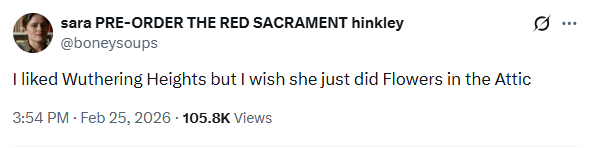
Before I got a chance to see Emerald Fennell’s recent “adaptation” “Wuthering Heights,” I stumbled across this social media post in the wild:
I had just recently completed my own most recent rewatch of 1987’s Flowers in the Attic, and I became fixated on this idea. I’ve been down the Flowers in the Attic rabbit hole more times than I’d care to remember, but at its core, I’ve always been fascinated by the connection between Emily Brontë’s and V.C. Andrews’s novels. I don’t know if there’s any academic discussion of this out there, but I have no doubt in my mind that Andrews drew inspiration from Wuthering Heights, from naming her protagonist “Cathy” to making the implied, sublimated incest of Heights (I’ve always subscribed to the theory that Heathcliff is Earnshaw’s bastard son, meaning he and Catherine are half-siblings) explicit and pervasive in Flowers in the Attic and its sequels.
When I did get around to seeing “Wuthering Heights,” my major criticism of it ended up being that it doesn’t need to, and in fact shouldn’t, be Wuthering Heights at all. The most interesting characters in that film are Alison Oliver’s Isabella and Hong Chau’s Nelly, and one could have done a Rosaline style film about the former or even gone full-tilt into the “Nelly is the villain” concept and made a Cruella style picture about the latter, and either one of them would have been infinitely more interesting than watching “Wuthering Heights” bash two sexy Australian Barbie dolls at each other while reenacting a half-remembered SparkNote. In essence, both Flowers in the Attic and “Wuthering Heights” are both unfaithful mutations of the same source material, which means that Fennell might actually be the perfect person to make a Flowers in the Attic adaptation. Right?
I don’t think so… however, I do think that she would be the ideal person to adapt the first follow-up novel, Petals on the Wind. It would be incorrect to say that Petals is an easier novel to read than Flowers. While it may eschew most of the more taboo elements that made Flowers so salacious, adult Cathy finds herself in just as dire straits in Petals, where she is constantly subject to sexual danger regardless of which of her husbands is exerting force over her. Based on the overall negative reaction to Fennell’s Promising Young Woman (which I didn’t share), I don’t think that she has the sensitivity needed to present Flowers. This is, after all, a director who looked at the same source text that Andrews did and, where Andrews saw both the tenderness and the danger of Heathcliff and Cathy together and the way that it would affect future generations, instead got horned up by imagining them getting off to voyeuristic observation of a couple of servants going at it in a barn. But also, don’t worry, in this version Cathy and Heathcliff definitely aren’t half-siblings, so don’t worry, it’s okay if you get aroused!
For those who are interested, Flowers in the Attic (the novel) doesn’t end in the same way that the ‘87 film does. The latter includes a hastily-shot death scene for Corrine Dollanganger after being confronted by her children during her wedding to Bart Winslow, her late father’s lawyer, as producers felt that the book’s ending, which occurs when the children simply escape the house after learning that their grandfather is dead and Bart and Corrine have been married for over a year. This big confrontation scene seems like it would be right up Fennell’s alley, and the equivalent scene, in which Cathy crashes the Winslow family’s Christmas party at Foxworth Hall to reveal to Corrine that she has (a) seduced Bart and (b) is pregnant by him, is the climax of Petals on the Wind. Of course, this is between her first marriage to an abusive narcissist and her second marriage to the doctor who fostered the children following their escape. Petals also borrows from Brontë, although it’s Charlotte this time, as Paul, the aforementioned doctor, initially pretends that his wife is dead before revealing that she’s actually in an institution, such that his initial overtures toward Cathy when she is of age are much like Rochester’s towards the title character in Jane Eyre. It’s all very, very messy, a true soap opera, and that’s the wheelhouse that Fennell would most bloom in if she took that opportunity.
Brandon has already written about Emerald Fennell’s “Wuthering Heights,” and although I was forewarned, my own love for the source material meant that, sooner or later, I was going to have to check this hot mess out for myself. And what a mess it is! Not as hot as one would expect, though, given that the director’s stated intention with this adaptation has been to recreate the horniness that she presumes is the universal experience of all first time readers. The thing about ”Wuthering Heights” is that the text I found myself thinking about most often while watching it wasn’t the novel itself or any of the prior adaptations, but Wicked: For Good. In writing about that film, I posited that its greatest flaw is also its greatest weakness: it only exists as a commercial product because of its connection to The Wonderful Wizard of Oz and its offshoots, sequels, and adaptations as a brand. The first half of the play (and the earlier film that adapted only that opening half) is allowed to find all sorts of fun things to explore within the “canon” of Oz, since the only thing it carries over is the necessity that, at some point, the Wicked Witch of the West and Glinda the Good Witch must eventually become enemies, in the public eye if not in reality. Everything else is fair game. In the second half of the play, which became For Good, every action exists in service of putting the characters from Wizard of Oz into the positions that they will be when Dorothy meets them upon her arrival in the fairy land, so characters march lock-step toward their places in the canon regardless of whether that works on a narrative, character, or even emotionally meaningful level. “Wuthering Heights” has the same problem. I’m not going to say it’s a bad movie because it’s a bad adaptation of Wuthering Heights, which it most certainly is, but it’s a bad movie because it’s an attempt at adapting Emily Brontë’s novel at all.
Widower Mr. Earnshaw (Martin Clunes), the tenant of farmhouse Wuthering Heights, returns home from the city with a young boy in tow, whom he “rescued” from a life of being abused by a drunken father so that he can come to the Heights and be abused by a drunken stranger instead. He gives the boy to his daughter, Cathy, who names the child “Heathcliff, after my dead brother,” and the two form a fast friendship. Also present in the household is Nelly, who as the bastard daughter of a lord is not entitled to recognition or shelter, but is welcome to act as the formal companion to Cathy; this relationship is challenged by Cathy’s burgeoning devotion to Heathcliff, who absorbs some of Earnshaw’s parental abuse. Some years later, Cathy (Margot Robbie) and Heathcliff (Jacob Elordi) watch as a procession of carriages deliver their new neighbors, The Lintons, to the manor of Thrushcross Grange. Cathy, who has been raised with no mother and is thus somewhat as wild and unmannered as her lowborn foster brother, sneaks up to spy on Edgar Linton (Shazad Latif) and his “ward” Isabella (Alison Oliver) and ends up injuring her ankle and being hosted at Thrushcross Grange for several weeks to recuperate. She returns to Wuthering Heights “quite the lady” and admits to Nelly (Hong Chau) that she has fallen in love with Linton and will marry him; she says aloud that she cannot marry Heathcliff because of their vast social class gap, and Nelly, knowing that Heathcliff has overheard this, keeps this information to herself. Linton and Catherine marry, Heathcliff leaves, Catherine becomes pregnant, and Heathcliff returns, at which point Catherine learns that Nelly allowed him to believe that Catherine didn’t love him. Heathcliff marries Isabella, but he and Catherine begin a brief, torrid affair that ends in tragedy.
If you’re familiar with the novel (or any of its more faithful adaptations, although there are surprisingly few), then that synopsis undoubtedly feels strange to you. It’s like Brontë’s in some ways; the character names are the same and some of the larger events from the novel are present. The exclusion of Hindley, Cathy’s brother and Heathcliff’s primary tormentor (and thus also his wife and child), is very jarring, as is the complete absence of Mrs. Earnshaw. Earnshaw family employee Joseph has also been aged down and cast with a handsome actor (Ewan Mitchell), eschewing the novel Joseph’s characterization as a religious zealot and instead giving him the chance to engage in kinky, largely unseen BDSM with one of the housemaids so that Heathcliff and Cathy can observe them surreptitiously in a way that sets both characters’ sexual imaginations ablaze. Most adaptations focus solely on the Cathy/Heathcliff story and leave out the entire plot about the second generation that constitutes the entire second half of Wuthering Heights, so its excision here isn’t surprising, but knowing that it doesn’t need to take that into consideration, “Wuthering Heights” decides to instead have Cathy not only die, but miscarry her child with Linton, since there’s no reason to have a living child if the story isn’t going to continue. I also can’t fault the film for choosing to narratively manifest the “Nelly is the villain” theory. Although I have personally never accepted that in my reading of the text, it has become the prevailing literary lens for the novel’s academic criticism since James Hafley first posited this thesis in 1958. (If you have JSTOR access, his essay can be found here; it’s a good read even if you, like I, remain unconvinced.)
If you’re not familiar with the novel, none of this may seem like it changes that much about the text, but I can assure you: it does. My distaste for the film could be said to be either (a) entirely predicated on, or (b) have nothing to do with my love of Wuthering Heights, by which I mean that I don’t particularly care that this is a bad adaptation of Wuthering Heights—in fact, the number of faithful adaptations is rare, and I prefer some of the less faithful adaptations over the more detail-oriented ones—I just don’t think this needed to be an adaptation of Wuthering Heights specifically. It almost feels as if Fennell responded to critics’ dismissal of Saltburnas a lesser Talented Mr. Ripley by deciding to take her Wuthering Heights-inspired erotic fiction and—in an inverse of E.L. James filing the serial numbers off of her Twilight fanfiction and publishing it as Fifty Shades of Grey—direct an adaptation of that and call it “Wuthering Heights.” I’m not frustrated with this movie as a fan of Brontë’s; I’m frustrated with it as a movie lover, the part of me that just wants to go to the movies and have a good time. Where this ties into Wicked: For Good is that like that film, “Wuthering Heights” goes awry in having to fall in line with the text that it is branded, meaning that the film is inexorably tied to the text from which it takes its name, when liberating it from that title would have allowed this to go in more interesting directions.
Robbie is very good as Cathy (Elordi is fine), but our two lead characters are so boring. In the film’s second act, we get to see some of the home life of Heathcliff and Isabella, and it’s the best stuff in the movie. Instead of being a victim of Heathcliff’s abuse, Isabella is all-in on his weird degradation play; she gets off on sending letters to Cathy and Nelly lying about how horrid Heathcliff is to her while also clearly enjoying being chained up and treated like a dog. We’ve already gotten a clear look into her bizarre psyche earlier in the film, in which we learn that she has an entire room devoted solely to her hair ribbons, and we get to see her create a fun murder scene in miniature by venting her frustrations at Cathy herself on the doll she made of the woman instead, with a dollhouse tableau that’s as funny as it is disturbing. While sitting in the theater, I couldn’t help but think about how much better a movie “Wuthering Heights” would be if it realized that its most interesting character was Isabella, and the movie had been made about her instead. I fantasized about the film taking a sudden turn into being about Heathcliff realizing that Isabella truly could match his freak and the two of them falling for each other. “Wuthering Heights” could never go in that direction because it’s called “Wuthering Heights,” rather than “[Untitled Emerald Fennell Sexy Gothic Romance starring Jacob Elordi].” The first time that we meet Isabella, she’s sitting in the garden and delivering an excruciatingly detailed recap of Romeo & Juliet to Linton. For a moment, I really was naive enough to think that Fennell was going to do something truly audacious, and that the mention of the play would draw attention to something crucial that Shakespeare’s play and Brontë’s novel share: they are decidedly tragic, non-romantic stories that the general public perceives as romantic. Alas, this was not to be the case, and the director’s much-vaunted “audacity” was once again constrained to the erotic consumption of another person’s bodily fluids (and occasionally egg yolks). Ho-hum.
Where Emerald Fennell does allow herself to get really freaky with things that she adds from outside the text are the moments where the film does actually shine. When she first arrives to live at Thrushcross Grange, Cathy is ushered into a room that Linton has prepared for her by having the place painted “the most beautiful color in the world, the color of [Cathy’s] flesh.” As we enter the room, it looks tasteful enough, but as the camera moves closer we get to see that Linton has had the decorators recreate not only her freckles but the light, almost imperceptible blue veins beneath. It’s delightfully grotesque. The film also occasionally goes for utter camp in a few fine moments, with the standout being the scene in which Mr. Earnshaw dies, surrounded by a physically impossible stack of empty wine and liquor bottles. The film also features very beautiful tableaux; there are several nearly-still chiaroscuro images of characters lit solely by the natural light streaming through a window, calling to mind Rembrandt’s Anna and the Blind Tobit or the Rembrandtian A Man seated reading at a Table in a Lofty Room. Evoking the imagery of Caspar David Friedrich’s Wanderer above the Sea of Fog is an easy go-to for Heathcliff’s return, but it’s also an effective choice. Visually, the film’s depiction of Thrushcross Grange having strong juxtapositions of white and blood-red are striking, even if the choice doesn’t seem to have a deeper meaning other than the most superficial symbolism. Any one of those things would have been a delight to see in [Untitled Emerald Fennell Sexy Gothic Romance starring Jacob Elordi], in which Fennell wouldn’t have felt the need to remain bound to “adapting” Wuthering Heights and instead been able to go full bore into the story she really wanted to tell. Instead, we have this disappointment.
Brandon forewarned me that he didn’t much care for Good Luck Have Fun Don’t Die, but based on what he related about the film, I had a feeling that I would enjoy it more than he did. For the entirety of the its darkly comedic first half, I barely went more than five minutes without a hearty chuckle. Around the midpoint, however, even though the film’s comedic tone remained largely the same, the laughs became fewer and farther between. Immediately after leaving the theater having watched the film, I texted Brandon to let him know that I had been let down by the fairly conventional (as much as that descriptor can apply here) second half, and we are very much aligned on what works and what doesn’t.
Good Luck opens with a purported time traveler (Sam Rockwell) arriving in a diner called Norm’s, where he informs the smartphone-addicted diners therein that he has arrived from the future to alter the upcoming AI quantum singularity — not by preventing its creation at the hands of a nine year old genius (as its genesis is supposedly inevitable) but by uploading a software patch that will result in the AI having a sense of ethics and benevolence. This is his 117th attempt to put right what once went wrong, as he is convinced that some combination of diners will result in the correct team to keep this apocalypse from kicking off. Using knowledge of the customers he’s gained in previous time loops, he gathers a small squad: ill-fated Boy Scout troop leader Bob, high school teachers Mark (Michael Peña) and Janet (Zazie Beetz), grieving mother Susan (Juno Temple), boisterous Uber driver Scott (Asim Chaudhry), and offbeat loner Ingrid (The White Lotus season two’s Haley Lu Richardson). Together, they have to make it out of the diner and across the city so that the future man can plug in a USB that will prevent the apocalypse, all while avoiding trigger-happy police, mask-wearing assailants wielding automatic weapons, and eventually, a chimeric monster made of cats.
Interspersed with this journey are the vignettes about the diners and their individual experiences with the various pieces of technology that will converge into our future overlord. While working as a substitute at the school where Janet is employed full time, Mark discovers that the students have become mindless automatons that—between verbalizing the occasional brand name—act as a horde at the direction of something within their phones. Susan loses her son in a school shooting but is presented with the opportunity to “resurrect” him, after a fashion. Ingrid suffers from a condition that makes her nose bleed in the presence of wireless signals, leaving her little opportunity to find gainful employment; for a time, she’s able to get by as a generic “princess” character for little girls’ birthday parties, but as the prevalence of children using smartphones increases, she finds even this avenue to be a dead end. Compounding things, her equally luddite boyfriend is eventually tempted to try on a set of VR goggles, which leads him to choosing to “transition” into the virtual world full time, leaving her completely alone. Finally, we also get to see what the time traveler’s life was like growing up, in a world in which half of the population lives “jacked in” to the AI’s perfect virtual world, while the other half has perished.
You’ll notice that the first two backstories sound bleak, and while they are, the darkness within them is played for some great satirical humor. Mark and Janet’s story is a zombie pastiche that plays out like David Tennant-era Doctor Who attempting to do a Black Mirror plot, and although its “phones make you stupid” concept comes off as a bit of intergenerational youth-bashing at first, the blasé treatment of a school shooting is just observational enough to punch through the discomfort of the situation. Susan’s story is much more heart-breaking, as she learns that her son has been gunned down in another “unpreventable” school shooting, but that he can “come back” in a cloned form that is mostly subsidized by the government since he was the victim of campus-based gun violence. He’s not the same, of course, and she reluctantly accepts the delivery of a shallow shadow of her child who occasionally recites ad copy about a low-calorie peach tea. It’s very grim stuff, but this is also the funniest part, as the tragedy is treated with the same casual shoulder-shrugging that mass shootings in America are given in reality, and all of the bits within it land: the salesman who can hardly disguise his annoyance at being given a “first timer” or his boredom as he tries to speedrun Susan through her customization options, the vapid disregard for the tragedy that other moms who have already replaced their children before display, and the couple who have clearly succumbed to madness after going through the process four times and decided to do a “goofy one” this time around. This is also the more straightforward Black Mirror… let’s say “homage,” as this essentially smashes together the plots of “Common People” and “Be Right Back,” but that doesn’t mean it’s not effective unto itself.
It’s here that the film takes a downward turn for me, as the flashbacks we get for both Ingrid and the man from the future are completely lacking in moments of levity, even of the extremely dark kind. Ingrid’s loss of the one person she thought she could trust, who was turned into an obedient slave to the machine after only the smallest temptation, isn’t fun to watch. It’s also where the film feels the most reactionary in a way that doesn’t necessarily fit with the rest of the film’s thesis. Ingrid’s boyfriend, after spending his days in the VR headset over the course of less than a week seems to become completely radicalized without any regard for how his lifestyle change affects his partner. She comes home one day to find him having prepared dinner for them, acting out of character, and it’s during this seeming return to their happy domesticity that he springs on her that he’s going to “transition,” which seems like a loaded term in this context. What he’s doing is essentially allowing himself to be voluntarily hooked into the nursing home equivalent of one of those goo vats from The Matrix and live the rest of his life in the perfected version of reality that the machine promises. If anything, he’s “uploading,” but the use of transition, in combination with other behaviors, feels like a regressive take. Perhaps this is best demonstrated in his frustration that Ingrid doesn’t understand the niche slang that he’s suddenly picked up from those people he’s meeting online, you know, the ones predatorily encouraging him to transition? It hews too close to right wing conspiracy signaling for me, and I didn’t like that.
As one would imagine, the future man’s childhood is the most bleak, and as a result, when the back half of the film has to try and maintain a sense of comedic balance with the first half, it has to push its jokes out of the vignettes and into the framing device of the group trying to divert the quantum singularity before the timer on the traveler’s wrist finishes its countdown. This narrative has been jokey throughout, but the bits within it vary wildly in their success. Sam Rockwell yelling at a diner full of people? Goes on too long before he starts to demonstrate his knowledge of people gathered from previous loops, but once that starts, the jokes start to land better. Convincing Bob to draw the fire of the assembled police force outside? Decent enough, but barely consequential. In the second half, this has to escalate, so instead we get some exposition about the programmer’s access to both 3D printing tech and (presumably) the cloning potential from the company that “resurrected” Susan’s son and so we get a kaiju made of memes that didn’t work for me at all. It did get a 50% approval rating in my screening, since my viewing companion and I were alone and he enjoyed it, so it may work for others. The final showdown goes on for just a little too long and is, as noted in the intro, a bit of a conventional place for this narrative to go (its few “twists” will surprise no one but children). Bizarrely, the film concludes open-endedly; it’s not exactly calling for a sequel, but it’s clear that the ending is written with greater importance placed on that possibility than the importance of a satisfactory conclusion. Given that the film had plenty of things to say but had already run out of them by the time it ended, I think an ending that was either optimistic or nihilistic would have been a wiser way to go, rather than an unambitiously ambiguous one. It’s a little overcooked, but the highs of the first half carry it across the finish line despite the lows of the second, and it averages out to be pretty good overall.
During a recent discussion with friends about the name of a book shop in our city and how we find it unwieldy and off-putting, one person in the group stated that if he ever opened a bookstore, he would call it “Flowers in the Attic.” I asked if he knew what Flowers in the Attic was about, and he admitted that he didn’t; he just liked the poetry of the phrase. To demonstrate why this would be, at best, a bad name for his future hypothetical business, I suggested that we watch the novel’s 1987 film adaptation, which (naturally) happened to be streaming on Tubi. [For those interested, the 2014 Lifetime adaptation of the novel is also on Tubi, but the service doesn’t seem to house the channel’s further adaptations of the three sequel novels for some reason.]
Cathy Dollanganger (Kristy Swanson) has the perfect life. The second eldest of the Dollanganger kids, a couple of years younger than older brother Christopher Jr. (Jeb Stuart Adams) and a half decade older than twins Cory and Carrie, she is doted upon most by her beloved father, Christopher Sr., a fact that her mother Corrine (Victoria Tennant) takes note of. On his thirty-sixth birthday, Chris Sr. dies in a car accident, and as the family’s savings dwindle and they lose their home, Corrine packs the family up and takes them to the home of her parents, known in this film only as “the grandmother” and “the grandfather.” Grandmother (Louise Fletcher) is a harsh and cruel woman who wastes no time laying down the house rules and her interpretation of religious doctrines, which are, to her, one and the same. Some of them are reasonable, like ensuring that the boys share one bed while the girls share the other, while others, like that the children are to be silent at all times, are more authoritarian. Corrine explains to her children that Grandfather is very old, and Corinne must keep the kids’ existence hidden from them until she “wins back [her] father’s love,” and that once she has, he’ll recant his previous disinheriting of her and the family will once again be financially secure.
Of course, the most famous thing about Flowers in the Attic is that it’s a novel that deals with the taboo subject of incest. Notably, Cathy and the others have to be kept secret from Grandfather because they are the product of an incestuous relationship between their Corinne and Chris Sr. (Later books would overcomplicate this genealogy but Chris Sr. is stated to be the much younger half-brother of the Grandfather, making him Corinne’s half uncle.) This is also the stated reason that Grandmother is so monstrous to her own grandchildren, as she considers them abominations, despite their innocence. The 1979 novel on which the film was based, written by author V.C. Andrews, was derided upon publication for being utterly deranged but nonetheless proved to be shockingly popular, enough to warrant a few sequels during her lifetime (and some after that, but we won’t get into it). I read it years before I was even aware that there had been a film adaptation, and with that in mind, although this movie is difficult to defend from an objective standpoint, it’s the best way to enjoy this story with as little disgust as possible. Although the previous generation’s incest is kept intact as the inciting reason for the Dollanganger kids to be locked away in the attic, the film cuts out the relationship that develops between Cathy and Chris as the two enter puberty in complete isolation, which could be argued to both undercut the darkness of the narrative and make the more “young adult novel” elements of the original story blossom, no pun intended. It’s ultimately more toothless, but also more palatable.
Flowers in the Attic is by no means a good movie, but it’s one that I can’t help but watch any time I’m presented the opportunity. Fletcher isn’t asked to do much here but retread the same beats that netted her Oscar win for One Flew Over the Cuckoo’s Nest, and the film is wise to keep her out of frame with the child actors, who are universally dreadful. Swanson went on to have something of a career, albeit a brief one, but Adams appears to have mostly disappeared following Flowers, and the film world did not mourn his absence. He’s stilted, wooden, and clearly far too adult to convincingly portray a teenaged boy capable of being overpowered by Grandmother. Tennant’s portrayal is a mixed bag, as I think she subtly underplays Corinne’s financial panic and understandable horror at returning to Foxworth Hall but goes too broad later. I could almost buy that she is resentful of what she perceives as a lack of gratitude for her sacrifice on the part of her children, the film makes no time for her to have a meaningful aside glance, deep in troubled thought, as she reaps the benefits of her family wealth while her children grow emaciated and pale from lack of sunlight and exercise. There’s no evolution from the Corinne who genuinely loves her children but can’t provide for them and thus must accept a literal whipping from her parents in order to return home to the Corinne who coldly tells the remaining children that Cory has died in the hospital. It’s really on Fletcher to carry the whole thing, performance-wise, and she manages to make it work despite a role that she probably could have sleepwalked through.
I’ve never been able to put my finger on why this film has had such staying power in my mind, and it might simply be that this is a weird tonal and narrative mish-mash. Wikipedia suggests that it could be considered part of the psycho-biddy genre, but the story mostly involves juvenile fiction elements in the form of its fantasy about adolescent self-sufficiency and competence as Chris and Cathy come to act as surrogate parents to the younger two. The novel is often considered to be a gothic text, which is fascinating to me as it clearly does align with the kinds of plots one would find in most European (specifically English) gothic stories—the old dark house, the unwanted relatives in the attic, subordinated passions, etc.—but Andrews was an American writer. American gothic lit usually eschews those elements, trading castles for caves and replacing the metaphorical representations of the horrors of the old world with the existential terror of the “wilderness” of the Western Hemisphere. Andrews’s novel, for better or worse, is probably the primary example of an American writer, specifically a Southern American writer, crafting a European style gothic story set in the American south. The first time I saw this film was when I was in grad school, broadcast over a local New Orleans affiliate that I could pick up with my rabbit ear antenna, and I was deep in the study of American gothic literature at the time—as my intended capstone thesis was originally going to be about the influence of Calvinism on the gothic traditions of the U.S.—so that’s probably why it got so solidly lodged in my mind.
What’s fascinating about Andrews’s work is the fact that, deranged though the material itself may be, the author had a very distinct prose style. This was a trashy but popular novel that was adapted into a trashy and mostly forgotten movie, but when one thinks about contemporary literary output that would fall under the same subgenre now, the difference in actual literary quality is staggering. For all of its many, many faults, Flowers in the Attic isn’t slop. I say this as someone who is in the process of editing one of his own novel manuscripts right now, and I’ll freely admit that my own prose is not as good as Andrews’s. That carries over into the film adaptation as well. This is clearly a very cheaply made film ($3.5M) that spent most of its money on sets and (one hopes) Louise Fletcher, but even for mass-produced schlock of the late eighties, it still functions on a higher technical level than some theatrical releases I’ve seen in recent years, and it’s also fully committed to its bizarrely melodramatic tone. The periodic slow-motion shots of Grandmother unveiling the leather whip as she prepares to beat her daughter while Grandfather watches or her brushing Cathy’s treasured ballerina music box to the floor to shatter into dozens of pieces manage to somehow be both campy and utterly sincere, which is probably why it’s gone on to be a cult classic. That it never deviates from that tone even when Swanson is wearing perhaps the worst wig in the history of cinema is a testament to its staying power.
We love Park Chan-Wook around here. We recently discussed Oldboy on the Lagniappe Podcast (and Stoker years before), there was strong support for No Other Choice around here last year (it ended up in the number eight spot for our collective top ten of 2025), and I was personally very fond of both Decision to Leave and Lady Vengeance. It seemed to me that his thrillers generally have more cultural penetration in the west than his comedies, and I was finally able to track down a copy of I’m a Cyborg, But That’s OK, his 2006 romcom via my library. Alas, it is with a heavy heart that I report that I didn’t care for it.
Young-goon (Im Soo-Jung) is a young woman working in a factory building transistor radios, when one day the instructions on the overhead loudspeaker tell her to slash open her wrist and insert connecting cords under her skin. Following what is presumed to be a suicide attempt, Young-goon’s mother admits to the psychiatric facility’s doctors that her own mother (Young-goon’s grandmother) had been admitted to a sanatorium in later years, after decades of her own delusions, including that she was actually a mouse. Before leaving Young-goon at the hospital, her mother advises her not to admit to anyone that she believes that she is a cyborg. On her first day, the seemingly catatonic Young-goon is observed by Il-soon (Rain, credited here as Jung Ji-hoon rather than under his stage name), a boy who is serving time after being diagnosed as an anti-social kleptomaniac, as Young-goon climbs out of bed after everyone else is asleep and puts in her grandmother’s dentures, seemingly in order to commune with the various machines around the facility.
Il-soon’s supposed thievery around the hospital seems to revolve around other patients’ delusions that he is stealing some part of their essence, and he goes along with these ideas by pretending to “transfer” various neuroses between them. These stolen possessions are as ephemeral as one patient’s ability to play ping-pong or another’s neurotic “courtly behavior” of only walking backward. Within her own psychologically unwell self-storytelling, Young-goon believes that she must overcome the seven deadly sins for cyborgs, which include expressing gratitude, daydreaming, and having sympathy. She asks Il-soon to steal this from her, and he’s romantically fascinated enough with her that he attempts to work within the schema of her madness to try and nurse her back to health. Namely, Young-goon has been allowing another patient to eat all of her food because she believes that she gets all the energy that she needs from holding batteries, but knows that if she’s noticed not taking food during meal times, she’ll be forcefed, and if she stops eating altogether, she’s in for shock treatment.
This movie comes at an important inflection point in Park’s filmography, coming right on the heels of his “Vengeance Trilogy” and before he experimented with more standard horror forms (2009’s vampire horror Thirst) and working in English (directing the aforementioned Stoker and producing Bong Joon-Ho’s Snowpiercer, both in 2013). Bracketing Cyborg on both sides are films that Park wrote but did not direct: Boy Goes to Heaven, a fantasy romcom, in 2005, and 2008’s Cush and Blush, which is a more straightforward comedy but with clear romance elements. The Vengeance Trilogy is a set of dark, miserable films, and if I spent years of my life making them I would want to lighten up a little bit with my creative output for a while too, if for no other reason than to get the taste out of my mouth. Unfortunately, I’m a Cyborg, But That’s OK doesn’t work much as a romance (the tagline “She’s crazy; he’s crazy about her” is as accurate as it is awful) and the comedic elements mostly fail to land as well, since so much of it is dependent upon the viewer laughing at people with sufficiently severe mental illnesses to warrant medical intervention.
One of the patients is a consummate liar, a pathological “mythomaniac,” whose constructed narratives are there to replace the memories that she’s lost as a result of application of ECT “therapy.” Another patient lives an entire life within a compact mirror in which she imagines herself as one of the von Trapp children, while the same overweight patient who eats all of Young-goon’s food believes that she is capable of flight by rubbing together two socks of her own creation that repel her from the ground via static electricity (the script is much meaner about her weight than it is about her madness). All of this becomes important because Il-soon is able to weave together all of their counter-factual beliefs into a series of stories that, theoretically, will draw Young-goon out of her own delirium. This doesn’t work, although it does reach a decent ending when Il-soon refashions his sole beloved possession into a “device” that will allow Young-goon’s cyborg form to allow her to convert food into energy instead, including a cute scene in which he pretends to put the mechanism into her back. Despite feeling like the natural conclusion to the story, the film goes on for another fifteen minutes of nonsense that doesn’t make the whole any more complete or enjoyable.
As a fan of this director, I reached what felt like the halfway point of the film’s total runtime and was ready for it to deliver a big midpoint twist that would make everything prior to this point fall into place, but this was not to be the case. The two of them don’t escape from the psych hospital and find that their reality is as malleable as they believe it to be, nor is it revealed that all of these seemingly goofy hijinx surrounding our characters is reflective of a darker objective reality outside of either of their perceptions. There is a moment where it seems like the movie is going to really break out of the box and go in an interesting direction, as Young-goon’s “battery” reaches its full charge and she starts laying down automatic weapons fire out of every fingertip, massacring the staff of the place (whom she associates with the sanatorium employees to whom her grandmother was remanded). This proves to be another fantasy sequence, however, as Young-goon then faints from starvation and the forced feeding begins in earnest.
It’s only in these fantasy fugues that Park really shows off his distinct style. So much of the film is shot in the sterile confines of the asylum that the breaks from reality feel like a breath of fresh air. The girl with the Sound of Music obsession who is only ever seen with her back to the camera and observing the world through her reflection allows for some impressive transitional trickery as it zooms in and out of her mirror, which is fun. Overall, however, this misses the mark for me, and it isn’t one that I would recommend.