Remember when 90s action movies like Hard Target & Rumble in the Bronx would import Hong Kong martial arts filmmaking sensibilities to American cities like New Orleans & NYC (or, at least, Toronto cosplaying as NYC)? The new Italo crime thriller The Forbidden City plays like a nostalgic throwback to that cross-cultural moment, except it’s set in Rome and takes its duties as a mafia melodrama just as seriously as its elaborate fight sequences. Stunt performer Yaxi Liu stuns in her first lead role, playing a Chinese martial artist on an international revenge mission to retrieve her lost sister, whom she suspects has been sold into sexual slavery in Roman brothels. Enrico Borello co-leads as a dopey local, whose Italian heritage is so important to his characterization that he literally makes pasta all day in a restaurant indebted to mobsters. The physical proximity of that restaurant to the Chinese brothel down the street proves to be important to the two leads’ shaky connection, as the chef’s father and the fighter’s sister were violently “disappeared” by the same violent thugs. They team up to get their dual revenge, combining their respective skills for bone-crunching violence and mouth-watering cuisine to take down the older, corrupt men who have broken up their families. And maybe, just maybe, they find love along the way.
The funny thing about this particular action-drama mashup is that its two genres mix like oil & water. Its dual modes as a Chinese martial arts revenger and an Italo family drama remain entirely separate, with their own beginning & ending. We start in China, detailing how the nation’s recent-history One Child Policy could make children invisible to the system and, thus, vulnerable to human trafficking. In that grimy storyline, every Roman backroom is a potential sex-traffic hotspot, including the upstairs portion of family restaurants where customers dine totally unaware of the crimes being committed above their heads. Yaxi Liu’s wronged woman makes quick work of punishing the ghouls who run those backroom brothels, relentlessly beating the life out of them with whatever makeshift weapons she can reach for on-site: knitting needles, Compact Discs, slabs of beef, dead fish, flowers, whatever. When she makes an uneasy connection the pasta chef down the street, she finds there are other skills that can be used to bring powerful men to their knees, such as Catholic guilt and a well-cooked meal. Both combatants find their own satisfaction in their dual revenge mission through two separate endings with their own respective Big Bads. Their stories only meaningfully intertwine in an unexpected romance plot, which feels semi-incestuous by the time you realize their missing relatives also indulged a romantic fling of their own, which is why they’re missing in the first place.
Director Gabriele Mainetti previously made a name for himself as an off-kilter genre masher in 2021’s Freaks vs. The Reich, which combined the superhero team-up picture with the vintage sideshow horrors of Todd Browning’s Freaks. Here, he hits all of the exact genre markers you’d want to see in both of his oil-and-water ingredients. The action set pieces feature some of the most elaborate & legible fight choreography around today, and the Old-World setting makes the whole thing feel surprisingly romantic despite its frequent bursts of violence. It’s impossible not to swoon at the gallery-style nocturnal lighting of ancient Roman architecture, so much so that you frequently forget just how sordid & absurd the details of the central romance are in context. If the doomed lovers’ clashing cultures are convincingly explored in any way, it’s through the assessment of a villainous gangster who muses that in Rome, “Nothing is important, and everything is permitted,” while in China the exact opposite is true: “Everything is important, and nothing is permitted.” Within that framework, emigration to Rome is both a liberating lifesaver and a soul-corrupting death sentence, which proves true in the fates of its characters’ families and fellow immigrant communities. The emotional impact of its interpersonal character drama never hits as hard as the sequences of Yaxi Liu throwing punches & kicks at Dutch angles, but Mainetti appears to be displaying his heart on his sleave throughout, and his dramatic sincerity is just as charming as it is quintessentially Italian.
2004’s Kill Bill: Vol. 1 was the first—and to this day—only movie I’ve ever watched on a bootlegged camrip. I was a senior in high school at the time, and there was something still novel about torrenting a movie online before it was officially released in theaters, no matter the quality. A friend smuggled a copy of the movie on two CD-Rs into our high school art class, where we cheered & squealed over Quentin Tarantino’s newly achieved levels of cartoonish bloodshed & overwritten dialogue. I’m sure I also saw the movie in theaters that same week, but I don’t remember that experience. I do remember Kill Bill: Volumes 1 & 2 being in constant rotation as second-hand Blockbuster liquidation DVDs during my college years though, casually thrown on the living room TV when no one’s sure what to watch (the same way Boomers in no particular mood end up listening to the Beatles as an automatic default). Vol. 1 was always The Fun One, Vol. 2 was always The Boring One, and they were always buried behind a layer of standard-definition fuzz and only half-paid attention to, like animated dorm room wallpaper. So, twenty years later, I might have just experienced The Kill Bill Saga the way it was meant to be seen for the very first time, despite having been in the same room with “Tarantino’s 4th Film” untold dozens of times. Only, not exactly.
The Whole Bloody Affair is a new, seemingly finalized edit of the two Kill Bill movies, now smashed together to create one monstrously ginormous butt-number. Tarantino has been casually playing around with this project since 2006, undoing the Weinsteins’ work of splitting his mid-career epic into two separate parts by occasionally trotting out this one-long-cut version into prestigious venues like the Cannes Film Festival and his own vanity movie theater The New Beverly Cinema. The original uptown location of The Prytania recently secured a 70mm print of the film and has been running it on loop for the past few weeks, giving its local New Orleans rollout a prestigious feel it wasn’t afforded when DCPs were screening out at the Metairie AMC Palaces last December. So, it’s funny that I still left the theater feeling like I’ve only seen Kill Bill in a compromised, mucked up form. It seems that in Tarantino’s current, meaningless pursuit to land the “Perfect Ten” filmography, he’s gotten distracted by some George Lucas-style tinkering with the original texts. I’m willing to forgive the new silly title cards underlining that both halves of this picture technically count as “The 4th Film” in the Tarantino oeuvre, since the original project was split into two parts by meddling producers. Still, though, I’m skeptical that his original intention was to make a 5-hour movie with a Fortnite cutscene epilogue (“Yuki’s Revenge”), which is what The Whole Bloody Affair ultimately amounts to. I’m also unsure why he felt the need to extend the original films’ anime segment with newly commissioned footage, other than that no one is around to tell him “No” anymore because his most looming collaborator is currently, rightfully imprisoned. All of the newly printed material inserted into the Kill Bills of old are a waste of time & resources, but if putting up with those distractions is what it takes to revisit these films on celluloid with a savvy crowd I’m willing to go along with this fussy nerd’s legacy-curation bullshit just a little bit. At least he didn’t retroactively add a CGI Bruce Lee into the picture, Jabba the Hutt style.
Just as Kill Bill has changed over the years (through newly added animation, alternate takes, and a self-imposed intermission), so have I. It’s difficult to say anything about how this project’s place in the larger cultural zeitgeist has shifted, since it’s been so long since I’ve engaged with it and, more importantly, I’m no longer a teenager. I hadn’t personally seen much anime, wuxia, or kung-fu cinema when Kill Bill first came out, so the film’s stylistic flourishes are no longer as impressive to me now having seen The Original Texts like Lady Snowblood or The 36th Chamber of Shaolin. Like all Tarantino pictures to date, there’s nothing in Kill Bill that represents the best of any genre he liberally borrows from, but he has admittedly remixed them all into something undeniably entertaining & cool — like a video store DJ. Allow me, then, to play overly-opinionated video store clerk for a moment myself and talk about where this outing ranks in Tarantino’s filmography. Kill Bill: Vol. 1 has always been Jackie Brown‘s strongest competition for the best of his best, and the newly restored cartoonish violence of the Crazy 88s fight sequence (previously censored for MPAA approval) only strengthens that case. It succeeds through the same method that Jackie Brown does, by employing real-life participants from the vintage genres he’s riffing on: Blaxploitation superstar Pam Grier & Hong Kong fight choreographer Yuen Woo-ping, respectively. If The Whole Bloody Affair does Kill Bill any favors in the greater Tarantino rankings, it does so by elevating Vol. II, integrating it more smoothly with its better half by dropping the “Until next time …” teaser that once divided them. And yet, the newly, needlessly extended anime sequence drags the first half down a little, so who knows (or cares). Everything else that’s changed about these movies is a jumbled mix of passing time and personal maturity. The choppy bangs, flip phones, and low-rise jeans scattered throughout the revenge epic have marked the passing of time since it first premiered in the early aughts, when all those props & fashion accessories felt as natural as oxygen. I’ve also found a new appreciation for Lucy Liu’s performance as the unlikely assassin turned yakuza figurehead O-Ren Ishii, with her Big Speech about her gender & heritage bringing unexpected tears to my eyes through sheer fierceness. I’m sure that in 2004 I was just happy to watch her decapitate an underling in the following seconds. It was a simpler time; I was a simpler man.
You will find no plot summary here, as I’m already embarrassed to have added this much text to the server space reserved for discussing Tarantino’s filmography. All I can muster the energy for is observations about how the passage of time can dull or distort a movie that means a lot to you when you’re a teenager. For instance, it’s much easier to be dazzled by a live-action Hollywood film indulging a brief diversion into anime when you’re not as hyper aware that there’s much better anime out there; extending that sequence with five additional minutes of footage doesn’t help either. It’s also much easier to enjoy Tarantino’s work in a vacuum without decades of hearing him say things that range from idiotically petty (taking out-of-nowhere potshots at Paul Dano as “the worst actor in SAG”) to outright evil (showing support to IDF soldiers during the ongoing genocide in Gaza). Even if you want to engage with the movies themselves and ignore the man behind them, he’s now stuck in a navel-gazing thought loop that makes the task impossible. Tarantino is currently terrified of directing another feature film because he might mess up his self-assigned “Perfect Ten” filmography, so he’s turned himself into a lowly film podcaster instead, and his niche topic of discussion is his own work. It’s shameful. There are two unqualified positive things I can say about Kill Bill: The Whole Bloody Affair: 1. Its theatrical release is the only good thing to have come out of Tarantino’s current self-analysis era, and 2. It was smart of him to bury his newly commissioned Fortnite animation sequence after the 20 minutes of end credits, where few people are likely to see it. Otherwise, everything that I like about The Whole Bloody Affair I already liked about Kill Bill Vol. 1 and Kill Bill Vol. 2: two solidly, separately entertaining pieces of post-modern pop art from one of Hollywood’s sweatiest loudmouth bozos.
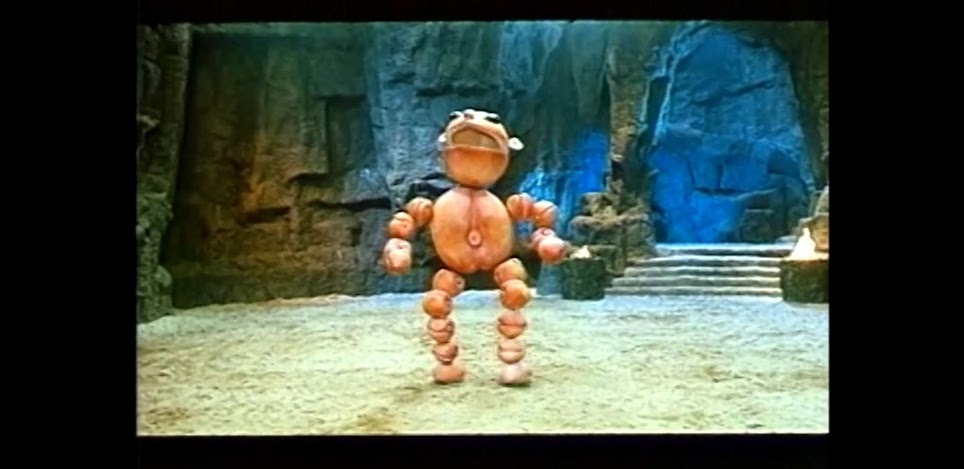
Although our discussion of The Maidens of Heavenly Mountains included ongoing discourse about whether the film was comprehensible, I have yet to be completely disappointed by any of the Wuxia films that was shared with the Swampflix crew by one of our listeners last year. I was excited to get back into the thick of it after lovingBuddha’s Palm, and among the movie files I had downloaded to my phone to watch if I got bored while traveling was what I assumed was another Wuxia parody like Buddha’s Palm, titled Child of Peach. Upon completion, I can say that it almost certainly was, as it contains this image:
However, unlike Buddha’s Palm, this movie is awful.
Child of Peach is based on the story of Momotarō, a Japanese folk hero. The linked Wikipedia article gives a more detailed description, but the bare bones stations of the Momotarō canon are as follows . . . A boy is born from a giant peach found floating in a river by an elderly childless couple (in older versions the peach rejuvenates them to a younger age and they conceive of Momotarō more conventionally); he demonstrates essentially superhuman strength at a very early age; he leaves his parents in order to battle demonic Oni who are marauding the lands; and along the way he befriends a talking dog, monkey, and pheasant who join him in his quest to ultimately defeat the demons of Onigashimi, the demon island. This film adheres pretty closely to that schematic, adding in some additional villains, a backstory for our main character, some army shenanigans, and far, far too many puerile bathroom humor gags about piss.
The film opens as every Wuxia film I’ve seen so far has, atop a misty mountaintop, where a master martial artist and his wife are raising their infant son while protecting the Sword of the Sun, attended by the master’s young apprentices who can shapeshift into the animal companions of the Momotarō legend. Here, their names are translated as Tiny-Dog, Tiny-Monkey and, um, “Tiny-Cock.” The mountaintop is invaded by an Oni whose name is translated as King Devil, who slays the couple, but not before the wife beseeches the giant magic peach that is the centerpiece of their cave home to save her child, which it does by taking the baby within itself and flying off of the mountain like a pod out of Krypton. The young animorphs are exiled from the mountain as well as King Demon emerges victorious. Below, an elderly couple argues “humorously” with one another before the wife goes to the river to wash clothes. The giant peach floats by and she gets into some tiresome slapstick shenanigans while trying to capture it. When she does, she plans to eat the peach, only to discover a human(?) child within. Also, before she does so, the big peach urinates on her from its peach crack. Comedy!
“Peach Kid,” as the subtitles refer to him, grows up quickly due to interference from a magic fairy who also used to reside on the mountain of the Sword of the Sun, as she is aware that King Devil has gone to the underworld and resurrected some evil warriors, and his hordes start to ravage the land. A local known as the Melon Knight holds a contest to gather together a group of warriors to fight off King Devil and his goofy minions, with one such event involving the wrestling of a bull. Peach Kid, now a magically aged adult (and very clearly played by a woman, Hsiao-Lao Lin), has already demonstrated super breath when an attempt to stoke the stove fire in his adopted parents’ home results in him blowing the thing apart and whom we have also already seen splitting firewood in half with his bare hands like Captain America in Age of Ultron, manages to flip the animal completely. The soldiers laugh him off, and his animal friends help him get revenge on Melon Knight and his vizier by peeing in their sake. Comedy!
Eventually, all of this comes to a head. Peach Kid and his animal buddies form into a peach-themed Voltron kind of thing (as seen above) and defeat King Devil and all is right in the land.
I really wanted to like this one, and went into it with the expectation that, even if it weren’t great, there would at least be some cool wizard fights, but it barely has any of that. A few of the lieutenant Oni have some cool things going for them; one has a big bag of mystical wind that he can use in fights to blow his opponents backwards, and “Granny” has a staff that shoots a stream of fire, but that’s really all that there is to speak of. It’s also worth noting that the version I saw referred to the windbag Oni as “Aeolus,” whom you may remember from The Odyssey as the god of the wind. I’m not sure that this allusion to Greek mythology is present in the original text, but I did fail to mention earlier that the mountain on which Peach Kid is first born is referred to in the subtitled dialogue as “Olympus.” I can’t tell if that’s just thematic naming on the part of the translator, but I would assume so. There’s very little information about this film online (in English, anyway), and the IMDb translations of the characters names make a lot more sense that what was present in the version I saw. I’ll also admit that the copy I saw had some of the worst subtitle quality control that I have ever seen, as there were large swathes of the dialogue that were rendered completely illegible by their placement on white portions of the screen. I may have understood the film better if a little more care had been put into it, but I don’t think that I would have liked it more. This was intended to be enjoyed only by children, as the preponderance of scat humor and lack of any comedy that would appeal to a more mature audience make clear. If you’re working your way through the Wuxia canon, skip this one.
Golden Harvest’s 1988 rape revenge thriller Her Vengeance is reportedly a remake of fellow Hong Kong exploitation flick Kiss of Death, released by the rival Shaw Brothers studio in 1974. However, sometime between those two productions the most notorious American landmark of the genre, I Spit on Your Grave, left its permanent mark on the rape revenge template, so citing its primary influence becomes a little muddled. Her Vengeance does adhere to the exact plot structure of Kiss of Death, following the training-and-payback saga of a sexually assaulted woman who learns her martial arts skills from a physically disabled wheelchair user before getting her titular vengeance. Something about the continued violation of that initial assault following her well after the inciting incident screams I Spit on Your Grave to me, though. The frustrating, traumatizing thing about I Spit on Your Grave is that its vengeful antiheroine is assaulted multiple times before she flips the power dynamic of the film’s violence, restarting the 1st-act violation several times over without letting the audience move on to something less vile. In Her Vengeance, the initial assault continues in less literal ways, but persists nonetheless. Our assaulted antiheroine contracts gonorrhea, which exponentially worsens even as she trains her body for combat. She reveals her assault to her blind sister (and, by extension to the audience) by explaining that the gang who jumped her were also the same five scumbags who killed their father and left both the sister and the sister’s fiancée physically disabled. Then, her vengeful warpath accidentally puts the last few living people she cares about in their own mortal danger as innocent bystanders, so that she’s repeatedly traumatized every time the gang goes tit-for-tat with her assassinations. It’s relentlessly, exhaustingly bleak.
Thankfully, the dependably entertaining director Lam Nai-Chou lightens up the mood where he can, bringing some of the cartoonish hijinks from his better-known classics The Seventh Curse & Riki-Oh to a genre not typically known for its goofball amusements. As nightmarishly vicious as the gangsters are in every scene, they do initiate an armored truck heist by sticking a banana in the tailpipe, a classic gag. Frequent Sammo Hung collaborator Lam Ching-ying performs most of the more outlandish antics as our heroine’s wheelchair-using martial arts trainer, using his chair as a weapon and a constant inspiration for over-the-top stunts. Seemingly overwhelmed by the pure evil emanating from the worst of the surviving gangsters, he also rigs his nightclub with lethal boobytraps for a spectacularly violent climax, like a Home Alone precursor for convicted murderers. These outrageous “Triad Spring Cleaning” sequences are especially fun to watch due to the film’s Category III rating, which allows it to indulge in the most grotesque practical gore details imaginable. That freedom to indulge cuts both ways, though, making for an excruciating first-act assault as the gang members take turns abusing our antiheroine in a graveyard nightscape. Lam mercifully does not fixate on actor Pauline Wong Siu-Fung’s naked, abused body during that sequence, which helps diffuse any potential dirtbag eroticism seen elsewhere in this disreputable genre. Instead, he catalogs the cartoonishly evil Dick-Tracy-villain faces of her attackers, each with names like Salty, Long Legs, and Rooster. He also finds some sly humor in her eventual revenge on those C.H.U.D.s, having her cut off one of their ears with a pair of scissors, then later featuring a Vincent Van Gogh portrait as a background detail. Her Vengeance is not the Steel & Lace-level absurd escalation of the rape revenge template you’d expect from the director of The Seventh Curse, but Lam still finds a few occasions to have his usual fun, so it’s not a total dirge.
Curiously, the recent Vinegar Syndrome release includes a longer-running alternate Category IIB cut of the film that averts its lens from some of the more violent details but adds in additional scenes of dramatic context that overcorrects their lost length. Apparently, Golden Harvest produced five different cuts of the film in total, mostly as a preemptive measure to avoid its inevitable censorship by the Hong Kong government. If I were a more diligent cinema scholar I might’ve watched the IIB cut of the film for comparison’s sake before writing this review, or revisited I Spit on Your Grave, or sought out Kiss of Death. Since this is such a deeply, deliberately unpleasant genre, however, I can’t imagine wanting to suffer through this story a second time, no matter how softened or warped. The only reason I watched Her Vengeance in the first place is because it was packaged with my recent purchase of fellow Category III grotesquerie Devil Fetus, and I had some light familiarity with the director’s name. I do not regret the discomfort at all. Pauline Wong Siu-Fung gives a heartbreaking performance as a sweetheart nightclub employee who’s embittered & radicalized by her Triad gang-assault, emerging as a vicious killer herself on the other side. Lam Ching-ying makes spectacular use of his wheelchair prop, delivering some of the coolest, most badass disability representation I’ve ever seen in a martial arts film. Lam Nai-Chou crafts some memorably bizarre action-cinema payoffs typical to his most eccentric works. Still, I don’t think I’ll be making this particular journey into rape-revenge Hell again anytime soon. Once was plenty, thank you. I’ll stick to the relatively wholesome safety of Devil Fetus until these psychic wounds have healed.
For this lagniappe episode of The Swampflix Podcast, Boomer & Brandon discuss the Shaw Brothers’ laser-wizards martial arts actioner Buddha’s Palm (1982).
I’m generally positive on the current state of film culture, at least on the audience end. Thanks to organizational hubs like Letterboxd, Discord, and the podcast circuit, it’s easier to find a wider cultural discussion on the niche cinematic artifacts I care about now than ever before in my lifetime, which leaves a lot of room for sharing & discovery outside the traditional print-media forum. Growing up, my familiarity with movie titles was determined by video store curation and magazine articles, but now there’s an infinite supply of Movie Discourse to delve into in all directions, if you care to look. It’s a blessing in terms of expanding the public library of accessible titles, but it can also be a little exhausting when it comes to those films’ analysis. Pinpointing what every movie is really “about” (i.e. Grief, Trauma, Depression, Isolation, etc.) gets to be a little tiresome over time, since it feels more like solving a literary puzzle than indulging in the art of the moving image on its own terms. Every modern film discussion tends to boil down to deciphering metaphor or interpreting the career-span mission statement of an auteur. As a civilian with a movie blog, I’m among the guiltiest participants in that constant ritual, and I genuinely don’t know how to stop compounding the problem with my own inane analysis of every movie I watch. How else could I justify logging all this stuff on Letterboxd?
The shot-on-video martial arts cheapie Furious is a huge relief in that modern context. A subprofessional, no-budget production from wannabe Hollywood stuntmen before they worked their way into the industry proper, it’s the exact kind of vintage cinematic artifact you never would have encountered in the wild unless it happened to be stocked at your specific neighborhood video store. Now, it’s accessible for streaming on several free-without-subscription platforms, backed by thousands of glowing Letterboxd reviews highlighting it as an overlooked gem. Better yet, it’s a film that sidesteps the need for any concrete analysis, since its story was obviously figured out in real time during its month-long shoot, purpose or meaning be damned. It’s all supernatural martial-arts nonsense that’s so light on plot & dialogue and so heavy on for-their-own-sake magic tricks that it plays less like a metaphorical puzzle to solve than it is a meandering dream dubbed direct to VHS. Sleight-of-hand card tricks and droning synths pull the audience into the opening credits with a chintzy sense of mystery, followed by 70 minutes of incoherent action adventure across the cliffs and rooftops of sunny California, with no particular destination in mind. Furious is much more concerned with convincing you that its stuntmen are jumping to their deaths from great heights or that its evil sorcerers are casting actual magic spells than it is concerned with filmic abstraction or metaphor. It’s illusion without allusion, the perfect salve for modern film discourse.
In the opening sequence, a nameless warrior fights off attackers through some very careful cliffside choreo while attempting to operate what appears to be a magic tusk, as it spins like a compass. It’s unclear where that compass is meant to lead her, since she’s soon overcome by combatant goons, who then bring the magic tusk to a sorcerer who runs a karate dojo out of a nearby 80s office building. The fallen warrior’s brother leaves his own mountainside dojo to investigate and avenge his sister’s death, which throws him into the middle of a wide conspiracy involving wizards and, possibly, aliens. Really, he just punches & kicks his way through a series of fights until he works his way up to the Big Bad, occasionally stopping to gawk at screen-illusion magic tricks, like the Big Bad’s ability to levitate or the main henchman’s ability to shoot live chickens out of his hands like bullets. Nothing about Furious makes much linear, narrative sense, but its curio collection of spinning tusks, severed heads, flaming skeletons, and so, so many chickens has its own distinct sense of magic to it. Our hero’s loopy revenge mission recalls the SOV surrealism of Tina Krause’s Limbo – Lynchian in the sense that they’re better enjoyed at face value than they are as 1:1 metaphors that can be unlocked through critical interpretation. Furious just happens to feature more punching, kicking, and stunt falls than Limbo, along with more bright California sunshine.
The “remastered” version of Furious currently available on most streaming platforms still looks like it was dubbed over an already-used VHS, which only adds to its charm as a vintage martial-arts novelty. Its narrative incoherence is also echoed in its editing style, in which every shot is either one beat too short or one beat too long, constantly keeping its rhythm off-balance. The fight choreography is just as precise as the editing is sloppy, however, with each punch & kick sharply delivered on-target. If I were to put on my 2020s movie blogger thinking cap, I’d say that the film’s narrative and editing incoherence reflects the protagonist’s hazy, disjointed mind as he recovers from the grief of his sister’s sudden death. Really, though, the movie just kicks ass because the fights look cool and there’s a wizard who shoots chickens out of his hands. It’s not that complicated.
There are currently 8,867 films on my Letterboxd watchlist, and roughly 8,000 of them will remain unwatched for all eternity. Every time a movie looks interesting to me, I toss it into the bottomless watchpit, with no concrete plans to dig it up at any particular time. Either it’ll tumble out of the Shuffle button at the exact right moment or it will rot there forever, and I think that’s beautiful. What I’m much more dutiful about it is my physical media watchpile, which fits neatly into one humble box besides my television that I’m not “allowed” to let overfill before bringing home more discs. Having a physical Blu-ray or DVD in my home is a guarantee that a movie will be watched—soon!—if not only because it then enables me to buy more Blu-rays & DVDs. The watchbox has been getting a little tight lately, though, so it’s time to clear out a few lingering titles with some short-form reviews.
I’ve been having especially good luck finding used martial-arts DVDs at local thrift stores this year, so that feels like as good of a category to start this KonMari process with as any. Listed & reviewed below are four kung fu action flicks I purchased on used DVDs at two local Goodwill stores in 2024 (the one on Tulane Ave in MidCity and the new outlet “bins” location in New Orleans East, in case you’re on the hunt). They all roughly follow the same story template in which a young fighter is violently wronged, trains for violent revenge, and then takes that revenge against his oppressors in violent spectacle. Their individual emphases on the wronging, the training, and the avenging vary from film to film, though, as does their entertainment value as vintage martial-arts relics.
The 36th Chamber of Shaolin (1978)
By far, the best of this batch is the Shaw Brothers classic The 36th Chamber of Shaolin, which mostly focuses on the training aspect of the kung-fu story template. While most kung-fu revengers include a martial-arts training montage in which a young fighter is taught fighting skills & Buddhist philosophy in a temple of violence, The 36th Chamber expands that 2nd-act rebirth to stretch over the majority of its runtime. Gordon Liu plays a young student whose schoolmates & teacher are slaughtered by a fascistic government who sees them as a rebellious threat. He retreats to a Shaolin temple to learn how to fight back against those government brutes and is reluctantly trained by the monks who live there to be a world-class combatant. Most of the film features Liu solving physically challenging puzzles while older monks nod in silent approval, and he grows frustrated to be learning discipline rather than vengeance. His impatience eventually fades as he matures into becoming a deadly weapon of great wisdom, which is a gift he then vows to spread to the common man outside the temple so they can fight their oppressors in great numbers instead of as individual rebels.
I watched The 36th Chamber of Shaolin in its ideal format: a thrifted Dragon Dynasty-label DVD with a 10min RZA interview reminiscing about marathoning Golden Age martial-arts & porno schlock as a kid in late-70s NYC. The film would be considered a classic of Hong Kong action cinema without RZA’s help, but his grindhouse cinephilia helped sew its name into the fabric of American culture, so that every time you hear the words “36th Chamber”, “Shaolin” or “Master Killer” (the film’s alternate American title), a Wu-Tang Clan beat automatically plays in your head. It’s a little silly to include a 2min “Wu-Tang concert video” as an additional special feature, but there’s still some thematic overlap there in how the dozen people performing on stage at once have found strength in numbers that they wouldn’t wield as individual rappers. In his interview, RZA attempts to contextualize why Hong Kong martial-arts films might have resonated so deeply with him as a young Black youth in America, citing “the underdog thing,” “the brotherhood thing,” and “the escapism” as resonant themes. The truth is he more likely cited this classic so often in Wu-Tang lyrics simply because it looked & sounded cool. Either way, he’s right.
The Iron Monkey (1977)
The title & thrills of the 1977 martial-arts revenger The Iron Monkey are so much more generic & forgettable than 36th Chamber‘s that it’s usually only brought up as a footnote to a much more popular 1993 film of the same name, to which it has no narrative relation. Chen Kuan-tai directs and stars as a frivolous, drunken gambler with a rebel father who is—you guessed it—assassinated by a fascist government. He cleans up his act at a Shaolin temple and trains for revenge, which he eventually gets hands-on against the General that killed his father at the movie’s climax. Given the stark-white backdrop of its pop-art opening credits and its genre-dutiful training sequences you might suspect that it was a cheap knockoff of The 36th Chamber . . . until you realize that it was released an entire year earlier.
The Iron Monkey is a standard-issue kung-fu revenger with nothing especially noteworthy about it except that the violence occasionally goes way overboard, especially in the opening sequence where an actual monkey & eagle are forced to fight as symbols of the “Monkey Fist” vs. “Eagle Claw” combat choreography of its central hero & villain. There’s also a scene where the bad guys show they mean business by choking a child to death, which makes for two pretty alarming choices on when to color outside the lines. My used DVD copy was a digital scan of a dubbed & scratched film print, which feels indicative of its significance in the larger kung-fu landscape. I couldn’t tell if the off-screen impact sounds of punches & kicks that are heard but not seen were added by an American distributor hoping to keep the audience’s pulse up or were included in the original mix as a cost-cutting ploy, but the choice was something I had never encountered in a movie before. I’d rather indulge in that kind of novelty than watching a stressed-out monkey fight an eagle for my entertainment.
Return of the Tiger (1977)
Just because a martial arts film is cheap doesn’t mean it’s worthless. I was much more enthused by the Brucesploitation novelty Return of Tiger, which starred “Bruce Li” as yet another wronged son avenging the murder of his father. Supposedly a sequel to a film called Exit the Dragon, Enter the Tiger (which starred Li as an entirely different character), Return of the Tiger skips the hero’s training montage to instead detail the training of his enemies. Bruce Li and “special guest star” Angela Mao show up ready to do battle, but their Enemy No. 1 (Paul L. Smith, Altman’s Bluto) is continuously training a kung-fu army of underlings to protect his empire. As a result, the film has incredibly athletic martial arts sequences, but most of them are confined to the relatively drab setting of an Olympic training gym — including Li’s intro in the music video style opening credits. Mao’s intro is also literally gymnastic, in that she initially fights off the gang leader’s nameless goons while jumping on a trampoline and launching herself off a balance beam. As her special credit suggests, she steals the show.
While Return of the Tiger follows a familiar wronging-training-avenging story template, it does distinguish itself from the other films on this list in its contemporary setting. The main Bad Guy in the film is not some empirical warlord of the 18th Century; he’s a heroin dealer who runs a shipyard. My English-dub DVD copy (“digitally mastered” by the fine folks at Reel Entertainment in Digital, which cannot be a real company) not only overdubs the dialogue but also replaces the soundtrack with incredibly baffling song choices, including a nightclub scene set to Wild Cherry’s “Play that Funky Music” while a lounge singer mouths lyrics to an entirely different song. It’s a nice change of setting for the genre, and the fights staged there are accomplished in their precision & brutality.
The One-Armed Swordsman (1967)
The first-act wronging of The One-Armed Swordsman is two-fold, which doubles the amount of training sequences the film gets to indulge in. First, a young child watches his father get slaughtered (go figure), then is raised by a kung-fu master to become the formidable Hong Kong action hero Jimmy Wang. Only, the fellow students at his temple are jealous of his skills and spiteful of having to be equals with the son of a (dead) servant, so in an overboard schoolyard bullying incident they cut off his sword-carrying arm. Wang survives, improbably, and then trains again to re-learn how to fight with just one arm before local bandits get out of hand and harm untrained villagers who need protection. Despite this doubling down on its training-for-revenge sequences, much of the runtime involves debates between our titular hero and his wife about whether he should relearn his fighting skills at all, since it’s a like he’s inviting violence into the family home — like how gun owners are statistically more likely to be killed by guns. The title & premise make it sound like a gimmicky wuxia novelty, but in practice it’s a surprisingly classy drama set inside of a series of illustrated postcards . . . with some occasional swordfight gore.
What I mostly learned from this loose group of titles is that the Dragon Dynasty-label DVDs of classic Shaw Brother titles are a sign of quality & class, and they’re worth picking up any time you stumble across one at a Goodwill. The best special feature included on this particular disc was a short career-retrospective documentary on its director, Chang Cheh, which added at least a dozen titles to my ever-expanding Letterboxd watchlist. I’ll likely never get to them all unless they fall into my lap as used media, where tangibility means accountability and quality varies wildly.
When I hear Cynthia Rothrock’s name, I immediately picture her hanging off scaffolding in what appears to be a mall’s parking garage, throwing punches & kicks at fellow martial artist Karen Sheperd, who attacks her with sharpened, weaponized jewelry. I’ve seen that clip shared hundreds of times out of times out of context on social media, so it was amusing to learn that there isn’t really much additional context to speak of. Sheperd’s assassin character is only in the movie Righting Wrongs for those few minutes, and Rothrock spends most of the runtime chasing & fighting the film’s hero, played by Yuen Biao. The Vinegar Syndrome release of the film includes a 1990s Golden Harvest “documentary” that’s basically just a highlight reel of the action cinema studio’s best fights, titled The Best of the Martial Arts Films. Seemingly half of the fights from that docu-advertisement are pulled from Righting Wrongs (billed as Above the Law), including the entirety of the Rothrock-Sheperd showdown. That’s because every fight sequence in the movie rules, and they each stand on their own as individual art pieces outside their duty to the plot. They’re so incredible, in fact, that you can know & respect the name “Cynthia Rothrock” just from seeing those clips in isolation, without having ever seen a full Cynthia Rothrock film.
Rothrock stars in Righting Wrongs as a kickass, righteous cop, and yet the movie ultimately makes it clear that it hates all cops — the perfect formula for an action film. Yuen Biao headlines as a prosecutor who’s frustrated with his job’s inability to bring high-end criminals to justice, so he becomes a murderous vigilante. Rothrock’s colonialist cop fights to stop him, essentially fighting against justice by doing her job as the white-lady enforcer of British rule over Hong Kong. Everyone at the police station refers to her as “Madam,” which means that the title of her previous film Yes, Madam! is repeated constantly in-dialogue. This one is just as great as that debut outing, both directed by Cory Yuen. They have the same spectacular martial artistry and the same grim worldview – ending on a bleak, defeatist note where the corrupt Bad Guys higher up the food chain always win (as long as you watch the Hong Kong cuts of Righting Wrongs, anyway; the extended international versions shoehorn in an ending where the Good Guys improbably prevail). The only difference, really, is whether you’re more in the mood to watch Rothrock fight alongside Yuen Biao or alongside Michelle Yeoh, to which there are no wrong answers, only right ones.
For all of its thematic preoccupations with The Justice System’s inability to enact true justice (or to protect children from being stabbed & exploded, which happens onscreen more than you might expect), Righting Wrongs is mostly an excuse to stage cool, elaborate fight sequences, almost as much so as the Best of the Martial Arts Films infomercial. Yuen Biao puts in some incredible, death-defying stunts here, which should be no surprise to anyone familiar with his background as one of the Seven Little Fortunes, alongside his “brothers” Jackie Chan & Sammo Hung. After winning a fistfight against a half-dozen speeding cars in a parking garage, he later hangs from a rope trailing from a small airplane. It’s exhilarating but worrying. He also risks severe injury in a scene where Rothrock attempts to handcuff him in arrest on an apartment balcony, so he moves the fight to the flimsy railing in evasion. Rothrock also makes skillful use of those handcuffs in a scene where she arrests several gangsters in a mahjong parlor, pulling them from a leather garter under her skirt to cuff them all to a chair with a single pair. Still, her highlight fight is the standalone showdown with Karen Sheperd, which has somewhat overshadowed the rest of the film’s legacy online. It’s one great fight among many, a spoil of riches you can only find in Golden Age Hong Kong action cinema.
Growing up, I only knew the bookends of Brandon Lee’s biography: birth and death. Brandon Lee was born famous as the son of martial arts legend Bruce Lee and, shockingly, died at the height of that fame while filming his breakout role in the goth superhero classic The Crow. There were obviously other highlights to his fame in the 28 years between those bookends, but I don’t remember them happening in real time. I’ve since been getting to know Lee posthumously as he randomly appears on the covers of used DVDs at local thrift stores, starring in low-rent martial arts actioners with titles like Laser Mission, Rapid Fire, and Kung Fu: The Movie. He’s not especially talented as a dramatic actor in any of those forgotten action cheapies, but he does share his father’s talents for sharp, convincing fight choreography and, not for nothing, his father’s handsomeness. Maybe that’s why Lee was paired with a more charismatic actor for his leap from Hong Kong to Hollywood productions in 1992’s Showdown in Little Tokyo. Just a couple short years before his major break in The Crow, Lee was cast as a sidekick to cartoon muscle freak Dolph Lundgren, who gets all of the best one-liners and over-the-top stunts while Lee plays straight man, cheering him on. Like Laser Mission, I had never heard of this film before I found it at the thrift store, and it helped flesh out my understanding of Lee’s brief movie star career between birth & death. Unlike Laser Mission, though, it was a memorably fun, goofy action flick regardless of its significance to Lee’s biography.
A sleazy Los Angeles buddy cop movie from the director of Commando, Showdown in Little Tokyo has great pedigree as a VHS-era action classic. It also has one of the most racist premises in that canon, which is no small feat for an era obsessed with urban and immigrant crime. Brandon Lee (a half-Chinese actor) plays a half-Japanese cop who was raised in California, disconnected from his cultural heritage. Dolph Lundgren (a Swedish actor) plays an all-American cop who was raised in Japan, submerged in that heritage, so he serves as Lee’s tour guide on all of the finer points of Japanese culture as they take down the yakuza stronghold in Little Tokyo. It’s a racist angle on mismatched multicultural partnership that’s not at all helped by the decision to avoid subtitling most of the Japanese dialogue, nor by the Orientalist notes of the soundtrack cues whenever they encounter the head of the yakuza (Cary-Hiroyuki Tagawa, of Mortal Kombat fame). And yet, even though the central white-cop-Asian-cop dynamic of Showdown in Little Tokyo is heinous in concept, it’s often adorable in practice. Lundgren & Lee have an oddly romantic rapport, even partnering up after a meet-cute fight scene and spending some quality time at a local bathhouse. In the movie’s most often-quoted scene, Lee compliments the size of Lundgren’s penis after spotting him disrobing for a soak in the hot tub, remarking “You have the biggest dick I’ve ever seen on a man,” to which Lundgren replies, “Thank you.” The two end that exchange unsure how to say “I love you” in a macho way, so they opt for “Don’t get killed,” and “You too,” instead. Since they can’t have sex with each other for 1980s reasons, they’re assigned to protect the life of Tia Carrere from the yakuza, whom Lundgren beds while Lee salivates, but it’s mostly a formality.
The homoeroticism of Showdown in Little Tokyo is apparent as soon as the opening credits, which are a dreamlike montage of biceps, swords, guns, abs, and tattoo ink shot with the erotic tenderness of a Red Shoe Diaries episode. The women of the film get little to do beyond being rescued and stripping topless – sometimes as erotic dancers, sometimes as erotic sumo wrestlers, sometimes as live sushi platters, always as objects. Otherwise, it’s a film entirely about men and the male form. Having defined the pinnacle of the genre with Commando, director Mark Lester has an eye for the shameless beefcake ultraviolence and an ear for the groany, juvenile one-liners that make for a memorable action classic. Lundgren doesn’t have Schwarzenegger’s comedic chops, but he still fires off line-deliveries of phrases like “This is illegal, and it pisses me off,” and “If I don’t have breakfast, I get grumpy. I don’t think you’ll like me grumpy” with enough deadpan bravado for those moments to land. More importantly, he looks like a cartoon superhero in the flesh, especially with the exaggerated shoulder pads of his Japanese-themed leather jacket extending his frame. Lee doesn’t come anywhere close to touching Lundgren’s action-star charisma here, but the movie also isn’t all that interested in giving him a chance to do so. He’s just there to pump up Lundgren’s ego, compliment the gargantuan size of his dick, and give credibility to the phrase “reverse racism.” Thankfully, Lester often distracts from that uneasy dynamic with enough explosions, swordfights, and beheadings to get away with the worst cross-cultural impulses of the script. He has complained about the studio removing 10 minutes of footage from the final cut without his permission, but what’s left is one of the leanest, funniest, gayest action novelties of its era (and, by default, of Lee’s entire career).








 Swampflix