

I recently suffered an online indignity worse than being Rickrolled, Goatsied, Lemon Partied, 1-Cupped, and Dickbutted all at once: I was pressured into watching a YouTube clip from The Joe Rogan Experience. After fifteen years of deliberately avoiding that Libertarian MRA anti-vaxxer shitshow, I finally caved, and it’s all because of my weakness for cheaply produced monster movies. I was just minding my own business watching the forgotten 1970s creature feature Octaman on Tubi, and a couple Google searches later I discovered it was the very first professional monster makeup job for a college-student-age Rick Baker. My interest was piqued, but my usual lazy research methods bore no fruit; Octaman is not currently listed among Baker’s IMDb credits, nor is it mentioned on his Wikipedia page. To my horror, when you search for “Rick Baker Octaman” the only substantive result is a 13-minute clip of his career-spanning interview on Joe Rogan’s podcast. I’m always down to hear anecdotes from Baker’s legendary career regardless of the venue, but I gotta say this one really tested that resolve.
I won’t be linking to Joe Rogan’s podcast on this blog, but I will report what I learned during my short visit there. While Baker was a full-time student, he picked up side work in a small studio that created Harryhausen-style stop-motion effects, so he could learn the craft. When B-movie producers approached that studio to animate their original octopus-monster creation Octaman, they ultimately decided that the stop-motion medium was too expensive for their budget and instead poached Baker (along with coworker Doug Beswick) to craft him as a traditional rubber-suiter instead. Baker is careful to note that the titular Octaman was not his design; he worked from sketches that were already created before he was hired for the gig. He had six weeks and $1000 to bring the aquatic beast to life, and he looks back on the final result with slight professional embarrassment. That’s largely because the producers lied to the young artist, assuring him that the Octaman would only be shown briefly onscreen in forgiving low-light scenarios that obscured the cheapness of the costume. They must’ve been surprised by the quality of Baker’s work, then, because the Octaman himself is all over the Octaman film, so much so that “Octaman” is listed among the acting credits in the opening title card sequence.
The most endearing detail of Baker’s involvement in Octaman is that the film was directed by the screenwriter for Creature from the Black Lagoon, a Universal monster classic for which this later work could only compare as a distant echo. There’s something adorable about there being a rubber-suit monster movie directed by Harry Essex with creature effects from the much younger Rick Baker, who grew up idolizing his screenwriting credits like Black Lagoon & It Came from Outer Space. At face value, there’s nothing especially important or unique about Octaman as an out-of-time Atomic Age sci-fi that arrived two decades too late to mean anything. However, Baker & Essex’s collaboration position it as the exact dividing line between old-school creature features and their nostalgic throwbacks – a generational passing of the torch. Baker was a toddler when Creature from the Black Lagoon first hit drive-in theaters, but he still got to work on a bargain bin knockoff from one of its central creators years later, and I think that’s beautiful.
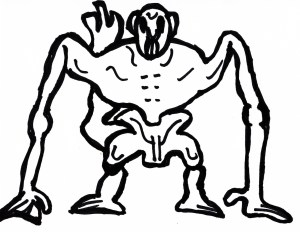
If I’m avoiding talking about the events or themes of Octaman here, it’s because there’s not much to it. American scientists researching environmental contamination from “underwater atomic detonations” in Mexico discover small, rubber, octopus-like puppets that live at the mouth of a polluted river, taking them back to the lab for dissection & study. Ever the protective father, the titular Octaman swiftly arrives to slap those scientists to death with his giant rubber tentacles. The 76-minute double feature filler is heavily padded out with Ed Woodian stock footage and faux-philosophic narration about the value of scientific research & adventure in the modern world. It does not skimp on the Octaman action, though. The aquatic beast frequently pops into the frame to strike scientists down for daring to experiment on his octababies, with the camera often shifting into 1st-person octavision so we can watch the kills though his monstrous eyes. Baker gets to play with some light gore effects here, as Octaman rips throats and pops eyeballs out of their sockets, but for the most part the joy is in basic design of the suit. Octaman is more than a little phallic in silhouette (and weirdly veiny to boot), and his eight tentacles sprout from comical angles around his body. He’s more Riverbeast than he is Gill-man, but that is exactly why he’s loved by all who’ve gotten to know him.
Rick Baker is not so embarrassed of Octaman that he refuses to acknowledge his involvement. If nothing else, one of his greatest film credits, Gremlins II: The New Batch, plays a clip from Octaman in a throwaway TV horror host gag (billing it as The Octopus People instead of its actual title), which alone shows that he’s a good sport about it. Why Baker would choose to save all of his juiciest Octaman insight for The Joe Rogan Experience of all platforms remains a mystery to me, though. Maybe Rogan was the only interviewer who’d listen. Or maybe it’s just a result of the movie being so cheap that it couldn’t afford official advertising, so Baker couldn’t take those anecdotes to his usual home on Joe Dante’s Trailers from Hell YouTube series – a place I’m a lot more comfortable visiting.
-Brandon Ledet

 Swampflix