Wake Up Dead Man: A Knives Out Mystery (2025)

“His flock has not only begun to shrink, but to calcify,” Bishop Langstron (Jeffrey Wright) warns young Reverend Jud Duplenticy (Josh O’Connor) about his reassignment to serve under Monsignor Jefferson Wicks (Josh Brolin) at Our Lady of Perpetual Fortitude in upstate New York. Jud has just faced a committee of three upper-level members of the church for punching a fellow priest in the face, and he recounts the story of his turn to Christ, one of redemption not achieved but ongoing. Jud was a boxer in his youth before he found salvation, and for large parts of the film, the driving conflict is between Jud’s willingness to sacrifice, his sincere desire to bring others closer to Christ, and his testament to Christ’s love, versus Wicks’s egotistical self-martyrdom, his drive to consolidate his power at the expense of eroding his flock’s faith, and his heretical performance of his own prejudices as if they were God’s words. If Glass Onion could be (rightly) criticized for being a little too on-the-nose with its depiction of an Elon Musk-like richer-than-sin weenie loser villain, Wake Up Dead Man instead goes for a less specific target with the same ostentation by taking on all of the sins of modern right wing nationalism that cloak their evil under a banner of faith, and those who put darkness for light. Like me, director Rian Johnson had a profoundly religious upbringing, and although we both have left the churches in which we were raised, this film demonstrates a deep and abiding admiration for and fondness of true believers who practice God’s love, and I both respect and was moved by the approach. Johnson may have, intentionally or unintentionally, created one of the best pieces of Christian propaganda since Chronicles of Narnia or “Sinners in the Hands of an Angry God,” and he did it showing the apotheosis of contemporary American Christian Nationalism tending to a church that was literally without Christ. 

When I was young, one of the oft-repeated sermons that I witnessed (through countless Thursday chapel sessions at the fundamentalist Christian school that I attended, Sunday School sermons, Children’s Church ministries, and Wednesday Youth Pastor recitations) was one about the Christ-shaped hole in everyone’s being. Sometimes the hole was in your soul, and sometimes it was in your heart; if it was in your latter, they would occasionally use a piece of wood cut into a heart, with a lower-case-t-shaped void in the middle, into which a conveniently sized cross could slot as a visual representation. (Presumably, the more ambiguous nature of the soul prevented it from being carved out of scrap wood for these performances). I get the feeling that Johnson likely sat through some of these same services, and he transposes that metaphor in this film to a literal void in the shape of a crucifix on the walls of Our Lady of Perpetual Fortitude. We learn the reason for this in a story related by Martha Delacroix (Glenn Close), who witnessed the destruction of the temple as a child; the monsignor’s grandfather Prentice was a widower with a daughter, Grace, when he became the shepherd of the town’s flock, and the daughter was a girl of “loose morals” who ended up a pregnant teen. Prentice promised her his fortune if she remained under his roof and didn’t embarrass him by going into the town, and she honored her end of the bargain until his dying day, watching as Prentice poisoned her own son against her and groomed him into becoming the next in a line of men who disguise their hatred behind their vestments. She found his bank accounts empty, and destroyed much of the church, supposedly out of rage, before dying while pounding on the outside of his “Lazarus tomb,” which can only be opened from the outside by construction equipment but which can be opened from within with only a light push. Ever since, Grace has been characterized as “The Harlot Whore,” and has become a key figure in Monsignor Jefferson’s fiery sermons.

It’s to this lost flock, not only shrinking but calcifying, that Jud arrives. That sounds like a coldly analytical way to describe it, but it’s with that same clinicality that Jud diagnoses the rot at the heart of Perpetual Fortitude, metaphorically calling it a cancer that must be cut out. This raises suspicions, of course, when Jefferson Wicks dies, seemingly impossibly. He entered a small cubby near the pulpit with no apparent exit, in full view of all witnesses, and collapsed before a knife was found in his back. Those in attendance that day other than Jud were a select few extremely devoted followers, who form our cast of suspects and witnesses. Martha was there, as was her husband Samson (Thomas Haden Church), the church groundskeeper who has found the strength to maintain his own sobriety because of his respect for the Monsignor’s own dubious overcoming of his addictions. Town doctor Nat Sharp (Jeremy Renner), whose wife recently left him for someone she met on a Phish message board and took the kids with him, is present, as is concert cellist Simone Vivane (Cailee Spaeny), who is currently funneling all of her savings into Perpetual Fortitude in the hopes that the Monsignor will be able to cure her of her painful, disabling neuropathy. The town has also become home to Lee Ross (Andrew Scott), a former pulp sci-fi novelist of some (niche) renown whose pivot into libertarianism has made him an outcast in the elite literary circles he envies and left him with only a small but devoted fandom of survivalists who, in his words, “all look like John Goodman in The Big Lebowski.” Ross hopes to make his way back into polite society by publishing a book of Wicks’s sermons and his own accompanying essays and commentary, and as such is one of the Monsignor’s sycophants. Rounding out the group is Vera Draven (Kerry Washington), who is carrying on the family tradition of acting as the Wicks family’s lawyer, following in her father’s footsteps, as well as Cy (Daryl McCormack), the son her father forced her to adopt when she was still a student and the boy was already old enough to be in school. Cy has returned to Perpetual Fortitude, tail between his legs, after a failed attempt at breaking into politics. 

Most of the film’s political satire revolves around Cy. I mentioned before that the satire in this one is less about mocking a specific individual than about painting a broader picture, but Cy seems like a deliberate invocation of Christian Walker, at least if I’m reading Cy as being as closeted (which I am). When Cy complains to Jud that he failed to make his political ambitions come true, it was in spite of the fact that he hit every single right-wing talking point, listing them one by one in a screed that lasts for over a minute of the film’s runtime. He describes his playbook as, to paraphrase, “making people think about something that they hate and then make them afraid it will take away something that they love,” which is an encapsulation of the go-to method of reactionary appeals to perceived attacks on normalcy. Wicks is clearly not a technically adept person, a member of an older generation, but Cy’s incessant need to constantly curate his existence for his online following means that Wicks’s ideas work their way out to Cy’s followers, a genealogy of intolerance. It works thematically while also justifying why there’s footage of a very important meeting that reveals every participant’s motivation. 

We’ve gotten pretty far into this without ever mentioning Benoit Blanc (Daniel Craig), the gentleman detective who is ostensibly the star of this series. He enters the film fairly late as well, but it’s a damned good entrance, as he finds himself inside Perpetual Fortitude and face to face with Jud, who has provided the narration to this point, and finds it difficult to find something nice to say about the church and can only bring himself to compliment the architecture. Blanc has been brought in by the local sheriff (Mila Kunis), and he’s fascinated by the opportunity to solve what is, despite the lack of a door, a locked-room mystery. It turns out that the church reading group has all read multiple examples of the genre, including The Murder of Roger Ackroyd and The Hollow Man, which means that any one of them could have drawn inspiration from them. It was here that I first suspected that we were being led to the inevitable conclusion that Jud had committed the crime and was merely an unreliable narrator, as is the case in Roger Ackroyd (um, spoiler alert for a book that turns one hundred next year, I suppose); after all, his name sounds like someone trying to say the word “duplicity” after too many drinks. As it turns out, the presence of Roger Ackroyd is a clue, but not the one that I thought. 

Blanc, despite a slightly smaller presence here, is nonetheless excellent when he’s on screen. As with the previous two installments in this series, there’s much to laugh at and be puzzled by here, and the audience for my screening had a delightful time. You will too. 

-Mark “Boomer” Redmond

Meet Maigret

Literary police detective Jules Maigret was featured in at least 75 mystery novels published from the 1930s to the 1970s. The Maigret series was such an immediate hit that the fictional detective was adapted to cinema starting in the first year of publication, and he’s such an enduring literary icon that he’s still being portrayed in prestige television series, most recently by Gerard Depardieu. There’s a statue erected in his honor in the Netherlands where the first Maigret novel was written, despite his fictional & cultural home base being Paris, France. Personally, I’ve never heard of the guy. Considering the near-century of continued circulation & celebration, I have to assume that Maigret is as popular of a literary figure as fellow mystery-novel icons Sam Spade, Philip Marlow, Miss Marple, and Hercule Poirot. However, the first time I ever saw his name in print was on the covers of used DVDs at a local Goodwill, where I recently picked up two 1950s adaptations of famous Maigret novels directed by Jean Delannoy. The completionist in me would normally be intimidated by a new movie-watching project like this, since getting the full scope of Maigret’s cinematic output would mean watching a half-dozen actors portray the character across at least a dozen films. I’m not doing all that. Delannoy only directed two of those Maigret features, though, and they both starred Jean Gabin in the titular role. That’s about as manageable of a crash course as possible for such a prolific film subject.

Unsurprisingly, Delannoy & Gabin’s Maigret collaborations aren’t especially interested in introducing new audiences to the already-long famous character. They are both self-contained mysteries that presume audience familiarity with the titular detective, the same way a modern adaptation of The Hounds of Baskervilles wouldn’t feel the need to explain the basic character traits of Sherlock Holmes. So, 1958’s Maigret Sets a Trap is not especially helpful as an introduction to Maigret’s whole deal, but its central murder mystery is shocking & compelling enough for that not to matter. If anything, Jules Maigret is protective of his identity, hiding his personal feelings behind a mask of strait-laced, middle-aged machismo, with Jean Gabin playing the detective as the French equivalent of George C. Scott. As buttoned-up & conservative as Maigret can be, however, the crimes he’s tasked to solve are shockingly salacious. In this first outing, he must scheme to trap a serial “killer of sluts,” a psychosexual freak who’s been stabbing anonymous women in Parisian alleyways as punishment for the alleged sins of their gender. As soon as the audience meets the killer halfway through the film, his guilt is obvious, shifting the “whodunnit” structure into a “whydunnit” story instead, with Maigret boiling to an angry intensity as he hammers the suspect during interrogation into a full confession. The remaining mystery is in discovering his motivation and accomplice, untangling an unseemly tale of cuckoldry, impotence, and homosexual repression covered up by his doting mother & frustrated wife. The shadowy alleyways and mood-setting jazz of the early killings promise the genre trappings of a 1950s noir, but the details of the case eventually lead to Maigret Sets a Trap operating as a French precursor to Psycho & Peeping Tom. Maigret may not have the expressive charisma of a Sam Spade or a Norman Bates, but he does walk the streets of their shared sordid world.

In Delannoy & Gabin’s second Maigret outing, the detective becomes a little more personable to the audience through some nostalgic soul-searching. 1959’s Maigret and the Saint Fiacre Case sends him back to the rural hometown he left as a teenager to pursue a law enforcement career in the big city. There, he fails to protect the heiress of the local estate who was his first boyhood crush, and must spend the rest of the film solving her murder after it’s committed before his very eyes. At this point, it’s still difficult to fully understand what makes Maigret special detective after getting to know him over two films, but he can at least be narrowed down to a few scattered attributes: middle-aged, pipe smoker, mostly quiet but shouts during interrogations, detests ninnies & “dilettantes”, etc. This second case is much more of a traditional whodunnit than the first, with a wide field of nervous, effeminate weirdos serving as possible suspects for the overly severe brute to expose. Will the killer be the countess’s playboy heir, the gigolo art critic, the sexually repressed priest, or the pipsqueak bank teller who rides into town on a Vespa scooter? I found the field of suspects to be a clearly distinguished type but the exact guilty party to be entirely unpredictable. In a way, their contrast against the more traditional, stoic masculinity of the detective on the case is the greater crime that must be solved, which opens up this duo of films to a range of strangely reactionary sexual politics. At the very least, it seems like the appeal of these Maigret stories is partly that the mysteries he gets wrapped up in are way more salacious & distinctive than the detective solving them. He’d much rather be at home having a cup of coffee with his adoring housewife than getting his hands dirty with the effete riff raff of modern urban life, but duty calls, and it calls often.

As soon as its opening credits sequence, Maigret Sets a Trap nails down the iconography of Maigret’s detective work. Maigret is introduced through the silhouette of his signature pipe, casting a massive shadow over a map of Paris – an image that is violently interrupted by the stab of a dagger onto the city streets. That visual stylishness continues throughout the picture, with Dellanoy constantly moving the camera to capture every inch of the mise-en-scène and even experimenting with some 1st-person POV cinematography while navigating Parisian alleyways. The details of the case get surprisingly gruesome for a mainstream 50s production too, with frank depictions of rape, bloodshed, and male sex work upending standards & expectations set by Hays Code-inhibited Hollywood productions of the era. for In contrast, The Saint Fiarce Case is much more generic detective-novel fodder, with only occasional excursions to modern strip clubs & printing presses breaking up what’s essentially a by-the-books Old Dark House story. It’s most interesting as an attempt to pick at the personal backstory & hang-ups of a character who’s protective of his privacy even to his audience, whereas Sets a Trap stands on its own as a great film regardless of its connections to other Maigret tales. Jean Gabin was so celebrated for his portrayal of the character that he was later invited to return to the role in 1963’s Maigret Sees Red, well after Jean Delannoy had moved on to direct other projects. Personally, I didn’t get to know Maigret well enough over these two films to be on the hook for his continued adventures unless, like Maigret Sets a Trap, the mysteries he’s tasked to solve in them sound especially shocking or prurient. It would take another chance meeting at the second-hand shop to spend more time with the detective, so it’s unlikely I’ll ever fully get to know the man behind the pipe.

-Brandon Ledet

Lagniappe Podcast: Tesis (1996)

For this lagniappe episode of The Swampflix Podcast, Boomer & Brandon discuss Alejandro Amenábar’s snuff-film murder mystery Tesis (1996).

00:00 Welcome

01:24 Goodbye Horses – The Many Lives of Q Lazzarus (2025)
09:20 The Haunted Palace (1963)
14:56 Mission Impossible – The Final Reckoning (2025)
20:57 Leila and the Wolves (1984)
25:12 The Prophecy (1995)
27:31 The Raven (1963)
28:57 The Pit and the Pendulum (1961)
34:07 The Ugly Stepsister (2025)
36:06 The Shrouds (2025)
40:16 Touch of Evil (1958)
44:25 Strangers on a Train (1951)
46:36 Frenzy (1972)
50:41 Fight or Flight (2025)
52:27 Final Destination (2000 – 2025)

1:24:13 Tesis (1996)

You can stay up to date with our podcast through SoundCloudSpotifyiTunesTuneIn, or by following the links on this page.

– The Lagniappe Podcast Crew

Death on the Nile (1978)

I really, really wanted to love Death on the Nile. I first acquired a copy of it shortly after the death of the late Angela Lansbury, my love for whom is widely advertised all over this site. Unfortunately, her role in this is one of the smaller ones from among the ensemble, and the overall tone and extended length of this one was a bit of a letdown. It’s not bad; I quite enjoyed it, but I didn’t love it. 

As the film opens, we meet Jackie de Bellefort (Mia Farrow), who practically begs her heiress friend Linnet Ridgeway (Lois Chiles) to hire Jackie’s fiance Simon (Simon MacCorkindale) for a position at Ridgeway’s estate. She relents, and then we jump forward a year to find Simon on a honeymoon with his wife, except he hasn’t married Jackie, and is instead now wedded to Linnet. That doesn’t stop Jackie from being a thorn in their side, however, as she shows up at their most recent romantic rendezvous atop a Giza pyramid to recite facts about its dimensions, with Linnet and Simon both expressing frustration that she has appeared at every destination on their post-wedding trip. (As a side note, I loved this; if my best friend stole my betrothed, I would also be so petty that neither of them would know a moment’s peace for the rest of their lives, and there would be no corner of the earth in which I could not find a way to be a nuisance.) They attempt to give her the slip before the next leg of their trip, and appear to have been successful, as they board a steamboat travelling down, as the title would suggest, the Nile River. 

As it turns out, not only are they not alone on this journey, but many of the passengers, like Jackie, are in the vicinity because of their desire to cause trouble for the newlyweds. There’s Linnet’s maidservant, Louise (Jane Birkin), who was promised a dowry for her service to Linnet so that she could marry a man she loves, but which Linnet continues to delay paying, possibly with the intention of completely reneging on their deal. Miss Bowers (Maggie Smith)’s formerly noble family lost their fortune at the machinations of Linnet’s father, forcing her into taking a thankless job as the companion of Marie Van Schuyler (Bette Davis), whose own aristocratic status does not stop her from having kleptomaniacal inclinations, especially with regards to Linnet’s pearls. Linnet has also publicly denounced the practices of Dr. Bessner (Jack Warden), as her friend died under his “care,” which includes treating patients with intravenous armadillo urine, and his career is in the balance. Then there’s Andrew Pennington (George Kennedy), who manages Linnet’s stateside business and who is set on preventing her from finding out that he’s been skimming, while Colonel Race (David Niven) is there surreptitiously acting on behalf of her English lawyers, who want to bring this to her attention. Nebulously, there is a young communist aboard named James (Jon Finch), who bears hatred for Linnet as a representative of class striation, and, last but not least, the ship is also carrying Salome Otterbourne (Lansbury) and her daughter Rosalie (Olivia Hussey); Salome is a romance novelist currently embroiled in a libel lawsuit over one of her recent books, which was partially based on Linnet’s real life and may have insufficiently differentiated the main character from the inspiration. And, of course, Hercule Poirot (Peter Ustinov) is there, because someone has to use their little grey cells to figure out who did it when Linnet turns up dead, and the only ironclad alibi is Jackie’s. 

The oddest thing about this adaptation is that it decides to play the story for light comedy; that’s not that strange in and of itself (yours truly was in a Christie parody entitled And Then There Was One in high school—it’s a common way to present her work), but it’s curious how intermittently the comedy works. Where this least was least successful was when the humor went very broad, most notably in regards to Lansbury’s perpetually intoxicated (and horned up) Salome, who is possibly the most obnoxious character in the whole thing. You know that if I’m looking at Lady Angela and having a bad time, then we’re really in trouble. Shortly before a failed attempt on Linnet’s life at the Temple of Karnak, we’re treated to a scene of all of the passengers disembarking the ship and setting out to ride up to the site; I suppose we’re supposed to laugh at the sight gag of George Kennedy struggling to mount a donkey while the others get on camels, but it certainly failed to get a mirthless smile out of me, let alone a chuckle. There’s also an overlong gag when the group first boards the ship and I. S. Johar’s captain character does an extended bit about trying to guess which guest is which, and I can’t quite put my finger on it, but it’s possibly racist and at the very least undignified. On the other hand, the biggest laugh I did get was from one of Lansbury’s scenes, in which Salome is recounting how she managed to witness the killer flee from the stateroom, her voiceover explaining that a deckhand was showing her something on the shore, while the flashback itself reveals her buying several large liquor bottles from the man instead. At least I can say that the film got funnier for me as it went along, with more of the jokes landing in the back half than in the front. 

On a purely visual level, the film is much more notable. As a period piece, all of the clothing is gorgeous; the only Academy Award for which it was nominated was Best Costume Design, and it won that Oscar as well as the BAFTA in the same category. Special attention should be drawn to Smith’s outfitting as Miss Bowers. Throughout the film, she’s consistently dressed in tightly tailored men’s tuxedos and other formalwear, and she looks great in every one of them. Her silhouette is stunning, and she works the slightly transgressive look quite well. I was also struck by the various gowns in which Farrow is costumed. When most people think about her, I assume that they all have the same first mental image that I do, which is of her emaciated, shaven-headed prisoner in a nightgown in Rosemary’s Baby. Everything else I’ve ever seen her in was during (or after) her marriage to Woody Allen, during which time she was, to put it lightly, not doing well. I don’t think that I ever realized before that she’s a beautiful woman, and getting to see her slink about in dresses that won costuming awards on both sides of the Atlantic was a thrill. I loved her angry, vengeful energy, and she ended up being one of the movie’s highlights. 

This is somewhat condensed from the 1937 novel on which it was based, as usually must be done when making a Christie adaptation. Characters are removed, motives are swapped around or condensed, and you’re still likely to end up creating something that’s over two hours long, with this particular film clocking in at 134 minutes (Kenneth Branagh’s 2022 version was 127 minutes long, and I can’t imagine how the David Suchet adaptation manages to get the plot resolved in 97 minutes). That’s a decent time for a good mystery, but it errs quite long for a comedy, so it ends up succeeding more as one than the other. It’s not bad, but it almost feels like it would work better broken up into two parts for Masterpiece Theatre. And, frankly, I didn’t enjoy seeing Angela Lansbury take a bullet during these trying times. Embark (or don’t) with that in mind. 

-Mark “Boomer” Redmond

Memories of Murder (2003)

Bong Joon-ho’s 2003 feature 살인의 추억 (Memories of Murder) is an example of a familiar genre made unfamiliar in its trappings, at least at first. Initially, this is because it is set in the yesteryear of 1986—and, as L.P. Hartley noted in his 1953 novel The Go-Between, “the past is a foreign country” where things are done differently—but also because it takes place in the South Korean city of Hwaseong. It follows two police officers on opposite ends of the scale of corruption who, because of the depravity and darkness of the crimes that they are investigating, eventually exchange places on this spectrum. Detective Park (Song Kang-ho) is local to Hwaseong and is the lead on the investigation into a nascent series of serial assaults and murders on women in the community, and Detective Seo (Kim Sang-kyung) has been sent from Seoul to assist after the discovery of a second body. There’s some jurisdictional friction between the two, including a vigorous discussion about the lack of a national investigative agency like the U.S. has with the FBI. (A useful note here: S. Korea’s National Police Agency wasn’t founded until 1991, and during the time in which this film is set, this would theoretically have fallen under the auspices of the National Security Headquarters, but with Chun Doo-hwan and his junta in power, it’s a wonder that Seo was even sent.) Their biggest difference, however, lies in their approaches. Park may not be as violent or hot-tempered as his partner, another local detective named Cho (Kim Roi-ha), but his apathy about justice is in many ways worse; it’s clear that Cho is driven by his temper and his aggression, while Park’s casual treatment of, for instance, the elicitation of a false confession in order to close the case, demonstrates that performing that kind of quotidian evil is driven by nothing more than the banality of doing one’s job. Seo, in contrast, is more evidence and psychology driven, and sees through Park and Cho’s arrest of an innocent man with developmental disabilities and the rehearsed admission of guilt that he recites in Seo’s presence. 

As I was thinking about how I would open my review while watching the film, a phrase came to mind about how the world that these characters inhabit is so unlike our own, where police brutality is so naked and unafraid, where violence and torture are commonplace means of maintaining the status quo. Then I remembered that we do live in that world. A girls’ school is visited in the film by one of the investigators, and the students there are practicing drills on how to escape from deadly attack and provide each other with first aid in the event of violence on the school grounds. Cho, the very same detective who has a special boot cover for when he is kicking prisoners to avoid leaving obvious marks, grows enraged when a local eatery’s television displays a report about a Seoul officer being indicted for similar actions, and he both destroys the television and physically attacks the students there who cheer on justice being served, protesting too much. Even the “good cop” Seo sits by idly while Park and Cho hang a suspect upside down, only becoming involved when the man says something that provides an epiphanic deduction. Park, an unapologetically bad cop, thinks he has some kind of preternatural sense that allows him to discern when someone is guilty or not, a frightening look into how someone can get the idea that they can sense other people’s spirits and then mete out punishment on them based on their own preconceptions. What Bong was saying in 2003 about both the contemporary present of the film’s production and about the 1986 on which it focused is the same thing that he’s still saying about the distant past, the near past, and today: “Essentially,” he said in 2019, “we all live in the same country called capitalism.” The S. Korea of 2003 is the present United States is S. Korea in 1986, and it’s jackboots all the way down. 

For those who haven’t seen the film, a brief synopsis: Detectives Park and Cho, under orders from Sergeant Shin (Song Jae-ho), partner with Seoul city detective Seo when the body of a woman is found in a roadside culvert, the second victim of a potential serial killer. The two local detectives physically torture Kwang-ho (Park No-shik), their first prime suspect, the mentally handicapped and physically scarred son of a local restaurateur. They take him out to the woods to force him to dig a hole under the pretense that he is digging his own grave if he does not confess, and he does so, into a tape recorder. Seo is not convinced by any of this and, much to Shin’s chagrin, finds evidence that exonerates the man, embarrassing Park and Cho. Seo connects the dots on the fact that both women were murdered in the rain to a missing person case for a woman who also disappeared on a rainy night, and he is able to turn the search to a specific area and a search team finds her body relatively quickly, further driving a wedge between Park and Seo, the former of whom thinks the latter looks down on him as a comparative bumpkin. A trap is laid for the killer the next evening that it rains, but it fails; although Officer Kwon (Go Seo-hee), who was used as bait, fails to draw out the killer, she does discover a link between the nights of the murders, the rain, and a series of postcards to a local radio station that requests the song “Sad Letter” be played when it’s a rainy day. An accidental sting operation at the location where the fourth body was found leads to the arrest of the next prime suspect, Jo (Ryu Tae-Ho), while a follow up on the song requests leads to another, Park Hyeon-gyu (Park Hae-il). Jo is Park’s collar, and he grows infuriated when Seo finds proof of the man’s innocence, once again enraged that his case closure has been torn out of his hands, and Hyeon-gyu is Park’s man, but there’s no solid proof and even some physical evidence that seems to exonerate him. I wouldn’t consider any of this a spoiler, though, because although this is a crime thriller, it’s not a mystery, even though it occasionally wears one’s clothes. 

Like the crime on which it was based (at least at the time of release), the killer is not found in this film. He’s present in the movie, in peripheral glances and blurred visions of final moments, but we never see his face and the police never apprehend him. The final scenes of the film, which take place in 2003, find Park returning to the road where the opening scene took place and staring into the culvert in which the second victim’s body was found, seventeen years older and now a small kitchen appliance salesman. A little girl asks him what he’s doing and tells him that another man was there a few weeks prior, also looking into the same space and, upon being asked, said he was remembering something that he did there a long time before, implying that the killer is still loose, but history ended up proving this one wrong. As it turns out, the Hwaseong serial killer had actually been in prison since 1994, for killing his sister-in-law, and he was prompted to confess to the Hwaseong killings upon the discovery of further DNA evidence to confess in 2019. This doesn’t hurt the film in any way, but I don’t want to leave pedant bait out there in the open like that. 

This movie is beautifully shot, and the action is often kinetic and fun. Clocking in at 2 hours and 10 minutes, I can see how some of the scenes in the middle could feel like the film is going in circles if you don’t have the attention span for a film of that length, but I never felt like the film was spinning its wheels. There are countless independent pieces at play here that add up into a whole that is larger than the sum of its parts. Some of the police violence can be hard to stomach, and without some knowledge of S. Korean politics of the 1980s there are probably some details in the film’s metaphorical filigree that are lost. Even if you don’t, the violence of the police against protestors and students speaks for itself, as does the way that different members of the institution behave, with Cho being more violent than before and Shin growing increasingly furious that his subordinates are disobeying his direct orders to show restraint while they are under the microscope. It’s familiar even if the time and place are foreign to you, because we do all live in one national police state. If you can stomach that, this is a masterpiece you should see as soon as you can. 

-Mark “Boomer” Redmond

Lagniappe Podcast: Murder by Death (1976)

For this lagniappe episode of the podcast, Boomer, Brandon, and Alli discuss the murder mystery meta comedy Murder by Death (1976), a direct precursor to Clue (1985).

00:00 Welcome

06:33 Heavenly Creatures (1994)
12:30 Bodies Bodies Bodies (2022)
15:38 Ant-Man and the Wasp: Quantumania (2023)
19:01 Lust in the Dust (1984)
23:50 Scream VI (2023)
40:52 Cocaine Bear (2023)
42:45 Day of the Animals (1977)
46:46 Cleo from 5 to 7 (1962)
51:14 Nathan for You: Finding Frances (2017)

58:13 Murder by Death (1976

You can stay up to date with our podcast through SoundCloudSpotifyiTunesStitcherTuneIn, or by following the links on this page.

-The Lagniappe Podcast Crew

The Last of Sheila (1973)

Swampflix readers, the internet has been essentially de-democratized. What I mean by that is that when you or I go online to look for the answer to a question or read one (1) article about a thing that we engaged with or enjoyed, we no longer get to interact with that article in a vacuum. Unless you’re VPN’d up every single time that you look for a movie review or try to purchase a replacement ice mold for the Rival snow cone maker that you purchased at an estate sale without realizing that it required a part that was not present, you’re going to start getting ads for snowball machines and your YouTube homepage is going to be flooded with think pieces and video essays about the film that you just wanted one critic’s viewpoint on. Well, that and advertisements and algorithmically driven content to make you stay on the platform longer, feel encouraged to interact with the content to drive engagement, etc. Like most Swampflix contributors, my interests are not fully in alignment with the zeitgeist, but every once in a while, they are; unfortunately, although that means that I was as excited about M3GAN as the culture at large was, discussion of her wasn’t omnipresent in the discourse of the YouTube channels that I haven’t blocked. But boy howdy did YouTube love that I loved Glass Onion. Amidst a deluge of clickbait bids titled “[Number] Things You Missed in Glass Onion!”, “All the Secret Connections between Knives Out and Glass Onion!”, and the like, I have to admit that I did encourage the algorithm just a little by watching videos that talked about the various films and TV shows that had served as inspiration for the film, because I go through periods where mysteries are all that I ever want to consume. Frequently cited as a major creative jumping-off point for the film was 1973’s The Last of Sheila

Helmed by director Herbert Ross and scripted by Anthony Perkins and Stephen Sondheim (the only screenplay credit for each), the film tells the story of film producer Clinton Greene (James Coburn) and his plan to take several of his friends on a pleasure cruise aboard his private yacht. Their voyage begins, presumably not accidentally, on the anniversary of the death of Greene’s girlfriend, Sheila, who left one of his parties in a fit and was killed by a hit-and-run driver mere blocks from his house. An avid player of games of strategy and wit, Greene has planned out a series of mystery nights where his guests will go ashore with a set of clues and split up to try and solve a mystery. Each person aboard is also given a card that is to be their “secret identity” for the game, and the first of these that we see as characters open their envelopes are things like “Alcoholic,” “Shoplifter,” and “Homosexual.” Further, each of his traveling companions was there the night of Sheila’s death: Christine (Dyan Cannon), a film talent agent who’s full of wit and flirtatiousness in that a 1970s showbiz liberated way; glamorous but troubled starlet Alice (Raquel Welch) and her current beau, another film agent named Anthony (Ian McShane), who’s forever angling to get more involved with the production side of film; faded movie star and giant of another age Philip Dexter (James Mason) who’s now stuck in undignified commercials for dog food; and Tom Parkman (Richard Benjamin), a screenwriter who’s been stuck doing rewrites on spaghetti westerns while his original work remains unsold and unproduced. The only person on the cruise whom we are explicitly told wasn’t there the night Sheila died isTom’s wife Lee (Joan Hackett), a kind but idle and neurotic heiress. The first night of the mystery game is largely a success, with half of the group getting to the secret while the other half is either too late or doesn’t try at all. On the second night, however, tragedy strikes, and when not everyone comes back to the boat, our cast of characters return to the site of the previous evening’s game and discover that someone from their number has died, under mysterious circumstances. 

Excited as I was to finally see this film, at a full two hours, it starts to feel its length in places. The site of the second night’s game is an abandoned monastery where the gang has to don identity-revealing robes and remain quiet until they locate the confessional in which Greene is hiding, which makes for a lot of fun as characters pass each other without we in the audience ever really knowing with whom they’re speaking or even if the characters know; unfortunately, this runabout through the monastery feels much longer than the ten minutes of screen time that it occupies and unfortunately telegraphs that a twist is coming. For the first hour of the movie, the omnipresent implication is that Greene has arranged some elaborate plan to discover which of his guests was Sheila’s killer, but a savvy viewer will know that there’s simply no time left in the runtime of the film to go through five more puzzles, and so there’s going to be a complicating factor at any moment. You’re not surprised by the second death, merely by who is the unfortunate corpse. I’ll be the first to admit that I might have been spoiled (or had a certain part of my brain atrophy while another part grew three sizes) by watching some 250+ episodes of Murder, She Wrote in the past thirteen months, so I could be stuck on that formula, but an hour in feels like an awfully late place to stick your midpoint murder twist. At the same time, there’s no fat to trim here, no extraneous beats that don’t reveal something relevant about character, motive, time, and secrecy, it’s just that the relevancy of all of these narrative moments is often revealed late in the game. 

If there are two performers who stand out to me, I’d have to name Cannon and Hackett. Every performance here is good, but Cannon is delivering a wonderfully understated performance as a woman who’s committed to living life as sensually and hedonistically as possible but whose dark past she regrets; she’s stunning. A whodunit like this doesn’t require the sincerity and humanity that she brings to her delivery of a monologue in which she confesses to having furthered her career by slipping some names to the HUAC, but it certainly elevates it. “Then those people didn’t work for a while,” she says. “Now they work. Sometimes I try and get them work. Sometimes I see them on the street and sometimes … they cross the street.” She tries to play off her guilt, but no one is convinced, least of all herself, and it’s magical. Also doing great work here is Hackett, whose frantic, nervous, chain-smoking Lee is clearly having a very hard time with all of this business right from the start as the only person aboard who doesn’t belong there, since she was hundreds of miles away when Sheila died. As the only person we can be assured isn’t a killer, she seems to understand the jeopardy of being on the boat with someone willing to cover up their hand in an accident that resulted in a death. After all, someone almost kills Christine by turning on the yacht’s propellers while she’s taking a swim; who’s to say there won’t be more “accidents”? The big stars are clearly supposed to be Mason and Benjamin, the actor and the writer, who take point on trying to spin out the narrative that would lead to the things that the group has uncovered and discovered—and let there be no mistake, they are both more than satisfactory, with Mason having the upper hand over Benjamin in the charm department—but it’s Cannon and Hackett that I’ll be thinking about weeks from now. 

Let’s talk humor. I’d be remiss if I didn’t mention that, alongside the performances, the other tempering element that helps the movie feel like it’s got some pep in its step when it gets a little slow is the film’s comedic wit. Before she can even get on the boat, Christine complains about the lack of a drink in her hand by declaring “My mouth is so dry they could shoot Lawrence of Arabia in it,” which I’ve found myself saying every once in a while over the years without ever remembering its origin (it’s the pull quote used for the film in Douglas Brode’s compendium—and my longtime companion—Edge of Your Seat: The 100 Greatest Movie Thrillers, where it ranks at 88th). Even the jokes that characters make that are supposed to be either unfunny or in bad taste within the text got a chuckle out of me, especially those that poke fun at Hollywood and celebrity culture. This includes Greene’s mocking of Tom’s body of work as a second set of eyes on Westerns by asking him to read from a section of Fistful of Lasagna (“or whatever it’s called”). Even if the references are a half century old now, the core truths in play keep the film feeling fresh, despite some major dissonance in other areas that it’s important to address: one of the characters is outed as a child molestor, which is bad enough, but the other characters don’t really seem to think that it’s a problem that needs to be addressed or even has a glimmer of an idea of reporting him to the authorities. If there’s one thing in this film that hasn’t aged well, it’s the casualness with which that horrifying little tidbit is dropped and the lack of reaction to it. 

Already, I’ve risked giving away too much of the plot of this one, so I’ll wrap it up. Stellar performances, creative misdirects and clues, and clever jokes stashed away in little corners more than make up for the times where the film feels like it’s dragging the bottom. Although you can rent this one streaming, I’m sure your local library has a DVD that’s probably got some fun extras and easter eggs on it, so why not visit them instead? 

-Mark “Boomer” Redmond

See How They Run (2022)

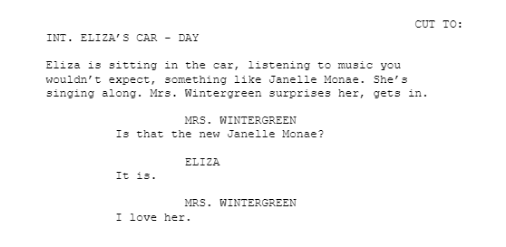
I recently talked on the podcast about my dear friend Ana Reyes’s astounding and well-deserved success surrounding her first novel, The House in the Pines (still #2 on the NYT bestseller list for hardback fiction as of this writing!). When we were all having drinks after the launch party back on January 3, her husband, who is also a writer and friend, mentioned to me that he and Ana had recently been talking about how ahead of the “cozy mystery” curve I was when I put together my pitch document/series bible for the as-yet-undiscovered project Mrs. Wintergreen. As I smiled a toothless grin that belied my bitterness that fate has not seen fit to bring Mrs. Wintergreen to life, I didn’t even point out that not only was that the case, but also that I had even included a scene in which my protagonist, 108-year-old semi-pro sleuth Constance Wintergreen, expressed an appreciation for Glass Onion star Janelle Monae:

Anyway. 

Agatha Christie is very in vogue, as evidenced by not only the aforementioned Christe-adjacent 2022 release Glass Onion, but also the Christie-containing See How They Run, a confident first feature from director Tom George penned by Mark Chappell, who is perhaps best known for his writing for the David Cross vehicle The Increasingly Poor Decisions of Todd Margaret. A period piece, the film begins on the night of the hundredth performance of The Mousetrap, a Christie-authored play which is infamous for two things: first, that there is a twist ending that the audience is encouraged not to reveal to others, resulting in the play’s ending remaining largely unknown to this day, and second, that the contract for the play forbids any adaptation of the source material to film (or the short story on which it was based from being published) until at least six months have passed since its final performance at London’s West End. This was a particularly long-sighted bit of legal play, as the show has run continuously (other than a COVID-caused pause) since its opening night in October of 1952, seventy years ago. In fact, I have some suspicion that this film exists solely for that reason, as it is the closest we can get to a Mousetrap adaptation for the foreseeable future. 

Leo Köpernick (Adrien Brody) is a sleazy slimeball of an American film director (redundant, I know) who has his sights set on turning The Mousetrap into a hit motion picture. That previously noted clause about the show being forced to close before this can even be a possibility is at the forefront of the minds of many involved, but theatre producer Petula Spencer (Ruth Wilson) assures him that the play has already reached its 100th performance and surely it will run out of steam soon, espousing the idea that a narrative with a whodunit at its core will, by its nature, see few repeat visitors and will necessitate closure sooner than later. Although we the viewers are sufficiently distant from this event that this is an historical irony for us, the contemporary American studio system is so confident that they already have Mervyn Cocker-Norris (David Oyelowo) working on a screenplay. Cocker-Norris’s English sensibilities and sense of adaptational faithfulness brings him into conflict with the flashy Köpernick, although the former is not alone in his distaste for the latter: British film producer John Woolf (Reece Shearsmith) is also protecting a scandalous secret about which Köpernick is blackmailing him; Köpernick is rude to all members of waitstaff everywhere, which includes the put-upon usher Dennis Corrigan (Charlie Cooper); and, mere moments before his murder at the ten minute mark, he is decked by Richard “John ‘Spared no expense’ Hammond” Attenborough (Harris Dickinson), who portrays the lead in The Mousetrap, for flirting with his co-star and wife Ann Saville (Pippa Bennett-Warner). The investigation of his death necessitates the appearance of Inspector Stoppard (Sam Rockwell), the archetype of the drunken detective who plays fast and loose with the rules; due to a shortage of available partners, he is paired with Constable Stalker (Saoirse Ronan), a plucky, energetic up-and-comer who is mere months away from being the first woman to take the sergeant’s exams. 

This is a neat little movie that makes sense in and of itself but also functions as a love letter to Christie and to her longtime fans, a body of which I consider myself to be a member. For instance: a scene in which the excitable Stalker asks a hotelier what part of France he is from based on the fact that he speaks French only to receive a deadpan response that he is Belgian is a fun comic bit in and of itself, but it’s also a nod to fans of Christie’s Belgian detective Hercule Poirot, who often finds himself on the receiving end of this exact misunderstanding. There’s also a good running gag about Hamlet: Early on, Attenborough says of The Mousetrap “It’s not exactly Hamlet.” Later, Stoppard half-quotes Act II Scene II’s famous ending line “The play’s the thing” [“Wherein I’ll catch the conscience of the King”], spoken when Hamlet commits himself to obtaining evidence of his uncle Claudius’s guilt through an elicitation of a confession upon seeing a fictionalization of Hamlet’s father’s murder. This is itself a circular reference, as not only does it reveal that Stoddard has realized that the connection between the murder of Köpernick may actually have to do with the play’s content, not its performance as initially suspected, but the word “mousetrap” likely comes from Hamlet in the first place as Hamlet refers to the play as a mousetrap in Act III Scene II (line 2131), in what may be the invention of the term. Your mileage is likely to vary on certain comic elements, of course; whether or not you find it clever that Cocker-Norris disdains screenplays that include flashbacks as crass and artless moments before one occurs in his narration is going to be left up to the individual viewer. I find his asking of “Whatever next? A caption that says, ‘Three weeks later’?” juxtaposed with that very caption to be charming and fun, but I know that others will find it to be more of a moment of bathos. 

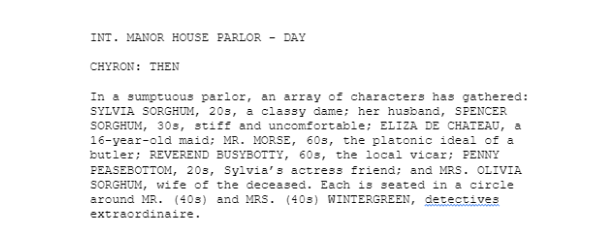
My favorite gag, however, cribs neither from Shakespeare or Christie, but Adaptation: in a flashback, much to the chagrin of Cocker-Norris, we get to see a little bit of how Köpernick’s mind works as he shows a series of storyboards that he put together for the climax of the film version of The Mousetrap. The images are quick cuts between detailed insets: gloved hands at a power box, a revolver being cocked by an unknown person, a fire breaking out in the middle of a tense standoff with a hostage—all of it very un-Christie and extremely Hollywood. This is Köpernick’s attempt to “jazz up” the very un-Hollywood and extremely Christie ending of the play, which uses one of her most well-known and genre-defining tropes: the end-of-the-story summation gathering, in which the detective gets everyone together in a parlor to explain their investigation and conclusion. In fact, not that it matters, but it’s so very much part of the genre that a parody of this type of scene is the very first thing that happens in the script for the Mrs. Wintergreen pilot, “Mrs. Wintergreen and the Thorny Dilemma” 

See How They Run turns this on its ear by playing both sides in the same way that Adaptation does, by mocking the hand that feeds it via denigrating comments about the formulaic nature of Hollywood adaptations, and then doing each and every one of the things that it mocks. The climax of the film takes place in a parlor that has the exact same layout, dimension, and decorations as the final set of the play, although this is obscured until the last possible moment to reveal it. The revolver, the fire, the standoff, the power box—the whole thing plays out in exactly the same way that Köpernick’s storyboard does. It’s a lot of fun to watch. (So would Mrs. Wintergreen be, I think, but I digress.) 

I was engaging with some essay or other this week and was taken aback when the author noted that, for all of his extremely large body of literary work, Isaac Asimov’s oeuvre rarely sees film adaptations, with only a handful ever being produced: Konets Vechnosti from 1987, based on The End of Eternity, which I assume must have had a subtitled release in the U.S. at some point but I can find no evidence of; the Robin Williams vehicle Bicentennial Man; two separate adaptations of the 1941 short story “Nightfall;” and, theoretically at least, I, Robot. In general, the world does not lack for Christie adaptations; they are so numerous that films based on And Then They Were None alone have their own Wikipedia subpage. The Mirror Crack’d from Side to Side was adapted as an episode of Miss Marple and Agatha Christie’s Marple, which are two separate television shows, as well as a film version in 1980 starring Angela Lansbury as Marple. When it comes to Christie media, we are the lilies of the field, neither toiling nor spinning, nevertheless arrayed in splendor. But we don’t have an adaptation of The Mousetrap, and we likely never will. Even if that day comes, there’s a risk it will be as dull and uninteresting as 2017’s Crooked House, which even Glenn Close and Gillian Anderson couldn’t save. What we do have is See How They Run, which is more than good enough; it’s great. 

-Mark “Boomer” Redmond

Glass Onion (2022)

“It hides not behind complexity but behind mind numbing, obvious clarity!” So Daniel Craig’s Glass Onion character Benoit Blanc, called by Google “the world’s greatest detective,” says to much-vaunted “inventor” Miles Bron (Edward Norton) toward the end of this Knives Out sequel. I was a big fan of Knives Out when it premiered a few years ago. Brandon got a screener copy of its sequel along with some fun swag, and he was kind enough to both let me wait until the film fell into my greedy little clutches to publish a review, but also send along some of said swag, which includes the fantastic “A Rian Johnson Whodunnit” hat which you can see me wearing below while also clothed in one of my Angela Lansbury shirts: 

For Glass Onion, Benoit Blanc once again finds himself insulated from the world among a smaller world of morons, ingrates, and moronic ingrates as well as hucksters, snake oil salesman, and politicians. This time, he has ostensibly received an invitation to a murder mystery weekend at the home of the aforementioned Bron, who is an amalgamation of various rich douchebag stereotypes (and truths) but who most closely resembles Elon Musk due to his involvement in various companies and businesses which work together to create an impression of a wise ubermensch, when he is in fact a little weirdo who obsesses over getting approval from others. Also invited to the island were several of Bron’s friends, each of whom received a puzzle box that required them to work together to solve and receive their invitation. There’s Birdie (Kate Hudson), the ignorant socialite whose put-upon assistant Peg (Jessica Henwick) has the full time responsibility of not letting her tweet something racist and dumb that could get her cancelled for good; there’s also sad MRA Duke (Dave Bautista) who lives in his mother’s basement while hawking various products that promise to make his viewers “alphas” like he presents himself to be, while his social-climber girlfriend Whiskey (Madelyn Cline) plays along with his internet image. On the smarter end of the scale of Bron’s friends is Lionel Toussaint (Leslie Odom, Jr.), one of the lead scientists at Alpha who liaises with upper management about Bron’s ideas; and the gang is rounded out by Claire Debella (Kathryn Hahn), former governor of Connecticut who is now campaigning for a senatorial run. Finally and apparently unexpectedly, also in attendance is Andi Brand (Janelle Monáe), a former business partner of Bron’s who was unsuccessful in preventing him from pushing her out of the business and exposing his questionable business practices. It’s May 2020, and they have gathered at Bron’s Grecian estate, which is topped with an ostentatious lúkovichnaya glava made of transparent glass, from which the film partially takes its name. 

Of course, the title could mean a lot of things. For instance, it’s the name of the bar where all of the main characters (sans Blanc) gathered in their pre-wealth days, when Andi first brought them all together and before they all stabbed her in the back. It’s also, famously, the title of a track from what we colloquially call The White Album, although it’s properly titled The Beatles. Following all of the fan speculation about the meanings of some of the more psychedelic and impenetrable lyrics on their 1967 album Sgt. Pepper’s Lonely Hearts Club Band, John Lennon opted to pen a song that was intentionally antagonistic to anyone attempting to find a deeper meaning in the words; even if you don’t know the song title, you’re familiar with the Paul is dead conspiracy theory that’s now 55 years strong because of the lyrics “the Walrus is Paul.” Or, as Blanc says at one point: “I like the glass onion as a metaphor, an object that seems densely layered, but in reality the center is in plain sight.” From title to exposition, everything is a clue here, just as it was in Knives Out in 2019, and although the social criticism is a little shallower and more obvious than it was last time, I’m still here for the very fun ride. 

Of course, that’s one of the things that makes films this elegantly constructed difficult to write about. You’re either going to end up recapitulating all of the fun and foreshadowing how it pays off, which ruins the ride for first-time viewers (hell, I’m already worried I might have given away who the killer is just from my little gags in this review so far) or you’re stuck trying to explicate on something in which the pleasure of the viewer lies in running alongside the narrative and having the revelations to the audience coincide with those to the characters. It’s tricky to pull off, and I’ve often cited how I feel comedy and mystery exist in and evoke neurochemical pleasure in the same parts of the mind: it’s all very specific planting and payoff, and if your audience gets to the solution/punchline too far in advance of the flow of the narrative, it can be death for both genres. Melding them together is a perfect idea (I’ve got more than one work in progress right now that does precisely that) that also doubles the potential for the film to crash and burn like, I don’t know, a SpaceX Falcon 1 launch. Both the previous Knives Out film and this one manage to pull it off. Every reveal makes total sense and falls perfectly in line with what we’ve already seen and what we already know while still allowing us to feel some sense of accomplishment in “figuring it out” along with the characters. It’s an effect you can only find in great examples of the genre, like Murder, She Wrote, which gets a loving reference here in the form of several celebrity cameos playing Among Us with Blanc during his quarantine blues before his invitation to the Onion, most notably and most wonderfully the divine, magical Dame Lansbury.

If I have any complaints about the film, they are few and far between. Blanc is bigger and bolder here than he was in the last film, which matches the zanier plot of this one but also makes it feel like the character isn’t quite consistent. This one doesn’t straddle the line of mocking conservatism and neoliberalism from a slightly left position as well as the last one did, which makes this one feel more “Hollywood” than the last one as well, despite both featuring a cast full of legitimate movie stars. It has a little bit of the Trump SNL taint on it (alternatively we could call it the There’s Someone Inside Your House problem), where just because something happens to align with my belief system doesn’t mean that it automatically makes it a better or more worthwhile piece of art. Most of its barbs are sharp, though. In particular, I love the detail that Birdie, who has already been shown to have zero concern about hosting a superspreader event in her apartment, arrives to the dock on the way to Bron’s island in what the script describes as a “fashionable but totally useless lace mask”. Some of them land a little more loudly or call more attention to themselves than they should, when I don’t remember the first film having any issues with this at all, but maybe that’s the nature of political satire now. There are elements of the plot, setting, and choices here that seem eerily prescient given how long the film took to make, like that it was in theaters at the time that Elon Musk had his bluff legally called and was forced to complete his purchase of Twitter, or that there is a giant mural in Bron’s house depicting Kanye West as Jesus Christ, which is both funny and depressing given the nature of West’s current public persona entirely revolving around spouting Anti-Semitic rhetoric with his whole chest. It recalls how there was an entire garden industry on the internet for a while of pointing out things that The Simpsons “predicted,” when the simpler and more depressing reality is that, with a few notable exceptions, there hasn’t been much of an improvement in most people’s lives since 1989. Glass Onion didn’t predict anything either, but it certainly has a talent to reflect how bleak things are at the moment. 

At the end of the day, this is the kind of movie that I can only recommend you watch it or not, given that saying more than I’ve already said runs the risk of spoiling too much. If you’ve already got Netflix, you really have no reason not to, and I think that you’ll really enjoy the twists and turns along the way if you have the patience. And you’re at home, where you can pause and create your own intermission to go to the bathroom or make a cocktail, so why not? If nothing else, every person who watches this movie pushes Ben Shapiro closer and closer to having an epiphanic moment about what his actual place in the world is, and isn’t that a dream we should all strive towards? 

-Mark “Boomer” Redmond

Nostalgia Check: Tim Curry is Clue (1985)’s Overworked, Undervalued MVP

Rian Johnson’s crowd-pleasing ensemble cast whodunnit Knives Out is proving to have a surprisingly substantial box office presence. The murder mystery Old Dark House throwback with a large cast of celebrity players is a time-honored Hollywood tradition, but it’s not one that always translates to commercial success. Consider, for instance, the 1985 John Landis-penned whodunit spoof Clue, a tongue-in-cheek adaptation of the eponymous board game. While Clue has gradually earned cult classic status over decades of television broadcasts, it first arrived in American theaters as a financial flop. That’s difficult to fathom in retrospect, as its TV broadcast familiarity throughout my life has always framed it in my mind as a beloved, popular classic. It turns out its financial & cultural impact aren’t the only aspects of Clue that had been altered through the faulty lens of my own memory either. Through time, I’ve lost track of exactly how funny this film is and who in the cast is responsible for its biggest laughs.

Given the presence of comedic heavyweights like Landis, Michael McKean, Madeline Kahn, Christopher Lloyd, and Tim Curry, it’s easy to misremember Clue as a nonstop laugh riot. The collective charms of its cast does make the film eternally pleasant to revisit, but its laugh-to-joke ratio is disappointingly low. In recent years, I’ve come to think of Clue as a less-funny Murder By Death (which admittedly does have its own problems, mostly due to Peter Sellers’s yellowface performance as a Charlie Chan archetype), just with an updated-for-the-80s cast. Clue‘s sense of humor is a paradoxically low-energy offshoot of ZAZ spoofery, in which the genre-homage slapstick is plentiful but arrives at an unrushed pace. The biggest knee-slapper laugh lines come from mainstay Mel Brooks collaborator Madeline Kahn, whose “flames on the side of my face” & “It’s a matter of life after death; now that he’s dead I have a life” zingers have transformed the murderous widow character into a hall-of-fame meme. However, her presence is too sparsely doled out to carry the film on its own. To match the ZAZ-level energy needed to keep this genre spoof lively, Clue needed a much louder, more frantic MVP.

As the deceptive butler of the Old Dark House who gathers a group of high-profile strangers as dinner party guests to reveal that they’re all being blackmailed by the same soon-to-die rapscallion (the amusingly named Mr. Body), Curry has the fairly thankless role of constantly explaining the situation at hand. While the rest of the cast can rest on the charm of their personalities & Old Hollywood noir costuming, Curry is constantly doing the labor of providing direction & purpose for the proceedings. The true comic genius of Clue is in watching how that role escalates into total delirium as the bodies pile up and the party descends into chaos. By the final half hour of the film, Curry is soaked in flop sweat as he frantically runs around the house, dragging the rest of the cast behind him and explaining at length What’s Really Going On Here. In bewildering rapid-fire line deliveries & breathless monologue, Curry re-explains the entire plot of the film from the very first scene to the revelation of who among the suspects killed Mr. Body. It’s an absurd spectacle of physical comedic acting, one that only becomes funnier the longer it stretches on — driving Curry into a blissful mania that hasn’t been given nearly as much credit for its accomplishments as Kahn’s laidback zingers.

I don’t mean to downplay the pure pleasure of Madeline Kahn’s magnificent presence in Clue. I just find it bizarre that her cultural impact has been outshining what Tim Curry acheives in the film, when he does so much more heavy-lifting in keeping the film memorably funny. For instance, Kahn’s .gif-famous “flames on the side of my face” zinger is only included in one of the film’s three alternate endings, which you might not even see if you allow your DVD player to choose an ending at random. Meanwhile, Curry’s deranged flop sweat explanation of What’s Really Going On here is a substantial anchor in all three alternate endings, so that he’s literally doing triple the work of the rest of the cast. As so much of Clue’s legacy is built on nostalgia—both in its 1950s Agatha Christie throwback aesthetic and its 1990s television broadcast repetition—the frantic spectacle of this performance is just yet another element at play that deserves re-evaluation in a nostalgia check. The movie may not be as energetically silly, commercially successful, or Madeline Kahn-heavy as it’s misremembered to be, but Tim Curry sure does his damnedest to make up for any & all of its shortcomings all on his own, practically turning an ensemble-cast comedy into a one-man show.

-Brandon Ledet