Meet Maigret

Literary police detective Jules Maigret was featured in at least 75 mystery novels published from the 1930s to the 1970s. The Maigret series was such an immediate hit that the fictional detective was adapted to cinema starting in the first year of publication, and he’s such an enduring literary icon that he’s still being portrayed in prestige television series, most recently by Gerard Depardieu. There’s a statue erected in his honor in the Netherlands where the first Maigret novel was written, despite his fictional & cultural home base being Paris, France. Personally, I’ve never heard of the guy. Considering the near-century of continued circulation & celebration, I have to assume that Maigret is as popular of a literary figure as fellow mystery-novel icons Sam Spade, Philip Marlow, Miss Marple, and Hercule Poirot. However, the first time I ever saw his name in print was on the covers of used DVDs at a local Goodwill, where I recently picked up two 1950s adaptations of famous Maigret novels directed by Jean Delannoy. The completionist in me would normally be intimidated by a new movie-watching project like this, since getting the full scope of Maigret’s cinematic output would mean watching a half-dozen actors portray the character across at least a dozen films. I’m not doing all that. Delannoy only directed two of those Maigret features, though, and they both starred Jean Gabin in the titular role. That’s about as manageable of a crash course as possible for such a prolific film subject.

Unsurprisingly, Delannoy & Gabin’s Maigret collaborations aren’t especially interested in introducing new audiences to the already-long famous character. They are both self-contained mysteries that presume audience familiarity with the titular detective, the same way a modern adaptation of The Hounds of Baskervilles wouldn’t feel the need to explain the basic character traits of Sherlock Holmes. So, 1958’s Maigret Sets a Trap is not especially helpful as an introduction to Maigret’s whole deal, but its central murder mystery is shocking & compelling enough for that not to matter. If anything, Jules Maigret is protective of his identity, hiding his personal feelings behind a mask of strait-laced, middle-aged machismo, with Jean Gabin playing the detective as the French equivalent of George C. Scott. As buttoned-up & conservative as Maigret can be, however, the crimes he’s tasked to solve are shockingly salacious. In this first outing, he must scheme to trap a serial “killer of sluts,” a psychosexual freak who’s been stabbing anonymous women in Parisian alleyways as punishment for the alleged sins of their gender. As soon as the audience meets the killer halfway through the film, his guilt is obvious, shifting the “whodunnit” structure into a “whydunnit” story instead, with Maigret boiling to an angry intensity as he hammers the suspect during interrogation into a full confession. The remaining mystery is in discovering his motivation and accomplice, untangling an unseemly tale of cuckoldry, impotence, and homosexual repression covered up by his doting mother & frustrated wife. The shadowy alleyways and mood-setting jazz of the early killings promise the genre trappings of a 1950s noir, but the details of the case eventually lead to Maigret Sets a Trap operating as a French precursor to Psycho & Peeping Tom. Maigret may not have the expressive charisma of a Sam Spade or a Norman Bates, but he does walk the streets of their shared sordid world.

In Delannoy & Gabin’s second Maigret outing, the detective becomes a little more personable to the audience through some nostalgic soul-searching. 1959’s Maigret and the Saint Fiacre Case sends him back to the rural hometown he left as a teenager to pursue a law enforcement career in the big city. There, he fails to protect the heiress of the local estate who was his first boyhood crush, and must spend the rest of the film solving her murder after it’s committed before his very eyes. At this point, it’s still difficult to fully understand what makes Maigret special detective after getting to know him over two films, but he can at least be narrowed down to a few scattered attributes: middle-aged, pipe smoker, mostly quiet but shouts during interrogations, detests ninnies & “dilettantes”, etc. This second case is much more of a traditional whodunnit than the first, with a wide field of nervous, effeminate weirdos serving as possible suspects for the overly severe brute to expose. Will the killer be the countess’s playboy heir, the gigolo art critic, the sexually repressed priest, or the pipsqueak bank teller who rides into town on a Vespa scooter? I found the field of suspects to be a clearly distinguished type but the exact guilty party to be entirely unpredictable. In a way, their contrast against the more traditional, stoic masculinity of the detective on the case is the greater crime that must be solved, which opens up this duo of films to a range of strangely reactionary sexual politics. At the very least, it seems like the appeal of these Maigret stories is partly that the mysteries he gets wrapped up in are way more salacious & distinctive than the detective solving them. He’d much rather be at home having a cup of coffee with his adoring housewife than getting his hands dirty with the effete riff raff of modern urban life, but duty calls, and it calls often.

As soon as its opening credits sequence, Maigret Sets a Trap nails down the iconography of Maigret’s detective work. Maigret is introduced through the silhouette of his signature pipe, casting a massive shadow over a map of Paris – an image that is violently interrupted by the stab of a dagger onto the city streets. That visual stylishness continues throughout the picture, with Dellanoy constantly moving the camera to capture every inch of the mise-en-scène and even experimenting with some 1st-person POV cinematography while navigating Parisian alleyways. The details of the case get surprisingly gruesome for a mainstream 50s production too, with frank depictions of rape, bloodshed, and male sex work upending standards & expectations set by Hays Code-inhibited Hollywood productions of the era. for In contrast, The Saint Fiarce Case is much more generic detective-novel fodder, with only occasional excursions to modern strip clubs & printing presses breaking up what’s essentially a by-the-books Old Dark House story. It’s most interesting as an attempt to pick at the personal backstory & hang-ups of a character who’s protective of his privacy even to his audience, whereas Sets a Trap stands on its own as a great film regardless of its connections to other Maigret tales. Jean Gabin was so celebrated for his portrayal of the character that he was later invited to return to the role in 1963’s Maigret Sees Red, well after Jean Delannoy had moved on to direct other projects. Personally, I didn’t get to know Maigret well enough over these two films to be on the hook for his continued adventures unless, like Maigret Sets a Trap, the mysteries he’s tasked to solve in them sound especially shocking or prurient. It would take another chance meeting at the second-hand shop to spend more time with the detective, so it’s unlikely I’ll ever fully get to know the man behind the pipe.

-Brandon Ledet

Death on the Nile (1978)

I really, really wanted to love Death on the Nile. I first acquired a copy of it shortly after the death of the late Angela Lansbury, my love for whom is widely advertised all over this site. Unfortunately, her role in this is one of the smaller ones from among the ensemble, and the overall tone and extended length of this one was a bit of a letdown. It’s not bad; I quite enjoyed it, but I didn’t love it. 

As the film opens, we meet Jackie de Bellefort (Mia Farrow), who practically begs her heiress friend Linnet Ridgeway (Lois Chiles) to hire Jackie’s fiance Simon (Simon MacCorkindale) for a position at Ridgeway’s estate. She relents, and then we jump forward a year to find Simon on a honeymoon with his wife, except he hasn’t married Jackie, and is instead now wedded to Linnet. That doesn’t stop Jackie from being a thorn in their side, however, as she shows up at their most recent romantic rendezvous atop a Giza pyramid to recite facts about its dimensions, with Linnet and Simon both expressing frustration that she has appeared at every destination on their post-wedding trip. (As a side note, I loved this; if my best friend stole my betrothed, I would also be so petty that neither of them would know a moment’s peace for the rest of their lives, and there would be no corner of the earth in which I could not find a way to be a nuisance.) They attempt to give her the slip before the next leg of their trip, and appear to have been successful, as they board a steamboat travelling down, as the title would suggest, the Nile River. 

As it turns out, not only are they not alone on this journey, but many of the passengers, like Jackie, are in the vicinity because of their desire to cause trouble for the newlyweds. There’s Linnet’s maidservant, Louise (Jane Birkin), who was promised a dowry for her service to Linnet so that she could marry a man she loves, but which Linnet continues to delay paying, possibly with the intention of completely reneging on their deal. Miss Bowers (Maggie Smith)’s formerly noble family lost their fortune at the machinations of Linnet’s father, forcing her into taking a thankless job as the companion of Marie Van Schuyler (Bette Davis), whose own aristocratic status does not stop her from having kleptomaniacal inclinations, especially with regards to Linnet’s pearls. Linnet has also publicly denounced the practices of Dr. Bessner (Jack Warden), as her friend died under his “care,” which includes treating patients with intravenous armadillo urine, and his career is in the balance. Then there’s Andrew Pennington (George Kennedy), who manages Linnet’s stateside business and who is set on preventing her from finding out that he’s been skimming, while Colonel Race (David Niven) is there surreptitiously acting on behalf of her English lawyers, who want to bring this to her attention. Nebulously, there is a young communist aboard named James (Jon Finch), who bears hatred for Linnet as a representative of class striation, and, last but not least, the ship is also carrying Salome Otterbourne (Lansbury) and her daughter Rosalie (Olivia Hussey); Salome is a romance novelist currently embroiled in a libel lawsuit over one of her recent books, which was partially based on Linnet’s real life and may have insufficiently differentiated the main character from the inspiration. And, of course, Hercule Poirot (Peter Ustinov) is there, because someone has to use their little grey cells to figure out who did it when Linnet turns up dead, and the only ironclad alibi is Jackie’s. 

The oddest thing about this adaptation is that it decides to play the story for light comedy; that’s not that strange in and of itself (yours truly was in a Christie parody entitled And Then There Was One in high school—it’s a common way to present her work), but it’s curious how intermittently the comedy works. Where this least was least successful was when the humor went very broad, most notably in regards to Lansbury’s perpetually intoxicated (and horned up) Salome, who is possibly the most obnoxious character in the whole thing. You know that if I’m looking at Lady Angela and having a bad time, then we’re really in trouble. Shortly before a failed attempt on Linnet’s life at the Temple of Karnak, we’re treated to a scene of all of the passengers disembarking the ship and setting out to ride up to the site; I suppose we’re supposed to laugh at the sight gag of George Kennedy struggling to mount a donkey while the others get on camels, but it certainly failed to get a mirthless smile out of me, let alone a chuckle. There’s also an overlong gag when the group first boards the ship and I. S. Johar’s captain character does an extended bit about trying to guess which guest is which, and I can’t quite put my finger on it, but it’s possibly racist and at the very least undignified. On the other hand, the biggest laugh I did get was from one of Lansbury’s scenes, in which Salome is recounting how she managed to witness the killer flee from the stateroom, her voiceover explaining that a deckhand was showing her something on the shore, while the flashback itself reveals her buying several large liquor bottles from the man instead. At least I can say that the film got funnier for me as it went along, with more of the jokes landing in the back half than in the front. 

On a purely visual level, the film is much more notable. As a period piece, all of the clothing is gorgeous; the only Academy Award for which it was nominated was Best Costume Design, and it won that Oscar as well as the BAFTA in the same category. Special attention should be drawn to Smith’s outfitting as Miss Bowers. Throughout the film, she’s consistently dressed in tightly tailored men’s tuxedos and other formalwear, and she looks great in every one of them. Her silhouette is stunning, and she works the slightly transgressive look quite well. I was also struck by the various gowns in which Farrow is costumed. When most people think about her, I assume that they all have the same first mental image that I do, which is of her emaciated, shaven-headed prisoner in a nightgown in Rosemary’s Baby. Everything else I’ve ever seen her in was during (or after) her marriage to Woody Allen, during which time she was, to put it lightly, not doing well. I don’t think that I ever realized before that she’s a beautiful woman, and getting to see her slink about in dresses that won costuming awards on both sides of the Atlantic was a thrill. I loved her angry, vengeful energy, and she ended up being one of the movie’s highlights. 

This is somewhat condensed from the 1937 novel on which it was based, as usually must be done when making a Christie adaptation. Characters are removed, motives are swapped around or condensed, and you’re still likely to end up creating something that’s over two hours long, with this particular film clocking in at 134 minutes (Kenneth Branagh’s 2022 version was 127 minutes long, and I can’t imagine how the David Suchet adaptation manages to get the plot resolved in 97 minutes). That’s a decent time for a good mystery, but it errs quite long for a comedy, so it ends up succeeding more as one than the other. It’s not bad, but it almost feels like it would work better broken up into two parts for Masterpiece Theatre. And, frankly, I didn’t enjoy seeing Angela Lansbury take a bullet during these trying times. Embark (or don’t) with that in mind. 

-Mark “Boomer” Redmond

The Dark Mirror (1946)

I was recently so impressed with The Spiral Staircase that I went down a little bit of a rabbit hole seeking out other films from director Robert Siodmak. Just a year after Staircase, he helmed another shockingly modern proto-slasher entitled The Dark Mirror. The film stars Olivia de Havilland in dual roles as twin sisters Ruth and Terry Collins, one of whom is concealing a dark secret. You see, Terry is a sweet girl working at a lobby newspaper stand and has fallen for the beguiling charms of one Dr. Frank Peralta, who has an office in the building. When she’s seen leaving his apartment the very night on which he was found stabbed to death, multiple eyewitnesses can account for her presence — except that her alibi is rock solid, as she was also seen at the exact same time in the park by her butcher and a patrolman. Befuddled police lieutenant Stevenson (Thomas Mitchell) can’t make heads or tails of it until he visits Terry one night and meets her twin sister, Ruth, learning that the two live together and even trade off the “Terry” identity in public so that they only have to have one job. When the district attorney admits that they can’t make a case against either woman as they’d each be covered by the proverbial shadow of a doubt, Stevenson enlists the help of Dr. Scott Elliott (Lew Ayres), who coincidentally has an office in the same building as the late Peralta and happens to be a specialist in the field of twin studies, to surreptitiously study the two and find out which of them is the killer. 

The duplication special effects in this one are fantastic, give or take a couple of dodgier scenes where the intercutting and blocking don’t quite measure up. As the title would suggest, there are numerous sequences in which mirrors are a focal point, including several in which both Ruth sits at a vanity mirror and has a conversation with Terry while the latter reclines in bed behind her, both of them visible in the reflection. It was a technical marvel, and I kept trying to figure out how it was done, getting a little lost in trying to tease out the details (I decided it must have been that the Terry segment was shot first and then projected on a screen behind de Havilland while she shot the Ruth portion). Regardless of how it was accomplished, it looks amazing, and when the two are in the same shot using split screen tech, it’s also very well done. Of course, all of that movie magic would be wasted were it not for de Havilland’s strong performances as each sister, as there’s never any real doubt about who’s who. The film often differentiates them through their monogrammed bathrobes, Ruth’s “R” brooch, and a pair of extremely tacky necklaces that bear their full first names, but de Havilland plays each woman so that these visual cues are largely unnecessary. Terry seems forthright and personable while also clearly being the steelier, stronger woman; Ruth appears to be extremely kind-hearted and verging on the naive, and clearly more troubled by the situation in which the twins find themselves than her sister. 

Contemporary reviews of the film were mixed, but one of the ones that stood out to me was from Variety, which stated that the film “runs the full gamut of themes currently in vogue at the box office — from psychiatry to romance back again to the double identity gimmick and murder mystery.” I was struck a bit by this reference to “psychiatry” as a common film topic, since I’ve not run across many films of this era in which this was a common element or theme. M certainly had an element of psychological detective work at play, and there was a series of films based on an earlier radio series that began with 1943’s Crime Doctor (all ten films in the series were released before 1949). If anything, I associate suspense thrillers of the 1960s with direct references to psychiatry: hitting the ground running in 1960 with Psycho devoting its closing moments to a psychologist explaining Norman’s particular maladies; the ongoing exploration of the psychological profiles of the dueling personalities at the center of Whatever Happened to Baby Jane? in 1962; the journey to the heart of the mental health hospital system in 1963’s Shock Corridor. On further reflection, though, this one came very close on the heels of Gaslight in 1944 and Alfred Hitchcock’s 1945 feature Spellbound, the latter of which featured Ingrid Bergman as a psychoanalyst who falls for her amnesiac patient played by Gregory Peck (who wouldn’t?), so I suppose there is a possibility that this was, at the time, a gimmicky attempt to cash in on a recent craze (no pun intended). It even features a Rorschach test, although they refer to it only as an “inkblot test,” as perhaps the Swiss inventor’s name hit the post-war American ear as a little too Germanic. 

Where this one fell a little short of Staircase’s greatness was in its failure to live up to my expectations, which is hardly the film’s fault. I’m eighty years removed from when this was made, so it may be unfair of me to resent that the twists in this one didn’t go as far as I would have liked. I would have appreciated the film more had it spent some small amount of time on the possibility that neither sister was Peralta’s murderer, as it would have been fun to see de Havilland playing off of herself in scenes in which both sisters wonder if the other is a killer. I’ve also seen “Treehouse of Horror VII” (the one with Bart’s evil twin Hugo locked in the attic) more times than I could possibly recall, so there’s a part of my brain that kept waiting for the twist that the supposed “good” twin was the killer and that the “bad” twin was covering for them, or that one of the twins had some history of violence but not the one we think. Maybe the twins were both trolling Dr. Elliott all this time and occasionally impersonating one another in their sessions with him. Any one of those would have pushed my rating a little higher; instead, once Dr. Elliott establishes that one of the women is a one-in-a-kajillion sociopath, it’s clear which one is virtuous and which one is responsible for all their troubles, and it’s a little rote from there. What keeps it from falling off completely is that this revelation allows more insight into just how manipulative one sister is of the other, and the final scene is still a phenomenal showcase for de Havilland. This one has been slightly difficult to find at times, but is currently available on the Roku app. If you, like me, don’t have that, then maybe you can find it at your local library. I did!

-Mark “Boomer” Redmond

The Spiral Staircase (1946)

I’ve brought up in previous reviews that, for many of my teenage years, Douglas Brode’s Edge of Your Seat: The 100 Greatest Movie Thrillers was a treasury of knowledge for me. I’ve had the book for decades, making notes in it that go back to 2003 about when I watched a film on the list, what my personal rating was, that sort of thing. I’m still working my way through it, having seen about half of them. Some of these were fairly recent, like The Conversation (#60) and The Last of Sheila (#88), with my Roger Corman Poe adaptation journey meaning that The Pit and the Pendulum (#61) soon to be added to that list. Just ahead of that one and The Conversation, at #59, is 1946’s The Spiral Staircase, and I’m delighted to report that it does not disappoint. Just as a forewarning to anyone who may be interested and has access to Brode’s book, however, please note that the film’s synopsis does spoil the identity of the killer, so make sure to view the film before reading that section. 

Set some years before the film’s actual production date (more on that later), the film opens on Helen (Dorothy McGuire) attending a screening of the silent 1896 film The Kiss, although the movie treats this as a feature rather than the 18 second featurette that it really is. The screening is being held just off of the lobby of a hotel, and upstairs, a woman is strangled to death. The constable (James Bell) arrives and speaks with Dr. Parry (Kent Smith), a relative newcomer in town who wishes to offer his opinion, even though the town’s primary physician is already on-site. Parry then offers to give Helen a ride home in his horse-and-buggy, and it becomes apparent that Helen is mute, and Parry regards her with some affection and has attempted to interest her in seeing a Bostonian doctor friend of his about treatment for her condition. He’s pulled away by a medical emergency before getting her all the way home, but she’s fine to walk the rest of the way, at least until a sudden thunderstorm occurs. As Helen races back to the mansion in which she is employed as a servant, we see that she is being watched by a rain-drenched man in a slicker and hat. There’s great concern that Helen may be the killer’s next victim, as each of the previous killings were of women with some kind of disability. 

The mansion itself is a great set, with the spiral staircase that Helen ascends and descends throughout taking center stage. Even though we spend an unbroken hour within its walls, the house’s expansiveness means that it never becomes boring visually, and we learn the place’s general layout fairly quickly, which makes the breakneck pace of the final act easy to follow as Helen rushes about, pursued by her would-be killer. It also means that there’s plenty of room for a smorgasbord of characters, any one of which could be the murderer. There’s Dr. Parry, of course, whose recent arrival to the community marks him as a kind of outsider, and whose interest in Helen could be more than merely medical or social. The house’s matriarch is Mrs. Warren (Ethel Barrymore), apparently bedridden and requiring nursing care, but who prefers the ministrations of Helen, although she warns the girl several times that she should flee the house and never come back, if she can. The house is also occupied by Professor Albert Warren (George Brent), Mrs. Warren’s stepson, an upstanding member of the community who nonetheless has some resentment for his stepbrother Steven (Gordon Oliver), who has all but abandoned his mother to Albert’s care while he lives prodigally on the family’s money, only taking time from philandering around Europe with loose women when he needs to return home to refresh his accounts. This means that he, too, has only recently returned, and his arrival’s overlap with the sudden rash of killings makes him suspicious, and although he tells the constable that he didn’t leave the house the whole of that day, Professor Warren notes that his shoes are muddied, and questions why he would lie. Of course, one wonders when he would have time to get away when he’s so smitten with Blanche (Rhonda Fleming), the professor’s assistant/secretary. For the most part, the women are above suspicion, except for Mrs. Warren’s nurse, Barker (Sara Allgood, just a few years after her Best Support Actress win for How Green Was My Valley), whom one character refers to as being just as good as a man in a fight. Also not a likely suspect is Mrs. Oates (the Bride of Frankenstein herself Elsa Lanchester), the housekeeper, although her groundskeeper husband, Mr. Oates has suspicion cast upon him from the moment he appears, as he enters the house wearing a raincoat and hat just like the person stalking Helen in the yard. 

It’s a decent cast for a mystery that takes place over the course of a single evening in a single locale, creating a great sense of suspense. Clues are planted throughout (like the early foreshadowing of the use of ether as a medicine for Mrs. Warren), doubts are raised about everyone’s activities (like who has the missing ether), and characters are given good reasons to be leave the vicinity just long enough to be suspicious (like Mr. Oates being sent to the next town over to get more ether; it’s a rather ether heavy plot). We learn fairly early on that Mrs. Warren is a crack shot and may be less enfeebled than she lets on, as she keeps a gun next to her bed that Helen is unable to wrest from her grasp, and she boasts about having slain the tiger that gave its life for her bedroom rug. She even notes that her late husband used to tell her that although she was not as pretty as his first wife, she was a much better shot. That late Mr. Warren, though long passed, cast a pall over the house that is still very much in effect. A man of much machismo, he resented that neither of his sons had much interest in sport or riflery as he did, and thought little of both of them as they instead chose academia and ribaldry as their passions instead. That paternal disappointment is at play in the behavior of both living Warren men, and a revelation that a woman was murdered at the house years before casts further suspicion on them both. It’s great character work that effectively keeps you guessing until the moment that the killer is revealed. 

We often talk about Psycho as the sort of decades-early prototype of the slasher genre, but there are a lot of novel, modern elements here that are also clearly part of that same genealogy, and even earlier to boot. Images of the slicker-wearing killer hiding just where Helen cannot see him, framed from the back, have a very slasher vibe, with the first image that comes to mind being the hook-wielding killer in exactly the same outfit in I Know What You Did Last Summer. As Dario Argento later would, director Robert Siodmak used himself to represent the killer before the reveal, most notably in several moments where there is an extreme close up of the killer’s eye. Sometimes, we get to see the reflection of a victim in said eye, which is not something I expected to see in a film produced in 1945. It’s so modern that it feels almost too far ahead of its time. We even get several first-person shots from the killer as he snuffs out his victims. In the first, they attack the woman when she’s changing clothes and is halfway through getting her dress on, her arms pinned in an overhead position, her long-nailed hands grasping at the air as she struggles; in the second, the victim plays the old “Oh! It’s you! You scared me!” routine until the killer lunges and strangles her in a chiaroscuro-lit cellar, with the actual murder happening in the darkened, unlit center of the frame, her seemingly disembodied hands likewise clawing at nothing from opposite sides of the image. 

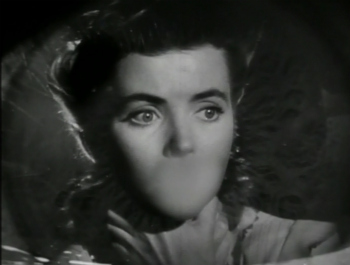
The imagery is potent, and the film isn’t afraid to occasionally go for the surreal. When Helen first returns to the Warren estate and is making her way up the grand central staircase, she stops for a moment to look into the mirror mounted on the landing (which will later make for some very cool angles in the chase scenes), and the camera crawls along the floor of the upstairs to reveal a pair of feet, letting us know that the killer is already in the house and is watching. As the killer watches, we see from their perspective that Helen has no mouth, and although the effect is rather limited, it’s still very creepy. Later still, when Parry has convinced Helen to run away with him, we get to see her imagine a brief, sweet courtship that leads right up to a wedding, the daydream turning into a nightmare when she is unable to say “I do,” as even in her fantasy she is unable to speak. 

Helen is a very cool final girl, and McGuire imbues a character who has no lines before the film’s final moment with a great deal of life and vivaciousness, conveying a lot through her body language and expressions. In one of the film’s most exciting moments, Helen is alone in the house with the killer as everyone else is dead, gone, imprisoned, or bedbound, and the constable comes to relay that Dr. Parry will not be returning that evening as he is attending a medical emergency, and Helen, in an upstairs room, beats against the window to get the lawman’s attention to no avail, and her desperation and frustration as he leaves are palpable. We see her playfulness with Mrs. Warren, her professionalism with Professor Warren, and her warmth and affection with Mr. and Mrs. Oates, and there’s a tangible difference in the way that she “speaks” to each of them. It’s damn fine acting work. The two best on-screen pairings are McGuire with Barrymore and McGuire with Lanchester. For the former, there’s an authentic sense of maternal warmth and protectiveness that Mrs. Warren has for Helen, and Helen seems to be the only person in the house whose company Mrs. Warren genuinely enjoys. With the latter, a lot of that is simply that Mrs. Oates is my favorite character here, and she was a delight every moment that she was present. Her rambling to Helen when she first returns home is quite fun, as is her antipathy toward her husband’s lazy dog. There’s a very fun bit in which she goes for her hidden brandy and finds it empty, to which Mr. Oates replies that he got rid of it because of her temperament. Later, when Professor Warren needs her help retrieving a bottle of brandy from the cellar, she fakes dropping the candle in order to steal another bottle for herself. It’s a helpful addition of some physical comedy to the proceedings while also setting up a scene later in which Helen locks her potential killer in the same underground room (and also a scene in which Helen is unable to rouse Mrs. Oates to help her with the killer as the older woman is passed out drunk). 

One thing that seems to be a point of contention is exactly when the film is supposed to be set. It’s clearly some time before the actual production date, as there is not a single automobile in sight, with characters riding around in horses and buggies. There’s no on-screen confirmation of an exact year, but Wikipedia lists it as 1906, as does TVTropes (although I assume the latter gets this from the former). Brode’s book lists it as 1916, and in fact makes some hay with the fact that this would have been right in the middle of the Great War, at a time when Freudian theory was becoming somewhat mainstream and that the film’s text is about Freudian themes of suppression and desire. It doesn’t really matter in the end, but thought it was worth mentioning, as I sometimes wonder where we get these “facts” about movies, and the way that something you might only learn in a now long-lost press kit have somehow been passed down as paratext and become unclear over time. 

-Mark “Boomer” Redmond

The Kid Detective (2020)

Several years back when I was working on a pitch document for a potential subversive cozy mystery series, I wanted my main character (a riff on Miss Marple) to have had a previous mentor relationship with a now-jaded adult who was formerly a child detective. I imagined her as a kind of Veronica Mars by-way-of Encyclopedia Brown, a character whose books were among some of my favorite reading when I was eight or nine. Even at that age, there was a simplicity to the brief mysteries, and it was always fun to try and figure out what the clue was that led Encyclopedia to his always correct solution, flipping to the “solutions” section at the back of the book to see if I had come to the correct conclusion. I had also very much enjoyed Joe Meno’s novel The Boy Detective Fails when I read it while in college. There’s something so fascinating about that archetype to me, perhaps speaking to the former gifted child in me, about a kid whose potential fails to pan out as an adult because they peaked too early in life. There was a 2009 film starring Donald Glover called Mystery Team that I remember trying and failing to enjoy when it first came out; it was more about adults stuck in their misdemeanor-catching adolescence, and the humor was a little too broad for me. I was hesitant to give Kid Detective a shot after the bad taste that one left in my mouth, but the Adam Brody of it all pulled me in, and I’m glad it did. 

When he was a kid, Abe Applebaum was the similar-to-but-legally-distinct-from Encyclopedia Brown of his quiet town. He figured out who stole the cashbox from the student fair, solved the riddle of missing jewelry, and even managed to solve a couple of majorish crimes. His youth was his advantage, as any time he had to hide in a closet when someone came home while he was searching their house, they found the situation cute rather than troubling. Eventually, the town set him up with an office, where the mayor’s daughter Gracie was his secretary and got paid in soda pop, but at age twelve, he lost all zest for his shenanigans when Gracie went missing. Although all of the adults in his life tell him that this is out of his league, he gets calls from his peer group asking when he’ll find her, and he carries that psychological weight into adulthood. Now, Abe (Brody) is barely getting by on the meager money he makes doing private detective work, sharing a rental house with a slovenly roommate and bickering with his current assistant, Lucy (Sarah Sutherland). It’s mostly still the same half dollar ante nonsense as when he was a kid—finding out if a kid’s classmate actually played with the Mets while on summer vacation, locating a missing cat—until Caroline (Sophie Nélisse, now best known for playing teenaged Shauna on Yellowjackets) appears in his office. Her boyfriend Patrick Chang was murdered, stabbed seventeen times, and she doesn’t feel like the police are doing anything. She wants Abe to solve the case. 

The actual mystery throughline in this one is clever, with red herrings aplenty and revelations that seem important in the moment but which end up leading nowhere, while smaller moments have greater implications down the line. That’s the basic art of the mystery misdirect, but comedic ones like Kid Detective are rarely woven so expertly. It turns out that Patrick was living a bit of a double life, as the Red Shoe Gang had started turning to the tactic of recruiting academic high performers to sell in school since they were above suspicion, and he had cheated on Caroline with an older girl. There’s also the presence of Calvin, Patrick and Caroline’s schlubby friend who has a strong crush on her, and he joins a pack of potential suspects that populates the film. Caroline is along for most of the ride, or more accurately is there to provide the ride, as she carts Abe around in a beige 1990 Chrysler LeBaron convertible so he can interview people. 

When reminiscing, Abe narrates that he used to lie awake at night wondering if he was the smartest person in the world. We do see that a large part of his solutions to the mysteries from his childhood were the result of the exact kind of (simplistic) deduction that Encyclopedia Brown would come to. E.B. would figure out that Bugs Meany had never actually hidden a dollar bill in the book he claimed to because he said he hid it between “pages 77 and 78,” which is of course impossible because those two page numbers would be on opposite sides of the same leaf. Abe does the same, naming a boy who was bitten by a dog the previous summer for stealing the school’s money because it was for animal welfare, and his apparent random deduction does seem to be correct based on the cashbox being found in the kid’s desk the next day. Abe has gone through his whole life like this, synthesizing scientific tidbits with questions that get people to think around their problems, like asking someone who had a piece of jewelry stolen at a birthday party who had the most cake, to determine who the burgled person subconsciously trusts the least. A lot of his leaps in logic, like that a person’s recent preference for bananas over peaches suggests a depressive episode because one fruit requires much less effort and cleanup, are far from “evidence,” but he gets things right just often enough that he’s decently good at his “job” despite the trauma and failure that haunt him. 

The first two acts of the film are comedically balanced. We establish who Abe is and that he’s still literally reaping the rewards of his past despite people’s general apathy toward him in the present, like still cashing in on the “free ice cream for life” that he was given at Old Mr. Hepburn’s sweets shop for something that he did as a child, despite Mr. Hepburn’s clear resentment of him. The scenes with Calvin are among the best. When we first meet him, he attempts to delicately tread around revealing some of Patrick’s indiscretions in front of Caroline, while also unsuccessfully concealing his crush. Later, he sneaks into Calvin’s family’s home while he believes that they’re away and ends up trapped in an upstairs closet in the younger sister’s room, where he ends up being caught while trying to escape after night falls and ends up branded as a pedophile. Another decent running gag is that Abe is so disconnected that he never seems to know what day of the week it is, breaking into people’s houses when he expects them to be at work only to be told that it’s Sunday. The only thing that doesn’t really work is the relationship that Abe has with his parents; there’s just something that’s a little off about the “You need to get a real job” paternalism that’s undercut when they follow him around while he’s following leads. 

In the third act, we take a pretty steep turn into the dark. There turns out to be a connection between Patrick’s murder and Gracie’s disappearance two decades prior that I didn’t see coming, although there were a couple of things that were already failing to add up for me. Patrick’s killing turns out to have had nothing to do with the Red Shoe Gang leads that Abe was trying to track down, but I won’t spoil it for you here. This is one that’s worth checking out, especially if you always wanted to be a kid detective, too. 

-Mark “Boomer” Redmond

The Wolf of Snow Hollow (2020)

When watching Last Stop in Yuma County last year, my viewing companion mentioned that he had quite enjoyed The Wolf of Snow Hollow, another vehicle for Yuma lead Jim Cummings. Cummings first gained recognition for his feature film Thunder Road, which was an extension of his earlier short film of the same name. I remember seeing the trailers for Thunder Road at the Alamo Drafthouse during that summer that MoviePass was acting as a real-life free movie hack, but its time in theaters was relatively brief and I still have not managed to check it out. Per some contemporary reviews citing Cummings’ character in Snow Hollow as merely a variation on the one that he portrayed in Thunder Road (negatively), that may be for the best, as I came into Snow Hollow with no expectations. 

The film opens on the arrival of a young couple to a short-term rental in Snow Hollow, Utah. After the two relax for a bit in the hot tub, PJ (Jimmy Tatro) goes into the house to shower (and grab the engagement ring with which he is about to propose) while his girlfriend turns off the hot tub, but she’s attacked by someone or something that tears her to pieces. The local police arrive, and it becomes clear that deputy John Marshall (Cummings) is covering for the failing health of Sheriff Hadley (Robert Forster in his final film role), who also happens to be his father. John’s dealing with other issues in his family life as well, as his ex-wife serves as a thorn in his side in his relationship with his teenage daughter Jenna (Chloe East), who is set to start college early that January on a gymnastics scholarship. Further, he’s an alcoholic in recovery, having been in AA for six years and sober for three. His fellow law enforcement officers are largely inept and lazy, pleading to let state or federal officials take on the investigation, and the only other person on the team with any real interest in stopping the killer is Officer Julia Robson (Riki Lindhome). Matters only get worse when another body pops up, this time with evidence that the victim was killed by “a wolf the size of a Kodiak bear,” and the local citizens start to wonder if there’s a werewolf in their midst. 

This is a neatly constructed little mystery, although I would have preferred if some elements of the mystery were played a little closer to the vest, or for longer. Early on, there are a lot of potential suspects for who might be the werewolf (or the serial killer, as John forcefully reiterates time and again). There’s a local dudebro (Marshall Allman) with whom PJ got into an altercation at a local watering hole over the former’s use of the f-slur; Sheriff Hadley’s medical complications may bely that his body is undergoing changes, as poor health can often be an indicator of lycanthropy in horror; the owner of the short term rental (Will Madden) is suspicious since we saw that the AirBnB had all of its knives removed at the start of the film, as if setting up a victim to have no way of defending themself; even John himself could be the “wolf,” since we see that he’s short-tempered, and lycanthropy could be used as an effective shorthand for the complete personality change that alcohol abuse brings on. Subversively, the film shows us a potential suspect whose name we never learn and only ever see from a rear or ¼ rear profile, and who mostly resembles PJ, whom we know can’t be the killer since we saw him in the shower while the first murder is committed. Later, this character dies of an overdose and, because of feasible but circumstantial evidence, the werewolf’s killings are pinned on him, but by this time we’ve seen enough of the actual killer to know that he’s still out there, even if we have yet to identify him. I was expecting the film to get a little more mileage out of the “Which characters have we met could the killer be?” a little longer, but this is still a mostly elegantly constructed mystery regardless. 

What doesn’t quite work is the way that John’s alcoholism is portrayed. After his AA self-intro that functions as his character exposition scene/thesis statement, every time that we see him afterward, he’s clearly a hothead. He pops off at the first crime scene, berates his subordinates (who, since they’re all deputies, are really his peers) at a diner, and screams at Deputy Chavez (Demetrius Daniels) at the second site where a body is discovered. We understand why he’s so stressed, but he’s not a man that’s barely holding it together in the face of tending to his ailing father while facing pressure to find a killer, and is a man who’s already experiencing outbursts of anger long before he falls off the wagon. In the midst of these pre-relapse tantrums is a sequence that actually works, when John meets his ex-wife and Jenna at a diner and the former works to elicit a promise that John will be able to be present at their daughter’s college orientation, and he remains calm and speaks directly to Jenna while clearly struggling not to lose his temper at his ex at the same time. After a second body is found, John finally digs out the beers he has stashed away in the top kitchen cupboard, but there’s very little change in the way John treats the people around him. 

Cummings has the face of a movie star from a different era; when you look like he does, you don’t have much choice but to put it up on a screen somewhere. When it comes to this particular performance, however, it remains pretty flat from start to finish, which makes it seem like he only has one setting, and that static nature of this character takes a little shine out of the movie’s luster. Where we do see some escalation from his drinking comes as he falls completely off the wagon. After collapsing on his oven door and shattering it before passing out in the detritus, there’s a scene in which Jenna comes home to find John passed out on the living room floor, and after some struggle she manages to get him upstairs and into his bed. John, completely inebriated, breaks down into barely coherent sobs about his failures while Jenna stands in the hallway begging and pleading through her own tears for her father to just go to bed, screaming that he’s scaring her. It’s harrowing, even more so than any of the murders or crime scenes we’ve witnessed. More than that, it proves that Cummings does have more than one performance style in him, and it just makes me wish that I had seen a greater degree of difference between John before and after his demons got the better of him. 

This is a fun little horror comedy (with occasional heaving helpings of drama) with a talented cast and good inspiration. There are elements of Jaws at play here as the police force finds itself under intense scrutiny and pressure in order to make sure that the town doesn’t miss out on its annual cash injection from ski tourism. There’s great ambiguity throughout about whether there really is a werewolf in Snow Hollow or if there’s a seven-foot serial killer using folklore and superstition to cover for their compulsions. There’s some fun misdirection throughout, as it at first seems that the connection between the victims has something to do with the elementary school that they attended, but this is either a subplot that was dropped or it’s an intentional red herring, and I’d say that the scaffolding of the story is otherwise solid enough that I’d vote it’s the latter.

-Mark “Boomer” Redmond

The Forbidden Photos of a Lady Above Suspicion (1970)

A couple Halloweens ago, I was costumed as a creepy teddy bear and dancing to loud electronic music over cocktails at R Bar.  Being a helpless cinema addict and not on the hunt for a Halloween hookup, I remember fixating on the muted, subtitled giallo that was screening on the walls of R Bar, fascinated.  My body may have been politely gyrating to the DJ’s set, but my mind was racing trying to figure out what gorgeous giallo oddity was providing the party’s background texture, since it was one that I had not yet seen.  Some light googling on All Saint’s Day led me to the typically poetic, overlong giallo title The Forbidden Photos of a Lady Above Suspicion, which soon enough mysteriously appeared on a used DVD at a local thrift store.  Is it the same copy they were spinning at R Bar?  Was I being stalked by a giallo?  What could this vintage Technicolor erotic thriller possibly want from me?  The answer, of course, was nude photographs.

In retrospect, it’s funny that of all the gialli in the world, the above-the-bar selection that Halloween night was Forbidden Photos, since it’s not nearly as pronounced of a Horror Film as some of the more obvious titles from a Bava, or a Fulci, or an Argento.  Director Luciano Ercoli is less of a household name because of that lack of horror fandom support, since this falls closer to the proto-erotic thriller end of the giallo spectrum than the proto-slasher end.  With an atypically focused script from Ernesto Gastaldi and a softly melodramatic score from Ennio Morricone, Forbidden Photos is relatively straightforward and emotional for a giallo – trading in throat slashings from a leather-gloved killer for amateur porno shoots & sadomasochistic acts of blackmail.   It’s stylish, swanky, sadistic and, ultimately, sad, with internal-monologue narration that invests in its female victim’s inner life more than most examples of the genre.

Dagmar Lassander stars as the tormented Minou, played with the sad, glassy eyes and stiff, vaulted wigs of a Cole Escola character.  While her wealthy businessman husband is away on a work trip, she is physically assaulted by a mysterious brute who claims to have evidence that her spouse is a murderer (through the ludicrous method of artificially inducing The Bends in a business rival, then staging their death as a drowning).  Drawn into the stranger’s web, she involuntarily sleeps with him to receive (and destroy) evidence of the murder in trade, then briefly becomes his “sex slave” once he produces photographic evidence of their tryst (i.e., her rape) which he again leverages as blackmail.  Seedy pornography seems to be the criminal’s livelihood, as he appears as a performer himself in illicit photos owned by Minou’s hedonist bisexual friend Dominique (Susan Scott, who steals every scene she’s in).  Only, he may not exist outside of the pornography at all. Minou quickly spirals as the master-slave relationship escalates until her blackmailer suddenly vanishes; she’s then unsure whether she’s being gaslit or losing her grip on reality thanks to her favorite snack & drink combo of cocktails & tranquilizer pills.  That mental breakdown is when the film fully tips into supernatural horror territory, finally justifying its Halloween Night background programming.

In his interview on the 2006 Blue Underground disc I picked up, Gastaldi credits Forbidden Photos‘s unusual sense of clarity & cohesion to Ercoli sticking to the narrative of his screenplay instead of using it as a flimsy excuse for whatever visual indulgence happened to catch the director’s attention that day, as was giallo tradition.  An incredibly prolific writer in his heyday, Gastaldi would know, having written over eighty produced screenplays – including such formidable titles as All the Colors of the Dark, The Whip and the Body, The Vampire and the Ballerina, and Your Vice is a Locked Room and Only I Have the Key.  If you’re looking for the version of Forbidden Photos that takes wild, stylistic swings at the expense of narrative & tonal control, I’d recommend Fulci’s maniacal erotic thriller The Devil’s Honey, which is much looser in its forced S&M plot.  Ercoli is more grounded & restrained in his approach, which means that this is the rare giallo where the reveals behind its central mystery (whether Minou is being blackmailed or experiencing a mental breakdown) actually matter to the audience, as opposed to being treated as a last-minute formality.

That’s not to say that Forbidden Photos is not dripping with classic giallo style.  All of its characters live in sparse, swanky houses, which operate more as minimalist art galleries than traditional homes.  When Minou reunites with her husband after her initial attack, he’s introduced through a pane of shattered glass, sharply calling his honesty & integrity into question.  When she first enters her blackmailer’s apartment, she has to peer into his seedy world through Lynchian red-velvet curtains, like entering a fairy tale realm through a theatre stage.  Her rape in that apartment is only visually represented in flashback, with the more salacious details punctuated by a severe “Chinese devil statue” that the brute keeps on display.  Even more important to the picture is Minou’s genuine sexual tension with Dominique.  Their first hangout together involves the two gal-pals browsing through a mountain of amateur pornography, much of it featuring Dominique herself.  Dominique is such an aspirational antidote to Minou’s torturous lack of confidence that you actively root for her not to be involved with Minou’s potential gaslighting plot, since the story would be much more satisfying if they could manage to stay “friends.”  I will not spoil the way that story turns out, but I think it says a lot that it’s a giallo with a mystery worth leaving unspoiled just as much as it’s worthy of being projected as a stylish Halloween Night mood-setter at a dive-bar dance party.

-Brandon Ledet

Who Killed Teddy Bear? (1965)

Who Killed Teddy Bear? is a 1965 neo-noir about a woman named Norah Dain who receives threatening phone calls from an unknown stalker, whose attentions escalate. You might not know that the identity of the stalker is meant to be unknown if you read virtually any synopsis, including the one that appears when you select the film on just about any streaming service where it is housed, or on the Google search results landing page. I’m telling you this now so you can avert your eyes as much as possible in navigating to watch this one, which I (mostly) recommend. 

Norah (Juliet Prowse, who was involved with both Elvis and Frank Sinatra at the same time in 1962!) has a small life, but it’s her own. She works at a discotheque as a DJ under the watchful eye of the world-weary but rapier-witted Marian (Elaine Stritch). It’s a job that occasionally means that drunken men try to get handsy with her, but it’s the kind of classy joint with not only waiters like Larry (Sal Mineo) but also hulking doormen like Carlo (Dan Travanty) to take care of men who get a little too familiar. On one such night, Carlo tosses a man into the alley, but gets slashed by the man when he turns his back, forcing Carlo, Marian, and Norah to go to the station to provide statements. There, Norah meets Lt. Dave Madden (Jan Murray), who appears to become interested when he overhears about the heavy-breather who keeps calling her at all hours. She continues to get these calls, and, until the midpoint, we are kept in suspense about who keeps making them. Could it be that the supposedly mute Carlo was being overprotective of Norah the night he was hurt, because he has his own interest? Could it be the slasher himself, who escaped into the night? Perhaps it’s soft-spoken Larry, who checks in on Norah whenever men pester her. It might even be Lt. Madden himself, who seems to become over-invested in Norah’s situation very quickly, and who is seen performing such odd behavior as listening to recordings of the calls. 

For the first half, the identity of the lecherous caller is hidden behind a series of interesting, noir visuals: a hand that seeks and finds a pack of cigarettes, only to find them empty and crush the package in a rage; gaussy shots of the man’s body as the camera’s focus renders his white-knuckle grip on the telephone in the foreground in stark relief; the corner of a mouth peeking around the jet black phone receiver, twisted in a leering grin. Although the implied sexual violence is palpable, there’s also something strangely erotic about the way that the film’s eye lingers on the killer’s muscular frame. Like a Grindr photo, he’s a torso without a face, and the way that he’s often almost-but-not-quite touching himself makes this feel like an under-the-radar muscleman flick. Both he and Norah are presented in states of undress, but in her case, the image is impersonal and detached, as we see her through Madden’s eyes as she changes, while the images of the killer’s body are intimate, almost first person, with no room for us to create a level of rhetorical distance between ourselves and the image. There’s something about it that reminds me of Dead Calm, where Billy Zane’s killer character is obviously dangerous and unstable, but also undeniably sexy, both in the text and the metatext. 

The film takes its title from a question asked by Larry’s sister Edie (Margot Bennett), a developmentally disabled young woman who he looks after. Her childlike innocence is framed as a foil to the worldly knowledge of Madden’s daughter, Pam (Diane Moore), who is younger but has learned too much about how the world and its dangers operate, both as the result of losing her mother to a random act of violence and from being too aware of her father’s work as he obsesses over criminal deviance. The men are likewise foils to one another, and although I won’t say who the killer is (or even if it’s one of these two), Madden is by far the more menacing to Norah. He’s hard-boiled and has a chip on his shoulder, and although that’s not an uncommon thing for a police character for this era and this genre, he’s boorish and pushy to the modern viewer. Despite the fact that his behavior ties this film to a certain place and time, there are many elements, especially in the cinematography, that feel very modern. There are multiple scenes in which Norah is followed around the city that are clearly shot from a moving car, which could easily be a normal tracking shot but because of its handheld-like camera movement, it creates a sense of unease as the audience is put in the point of view of her stalker, unless she isn’t being stalked at all. The scene in which the killer, in an attempt to purge himself of his sexual urges, wanders the streets of the city and stares into the windows of erotic bookstores is fantastic (as long as your brain hasn’t been completely broken by that Kath & Kim gay panic scene, which resembles this sequence). Where the film feels the most dated, however, is in its ending. Yes, Norah’s stalker does eventually get her alone and forces himself upon her, and it’s very distressing, before he meets his end at the hands of the police; this was, after all, the final year of the Hayes Code, so he must. But as a late-60s noir piece, there’s a lot to enjoy here, especially since this one often seems to end up on various free, ad-supported streaming services. It’s an oddball, but worth finding. 

-Mark “Boomer” Redmond

Missing (2023)

When I think of movie sequels that best their originals, what come to mind are the ones that go bigger, broader, and cartoonishly extreme, exploding the comparatively timid premises of their source texts – titles like Gremlins 2, Ghoulies 2, Child’s Play 2, Paddington 2, Batman Returns, and Magic Mike XXL.  In all of those examples, though, I still like the original films that preceded them, which is more than I can say for the volatile, twisty screenlife thriller MissingMissing is a spin-off sequel to one of my least favorite entries in the screenlife genre, Searching (a film that I should note Britnee reviewed very positively for this site back in 2018).  Searching wasn’t embarrassing in the way that lower-budget screenlife schlock like Safer at Home and Untitled Horror Movie can be, but I still resented it for cleaning up a trashy genre I love for its illogical technophobic fearmongering by turning it into safe, This Is Us-style melodrama.  Laptop-POV thrillers should prey on the eeriness of life on the internet, not act as tech-friendly advertisements that constantly reassure parents their terminally online children are actually doing okay.  It was basically Unfriended for the corniest of suburbanites, a perspective I was happy to see dropped in its much meaner, trashier sequel.

Missing improves on the Searching formula in practically every way, most of all in how it maintains a healthy paranoia around modern tech even while explaining why it’s useful (and in how it’s willing to put its characters in actual, sustained danger instead of just pretending to).  Storm Reid stars as the mouse-clicking, keyboard clacking internet detective du jour, a teenager who investigates the sudden disappearance of her mother—lost while vacationing in Colombia—from her laptop control room in California.  Missing‘s tone echoes the hokey schmaltz of Searching‘s parent-child melodrama, scoring its petty mother-daughter tensions with heart-tugging piano flourishes you’d expect to hear in an engagement ring jewelry store commercial.  Only, while Reid clicks away at the Ring cameras, location trackers, search histories, password workarounds, and username paper trails at her fingertips to solve the mystery of her mother’s disappearance, she’s revealing more than just the speedbumps & heartbreaks of modern familial bonds; she’s also cataloging the tools of the modern surveillance state.  The surface-level text of the film details the twists & turns of a Dateline-style “true” crime mystery and subsequent familial grief, while the glaring subtext is all about how deep privacy-invading technology has already seeped into our daily lives in ways we’ve learned to ignore, simply because it’s convenient.

One of the major things I love about screenlife thrillers (and one of the major reasons they’re dismissed as frivolous novelties) is their nimble ability to document of-the-moment trends in modern life online.  It’s something most other genres are scared to touch for fear of looking gimmicky or dated, despite computer screens accounting for so much of the visual data most audiences absorb on a daily basis.  There’s something fearlessly honest about engaging with that supposedly uncinematic imagery, but I also just like to imagine how incomprehensible screenlife aesthetics would be to earliest cinemagoers who were astounded by The Arrival of a Train at La Ciotat Station in 1896.  For its part, Missing doesn’t have many updates in modern screenlife to document, except maybe the frustrating ambiguity of Captcha challenges and the low-key hostility of a thumbs-up emoji.  It does have plenty notes about life outside of the computer, though, marking our cultural obsession with turning real life tragedies into true crime #content; zoomer teens’ uncanny savvy in navigating the back roads of social media; and our casual, collective acceptance of privacy invasion from vampiric tech-world capitalists.  On a more practical, immediate level, it’s most useful as a showcase for Reid’s skills as a young actor and editors-turned-directors Will Merrick & Nick Johnson’s understanding of screenlife’s unique visual language, since those three collaborators account for almost everything we see onscreen.  It’s a fun, well-staged mainstream thriller with just the right balance between social commentary, shameless sentimentality, and trashy what-the-fuck twists, when Searching only hit one of those three metrics.

-Brandon Ledet

The Last of Sheila (1973)

Swampflix readers, the internet has been essentially de-democratized. What I mean by that is that when you or I go online to look for the answer to a question or read one (1) article about a thing that we engaged with or enjoyed, we no longer get to interact with that article in a vacuum. Unless you’re VPN’d up every single time that you look for a movie review or try to purchase a replacement ice mold for the Rival snow cone maker that you purchased at an estate sale without realizing that it required a part that was not present, you’re going to start getting ads for snowball machines and your YouTube homepage is going to be flooded with think pieces and video essays about the film that you just wanted one critic’s viewpoint on. Well, that and advertisements and algorithmically driven content to make you stay on the platform longer, feel encouraged to interact with the content to drive engagement, etc. Like most Swampflix contributors, my interests are not fully in alignment with the zeitgeist, but every once in a while, they are; unfortunately, although that means that I was as excited about M3GAN as the culture at large was, discussion of her wasn’t omnipresent in the discourse of the YouTube channels that I haven’t blocked. But boy howdy did YouTube love that I loved Glass Onion. Amidst a deluge of clickbait bids titled “[Number] Things You Missed in Glass Onion!”, “All the Secret Connections between Knives Out and Glass Onion!”, and the like, I have to admit that I did encourage the algorithm just a little by watching videos that talked about the various films and TV shows that had served as inspiration for the film, because I go through periods where mysteries are all that I ever want to consume. Frequently cited as a major creative jumping-off point for the film was 1973’s The Last of Sheila

Helmed by director Herbert Ross and scripted by Anthony Perkins and Stephen Sondheim (the only screenplay credit for each), the film tells the story of film producer Clinton Greene (James Coburn) and his plan to take several of his friends on a pleasure cruise aboard his private yacht. Their voyage begins, presumably not accidentally, on the anniversary of the death of Greene’s girlfriend, Sheila, who left one of his parties in a fit and was killed by a hit-and-run driver mere blocks from his house. An avid player of games of strategy and wit, Greene has planned out a series of mystery nights where his guests will go ashore with a set of clues and split up to try and solve a mystery. Each person aboard is also given a card that is to be their “secret identity” for the game, and the first of these that we see as characters open their envelopes are things like “Alcoholic,” “Shoplifter,” and “Homosexual.” Further, each of his traveling companions was there the night of Sheila’s death: Christine (Dyan Cannon), a film talent agent who’s full of wit and flirtatiousness in that a 1970s showbiz liberated way; glamorous but troubled starlet Alice (Raquel Welch) and her current beau, another film agent named Anthony (Ian McShane), who’s forever angling to get more involved with the production side of film; faded movie star and giant of another age Philip Dexter (James Mason) who’s now stuck in undignified commercials for dog food; and Tom Parkman (Richard Benjamin), a screenwriter who’s been stuck doing rewrites on spaghetti westerns while his original work remains unsold and unproduced. The only person on the cruise whom we are explicitly told wasn’t there the night Sheila died isTom’s wife Lee (Joan Hackett), a kind but idle and neurotic heiress. The first night of the mystery game is largely a success, with half of the group getting to the secret while the other half is either too late or doesn’t try at all. On the second night, however, tragedy strikes, and when not everyone comes back to the boat, our cast of characters return to the site of the previous evening’s game and discover that someone from their number has died, under mysterious circumstances. 

Excited as I was to finally see this film, at a full two hours, it starts to feel its length in places. The site of the second night’s game is an abandoned monastery where the gang has to don identity-revealing robes and remain quiet until they locate the confessional in which Greene is hiding, which makes for a lot of fun as characters pass each other without we in the audience ever really knowing with whom they’re speaking or even if the characters know; unfortunately, this runabout through the monastery feels much longer than the ten minutes of screen time that it occupies and unfortunately telegraphs that a twist is coming. For the first hour of the movie, the omnipresent implication is that Greene has arranged some elaborate plan to discover which of his guests was Sheila’s killer, but a savvy viewer will know that there’s simply no time left in the runtime of the film to go through five more puzzles, and so there’s going to be a complicating factor at any moment. You’re not surprised by the second death, merely by who is the unfortunate corpse. I’ll be the first to admit that I might have been spoiled (or had a certain part of my brain atrophy while another part grew three sizes) by watching some 250+ episodes of Murder, She Wrote in the past thirteen months, so I could be stuck on that formula, but an hour in feels like an awfully late place to stick your midpoint murder twist. At the same time, there’s no fat to trim here, no extraneous beats that don’t reveal something relevant about character, motive, time, and secrecy, it’s just that the relevancy of all of these narrative moments is often revealed late in the game. 

If there are two performers who stand out to me, I’d have to name Cannon and Hackett. Every performance here is good, but Cannon is delivering a wonderfully understated performance as a woman who’s committed to living life as sensually and hedonistically as possible but whose dark past she regrets; she’s stunning. A whodunit like this doesn’t require the sincerity and humanity that she brings to her delivery of a monologue in which she confesses to having furthered her career by slipping some names to the HUAC, but it certainly elevates it. “Then those people didn’t work for a while,” she says. “Now they work. Sometimes I try and get them work. Sometimes I see them on the street and sometimes … they cross the street.” She tries to play off her guilt, but no one is convinced, least of all herself, and it’s magical. Also doing great work here is Hackett, whose frantic, nervous, chain-smoking Lee is clearly having a very hard time with all of this business right from the start as the only person aboard who doesn’t belong there, since she was hundreds of miles away when Sheila died. As the only person we can be assured isn’t a killer, she seems to understand the jeopardy of being on the boat with someone willing to cover up their hand in an accident that resulted in a death. After all, someone almost kills Christine by turning on the yacht’s propellers while she’s taking a swim; who’s to say there won’t be more “accidents”? The big stars are clearly supposed to be Mason and Benjamin, the actor and the writer, who take point on trying to spin out the narrative that would lead to the things that the group has uncovered and discovered—and let there be no mistake, they are both more than satisfactory, with Mason having the upper hand over Benjamin in the charm department—but it’s Cannon and Hackett that I’ll be thinking about weeks from now. 

Let’s talk humor. I’d be remiss if I didn’t mention that, alongside the performances, the other tempering element that helps the movie feel like it’s got some pep in its step when it gets a little slow is the film’s comedic wit. Before she can even get on the boat, Christine complains about the lack of a drink in her hand by declaring “My mouth is so dry they could shoot Lawrence of Arabia in it,” which I’ve found myself saying every once in a while over the years without ever remembering its origin (it’s the pull quote used for the film in Douglas Brode’s compendium—and my longtime companion—Edge of Your Seat: The 100 Greatest Movie Thrillers, where it ranks at 88th). Even the jokes that characters make that are supposed to be either unfunny or in bad taste within the text got a chuckle out of me, especially those that poke fun at Hollywood and celebrity culture. This includes Greene’s mocking of Tom’s body of work as a second set of eyes on Westerns by asking him to read from a section of Fistful of Lasagna (“or whatever it’s called”). Even if the references are a half century old now, the core truths in play keep the film feeling fresh, despite some major dissonance in other areas that it’s important to address: one of the characters is outed as a child molestor, which is bad enough, but the other characters don’t really seem to think that it’s a problem that needs to be addressed or even has a glimmer of an idea of reporting him to the authorities. If there’s one thing in this film that hasn’t aged well, it’s the casualness with which that horrifying little tidbit is dropped and the lack of reaction to it. 

Already, I’ve risked giving away too much of the plot of this one, so I’ll wrap it up. Stellar performances, creative misdirects and clues, and clever jokes stashed away in little corners more than make up for the times where the film feels like it’s dragging the bottom. Although you can rent this one streaming, I’m sure your local library has a DVD that’s probably got some fun extras and easter eggs on it, so why not visit them instead? 

-Mark “Boomer” Redmond