Dicks: The Musical (2023) 

Dicks: The Musical opens with a title card joking that the film bravely breaks new ground by casting gay actors as straight characters.  In reality, it breaks ground by being the world’s first feature-length movie Rusical, hitting the exact same braying, sarcastic tone as the musical theatre challenges of RuPaul’s Drag Race.  In this case, we’re watching a Rusical parody of The Parent Trap (a step up from the Footloose/Dear Evan Hansen matchup from last season, at least), in which non-related writer-performers Joshua Sharp & Aaron Jackson discover they are “fucking identical twins” as adult Big City businessmen and plot to restore order in their family unit by getting their estranged parents back together.  Those estranged parents are the ringers in the cast (give or take an extended cameo from Megan Thee Stallion as the twins’ nonplussed dominatrix boss): Megan Mullally as a kooky Manhattan shut-in and Nathan Lane as a closeted Manhattan drunk.  The film’s humor recalls the offensive-on-purpose musical theatre of Trey Parker & Matt Stone, but the effort to underline every line of dialogue with an explicitly gay sense of camp is pure Drag Race kitsch.  The Fucking Identical Twins stage show that Dicks is adapted from started as a UCB revue in the 2010s and, although still funny, feels dated at least that far back in terms of its equal-opportunity-offender sensibilities.

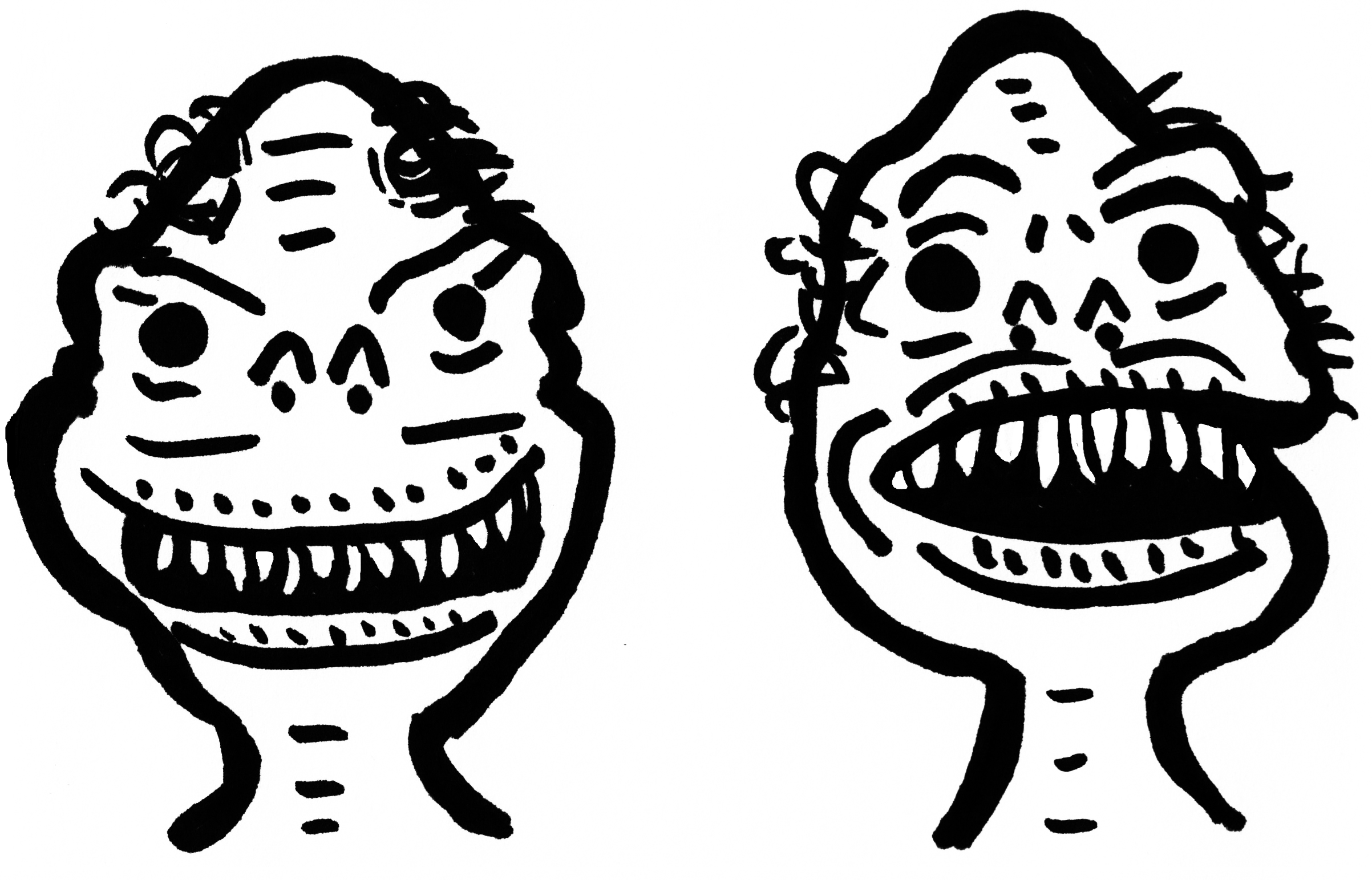
Okay, now that the big-picture premise is out of the way, let’s talk about The Sewer Boys.  Dicks is mildly, low-key funny throughout, but it stumbles up on one truly Great joke in the unholy creation of the subhuman characters The Sewer Boys.  During Nathan Lane’s big musical number about why his marriage to the twins’ mother didn’t work out, he breaks down exactly what it means that he is a gay man: he appreciates fine things, he has sex with men, and he loves his Sewer Boys.  He is, of course, referring to the small, diapered goblins that he keeps caged in his living room, periodically feeding them with premasticated ham.  Every detail about the sewer boys’ underground origins, grotesque physiology, and hierarchy within Lane’s unconventional family structure is outrageously funny and earns most of the film’s biggest laughs.  The little grey goblin puppets are on-theme with the movie’s larger project of queering up gay-musical representation too, as Lane equates their role in his life to Gay Culture™, as if every adult gay man in America keeps a couple Sewer Boys as pets at home.  It’s obvious that Sharp & Jackson knew they struck gold when creating The Sewer Boys as a tossed-off joke, since they keep returning to the boys’ gilded cage to mine more visual punchlines out of their wretched image.  It’s disappointing, then, that they didn’t just abandon the initial Adult Men Parent Trap premise they used as an improv thought exercise to instead refine the one great idea they discovered in the process.  This should have been Sewer Boys: The Musical from start to end.

In that way, Dicks feels like a wish granted by a cursed Monkey’s Paw.  I’ve found myself wishing in recent years that partial-musical comedies like Barb & Star and Barbie would just fully commit to being proper musicals, and when I finally get one, I’m frustrated that it wasn’t a musical entirely about its one great joke.  If anything, this might have even changed my mind about wanting to force Barbie & Star into a musical theatre format, since that medium doesn’t always serve Sharp & Jackson’s humor well.  Each song in the book starts very funny, but they have nowhere to go once the audience gets the joke.  There’s a punchline up front in each song that earns a genuine laugh, and then there’s three more minutes of song left to play out in full, based on traditional stage musical structure.  Even my beloved Sewer Boys never stop being funny, but once they’re revealed it feels anticlimactic to return to the foretold Parent Trap story beats as if reality had not just been broken.  I appreciate that Mullally is eventually given her own flying pet monster to help balance that out, and Bowen Yang’s performance as God eventually builds to a joke meant to offend anyone left unshocked in the room — an ambitious last-minute gamble.  Mostly, though, Dicks: The Musical is a little too predictable in its adherence to musical theatre song & story structure, leaving very little room for surprise once the audience catches onto each telegraphed punchline.  Only The Sewer Boys continue to surprise & delight throughout, and the movie is most recommendable for their ghoulish presence.

-Brandon Ledet

Robin Williams’s Undervalued Restraint in The Birdcage (1996)

Usually, when we praise comedians for their acting, it’s when they Get Serious in a dramatic role. When Melissa McCarthy goes dark for a Can You Ever Forgive Me? or Bill Murray dulls down his irreverence for a Lost in Translation, it almost feels like a cynical Oscars play – because those are the roles that get prestige-circle accolades. Robin Williams’s career is an excellent sample of this pattern, since the hyperactive goofballery of his comedy and the reserved vulnerability of his dramatic performances are at such drastically opposed extremes. Williams’s dramatic turns in grounded, sober films like Dead Poets Society & Good Will Hunting are paradoxically showy in their restraint, considering how starkly different they are from the frantic, coke-rattled mania of his comedic sidekick roles and his on-stage stand-up routines. His awards attention for those more somber, restrained performances practically register as a child getting a lollipop for good behavior.

If we’re going out of our way to highlight Williams’s finest roles as the ones where he’s most restrained, there is at least one frantic screwball comedy that belongs in the conversation: 1996’s The Birdcage. A collaboration between comedy legends Nichols & May (as director & screenwriter, respectively), an early credit for overachieving cinematographer Emmanuel Lubezki, and a remake of a popular French farce, The Birdcage has enough built-in prestige to appear Respectable in a way that other Robin Williams comedies like Mrs. Doubtfire & Death to Smoochy do not. More to the point, it’s a performance that explicitly asks Williams to tone it down and keep his flamboyance under wraps for the sake of the plot – a self-inflicted restraint that you can practically see is eating him alive as the rest of the world around him gets exponentially zanier. The Birdcage might just be the one movie where Robin Williams is the best-behaved adult in the room, and much of its humor derives from the fact that he so badly wants not to be.

The Birdcage is a traditional screwball comedy about a tense, disastrous dinner party in which a gay couple (Robin Williams & Nathan Lane) hide their true personalities from the straight Conservative parents (Gene Hackman & Dianne Wiest) of their child’s fiancée (Calista Flockhart). Ironically, Williams is cast as The Straight Man in this comedic set-up, a proud but accommodating nightclub owner who’s willing to tone down his eccentricities to appease his monstrous asshole of a son. His main job is to sweat & fret as the deception unravels from every direction. Meanwhile, other comedic performers are set loose to go as over-the-top as they please: Lane as a drag queen doing Barbara Bush schtick; Hackman as a cartoon exaggeration of Republican Party cruelty (one that’s only become closer to the truth in the past couple decades); Hank Azaria as a hot-to-trot houseboy; etc. It’s a rare instance where Williams sets aside his usual “Look at me! Look at me!” manic comedy to merely react to the buffoonery that surrounds him, and that silent frustration elevates every other performance handily.

There is one isolated moment in The Birdcage where Robin Williams is set loose to do his usual hyperactive child routine. In a scene where he’s choreographing a stage number for his drag club, he excitedly shouts the directions “You do Fosse, Fosse, Fosse! You do Martha Graham, Martha Graham, Martha Graham! […] Madonna, Madonna, Madonna!” while acting out each impersonation in pantomime. It’s a brief moment where his manic stand-up persona (later repurposed for the eccentric sidekicks he voiced in kids’ movies like Aladdin & Happy Feet) is allowed to invade the screen. For the rest of the runtime, he’s asked to keep that flamboyance in check, and the act of bottling it up is visibly crushing him in a consistently hilarious way. If Robin Williams’s acting chops are mostly going to be remembered & lauded in roles where he exercises a toned-down restraint that contrasts his over-the-top comedies, I think it’s worth singling out The Birdcage as a performance where we can see that self-discipline being practiced in real time. If nothing else, it’s a lot more fun to watch than snoozers like Good Will Hunting or What Dreams May Come.

-Brandon Ledet

Mirror Mirror (2012)

EPSON MFP image

onehalfstar

How many times do you allow a filmmaker to burn you before you stop coming back for more? Usually I’d allow a fairly long leash in these situations, but I have a feeling Tarsem Singh is about to really test my patience. Singh’s first feature, The Cell, is a fairly decent thriller that’s stuck with me over the years due to its intense, dream-logic visuals (a knack the director undoubtedly picked up from his music video/advertisement days). It was The Cell‘s follow-up, The Fall, that affords him so much patience form me as an audience. Easily one of the most gorgeous films I’ve ever seen in a theater, The Fall is a fantastic, visually overwhelming movie about the very nature of storytelling as an artform, a work that nearly outdoes the great Terry Gilliam at his own game. I can’t say enough hyperbolically great thing about The Fall, which makes it all the more confusing why not any one of the three Tarsem Singh features that have followed have piqued my interest. Somehow, each follow-up looked even blander than the last and I didn’t want to ruin the high note The Fall left me soaring on.

I recently ruined all that goodwill by checking in on Tarsem Singh’s most high profile work to date. When considered in the abstract, a big budget retelling of a classic Grimms’ tale would be a perfect follow-up to the grandiose fantasy dreamscape of The Fall, but Singh does so little to justify that optimism here. I’m honestly not convinced that he hasn’t been murdered & replaced by an imposter, possibly some kind of artificial intelligence from the future or an ancient human-impersonating monster. Mirror Mirror is Tarsem operating in the world of fairy tales (Snow White, for those somehow unaware), but it’s a dull, passionless work that could’ve been handled by any number of journeymen with a Hollywood-sized checkbook. Indeed, there are echoes of the film’s contemporaries like Maleficent and Snow White & The Huntsmen at work in Mirror Mirror, but I’d argue that even those far-from-prestigious comparison points far outshine this lifeless exercise. They’re at least occasionally fun. Even this film’s out-of-nowhere Bollywood song & dance ending was somehow more painful than delightful.

I’m not sure how closely Mirror Mirror follows the original Grimms’ tale, but I am sure that I don’t care to investigate. In this version (subversion?) Snow White carries a sword and saves her own ass from peril, which is presented as a big whoop, but instead bores to the point of cruelty. If I’m remembering correctly, I’ve seen a swordfighting, swashbuckling Snow White onscreen before on the impossibly cheesy ABC show Once Upon a Time and even they did a better a job of keeping my eyes open than this drag. I guess the film gets certain brownie points for at least attempting to subvert the damsel in distress dynamic of many (bastardized) fairy tales, but it does so with such a half-hearted non-effort that it’s hard to drum up any genuine enthusiasm for the content.

The true story of this film is the long list of suffering actors practically checking their watches as the running time slowly bleeds out. Nathan Lane looks especially pained in his boredom and, despite thanklessly giving the same endless charm he brought to his roles in The Social Network & The Man from U.N.C.L.E.,  Armie Hammer does little to lighten the mood. The most embarrassing turn of all comes from Julia Roberts, however, who fully commits to her role as the evil queen/witch, but fails miserably. Roberts toothlessly gums the scenery when the movie demands that she devour it. An over the top villain might’ve saved Mirror Mirror from total devastation but Roberts simply isn’t up for it & watching her try is admittedly a little pathetic.

I guess if I were to say one nice thing about Mirror Mirror I could point to its lavish costumes, which likely deserved the Academy Award they took home in 2013. As the costuming in The Fall was similarly striking, this one detail could maybe serve as a glimmer of hope that Tarsem Singh has at least one more decent movie buried deep within him somewhere, depending on how closely you want to look. Costume design is only one small piece in the larger, complex filmmaking puzzle, though, and I doubt the other Singh films I’m going to catch up with despite myself are going to fare much better, brilliant costume design or no. There honestly isn’t much hope left out there.

-Brandon Ledet