The Craft (1996)

Two of my childhood-favorite horror classics from the year of our Dark Lord 1996 screened at The Prytania Theatre this month: Wes Craven’s teen-slasher renaissance sparker Scream and Andrew Fleming’s teen-witchcraft charmer The Craft.  Of the two, I only made time to revisit the latter, where I had the pleasure of sitting behind a row of giggling college students who were enjoying it for the very first time.  Repertory screenings of The Craft are a much rarer treat than screenings of Scream (as evidenced by only one of those titles also playing at The Broad this month), which makes sense given the stature of Scream‘s director within horror nerdom and given that it is still being kept alive by endless discourse & rebootquels well into the 2020s.  Both movies meant a lot to me as a wannabe goth young’n who never earned his eyeliner wings, if not only because I was the perfect age to look up to their much cooler, slightly older teen protagonists when the movies were fresh arrivals on the shelves of my local Blockbuster Video.  My anecdotal research (scrolling through my Letterboxd follows’ flippant one-liner reviews) suggests that The Craft is considered the much lesser of the two works, especially in recent years, which is the exact opposite opinion that dawned on me while watching it on the big screen for the very first time.  As a kid, Scream was a great reference text for a laundry list of horror classics I needed to catch up with in future video store rentals, while The Craft was the full witchy power fantasy I desperately needed in my miserable Catholic school years – a substantial, self-contained work that required no extratextual viewing.  Among the two slick ’96 teen studio horrors currently enjoying victory laps around the city, my heart clearly belongs to coven; praise be to Manon.

Pitting these two enduring sleepover classics against each other is mostly a game of 1-on-1 performance match-ups.  Fairuza Balk is just as chaotically charismatic in The Craft as Matthew Lillard is in Scream, but she’s much better dressed – sporting mega-goth bondage gear instead of oversized sweaters from The Gap.  Neve Campbell is dependably lovely & solid in both, playing the genre’s most sensible Final Girl in Scream and the coven’s most vulnerable pushover in The Craft, where she cedes power to Balk, Rachel True, and Robin Tunney.  Skeet Ulrich is the deciding factor, then, putting in the performance of his career as a dopey puppy dog under a love spell in The Craft, which comes slightly ahead of his performance as a dirtbag psycho boyfriend with a horrid secret in Scream.  It’s unlikely that these names mean anything to anyone born outside the Millennial age range of 1981 – 1996, but I can confirm from first-hand observation that Skeet Ulrich’s performance in The Craft still kills with the modern teenage crowd.  The row ahead of me was explosive with giggles every time he showed up at Tunney’s feet, adorably perplexed over why he was so magnetically attracted to her despite his usual aloof bad-boy demeanor.  Of course, a lot of the film’s current entertainment value is rooted in nostalgia for 90s pop culture aesthetics, whether it’s the extremely dated teen cast or the tie-in CD soundtrack that includes artist like Jewell, Julianna Hatfield, Letters to Cleo, Portishead, Elastica, and Our Lady Peace.  Even on that end, I’d say The Craft has Scream beat, since it’s only invested in setting a traditional witchcraft story within that 90s pop arena instead of simultaneously cataloging & restaging tropes from previous missteps & triumphs in its genre.

When I say that The Craft doesn’t require extratextual viewing the way Scream does, that doesn’t mean I didn’t immediately go home to watch all of the Special Features on my ancient DVD copy as soon as I left The Prytania, so I could prolong the pleasure of the experience.  There were some fun insights in its promotional behind the scenes “interviews”, mostly in the cast’s recollections of Fairuza Balk’s contributions as a true-believer Wiccan bringing authenticity to the production (along with hired outside Wicca consultants) and in Rachel True’s observation that as the coven’s magical powers grow stronger & stronger, their skirts are hemmed shorter & shorter.  Mostly, my extratextual journey outside The Craft was a horrified scroll down Letterboxd lane, where I found a lot of complaints from cinephiles I usually trust about a movie I’ve always loved.  Most reviews among mutuals range from 1-to-3 star ratings, with a particular disdain for the third-act dissolution of the central teen coven.  It’s true that the “Fuck around” section of the movie is a lot more fun than its “Find out” counterpart, as that’s when we watch goth teen witches confidently strut down their Catholic high school hallways to 90s pop tunes in defiance of their school’s usual social power rankings.  Once all four witches have solved their very simplistic personal issues at home (racism, body dysmorphia, the powerlessness of poverty and, least significantly, crushing on a bully) through dabbling in dark magic, there’s nothing left for the movie to do than to show what happens when they take their magic powers too far.  It’s a political blow to idealists looking to The Craft for depictions of feminist solidarity (who would be best served skipping the ending entirely), but it at least opens the movie up to other themes besides the allure of power to teen-girl outsiders: addiction, fear of losing social stature, the willingness to cower behind an overly bossy leader for convenience, etc.

Speaking of extratextual viewing, what’s interesting to me about the complaints over The Craft‘s third act is that someone did attempt to correct its political issues in a modern revision of the film.  Zoe Lister-Jones’s recent soft reboot The Craft: New Legacy smooths out a lot of the original film’s rough spots in representation, feminist solidarity, and third-act resolution, mostly by giving its own coven an outside enemy to fight instead of each other (David Duchovny as an MRA warlock) and by putting their hunk-bully stand-in for Skeet Ulrich under a “woke” spell instead of a love spell.  It might be a more politically sound film, but it’s also a thoroughly dull one, mostly because its poorly lit, dialogue-heavy teen drama registers more like a backdoor pilot for a CW series than a legitimate Movie.  Say what you want about the original, but it at least has a sense of style, something the recent remake only approaches when copying the exact occultist-imagery graphics of the original’s opening credits as lazy homage.  The Craft‘s style happens to be tied to a very specific era in commercial filmmaking that I happen to be susceptible to nostalgia for, but it still looks fantastic.  It probably serves me right, then, to see this same story warped into an extremely dated generational touchstone for a different era of potential horror nerds, so I can see how generic one of my childhood favorites looks to people who it didn’t hit at the exact right time.  To me, The Craft: Legacy is cute but inconsequential, which is seemingly what most audiences also think of the original, even among my peers.  So, maybe I should shelve my argument that there’s more overt queer sexuality in the suggestive wagging of Fairuza Balk’s fingers during the original’s iconic light-as-a-feather-stiff-as-a-board scene than there is in the entirety of the deliberately inclusive Queer Representation remake.  I’m already risking sounding like an out-of-touch whiner about the good old days here, exalting the pop culture residue of my youth as if it were a sacred text.

-Brandon Ledet

Lost Junction (2003)

I don’t know about you, but when I find an aughts-era Neve Campbell thriller set in the hot, sticky depths of the American South, I expect it to be a knockoff Wild Things. A real trashy one. It turns out Lost Junction is more a knockoff of the Melanie Griffith matricide dramedy Crazy in Alabama, so it’s an entirely different kind of trashy. Instead of echoing Wild Things‘s audience-trolling triple crossings and poolside threesomes, Lost Junction offers trashy delights of a much weaker flavor: Neve Campbell struggling to master a Southern accent; an emotional plot-stopping monologue from acting powerhouse Jake Busey; a touristy road trip to pre-Katrina N’awlins; vintage CW visual aesthetics, etc. It’s rated R, but it’s Rated R for “Language,” since Campbell’s genteel Southern belle can’t stand to hear the gruff men in her life do a cuss, so they tease her with those cusses incessantly. I expected Lost Junction to be a Bad Movie; that’s fine. I just wasn’t prepared for it to be such a chaste one.

You’ll have to excuse my unusual lack of contextual bearings here. Lost Junction apparently did not exist prior to my stumbling across it at a local Bridge House thrift store, and only the thinnest of Wikipedia pages has had time to populate since that fateful purchase. To borrow some inane language from people who like to chat Avatar online, this film has no cultural footprint. It’s not even streaming on its obvious, destined home platform Tubi. The only reason a bad-taste loser would ever pick up a physical copy in the wild is whatever residual affection for Campbell as a screen presence still lingers so many decades after her Golden Age titles like Wild Things, Scream, The Craft, and Party of Five. There’s some small pleasure in seeing her do a half-speed Kristin Chenowith impersonation as the world’s most chipper femme fatale, but it’s not a good sign that Jake freakin’ Busey steals the show from under her with only a fraction of the screentime. By her tragic damsel’s own admission, she can’t cook, she can’t sing, she’s not that bright, and she’s kind of a prude. There’s not much to her at all outside her “Southern” accent and her off-screen history of domestic abuse. As a result, there isn’t much to the movie either.

Billy Burke costars as a generic Drifter With a Past who hitches a ride with the wrong dame, climbing into the Manic Pixie Murder Suspect’s car not knowing that her husband’s dead body is cooking in the trunk. Our star-crossed lovers meet in the first few frames, and although the film basically functions as a sunlit neo-noir, there isn’t much actual criminal behavior in their subsequent Bonnie & Clyde crime spree. The dead husband clearly deserved it, it’s frequently questioned whether Campbell actually did it, and most of the movie is a getting-to-know-you first date that happens to involve his rotting corpse (give or take a third-wheel intrusion from Busey). At least in Crazy in Alabama, Melanie Griffith took great transgressive delight in carrying around her husband’s head in a hatbox. Here, Campbell would rather just pretend that her husband never existed, which isn’t much fun for the (nonexistent) audience following along at home. The most incongruous cheeriness we get is in the impromptu road trip to New Orleans, where Campbell refers to our cemeteries as “neat little buildings” and the doomed couple dance at a bar called Gator Blues. It’s cute, but it’s not worth the commute.

While perusing her IMDb page to confirm that Lost Junction does indeed exist, I was shocked by how many films Neve Campbell headlined in the aughts. She basically disappeared from my radar at the close of the 1990s, outside occasional resurfacings as Sidney Prescott or as one of Don Draper’s anonymous hookups. It turns out there are plenty of post-Wild Things titles out there waiting to offer the sleazy Neve Campbell thriller that’s apparently missing in my life, titles like Intimate Affairs, Last Call, and When Will I Be Loved. Or, those are just more dusty DVDs waiting to prank me with eye-catching, tantalizing covers at the thrift store, only to reveal their overly demure nature once I take them home. I hope Jake Busey will be there as a third wheel to keep the mood light & chaotic, because there’s no way I’m going to avoid taking the bait a second or third time.

-Brandon Ledet

5cream (2022)

Every time there’s news about a new Batman, there’s a new wave of “[Actor] is my Batman” discourse (Kevin Conroy is mine, for the record). For me, a more important question is: Who’s your Final Girl? There are a lot of good contenders, but mine has always been Sidney Prescott, followed very closely by Nancy Thompson. I was so excited to hear about 5cream after it had been so long since Scream 4, and was eagerly looking forward to seeing it as if Sidney were actually an old friend of mine with whom I would be getting the chance to catch up. So, it’s a bit of a disappointment that it takes so long for her to show up here, which is further underlined by the fact that we never get to see the three main characters of this franchise reunite for, well, one last time. Gale Weathers (Courteney Cox) gets scenes with both Dewey (David Arquette) and Sidney (Neve Campbell), and Sidney and Dewey talk briefly on the phone, but the three of them are never on screen together. That’s kind of weird, right? 

It’s been twenty-five years since Stu Macher (Matthew Lillard) and Billy Loomis (Skeet Ulrich) killed seven people within a series of peculiar homicides that were modeled after murders in slasher films. In the decade and a half that followed, there were three copycat sprees: one based around the “rules” of sequels, another those rules pertaining to trilogies, and in 2011 at the height of remake mania, a murder bender pertaining to sequels, reboots, and the like. But it’s been a quiet ten years, and all of our favorite characters aren’t where we left them. Dewey and Gale split up and he’s living in a Woodsboro trailer park, mooning over Gale still as she hosts a NY-based morning show. Sidney’s as far as she can be from Colorado, living her best life, presumably, since she has no trouble going for a healthy jog without fear of being watched; and she even answers her phone when she gets a call from an unfamiliar number (I can tell you one thing, if I were Sidney Prescott, I would never have owned or answered a telephone any time after 2002). All of that changes when a young girl named Tara (Jenna Ortega) is attacked in her home by Ghostface, and we’re introduced to our conceit for this time around. 

You see, Tara likes scary movies, but only “elevated horror”: things like It Follows, The VVitch, and Hereditary (her favorite, she says, as it’s a “meditation on grief and motherhood”). But Ghostface doesn’t want to talk about that; he’s more interested in what she knows about Stab, the film series within the film series that began life as a “ripped from the headlines” horror flick about the killings in the 1996 original, and which had, by Scream 4, bloated to a seven-movie franchise which had long ago stopped pretending to be based on true stories. Aligning with tradition, Tara is forced to participate under threat of violence to someone she cares about, and she gets through the first couple of questions but gets tripped up by the third. Just as Barrymore’s Casey Becker fumbled and said that Jason was the killer in Friday the 13th (it’s actually Mrs. Voorhees), Tara says that the killer in the original Stab was Billy Loomis, as it’s a trick question—she forgot about Stu. In a break with tradition, Tara actually survives this attack, if barely; this leads to the return of her older sister Sam (Melissa Barrera) to Woodsboro, but as it turns out, that might have been the point. As it turns out, Tara and Sam have a connection to previous killings, and they’re not the only ones. Several people in Tara’s tight-knit group of friends are, as it turns out, with Heather Matarazzo returning for a cameo as Martha Meeks, Randy’s younger sister from Scream 3, now the mother of twins Chad (Mason Gooding) and Mindy (Jasmin Savoy Brown) with whom Tara is friends, as well as a reappearance of Judy Hicks (the always-welcome Marley Shelton), now sheriff of the town after having previously served as Dewey’s deputy in Scream 4, and her son Wes (Dylan Minnette) is also among their group. That’s not all, though, as we also have Amber (Mikey Madison), Tara’s best friend, as well as Chad’s girlfriend Liv (Sonia Ben Ammar). 

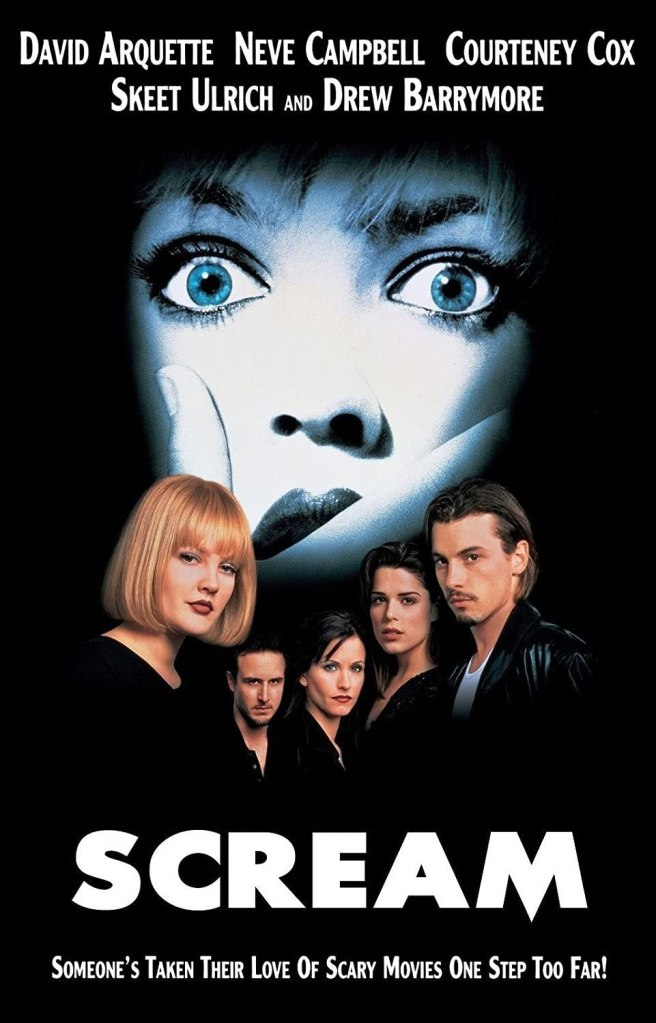
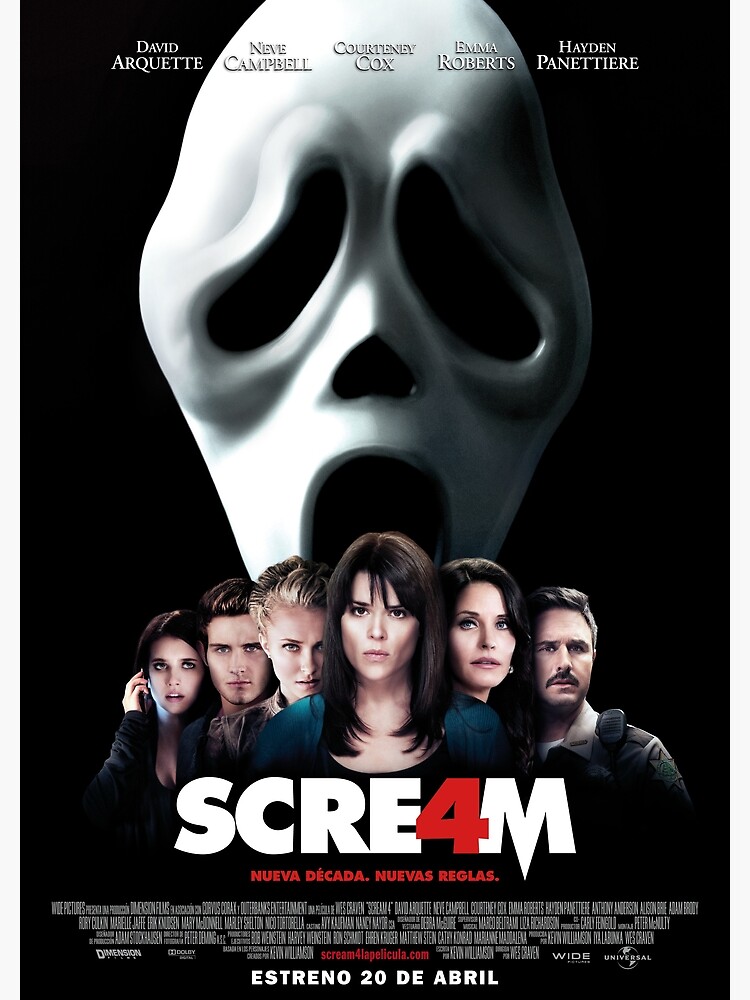
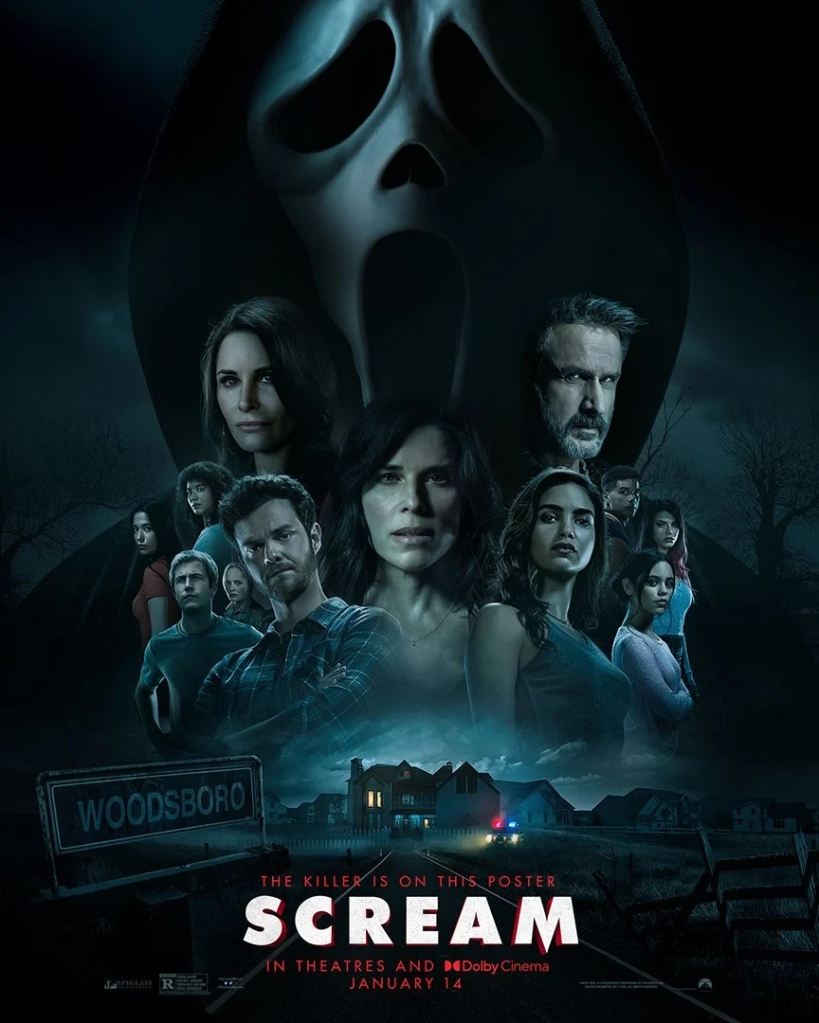
The biggest of the film’s flaws—beyond how little our legacy characters get to do and how late some of them appear in the screenplay (Gale doesn’t appear in person until nearly an hour in)—is that there are simply too many characters, and you can even see it in the poster. Consider the poster for the first Scream, which had five characters in total, including the three we would come to know as our principal characters in this series, but hyping up the appearance of Drew Barrymore, whose pre-titles murder is still the franchise’s defining moment. Then came Scream 2, which likewise limited its poster to five characters: the core three, Sidney’s new boyfriend, and (once again) the decoy lead who is killed off in the film’s opening. Scream 3‘s poster followed this trend with five characters, and then Scream 4 featured the first cast expansion to feature six: the three leads, and the would-be new Sidney, her boyfriend, and the new Randy Meeks. But the poster for this one has a full dozen people on it, and it’s just too many. 

I don’t want to be the one to complain that Kyle Gallner is here, since he was in both one of the most original horrors of the aughts and the most derivative remake of the same relevant time period (Jennifer’s Body and the remake of Nightmare on Elm Street, respectively), so he feels like a genre acknowledgement that belongs here; but he’s also the most frivolous presence, existing only to provide cannon fodder for Ghostface and cement the theory that the killers are targeting people connected to the original killings when it’s revealed that he’s the son of Stu’s (I believe) heretofore unmentioned sister. When Dewey recounts “three attacks” at the 30-minute mark, I legitimately turned to my friend and asked if there was an assault I was forgetting other than Tara’s attack and “the one at the hospital,” and had to be reminded that he had been there at all. Liv’s also the worst kind of red herring, in that though it’s true that she always seems to be conveniently elsewhere when a killing occurs, she also is such a non-presence that when she’s not on screen; you forget that she exists. It is a bit of a narrative catch-22, though, since there need to be killings of people outside of this friend group to provide clues about the killer’s selection process, but if you change the story a bit and have, for instance, Dewey gathering potential victims who aren’t as familiar with one another to protect them from Ghostface, then you kinda lose the friend group Screamness of it all. And, despite all of that, the first two people I first and most immediately suspected, which is both satisfying and a little deflating. 

It may seem like I have a lot of complaints, but I actually thoroughly enjoyed this one. It vaults over Scream 3 handily and lands just behind Scream 4 in the rankings. The reinvention here may actually be mpre clever, but it doesn’t feel as clever. The opening of Scream 4 alone was a fun, bizarre ride that really shook things up to the point where you weren’t really sure what the rules were anymore. The motive of the killings is fantastic; we learn early on that the previous year saw the release of Stab, which is actually Stab 8 (get it?), and that fans hated it—and from what little of it we see, with good reason. Stab has become a cultural phenomenon in Scream‘s world, and that world has now entered the era of The Snyder Cut, wherein groups of fanboys feel that the media belongs to them, so they want to course correct back to the “original concept” by enacting a new series of murders in Woodsboro to inspire the Stab franchise to return to its roots. It’s not as clever as “movies made us do it,” but it’s just as cohesive, and allows for one of the killers to deliver great lines like “How can fandom be toxic?” while holding a bloody knife.

-Mark “Boomer” Redmond

Scream (1996) is a Modern Horror Classic, but It’s Not Wes Craven’s Meta Masterpiece

When Wes Craven passed away in 2015, I commemorated the loss by revisiting what I’ve long thought to be his crown jewel, New Nightmare. The late-in-the-game Nightmare on Elm Street sequel is a meta reflection on the philosophical conundrums of the director’s own work. By creating the evil of Freddy Krueger in his fiction, what exactly was Craven unleashing into the world and what power did he hold over that evil once it seeped into public consciousness? This intellectual launching pad allowed the director, who appears as himself within the film, to not only lament & poke fun at the way his vision had been bastardized by the Elm Street series’ diminished returns sequels, but also to engage with the nature of Art & Horror as ancient societal traditions & metaphysical lifeforms all unto their own. It continues to surprise me that the Scream series that followed the trail of these meta-critical inquiries is generally held in higher regard than New Nightmare, despite their much shallower mode of self-aware criticism. 1996’s Scream is a modern classic that completely rejuvenated the teen slasher genre, altering the trajectory of mainstream horror as an art form for many years to come. Scream is a great film. However, its meta-commentary on the nature of horror isn’t nearly as philosophical or as ambitious as New Nightmare‘s, as it shifted Craven’s focus away from self-examination & towards the deconstruction of tropes.

I was very young when Scream hit theaters in the mid-90s, so the film served as my Rosetta Stone for a genre I didn’t know much about at the time, outside titles like Killer Klowns from Outer Space & The Monster Squad. Its hook is that it’s a slasher film where every character is highly aware that they’re living in a slasher film. Before setting in motion its A-plot hybrid of Prom Night & John Carpenter’s Halloween, Scream opens with a vignette homage to When a Stranger Calls. A (supposedly) teenage Drew Barrymore is harassed over her parents’ cordless phone by a masked, off-screen killer who grills her over the line about her favorite scary movies. Their verbal cat & mouse game escalates to real life violence in a trivia game about horror classics like Halloween & Friday the 13th. When Barrymore gets enough answers wrong, she’s brutally murdered. This opener has become more infamous than the film’s main plot in some ways, if not only for the shock that Barrymore is so easily discarded after featuring prominently in the advertising (which might in itself be a nod to Vivian Leigh’s role in the first act of Psycho). Scream’s main plot follows (a conspicuously twenty-something) Neve Campbell as she attempts to survive her final year of high school despite being stalked by the same serial killer from that opening vignette. As the killer’s catchphrase is “What’s your favorite scary movie?” and most of Campbell’s friends appear to be horror nerds (including a video store clerk played by Jamie Kennedy), Scream allows itself to name check nearly every classic horror title it apes in its own dialogue: Psycho, Carrie, Friday the 13th, Candyman, Basic Instinct, Prom Night, The Silence of the Lambs, the list goes on. The film even openly jokes about the declining quality in Nightmare on Elm Street sequels and features a brief cameo from Wes Craven himself as the high schools’ janitor, wearing Freddy Krueger’s exact sweater & fedora costume. Having since caught up with virtually all of these reference points in the two decades since I first saw this film as a child, these namedrops now play like adorably clever winks to the camera. In the mid-90s, however, that list was a doorway to a world of horrors I would take mental note of for future trips to the video store. It was essential.

As a more seasoned horror nerd, my appreciation for Scream has shifted away from its direct horror references to its broader deconstruction of slasher genre tropes. As fun as it is to hear characters reference The Howling as “the werewolf movie that has E.T.’s mom in it,” it’s much more rewarding to pick apart the mechanics of the genre while still delivering on their basic chills & thrills. Neve Campbell is immediately introduced to us as a virginal Final Girl archetype, wearing the girliest white cotton nightgown costume imaginable for a “high school senior.” Despite her self-awareness about that archetypal role in horror films, she lives out her Final Girl duties in a textbook manner. In one breath she’ll deride how it’s insulting that female horror victims are idiotic enough to run up the stairs instead of out the front door, then in the next breath she’ll allow herself to be chased up the stairs instead of running out the front door. Characters seem totally aware of the mistakes that get victims killed in slashers, warning each other not to drink, fuck, or say things like “Who’s there?” or “I’ll be right back.” Despite a verbal assurance that “This is life. This isn’t a movie,” the soon-to-be-victim teens make all of these exact mistakes anyway and immediately suffer the consequences. The movie is so aware of its own participation in well-worn slasher tropes that even decisions like casting twenty-somethings to play high school students feels like an intentional choice of self-parody when it could just as easily be a genuine participation in a Hollywood cliché.

Scream’s meta-commentary on the slasher genre is much more clever & trope-aware than New Nightmare’s earnest, philosophical stares into the metaphorical mirror. This may be a symptom of the Scream screenplay being written by Kevin Williamson instead of Craven himself, who was certainly doing a bit of career-spanning navel gazing with his New Nightmare script. As intricate & delightful as Scream’s self-awareness of its participation in horror tropes is for a lifelong fan of the genre, the film’s not nearly as impressive in its thematic depth as New Nightmare’s more metaphysical interests. The closest the film gets to reaching those New Nightmare heights is in a sequence where a newscaster van is watching hidden camera surveillance footage of a teen party on a 30 second delay, helpless to save victims who are unaware of the killer behind them, despite shouting “Turn around! Turn around!” at the screen. It’s as if the characters themselves are watching a copy of Scream in that moment, which is an interesting logical thought loop the movie creates within itself. Since Scream’s release, I do feel like I have seen a trope-deconstruction meta-horror that does approach New Nightmare’s philosophical ponderings; Drew Goddard & Joss Whedon’s The Cabin in the Woods does a phenomenal job of satisfying both ends of that divide. What’s interesting now is that in the decades since its release Scream itself has become a kind of cultural object worthy of nostalgia like the countless slasher titles it namedrops in its dialogue. It not only has been spoofed by the (godawful) Scary Movie series (as if a self-aware meta horror needed spoofing) & was followed by four of its own sequels, but its 90s-specific details have amounted to a kind of cultural time capsule. 90s telephone technology & fashion choices, along with callbacks to a time when Neve Campbell was the star of Party of Five and Courtney Cox & David Arquette were America’s goofball power couple/punching bag have all aged the film in a way that’s ripe for its own nostalgia. Even the mask design of the film’s killer, colloquially known as Ghostface, has become just as iconic as the killer visages of Jason, Freddy, Michael Meyers, and any other fictional slasher villain mentioned in the film. Scream may not be as philosophically curious or thematically ambitious as New Nightmare is in its own self-examination, but it has proven to be one of Wes Craven’s most iconic works in its own right instead of getting by as just an empty callback to the titles that inspired it.

-Brandon Ledet