The Not-So-New 52: Batman – Assault on Arkham (2014)

Welcome to The Not-So-New 52, your digital Swampflix comic book (adaptation) newsstand! Starting in 2007, DC Comics and Warner Premiere entered the direct-to-home-video market with animated features, mostly in the form of adaptations of well-received event comics or notable arcs. This Swampflix feature takes its name from the 2011 DC relaunch event “The New 52,” and since there are (roughly) fifty-two of these animated features as of the start of 2024, Boomer is watching them in order from the beginning with weekly reviews of each. So, get out your longboxes and mylar sleeves and get ready for weekly doses of grousing, praise, befuddlement, recommendations, and occasional onomatopoeia as we get animated for over fifteen years of not-so-new comic cartoons. 

For the first time since Superman: Unbound, we’ve got one of these movies that’s not part of the “DCAMU.” It’s not untethered from a pre-existing continuity altogether, however, as this one is, for all intents and purposes, deliberately invoked synergy between the animated direct-to-video films and the Batman: Arkham video game franchise. I’m not really familiar with those; I played through about 20% of the first game, decided it wasn’t really the kind of gameplay that I’m into, and never really returned to it. They’re popular games, critically and commercially, but I’m just not that into that much sneaking and stealthing. With that admission, I have no idea how this movie is supposed to fit into that continuity (Wikipedia has that covered for you, if you’re interested), and if there’s something I’m supposed to be annoyed about here because it contradicts this or that here and there, you’ve come to the wrong place for that bit of criticism. But as you can already tell from the star rating above, this one turned out a lot better than the last couple of times the studio plopped out a cross-promotional tie-in. 

The Riddler (Matthew Gray Gubler) is up to shenanigans, and Amanda Waller (CCH Pounder) has one of her black ops teams on murder duty, but Batman (Kevin Conroy) takes care of the situation and remands Riddler back to Arkham Asylum. This prompts Waller to put together—you guessed it—a Suicide Squad, to infiltrate the facility and reclaim a thumb drive in Riddler’s cane. Her recruits are Deadshot (Neal McDonough), Captain Boomerang (Greg Ellis), Black Spider (Giancarlo Esposito), King Shark (John DiMaggio), and Killer Frost (Jennifer Hale). Oh, and Harley Quinn (Hynden Walch), of course, and our sacrificial goon who gets his head blown off to prove Waller’s sincerity to the others is KGBeast, if you’re playing bingo at home. Harley lets herself get caught and taken to Arkham as part of the infiltration plan, but things are complicated by the fact that she and a thoroughly locked-down Joker end up interacting. This triggers her rage and ends up with her attempting to shoot him through the holes in his Hannibal Lecter-esque cell, which is only effective insofar as creating a tear on the inside of his cell that will allow him to escape later. There are plans within plans, of course, as one or more of the draftees may be there to “take care” of Riddler, and their competing agendas mean that there are going to be some changing loyalties throughout. 

This isn’t a Batman movie – not really. I’m not all that shocked that this falls under the “Batman” label, however, and not just because it’s extended universe (sigh) stuff for the Arkham games. There are (roughly) 52 of these, as noted in the introduction, and within those titles, “Wonder Woman” appears all of twice (3.8%), “Superman” ten times (19.2%), and “Justice League” thirteen times (25%). “Batman” appears in twenty titles (38.5%), and that’s all down to the fact that WB marketing knows what side of the batbread is batbuttered. Batman is around but this isn’t about him. This is a Suicide Squad movie, through and through, with a plot that, in some ways, both presages the much-maligned 2016 feature and pre-emptively improves upon it. There’s bound to be character overlap, of course, but the premise of this one is a lot more sensible; instead of sending a crew of mostly-mortal criminals who happen to have good aim to try and stop a magical apocalypse, here we’ve got a few different skill sets that are tasked to work together to pull off a heist, and some of them also have “assassination” in their specific dossier. When he does appear, Batman is working his own parallel investigation that periodically overlaps or interacts with the Squad pulling an Ocean’s to get into a vault. 

As when she voiced the character before in Public Enemies, Pounder once again proves that she was born to play Waller, although the character is reduced to being a bit more one-note and villainous than more nuanced portrayals since, in case you forgot, this is a video game tie-in. Walch is fun as Harley Quinn, who’s played comedically in this deadly serious world, which makes for a nice touch. Other characters get in on it, too, with the odd romance that grows between Killer Frost and King Shark drawing a few chuckles. Shark himself looks a lot like Venture Bros. character Baron Underbheit, which adds to the comedy, and when his head explodes, it seems that direct visual inspiration is taken from the goombas in the Super Mario Bros. movie. It’s a tad obvious from the outset that Joker will escape from his cell and complicate the plan, but there’s a lot of real tension in the helicopter escape scene. All of the fight scenes are decent, and the animation is nice and fluid. 

There should be no mistaking; this is a product first and a creative endeavor last, but it’s a product of good quality that ticks off all the right boxes. Conroy is Batman, forever (no pun intended) and always. If you’re looking for a fun little Suicide Squad story, this is well above the median. And the breakout scene where all of the villains get to show off a little is fun. There are worse Suicide Squads out there, even if this one only exists to milk a few extra dollars out of fans of the game series. 

-Mark “Boomer” Redmond

The Not-So-New 52: Son of Batman (2014)

Welcome to The Not-So-New 52, your digital Swampflix comic book (adaptation) newsstand! Starting in 2007, DC Comics and Warner Premiere entered the direct-to-home-video market with animated features, mostly in the form of adaptations of well-received event comics or notable arcs. This Swampflix feature takes its name from the 2011 DC relaunch event “The New 52,” and since there are (roughly) fifty-two of these animated features as of the start of 2024, Boomer is watching them in order from the beginning with weekly reviews of each. So, get out your longboxes and mylar sleeves and get ready for weekly doses of grousing, praise, befuddlement, recommendations, and occasional onomatopoeia as we get animated for over fifteen years of not-so-new comic cartoons. 

Canon is a funny thing. I think that for a lot of people and within a lot of media, what’s “real” in any long-running piece of fiction is whatever was the normal state of affairs when you entered the fandom. Whatever happens moving forward from there is just new stuff to enjoy or not. When something is added retroactively (usually referred to as “retcon,” as in “retroactive continuity”), it can be something really fun and new and interesting, or it might end up being a big pile of steaming garbage. For the former, my favorite comic book character of all time, Jessica Jones, was completely retconned out of nothing for the series Alias (no relation) because Brian Michael Bendis wasn’t allowed to use Jessica “Spider-Woman” Drew for his noir detective series, so he had to make someone up. For the latter, my go-to example is the 2003 retcon that Chuck Austen introduced in an X-Men storyline entitled “The Draco.” This arc “revealed” that beloved character Nightcrawler was actually half-demon and his entire years-long arc of coming to terms with his faith and becoming a member of the clergy was actually a manipulation on the part of a group that sought to “unveil” his “demonic” form in concurrence with a technologically-induced rapture once they were able to elevate him to pope. Everybody hated it, no one accepts it as canon, and we’ve probably had two or three more retcons since then. As an example of changes that have gone back and forth for better and for worse, there are the characters of Quicksilver and the Scarlet Witch, who were initially introduced merely as members of Magento’s Brotherhood of Evil Mutants before being revealed to be his children (good), before they were again retconned to not only not be his children, but to also not be mutants at all. Why? Because the characters had been members of the Avengers at one point, and thus were shared between Disney’s ownership of MCU-related film rights and Fox’s then-independent ownership of X-Men-related film rights, and Disney, like a toxic parent in a shared custody situation, flexed their muscles to get the source material to change. 

I have to admit that I struggle with this myself, with the particular way that my brain functions meaning that I’m in conflict between being (a) resistant to big changes, (b) appreciative of new angles that make for a more interesting story even if it’s not in alignment with what I’ve believed before, and (c) annoyed by changes that conflicts with what we already knew. Where I was worst about this (and where I’ve been forced to grow the most in how I approach the material) is in the Star Trek franchise. My weird little prepubescent brain accepted the aesthetic differences between my contemporary present and the original series without question, but by the time Enterprise rolled around, I was of just the right age to take offense at and get too caught up in complaining about its “too modern” look for a prequel series. It’s been over two decades since, and the large and amorphous continuity of Star Trek has just gotten bigger and more difficult to contain in the intervening years, and at this point, I don’t care how neurodivergent you (and by “you” I mean “we”) are, sometimes you just have to let go. 

This is all a long-winded introduction to talk about my feelings about the ways that the story of Batman changed over the course of my life. When I was a kid, Batman: The Animated Series was Batman, with the occasional sighting of an episode of the Adam West sixties series when I was at the home of a relative who had cable. All of the things that are “Batman” to me are caught up in that series: the faithful loyalty and acerbic wit of Alfred, the partnership of a Robin, the unresolved romantic/sexual tension with Catwoman, the rivalry with the Joker, the presence of a large, consistent rogues gallery (Mr. Freeze, The Riddler, Penguin, Poison Ivy, Two-Face, and second-stringers like Clayface, Scarecrow, and Mad Hatter), and an eventual Batgirl. But when you’re talking about a story continuity that was already six decades old at that point, all of those elements had to have been introduced as new at some point, and, as it was ongoing, it was never going to remain static and unchanging at that point. In fact, the character of Harley Quinn, who is now one of the most recognizable and well-known DC characters in the mainstream, was created for and introduced within BTAS, and although she’s beloved by now, I’m sure that there were cranky gatekeepers at the time who hated her introduction. New live action films continued to be made, and their effect on the landscape of the comics and their affiliated media would echo across the narrative topography, and those reverberations would then end up in the new adaptations, symbiotically. It’s impossible to know which ones are going to be a flash in the pan before being rejected and never referenced again (see above re: demon Nightcrawler) and which ones will “take” and stick around. When the whole “Court of Owls” thing (a secret society of rich Gothamites going back generations who influenced the city) was introduced in 2012, I didn’t think it would stick around, but given that it’s now associated with Bat-lore in the public consciousness because of Fox’s Gotham, it’s probably here to stay. Even before that when Damian Wayne, Batman’s son via Talia al Ghul, was first introduced in comics in 2006, the obvious expectation was that he would prove so unpopular that he would be written out as a character and written off as a failed ploy, but here we are, nearly twenty years later, and it looks like he’s here to stay, too. 

Son of Batman opens on the island fortress headquarters of the League of Assassins, headed by Ra’s al Ghul (Giancarlo Esposito). Under his grandfather’s tutelage, young Damian (Stuart Allan) is being trained to one day replace Ra’s, all under the watchful eye of his mother, Talia (Morena Baccarin). Under the cover of night, spurned pupil Deathstroke (Thomas Gibson), who was previously being groomed to become the new leader of the League before Damian’s birth, has returned for revenge. Ra’s is critically injured and, unable to make it to the Lazarus Pit that has so prolonged his life, dies. In order to seek out her father’s killer and find her revenge, Talia leaves her son with his father, whom she knows is both Bruce Wayne and Batman (Jason O’Mara), under the care of the hero and his butler, Alfred (David McCallum). Gotham is less of a safe haven than expected, however, as this is also the home of Dr. Kirk Langstrom (Xander Berkeley), a scientist who has been working on a serum that will turn League assassins into bat hybrid creatures known as “Manbats.” When Langstrom and Talia are both captured by Deathstroke, it’s up to Batman and former protege turned independent hero Dick “Nightwing” Grayson (Sean Maher) to find them and stop Deathstroke, with young Damian as the newer, less morally clear Robin.

This is a good one. The animation is crisp, the designs are clean, the contrast is extremely well done. Scenes in the day are suffused with light, and the more frequent night scenes have a slight moonlight glow to them. It’s carried over from Justice League: War, of course, but it’s nice that it’s consistent here, and this slots into the same art style as that film without looking identical to it, which is a nicer touch than I was expecting from this ongoing series. The fact that this is supposed to be a new timeline that’s still in the early days of the emergence of heroes continues to be a bit of sand in the shoe, as the previous film made it seem like Batman had only been on the scene for a couple of years at the most, while this one now establishes that he’s been at this long enough that he’s already had one young sidekick graduate to start his own enterprise. It’s also strange that this series would decide to kill off Ra’s al Ghul so early into this franchise (only the third film now if we count Flashpoint Paradox, and the first to focus on Batman primarily), it seems very sudden and early to get rid of one of the Bat’s most important foes, and means that any attempts to graft other adaptations of stories into this continuity may have to compensate for his absence. 

Still, that’s not this film’s problem. It’s good! Not special, really, but good, definitely above the median of quality in this overall franchise so far. I ended up making yet another long-winded introduction and a comparison to Star Trek (two of my specialties!) all up top because, really, there’s not that much to say. I’ve listed what I didn’t like above, and it’s mostly minor stuff that relates to continuity, and which most people probably wouldn’t care too much about. What there is to like isn’t so groundbreaking that it requires description, either; the fight choreography is very good, and the more ninja-style action is a real standout when most of these fights are all about punching while flying, eye beams, and occasional Amazonian hand-to-hand content. Damian has a lot of potential for his petulance to be extremely annoying, especially when he has a nepo baby’s sense of smug entitlement coupled with no real qualms about committing straight up murder because of how he was raised. Instead, he’s not only tolerable, but occasionally even likable, when he isn’t being a twerp about how effeminate the original Robin costume was. 

I might have been wrong about this new continuity within the larger franchise. I’ve seen a few of the others and although I don’t remember disliking them, I don’t remember them being particularly memorable, either. I guess we’ll just have to wait and see.

-Mark “Boomer” Redmond

The Not-So-New 52: Justice League — War (2014)

Welcome to The Not-So-New 52, your digital Swampflix comic book (adaptation) newsstand! Starting in 2007, DC Comics and Warner Premiere entered the direct-to-home-video market with animated features, mostly in the form of adaptations of well-received event comics or notable arcs. This Swampflix feature takes its name from the 2011 DC relaunch event “The New 52,” and since there are (roughly) fifty-two of these animated features as of the start of 2024, Boomer is watching them in order from the beginning with weekly reviews of each. So, get out your longboxes and mylar sleeves and get ready for weekly doses of grousing, praise, befuddlement, recommendations, and occasional onomatopoeia as we get animated for over fifteen years of not-so-new comic cartoons. 

Right off the bat, this one starts out a lot stronger than its predecessor, although its differences from it only further ask the question of why Flashpoint Paradox was made in the first place. The art design is miles better, with the character models looking much more slick and complete, and it has a pretty strong opening. Right off the bat (no pun intended), we are introduced to Green Lantern (Justin Kirk) as he pursues an apparent kidnapper that has been construed with the supposed Batman, who most believe to be an urban legend. Rescuing the kidnapping victim from her would-be captor, he unmasks what turns out to be some kind of alien monster, only to be joined by the real Batman (Jason O’Mara). The scene counterbalances exposition with some fun new character work as these two meet for the first time, showcasing Hal’s brashness and sarcasm while allowing him to demonstrate his powers and explain their function and form to Batman, who in turn demonstrates his own newly-playful mystique and the deftness that allows him to play in the same league (pun intended this time) as people with superpowers, when he manages to lift the Green Lantern ring without Hal’s knowledge. 

Elsewhere, we get our character introductions to others, some of which are intertwined. Young Billy Batson (Zach Callison) sneaks into a football game to see his hero, Vic Stone (Shemar Moore), ending up sitting in the seat reserved for Stone’s scientist father, Silas (Rocky Carroll). Dr. Stone, as usual, is too preoccupied with his work to take any interest in his son’s athletic achievements; his most recent object of obsession is a seemingly alien device that was delivered to him by the Flash (Christopher Gorham) sometime before the movie began. The device is identical to the one that Batman and Green Lantern were able to obtain from the alien that they pursued in the film’s opening, and which they have taken to Metropolis in order to get more information from the only other alien they know of, Superman (Alan Tudyk). Meanwhile, unconnected to anyone else, Wonder Woman (Michelle Monaghan) finds herself in Washington en route to meet the U.S. President when her motorcade encounters protesters; she initially offers to lend her support in taking action against the person that they are chanting about, only to discover they are carrying an effigy of her. Using her lasso, she compels the leader of the protest to explain why he really hates her, and he is forced to admit that he dresses up as her in lingerie to make himself feel powerful. After she tries some ice cream, she learns that the President will not be able to see her. 

This seems as good a time as any to point out that this film has a pretty decent sense of humor, and I appreciated that. Most of the time, when these movies have succeeded, it’s been because of the depth of their dramatic elements, and rarely because they were able to make me laugh. It’s interesting that this was the first real attempt by the DC animation division to create an MCU-style interconnected franchise and came out a few years prior to the 2017 cut of Justice League, and it shares some plot elements with that one – notably, that the villain is fromApokalips, uses Parademons as foot soldiers and Mother Boxes for his plans, and that we see Victor Stone turn into Cyborg over the course of the film as fallout from said Mother Box. Also like that film, it’s also attempting to echo some of that MCU-style jokey dialogue, but to much better effect than the live action adaptation. Not all the jokes land, and the ones that really don’t are mostly references to contemporary pop culture, like Green Lantern initially japing/probing to see if Batman is a vampire by referencing the in-universe product from which True Blood took its title. There are even references to TMZ and World of Warcraft, with the latter invoked in order to tease Darkseid, the film’s villain, for his silly name. 

What does work are the interpersonal touches. Batman and GL get off on the wrong foot at the beginning of the movie, and their sniping at each other as they work together usually features the latter moaning about having to deal with the former. Later, when they are joined by Flash, GL immediately tries to ingratiate himself with the speedster, attempting to do an awkward series of secret handshake segments that Flash could not give less of a shit about. When Flash then fanboys upon learning that Batman is real, Lantern tries to play off that the guy is a tool, only for Batman to recognize Flash as a peer, telling him that he does “tight, efficient work” and that shaking his hand, much to GL’s consternation. It’s not groundbreaking intercharacter work, but it is fun. Cyborg’s puzzlement over why the Shazam (Sean Astin) is so interested in partnering with him, in conjunction with Shazam’s apparently adult form fawning over his child alter ego’s hero, also makes for a nice dynamic. There’s also a fair amount of decent physical comedy as well, with one particular standout being the sequence in which an overzealous Lantern is backhanded by an unimpressed Darkseid, then is immediately jumped by a couple of Parademons, who just start kicking him like he went down in a schoolyard fight. 

And now for a few one-off notes that I took while watching this one. It’s funny to think of this one as being considered to be a direct continuation of Flashpoint Paradox, taking place in the new timeline created by all the tiny ripple effects left over after Barry tried to fix the timeline in that one. For one thing, Barack Obama was definitively the POTUS in the timeline where Atlantis and the Amazons were at war, with the implication he was president before Flash went back in time, but in this new timeline, he’s replaced by a generic white prez. It’s also funny to me that Diana gets so bored of waiting to meet him that she decides to just bail and get ice cream, given the current president’s fondness for it (he loves it almost as much as genocide and rolling over to show the GOP his soft underbelly). I also really enjoyed the way that Superman and Batman first meet here, with their fight being about as one-sided as you’d expect before the latter stops his god-tier opponent by simply whispering “Clark,” showing immediately that he’s not to be trifled with. 

Overall, I enjoyed this one a lot more than I was expecting to. There are parts of it that are so familiar that I can’t help but wonder if I already saw this one or just consumed the comic it adapts or the movie with which it shares so many narrative elements. I can say that I don’t love that the threat that they team up to defeat is Darkseid. I know that’s an artifact of Justice League: Origin, the comic on which this is based, but hitting the ground running with Darkseid as your primary villain still doesn’t quite sit right with me. That’s the kind of thing that you should build up to. Still, this one was actually quite a lot of fun, which was a nice surprise after Flashpoint Paradox. I’m hoping the quality holds.

-Mark “Boomer” Redmond

The Not-So-New 52: Justice League — The Flashpoint Paradox (2013)

Welcome to The Not-So-New 52, your digital Swampflix comic book (adaptation) newsstand! Starting in 2007, DC Comics and Warner Premiere entered the direct-to-home-video market with animated features, mostly in the form of adaptations of well-received event comics or notable arcs. This Swampflix feature takes its name from the 2011 DC relaunch event “The New 52,” and since there are (roughly) fifty-two of these animated features as of the start of 2024, Boomer is watching them in order from the beginning with weekly reviews of each. So, get out your longboxes and mylar sleeves and get ready for weekly doses of grousing, praise, befuddlement, recommendations, and occasional onomatopoeia as we get animated for over fifteen years of not-so-new comic cartoons. 

Well … it’s come to this. This feature takes its name from the 2011 reboot of DC comics, The New 52, and if you’ve learned anything from reading these “issues,” it’s that each reboot of the comics requires a “crisis” event in order to reset everything and create a new, “fresh” jumping on point. For The New 52, that crisis was called Flashpoint, and it involved Barry Allen’s version of The Flash traveling back in time to prevent the death of his mother, only to return to a present so altered from his experience that things are worse for everyone else. Sure, his mom is alive in the present, but his wife is married to and has had children with another man, he is without his powers, and several key players in the ongoing preservation of mankind are absent or so altered that they are barely recognizable. If this sounds familiar to you, then maybe you read this comic, or maybe you watched the third season of CW’s The Flash, which adapted parts of this story, or you saw the disastrous Warner Bros release of The Flash last year, which also featured parts of this plot. For something so recent, it’s been picked apart and reused in quite a few adaptational ways. And hey – that’s fine! The source material isn’t the problem with this movie, it’s just that I hate the animation in this one, and I really despise that this was the first step in DC’s attempt to create a more interconnected universe (sigh) among these DTV features, which had heretofore been standalones or duologies. You see, this is the first film in the “DC Animated Movie Universe™,” and that series will encompass sixteen of the next twenty-four of these movies, with up to three or four of them being released in succession before they throw in the occasional standalone to break things up. I have a feeling we’ll be desperate for them when the time comes. On your mark, get set, I guess. 

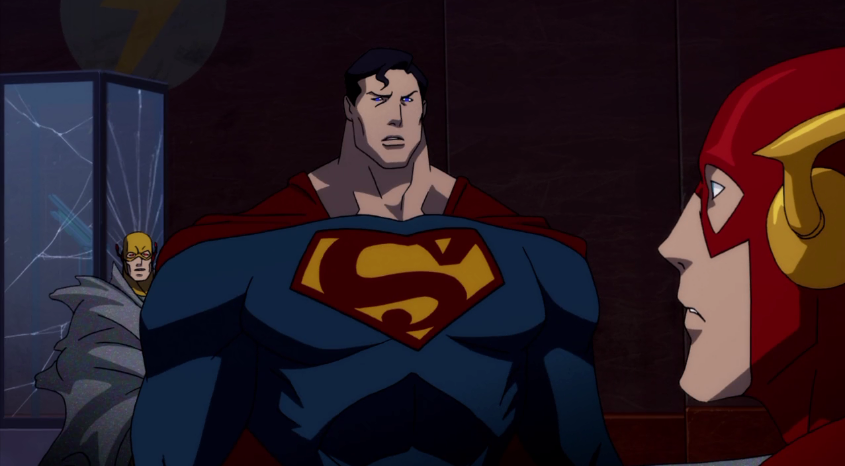
We open with a brief prologue in which we establish the relationship between child Barry Allen and his mother, including her teaching him the so-called “serenity prayer” as a kind of proverb, followed by him discovering her murdered body after school one day. From this, we transition to present day, where Barry (Justin Chambers), accompanied by his wife Iris (Jennifer Hale), leaves flowers on his mother’s grave and says that he wishes he could have been fast enough to save her that day; Iris reminds him that he was only a boy, and if he had gotten home any earlier, it’s likely that he would have been murdered as well. This discussion is interrupted by news that several of Flash’s rogues have gathered at the Flash Museum in order to destroy his legacy; he arrives to face off against the Top, Mirror Master, Heat Wave, and Captains Boomerang and Cold. He handles them all with relative ease until the arrival of Eobard Thawne (C. Thomas Howell), aka the Reverse Flash, who manages to cement him onto a wall and attach a bomb to him. He also reveals that he’s put bombs on all of the other rogues present, and that’s when the rest of the Justice League arrive, and boy oh boy, are they ugly as shit. Their proportions are all out of whack in a way that I think is aiming to be anime-esque but is really just hideous. I mean, look at Superman here: 

His insignia is three times the width of his face, and his shoulders are 8.5 times as wide as the widest part of his jawline. For comparison, when drawing the human figure in proportion, most artistic instruction tells the artist to draw the shoulder line as twice the length of the height of the head, or three times as wide. Superman’s shoulders here are almost double that, at 3.75 times his head height and 6.92 times his head width. I know that some of this is a matter of artistic license or preference, but I would prefer not to look at this; it’s fucking hideous. If we’re being charitable, we can say that this is probably to provide greater contrast to how emaciated and weak his alternate self will appear in the other timeline (spoiler alert), but I hate it, and it puts as much of a sour taste in my mouth about his new film “series” right from the get-go, both the first time I saw it and this time as well. 

Anyway, after they disarm the bombs and Thawne is taken into custody, he says some creepy shit and we head into the opening credits. When we re-emerge into the film proper, Barry wakes up at his desk to find that things are not quite as he remembered them; his boss asks him for an update on the case of the Elongated Kid being murdered rather than the Elongated Man, a TV news report shows a “Citizen” Cold fighting off Captain Boomerang at the Cold Museum, and oh, yeah, he doesn’t have his powers, and his mother is alive. He tries to tell his mom that he’s the Flash, but she doesn’t have any idea what he’s talking about. Elsewhere, a more grizzled Batman (Kevin McKidd) has no problem using guns or throwing his enemies off of buildings to their deaths, although his attempted murder of a villainess is interrupted by Cyborg (Michael B. Jordan, wasted in this role). The younger hero attempts to recruit the Bat into joining the squad that the former is attempting to put together—and in so doing exposits the greater context of what’s happening in this new reality—in order to end the war between Atlantis, as led by Aquaman (Cary Elwes) and the Amazons, with Queen Diana (Vanessa Marshall) as their leader. These two plotlines intersect when Barry, desperate to find someone to help him figure everything out, slips into Wayne Manor, where he finds that this world’s Batman is Thomas Wayne, who became a vigilante when his young son was gunned down in an alley, rather than the other way around. From here, it’s all about figuring out how to get Barry’s powers back and set right what once went wrong. 

There’s fun to be wrung here from some of the little twists of fate and characterization on the darker side of the mirror. It’s so corny that Martha Wayne becomes the Joker in the same moment that Thomas decides to become Batman that it loops all the way back around to being kind of cool, actually. The idea of the “Shazam Kids,” a group of kids to all merge into one hero in the form of Captain Marvel/Shazam is also a neat little touch. Otherwise, though this is a real slog to get through. My problem with the animation isn’t just that the new character designs are awful (although they are, just terrible, really), but also that some of the designs that are clearly reused from other projects look bizarre alongside these bulging hulks; this is most noticeable with the contingent of Atlanteans who are clearly just copied over from Young Justice (Kaldur is especially obvious), who look like carefully carved Greek statues next to the blown-out Aquaman. It also looks cheap, and it has the unfortunate problem of looking cheaper the longer the movie goes on, as if they were running out of budget with every minute. The seams show most close to the end when a newly-repowered Barry is running at superspeed, and the figure of him running on screen looks like an incompletely rendered animatic, like they didn’t actually bother to give the animation team time to finish rendering the CG elements for the final release. One would think that, with the launch of a new ongoing film franchise following this movie that some of the budget would be spent on creating, for instance, a CGI running Flash that looks top-notch, so that they could then use that same model for future films in the series, but this just looks like shit. Furthermore, although it isn’t this film’s fault, both other adaptations of this story for TV and film include the fact that Barry sets out to save his mother from being killed as the catalyst for the plot, meaning that the mystery in this adaptation—who changed the past and why—is utterly moot if you’re coming to this film after interacting with either of those pieces of media. 

I hate this one, and it doesn’t even really need to exist. In a meta sense, I understand the impulse to make one last movie under the Warner Premier label (which dissolved in 2013 and was absorbed into Warner Bros Home Entertainment and Warner Bros Animation; the next film will be released with solely the latter in its production logos), and to find it clever to do a rebooting crisis as the finale. That doesn’t make me feel more fondly toward it, however. Almost all of these movies so far have been completely standalone, with no connection to one another. So what continuity do you need to reboot in order to start telling a new story from the ground up? None! Just start your DTV interconnected franchise with the next movie! There was no tract of land here that needed to be cleared to build a new house, just open space, and they stuck this hideous movie in here for no good reason.

-Mark “Boomer” Redmond

The Not-So-New 52: Superman — Unbound (2013)

Welcome to The Not-So-New 52, your digital Swampflix comic book (adaptation) newsstand! Starting in 2007, DC Comics and Warner Premiere entered the direct-to-home-video market with animated features, mostly in the form of adaptations of well-received event comics or notable arcs. This Swampflix feature takes its name from the 2011 DC relaunch event “The New 52,” and since there are (roughly) fifty-two of these animated features as of the start of 2024, Boomer is watching them in order from the beginning with weekly reviews of each. So, get out your longboxes and mylar sleeves and get ready for weekly doses of grousing, praise, befuddlement, recommendations, and occasional onomatopoeia as we get animated for over fifteen years of not-so-new comic cartoons. 

Superman: Unbound is a breath of fresh air after what feels like way too many of these animated DC movies in a row that were centered around the morality of killing. Under the Red Hood had, as its central feature, that the Red Hood’s vendetta against Batman wasn’t because the latter let Jason Todd die, but because he let Jason’s killer, Joker, live. Superman vs. The Elite focused on the importance of Superman’s intractable moral code and how his rule that he never uses deadly force ensures that he is a benevolent force in contrast to the “modern” Elite. Dark Knight Returns has Batman’s refusal to break his no-killing rule in order to put Joker down for good also be a major plot point, as his almost doing so and then being framed for the Joker’s murder is the primary axis on which the second part turns. Although all of these movies were adaptations of source material that was spread out across decades of comics, having all of them adapted within such a short time was beginning to feel stale and uncreative. And that’s not even getting into the fact that the next film from this studio, Flashpoint Paradox, will also feature this as a plot point (in the form of an alternate timeline Batman who is willing to murder), it’s nice to get a break from that, if only for one movie. 

That Unbound is a little different is a nice change of pace, even if it creates a bit of a snarl regarding which of these movies are related to each other, which shouldn’t be too much of a surprise, given how often this is a problem in the originating medium. Remember when we talked about Superman/Batman: Apocalypse, and how that was an adaptation of the “Supergirl from Krypton” story arc in that book that led into the 2005 relaunch of the Supergirl comic, which was itself created to reintroduce the character after the most recent reboot of the company’s continuity with 2005-6’s Infinite Crisis (not to be confused with 1986’s Crisis on Infinite Earths)? Long-running Superman foe Brainiac hadn’t been seen since that crossover event, and was reintroduced in 2008 with a storyline in the “Brainiac” storyline from Superman’s main comic, Action Comics, upon which Unbound is based. That comic plot heavily featured the involvement of the new Kara Zor-El Supergirl that we all now know and love, and threads left over from both “Supergirl from Krypton” and her own ongoing series are part of the “Brainaic” arc. So, to recap, this film is an adaptation of a storyline that follows closely upon and directly tied to the storyline that was adapted into Apocalypse, but Unbound is, for some reason, not a sequel to Apocalypse in its film form. It’s okay if you need to take a break or a drink after that, I promise. It’s not really relevant, but has to be mentioned because, in case you’ve never noticed, comic book pedantry is the lifeblood of the internet, where you’re reading this right now. 

Unbound opens in the middle of a hostage situation, as Lois Lane (Stana Katic) has been taken by armed men after volunteering to be their captive in lieu of other, less Superman-adjacent people who might otherwise be at higher risk, per her logic. It’s not him who comes to her assistance initially, however, as the first hero to arrive on scene is Supergirl (Molly Quinn), whose recent appearance in this fictional world is given some lip service based on the fact that Lane’s captors don’t recognize her. Superman (Matt Bomer) eventually arrives on the scene, and our unrelated-to-the-plot action cold open comes to a conclusion. Back at the offices of The Daily Planet, one of Lois’s co-workers hits on her piggishly while insinuating that he “knows” Clark and Lois aren’t together because there can be only one reason that Kent is forever disappearing without explanation and is ostensibly single despite being built like a brick house, and it starts with “in” and ends with “the closet.” Clark walks in while this is happening and uses his heat vision to cause the man to take a harmless but humiliating tumble out of his chair, which sets up our emotional conflict for this film: Clark and Lois are dating, she knows his secret identity, she does count on him to rescue her from terrorists but not the office misogynist, she thinks that there’s no reason to keep their relationship a secret while he keeps her at emotional arm’s length with that tired old canard about how their dating as civilians would somehow endanger her, and so on and so forth. 

As a side note, for each of these movies that has focused on Superman as the primary character (rather than just as a member of the Justice League), whether as a result of what source material is chosen for adaptation or through deliberate choice, the most traditional Clark/Lois relationships (she adores Superman and either sees Clark as just a friend or is obsessed with proving that he’s secretly the big blue boy scout) has either been excised or used as part of the narrative and then dismissed. In Doomsday, Lois and Superman are openly dating but he refuses to “come out” to her as Clark until the end of the film, when his (temporary) death at the hands of the titular villain put things into perspective for him. In Public Enemies, she’s absent completely, other than an unvoiced cameo at the end of the film, and she’s likewise not present in the entirety of Apocalypse. All Star Superman featured their relationship as a major part of the plot, with Superman and Lois having been an item for some time and him again “coming out” to her as Clark as he nears the end of his life. Most recently, in Superman vs. The Elite, their relationship was as intimate as it could be, with her already being aware of both of his identities and the two of them at least cohabitating and possibly being married already. Here, the formula is a little different: she’s aware of both of his identities, the two are dating, but they’ve kept their relationship (as Clark and Lois) a secret; even still, based on the recurring story elements we’ve mentioned, it’s not exactly a surprise that the events of the film cause Clark to (sing along if you know the words) re-evaluate his position and decide to come around to Lois’s more open way of thinking. 

Back to the narrative, Clark must dash out of a staff meeting when there’s news of a meteorite that’s headed toward Arizona. When he gets there, however, he learns that the meteorite is actually a probe that can transform into a humanoid robot that he puts down after some difficulty. Bringing the ‘bot back to his Fortress of Solitude, Kara joins him and identifies the probe as a herald of Brainiac (John Noble), a spacefaring cyborg who roams the galaxy in an effort to collect all knowledge in the universe. It’s not a bad goal, but his methods are genocidal: he finds planets with sentient life, “collects” one of said planet’s major cities and shrinks it down to bell jar size and keeps it in his menagerie, then destroys the planet. It’s the result of a flaw in his programming; once he’s “studied” a planet, he can’t let it grow and change from that point forward because then his knowledge would be incomplete, so he must ensure that his database remains inerrant by freezing the planet in time via total annihilation. Kara saw him in action when she was a child, as he came to Krypton and “collected” the planet’s Argo City; the only reason anyone lived to tell the tale was because Brainiac didn’t see the logic in wasting the energy to blow up a planet that was already on the precipice of destruction. Having learned this, Superman heads into space aboard a Kryptonian ship to face Brainiac head-on and, if possible, restore the shrunken cities that the cyborg has captured. 

I like how straightforward this one is, and as these movies go, this is possibly one of the ones with the lowest barrier to entry. You don’t really need to know anything about Brainiac since it’s all explained over the course of the film. There are a lot of nifty setpieces, like Supes’s early desert battle with the Brainiac probe, Superman’s time spent shrunken down and placed into Argo City, and the final swampy battle between Superman and Brainiac proper. This film also approaches the series’ mandate for more adult storytelling from a different angle, as it doesn’t rely solely on more violence to hit a PG-13 rating, and instead uses more adult humor (Lois is surprised that Clark didn’t think of pretending to be gay years ago, as it’s “the perfect cover,” made more on-the-nose given that this is the first time that the character has been voiced by an out gay man). There’s also some horror on display here, too, of the overt body horror variety on display with all of the upgrades Brainiac has made to his body and the way that all of his weird prehensile tubes attach to him, as well as the terror of more subtle moments. This is best evidenced when Superman is horrified to learn that the people in Brainiac’s shrunken cities are alive but essentially in stasis, meaning that one of the children who is excited to see him has been a toddler for decades. It’s good stuff, and reminds me of the simplicity of the old Fleischer Studios Superman cartoons of the 1940s: straightforward, cleanly animated, and digestible. Not necessarily the best of the lot, but a perfect low-commitment animated movie for a rainy weekend afternoon. 

-Mark “Boomer” Redmond

The Not-So-New 52: The Dark Knight Returns (2012, 2013)

Welcome to The Not-So-New 52, your digital Swampflix comic book (adaptation) newsstand! Starting in 2007, DC Comics and Warner Premiere entered the direct-to-home-video market with animated features, mostly in the form of adaptations of well-received event comics or notable arcs. This Swampflix feature takes its name from the 2011 DC relaunch event “The New 52,” and since there are (roughly) fifty-two of these animated features as of the start of 2024, Boomer is watching them in order from the beginning with weekly reviews of each. So, get out your longboxes and mylar sleeves and get ready for weekly doses of grousing, praise, befuddlement, recommendations, and occasional onomatopoeia as we get animated for over fifteen years of not-so-new comic cartoons. 

In this very special double-sized issue of The Not-So-New 52, we will be covering not one but two films (after a fashion). Even though it’s Marvel that’s better known for their double-sized special editions, I won’t let the fact that Warner Premiere released their adaptation of Frank Miller’s seminal 1986 work The Dark Knight Returns in two separate parts keep me from reviewing them together. Combined, they make up a run time of just about two-and-a-half hours, which is the length of a real movie and is shorter than any live action Batman movie has been since 2005, so let’s get to it.

The Dark Knight Returns is probably one of the best known stories in the Batman canon, right? It, alongside Watchmen, basically shattered the paradigm of comic books as a medium in the late 1980s, ushering in (for better and for worse) a whole new era of comics, one designed with a more mature reader in mind. For some, this meant more adult storytelling; for others, this meant more grounded, realistic stories; for still others, this meant more tits, guns, and swearing, none of which are bad things in their own right, but which were not used creatively. The comic version of Returns can be considered a bit of an original sin with regards to creating expectations of maturity in the medium that instead ushered in an era characterized by a lack of subtlety, artistically meritless storytelling, and so, so, so many pockets—more than anyone could ever want or need. But Returns can’t be blamed for that, since other than a few poorly aged elements (as in Year One, Frank Miller’s depiction of Selena is once again as a sex worker, although she’s graduated to madame in her old age), there’s nothing that stands out. It was groundbreaking in its time and for good reason. Even reading it today, it’s hard not to be impressed with the unconventional use of the medium, from the way that political talking heads are presented in little boxes that capture the not-quite-square edges of a cathode ray tube TV, the way that simultaneous action is depicted not from simple panel-to-panel cutaways but in the way that a splash page might be boxed in by a series of smaller squares and errant dialogue boxes. Its place in the canon is well-deserved, and while I understand the critical backlash when it’s viewed through the lens of its (il)legacy, I see this for the landmark that it is. 

This is the story of an aged Bruce Wayne, forced out of retirement just as Jim Gordon is forced into it, back on the prowl after watching his city fall into disrepair and dystopia under the Reagan administration (an element that the film keeps intact, making a product of its time into a period piece). As more innocent civilians fall victim to the ever-expanding gang calling themselves The Mutants, Bruce once again dons the cowl in order to fight the rising tide of crime in Gotham. Along the way, he finds himself aided by Carrie Kelly, a teenage tomboy who christens herself the new Robin and refuses to be left out of things. Unfortunately, although the wounds of the past may scar and heal, they can also run deep. The supposedly reformed Harvey Dent, now having undergone extensive reconstruction of the side of his face that scarred him and made him Two-Face, is unable to avoid the temptations of recidivism and his own alter ego, while the Joker, catatonic (and thus harmless) for decades, awakens out of his waking sleep as soon as his nemesis returns to public attention. 

This ends Part 1 of the films, while Part 2 spends some time with the long-delayed final dance between Batman and Joker, which ends in a way that brings down the wrath of Gotham’s new commissioner, Ellen Yindel, who wants Batman brought down, dead or alive. Outside of the context of all of this, there’s Cold War shenanigans afoot, which finally intersects with our main story when the Gipper starts a nuclear war with the USSR via conflict with the fictional nation of Corto Maltese. Superman, reduced to little more than an errand boy for the White House, manages to divert the missiles that are bound for the US, but only just, and the resultant EMP blast causes chaos in Gotham. Through the respect that he commands from the Mutants gang—some of whom have already rechristened themselves “Sons of Batman” following his hard-won defeat of the Mutant leader—he conscripts them to help get people out of harm’s way in the forms of various fires and other disasters. In one memorable image, the shadow of an airplane that is falling out of the sky grows larger as people scream in terror below. And in the midst of all of this, Reagan sends Superman in to “handle” his old friend.

Frank Miller, who wrote both Year One and The Dark Knight Rises in a short period of time in the back half of the 1980s, is a polarizing figure, and there are elements of his political … “eccentricities” all over the original work and, as a result of being a pretty faithful adaptation, this film. Don’t be confused by the fact that Reagan is presented as a bumbling fool playing dice with the so-called free world in the name of his ego and the corporations that own him; this is a story that deeply reflects the right-wing views of its creator. It’s tricky, because Miller’s oeuvre often reflects a staunch anti-authoritarian bent, insofar as he depicts all politicians as either puppets or puppeteers, all police (other than Jim Gordon) as rotten and violent, and all authority as inherently corrupt. On the other hand, his heroes are usually somewhere on a narrow spectrum between the Randian hero (individualistic, suited to his life through intelligence and aptitude, characterized by moral fortitude — at least in the eyes of the author) and the Great Man Theory (that great leaders, like Batman and Jim Gordon, are born with the instinct to lead when the need for them to emerge is greatest, and that history is founded upon the acts of such men); the latter of these two is a pillar of fascism, and the former could charitably be called fascism-curious. Miller’s Batman is the libertarian Batman, for better or for worse, but in a way that feels so quaint that it’s almost comforting in its simplicity in comparison to whatever the fuck is happening today. 

So, yeah, Reagan is the overarching villain of this piece, but not because of any of the reasons that he was in real life (scratch just about any social problem in our country and Reagan bleeds), but because his cowboy aw-shucks approach to international conflict wrote a check that his ass couldn’t cash. All the other targets of ridicule are strawman sock puppets through whom Miller can verbalize a reductive caricature of bleeding hearts who get their comeuppance, always painfully and frequently fatally; they espouse the kind of wooly-headed liberal thinking that leads to getting gassed to death. Carrie Kelley’s parents are burnouts too stoned to notice that their teenage daughter isn’t in her room at night, let alone that she’s become the protege of the local vigilante that they consider a fascist (a bit of pre-emptive mocking of any reader who might have the same criticism). All mainstream media TV anchors (other than Lana Lang) are empty-headed, spineless gigglepusses spouting glib puns while delivering devastating, life-changing news. A man-on-the-street interview features one man praising Batman’s defeat of the Mutant leader and expressing that he hopes the Dark Knight takes out the landlords next, and we’re supposed to disagree with him. The (then) newer, gentler approach to psychiatric treatment is painted as an elaborate pantomime of rendering individual responsibility irrelevant through the construction of a narrative of victimhood, which is a reactionary position to a reductive view of some mental health. 

The last of these is personified in Dr. Bartholomew Wolper, a fame-seeking psychiatrist who also identifies Batman as a “fascist vigilante,” and who first gains attention in the narrative as the doctor treating Harvey Dent. Wolper’s argument is that all of the rogues gallery of Gotham are all victims of Batman, you see, acting out horrific crimes because the Batman is so menacing that he creates his own villains. After three years of rehabilitation and extensive reconstructive surgery that restores him to his pre-Two-Face face, Wolper is successful in getting Dent paroled, only for Dent to disappear within hours and return to his old habits immediately, with his mantra of “both sides match” given a darker meaning as we see that he hallucinates himself as fully scarred now. Despite this clear error in judgment, when Joker is inspired out of his withdrawal from the world, Wolper is given the opportunity to treat him as well, and once again advocates for the release of a dangerous murderer. The irony, of course, is that Wolper is actually right this time, as the narrative makes it clear that Joker truly had no will to live without a
Batman to face, and he probably would have remained in his catatonia until he died of old age if Bruce hadn’t been forced to take up the cowl again and wake him up out of his stupor. Any kudos we could give Wolper for his insight here is immediately irrelevant, as he is the Joker’s first victim almost immediately, getting his throat slit live on television while on a thinly veiled late night show (in the original comic, the host is “Dave Endocrine” and clearly modeled on Letterman, while in the film he’s just a generic brunet voiced by the actual Conan O’Brien). 

This is a fundamentally conservative work in many ways, but more than that, it’s reactionary. The media, the peace movement, psychiatry as whole: it’s all quackery in Miller’s eyes and is therefore the same under his pen. In this most recent viewing, my second, I was struck by some of the similarities to a semi-contemporary work that we had recently discussed on the podcast, Tightrope, which was also right-of-center in its relationship with 80s urban crime. Even if you’ve never really identified it as such, you know the kind of thing that I’m talking about when you see it. Everything’s always grimy, the city is a place where it’s not safe to go out at night or in the day, as upstanding citizens are in constant mortal danger at the hands of violent addicts and remorseless sociopaths, and the only thing standing between life and death for the next victim is a morally gray cop who’s not afraid to get his hands dirty. It bears a lot in common with Returns, down to the Reagan cameo (in Tightrope, this is in the form of a papier-mâché head of the Gipp in a parade float storage facility). Returns takes place in a similarly dangerous locale, but with a societal order whose edges are more frayed and a greater sense of hopelessness, but it’s impossible to separate it from its regressive elements; that man on the street who wanted Batman to take care of landlords that I mentioned a few paragraphs back? In Miller’s original text, it’s homosexuals that he hopes Batman eradicates with violence. Even when the words are changed, that spirit of bone-deep right-wing meanness permeates everything. 

But the fact of the matter is this: The Dark Knight Returns is a great narrative. Truly one of the best. All through the first half of the story, I kept thinking about how it’s impossible to really translate the way that the comic used its form as part of its storytelling device into a feature for the screen, and grousing about the things that I didn’t like about it. Some of the 80s slang that the Mutants and Carrie use is like, totally radical, so razor, utterly fetch, but sounds artificial when actually spoken aloud instead of read on the page, and the casting of Ariel Winter (of Modern Family fame) as Carrie was also dissonant to me in a way that was distracting. But once the meat of the story gets going, it takes off and doesn’t stop, and I was won over by it. Peter Weller endows the aged Wayne with so much pathos that it’s impossible not to be moved by it, which feels silly to say about one of these little direct to video products, but there’s a great attention to detail here that’s worth the time, even if it’s twice what’s normal for one of these. It’s not perfect, but it’s so damn good that you forgive it for its shortcomings. 

-Mark “Boomer” Redmond

The Not-So-New 52: Superman vs. The Elite (2012)

Welcome to The Not-So-New 52, your digital Swampflix comic book (adaptation) newsstand! Starting in 2007, DC Comics and Warner Premiere entered the direct-to-home-video market with animated features, mostly in the form of adaptations of well-received event comics or notable arcs. This Swampflix feature takes its name from the 2011 DC relaunch event “The New 52,” and since there are (roughly) fifty-two of these animated features as of the start of 2024, Boomer is watching them in order from the beginning with weekly reviews of each. So, get out your longboxes and mylar sleeves and get ready for weekly doses of grousing, praise, befuddlement, recommendations, and occasional onomatopoeia as we get animated for over fifteen years of not-so-new comic cartoons. 

It’s funny that Batman: Year One is the shortest of these films, faithfully adapting a brief four-issue comic run, while this follow-up is about ten minutes longer despite adapting a single issue, Action Comics #775, titled “What’s So Funny About Truth, Justice & the American Way?” But let’s back up a bit; remember when we talked about All Star Superman and I mentioned in passing that DC Comics had a habit not just of rebooting, but also of buying out other comic book companies and then grafting that company’s line up onto their own as a new universe in their big multiversal complex? We didn’t get into it at the time, but that wasn’t just a thing that they did back in the golden era, it’s something that they still do, or at least they were still doing up until the turn of the millennium. You see, discussion of Superman vs. the Elite requires a little bit of discussion about The Authority, a comic published by Wildstorm, shortly after DC’s acquisition of said organization, and buckle up, because this is a wild one – no pun intended. Jim Lee, already a widely beloved and known comic book artist, founded WildStorm in 1992 as one of the initial studios working under Image Comics, starting out with two Lee-drawn series, WildC.A.T.S. and Stormwatch (hence “WildStorm”). Stormwatch saw sales and interest stagnate as the nineties continued, and in 1997, Warren Ellis was brought on to helm the series’ second volume; he used this opportunity to inspect comics as a medium, and he slowly introduced a couple of his original characters to the series. 

First up was Jenny Sparks (intro’d in 1996 in issue #37 of the first volume of Stormwatch), an electrical lady (let’s leave it at that, if you’re a fan, you know, but let’s not drag this down or out), followed by Apollo and Midnighter in February 1998’s Stormwatch vol. 2 #4. These two are obvious pastiches of more famous heroes, with the sun god representing Superman and the violent vigilante standing in for Batma; and they’re a couple, although this isn’t confirmed for a few years. Now, going back to WildStorm for a minute, it’s worth noting that they didn’t just publish entries in their own little superhero universe, but they also licensed other properties like The X-Files, A Nightmare on Elm Street, and Friday the 13th. So, uh, in August of 1998, virtually all of the characters not created by Ellis were killed off … by xenomorphs … in an intracompany one-shot entitled WildC.A.T.s/Aliens. This let Ellis pick his favorites and start a new team with them, so that’s good news for him, right? Except, sometime late that year, Lee sold WildStorm to DC Comics, with the deal going into effect in January of 1999. In yet another plot twist, however, DC still gave Ellis the go-ahead to proceed with the planned comic The Authority, which was headed by Jenny Sparks and featured Superman Apollo and Batman Midnighter, as well as Hawkgirl Swift and Doctor Fate the Doctor, alongside characters like The Engineer and Jack Hawksmoor, whose analogues are less straightforward. The first issue of The Authority hit the newsstands in May of 1999, and it was already clearly a different kind of comic — one in which the “heroes” weren’t afraid to kill their enemies, with the issue’s final pages showing panels of Midnighter breaking necks and Jack Hawksmoor punching a man in the face so hard that his head explodes. Then issue #2 starts with this image:

Or at least it does in the reprints. That was what I read, lo these many years ago, when a friend loaned me his trade paperbacks when I was a freshman in college, a half decade or so after these were originally published. I really enjoyed them at the time, although I remember them with the same sort of “I can’t believe I’ve never read something like this before” awe that I felt about some other things which, looking back, have aged terribly (Garth Ennis’s Preacher comes to mind). A quick review of the comics themselves on a few sites of ill repute alongside the publication information among a frighteningly high number of tabs that were created since I started writing this document tells me that what I liked mostly came from the Ellis era, while what left a bad taste in my mouth (like the character of Seth Cowie) came later, when the comic was handed off to Mark Millar. In general, The Authority was a book about, essentially, a team of empowered people who were willing not just to kill, but to murder. 

Which brings us back to Superman vs. The Elite. The film is based, as previously mentioned, on the Authority Elite, a new team of “heroes,” who appear on the scene shortly after a bit of a mixed PR issue for Superman (George Newbern). Supervillain Atomic Skull escapes from his imprisonment and goes on a rampage in Metropolis, killing dozens of people and causing the standard evil amount of property damage, before the Kryptonian arrives on the scene and apprehends the Skull, remanding him once again to the custody of the authorities (no relation). But the public isn’t fully satisfied by this resolution, as Supes finds himself questioned by several members of the populace about why he doesn’t just execute the Skull there on the spot, since he has the power to do so, and if he did, it would ensure that he won’t escape to do it again. Called to account for this before the UN, under the lead of Secretary Efrain Baxter (Henry Simmons), Superman is asked point blank, right at the nine-and-a-half minute mark: “Are you the Superman that the 21st Century needs?” Superman starts to give one of his speeches about how he isn’t an executioner, but he’s called away due to escalating tensions between the recurring fictional DC Middle Eastern nations of Bialya and Pokolistan. When he arrives on the scene, the Pokolistani military unleashes a new bio-weapon in the form of a big bug monster thing, that Superman fights for a bit before splitting in half; unfortunately, each half regenerates into its own separate entity, and Supes is assisted in putting them both down by the titular Elite, led by Manchester Black (Robin Atkin Downes). Afterwards, the starstruck neophyte heroes teleport away before they can embarrass themselves. 

People are excited by these new figures, at least initially. Unfortunately, after they work with Superman to save a high number of civilians from becoming casualties of terrorism, they set out to prove themselves to be the kind of heroes that “the world needs” for the modern world, including executing Atomic Skull in the street after another prison break and assassinating the leaders of Bialya and Pokolistan to end the conflict abroad. Kal-El, disquieted by the speed at which the citizenry turn on him and embrace superpowered beings dealing out summary executions, spends some time out of the public eye with Lois (Pauley Perrette), but is ultimately drawn back into the conflict and shows the world just how scary he can be without his unflinching adherence to his own moral code, killing the Elite one by one and forcing Manchester to watch and await his own murder . . . Until, of course, the curtain is pulled back to reveal that Superman has killed no one, and that all of this was a bit of pageantry to remind everyone that mercy is a virtue, especially in the face of an alien god. 

Writing this review has been a pain, to be honest. I got through that first batch of reviews for the first quarter of the year and told myself that I’d keep on powering through and keep my nice publication buffer in place, but this one was a real speed bump in that plan. The fact of that matter is that this one isn’t bad; it would be hard pressed to be less than decent given that the story on which it’s based is considered top tier. There was a solid year and a half (and three other movies) between All Star Superman and this one, which is sufficient time between releases (and expected viewings) for the immediate comparisons to one another to be less obvious, but when you watch them within a couple of weeks of one another, it becomes hard not to. I dislike the animation and character designs in this one quite a lot, with special attention to Manchester Black’s severely angular face and the exaggeration of Superman’s chin to the point of making his face pear shaped a lot of the time. Again, it’s not “bad” in any objective way like some of these that had extremely cheap looking character designs (Public Enemies comes to mind), but I’m not a fan. At other times, the action can look quite good, with Superman’s de-escalation of the Pokolistani and Bialyan conflict without the loss of life being a nice bit of fun, but it adds up to an experience that’s a little bit less than the sum of its parts. I think I would have liked this one a little more if we were further removed from All Star. Both of them are stories that examine the classic character through the lens of viewing him as a humble god living amongst mortals, more powerful than they but in awe of their potential; their shepherd, their servant, their steward … their Superman. But whereas the previous film does so by showing us an aloof omniscient being spending his last days making sure that his work will continue after his death, and in so doing creating a peaceful parable about choosing to be the best versions of ourselves, this one turns it back around on us and is about recognizing that might does not make right and that Superman (and perhaps, by extension, God)’s deification isn’t because of his omnipotence, but because of his mercifulness.

There’s a lot to really enjoy here, from the intentionally comedic (there’s an in-universe cartoon about Superman that features an even more kid-friendly version of the character) to the meaningful (Superman’s solemn crisis after his super-hearing causes him to overhear a child who has fallen under the sway of the Elite’s media influencer campaign to talk about how it would be “fun to kill,” even in a backyard game), to the heartfelt (the revelation that the note he left behind for Lois prior to his final showdown with the Elite saying simply “Believe, always believe”). I’m going to chalk it up to its proximity to All Star Superman as the reason that it failed to connect with me, even as I can admire parts of it. It probably works a lot better with a little breathing room. 

-Mark “Boomer” Redmond

The Not-So-New 52: Justice League — Doom (2012)

Welcome to The Not-So-New 52, your digital Swampflix comic book (adaptation) newsstand! Starting in 2007, DC Comics and Warner Premiere entered the direct-to-home-video market with animated features, mostly in the form of adaptations of well-received event comics or notable arcs. This Swampflix feature takes its name from the 2011 DC relaunch event “The New 52,” and since there are (roughly) fifty-two of these animated features as of the start of 2024, Boomer is watching them in order from the beginning with weekly reviews of each. So, get out your longboxes and mylar sleeves and get ready for weekly doses of grousing, praise, befuddlement, recommendations, and occasional onomatopoeia as we get animated for over fifteen years of not-so-new comic cartoons. 

A direct sequel to Crisis on Two Earths, Justice League: Doom does not follow up on the apparent membership drive that ended the previous film. It seems that only one new recruit has joined the team since that movie’s finale, but it’s still a continuation, if one knows that this is the case and what to look for. This was another one that I had seen a few times even before beginning this project, not so much out of any particular fondness for it, but because it was the last one that was released before I finished grad school and moved back to Baton Rouge, so it was an easy one to put on in the background and do some unpacking or chores. It’s not as strong a film as Crisis was, but it still has some of the same magic, and it’s pretty good, even if it’s a little thinner than its predecessor. 

The Royal Flush gang, a villainous group that is characterized by their costumes taking inspiration from the highest point cards for the suit of spades, has been engaging in a series of break-ins, and Batman is on the case. He discovers that they have been using a piece of technology that allows them to pass through walls in order to complete their crimes, and when he engages them, the rest of the Justice League gets involved. During this distraction, Flash villain Mirror Master is able to use his ability to hide in reflections to surreptitiously enter the Batcave via the Batmobile’s rear view mirror, where he downloads files from the main computer. Some time later, each member of the League is attacked while they are alone. The man behind the attacks is Vandal Savage, an immortal who has been alive since the dawn of mankind, and he offers each of the League’s individual nemeses the opportunity to finish off their archenemy once and for all. While in his civilian guise, Martian Manhunter is given a drink by an attractive woman who turns out to be his enemy Ma’alefa’ak (another shapeshifting Martian and, depending on the continuity, J’onn’s brother), and the drink turns out to contain a compound that will result in the Manhunter sweating out highly flammable magnesium. Wonder Woman faces off against Cheetah, who manages to land a cut on the Amazon, resulting in an infection that causes her to see everyone around her as Cheetah, so that she will fight until her heart gives out. Superman is lured to the top of the Daily Planet building because a downsized reporter is planning to jump off of the roof, but is in fact a disguised Metallo, who is armed with a gun with a kryptonite bullet. Flash ends up with a bomb drilled into his wrist which will explode if he goes under a certain speed, Green Lantern is lured to an apparent hostage situation that goes south in a way that leaves him feeling unworthy of his powers, and Batman is tricked out of his home by the apparent disterment of his parents’ graves, only to find himself taken off guard by Bane, who knocks him out and stuffs him in his father’s casket (with the late Thomas Wayne’s skeletal remains) and reburies them in Thomas’s grave. 

It’s the darkest hour for the Justice League, but Batman breaks free first by digging himself out of his father’s grave and then finding Green Lantern and showing him that the people who were presumably killed by his failure were animatronics designed to shake his confidence, and along with newest ally Cyborg, they are able to rescue the others from their various traps. Batman reveals that all of these plans were actually his, that they were his failsafes should any of the other members of the League go rogue (or fall under brainwashing or magic compulsion, or any other manner of things that can and do happen in these four color fantasies). The others are not pleased with this revelation, but they still have to work together to face off against Vandal Savage, whose current plan is nothing short of genocidal: induce a solar flare that will ravage half of the planet’s surface and rewind the clock on mankind’s technological level to that of the Industrial Revolution. 

As a movie, this one doesn’t really feel like a sequel to the film that preceded it. While that one began life as a part of the Justice animated series, it had an entirely new voice cast that relied on some of the stunt casting that this series was known for, while this one mostly brings back the voice cast of that show. Kevin Conroy is back as Batman (as it should ever be), Tim Daly returns to voice Superman, Susan Eisenberg again voices Wonder Woman, Carl Lumbly is once again Martian Manhunter, and Michael Rosenbaum also returns to play Flash (albeit a different Flash). The only major casting change is that this film has Nathan Fillion as Green Lantern, as it features the Hal Jordan version of the character rather than the John Stewart version (voiced by Phil LaMarr). This is Fillion’s second time playing the character following his appearance in Emerald Knights. The character designs are a little different, too, and I watched this one several times without ever realizing it was supposed to be connected to Crisis, despite that one being one of my favorites. This time around, the connections were a little more apparent, especially in the musical choices; the opening title theme for this one very clearly incorporates the distinctive notation from the first. You can hear the exact same motif when the title appears here in Crisis and here, but I don’t think I’ve ever watched them close enough together to notice that before. There’s also fun new voice talent in this one, and it falls to me as one of the carriers of the Farscape fandom flame to call special attention to Claudia Black’s performance as Cheetah, which is absolutely delightful. The scene where Wonder Woman sees everyone as Cheetah gives Black the chance to do some neat little work as different variations on the same voice, which I liked a lot. 

Speaking of villains, however, this one falls a little flat in that department. Whereas Crisis had two interesting villains in the form of the nihilistic Owlman and the unhinged Superwoman, this is one of the thinner portrayals of Vandal Savage. Phil Morris’s voice acting is strong, but the characterization is a bit light, especially when you compare him here to his presence as the overall big bad of Young Justice, which admittedly had a lot more time to flesh him out. While both Owlman’s plan to destroy all universes and Vandal’s here to rule by reducing the population to a manageable half are very much schlocky comic book evil plans, the former had a sense of reality to it based on character motivation, while the latter feels broad and out of proportion for the motivation, like taking a bulldozer to a hangnail. Doom hinges on two major axes: the emotional core of the League’s feelings of betrayal due to Batman’s distrust, and the narrative plot point of the doomsday plan. The climax of the first is much more interesting and comes fairly early on, while the evil plot itself—despite being smaller in scale than in the preceding film—feels very cackly, Saturday morning cartoony. 

It’s unfortunate that this one is a bit of a dull note to end our time with Lauren Montgomery, who directed this film and several previous, starting with Superman Doomsday, when she was only twenty-seven years old(!). She was also a storyboard artist for that one, before she directed Wonder Woman, First Flight, Crisis on Two Earths, Apocalypse, and Year One. She was a storyboard artist on virtually all of the others, and she would continue to do this up through Batman: Bad Blood, at which point she became very heavily involved with a series called Voltron: Legendary Defender. These days, it looks like she’s gearing up to direct an as-yet-untitled animated film that is being released by Avatar Studios (she had previously been a storyboard artist on eight episodes of Avatar: The Last Airbender and was a supervising producer on The Legend of Korra in addition to doing some storyboard work for that program), so she’s still working, but this will be her last feature for this franchise. I wish her well! If they ever do another follow-up in this sub-series, I would love to see her return. For now, though, we say goodbye, and choose to remember her work at its best.

-Mark “Boomer” Redmond

The Not-So-New 52: Batman — Year One (2011)

Welcome to The Not-So-New 52, your digital Swampflix comic book (adaptation) newsstand! Starting in 2007, DC Comics and Warner Premiere entered the direct-to-home-video market with animated features, mostly in the form of adaptations of well-received event comics or notable arcs. This Swampflix feature takes its name from the 2011 DC relaunch event “The New 52,” and since there are (roughly) fifty-two of these animated features as of the start of 2024, Boomer is watching them in order from the beginning with weekly reviews of each. So, get out your longboxes and mylar sleeves and get ready for weekly doses of grousing, praise, befuddlement, recommendations, and occasional onomatopoeia as we get animated for over fifteen years of not-so-new comic cartoons. 

Right here on the cusp of the twelfth film of this project, I hit the first snag; Batman: Year One is not available on HBO Max, or whatever it’s called these days. Heretofore, every single one of these movies was on the service, and from what I can tell, all of the remaining ones are as well. With the high number of premium subscription service material that has started to migrate over to free services (Lovecraft Country is on Tubi, the people’s streaming service) or more widely accessed ones (Six Feet Under is on Netflix) while David Zaslav plunders and pillages HBO and Warner Brothers, I checked to see if it was on one of those, and it was not. In fact, it’s only available as a rental. So, while I wait to acquire it through the library, I figured I’d talk a little bit about the recent history of these movies as they relate to streaming and the Warner Bros. conglomeration. It hasn’t come up here before, but Warner got into it pretty heavy with Netflix some years back, and it was because of these movies. 

Well, it was technically mostly because of Warner Premiere, but considering that Warner Premiere consisted almost entirely of these films, cheapy cash-ins on legacy animated properties (Happiness is a Warm Blanket, Charlie Brown; Tom and Jerry Meet Sherlock Holmes; A Miser Brothers’ Christmas), even cheaper long-distant sequels to Warner properties (Return to House on Haunted Hill, The Dukes of Hazzard: The Beginning, The Lost Boys: The Tribe), eleven separate Scooby-Doo movies, and—inexplicably—Trick ‘r Treat, let’s be honest, these DC flicks were the real reason this happened. In 2010, Netflix and Warner agreed that the former, which was still largely a DVD-by-mail service and had not pivoted to streaming as their primary market, would allow for a 28-day gap between the retail release of a DVD and the date that it would be allowed to be sent out to subscribers. This was under pressure from Warner, who cited at the time that they make approximately 75% of their retail sales for all physical media within that time frame. By 2012, this window had increased to 56 days; to put that time frame into perspective, the first film to be affected by the 28-day window would have been Justice League: Crisis on Two Earths, and the last to be mailed out within the first month would be this film, before the next one (Justice League: Doom) would be delayed to two months. 

All of this is, of course, moot now, as Netflix ended its DVD service as of September of last year. A half decade ago, however, DC had the idea to create their own streaming service. It would not only host every DC-related series and movie ever produced, but it would also provide unfettered access to the company’s digital comic vault that contained every story ever published, and would produce a few original series, notably the previously mentioned Titans, the Doom Patrol adaptation, and (most excitingly for me and the reason that I signed up for it) the third season of the prematurely canceled Young Justice series, which was originally supposed to be a Netflix production. DC Universe, as the service was called, didn’t last long, launching in September of 2018 and being discontinued in less than three years in January of 2021, when its programming was folded into the then-new HBO Max service, which had replaced HBO Go in September of 2020, and even as HBO Max was rebranded Max in May of 2023. This didn’t include everything that DC Universe had hosted (obscure TV series like the 1980s Superboy didn’t migrate over), but it has, to my knowledge, always included these animated movies, and the fact that Batman: Year One seems to be missing is another indicator, perhaps, that the overall quality of the service has declined. 

Batman: Year One is a fairly faithful adaptation of its source material, perhaps the most true-to-the-text one we have seen so far. Said comic is also the oldest one that has been tackled in this franchise as well. The Year One comic was released in 1986, following on the heels of the previously discussed crossover event Crisis on Infinite Earths, and was intended to cement what would now be the character’s new origin canon, although the Dark Knight’s was one of the least changed backstories under the new reboot. An adaptation of the comic languished in development for decades. In fact, the legends tell us that it was even considered for adaptation as the third film in the Burton Batman franchise, before the reins were turned over to Joel Schumacher in order to move in a more “kid-friendly” direction and away from the gritty reality of this narrative. Years later, when Christopher Nolan’s Batman Begins was first announced, I seem to remember early trade publications citing that it would be a direct adaptation of Year One, but I don’t feel like fighting with the pathetic shell of a useful search engine that Google has become in order to confirm that one way or another. Even without that confirmation, the 2005 film does bear many similarities to the comic, with two major direct lifts from it; the first is the scene in which Batman summons a huge flock of bats that darken the sky using a supersonic device, and the second a sequence in which Jim Gordon tells Batman, his new ally, about the impending appearance of a clown-like villain who calls himself “Joker,” which is the final scene in both movies. 

This is a short one, but it’s got meat on its bones. On the same January day, Gotham City’s “prodigal son” Bruce Wayne (The OC’s Benjamin McKenzie) returns home, musing from his high vantage point as he flies into the city that it almost looks calm from the air, despite being a seedy place of misery at ground level, while Internal Affairs Lieutenant James Gordon (Bryan Cranston) arrives in the city by train, fretting about the place’s high crime rates and his concerns about bringing his pregnant wife to such a place. Bruce plans to rid Gotham of crime from the ground up, demonstrating that he has spent his eight year absence training physically to do so. Elsewhere, Gordon is “welcomed” to the GCPD by corrupt Commissioner Loeb (frequent Cohen Brothers collaborator Jon Polito), reckless and bloodthirsty SWAT lieutenant Brendon (Stephen Root), and Gordon’s new partner, the violent and hair-triggered Flass (Fred Tatasciore). Loeb hints at some dark part of Gordon’s past that makes him think that he’ll be easy to extort, but Gordon’s plan is the same as Bruce’s: making Gotham a place worth living in. Bruce’s first night out as an attempted crime fighter goes very poorly, as he attempts to rescue an underage sex worker from her pimp, only to be stabbed by the girl herself and being severely beaten by the crowd that gathers. The person who deals him the most damage is a prostitute named Selena Kyle (Eliza Dushku, in a pretty thankless role overall considering what she’s capable of). Although he manages to evade police and drag his way into his home, Bruce sits facing a bust of his father and planning to let himself bleed out if he doesn’t receive a sign that he should go on, which arrives in the form of a bat that crashes through the window. We don’t get to hear the line about “criminals [being] a cowardly and superstitious lot” in his internal monologue, but this is a very straightforward reenactment of the same scene in the comics, which emulates the first appearance of the character all the way back in 1939. 

Inspired, Bruce takes on the costumed alter ego of “Batman,” and although he starts out hassling a trio of teenagers boosting a television set, he eventually works his way up to threatening Loeb and his associate, the mobster Carmine Falcone (Alex Rocco), during a dinner at one of their homes. Gordon is the mythological one good apple in the GCPD, but Loeb’s fury about Batman’s threats leads him to assign Gordon to finding the Batman, all while Jim faces off against his own department — up to and including his fellow detectives beating him with a baseball bat in a parking garage while wearing masks because he refuses to get dirty and join the grift like they did. Inspired by the Bat, Selena Kyle decides to become a masked denizen of the night herself, but in pursuit of theft instead of justice, and models her costume on a cat motif. 

At barely more than an hour, this one just barely qualifies as a feature, but it’s a pretty good one. It’s economically paced, even if the parts with Selena feel like dead weight. In contrast, the original comic had a bit more plot having to do with Harvey Dent (the future Two-Face) as the third face of the fight for justice in Gotham, from within the DA’s office, with the added wrinkle that his overt derring-do made him one of Gordon’s suspects for the true identity of Batman. The Selena stuff is also everything that has aged most poorly about the source material, as it was one of those things where Frank Miller just couldn’t help himself but make Catwoman a sex worker (this was retconned almost immediately and is, for all intents and purposes, the only thing considered non-canonical in the comic to this day). The film’s biggest weakness, however, is that everything great about it has already been adapted in some form. Batman: The Animated Series depicted the death of Thomas and Martha Wayne almost exactly as it was retold in Year One, down to angle and perspectives from the comic. An uninformed viewer would likely see this one and think that it was ripping off Batman Begins by centering the narrative around the antics of Carmine Falcone or having Batman be saved by the appearance of hundreds of bats, but both that character and that sequence originated in this film’s source material. As a whole, I can’t see it having much reason to exist other than for its own sake and for the interest of people who are already familiar with and fans of the comic, which doesn’t seem to add up to much. Cranston is great as Gordon, and it’s great that what feels like the entire second half of the film is just Batman vs. cops, but I’m not sure it’s enough, especially given the number of hoops you have to jump through to find this one. There’s nothing wrong with it, but it does feel … vestigial.

-Mark “Boomer” Redmond

The Not-So-New 52: Green Lantern — Emerald Knights (2011)

Welcome to The Not-So-New 52, your digital Swampflix comic book (adaptation) newsstand! Starting in 2007, DC Comics and Warner Premiere entered the direct-to-home-video market with animated features, mostly in the form of adaptations of well-received event comics or notable arcs. This Swampflix feature takes its name from the 2011 DC relaunch event “The New 52,” and since there are (roughly) fifty-two of these animated features as of the start of 2024, Boomer is watching them in order from the beginning with weekly reviews of each. So, get out your longboxes and mylar sleeves and get ready for weekly doses of grousing, praise, befuddlement, recommendations, and occasional onomatopoeia as we get animated for over fifteen years of not-so-new comic cartoons. 

This one … it’s fine. Ok? It’s fine. This is an anthology film that centers around the first days of training of the Green Lantern Corps’ newest recruit, Arisia Rrab (Elisabeth Moss), with her induction into the group coinciding with a major crisis—naturally—that threatens the Corps’ founders, the Guardians, and the planet on which the organization is based, Oa. Things start out easy enough, as she meets her mentor Hal Jordan (Nathan Fillion, in the first of many portrayals of the character), learns about some of the Corps’ most legendary heroes of past and present, and ultimately proves her mettle by figuring out how to defeat the wraparound story’s big bad. And it’s fine! 

The meat of the story lies in its vignettes, which are perfectly suitable. Together, both we and Arisia learn about the origins of the Green Lanterns, the forging of their rings and those rings’ selection of the first four bearers, including one unlikely candidate in the form of the Guardians’ scribe, who—naturally—winds up defying all expectations. When Arisia worries about how her boot camp with the hulking Kilowog (Henry Rollins) will go, Hal recounts Kilowog’s own brutal training under a previous veteran, who came to see the potential in his pupil when the younger man demonstrated exceptional heroism. When Hal and Arisia encounter Laira (Kelly Hu) and she delivers a prophecy to them, we learn about Laira’s backstory as a princess whose father was saved from death at the hands of an army by the sacrifice of their area’s Green Lantern, and how his ring chose Laira as his successor; years later, she is forced to intervene when her father seeks revenge against his previous oppressors. The following recitation is the best of the bunch, which is fitting, as it’s an adaptation of one of the best stories in the extended GL universe, “Mogo Doesn’t Socialize,” and although it’s a pretty famous one, I won’t spoil it here on the off chance that you’d have any interest in this movie without already having read it. Finally, the still-a-Green-Lantern Sinestro (Jason Isaacs) reveals that his late friend Abin Sur (Arnold Vosloo) was a great believer in fate, unlike Sinestro, until he learned of a prophecy that Sinestro would fall to the dark side and create a Corps that was powered by fear, and rejected the concept of destiny. All that having been wrapped up, the framing device gets wrapped up when the combined might of the Green Lanterns are able to enact Arisia’s crazy/inspired plan and defeat the film’s villain, and a new era dawns. 

This movie is fine. It’s a little thin, which is ironic considering that this one is actually the longest of these films to date, clocking in at 83 minutes; the franchise wouldn’t break the 80 minute mark again for six years, and that’s not even taking into consideration that the title sequence for Emerald Knights is the shortest of them so far as well, not counting Wonder Woman, which consisted solely of a title card. Public Enemies, for example, had a 2:10 title sequence, First Flight’s was two minutes long, and Doomsday clocked in with a whopping three minutes, which is a lot of screen time for something that’s barely more than 75 minutes long. This one is more packed with story than any of the others have been, but that’s not a huge mark in its favor. Although every single one of these things is a corporate product, this one feels the most like it was made with its brand name in mind. This came out the same year as the ill-fated live action Green Lantern starring Ryan Reynolds, and Emerald Knights positively smacks of an attempt to coax some easy money out of a gullible public through synergistic marketing. It’s not badly made—Lauren Montgomery and the other directors on the project are doing good work—but none of these segments are better than the stories from which they’re adapted. Only the first vignette (and the wraparound) is new material, and while it’s fine, that’s all that it is. That same sense of corporate oversight and aftertaste is present in how this film mostly pulls its punches. Compare any of the scenes of action in this one to, for instance, the casual cruelty of Sinestro and the brutal violence of Boodikka’s death in First Flight, or the Amazon battles of Wonder Woman, or even the threat of death by immolation at the hands of the Joker in Under the Red Hood, and this one has more of a Saturday morning feel. It has to if we’re going to be able to package it in a multi-disc set alongside the surefire hit live action feature in time for Christmas! Except it didn’t happen that way, and this film suffers for having been destined (haha) to not only be forgotten because of that movie, but worse because of it, too. 

In its defense, none of these are bad stories. They’re just not as interesting here as they are in the comics, and none of them stands out as an adaptation that improves upon the original text. I can see David Gibbons’s art for “Mogo Doesn’t Socialize” so clearly in my mind (and, at least at the time of writing, you can find it here in its entirety), and although this film does dabble in different art styles for each segment like Gotham Knight, the differences between vignettes is not as extreme, so this one isn’t as exciting as the original comic story. As an intro to the greater Green Lantern mythos for newbies, this one might be perfectly suitable, but it’s very middle of the road for this direct-to-video project, and a little too much of a Green Lantern-shaped corporate project to really lose oneself in.

-Mark “Boomer” Redmond