
My local video store is run as a non-profit, and one of their ongoing community projects is to offer a window display residency. Artists submit their design concepts, and award recipients get the opportunity to actualize their ideas. Right now, that display is a testament to film piracy:
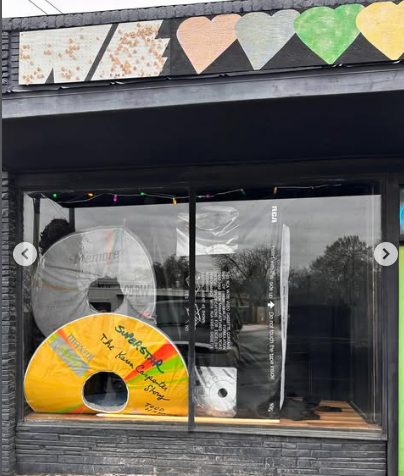
Unless you’re a real cinemaniac, you’ve probably never seen Superstar: The Karen Carpenter Story, a bizarre forty-three-minute cult film created in 1987 by Todd Haynes. In it, the strife between Karen Carpenter and her (according to the semi-biographical film) controlling brother Richard plays out, with all characters being portrayed by Barbie dolls. Memorably, Karen’s worsening health due to her anorexia is demonstrated by her doll being slowly whittled away. If you have seen Superstar, then the only reason you’ve ever had the opportunity to do so was through piracy. Whether because the use of Barbies does not fall under fair use, because of the presence of contemporary music that is unlicensed, or just because Richard Carpenter raised a big enough stink about it, there’s no way for you to watch this film legally. A copy exists at the Museum of Modern Art, but it is not exhibited. I personally have seen it, and the copy that I watched was on a burned bootleg Maxell DVD-R just like the one recreated in Maura Murnane’s display above.
The question of the ethics of piracy arose recently when I texted Brandon about whether or not we (read: I) should cover the leaked film Avatar Aang: The Last Airbender, a continuation of the animated 2005-2008 Nickelodeon series Avatar: The Last Airbender, following the show’s child characters into young adulthood (some of them had also appeared as elderly characters in continuation series The Legend of Korra). AATLA was set to be released theatrically this year, but Paramount opted to pull the film from its planned cinema release and drop it solely to their streaming service, Paramount+. This announced change ruffled some feathers. Fans who wanted to see the film on the big screen and would have happily paid to do so would now have to sign up for a subscription service to see it, and at a reduced scale than the creators intended; members of the crew and animation teams were likewise disappointed to learn that something that had been created to be visually stunning and grand in scope would not get the opportunity to reach the intended audience. Universally, the decision to paywall the film in the winter was met with criticism. Avatar fans who want to have access to that content are more likely to already be subscribed to Paramount+ in the first place, meaning that the addition of the film to the service would likely have a negligible effect on overall subscription numbers. The money was already spent, there would be no chance for the film to recoup its budget theatrically, and the hellscape that is the current streaming service subscription model grinds on.
In general, although Swampflix and its contributors in no uncertain terms do not recommend piracy, as a legal disclaimer, I’m flexible about what this means for works that are inaccessible due to rights-holders’ choices and decisions. Consolidation of the ownership of all media into a few conglomerates is a bad thing. Even the least cinemanic among us have cottoned on to the fact that every streaming service is less functional, robust, and egalitarian they they once were, and the national government’s antipathy against monopoly prosecution in the death throes of our current economic era mean that it’s only going to get worse. The next inbound round of money-laundering square-dancing means that next year the guy who makes your toothpaste might also own The Little Rascals, or that every time you buy corn chips you’ll be adding a nickel to an account that will eventually fund a live-action Rocko’s Modern Life, or that some anarchocapitalist’s nepotistically inherited pyramid scheme will get to decide whether you can make Dorothy Gale’s slippers ruby or not. The back catalogs of films that are gatekept behind faceless entities are held back not so that said entities can do something with them, but just to keep others from having access.
Or, more frequently in recent years, to cancel huge, completed projects because not releasing them to the public means that they can be written off for tax purposes. It’s far from the worst thing that most of the 1% has done, but like most of their unethical actions, it’s rooted in the seed of all evil: a love of money. A couple hundred internet malcontents with too much time on their hands managed to leverage a global pandemic into browbeating Warner Brothers into releasing a supposed “lost” film at a time when productions were shut down. This emboldened probably the worst people it could have, but it also means that nothing is really set in stone. Three years after its cancellation was announced, Coyote vs. Acme is finally being released this August; maybe there’s even some hope that Adil El Arbi and Bilall Fallah’s Batgirl might see the light of day someday. But as Brandon pointed out to me when I texted him, there wasn’t really a good reason to review the animated Avatar film when it had a real scheduled release date, even if its release was a downgrade. That’s a different story.
I won’t reveal the circumstances under which I viewed Avatar Aang: The Last Airbender. Maybe someone was screening it at a bar, a bar that has since closed down and therefore no one can be held responsible. Maybe I watched it through a storefront window like a kid in a corny Christmas commercial. Maybe someone burned a bunch of copies onto Memorex DVD-Rs and let them fall off of the back of a truck. A full review will come, when the film is legally available. I would recommend that, should the winds change and you get the chance to see it theatrically, it will be well worth the cost of the ticket. As to whether it will be worth the cost of the subscription to Paramount+, only you, dear reader, know if you’re responsible enough to cancel before the renewal date if Avatar Aang is all that you want to see. I’m not entirely sold on the new voice cast (in short, Toph is pretty good, Katara is acceptable, Aang is iffy but occasionally perfect, and—all love and respect to Steven Yeun—Zuko is completely wrong), but the film is absolutely gorgeous. I struggled to adjust to the cast changes and what I perceived as tonal changes, but by the time Aang was soaring around and having a good time, so was I. I had missed him, and it was good to spend time with him again. If anything, Paramount’s bungling of this whole debacle means that it’s unlikely that we’ll get the opportunity again (unless you count the Netflix live action series, which has its own host of problems). Only time will tell.
-Mark “Boomer” Redmond

