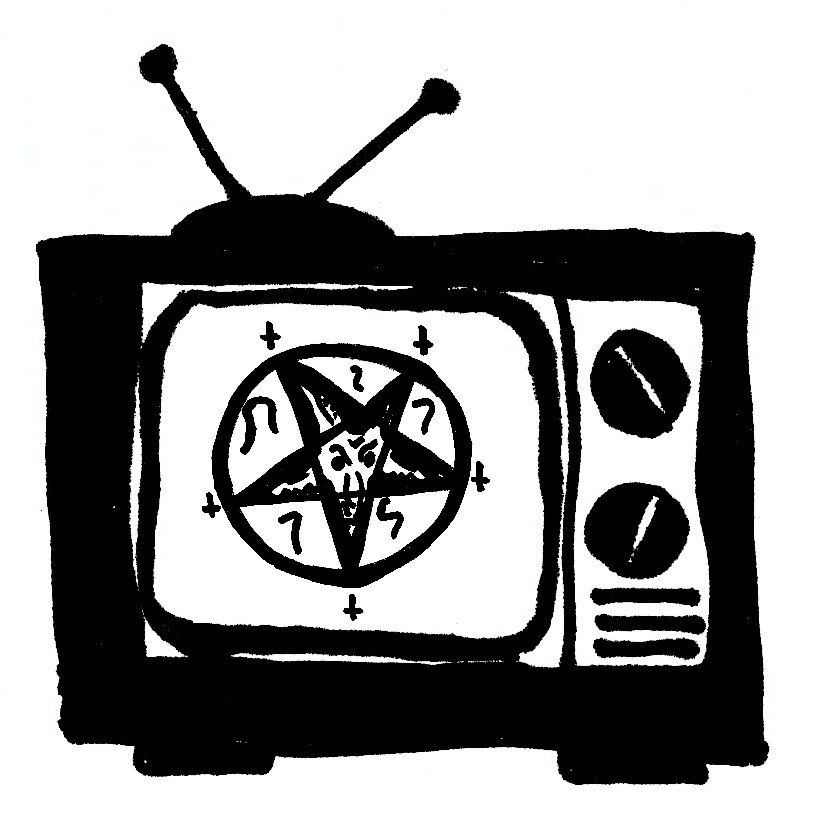
The Devil Conspiracy (2023)

We cover many flavors of schlock on this blog, but we tend to ignore one of the most popular, profitable sources of schlock around: “faith-based” Christian propaganda.  Outside a one-off podcast episode where we dipped our collective toe into the frigid waters of Evangelical schlock (covering God’s Not Dead & The Shack) and Boomer’s long-dormant Late Great Planet Mirth series covering the Evangelical Rapture films of decades past, we haven’t dealt much with the cheap-o Christian propaganda that pads out new release schedules at every suburban multiplex, despite it indulging the same market-based opportunism as genres we do love, like sci-fi, fantasy, and horror.  That’s mostly because modern “faith-based” media preaches only to the choir, echoing predetermined conclusions that its target audience already righteously agrees with: God is real, abortion is evil, and anyone who disagrees is an agent of Satan.  It’s hard to have fun with even the silliest of B-movies when their messaging is that sourly cruel & misanthropic.  If anything, the micro-industry of “faith-based” propaganda has made it explicitly clear that it doesn’t want heathens like us in the audience.  It doesn’t want us alive & free to walk about in public at all, a sentiment it’s more than willing to voice through fascist mouthpieces like Kevin Sorbo & Kirk Cameron into the nearest, loudest megaphone.  That’s why it’s so weird that I found myself watching, reviewing, and—against all odds—enjoying the faith-based propaganda piece The Devil Conspiracy.  Like God’s Not Dead before it, it’s a despicable film that asserts in every line-reading & plot beat that God is real, abortion is evil, and anyone who disagrees is an agent of Satan.  Unlike God’s Not Dead, however, it’s also a fun, silly little romp and a good time at the movies.

The Devil Conspiracy represents a new evolution in “faith-based” Christian propaganda, borrowing the visual language of action-fantasy superhero epics to sweeten the bitter, hateful messaging at the genre’s core.  It brings me no pleasure to admit that the gamble mostly works, which is evident in how little enthusiasm actual Catholics & Evangelicals appear to have for it.  My (admittedly light) internet research attempting to gauge the film’s cultural impact revealed very little since it snuck into wide distribution this January, except a few articles detailing small Catholic protests decrying the movie as “blasphemous.”  This is surprising on both sides of the Christian-heathen coin.  You’d think that religious groups would embrace the film as cultural outreach, Trojan Horsing the same anti-Satan, anti-abortion rhetoric that’s usually reserved for bland message pieces “starring” Kelsey Grammer into a thrilling action film comparable to (the Thor: The Dark World era of) The MCU.  You’d also think that schlock-hungry horror obsessives catching a glimpse of the word “Devil” in the title would’ve been drawn to its bonkers logline premise, of which I can do no better job marketing than to just copy & past in plain text: “The hottest biotech company in the world has discovered they can clone history’s most influential people from the dead.  Now, they are auctioning clones of Michelangelo, Galileo, Vivaldi, and others for tens of millions of dollars to the world’s ultra-rich.  But when they steal the Shroud of Turin and clone the DNA of Jesus, all hell breaks loose.”  The Devil Conspiracy may have achieved the widest gap between wild premise and mild purpose in the history of genre filmmaking.  It is the ultimate reactionary superhero film, approximating what it might be like if Zack Snyder remade End of Days for Pure Flix Entertainment.  The result apparently baffles everyone and pleases almost no one, except the few freaks who find the novelty of R-rated Christian superhero propaganda inherently fascinating (i.e., me).

It might surprise you to learn that the plot to clone Jesus from his mythical DNA remnants on the Shroud of Turin isn’t a ploy to jumpstart his Second Coming.  Because the world is so overrun with abortion-happy Satanists, Jesus’s DNA is instead perverted to create a suitable host body for the in-the-flesh coming of Satan, who has been awaiting his opportunity to reign on Earth since he initially rebelled.  Satan’s poor mother-to-be is an unsuspecting, unmarried academic who values science over religion, to her own peril.  After losing a few God’s Not Dead-style theological “debates” with enlightened clergymen, she’s kidnapped by Satanists and, in the film’s most hellish sequence, forcibly impregnated in a laboratory with the Jesus/Satan hybrid child, which essentially transforms her into a demonic hellbeast with a baby bump.  It’s up to the archangel Michael and his magical sword to save her soul and save humanity before the Satan-Christ can be born in the flesh, which mostly amounts to him fighting off a few robed cultists in industrial hallways.  It’s not easy staging a blockbuster superhero epic on the leftover sets & budget of Dario Argento’s Mother of Tears, but The Devil Conspiracy does a decent job of wringing its batshit premise for all its worth.  There’s something about its scrappy brand of demon-slaying, Satanist-decapitating action-horror that helps its despicable messaging that “Science has given The Devil his way out of Hell” go down a lot smoother than it would’ve coming out of Kevin Sorbo’s equally horrific mouth, despite my better judgement.  As soon as the superheroic prologue where Lucifer falls from “Heaven” (outer space) to Hell (the Earth’s core) and growls to Michael that it’s “better to reign in Hell than serve in Heaven” there’s no appropriate response to its incendiary, Biblically metal imagery other than “This is badass.”

I should be clear here: I’m glad The Devil Conspiracy failed.  Ideologically, I am opposed to everything it has to say about humanity & spiritualism.  Formally, I think it hits the exact same numbing dips in novelty & momentum that most secular, crowd-pleasing superhero epics suffer.  Still, there was a lot of perverse fun in watching one of these hateful propaganda pieces aim its weapons just outside its usual target demographic, seeking not just to preach but also to entertain.  In a different, worse world where it became a breakout success, I’d hate seeing its army of imitators emerge from the bowels of Heaven to smite my heathen ass.  As an anomalous, R-rated Christian propaganda film loved by no one, it’s got its scrappy, schlocky charms.  May I never be tempted by one of these evil, hateful sermons again, no matter how spectacularly silly.

-Brandon Ledet

Enys Men (2023)

In a year when all the buzziest horror titles are slow-cinema abstractions, it feels nice to finally have one stab me squarely in the brain stem after so many near-misses.  I greatly enjoyed the experience of parsing my way through The Outwaters & Skinamarink, but my response to both of those microbudget crowd-displeasers was more intellectual than emotional.  Yes, Skinamarink left me tense & unnerved, but it also left me with lingering questions about how its modern digital filters interacted with or clashed against its vintage analog setting.  The Outwaters is, by design, much more traditionally satisfying, delivering recognizable scares in its found footage freak-out finale, but it also leaves plenty of free time to question whether the deliberate boredom of its opening acts is worth the journey to that finale.  I had no such doubts or hesitations about Mark Jenkin’s slow-cinema nightmare Enys Men.  In many ways, Enys Men is even more inscrutable & disjointed than both of those digital-age D.I.Y. abstractions, since its dream-logic “plotting” makes it impossible to fully interpret in any clean, clear terms.  And yet I had full confidence that Jenkin thoroughly, thoughtfully considered each of his formal & narrative choices so that instead of picking apart its eerie psychedelic imagery I was instead fully submerged in it, eventually gasping for air as the resulting tension became unbearable.  When defining the effects & methods of slow cinema as a young film critic, Paul Schrader coined the term “transcendental style” as an easy go-to marker for what it could achieve.  It’s immensely satisfying to finally know what that transcendence feels like, at least when it’s deployed for a purely horrific effect.

It’s a little dishonest for me to link Enys Men so closely with smaller, modernist works that just happen to terrorize audiences at the same slow-drip tempo.  This Cornish folk horror about a Stone Henge-like monument to sailors drowned at sea is part of a long English filmmaking tradition, as recently documented in the folk horror compendium Wooodlands Dark and Days Bewitched.  Its vintage 16mm camera equipment & 1970s setting threaten to dip into kitschy folk-horror pastiche, but instead it feels like a genuine marriage of form & content that projects a timeless, eerie familiarity rather than cutesy nostalgia.  Even its version of “transcendental style” owes a lot to slow cinema giants of the distant past, with its science researcher protagonist repeating her daily field work in a distinct, methodical Jeanne Dielman rhythm (before her own fixed routine unravels to resemble the seaside ghost story of John Carpenter’s The Fog).  Slow cinema has only gotten more extreme in the half-century since Chantal Akerman made The Greatest Film of All Time, though, and Enys Men‘s underlying modernity eventually shines through in the volatility of its editing style once its nameless researcher loses grip.  It’s remarkable how Jenkin dredges up something that feels at once familiar yet cutting edge – a Skinamarinkian slow-cinema shocker rendered in a vintage Don’t Look Now color palette.  More important, its traditionalist imagery is useful in establishing a false sense of comfort & safety among a jaded horror audience who’ve seen it all before, so that when we’re plunged into the unfamiliar in the final hour, the effect is much scarier than it would’ve been under a layer of modern digital grain.

Mary Woodvine stars as the nameless volunteer scientist who studies a small cluster of flowers on the cliffs of the titular Enys Men (a Cornish name that translates to “Stone Island”).  After several lonely weeks observing “No changes” in those flowers, she notices lichen growing on their pedals, an intrusion that has an instant hallucinatory effect on her psyche.  Initially isolated with only her field research and a few dog-eared paperbacks to fill her days, she’s joined by the presence of ghostly figures from both the history of Enys Men and from the history of her own life.  It’s unclear where the young girl who resembles her fits into her own past (a lost daughter? a younger version of herself?), but it is clear that the drowned miners & seamen memorialized by the stone monument outside her cottage door still linger around the island as lost spirits.  Or at least that’s what little sense my brain could make of the loopy, looping images Jenkin floods the screen with; there’s ultimately too little information to confidently assign any linear story to the emotional, hallucinatory journey our researcher in distress travels.  Enys Men is a pure psychedelic meltdown of id at the bottom of a deep well of communal grief, one where running out of your monthly supply of tea is just as devastating as losing a boatful of loved ones at sea.  Like Akerman before him, Jenkin makes his troubled protagonist’s world so small & regimented that the tiniest changes in her routine mean the world in the moment.  Only, assigning any logical meaning to those changes is a fool’s mission in this case, as her downfall is staged entirely inside her own mind, with the titular island serving mostly as spooky Old World set dressing.

Hesitations about individual examples aside, you have to respect that the innate marketability of the horror genre is starting to import experimental filmmaking tactics into the mainstream.  Enys Men immediately picked up North American distribution after it premiered at last year’s Cannes, likely because its traditionalist folk horror aesthetic was such an easy sell.  Meanwhile, Jenkin’s previous feature Bait has yet to reach wide domestic distribution despite its years of fanatic endorsement from major British critic Mark Kermode and its similar vintage visual panache.  It’s likely no coincidence that Bait is a real-world drama about gentrification in a small Cornwall fishing village, which can’t help sounding like homework even if it’s just as freely, weirdly expressive as Jenkin’s follow-up.  The joy of seeing movies as difficult as The Outwaters & Skinamarink break through as unlikely hits earlier this year only highlights how horror has become one of the only viable mediums where artists can Trojan Horse actual Art into mainstream venues, since the genre’s popularity is seemingly eternal.  Since Skinamarink was the biggest hit of the three, it turns out that a little grassroots buzz & viral marketing on TikTok also help.  It’s a shame that Enys Men missed the boat on TikTok’s momentary obsession with sea shanties a few years ago, when it was best primed to be a cult-circuit hit.  It’s still wonderful that it was nationally distributed at all, though, since it’s the exact kind of sensory nightmare that requires theatrical immersion to fully work its dark, hypnotic magic.

-Brandon Ledet

Late Night with the Devil (2023)

It’s easy to get dispirited by the deluge of current pop culture product that’s just nostalgic regurgitation of vintage hits from decades ago.  If you dwell on how much of our current “creative” output is just a distant echo of pre-existing iconic works, you’re only going to see a culture in decline.  Not all pastiche is empty, though.  While most nostalgia bait cites past triumphs for an easy pop of recognition, there are plenty modern throwbacks that sincerely interrogate or subvert the artistic intent & cultural context of their inspirational texts.  For every Netflix special that drags the Power Rangers out of retirement for a nostalgia-stoker victory lap, there’s an absurdist French comedy that subverts & recontextualizes that same vintage 90s iconography into something wonderfully new & strange.  The same day I saw Quentin Dupieux’s absurdist Power Rangers parody Smoking Causes Coughing at this year’s Overlook Film Festival, I also happened to catch a similarly subversive nostalgia piece in Late Night with the Devil, which dialed the pop culture clock even further back for even weirder effect (and won the festival’s Audience Award for Best Feature as a result).  Late Night with the Devil is vintage TV Land horror, a parody of a late-night 70s talk show broadcast that’s hijacked midway by The Devil.  It stokes vintage 1970s pop culture nostalgia as its initial hook, but mostly just uses that temporal backdrop for a sense of comfort & familiarity that can be stripped away for effective third-act scares once the titular Devil is conjured.  It’s also thematically purposeful in returning to that era because it has something specific to say about pop culture at that time, an embarrassingly low bar that isn’t cleared by more routine nostalgia cash-ins like the upcoming Mighty Morphin’ Power Rangers: Once & Always.

David Dastmalchian stars as a late-night talk show host who teeters somewhere between the post-vaudevillian comedy of Johnny Carson and the cigar-smoke intellectualism of Dick Cavett.  After a faux-documentary prologue sketches out the basic outline of Dastmalchian’s fictional Night Owl talk show (including its imagined ratings war with Carson and its host’s personal dabblings in the occult), we’re submerged in a real-time Sweeps Week novelty episode of the show, supposedly broadcast on Halloween Night in 1977.  Even within that Halloween Special context, Late Night with the Devil mostly functions as a loose collection of 70s kitsch, touching on iconic-to-forgotten figures of the era like Orson Welles, Anton LaVey, and The Amazing Kreskin as if they’re all of equal importance.  Things get dicey when the Night Owl producers restage a real-life version of Friedkin’s 70s horror classic The Exorcist as a shameless ratings stunt, unwittingly unleashing a powerful demon that calls itself Mr. Wriggles onto the American public through live broadcast.  The demonic scares of the film’s back half allow its initial Nick at Nite nostalgia trip to go wildly off the rails in exciting, unpredictable ways.  It also opens the text up for direct, sincere criticism of the era’s professional machismo – interrogating the ways that men nearing the top of the corporate ladder were willing to exploit the vulnerable underlings below them (especially if they’re women) just to scramble up the last few rungs.  Sweeps Week desperation has never been so deadly, nor has inane talk show chatter about “current” events & the weather. 

If there’s anything holding Late Night with the Devil back from achieving greatness as a standalone novelty, it’s that there are so many nostalgia-critical genre throwbacks already out there to match or best.  In particular, its real-time simulation of an actual cursed, vintage TV broadcast is outshone by the Satanic Panic era news report parody film WNUF Halloween Special, which is also framed as a ratings stunt gone wrong.  Not only does WNUF have more politically incisive things to say about the cultural moment it time-travels to for cheap gags & scares, but it also fully commits to the bit in a way Late Night with the Devil doesn’t dare.  Instead of repeating the WNUF trick of breaking up its broadcast with parodies of vintage television commercials, Late Night cheats by bolstering its narrative with backstage drama & impossible “documentary” footage that distract from the verisimilitude of its premise.  It’s a frustrating indulgence at first, but the film eventually makes the most of it in a go-for-broke, reality-bending finale that’s worth forgiving the few shortcut cheats it takes to get there.  If you don’t mind a little logical looseness in your “found footage” horror novelties, Late Night with the Devil is perfectly calibrated Halloween Season programming.  It pulls double duty in both nostalgically calling back to vintage horrors past (which is especially welcome if you’ve already seen The Exorcist and its many knockoffs one too many times) and finds modern political & technological justifications in returning to those well-treaded waters.  It’s not nostalgia bait so much as it’s nostalgia perversion, which is a much more interesting angle than you’ll find most modern pop culture attempting.

-Brandon Ledet

The Five Devils (2023)

One of the major reasons I love film festivals is that they transform otherwise low-profile, niche-interest oddities into the hottest tickets in town.  I always find it a little silly when festival crowds fight for a seat to see a wide-release studio film just a few weeks before it’ll play at every suburban multiplex anyway, but I’m charmed when that enthusiasm trickles down the program to smaller titles that will otherwise play to empty arthouse auditoriums before dying a slow death on streaming.  I was sharply aware of that phenomenon when lining up to see the weirdo fantasy drama The Five Devils at this year’s Overlook Film Fest the same day that it was premiering at The Broad Theater just a few blocks away from my house.  The Five Devils is the exact kind of low-budget, high-ambition art film that I’m used to watching alone at The Broad (or even at the same downtown location of The Prytania where most of Overlook is staged), so it was heartwarming to queue up with a swarm of like-minded, enthusiastic freaks psyched to be bewildered by it in unison.  It shouldn’t be surprising that a local genre festival could draw a sizable crowd to see a title that’s already screening outside its downtown shopping mall locale, considering the self-selection process of an audience already receptive to what Overlook offers.  Still, it was wonderful to see an odd, alienating little movie like The Five Devils get treated like a Cultural Event, when outside of festivals that kind of buzzy Thursday-night premiere is strictly reserved for superhero sequels & Tom Cruise suicide missions.

The last time I saw a French time-travel drama about a little girl who meets the younger, more troubled version of her mother through an unexplained, magical-realist device, it was in a near-empty auditorium.  Petite Maman is a much more accommodating, crowd-pleasing version of that story template too, underplaying the supernatural immensity of its time-travel premise to instead focus on subtle moments of dramatic grace.  In contrast, The Five Devils is Petite Maman for sickos, which is why it’s so heartwarming that Overlook was able to scrape together a full crowd of sickos to bask in its abrasive, brain-rattling glory.  Calling its time traveling anti-hero a “little girl” is a little reductive.  She’s more of an untrained, irresponsible witch, one who uses her supernatural sense of smell to jar up homemade potions that distill the unique essence of her few loved ones so she can mentally revisit them at will through sense memory.  This lonely pastime gets out of control when she gets a hold of an elixir that allows her to astral-project into those memories, effectively time-travelling to her mother’s youth.  What she discovers while traveling via these jarred scents is that she hails from a complex lineage of similarly obsessive, volatile women – most notably the younger, brasher version of her mother and her mother’s secret high school lover.  From there, The Five Devils unravels to reveal an intensely fucked-up little time-travel family drama, one punctuated by wild jabs of style & emotion that you won’t find outside of buzzy festival line-ups, empty arthouse theaters and, eventually, public library DVD loans.

There are plenty of readymade reference points that might help define The Five Devils through comparison: the childhood time travel & poolside romance of Céline Sciamma’s Petite Maman & Water Lilies; the ecstatic gymnastic seizures of Ana Rose Holmer’s The Fits; Divine’s supernatural sniffer in John Water’s Polyester; etc.  Its wide range of vaguely familiar elements are reconfigured into such a uniquely high-style, high-drama mode of modern queer filmmaking that it can’t be cleanly categorized into any one long-running genre, though, except maybe to say that it makes for an incredibly uncomfortable Christmas film.  Similarly, I can’t pinpoint exactly what’s being conjured by its provocative title, since there are no literal devils in its narrative (which would more firmly push it into the horror territory covered by most of Overlook’s programming).  Are the five “devils” the five senses?  It certainly made me squirm under the sense of touch as the hard sequins of a gymnastic uniform scraped against freshly burnt flesh in its barnburner finale, but most of the story is dominated by smell.  Are they the four family members that crowd the small French household where the little scent-witch dwells, plus the one spurned & injured lover her parents left behind when they hooked up as teenagers?  Maybe. But no one among them is evil or villainous, exactly.  They all just indulge in messy, passionate human behavior, sometimes heighted by their unexplained supernatural powers.  Ultimately, I don’t actually want an answer to the question.  It’s just indicative of the rhetorical games of provocation & illogic that the film plays with the audience, and it’s often shocking how complex & emotional the results of those games can be.

To find the passionate cult audience it deserves, The Five Devils needs to be chopped up into easily digestible, memeable morsels the way similar crowd alienators like Midsommar, Tár, and Annette have in the recent past.  There’s plenty to work with there, from the striking visuals of young newcomer Sally Dramé huffing her collection of self-labeled scents to the total emotional breakdown of indie darling Adèle Exarchopoulos drunkenly slurring “Total Eclipse of the Heart” on a karaoke stage.  Hell, even I’m guilty of reducing it to something cuter & simpler than it is with my little “Petite Maman for sickos” quip.  In truth, it’s a very thorny, elusive work that’s difficult to market in any effective way without spoiling & overexplaining each of its dramatic twists.  That’s why it’s so great that festivals like Overlook & Cannes (where The Five Devils premiered) are able to drum up actual, real-life enthusiasm for a film this abrasively weird.  I love that I regularly get to see this kind of genre-defiant anomaly at The Prytania & The Broad, but it’s often a much quieter, lonelier experience.

-Brandon Ledet

Smoking Causes Coughing (2023)

French absurdist Quentin Dupieux has been on a real hot streak lately.  Threatened to only be remembered as an early-internet memester for his Mr. Oizo music videos and the killer-tire horror comedy Rubber, Dupieux recently hit a creative breakthrough in the killer-jacket horror comedy Deerskin.  On paper, it might not appear that there had been much progression between his early novelty horror about a murderous rubber tire with telekinetic powers and his more recent novelty horror about a murderous deerskin jacket with telepathetic powers, but Deerskin really did mark a new level of maturity & self-awareness in Dupieux’s art that’s been consistently paying off in the few years since.  Every one of his films, including Rubber, are proudly Absurdist comedies about the meaninglessness of Everything, but Deerskin extended that worldview a step further to indict his own catalog of work as meaningless art about meaninglessness – an endless parade of empty frivolities.  That might sound like it would de-value Dupieux’s creative output, but it’s instead freed him to follow his most inane, meaningless impulses for the sake of their own pleasure, and he’s been making his funniest comedies to date as a result.

At first glance, Smoking Causes Coughing registers as just another one of Dupieux’s hilarious but meaningless novelties, no more important in his larger oeuvre than his recent Dumb & Dumber buddy comedy about a monstrously gigantic housefly.  Since all of his movies assert a consistent absurdist worldview, there isn’t much to distinguish the individual titles from each other outside the immediate humor of their high-concept bar napkin premises.  If Dupieux had fully committed to a feature-length Power Rangers parody entirely focused on the Super Sentai superhero knockoffs rebuilding group “cohesion” & “sincerity” on a mundane work retreat, that’s exactly what Smoking Causes Coughing would be: another fun, dumb, proudly meaningless comedy from an increasingly prolific director who makes two or three novelties just like it every year.  Instead, it manages to feel like yet another Deerskin-style shakeup to his creative routine, freeing him to be even dumber & more meaningless than ever before.  That’s because it’s an anthology horror comedy disguised as a feature-length Power Rangers parody, a surprise change in format that has not been hinted at in the film’s cheeky advertising.

Apparently antsy about having to spend 80 minutes on just one absurdist bar napkin premise, Dupieux is now chopping them up into bite-sized 8-minute morsels, which is great, because every impulse he has is hilariously idiotic.  With Smoking Causes Coughing, he’s entered his goofball Roy Andersson era, merging philosophical art & sight-gag sketch comedy into an efficient joke-telling machine that’s free to follow its momentary whims from vignette to vignette without fear of losing the audience’s confidence.  In the Power Rangers-spoofing wraparound story, a team of helmeted rubber-monster fighters called The Tobacco Squad (because they use the destructive powers of cigarette smoke to defeat their intergalactic kaiju enemies) find their teamwork in daily battles increasingly disjointed, so they go on a corporate-style work retreat to rebuild group cohesion.  As soon as that gag is milked for all it’s worth, the individual members of Tobacco Squad (Nicotine, Mercury, Methanol, etc.) entertain each other with campfire horror stories to pass the time, which allows Dupieux to fire off as many short-form, for-their-own-sake inanities as he pleases.  They’re all very funny (especially the slasher parody segment involving a noise-cancelling isolation helmet) and intensely idiotic in the exact ways Dupieux’s ideas have been from the start, but none of them threaten to outstay their welcome the way a single-joke premise like Rubber might have in the past. 

All that Dupieux’s missing at this point, really, is an American audience.  It’s likely no coincidence that my favorite two movies from him to date are the ones I happened to catch in the theater, so it’s a shame their only New Orleans screenings were at festivals, not in regular theatrical runs.  I very much appreciated getting to laugh along with like-minded crowds during Deerskin at New Orleans French Film Fest in early 2020 and, more recently, during Smoking Causes Coughing at Overlook Film Fest last week (the same day it was domestically released VOD). Still, it’s odd to see his work sidelined as specialty events for niche audiences.  Both films killed in the room, and it would be incredibly cool to see Dupieux’s recent output get the crowd-pleaser rollout they deserve.  If an easily marketable Power Rangers aesthetic and a glowing blurb from John Waters calling his latest “a superhero movie for idiots” & “one of the best films of the year” isn’t enough to earn Dupieux wide theatrical distro before being siphoned to streaming, it’s doubtful anything ever will.  We shouldn’t be allowing the funniest comedies on the market to be downplayed as high-brow festival fodder because they happen to be in French, but I guess I should just be grateful that he’s continuing to make them and that local fests like Overlook are continuing to program them; it’s always a blast, especially with a crowd.

-Brandon Ledet

Tár (2022)

I didn’t really have any interest in Tár when it first appeared on the scene. For one thing, Brandon’s Tár/Triangle of Sadness mash-up review invoked the name of Aaron Sorkin twice, which made me think he was actually associated with the production, which was a turn off for me (he’s not, and I was forced to retreat from a pre-viewing argument in embarrassment when this fact was pointed out to me after I claimed it, but in my defense, the last time Todd Field made a movie, I was nineteen years old). For another, I have an intense aversion to most “Oscar bait” movies, which this seemed to be in every conceivable way. But after watching Maggie Mae Fish’s video essay “Tár on Time”, I knew it was only a matter of, ahem, time before I would fall into its orbit. Because this isn’t just an Oscar bait feature, it’s a movie that falls into my favorite not-quite-a-genre: women on the verge. And what a rich and rewarding text it is (to me, anyway, even if that makes me, in Brandon’s words, one of “the most boring people alive”). 

Tár is the story of Lydia Tár, an elitist célébrité, a woman of prolific success in one of the most misogynistic artistic professions, musical conduction. But she’s not just that, of course; she’s also an accomplished composer, a studied musical anthropologist, an instructor at Julliard, and a forthcoming author. Outside of the realm of art and instruction, however, her personal life is … well, not “messier,” since every part of her life is ordered, measured, and precise, but definitely less in her command, even if she thinks that she’s in complete control. Her existence is a perfect curation of an image of who “Lydia Tár” is and what she means, and it’s built not on a solid foundation as she thinks and pretends, but hangs like a spiderweb, intricate and beautiful but incredibly fragile at the same time. Her marriage is perfunctory, passionless, and transactional, and the only person in her life who reciprocates her love without expectation, her daughter Petra, often goes long periods without seeing her, and even when she does, she calls her “Lydia,” not “Mom.” 

Her professional accomplishments, which include completion of an EGOT, draws a curtain over the fact that, like countless men who have come before her in the same profession and who have abused every iota of power which has ever been accorded them, she is a predator. Lydia Tár, over the course of her career, has left a bevy of scarred women in her wake, students upon whom she has heaped her affections and with whom she has carried on power-imbalanced affairs, all with the expectation that, under (or after) her tutelage, said women will reap the benefits of her largesse in the form of placement into a competitive composition program or coveted conductor position. When the film opens, however, the first crack in the ice over the deeper waters of her abuses of power is starting to form: Eliot Kaplan (Mark Strong), who oversees the Tár Fellowship (the organization that launders her sexual predation into academic acceptability), notes that they’ve placed every one of the previous fellows into a conservatory somewhere, Lydia herself notes “except one.” Although her house of cards was bound to fall eventually, it’s that one, a woman named Krista Tayor, who will be the catalyst that brings about the fall of Tár. 

In some ways, Tár is a ghost story, and Krista is the specter, regardless of whether she is on this plane of existence or not. She is a ghost, existing permanently on the outskirts of our perception, and perhaps Lydia’s as well. We never see her face: in early scenes and before we are aware of who she is, we see her from behind as she takes in the spectacle that is the walking, talking performance entitled “Lydia Tár”; she appears in Lydia’s dreams, but the warping of space that is the common element for these nightmare sequences occludes her; even the newspaper article that Lydia reads about her uses a photograph of Krista in motion, conducting, a great lock of her fiery red hair obscuring her face like a mask. She is present and non-present at once, like a vapor that Lydia tries to disperse with a waving of her conductorial hand, but which lingers, waiting for Lydia’s comeuppance. Although it’s not my interpretation, it’s possible to read that there is something supernatural at play here as well, as there are certain moments that imply a more conventional haunting is at play; Lydia is forever aware of various noises behind the walls or out of her sight. While running, she hears screams coming from somewhere out of her range of vision (keen-eared viewers will recognize these as, of all things, Heather’s screams from The Blair Witch Project); while trying to work on her newest composition, she is constantly interrupted by a two-tone sound reminiscent of a doorbell, which is later revealed to be the emergency tone of her dying neighbor on the other side of the wall; she is awoken by the humming of her refrigerator and the ticking of a metronome inside of a cabinet. It’s the last of these that’s most intriguing, as the metronome’s face is inscribed with a Kené pattern, which is not only used as a form of writing by the Shipibo-Konibo people of Peru who were the subject of five years of study by Lydia, but also appears in other places; notably, this pattern was added to the title page of Vita Sackville-West’s Challenge that is left anonymously at Lydia’s hotel (and which was presumably drawn in by Krista), as well as appearing in Petra’s bedroom in the form of clay that the child has been playing with.

Notably, this scene with the clay occurs after we learn that Krista has died. Is this just something that Petra saw in her mother’s work that she’s recreating, or a pattern that she stumbled across purely coincidentally? We know that Lydia gives her keys to her assistants based on an interaction with Francesca, so it’s not out of the realm of possibility that the inscription and activation of the earlier ticking metronome could have been something that Krista did intentionally in order to get under Lydia’s skin, but the clay remains unanswered. The fact that Petra is not allowed in Lydia’s office is mentioned several times, but immediately after observing the pattern in her daughter’s playthings, Lydia then finds Petra in that very office, a ghostly silhouette in the gossamer curtains, where the child has hidden from her sitter. Did Petra start the metronome while playing around after bedtime? Is Lydia sleepwalking and creating these patterns herself? The film doesn’t (and shouldn’t) provide a solid answer, and while I am firmly of the belief that there’s nothing supernatural happening here, the film doesn’t completely rule out that interpretation for the viewer who is so inclined. 

Frankly, that everything is happening might have a rational explanation, or that perhaps in her spiral Lydia is seeing patterns (literally) where they do not exist as her past catches up with her, is much more frightening and anxiety-inducing. Frequently, Lydia is seen responding to sounds, or perhaps impressions, that she perceives but which we do not. While listening to NPR, she mocks the tone of the voice on the speaker, then turns to look behind her suddenly as if she just saw something out of the corner of her eye. This happens several times throughout the film, and it paints her as a person who, although seemingly thoroughly self-possessed, is always looking over her shoulder for her past to catch up with her. That’s what makes this a “woman on the verge” picture: the mask of sanity is slipping. To quote her directly, Lydia knows that her fall from grace is coming, inevitable even, and we know it too; she “know[s] precisely what time it is, and the exact moment we [Lydia and we the viewer] will arrive at our destination together,” and that destination is her downfall. 

Everything about Lydia Tár is a lie, but she doesn’t see it that way; she’s conducting the way that people perceive her, even if that means out and out falsehood. She steals her wife’s medication before the movie even starts, gets replacements while abroad, and pretends to find a pill in a drawer when she returns home to find her wife in medical distress. She claims that she never reads reviews but in fact takes a detour on her miles-long run to visit a newsstand off the beaten path, where the proprietor has already pulled the publication with her most recent review for her; they do this all the time, and she adds this latest to a box of many more. She claims that other women doth protest too much about sexism in her field but she knows that this is an out and out falsehood. Her fellowship is supposed to help support women who want to get into the field, but it’s really little more than a recruitment front for the next ingenue who will become her sexual prey. She rejects gendered terminology and prefers “maestro” to “maestra,” but when confronting her daughter’s bully, identifies herself as Petra’s father, because she knows that, outside of being witty, urbane, and dismissive of the power of patriarchy as part of her public persona, maleness, with its power to intimidate and threaten, is still substantial, even if that masculinity exists only in perception and not reality. Even her impassioned defense of Bach to a queer, BIPOC student is not about Bach, but about herself: one must separate the art from the artist, she insists, but she’s really talking about herself, because beneath all the layers of tailored suits and carefully choreographed photoshoots that the art which is entitled Lydia Tár must be separated from the artist, Linda Tarr (as we learn she was named before deciding to play her own game of identity politics). It is a preemptive apology, not in the sense that it precedes her many ethical failings, but in the sense that it precedes their discovery. She’s already on the edge, verging on the fall, and she can hear her destiny sneaking up on her, even if there’s nothing there when she turns to look at it. 

This is a rich, detailed, many-layered, and beautiful text, one that lends itself to a multitude of interpretations. It’s dense with meaning and subtleties that exist to be cleaved and inspected. Now that it’s available to a wide audience, I can’t recommend it highly enough. It’s demanding, but it’s worth the reward. 

-Mark “Boomer” Redmond

John Wick: Chapter 4 (2023)

John Wick is back, folks. If you remember (and why would you, it’s been 4 years since the last one of these), at the end of John Wick 3, our antihero took a bullet and a tumble off of the New York Continental Hotel so that his friend Winston (Ian McShane) could maintain his management of the aforementioned locale. The Continental is part of the underground masquerade of the world of high class assassins, and Wick is being targeted for failing to uphold one of their many intricate rituals and rites, with Winston having sacrificed his position within that hierarchy to help his friend, a favor that Wick repaid by letting Winston shoot him in front of an Adjudicator so that Winston appears to maintain his allegiance to the so-called “Table,” which oversees this underworld. This appears to have been for naught, unfortunately; now, some half a year or so after being taken into the care of the Bowery King (Lawrence Fishburne), Wick has recovered and, before the ten minute mark, finds and kills the Elder, the only person who “sits above The Table,” resulting in Winston being confronted by a Harbinger (Clancy Brown) who tells him that the NY Continental has been deconsecrated and will be demolished, which is done within the hour. Our protagonists now have a new adversary, the Marquis Vincent de Gramont (Bill Skarsgård), a French aristocrat with a house-sized closet full of nice suits who has been empowered by the other members of The Table to bring John Wick down, based on his vow to do so by any means necessary. Wick, now (once again? still?) on the run from The Table and their machinations, must slay his way through armies, mercenaries, and mooks in pursuit of freedom from his debts to leaders of this underworld. This time, his flight is complicated by two players who are new to us: an upstart known only as The Tracker (Shamier Anderson) whose calculated pursuit of Wick is based on trailing him without apprehending him while waiting for the bounty on Wick’s head to get bigger and bigger; and Caine (martial arts legend Donnie Yen), a sightless assassin who is also John’s old friend. 

The third installment in this franchise was a little … muddled. I lumped John Wicks 1-3 all together into the #40 slot on my list of the best 100 films of the 2010s. I stand by that ranking, although after a few years, they have started to blend together a little. On the way to the theater to see 4, I mentioned to my companion that I was disappointed that Adrianne Palicki had been killed off and would not be reappearing, and was fairly insistent that this happened in the second film, when it actually happened at the end of the first. I also noted that there was a lot of time in Italy in the third film, but that was also a mistake; the Rome stuff is all in John Wick 2. I was still riding high on my experience of watching the third one when I wrote the blurb in the above-linked piece, because looking back now, the third one is difficult to recall, with its rapidly shifting locales and less cohesive storytelling that seemed intent on forcing as many celebrity cameos as possible, with the two things I remembered most being Anjelica Huston as the leader of an academy of ballerina-assassins and Halle Berry’s training of attack dogs that liked to go for the groin . Fortunately, although this film introduces more elements of the secret underworld that exists below and throughout the world that we civilians inhabit (Harbingers, one-on-one duels that are part of “the old ways” unto which even The Table are beholden, and even a Paris-based radio station that keeps listeners updated on bounties in between covers of apropos music), they’re much easier to follow than they were in the last installment. Wick can clear his debts with The Table if he kills the Marquis in a duel, the duelists are allowed to choose champions, etc. 

Of course, that’s not what most of this film’s audience is here for. I saw this on a Tuesday night, which isn’t exactly a prime movie night for most people, and there were perhaps twenty people in the screening other than my party, mostly college-aged men who came with their buds and several couples (although I guess I’m playing into heteronormative biases by assuming that none of the pairs of men who came to see the movie together weren’t couples, but I digress). My companion and I laughed much more than the others, and I firmly believe that the laughs we experienced were intentional jokes that simply flew over the heads of the others who were present; they did laugh, but only at some of the more crass jokes, with the most notable being that Tracker’s dog lifts his leg and pees on the corpse of a dog-hating assassin who recurred throughout the film, while many of Wick’s dry subtle jabs elicited not a peep. They’re here for the killing! And boy howdy, was there a lot of it. While I find the criminal underworld in these movies fascinating, there’s no denying that they exist primarily as a vehicle for extended (very, very cool) sequences of hyperviolence and novel martial artistry. 

John Wick 4 delivers on this, with various set pieces that thrill for minutes at a time (ages when it comes to screen time) without ever becoming boring or tiresome. After a great sequence in the Osaka branch of the Continental, we also experience a breathtaking fight that takes place in a Berlin nightclub that features multi-story waterfalls; at one point, there’s a shot of Wick being held by the lapels while his assailant punches him in the rain, and all I could think about was how much more satisfying this Matrix-esque image was than the actual Matrix sequel we got a couple of years ago was. The last hour of the film is one long fight as Wick tries to make his way to the Sacré-Cœur through a succession of Paris landmarks (the cowardly Marquis having hedged his bets by putting out a bounty that encourages all of Paris’s assassins to try and get to Wick, which the Marquis hopes will prevent Wick from making it to the duel in time and thus forfeiting). Each has its own distinctive flair: a battle that rages between Wick and his attackers, some in cars, some not, amidst the traffic flowing around the Arc de Triomphe; an impressively choreographed fight involving fiery shotgun blasts that is photographed entirely from above; and, finally, a grueling fight to climb the 222 stairs to the entrance of the Sacré-Cœur, which plays out like a brutally violent game of chutes and ladders. 

If I had one disappointment, it was in the lack of the late Lance Reddick in the film. There was a projectionist error at my local theater, resulting in the film already being played when I entered the theater several minutes before showtime, and I saw a pivotal early scene that, once the film was rolled back and played at the correct start time as planned, turned out to fall about 15 minutes into it. From that point on in the film, Reddick does not appear, and this was a shame. I was a huge fan of Fringe during its initial run (and I still am, in case that wording is confusing) and my erstwhile roommate and I watched The Wire in 2018 and it was every bit the masterpiece I had always been told. I was deeply saddened to learn of Reddick’s untimely death just a week or so ago, and I was looking forward to getting to see more of him in this, one of his last roles. I’m always hesitant to fall into even the slightest of parasocial relationships with media figures, but I can say without equivocation that he was a damn fine actor; in fact, many years ago, when I was fancasting a Star Trek: The Next Generation reboot in the vein of JJ Abrams’s films (before Paramount opted to go back to the franchise’s roots), I thought he would have made a perfect Picard. Although we will never get to see that now, I will miss seeing him. May he rest in peace. 

Perhaps our real world is violent enough without these fantasies, but maybe there is a place for this, too, in our cultural landscape. But if John Wick movies are something that you love, this one is another jewel in the crown. 

-Mark “Boomer” Redmond

Full River Red (2023)

Awards “Season” is such an exhausting, never-ending cycle that I fear I’m breaking a sensitive taboo just by speaking its name so soon after this year’s ritual “concluded”.  Any sane, sensible person should not be saying the word “Oscars” for at least another seven months.  I promise that there is a point to the transgression, though, as I’ve noticed a couple immediate benefits to surviving this year’s Awards Season gauntlet, mostly due to the sweeping wins of the Daniels’ sci-fi action comedy Everything Everywhere All at Once.  First, EEAAO is back in theaters again, and as much as its online fandom & Awards Season success makes it seem like a cultural juggernaut, it’s only been during this post-Oscars push that the its box office profits have finally surpassed the grim superhero origin story Morbius – a film sincerely enjoyed by no one.  Even better, the Oscars marketing machine has also cleared some space for a wider cultural appreciation of Michelle Yeoh, who is currently both the subject of a Criterion Channel sub-collection of Hong Kong action classics and the inspiration for a theatrical re-release of the early-aughts Oscar contender Crouching Tiger, Hidden Dragon.  I bring that up not only because it’s worth celebrating, but because in its own post-Oscars glow (landing four wins out of nine nominations) Crouching Tiger also cleared space for a wider range of genre cinema at the suburban multiplex, proving this post-EEAAO bump is no fluke. 

In particular, I remember the post-Crouching Tiger marketing push for wuxia martial arts cinema bringing the films of Zhang Yimou to the US, with his films Hero and House of Flying Daggers reaching a much wider international audience than they would have without Crouching Tiger‘s Oscars clearing the way.  Even concurrent to Crouching Tiger‘s post-EEAAO re-release two decades later, Zhang’s latest feature is currently screening in US theaters despite most modern Chinese blockbusters of its ilk not enjoying the same international platform.  Full River Red isn’t even a wuxia fantasy epic the way Zhang’s earlier successes were; it’s not even technically martial arts or action.  It’s being sold abroad on the strength of Zhang’s name alone – a name built on the back of Crouching Tiger‘s international success.  Looking back to those early days of Zhang Yimou buzz isn’t entirely flattering to Full River Red, since his latest is proudly exemplary of the way that modern Chinese blockbusters carry a dual duty as both populist entertainment and as state-sponsored nationalist propaganda.  Its title is a reference to a rabblerousing Chinese nationalist poem that is recited at the emotional climax with near-religious reverence, ensuring that all of the preceding cheap-thrills entertainment is contextualized within service & deference to the state.  That’s not any different than the rah-rah American militarism of Top Gun: Maverick, the MCU, or Michael Bay’s entire oeuvre, but it does feel like a far cry from the escapist fantasy epics Zhang Yimou used to get away with as recently as the aughts.

Before fulfilling its patriotic obligations as a pro-military poetry reading, however, Full River Red has a lot of cheeky fun as a murder mystery of covert political intrigue.  Set during a 12th Century clash between warring Song & Jing Dynasties, the film opens with the murder of a traveling diplomat and the disappearance of a secret-letter MacGuffin, a small token of widespread espionage.  With only a couple hours to solve the crime before dawn breaks and chaos ensues, an enigmatic Prime Minister figurehead assigns two makeshift detectives to the case: a cunning lowlife criminal turned loyal soldier and a hothead commanding officer who’s prone to killing suspects in fits of anger – creating literal dead ends in the investigation.  As the initial whodunnit premise gives way to a complex political puzzle of double-triple-quadruple crossings among the infinite sea of suspects, Zhang keeps the mood light with slapstick hijinks and the stakes high with vicious, horrific violence.  The walled-in fortress where the investigation plays out looks perfectly designed for close-quarters fistfights, but that’s not the genre Zhang is working in this time around.  He instead uses the setting as a labyrinth redesign of a classic stage play setup, with most of the “action” being restricted to wordplay, lies, and stabbings.  As actors travel from room to room, it appears they’ve gone nowhere at all, which only makes the circular murder investigation and contraband search all the more maddening as the morning light approaches.

Stylistically, Full River Red finds Zhang Yimou as sharp as ever.  He’s slightly held back by a lack of urgency in the circular plotting and by a muted day-for-night color palette but, overall, he delivers a viciously amusing shell game of 12th Century political espionage – one with an absolutely killer, operatic hip-hop soundtrack.  As birds-eye-view tracking shots of characters swiftly marching from room to identical room play out to electroshocked revisions of classical Chinese music, it feels like Zhang is delivering something that you can’t find anywhere else in modern cinema.  If Full River Red were a little brighter and a little zippier, it could’ve been an all-timer, both in Zhang’s catalog and in the greater whodunnit canon.  At the very least I would’ve appreciated a few more pops of red blood or lipstick against the metallic, stonework grays that wash over most of the screen.  It’s no matter.  Instead of complaining about the few ways Full River Red falls short of its ideal self, I’d rather just celebrate the fact that it made it to big-screen distribution at the AMC Westbank at all.  The movie would certainly exist without the Oscars marketing machine boosting its international profile, since the Chinese movie industry is sturdy enough on its own without the influence or support of Hollywood’s own nationalist propaganda muddying the waters.  I just don’t know that it would have reached me, personally, without that lingering Zhang Yimou bump in wuxia’s brief moment of Oscars glory – something that was impossible to ignore while Crouching Tiger, Hidden Dragon was simultaneously playing on the opposite side of the Mississippi from Full River Red at AMC Elmwood.

-Brandon Ledet

Signature Move (2017)

I remember Jennifer Reeder’s surrealist high school melodrama Knives & Skin harshly dividing the audience at Overlook Film Fest in 2019, with the more macho Horror Bros in the crowd grumbling that it was the worst film they’d seen all fest and with other scattered weirdos gushing that it was the best.  Personally, I dug it, especially for the way it warped the teen-friendly Lynchian melodrama of early Riverdale by submerging it in a hallucinatory Robotrip aesthetic.  I wasn’t especially surprised that Knives & Skin confused the more rigidly horror-minded section of the crowd, though, since it’s a Laura Palmer-style murder mystery that doesn’t care as much about the murder as it cares about teen-girl bedroom decor and eerie vocal choir renditions of 80s pop tunes.  Hell, even my own reaction was confused.   I left the theater thinking I had watched a messy but ambitious debut feature from a boldly stylistic genre nerd.  I was wrong.  Reeder had not only made a name for herself as a prolific short filmmaker on the festival circuit, but she also had already completed her first feature in 2017’s Signature Move.  And now having caught up with that debut, I’m as confused as ever.  After the slow-motion, high-style freakout of Knives & Skin, I was expecting a lot more visual panache out of the straightforward, Sundancey romcom that preceded it.  I still don’t have a clear answer to the question “Who is Jennifer Reeder?” Maybe I never will.

Signature Move stars Fawzia Mirza as a closeted, thirtysomething Chicagoan who hides her lesbian social life from her first-generation mother, an agoraphobic shut-in who spends all her time watching Pakistani soap operas and needling her daughter about marriage.  As an act of private rebellion and stress relief, Mirza secretly trains as a professional wrestler between dull dayshifts working the desk at a law office.  She also sneaks around the city’s lesbian bar scene, where she meets a much more out-and-proud love interest played by Sari Sanchez.  Her new girlfriend lives a freer, more honest lesbian life, having grown up with an actual professional wrestler as her mother – an open-minded luchadora named Luna Peligrosa.  As one woman struggles to reveal her true self to her conservative parent and the other refuses to regress into the closet, conflict ensues.  From there, there isn’t much to Signature Move that you can’t find in any 90s festival-circuit romcom or, more recently, any streaming-era sitcom.  Even the lesbian-scene setting isn’t especially distinctive amongst similar, superior titles like Saving Face, Appropriate Behavior, The Watermelon Woman, or whatever was the first queer romcom you happened to catch on IFC before Netflix “disrupted” (i.e., gutted) the original purpose of cable.  I suppose there’s some value in documenting the food, fabrics, art, jewelry, and bootleg DVDs of Chicago’s Muslim & Latinx neighborhoods as our two mismatched-but-perfectly-matched lovers negotiate their new relationship, but in some ways those moments of cultural window dressing almost make the film more anonymous among similar low-budget comedies that pad out the programs at Sundance & Outfest every single year.

If there’s any detectable trace of Jennifer Reeder auteurism in Signature Move, it’s in the inevitable climax where Mirza’s shut-in mother bravely ventures out of their shared apartment to witness her daughter’s pro wrestling debut at what appears to be a lucha-drag hybrid event akin to our local Choke Hole drag-wrasslin’ promotion.  There’s a heightened artificiality to that queer-dream-realm wrestling venue that Reeder would later intensify & expand in Knives & Skin until it consumed an entire fictional suburb.  Otherwise, I can’t say I found much to either praise or pick apart with any fervor in Signature Move, which is just as straightforward & unassuming as Knives & Skin is uncanny & confounding.  It’s a cute enough movie on its own terms, though, and there can never be enough media celebrating how gay wrestling is as a microculture.  Otherwise, it appears that I time-traveled in the wrong direction when trying to get a firmer handle on Jennifer Reeder’s signature aesthetics as a director.  Her two follow-up features after Knives & Skin—last year’s Night’s End and the upcoming Perpetrator—are both supernatural horrors that promise a lot more room for the high-style, low-logic playfulness that caught my attention at Overlook than this cookie-cutter indie romcom was ever going to deliver.

-Brandon Ledet

Scream VI (2023)

Being born on the day that I was made for an interesting way of keeping track of time with regards to school when I was a kid. One of my dearest friends was born on October 27th, which meant that she spent her childhood believing that her favorite movies, which were all Halloween-oriented, came on television in honor of her, which leant her younger years a little bit of magic that was sorely needed. My birthday always landed during or after the last week of school, so much so that I turned 18 the day after I graduated from high school, and my college graduation was also exactly one day prior to my birthday. I know this will finally be the thing that dates me after I’ve played so coy over the years about how old I am, but I finished fifth grade in 1998, and one of my classmates came home with me for a birthday sleepover. My next-door neighbor, a girl a few years older than I was, secretly snuck me a VHS tape of a movie that she had recorded off of HBO, for us to watch on the tiny TV/VCR combo that I got for my birthday that year. I didn’t know it, but my whole world was about to change, not because I was turning 11, but because an extremely meta horror film was about to stab me in the brain and change everything that I thought I knew about how movies worked. It’s been 25 years, and I’m still just as in love with it, as well as (all but one of) the sequels it spawned in the intervening time. What’s your favorite scary movie … franchise?

Scream VI is a delight. After a fairly decent return to the world of Ghostfaces and voice changers in 5cream, this new installment lands on its feet despite the departure of the franchise’s main lead, Neve Campbell. Don’t get me wrong; I love Neve Campbell, and I love Sidney Prescott. In fact, I went to two separate screenings of Scream VI just 48 hours apart because I overbooked myself, and I wore a different Sidney Prescott t-shirt to each one, which is a testament to the fact that she is my favorite final girl. Somehow, despite her leaving this series after the last film, Scream VI manages to not only soldier on in her absence, but feel complete in spite of it; in fact, her absence is barely felt at all. This loss is mitigated by several mentions of her and the agreement between the lone veteran of the first film, Gale Weathers (Courtney Cox), and new lead Sam Carpenter (Melissa Barrera) that Sidney “deserves her happy ending” with her husband and children far, far away from whatever Ghostface copycat shenanigans are happening in New York, to which I also whole-heartedly agree. It’s a shame that the studio wasn’t willing to meet her salary requirements (a friend asked me how much Campbell asked for and I have no idea what her fee would have been, but she is worth every penny that they refused to pay), but if she’s not going to be in it, I’m hard pressed to think of a kinder send-off than she got. The news that VI would bring back fan-favorite Kirby Reed (Hayden Panettiere) was the only thing that kept me from writing this sequel off when it was in development last year, and her return is one of countless elements that make this film feel like it’s living up to the franchise’s legacy in spite of the loss of its star. 

It’s been a year since the events of the last film, in which Sam Carpenter returned to her hometown of Woodsboro, a town that’s rapidly heading towards overtaking Cabot Cove as the murder capital of small town America. After years of running from her past after discovering that the man who raised her was not her father and that she was actually sired by infamous serial killer Billy Loomis (Skeet Ulrich)—who, alongside Stu Macher (Matt Lillard) went on a spree in 1996 that formed the plot of both Scream and its in-universe adaptation Stab—Sam returned to the town to protect her sister from the latest killer(s) to don the Ghostface mask. In the intervening twelve months, she has become the subject of a widespread online conspiracy theory that she, as Billy Loomis’s daughter, was the true mastermind behind the 2022 Woodsboro spree and that she framed the guilty parties. Now living in NYC with her younger sister Tara (Jenna Ortega), who attends Blackmore University as a freshman, Sam is struggling not only with PTSD but the fact that it felt good to kill her tormentors, and she’s worried that it’s her father’s legacy still living inside of her. Also at Blackmore are Mindy (Jasmin Savoy Brown) and Chad (Mason Gooding), twin niece and nephew of Sidney’s friend and classmate Randy, originator of “the rules.” Aside from these characters, introduced in the last film, we also meet: Quinn (Liana Liberato), the sex positive roommate of the Carpenter sisters; her father, Detective Bailey (Dermot Mulroney), who transferred to the NYPD when Quinn went off to college because of his guilt over the loss of his son, her brother; Ethan (Jack Champion), Chad’s shy, nebbish roommate; Anika (Devyn Nekoda), Mindy’s under-characterized girlfriend; and Danny (Josh Segarra), Sam and Tara’s neighbor, whom Sam has been snogging in secret. 

After a fun and effective twist on the opening scene formula that I won’t spoil here, Sam becomes a primary suspect in the slaying of two of Tara’s classmates, including “chode” Jason (Tony Revolori), a noted Argento freak (he even dies wearing a 4 mosche di veluto grigio shirt). The sympathetic Bailey is heading up the investigation and reveals that the killer left a Ghostface mask at the scene of the crime, which forensic evidence indicates was one of the masks used by the killer(s) in the previous installment; he gets an unexpected assist from Atlanta-based FBI agent Kirby Reed, who shows off the scars that Ghostface 2011 gave her. Despite some bad blood between herself and the Carpenters as the result of portraying Sam as a “born killer” in her latest book, a major crack in the case comes from longtime Ghostface opponent Gale Weathers, who finds a shrine to all of the previous killers and their victims in an abandoned theatre. From there, bodies start to rack up and more Ghostface masks are left behind at the scenes like Easter eggs, counting down from the killers in Scream 4 to 3 to 2, etc., leading up to a climax where no one is safe and no one can be trusted. 

What is your favorite scary movie franchise? Obviously, mine is Scream, but that wasn’t always the case. For many years, I was a Nightmare on Elm Street kid, through and through. What Craven’s earlier franchise had that made it stand out from so many other slasher empires was an increased focus on the continuity of characters between entries. Even though Nancy Thompson didn’t make it out of Dream Warriors alive, she effectively passed the baton to Kristen Parker (Patricia Arquette in Warriors, Tuesday Knight in Dream Master), who passed it on to Alice Johnson (Lisa Wilcox), who becomes a final girl par excellence, in my opinion. The Scream franchise has remained one of the most consistent with regards to its core cast and with its content, with every film (other than Scream 3) being good-to-great and subverting the trend of recasting characters between films that was common in earlier slasher series (see above, re: Kristen Parker, but also Tommy in the Friday the 13th films, Andy in the Chucky movies, Mike in the Phantasms, Angela in Sleepaway Camp 2, and on and on). People didn’t go to the movies to see Jason Lives because they cared about the characters from A New Beginning; they went to see Jason Voorhees kill a bunch of teenagers. Scream isn’t about that; it’s about commenting on that phenomenon, and as a series, it’s important to remember that the ever-changing killer behind the infamous mask allows for Scream to reinvent itself by evolving its storytelling and maintaining a symbiotic relationship with the genre of which it is both text and annotation. Nightmare laid this groundwork by straddling this line, with Nancy and Alice as characters that one cared about alongside the primary franchise driver in the form of Robert Englund’s Freddy. Scream is this concept in culmination; 5cream being willing to kill off Dewey (David Arquette), a character who has been with us since 1996, not only reiterated that no one was safe but also that horror isn’t just about fright and suspense and terror and surprise, but also about sorrow. I won’t spoil anything, but Gale takes some real hard hits in this one, and because I’ve known Gale since I was a child, I felt a profound sense of possible loss, which isn’t something you can say about Dream Child or Jason Lives (or Hellraiser: Hellseeker or The Curse of Michael Myers or The Texas Chainsaw Massacre: The Beginning, etc.). 

In the year since 5cream, one of the biggest complaints I’ve seen about the film had to do with Melissa Barrera’s purported lack of acting ability, and although I never participated in the spread of that complaint, I must admit that I agreed. I’m happy to report that I have no such complaints about her performance in Scream VI, where she really shines. Last time, Sam was wooden, unyielding, and didn’t seem to have chemistry with a single one of her co-stars; this time around, a large part of the film’s emotional weight requires a real sense of sisterhood between Ortega and Barrera, and the latter brought her A-game to the table this time. There’s a veritas and a humanity to the way that Sam worries about her younger sister’s refusal to process their shared trauma, and there’s just as much honesty in the way that Tara feels smothered by her long-absent sister’s overprotective return to her life; it would be easy for either character to seem unreasonable, but neither does, and that’s good conflict to find in the middle of this latest slasher sequel. It’s interwoven beautifully with the actual text as well, as, in the finale, both girls’ survival demands that Sam literally let Tara go, which is a nice touch. 

Overall, this is a strong sequel in a very strong franchise, possibly the horror franchise with the best hit to miss ration (5:1, in my book, and even the dud has Parker Posey to liven it up, so that’s something). Even though there are moments that are questionable (some of the people we see attacked should not have survived what happened to them), there are more than enough great sequences, character beats, and thrills to make up for them.

-Mark “Boomer” Redmond