Pathaan (2023)

Maybe it’s a hacky move to constantly compare Indian action blockbusters to their Hollywood equivalents, but the latest wide-release Bollywood export Pathaan doesn’t leave me much room to avoid repeating the offense.  Between its global spyware espionage, military-grade streetracing warfare, and 92-floor supertower heist sequence, it’s impossible to not compare Pathaan to the soon-to-conclude Fast & Furious saga – its most obvious genre template.  At least it compares favorably.  I want to call Pathaan the best Fast & Furious movie since Furious 7 in 2015, but that would be inaccurate.  It’s only the best Fast & Furious movie since the Tollywood actioner Saaho in 2019, further proof that India’s various film industries are outshining Hollywood action spectacle in a way that hasn’t been seen since Hong Kong’s martial arts boom in the 80s & 90s.  It’s no surprise that the basic thrills of the Fast & Furious saga would be echoed & warped in its Indian equivalents, since the streetracing-turned-espionage action brand has been one of Hollywood’s more successful global exports for the past two decades.  Only, as the Fast & Furious saga has become self-aware of its situational humor & blatant disregard for real-world physics, it’s also become weirdly timid about sincerely pushing itself to an over-the-top extreme.  Movies like Pathaan & Saaho are outperforming their American inspiration point because they’re willing to sincerely indulge in the cartoon physics that CGI affords their car-racing superheroes without any ironic “Well, that just happened” meta-commentary.  They also take the thudding fight choreography of hand-to-hand combat seriously in a way American action films were starting to lose touch with (until the success of John Wick reinvigorated the practice), perfectly balancing the uncanny computer graphics and tactile physical brutality of the genre for thoroughly entertaining blockbuster spectacle – with music video romance & dance breaks.

What makes Pathaan special within these larger, global industry concerns is that it’s gunning for a second American action franchise’s genre template, beyond its debts owed to Fast & FuriousPathaan is an overt, unashamed bid to establish a new MCU-style interconnected universe that unites several pre-existing action epics under one behemoth brand.  It’s an origin story for its titular tough-as-nails superspy Pathaan (played by the immensely popular Shah Rukh Khan), but it is somehow not a standalone action thriller.  Pathaan is the fourth film in a series that previously did not exist, acting as a better-late-than-never crossover that groups together 2012’s Ek Tha Tiger, its 2017 sequel Tiger Zinda Hai, and the standalone 2019 actioner War into what will now be called YRF Spy Universe, as if that were production company Yash Raj Films’ plan all along.  Of the three previous entries in this brand-new series, I had only seen War, which made the mid-film cameo from the Salman Khan character Tiger and the obligatory post-credits “Assembling The Avengers” stinger hilariously incongruous with what was otherwise a functionally independent shoot-em-up.  So far, this legion of superspies is only connected through their occasional employment by the government intelligence agency RAW (India’s CIA equivalent), which they frequently disregard to serve global justice outside of legal means.  Both War & Pathaan detail the on-again, off-again bromance of two unstoppable supersoldiers who find themselves falling on opposite sides of the patriot-terrorist divide.  Our hero, of course, is the jingoistic patriot who will do anything to uphold the sanctity & security of Mother India – in Pathaan’s case because Mother India adopted him after a tough childhood orphaned in a poor Afghani village.  Naturally, our villain is the terrorist defector who has lost his way, using his training as an Indian supersoldier to take down his own country out of selfishness & bitterness.  You don’t need to know much more than that to enjoy these car chase blow-em-ups, which generally have a pro-wrestling sense of face-heel dynamics that are easy to jump into with or without three backlogged films of build-up.

If there’s anything especially disappointing about Pathaan and its retroactive YRF Spy Universe brethren, it’s that celebration of jingoistic patriotism.  War pulled direct inspiration from Hollywood’s vintage Jerry Bruckheimer & Michael Bay era of the 1990s, and its own nationalistic bent was indistinguishable from the rah-rah-America rabblerousing of that action blockbuster heyday; all that changed was the colors of the flag.  That ugly streak bleeds into Pathaan, despite it finding a more modern, multicultural point of inspo in the Fast & Furious saga.  Say what you will about Top Gun: Maverick‘s recent revival of Reagan-era American militarism, but it was at least polite enough to not name the home country of its enemy combatants.  Every time Pathaan squares off against Pakistani terrorists, Somali pirates, and Indian defectors he demands to speak his only acceptable language—Hindi—there’s a sharp reminder of why American action greats like Rambo & Commando have been neatly quarantined as a thing of the past.  Of course, that political queasiness does nothing to sour the in-the-moment pleasure of watching Pathaan whoop ass.  Something modern Indian blockbusters get exactly right about their vintage Hollywood equivalents is their breathless, wide-eyed celebration of their titular heroes as the coolest motherfuckers to ever walk the planet Earth.  Pathaan models aviator sunglasses in front of a high-powered music video wind machine; he pilots CGI helicopters inside enemy warehouses, flying away just ahead of a whooshing fireball; he locates & defeats international terrorists in the deepest corners of “the darknet”; he eats apple slices off the tip of his knife, accompanied by hard rock guitar & soaring synths.  The movie reminds you how mind-blowingly sexy & cool Pathaan is in every single scene, even when that means backing his latent xenophobia.  It may not be politically conscious art, but it’s at least more honest about its gleeful militarism than the more timid approach of Top Gun: Maverick.  It may hit every single pulled-out-of-retirement, assembling-the-team, tough-guy-narcissism action cliché mocked in MacGruber, but it at least appears to do so with full-hearted sincerity.  It may indulge in the worst IP-conscious industry maneuvers established by American brands like Fast & Furious and the MCU, but it at least delivers the goods when it comes to its over-the-top, jaw-dropping action set pieces.  Maybe I should stop comparing these Indian blockbusters to their American equivalents, or maybe I should just stop watching the American ones entirely, since they’re just not keeping up with the competition.

-Brandon Ledet

Luminous Procuress (1971)

Like a lot of people, I found Kyle Edward Ball’s childhood nightmare simulator Skinamarink compelling both as an experiment in form (especially in its layering of visual & aural textures) and as a breakout success story (from microbudget outsider art to TikTok meme to wide theatrical distro).  Unlike its loudest, proudest champions, however, I can’t say I was fully captivated with it as a narrative or emotional experience.  I found Skinamarink effectively, impressively creepy, but I can’t say I felt the revelatory breakthrough in form that my fellow horror nerds found in its darkened corners.  I suspect that’s because I’m not a regular visitor to the spooky YouTube channels and creepypasta message boards where Kyle Edward Ball cut his teeth as a short-film director before making a splash in that debut feature.  In a lot of ways, Skinamarink is the exact low-fi creepypasta horror that We’re All Going to the World’s Fair was mismarketed to be, and its most ecstatic praise appears to be coming from creepypasta enthusiasts who are relieved to finally see their online obsessions projected at feature length on the big screen.

I mention all this because I recently did have a revelatory, emotional experience watching a film that shares formal similarities to Skinamarink; it just happened to be steeped in the visual art traditions of drag & genderfuckery instead of online creepypasta lore.  Luminous Procuress is the sole feature film of visual artist Steven Arnold, whose own experimental short-film production & programming happened to be platformed at the legendary Nocturnal Dream Show screenings in 1960s San Francisco, not on YouTube in the 2010s.  I recently purchased a DVD copy of the film’s 50th Anniversary restoration while playing tourist in San Francisco, unfamiliar with its history beyond its proud credit “introducing The Cockettes” – the genderfucked drag krewe that performed as carnival sideshow accompaniment for Arnold’s Nocturnal Dream Show programs.  I was a little worried that a feature-length dose of Cockettes-era hippie drag wouldn’t be able to sustain itself, so I was oddly relieved when it turned out to be an experimental anthology of “silent”, psychedelic vignettes.  Like Skinamarink, Luminous Procuress is a film composed entirely of vibes & textures; those vibes & textures are just slathered in acid & glitter instead of childhood fears & digital grain.

The titular Luminous Procuress is Arnold’s childhood friend & lifelong partner in art, Pandora, posing as a kind of drag queen sorceress in a California hippie commune.  Two himbos wander into her pleasure palace looking for a good time, and the Procuress obliges by guiding them through a series of gorgeous bootleg-drag tableaus: the bejeweled-beard Cockettes posing in tropical Carmen Miranda drag and staging a Last Supper food fight; pre-Deep Throat hardcore sequences shooting straight & bisexual sex as if they were far-out geek show attractions; Kenneth Anger-inspired occultist rituals worshipping a stoic sci-fi futurelord.  Their cumulative effect seeks psychedelic holy ground between the transcendent sensuality of Pink Narcissus and the thrift store glam of Vegas in Space.  Besides Arnold’s auteurist vision as director, The Cockettes’ self-styled Old Hollywood wardrobe, and the glorious “hair creations by Nikki” (modeled by Pandora, naturally), the most important name among the credits is experimental musician Warner Jepson’s, whose noise music soundscapes are almost entirely comprised of synthy bird chirps & shrill baseball stadium organs.  It was Jepsen who provided the film with its deliberately obscured, unintelligible Charlie Brown dialogue track, adding the texture of spoken language without any of the pesky words or meaning of traditional dialogue getting in the way of the tripped-out glam on display.

If there’s any legitimate reason to discuss Skinamarink & Luminous Procuress as a pair, it’s in their shared connections to the experimental cinema foundations of Luis Buñuel & Salvador Dalí’s Un Chien Andalou.  Kyle Edward Ball appears to make direct homages to that landmark surrealist short, both in Skinamarink‘s nonsensical time-passing title cards and in its ocular gore.  Steven Arnold’s connections to Un Chien Andalou‘s history is much more direct, as Dalí was such a massive fan of Luminous Procuress that he took Arnold in as a protege in his Court of Miracles.  In all honesty, though, any experimental, surrealist work made after 1929 owes some debt to Un Chien Andalou, so these films are likely only paired in my mind because I happened to watch them the same week.  Both are largely silent, experiential pieces with only the barest of plot structures to justify their liminal-space tableaus.  Of their two premises, I happened to connect much more deeply with a drag queen sorceress asking “Hey, y’all wanna see something weird?” than I did with a childhood nightmare simulation where all doors & windows disappear from a suburban home.  What’s incredibly cool about the two films’ modern distribution is that they’re both widely available outside of the fringe event spaces where experimental works of this ilk would’ve been exhibited a half-century ago: art galleries, universities, and Salvador Dalí’s hotel room. Skinamarink may be a far-out, revelatory work in the context of niche internet media being projected in suburban multiplexes, but it’s also part of a long tradition of experimental filmmaking – including, apparently, 16mm footage of drag queens playing dress-up on LSD.

-Brandon Ledet

The Last of Sheila (1973)

Swampflix readers, the internet has been essentially de-democratized. What I mean by that is that when you or I go online to look for the answer to a question or read one (1) article about a thing that we engaged with or enjoyed, we no longer get to interact with that article in a vacuum. Unless you’re VPN’d up every single time that you look for a movie review or try to purchase a replacement ice mold for the Rival snow cone maker that you purchased at an estate sale without realizing that it required a part that was not present, you’re going to start getting ads for snowball machines and your YouTube homepage is going to be flooded with think pieces and video essays about the film that you just wanted one critic’s viewpoint on. Well, that and advertisements and algorithmically driven content to make you stay on the platform longer, feel encouraged to interact with the content to drive engagement, etc. Like most Swampflix contributors, my interests are not fully in alignment with the zeitgeist, but every once in a while, they are; unfortunately, although that means that I was as excited about M3GAN as the culture at large was, discussion of her wasn’t omnipresent in the discourse of the YouTube channels that I haven’t blocked. But boy howdy did YouTube love that I loved Glass Onion. Amidst a deluge of clickbait bids titled “[Number] Things You Missed in Glass Onion!”, “All the Secret Connections between Knives Out and Glass Onion!”, and the like, I have to admit that I did encourage the algorithm just a little by watching videos that talked about the various films and TV shows that had served as inspiration for the film, because I go through periods where mysteries are all that I ever want to consume. Frequently cited as a major creative jumping-off point for the film was 1973’s The Last of Sheila

Helmed by director Herbert Ross and scripted by Anthony Perkins and Stephen Sondheim (the only screenplay credit for each), the film tells the story of film producer Clinton Greene (James Coburn) and his plan to take several of his friends on a pleasure cruise aboard his private yacht. Their voyage begins, presumably not accidentally, on the anniversary of the death of Greene’s girlfriend, Sheila, who left one of his parties in a fit and was killed by a hit-and-run driver mere blocks from his house. An avid player of games of strategy and wit, Greene has planned out a series of mystery nights where his guests will go ashore with a set of clues and split up to try and solve a mystery. Each person aboard is also given a card that is to be their “secret identity” for the game, and the first of these that we see as characters open their envelopes are things like “Alcoholic,” “Shoplifter,” and “Homosexual.” Further, each of his traveling companions was there the night of Sheila’s death: Christine (Dyan Cannon), a film talent agent who’s full of wit and flirtatiousness in that a 1970s showbiz liberated way; glamorous but troubled starlet Alice (Raquel Welch) and her current beau, another film agent named Anthony (Ian McShane), who’s forever angling to get more involved with the production side of film; faded movie star and giant of another age Philip Dexter (James Mason) who’s now stuck in undignified commercials for dog food; and Tom Parkman (Richard Benjamin), a screenwriter who’s been stuck doing rewrites on spaghetti westerns while his original work remains unsold and unproduced. The only person on the cruise whom we are explicitly told wasn’t there the night Sheila died isTom’s wife Lee (Joan Hackett), a kind but idle and neurotic heiress. The first night of the mystery game is largely a success, with half of the group getting to the secret while the other half is either too late or doesn’t try at all. On the second night, however, tragedy strikes, and when not everyone comes back to the boat, our cast of characters return to the site of the previous evening’s game and discover that someone from their number has died, under mysterious circumstances. 

Excited as I was to finally see this film, at a full two hours, it starts to feel its length in places. The site of the second night’s game is an abandoned monastery where the gang has to don identity-revealing robes and remain quiet until they locate the confessional in which Greene is hiding, which makes for a lot of fun as characters pass each other without we in the audience ever really knowing with whom they’re speaking or even if the characters know; unfortunately, this runabout through the monastery feels much longer than the ten minutes of screen time that it occupies and unfortunately telegraphs that a twist is coming. For the first hour of the movie, the omnipresent implication is that Greene has arranged some elaborate plan to discover which of his guests was Sheila’s killer, but a savvy viewer will know that there’s simply no time left in the runtime of the film to go through five more puzzles, and so there’s going to be a complicating factor at any moment. You’re not surprised by the second death, merely by who is the unfortunate corpse. I’ll be the first to admit that I might have been spoiled (or had a certain part of my brain atrophy while another part grew three sizes) by watching some 250+ episodes of Murder, She Wrote in the past thirteen months, so I could be stuck on that formula, but an hour in feels like an awfully late place to stick your midpoint murder twist. At the same time, there’s no fat to trim here, no extraneous beats that don’t reveal something relevant about character, motive, time, and secrecy, it’s just that the relevancy of all of these narrative moments is often revealed late in the game. 

If there are two performers who stand out to me, I’d have to name Cannon and Hackett. Every performance here is good, but Cannon is delivering a wonderfully understated performance as a woman who’s committed to living life as sensually and hedonistically as possible but whose dark past she regrets; she’s stunning. A whodunit like this doesn’t require the sincerity and humanity that she brings to her delivery of a monologue in which she confesses to having furthered her career by slipping some names to the HUAC, but it certainly elevates it. “Then those people didn’t work for a while,” she says. “Now they work. Sometimes I try and get them work. Sometimes I see them on the street and sometimes … they cross the street.” She tries to play off her guilt, but no one is convinced, least of all herself, and it’s magical. Also doing great work here is Hackett, whose frantic, nervous, chain-smoking Lee is clearly having a very hard time with all of this business right from the start as the only person aboard who doesn’t belong there, since she was hundreds of miles away when Sheila died. As the only person we can be assured isn’t a killer, she seems to understand the jeopardy of being on the boat with someone willing to cover up their hand in an accident that resulted in a death. After all, someone almost kills Christine by turning on the yacht’s propellers while she’s taking a swim; who’s to say there won’t be more “accidents”? The big stars are clearly supposed to be Mason and Benjamin, the actor and the writer, who take point on trying to spin out the narrative that would lead to the things that the group has uncovered and discovered—and let there be no mistake, they are both more than satisfactory, with Mason having the upper hand over Benjamin in the charm department—but it’s Cannon and Hackett that I’ll be thinking about weeks from now. 

Let’s talk humor. I’d be remiss if I didn’t mention that, alongside the performances, the other tempering element that helps the movie feel like it’s got some pep in its step when it gets a little slow is the film’s comedic wit. Before she can even get on the boat, Christine complains about the lack of a drink in her hand by declaring “My mouth is so dry they could shoot Lawrence of Arabia in it,” which I’ve found myself saying every once in a while over the years without ever remembering its origin (it’s the pull quote used for the film in Douglas Brode’s compendium—and my longtime companion—Edge of Your Seat: The 100 Greatest Movie Thrillers, where it ranks at 88th). Even the jokes that characters make that are supposed to be either unfunny or in bad taste within the text got a chuckle out of me, especially those that poke fun at Hollywood and celebrity culture. This includes Greene’s mocking of Tom’s body of work as a second set of eyes on Westerns by asking him to read from a section of Fistful of Lasagna (“or whatever it’s called”). Even if the references are a half century old now, the core truths in play keep the film feeling fresh, despite some major dissonance in other areas that it’s important to address: one of the characters is outed as a child molestor, which is bad enough, but the other characters don’t really seem to think that it’s a problem that needs to be addressed or even has a glimmer of an idea of reporting him to the authorities. If there’s one thing in this film that hasn’t aged well, it’s the casualness with which that horrifying little tidbit is dropped and the lack of reaction to it. 

Already, I’ve risked giving away too much of the plot of this one, so I’ll wrap it up. Stellar performances, creative misdirects and clues, and clever jokes stashed away in little corners more than make up for the times where the film feels like it’s dragging the bottom. Although you can rent this one streaming, I’m sure your local library has a DVD that’s probably got some fun extras and easter eggs on it, so why not visit them instead? 

-Mark “Boomer” Redmond

See How They Run (2022)

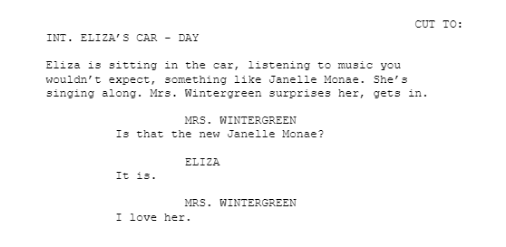
I recently talked on the podcast about my dear friend Ana Reyes’s astounding and well-deserved success surrounding her first novel, The House in the Pines (still #2 on the NYT bestseller list for hardback fiction as of this writing!). When we were all having drinks after the launch party back on January 3, her husband, who is also a writer and friend, mentioned to me that he and Ana had recently been talking about how ahead of the “cozy mystery” curve I was when I put together my pitch document/series bible for the as-yet-undiscovered project Mrs. Wintergreen. As I smiled a toothless grin that belied my bitterness that fate has not seen fit to bring Mrs. Wintergreen to life, I didn’t even point out that not only was that the case, but also that I had even included a scene in which my protagonist, 108-year-old semi-pro sleuth Constance Wintergreen, expressed an appreciation for Glass Onion star Janelle Monae:

Anyway. 

Agatha Christie is very in vogue, as evidenced by not only the aforementioned Christe-adjacent 2022 release Glass Onion, but also the Christie-containing See How They Run, a confident first feature from director Tom George penned by Mark Chappell, who is perhaps best known for his writing for the David Cross vehicle The Increasingly Poor Decisions of Todd Margaret. A period piece, the film begins on the night of the hundredth performance of The Mousetrap, a Christie-authored play which is infamous for two things: first, that there is a twist ending that the audience is encouraged not to reveal to others, resulting in the play’s ending remaining largely unknown to this day, and second, that the contract for the play forbids any adaptation of the source material to film (or the short story on which it was based from being published) until at least six months have passed since its final performance at London’s West End. This was a particularly long-sighted bit of legal play, as the show has run continuously (other than a COVID-caused pause) since its opening night in October of 1952, seventy years ago. In fact, I have some suspicion that this film exists solely for that reason, as it is the closest we can get to a Mousetrap adaptation for the foreseeable future. 

Leo Köpernick (Adrien Brody) is a sleazy slimeball of an American film director (redundant, I know) who has his sights set on turning The Mousetrap into a hit motion picture. That previously noted clause about the show being forced to close before this can even be a possibility is at the forefront of the minds of many involved, but theatre producer Petula Spencer (Ruth Wilson) assures him that the play has already reached its 100th performance and surely it will run out of steam soon, espousing the idea that a narrative with a whodunit at its core will, by its nature, see few repeat visitors and will necessitate closure sooner than later. Although we the viewers are sufficiently distant from this event that this is an historical irony for us, the contemporary American studio system is so confident that they already have Mervyn Cocker-Norris (David Oyelowo) working on a screenplay. Cocker-Norris’s English sensibilities and sense of adaptational faithfulness brings him into conflict with the flashy Köpernick, although the former is not alone in his distaste for the latter: British film producer John Woolf (Reece Shearsmith) is also protecting a scandalous secret about which Köpernick is blackmailing him; Köpernick is rude to all members of waitstaff everywhere, which includes the put-upon usher Dennis Corrigan (Charlie Cooper); and, mere moments before his murder at the ten minute mark, he is decked by Richard “John ‘Spared no expense’ Hammond” Attenborough (Harris Dickinson), who portrays the lead in The Mousetrap, for flirting with his co-star and wife Ann Saville (Pippa Bennett-Warner). The investigation of his death necessitates the appearance of Inspector Stoppard (Sam Rockwell), the archetype of the drunken detective who plays fast and loose with the rules; due to a shortage of available partners, he is paired with Constable Stalker (Saoirse Ronan), a plucky, energetic up-and-comer who is mere months away from being the first woman to take the sergeant’s exams. 

This is a neat little movie that makes sense in and of itself but also functions as a love letter to Christie and to her longtime fans, a body of which I consider myself to be a member. For instance: a scene in which the excitable Stalker asks a hotelier what part of France he is from based on the fact that he speaks French only to receive a deadpan response that he is Belgian is a fun comic bit in and of itself, but it’s also a nod to fans of Christie’s Belgian detective Hercule Poirot, who often finds himself on the receiving end of this exact misunderstanding. There’s also a good running gag about Hamlet: Early on, Attenborough says of The Mousetrap “It’s not exactly Hamlet.” Later, Stoppard half-quotes Act II Scene II’s famous ending line “The play’s the thing” [“Wherein I’ll catch the conscience of the King”], spoken when Hamlet commits himself to obtaining evidence of his uncle Claudius’s guilt through an elicitation of a confession upon seeing a fictionalization of Hamlet’s father’s murder. This is itself a circular reference, as not only does it reveal that Stoddard has realized that the connection between the murder of Köpernick may actually have to do with the play’s content, not its performance as initially suspected, but the word “mousetrap” likely comes from Hamlet in the first place as Hamlet refers to the play as a mousetrap in Act III Scene II (line 2131), in what may be the invention of the term. Your mileage is likely to vary on certain comic elements, of course; whether or not you find it clever that Cocker-Norris disdains screenplays that include flashbacks as crass and artless moments before one occurs in his narration is going to be left up to the individual viewer. I find his asking of “Whatever next? A caption that says, ‘Three weeks later’?” juxtaposed with that very caption to be charming and fun, but I know that others will find it to be more of a moment of bathos. 

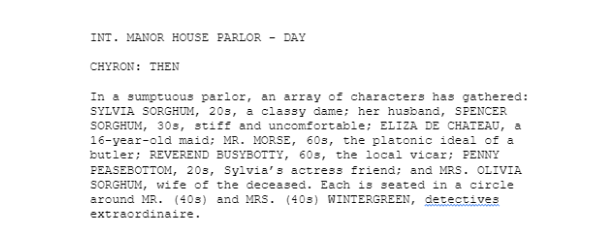
My favorite gag, however, cribs neither from Shakespeare or Christie, but Adaptation: in a flashback, much to the chagrin of Cocker-Norris, we get to see a little bit of how Köpernick’s mind works as he shows a series of storyboards that he put together for the climax of the film version of The Mousetrap. The images are quick cuts between detailed insets: gloved hands at a power box, a revolver being cocked by an unknown person, a fire breaking out in the middle of a tense standoff with a hostage—all of it very un-Christie and extremely Hollywood. This is Köpernick’s attempt to “jazz up” the very un-Hollywood and extremely Christie ending of the play, which uses one of her most well-known and genre-defining tropes: the end-of-the-story summation gathering, in which the detective gets everyone together in a parlor to explain their investigation and conclusion. In fact, not that it matters, but it’s so very much part of the genre that a parody of this type of scene is the very first thing that happens in the script for the Mrs. Wintergreen pilot, “Mrs. Wintergreen and the Thorny Dilemma” 

See How They Run turns this on its ear by playing both sides in the same way that Adaptation does, by mocking the hand that feeds it via denigrating comments about the formulaic nature of Hollywood adaptations, and then doing each and every one of the things that it mocks. The climax of the film takes place in a parlor that has the exact same layout, dimension, and decorations as the final set of the play, although this is obscured until the last possible moment to reveal it. The revolver, the fire, the standoff, the power box—the whole thing plays out in exactly the same way that Köpernick’s storyboard does. It’s a lot of fun to watch. (So would Mrs. Wintergreen be, I think, but I digress.) 

I was engaging with some essay or other this week and was taken aback when the author noted that, for all of his extremely large body of literary work, Isaac Asimov’s oeuvre rarely sees film adaptations, with only a handful ever being produced: Konets Vechnosti from 1987, based on The End of Eternity, which I assume must have had a subtitled release in the U.S. at some point but I can find no evidence of; the Robin Williams vehicle Bicentennial Man; two separate adaptations of the 1941 short story “Nightfall;” and, theoretically at least, I, Robot. In general, the world does not lack for Christie adaptations; they are so numerous that films based on And Then They Were None alone have their own Wikipedia subpage. The Mirror Crack’d from Side to Side was adapted as an episode of Miss Marple and Agatha Christie’s Marple, which are two separate television shows, as well as a film version in 1980 starring Angela Lansbury as Marple. When it comes to Christie media, we are the lilies of the field, neither toiling nor spinning, nevertheless arrayed in splendor. But we don’t have an adaptation of The Mousetrap, and we likely never will. Even if that day comes, there’s a risk it will be as dull and uninteresting as 2017’s Crooked House, which even Glenn Close and Gillian Anderson couldn’t save. What we do have is See How They Run, which is more than good enough; it’s great. 

-Mark “Boomer” Redmond

Sick (2023)

Besides maybe the horny-old-biddies football comedy 80 For Brady being inexplicably set in 2017, the new straight-to-Peacock slasher Sick is likely to be the most conceptually bizarre period piece of the season.  The COVID-19 pandemic might be waning, but it is still ongoing, which makes screenwriter Kevin Williamson’s decision to set Sick in the early-pandemic days of Spring 2020 a little confusing, if not outright immoral.  COVID-themed horror that takes advantage of the pandemic’s of-the-moment novelty and finance-forgiving social isolation is now a three-year-old gimmick at this point, with early standouts like the excellent screenlife ghost story Host getting produced & released in the same timeframe when Sick is set.  So, why would Williamson bother stepping outside his highly successful slasher franchise Scream to dial the clock back to those early COVID days, when that’s already such an overcrowded market?  Apparently, it’s because he’s been itching to complain about people who are a little too zealous & militant about mask-wearing, social-distancing safety measures in public life, and he couldn’t be satisfied venting about it in a Facebook rant like every other Gen-X crank, so he made a feature film instead.

In its opening hour, Sick appears to take the ambient terror of COVID very seriously, likening it to the intangible menace of horrors like Final Destination, The Happening, and Skinamarink.  Again, this is a period piece set in the early wiping-down-your-groceries era of the pandemic, when coherent public understanding of how COVID spreads—let alone vaccines—had yet to formulate.  There’s an oppressive paranoia in all public life that’s distinct to that era, illustrated by how a single cough in a grocery store has all other shoppers shooting daggers in your direction.  The tension is instantly high, and the vibes are instantly bad, which is a great start for a lean, low-budget slasher with only 80 minutes of playtime.  It’s also a great excuse to isolate a slasher’s teens-in-peril victims, who plan to ride the pandemic out by self-quarantining in a cabin in the woods.  The knife-wielding killer who stalks them also comes pre-masked, as was the fashion (and legitimate safety precaution) of the time.  All of this COVID-based terror is cleverly considered, but once the killer’s face & motives are revealed, Williamson’s screenplay devolves from we’re-all-in-this-together societal camaraderie into bitchy “Some of you are taking this pandemic stuff a little too seriously” apathy, and all of the tension gives way to eyerolls & jerk-off motions.

As often as Williams is determined to step on rakes in the last few pages of his screenplay, a lot of Sick‘s faults are smoothed over by DTV action director John Hyams’s knack for bone-crunching impact & small-scale visual spectacle.  The novelty of COVID horror is fading, and the basic tropes of the home-invasion slasher are so familiar that Williamson made a name for himself mocking them in a meta-horror franchise nearly three decades ago, but Hyams manages to make Sick feel consistently thrilling & surprising from moment to moment.  Yes, we have already seen Jason Voorhees emerge from Crystal Lake as an unkillable ghoul, but have we ever seen him thrust his blade at victims from under the water, like a deadly-sharp Jaws fin?  Yes, we’ve already seen teens chased around a remote cabin after enjoying a few hand-rolled joints, but rarely with such creative, dynamic blocking & fight choreography – since most independent first-wave slashers of that ilk were made by youngsters who enjoyed a few beers & joints on-set themselves.  Honestly, Sick has all the hallmarks of a classic slasher: style, efficiency, brutality, novelty, and boneheaded reactionary politics that sour nearly all of those merits.  According to that scorecard, Hyams has acquitted himself, Williamson has embarrassed everyone and, as is always true, Jane Adams (whose role I won’t spoil) deserves better.

-Brandon Ledet

Skinamarink (2023)

For anyone disappointed that Jane Schoenbrun’s microbudget darling We’re All Going to the World’s Fair was a somber teen-crisis drama instead of the low-fi creepypasta horror it was mismarketed as, Kyle Edward Ball’s Skinamarink might be the salve for your year-old wounds.  Curiously, the next project on Schoenbrun’s docket is titled I Saw the TV Glow, which is the closest thing to a coherent plot synopsis you could apply to Ball’s narrative-light experiment in digital-grained dread.  Skinamarink is crowdsourced Internet Age horror, both in funding and in conception.  After honing his craft by adapting user-submitted dream journals into horror shorts on his YouTube channel Bitesized Nightmares, Ball crowdfunded a feature-length amalgamation of those comment-section submissions’ most common themes & images for his official, theatrical debut.  Skinamarink was essentially conceived by the internet hivemind.  It was marketed by it too, illegally leaked out of online film festival platforms and spread around as a slumber party-style dare among TikTok Zoomers, as if it were vintage found footage instead of an upcoming theatrical release.  Whereas We’re All Going to the World’s Fair is about creepypasta, Skinamarink is a genuine example of it, which makes the two films an unlikely, unholy pair (and possibly just the start of a larger, not-yet-defined Internet Age film movement).

It’s easy to forget Skinamarink‘s Internet Age DNA in the moment, though, since it’s aesthetically nostalgic for an earlier era.  While the look & feel of Skinamarink conjures memories of impossibly late nights spent online in my teen years, its 1995 setting dials the clock back even further to a time before when it was affordable to bring the internet home.  Ball shot the film in his own childhood home, perfectly preserved with popcorn ceilings and unstylish lighting fixtures that recall a bland childhood everyhome.  In its one overtly nightmarish conceit, two young siblings—Kevin and Kaylee—wake to discover that not only are their parents missing, but the doors & windows to the outside world are missing too, with the remaining smoothed-out walls forming an endless, featureless labyrinth.  Ball creates a first-person-POV childhood nightmare experience by removing all possible distinguishing features from both the setting and his characters, ensuring there are no framed art pieces, family portraits, or even characters’ faces to differentiate this eerie childhood memory from your own (presuming you’re old enough to remember a pre-internet world).  The exact vintage toys, cartoons, and drab carpeting of a 90s childhood immerse the audience in an uneasy familiarity with this forgotten psychic space.  Even the title—a reference to an ancient novelty song best remembered as the repurposed theme for The Elephant Show in the 1980s—feels eerily familiar, but initially difficult to place.

That dual familiarity to 1990s suburban homes and 2000s internet subdungeons is an important sensory anchor in a film with very little narrative structure to speak of.  Kevin and Kaylee are young children with malleable minds, so they take the sudden disappearance of their parents & escape paths as a simple matter of fact, choosing to ride out the nightmare by playing with their off-brand Legos in front of public-domain Fleischman cartoons looping on the basement TV.  On their occasional excursions up the stairs and down the hallways it becomes increasingly apparent that something is in the house with them, an evil presence that’s destined to be colloquially known as The Skinamarink as this film’s legacy stretches into the future.  To explain how The Skinamarink torments these faceless children in this featureless suburban prison would spoil the three or four identifiable events in the otherwise sparse 100 minutes of film grain & room tone.  It’s a work mostly made of textures, not narrative.  The heavily distorted tape hiss & digital grain invite you to lean in, searching for something tangibly evil in the undulating darkness.  You do eventually find it, usually in loud flashes that interrupt long stretches of wooshy quiet with the arthouse equivalent of a jump scare.  What’s much more important is the dread you feel looking for something that isn’t there, though, which leaves a much starker, more memorable impression than the spooky shapes The Skinamarink eventually takes.

Skinamarink is simultaneously a familiar experience and an alien one, mixing generic horror tropes with an experimental sensibility – like a Poltergeist remake guided by the spirit of Un Chien Andalou.  It’s the kind of loosely plotted, bad-vibes-only, liminal-space horror that requires the audience to meet it halfway both in emotional impact and in logical interpretation.  In the best-case scenario, audiences will find traces of their own childhood nightmares in its darkened hallways & Lego-piece art instillations.  Personally, I was more hung up on the way it evokes two entirely separate eras of my youth: my alone-time online as a sleep-starved teen and my alone-time in front of cathode TVs as a sleep-starved tyke a decade earlier.  There’s some dark magic in the way it buries its analog horror tropes under a heavy digital shroud, and the looping, undulating patterns of the digital film grain were often just as mesmerizing as the search for the monster they obscure.  Even if the film doesn’t ignite your brain on that digital-psychedelia level or stir a more sinister, subliminal reaction in your chest, its immediate financial & cultural success is still a victory worth celebrating.  It isn’t often that a film this strange breaks out of the straight-to-Shudder release model, much less one shot in a single week for $15,000.  Skinamarink is a good omen for the continued theatrical distribution of Weird Art in our sanitized corporate hell-future, even if it plays like a cursed internet broadcast from a post-theatrical world.

-Brandon Ledet

Shin Ultraman (2023)

Just as the original Godzilla series quickly backslid from heartbreaking political allegory to novelty children’s fluff, Hideaki Anno’s Shin Godzilla franchise starter has already made way for quirky kitsch in its immediate follow-up – Shin Ultraman.  I could not be happier about it.  While Shin Godzilla is the smarter, more thematically purposeful film, Shin Ultraman is the more fun, breezy, rewatchable one.  It continues Shin Godzilla’s satirical illustration of the ineffectiveness of bureaucracy in the face of a kaiju-scale threat, but that governmental buffoonery is more of a background hum here than it is the main show.  Anno’s Ultraman film—which the Neon Genesis Evangelion mastermind wrote, produced, edited and, most surprisingly, mo-capped—is more of an upbeat celebration of both sides of the human/monster divide.  It crams in tons more of the skyscraper CG monsters than Godzilla’s solo outing could manage (although the individual designs of Godzilla’s Pokémon evolutions were a major highlight in the earlier film), and it also celebrates the humans below as adorable dorks who are just trying their best in a world stacked high against them.

If Shin Ultraman echoes any of Shin Godzilla’s high-minded artistic merit (beyond a main-cast performance from Drive My Car’s Hidetoshi Nishijima), it’s in its look & pacing.  Director Shinji Higuchi shoots governmental office scenes like he’s competing with Soderbergh in full showoff mode, finding the most improbable camera angles possible to accentuate the absurdism of modern office work’s fluorescent-lit mundanity.  Anno matches that overachiever energy in the editing room, cutting between Higuchi’s off-kilter shot compositions with a distinct anime sensibility – always going 10,000% hard no matter the occasion, even when depicting paperwork.  That dynamic attention to detail makes this a formidable contender for one of the most visually impressive comedies in decades; it’s just also one of the goofiest.  Instead of trying to conjure realistic-looking CG monsters (which was never a concern in the genre’s early rubber-suit days anyway), Shin Ultraman’s kaiju creatures lean into the uncanny end of the medium. That means it will be taken less seriously than aggressively dour competitors like Gareth Edwards’s American Godzilla film from 2014, but also means it’s a lot more fun to watch.  If it resembles any big-name kaiju movie from the past couple decades, it’s the goofball free-for-all Big Man Japan, which is at least a comparison that does it a lot of favors.

Story-wise, Shin Ultraman returns its titular space alien superhero to his children’s TV roots, pitting him against a series of skyscraper monsters in a consistent episodic rhythm.  Ultraman walks among us in a barely concealed Clark Kent disguise, powering up to kaiju scale whenever another post-Godzilla CG monster emerges to tear up Japanese cities & countryside.  His Earth-saving superheroics are even scored by a tin-canny mix of 60s throwback stock music presumably lifted from the original Ultraman series.  It’s a familiar formula for anyone old enough to remember a pre-MCU media landscape, but in the 2020s its vintage earnestness feels remarkably refreshing.  Ultraman is genuinely fascinated with the go-getter exuberance of the human spirit—especially when threatened by impossible odds—and, by extension, so is the film.  The hook of seeing Shin Ultraman big & loud at the theater is in the promise of weird-looking CG monsters doing battle over miniature cities while shooting laser beams out of their eyes, hands, and mouths.  Once your butt is in the seat, though, the real show is in its celebration of humanity’s adorable perseverance & naivete.  It can’t help but feel a little frivolous in comparison to the political cynicism of Shin Godzilla, then, but that unashamed frivolity is incredibly endearing.

Maybe I’m making Shin Ultraman sound like disposable kids’ fluff here, and in some ways maybe it is.  Its plot machinations surrounding intergalactic superweapons that can transform human beings into kaiju-scale war drones and Ultraman’s superheroic sacrifice in merging his alien DNA with a human’s are all old-hat comic book nonsense.  I’d much rather watch earnest nonsense like this than its ironic callbacks in post-modern works like Big Man Japan & Psycho Goreman, though, which borrow from the pop art beauty of its vintage kitsch but are too embarrassed to be mistaken for the genuine thing.  There’s plenty “adult” material lurking under this film’s Saturday Morning Cartoon surface too – from the governmental bureaucracy satire to the CG psychedelia to the momentary indulgences in sexual fetishism (including some especially shameless pandering to the giantess community).  They’re just not the main draw.  Shin Ultraman is a delight precisely because of its childlike exuberance, which is just as fitting to its titular alien hero’s television origins as Shin Godzilla’s political cynicism is to the original Gojira.

-Brandon Ledet

Babylon (2022)

“Welcome to the asshole of Los Angeles.”

Spending the holidays with family was a healthy shake-up for me after a couple years of COVID-related isolation, which only compounded my usual, longstanding reluctance to travel to rural & suburban Louisiana.  Getting outside the city meant getting outside my bubble, and I talked to a few distant loved ones about movies without being able to cite relatively popular artists like Bergman, Lynch, and Cronenberg as household names.  Meanwhile, actual household name Steven Spielberg’s magic-of-the-movies memoir The Fabelmans was being categorized as elitist snobbery for Julliard graduates on Twitter, and every movie without a blue space alien in it was drowning at the box office.  And if you count cameos, at least one movie with a blue space alien was drowning too.  Damien Chazelle’s Babylon sank while James Cameron’s Avatar sequel soared, and it was impossible not to fret over the two films’ disparate levels of success, since the madman Chazelle dared to include a few frames of Cameron’s Na’vi creatures in his film’s climactic Movies-Through-The-Years montage.  The financial failure of Chazelle’s star-studded movie industry drama sounds surprising in the abstract, but after a few days of talking about movies with people who don’t often Talk About Movies it makes total sense to me.  Caring about the craft & history of cinema as an artform is a niche interest, even when the cinema itself is populist media.  The thing is that Babylon is explicitly about that exact disconnect: the horrifying gap between how much general audiences love to be entertained by The Movies and how indifferent those audiences are to the lives & wellbeing of the people who make them.

The obvious reasons for Babylon‘s financial failure extend far beyond expectations that general audiences would share its nerdy academic interest in the century-old history of pre-Code Hollywood moviemaking.  If anything, Chazelle’s $80mil flop is most impressive in how eager it is to alienate its audience, regardless of its movie-nerd subject matter.  It’s a three-hour, coke-fueled montage on double-speed that not only indicts the unwashed masses for our indifference to the artistry behind our favorite movies but also assaults our eyes with every fluid the human body can produce.  Piss, shit, tears, blood, puke, and cum all dutifully grace the screen in their own time, with the piss & shit ticked off the checklist early on to help set the tone.  Modern-day movie stars Brad Pitt & Margot Robbie suffer the same rough transition from silents to talkies that has been mythologized as the downfall of Early Hollywood since as far back as 1952’s Singin’ in the Rain. Only, their backstage debauchery between productions is cranked to a year-round Mardi Gras bacchanal never before depicted with so much onscreen hedonistic excess.  It’s enough to make you want to puke yourself, if not only from the carsick momentum of the film’s manic pacing, which rarely slows down from its intercutting dialogue barrages to stage a genuine scene of real-time drama.

Because its characters are more symbolic than dramatic (directly recalling past industry castoffs like Clara Bow, Louis Armstrong, and Anna Mae Wong), Babylon is often more interesting for what it’s trying to say on a big-picture scale than it is for its scene-to-scene drama.  I was particularly struck by the way its repetition of Singin’ in the Rain‘s talkies-downfall plot is directly acknowledged in the text, with Babylon consciously positioning itself as yet another example of Hollywood’s cyclical, self-cannibalizing nature.  When most movies cite the magic of cinema being greater and more enduring than the people who make it, it’s coming from a place of awe & respect for the artform.  Here, Chazelle projects pure disgust & horror.  In its mission-statement climax, our low-level-fixer-turned-high-level producer POV character Manny (Diego Calva) watches caricatures of his dead friends & colleagues mocked as comic archetypes at a screening of Singin’ in the Rain, then slips into a subliminal montage of the next 100 years of Hollywood-spectacle filmmaking, with each successive title—Un Chien Andelou, The Wizard of Oz, 2001, Jurassic Park, Terminator 2, Avatar, etc.—building on and borrowing from the past for its own in-the-moment splendor until there’s no splendor left to go around.  Chazelle even shamelessly participates in this ritual himself, as Babylon can easily be passed off a cruder, shallower Hail, Caesar! crammed into a Boogie Nights-shaped box. It’s an ungenerous reading of how cinema perpetually “borrows” from itself in a way that feels like homage but rarely acknowledges or takes care of the real-life people who built its founding texts.  And when Manny snaps out of it to gawk at the uncaring, unknowledgeable audience cackling at ghosts of his loved ones, the tragedy of his cruelly perpetual industry hits way harder than any of the character deaths that sparked his melancholy in the first place.

I was most impressed with Babylon in its scale and in its eagerness to alienate casual moviegoing audiences.  It likely would have been better received if it were a 10-hour miniseries that allowed each of its overlapping character arcs to breathe (especially since it already intercuts their stories like a long-running soap opera anyway), but its manic tempo is exactly what makes it special among the million other movies about The Movies, so it was probably better off flopping than capitulating.  I also love that Chazelle projects such a sour view of moviemaking as an artform, a compulsory practice he immediately likens to dragging a diarrheal elephant uphill.  The only reason I don’t fully love this movie is I can’t shake the feeling that I’ve already seen it all before (even if at half-time pace), but that kind of complaint only plays into exactly what Chazelle is trying to say about Hollywood’s cyclical history here.  Even his climactic montage’s assertion that cinema has already reached its end—a death knell also sounded by the hundreds of click-bait articles that auto-populate every time a major production like Babylon flops—feels like a self-cannibalizing repetition of Hollywood lore.  How many times has cinema already “died”?  Did it die when the talkies ended the silent era, when television became affordable, when television went prestige, when normies began to stream?  Every generation thinks they’re going to be the last, and although one day they’ll be proven right, the cinemapocalypse has yet to fully come to fruition.  In the meantime, artists can only watch in horror as their work and their peers are absorbed, digested, and regurgitated by subsequent art movements they do not understand, with no wide audience recognition for how they contributed to that greater continuum.  Even the populist Spielbergs of the industry become historical, esoteric references in the long run, and there will come a time when Chazelle’s own name is synonymous with The Russo Brothers, Kevin Feige, and Michael Bay as dusty antiques only of interest to high-brow academics.

-Brandon Ledet

Glass Onion (2022)

“It hides not behind complexity but behind mind numbing, obvious clarity!” So Daniel Craig’s Glass Onion character Benoit Blanc, called by Google “the world’s greatest detective,” says to much-vaunted “inventor” Miles Bron (Edward Norton) toward the end of this Knives Out sequel. I was a big fan of Knives Out when it premiered a few years ago. Brandon got a screener copy of its sequel along with some fun swag, and he was kind enough to both let me wait until the film fell into my greedy little clutches to publish a review, but also send along some of said swag, which includes the fantastic “A Rian Johnson Whodunnit” hat which you can see me wearing below while also clothed in one of my Angela Lansbury shirts: 

For Glass Onion, Benoit Blanc once again finds himself insulated from the world among a smaller world of morons, ingrates, and moronic ingrates as well as hucksters, snake oil salesman, and politicians. This time, he has ostensibly received an invitation to a murder mystery weekend at the home of the aforementioned Bron, who is an amalgamation of various rich douchebag stereotypes (and truths) but who most closely resembles Elon Musk due to his involvement in various companies and businesses which work together to create an impression of a wise ubermensch, when he is in fact a little weirdo who obsesses over getting approval from others. Also invited to the island were several of Bron’s friends, each of whom received a puzzle box that required them to work together to solve and receive their invitation. There’s Birdie (Kate Hudson), the ignorant socialite whose put-upon assistant Peg (Jessica Henwick) has the full time responsibility of not letting her tweet something racist and dumb that could get her cancelled for good; there’s also sad MRA Duke (Dave Bautista) who lives in his mother’s basement while hawking various products that promise to make his viewers “alphas” like he presents himself to be, while his social-climber girlfriend Whiskey (Madelyn Cline) plays along with his internet image. On the smarter end of the scale of Bron’s friends is Lionel Toussaint (Leslie Odom, Jr.), one of the lead scientists at Alpha who liaises with upper management about Bron’s ideas; and the gang is rounded out by Claire Debella (Kathryn Hahn), former governor of Connecticut who is now campaigning for a senatorial run. Finally and apparently unexpectedly, also in attendance is Andi Brand (Janelle Monáe), a former business partner of Bron’s who was unsuccessful in preventing him from pushing her out of the business and exposing his questionable business practices. It’s May 2020, and they have gathered at Bron’s Grecian estate, which is topped with an ostentatious lúkovichnaya glava made of transparent glass, from which the film partially takes its name. 

Of course, the title could mean a lot of things. For instance, it’s the name of the bar where all of the main characters (sans Blanc) gathered in their pre-wealth days, when Andi first brought them all together and before they all stabbed her in the back. It’s also, famously, the title of a track from what we colloquially call The White Album, although it’s properly titled The Beatles. Following all of the fan speculation about the meanings of some of the more psychedelic and impenetrable lyrics on their 1967 album Sgt. Pepper’s Lonely Hearts Club Band, John Lennon opted to pen a song that was intentionally antagonistic to anyone attempting to find a deeper meaning in the words; even if you don’t know the song title, you’re familiar with the Paul is dead conspiracy theory that’s now 55 years strong because of the lyrics “the Walrus is Paul.” Or, as Blanc says at one point: “I like the glass onion as a metaphor, an object that seems densely layered, but in reality the center is in plain sight.” From title to exposition, everything is a clue here, just as it was in Knives Out in 2019, and although the social criticism is a little shallower and more obvious than it was last time, I’m still here for the very fun ride. 

Of course, that’s one of the things that makes films this elegantly constructed difficult to write about. You’re either going to end up recapitulating all of the fun and foreshadowing how it pays off, which ruins the ride for first-time viewers (hell, I’m already worried I might have given away who the killer is just from my little gags in this review so far) or you’re stuck trying to explicate on something in which the pleasure of the viewer lies in running alongside the narrative and having the revelations to the audience coincide with those to the characters. It’s tricky to pull off, and I’ve often cited how I feel comedy and mystery exist in and evoke neurochemical pleasure in the same parts of the mind: it’s all very specific planting and payoff, and if your audience gets to the solution/punchline too far in advance of the flow of the narrative, it can be death for both genres. Melding them together is a perfect idea (I’ve got more than one work in progress right now that does precisely that) that also doubles the potential for the film to crash and burn like, I don’t know, a SpaceX Falcon 1 launch. Both the previous Knives Out film and this one manage to pull it off. Every reveal makes total sense and falls perfectly in line with what we’ve already seen and what we already know while still allowing us to feel some sense of accomplishment in “figuring it out” along with the characters. It’s an effect you can only find in great examples of the genre, like Murder, She Wrote, which gets a loving reference here in the form of several celebrity cameos playing Among Us with Blanc during his quarantine blues before his invitation to the Onion, most notably and most wonderfully the divine, magical Dame Lansbury.

If I have any complaints about the film, they are few and far between. Blanc is bigger and bolder here than he was in the last film, which matches the zanier plot of this one but also makes it feel like the character isn’t quite consistent. This one doesn’t straddle the line of mocking conservatism and neoliberalism from a slightly left position as well as the last one did, which makes this one feel more “Hollywood” than the last one as well, despite both featuring a cast full of legitimate movie stars. It has a little bit of the Trump SNL taint on it (alternatively we could call it the There’s Someone Inside Your House problem), where just because something happens to align with my belief system doesn’t mean that it automatically makes it a better or more worthwhile piece of art. Most of its barbs are sharp, though. In particular, I love the detail that Birdie, who has already been shown to have zero concern about hosting a superspreader event in her apartment, arrives to the dock on the way to Bron’s island in what the script describes as a “fashionable but totally useless lace mask”. Some of them land a little more loudly or call more attention to themselves than they should, when I don’t remember the first film having any issues with this at all, but maybe that’s the nature of political satire now. There are elements of the plot, setting, and choices here that seem eerily prescient given how long the film took to make, like that it was in theaters at the time that Elon Musk had his bluff legally called and was forced to complete his purchase of Twitter, or that there is a giant mural in Bron’s house depicting Kanye West as Jesus Christ, which is both funny and depressing given the nature of West’s current public persona entirely revolving around spouting Anti-Semitic rhetoric with his whole chest. It recalls how there was an entire garden industry on the internet for a while of pointing out things that The Simpsons “predicted,” when the simpler and more depressing reality is that, with a few notable exceptions, there hasn’t been much of an improvement in most people’s lives since 1989. Glass Onion didn’t predict anything either, but it certainly has a talent to reflect how bleak things are at the moment. 

At the end of the day, this is the kind of movie that I can only recommend you watch it or not, given that saying more than I’ve already said runs the risk of spoiling too much. If you’ve already got Netflix, you really have no reason not to, and I think that you’ll really enjoy the twists and turns along the way if you have the patience. And you’re at home, where you can pause and create your own intermission to go to the bathroom or make a cocktail, so why not? If nothing else, every person who watches this movie pushes Ben Shapiro closer and closer to having an epiphanic moment about what his actual place in the world is, and isn’t that a dream we should all strive towards? 

-Mark “Boomer” Redmond

Fire Island (2022)

In my needlessly personal and passionately incoherent review of and apologia for Bros, I neglected to mention that it was not the only gay romcom that came out this year. It wasn’t even the only one with Bowen Yang in it. Fire Island flew a bit further under the radar than Bros did, and although I’d like to give our dear friend Billy Eichner an object lesson about how something that isn’t associated with a Twitter tantrum might end up being better received critically than something that is, we can probably chalk the overall absence of Fire Island from the conversation up to racism. The only upside is that being outside of the conversation also puts you outside of The Discourse. Small mercies. 

Fire Island is a contemporary gay update of Jane Austen’s Pride and Prejudice, sort of. Here, the biological Bennett family of the novel is replaced with a family of choice. Mrs. Bennett is replaced by Erin (Margaret Cho), who turned the misfortune of accidentally eating a piece of glass at an Olive Garden (or equivalent) into a house on notorious gay mecca Fire Island. In lieu of daughters, she is visited for a week every year by five gay men who are all at some point in the process of crossing the threshold from young adulthood to plain old adulthood adulthood. Max (Torian Miller) is the big guy of the group who loves to pretend that he’s “above” getting down and dirty on the island but who’s really the dirtiest of them all; hyper femme Keegan (Tomás Matos) wears crop tops and as little else as possible and also loves Marisa Tomei; while Luke (Matt Rogers) is also largely defined character-wise by his love of Marisa Tomei, although he also gets to be more involved in the actual plot than Max and Keegan as he takes Lydia Bennett’s role of being socially compromised by an immoral interloper. The real stars, however, are Bowen Yang and Joel Kim Booster as Howie (the Jane) and Noah (the Elizabeth and therefore our primary viewpoint character), who are clearly the two closest of the group, despite Howie having moved away from NYC to work on the west coast. The sexy, gym-bodied Noah provides the voiceover for the film, which starts with the famous opening lines of Pride and Prejudice: “It is a truth universally acknowledged that a single man in possession of a good fortune must be in want of a wife.” Noah then reveals his playboy nature to us by noting that not every man is looking to settle down. This is less true of Howie, who, at age thirty and dad-bodded, is stressed that he’s never had a boyfriend and fears that he’ll never get the romcom romance of his dreams. 

Upon arrival to the island, Erin reveals that she’s broke (she invested too much in Quibi) and will have to sell the house soon, meaning that this is the last summer that the crew will have together at the house, unless one of the sisters can marry a wealthy man like Mr. Darcy. Wait, no that’s not quite right; everything before the Darcy stuff is accurate, but no one needs to marry, sorry. Noah agrees to avoid getting laid until he successfully wingmans for Howie and, having committed himself thus, sets out to accomplish his mission with gusto. Howie immediately hits it off with Charlie (James Scully), while Noah is initially drawn to the sullen Will (Conrad Ricamora) but then is put off by him after overhearing Will being grumpy in that traditional Mr. Darcy way. I’m being quite literal, by the way; Darcy says of Elizabeth that she is “not handsome enough to tempt him,” while Will says of Noah that “he’s not hot enough to be that annoying.” But of course, as we all know, you can’t keep an Elizabeth and a Darcy apart forever. They may loathe each other for a while due to operating under bad first impressions, but they’re going to end up together. That’s just how this works. 

Fire Island is a fun, breezy, unpretentious movie. While I might have gotten more actual chuckles out of Bros, Fire Island is much more charming. One of the problems with Bros is the extent to which it felt the need to announce how important it was. And, I mean yeah, I wrote almost 3500 words about it; it is important. But it also never lets you forget that it knows how sophisticated and ground-breaking it believes itself to be, while Fire Island aims to be exactly what it is and quietly succeeds in being the best possible version of that thing. The pop culture references are funnier without needing to be so … explicative? Debra Winger’s bog monologue about how all gay men come to her with their relationship issues because in their minds she’s Grace Adler is funny, sure, but it has nothing on Keegan and Luke reciting dialog from My Cousin Vinny in an increasingly agitated hysteria because they’re stuck playing a celebrity guessing game with someone who doesn’t know who Marisa Tomei is. The jokes that allude to or directly cite other movies here are refreshing both in brevity and the fact that the film doesn’t need to belabor the audience with an explanation when, for instance, one character calls out another for being catty with the line “Way harsh, Tai.” If you get it, then you get it, and if you don’t, the movie’s already moved on to the next plot beat.

What also makes things work here is honesty. Noah and Howie are kindred spirits because each recognizes in the other the way that Asian men are ostracized within the community, and it brings them closer. Noah, however, can’t see past this surface similarity to be completely open and honest with himself about the way that he and the schlubbier Howie are treated differently on the island because of how one matches a very particular set of beauty standards and the other doesn’t. As someone with a fat body that prevents me from having the same social cachet as my better looking friends, this really hit home for me; not to keep comparing this to Bros, but in that movie, I couldn’t stop thinking about how the white, conventionally attractive Eichner feeling sorry for himself for his lack of a boyfriend while consistently hooking up with other attractive people was alienating and, frankly, dishonest. Howie’s emotional scene in which he begs Noah to really look at the two of them and see that although they are both two East Asian gay men who face the same ostracization from the mainstream, pretending Howie has the same more social credit as Noah—with his toned abs and perky pecs—is actually hurting Howie, even if Noah is trying to hype his friend up. Bros felt the constant need to draw attention to itself as “groundbreaking” gay cinema while Fire Island creates something that is fresh and new and hopeful simply by modernizing one of the cornerstones of romantic literature. If you’re only going to watch one, it should be this one.

-Mark “Boomer” Redmond