
Wake Up Dead Man: A Knives Out Mystery (2025)

“His flock has not only begun to shrink, but to calcify,” Bishop Langstron (Jeffrey Wright) warns young Reverend Jud Duplenticy (Josh O’Connor) about his reassignment to serve under Monsignor Jefferson Wicks (Josh Brolin) at Our Lady of Perpetual Fortitude in upstate New York. Jud has just faced a committee of three upper-level members of the church for punching a fellow priest in the face, and he recounts the story of his turn to Christ, one of redemption not achieved but ongoing. Jud was a boxer in his youth before he found salvation, and for large parts of the film, the driving conflict is between Jud’s willingness to sacrifice, his sincere desire to bring others closer to Christ, and his testament to Christ’s love, versus Wicks’s egotistical self-martyrdom, his drive to consolidate his power at the expense of eroding his flock’s faith, and his heretical performance of his own prejudices as if they were God’s words. If Glass Onion could be (rightly) criticized for being a little too on-the-nose with its depiction of an Elon Musk-like richer-than-sin weenie loser villain, Wake Up Dead Man instead goes for a less specific target with the same ostentation by taking on all of the sins of modern right wing nationalism that cloak their evil under a banner of faith, and those who put darkness for light. Like me, director Rian Johnson had a profoundly religious upbringing, and although we both have left the churches in which we were raised, this film demonstrates a deep and abiding admiration for and fondness of true believers who practice God’s love, and I both respect and was moved by the approach. Johnson may have, intentionally or unintentionally, created one of the best pieces of Christian propaganda since Chronicles of Narnia or “Sinners in the Hands of an Angry God,” and he did it showing the apotheosis of contemporary American Christian Nationalism tending to a church that was literally without Christ. 

When I was young, one of the oft-repeated sermons that I witnessed (through countless Thursday chapel sessions at the fundamentalist Christian school that I attended, Sunday School sermons, Children’s Church ministries, and Wednesday Youth Pastor recitations) was one about the Christ-shaped hole in everyone’s being. Sometimes the hole was in your soul, and sometimes it was in your heart; if it was in your latter, they would occasionally use a piece of wood cut into a heart, with a lower-case-t-shaped void in the middle, into which a conveniently sized cross could slot as a visual representation. (Presumably, the more ambiguous nature of the soul prevented it from being carved out of scrap wood for these performances). I get the feeling that Johnson likely sat through some of these same services, and he transposes that metaphor in this film to a literal void in the shape of a crucifix on the walls of Our Lady of Perpetual Fortitude. We learn the reason for this in a story related by Martha Delacroix (Glenn Close), who witnessed the destruction of the temple as a child; the monsignor’s grandfather Prentice was a widower with a daughter, Grace, when he became the shepherd of the town’s flock, and the daughter was a girl of “loose morals” who ended up a pregnant teen. Prentice promised her his fortune if she remained under his roof and didn’t embarrass him by going into the town, and she honored her end of the bargain until his dying day, watching as Prentice poisoned her own son against her and groomed him into becoming the next in a line of men who disguise their hatred behind their vestments. She found his bank accounts empty, and destroyed much of the church, supposedly out of rage, before dying while pounding on the outside of his “Lazarus tomb,” which can only be opened from the outside by construction equipment but which can be opened from within with only a light push. Ever since, Grace has been characterized as “The Harlot Whore,” and has become a key figure in Monsignor Jefferson’s fiery sermons.

It’s to this lost flock, not only shrinking but calcifying, that Jud arrives. That sounds like a coldly analytical way to describe it, but it’s with that same clinicality that Jud diagnoses the rot at the heart of Perpetual Fortitude, metaphorically calling it a cancer that must be cut out. This raises suspicions, of course, when Jefferson Wicks dies, seemingly impossibly. He entered a small cubby near the pulpit with no apparent exit, in full view of all witnesses, and collapsed before a knife was found in his back. Those in attendance that day other than Jud were a select few extremely devoted followers, who form our cast of suspects and witnesses. Martha was there, as was her husband Samson (Thomas Haden Church), the church groundskeeper who has found the strength to maintain his own sobriety because of his respect for the Monsignor’s own dubious overcoming of his addictions. Town doctor Nat Sharp (Jeremy Renner), whose wife recently left him for someone she met on a Phish message board and took the kids with him, is present, as is concert cellist Simone Vivane (Cailee Spaeny), who is currently funneling all of her savings into Perpetual Fortitude in the hopes that the Monsignor will be able to cure her of her painful, disabling neuropathy. The town has also become home to Lee Ross (Andrew Scott), a former pulp sci-fi novelist of some (niche) renown whose pivot into libertarianism has made him an outcast in the elite literary circles he envies and left him with only a small but devoted fandom of survivalists who, in his words, “all look like John Goodman in The Big Lebowski.” Ross hopes to make his way back into polite society by publishing a book of Wicks’s sermons and his own accompanying essays and commentary, and as such is one of the Monsignor’s sycophants. Rounding out the group is Vera Draven (Kerry Washington), who is carrying on the family tradition of acting as the Wicks family’s lawyer, following in her father’s footsteps, as well as Cy (Daryl McCormack), the son her father forced her to adopt when she was still a student and the boy was already old enough to be in school. Cy has returned to Perpetual Fortitude, tail between his legs, after a failed attempt at breaking into politics. 

Most of the film’s political satire revolves around Cy. I mentioned before that the satire in this one is less about mocking a specific individual than about painting a broader picture, but Cy seems like a deliberate invocation of Christian Walker, at least if I’m reading Cy as being as closeted (which I am). When Cy complains to Jud that he failed to make his political ambitions come true, it was in spite of the fact that he hit every single right-wing talking point, listing them one by one in a screed that lasts for over a minute of the film’s runtime. He describes his playbook as, to paraphrase, “making people think about something that they hate and then make them afraid it will take away something that they love,” which is an encapsulation of the go-to method of reactionary appeals to perceived attacks on normalcy. Wicks is clearly not a technically adept person, a member of an older generation, but Cy’s incessant need to constantly curate his existence for his online following means that Wicks’s ideas work their way out to Cy’s followers, a genealogy of intolerance. It works thematically while also justifying why there’s footage of a very important meeting that reveals every participant’s motivation. 

We’ve gotten pretty far into this without ever mentioning Benoit Blanc (Daniel Craig), the gentleman detective who is ostensibly the star of this series. He enters the film fairly late as well, but it’s a damned good entrance, as he finds himself inside Perpetual Fortitude and face to face with Jud, who has provided the narration to this point, and finds it difficult to find something nice to say about the church and can only bring himself to compliment the architecture. Blanc has been brought in by the local sheriff (Mila Kunis), and he’s fascinated by the opportunity to solve what is, despite the lack of a door, a locked-room mystery. It turns out that the church reading group has all read multiple examples of the genre, including The Murder of Roger Ackroyd and The Hollow Man, which means that any one of them could have drawn inspiration from them. It was here that I first suspected that we were being led to the inevitable conclusion that Jud had committed the crime and was merely an unreliable narrator, as is the case in Roger Ackroyd (um, spoiler alert for a book that turns one hundred next year, I suppose); after all, his name sounds like someone trying to say the word “duplicity” after too many drinks. As it turns out, the presence of Roger Ackroyd is a clue, but not the one that I thought. 

Blanc, despite a slightly smaller presence here, is nonetheless excellent when he’s on screen. As with the previous two installments in this series, there’s much to laugh at and be puzzled by here, and the audience for my screening had a delightful time. You will too. 

-Mark “Boomer” Redmond

Lagniappe Podcast: Brick (2005) vs Poker Face

For this lagniappe episode of The Swampflix Podcast, Boomer & Brandon discuss two detective stories from the earliest and latest extremes of Rian Johnson’s career: the 2005 high school noir Brick and the ongoing human-lie-detector TV series Poker Face.

00:00 Foreign Correspondent (1940)
04:14 Topaz (1969)
11:00 Play It as it Lays (1972)
15:11 Muriel’s Wedding (1994)
16:56 Pink Narcissus (1971)
30:23 A History of Violence (2005)
37:05 Eddington (2025)
47:52 The Saragossa Manuscript (1965)
50:41 Fellini Satyricon (1969)
54:49 The Tragedy of Man (2011)

1:01:44 I Know What You Did Last Summer (2025)

1:11:11 Brick (2005) vs Poker Face

You can stay up to date with our podcast through SoundCloudSpotifyiTunesTuneIn, or by following the links on this page.

– The Lagniappe Podcast Crew

Glass Onion (2022)

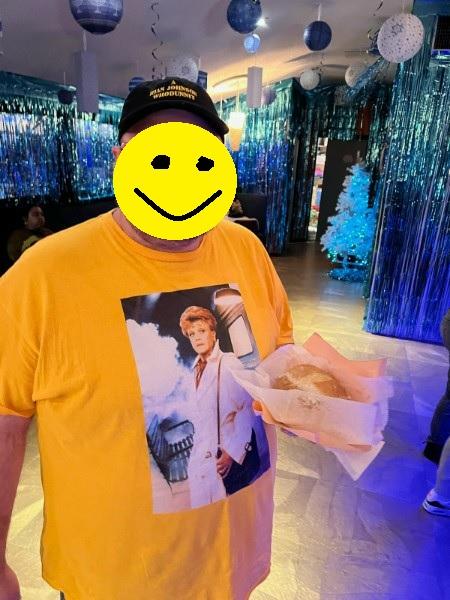
“It hides not behind complexity but behind mind numbing, obvious clarity!” So Daniel Craig’s Glass Onion character Benoit Blanc, called by Google “the world’s greatest detective,” says to much-vaunted “inventor” Miles Bron (Edward Norton) toward the end of this Knives Out sequel. I was a big fan of Knives Out when it premiered a few years ago. Brandon got a screener copy of its sequel along with some fun swag, and he was kind enough to both let me wait until the film fell into my greedy little clutches to publish a review, but also send along some of said swag, which includes the fantastic “A Rian Johnson Whodunnit” hat which you can see me wearing below while also clothed in one of my Angela Lansbury shirts: 

For Glass Onion, Benoit Blanc once again finds himself insulated from the world among a smaller world of morons, ingrates, and moronic ingrates as well as hucksters, snake oil salesman, and politicians. This time, he has ostensibly received an invitation to a murder mystery weekend at the home of the aforementioned Bron, who is an amalgamation of various rich douchebag stereotypes (and truths) but who most closely resembles Elon Musk due to his involvement in various companies and businesses which work together to create an impression of a wise ubermensch, when he is in fact a little weirdo who obsesses over getting approval from others. Also invited to the island were several of Bron’s friends, each of whom received a puzzle box that required them to work together to solve and receive their invitation. There’s Birdie (Kate Hudson), the ignorant socialite whose put-upon assistant Peg (Jessica Henwick) has the full time responsibility of not letting her tweet something racist and dumb that could get her cancelled for good; there’s also sad MRA Duke (Dave Bautista) who lives in his mother’s basement while hawking various products that promise to make his viewers “alphas” like he presents himself to be, while his social-climber girlfriend Whiskey (Madelyn Cline) plays along with his internet image. On the smarter end of the scale of Bron’s friends is Lionel Toussaint (Leslie Odom, Jr.), one of the lead scientists at Alpha who liaises with upper management about Bron’s ideas; and the gang is rounded out by Claire Debella (Kathryn Hahn), former governor of Connecticut who is now campaigning for a senatorial run. Finally and apparently unexpectedly, also in attendance is Andi Brand (Janelle Monáe), a former business partner of Bron’s who was unsuccessful in preventing him from pushing her out of the business and exposing his questionable business practices. It’s May 2020, and they have gathered at Bron’s Grecian estate, which is topped with an ostentatious lúkovichnaya glava made of transparent glass, from which the film partially takes its name. 

Of course, the title could mean a lot of things. For instance, it’s the name of the bar where all of the main characters (sans Blanc) gathered in their pre-wealth days, when Andi first brought them all together and before they all stabbed her in the back. It’s also, famously, the title of a track from what we colloquially call The White Album, although it’s properly titled The Beatles. Following all of the fan speculation about the meanings of some of the more psychedelic and impenetrable lyrics on their 1967 album Sgt. Pepper’s Lonely Hearts Club Band, John Lennon opted to pen a song that was intentionally antagonistic to anyone attempting to find a deeper meaning in the words; even if you don’t know the song title, you’re familiar with the Paul is dead conspiracy theory that’s now 55 years strong because of the lyrics “the Walrus is Paul.” Or, as Blanc says at one point: “I like the glass onion as a metaphor, an object that seems densely layered, but in reality the center is in plain sight.” From title to exposition, everything is a clue here, just as it was in Knives Out in 2019, and although the social criticism is a little shallower and more obvious than it was last time, I’m still here for the very fun ride. 

Of course, that’s one of the things that makes films this elegantly constructed difficult to write about. You’re either going to end up recapitulating all of the fun and foreshadowing how it pays off, which ruins the ride for first-time viewers (hell, I’m already worried I might have given away who the killer is just from my little gags in this review so far) or you’re stuck trying to explicate on something in which the pleasure of the viewer lies in running alongside the narrative and having the revelations to the audience coincide with those to the characters. It’s tricky to pull off, and I’ve often cited how I feel comedy and mystery exist in and evoke neurochemical pleasure in the same parts of the mind: it’s all very specific planting and payoff, and if your audience gets to the solution/punchline too far in advance of the flow of the narrative, it can be death for both genres. Melding them together is a perfect idea (I’ve got more than one work in progress right now that does precisely that) that also doubles the potential for the film to crash and burn like, I don’t know, a SpaceX Falcon 1 launch. Both the previous Knives Out film and this one manage to pull it off. Every reveal makes total sense and falls perfectly in line with what we’ve already seen and what we already know while still allowing us to feel some sense of accomplishment in “figuring it out” along with the characters. It’s an effect you can only find in great examples of the genre, like Murder, She Wrote, which gets a loving reference here in the form of several celebrity cameos playing Among Us with Blanc during his quarantine blues before his invitation to the Onion, most notably and most wonderfully the divine, magical Dame Lansbury.

If I have any complaints about the film, they are few and far between. Blanc is bigger and bolder here than he was in the last film, which matches the zanier plot of this one but also makes it feel like the character isn’t quite consistent. This one doesn’t straddle the line of mocking conservatism and neoliberalism from a slightly left position as well as the last one did, which makes this one feel more “Hollywood” than the last one as well, despite both featuring a cast full of legitimate movie stars. It has a little bit of the Trump SNL taint on it (alternatively we could call it the There’s Someone Inside Your House problem), where just because something happens to align with my belief system doesn’t mean that it automatically makes it a better or more worthwhile piece of art. Most of its barbs are sharp, though. In particular, I love the detail that Birdie, who has already been shown to have zero concern about hosting a superspreader event in her apartment, arrives to the dock on the way to Bron’s island in what the script describes as a “fashionable but totally useless lace mask”. Some of them land a little more loudly or call more attention to themselves than they should, when I don’t remember the first film having any issues with this at all, but maybe that’s the nature of political satire now. There are elements of the plot, setting, and choices here that seem eerily prescient given how long the film took to make, like that it was in theaters at the time that Elon Musk had his bluff legally called and was forced to complete his purchase of Twitter, or that there is a giant mural in Bron’s house depicting Kanye West as Jesus Christ, which is both funny and depressing given the nature of West’s current public persona entirely revolving around spouting Anti-Semitic rhetoric with his whole chest. It recalls how there was an entire garden industry on the internet for a while of pointing out things that The Simpsons “predicted,” when the simpler and more depressing reality is that, with a few notable exceptions, there hasn’t been much of an improvement in most people’s lives since 1989. Glass Onion didn’t predict anything either, but it certainly has a talent to reflect how bleak things are at the moment. 

At the end of the day, this is the kind of movie that I can only recommend you watch it or not, given that saying more than I’ve already said runs the risk of spoiling too much. If you’ve already got Netflix, you really have no reason not to, and I think that you’ll really enjoy the twists and turns along the way if you have the patience. And you’re at home, where you can pause and create your own intermission to go to the bathroom or make a cocktail, so why not? If nothing else, every person who watches this movie pushes Ben Shapiro closer and closer to having an epiphanic moment about what his actual place in the world is, and isn’t that a dream we should all strive towards? 

-Mark “Boomer” Redmond

Knives Out (2019)

“Physical evidence can tell a clear story with a forked tongue,” Daniel Craig’s Knives Out character Benoit Blanc, “last of the gentleman sleuths,” says to Lieutenant Elliott (Lakeith Stanfield) upon being told that all the physical evidence surrounding the death of publishing magnate Harlan Thrombey (Christopher Plummer) points to suicide. This is not the first or last of a series of surprisingly well delivered bon mots from Blanc as he doggedly pursues the truth of what happened the night of Thrombey’s 85th birthday.

All the family gathered that night: Thrombey’s eldest daughter Linda (Jamie Lee Curtis), who describes her real estate business as “self-made,” in spite of actually starting out with a million dollar loan from the family patriarch; widowed daughter-in-law Joni (Toni Colette), a self-described lifestyle guru/entrepreneur and would-be influencer whose knowledge of current events comes from reading tweets about New Yorker articles; and, finally, son Walt (Michael Shannon), who runs Blood Like Wine Publishing, his father’s business. Each has their own family and hangers-on, as well; Linda is married to the largely useless and unfaithful Richard (Don Johnson), and their son Ransom (Chris Evans) is likewise a rootless gadabout and playboy of the Tom Buchanan mold; the delightful Riki Lindhome is given little to do other than spout Trump-era rhetoric about “good immigrants” and “bad immigrants” in her role as Walt’s wife Donna, and their son Jacob (Jaeden Lieberher) is a smartphone-addicted teen described as a “literal Nazi” who allegedly masturbates to images of dead deer; Joni is accompanied by daughter Meg (Katherine Langford), who is attending a prestigious liberal arts college and serves as the closest thing to a good person this family has, although she is not without her flaws. There’s also Greatnana, Thrombey’s elderly mother of unknown age, played by onetime Martha Kent K Callan, who I was surprised to learn was still alive. Also in the house that night are Thrombey’s nurse, Marta (Ana de Armas), and pothead housekeeper Fran (Edi Patterson, taking a break from killing it on The Righteous Gemstones). When Ransom storms out early after a heated discussion, suspicion initially falls on him, but every member of the family has a motive, as Thrombey had announced to each of them that very night that he was cutting off their individual paths of access to his wealth. And then, 33 minutes into the film’s 130 minute runtime, writer-director Rian Johnson tells you who did it. And then things get interesting.

I’ve long been a fan of comedy pastiches and homages of genres that function perfectly as examples of those genres despite humorous overtones; my go-to example is Hot Fuzz, which I always tout as having a more sophisticated murder mystery plot than most films than most straightforward criminal investigation media (our lead comes to a logical conclusion that fits all of the clues, but still turns out to be wrong). Knives Out is another rare gem of this type, a whodunnit comedy in the mold of Clue that has a sophisticated and winding plot. Despite the big names in that cast list above, Marta is our real hero here, although to say more than that would be to give away too much of the plot–both the film’s and Harlan’s. I’m not generally a fan of Daniel Craig, but in this opportunity to play against type, his turn as a kind of Southern Hercule Poirot here is surprisingly charming, first appearing to be somewhat bumbling and ignorant in his pursuit of the truth but ultimately proving to have a sharp deductive mind. His affected drawl also helps take many of Blanc’s lines, some of the best one-liners ever committed to a movie script, and elevates them into true comedic art. From the quote at the top of the review to his description of a will reading (“You think it’ll be like a game show. No. Imagine a community theater performance of a tax return.”) to his reference to Jacob in his Sherlockian summation of the evidence near the film’s end (“What were the overheard words by the Nazi child masturbating in the bathroom?”), all are rendered hilarious in their Southern gentility. It’s a sight to behold.

The film is surprisingly political, as well, and not just in a “Communism was a red herring” way. Like Get Out before it, Knives Out mocks the occasional ignorance of the political left vis-a-vis latent and uninspected racism on the part of Joni and Meg, who profess progressive values while being, respectively, a largely uninformed buffoon and an easily corrupted intellectual. On the other side of the aisle, the fact that all of the Thrombey children and grandchildren consider themselves to be “self-made” despite succeeding only due to the generosity of their wealthy patriarch calls to mind certain statements about a “small loan” of a million dollars that a certain political figure has made. Likewise, Rian Johnson has claimed that Jacob’s character is based on blowback he received from some of the darker corners of the internet following (what some would consider to be) the mismanagement of the Star Wars franchise while helming The Last Jedi. In particular, the entirety of the wealthy white family seems completely ignorant of Marta’s country of origin, with each of them calling her a different nationality; after a few glasses of champagne, they devolve into an ugly debate about the current supposed immigration “crisis,” citing well-worn neocon talking points about “America [being] for Americans” and “millions of Mexicans” undermining American culture, as well as the purported illegality of seeking asylum. All of this is done in front of Marta, who is specifically called out as an model member of a minority group and then asked to speak to this experience, exotifying her and speaking over her (that the most useless member of this crew, Richard, does so while absentmindedly handing her his dessert plate—like one would with a server or a domestic servant—is a particularly nice detail). It comes across as rather toothless in the moment, especially given that Jacob is largely held unaccountable for his political ideology (other than Richard’s accusation that the boy spent Harlan’s party in the bathroom “Joylessly masturbating to pictures of dead deer”), but the white New England family’s desperation to hold onto property that they consider rightfully theirs despite having had no hand in building the family’s financial success is ultimately revealed to be a core part of the film’s thesis, as evinced in the film’s final frame. That having been said, there are moments when I wish that the family was a little less charming and a little more clearly depicted as being in the wrong; at one point at the screening I attended, there was a rather loud laugh when Jacob called Marta an “anchor baby,” and the effusive reaction to that line in particular chilled my blood a bit.

The first time I saw the trailer for this film was before The Farewell, and the friend with whom I saw that flick had no interest in Knives Out, asking only that I text him after I left the theater and tell him who the killer was. I initially assented, but after my screening, I texted him and told him that the movie was too clever to be spoiled that way, and I meant it. This is a movie that should be seen without as little foreknowledge as possible, and as soon as you can.

-Mark “Boomer” Redmond

Star Wars Fans Don’t Love Star Wars, They Love to Complain

Although I’m not quite as enthusiastic of a fan of The Last Jedi at its most fervent defenders, I greatly respected that film’s willingness to burn the Star Wars franchise, one of the most historically lucrative intellectual properties around, to the ground and start anew. Rian Johnson’s entry into the Star Wars canon was a bomb meant to blow up age-old traditions from the inside. It states its intentions in blatant terms by literally burning sacred texts, portraying the franchise’s longest-established hero as a coward who wastes his days drinking grotesque alien goo, and spelling out its mission statement in dialogue like, “Let the past die. Kill it if you have to. It’s the only way to become what you’re meant to be.” I was personally more emotionally invested in the earnest, nostalgic mythmaking of The Force Awakens than anything Johnson’s film accomplished, but I do resect the way his flippant blasphemy attempted to smash the reset button on Star Wars at large, making it more palatable to younger fans without prior attachment to the series. It’s understandable why old school Star Wars fans might feel alienated or even offended by that blasphemy; maybe that reaction was even part of the point. What’s less understandable is why they were also furious with the modern revision JJ Abrams gave A New Hope in The Force Awakens, which was extremely cautious in how it updated series lore (and, in my opinion, was an improvement on the source material). What’s absolutely maddening is their disregard for the latest entry in the canon, Solo: A Star Wars Story, which returns the series back to the sci-fi radio serial swashbuckling of the original trilogy, which should be exactly what old school fans want. Longtime Star Wars devotees have no idea what would actually make them happy, except the mundane activity of complaining on the internet.

I had very little interest in seeing Solo: A Star Wars Story after comedic pranksters Phil Lord & Chris Miller were booted from the project in favor of personality-free workman director Ron Howard. Reports that execs were especially frustrated with Alden Ehrenreich’s talents as an actor were especially alarming, considering that Ehrenreich gave one of the most complexly sweet, funny performances in recent memory in Hail, Caesar! just two years ago. It turned out, of course, that paying attention to this production history in real time, knowing things like the fact that Ehrenreich was given an acting coach and that new ideas from the Lord/Miller crew where being shot down in favor of those from series dinosaur Lawrence Kasdan, was only detrimental to Solo’s entertainment potential. I felt like I had been following complaints about Solo: A Star Wars Story on the internet for a full year before the final product actually hit theaters, to the point that I was too exhausted to really care whether it was a good movie or not. It’s a shame, to, because Solo is a really fun sci-fi adventure movie, even as a compromised finished product. As Boomer points out in his review, the first half-hour or so of the film is a little iffy in its handling of the burdens of telling an origin story for a character we already know. However, once Han Solo meets up with Chewbacca in a prison pit, the movie is all cheesy swashbuckling & space heists and I had way more fun with it than I expected to. The average, longtime Star Wars fan did not have fun, if they saw the film at all. They even relished Solo’s box office underperformance as if it were punishment for Disney’s sins against the brand, despite Solo delivering the exact old school Star Wars tone they supposedly wanted to begin with. The most fun Star Was fans had after Solo’s release was complaining online about how corny the movie was in cataloguing how Han Solo got his name, his ship, his buddies and so on. If you have been complaining about how corny Solo is, let me let you in on an open secret: Star Wars has always been corny. You were once too young to notice it; now you’re too cynical to get over yourself enough to enjoy it.

Of course, it’s worth addressing that at least some aversion to the modern Star Wars canon is born of racist & misogynist politics, not matters of taste. Just this week actor Kelly Marie Tran­­ was chased off her Instagram account by Star Wars “loving” trolls who have been relentlessly bullying her for months because they did not appreciate the perceived progressivism of her character arc as Rose Tico in The Last Jedi. Similar complaints have ben lobbed at Rey, Finn, Vice Admiral Holdo, and pretty much anyone who doesn’t resemble the legion of white men who used to command the spotlight in older entries. It’s grotesque behavior that should be called out for its bigotry, but I really do think that regressive politics is just one motivator for longtime Star Wars Complainers. The more widespread problem among (to use a cursed word) the fandom is that complaint culture is Star Wars culture. The (admittedly, objectively bad) prequels from the early 2000s arrived at a time when complaining on the internet was a fresh, novel activity that kept longtime fans busy whining for over a decade before the Disney era sequels arrived. Its presumable that many Star Wars fans out there were socially raised complaining about The Phantom Menace & its ilk on the internet; it’s part of their DNA. The problem extends even further back than that, however. Young fans who first saw A New Hope in 1977 had enough time to grow cynical in the six years until The Return of the Jedi was released in 1983, which gave them plenty to complain about in the adorable teddy bear space alien Ewoks. That’s not even including the two made-for-TV Ewok movies and the cursed Star Wars Holiday Special that gave “fans“ complaint fodder between proper franchise entries. If, in all these instances, the loudest complainers speak for the hegemony at large, The Old School Star Wars Fandom only enjoys two out of the ten movies in the Star Wars canon: A New Hope & The Empire Strikes Back. Not only is that a dismal percentage for a supposed devotee, but the practice of complaining about everything under the Star Wars umbrella has become such an ingrained routine that when something like Solo actually does recapture the old school sci-fi swashbuckling charm of those two pictures, they’re entirely unsure how to enjoy it without complaining about it.

Usually, intensely dedicated fandoms complain because they have too specific of an idea of what an entry into their pop culture obsession of choice should be, especially in adaptations of pre-existing material, instead of enjoying it for what it is. Star Wars “Fans” certainly suffer that pitfall to an extent, forming concrete *shudder* “headcannons” of what should happen in Star Wars movies based on pre-existing video games, novels, fan theories, and (most disgustingly) regressive race & gender politics. In a roundabout way, though, the recent films are giving them exactly what they want: a reason to complain on the internet. If Solo’s old school swashbuckling cheese isn’t faithful enough to the Star Wars originals’ tone to satisfying these serial complainers, it’s doubtful anything ever will be. I’m only respecting The Last Jedi’s flippant blasphemy more the further I get away from it. Star Wars Complainers deserve to see their sacred texts burn to make room for new, potentially appreciative fans who haven’t spent the last few decades exhaustively complaining about the thing they supposedly love most. New fans at least stand a chance of actually finding joy in what’s projected on the movie screen, instead of finding joy in bitterly abusing its stars & creators on the computer screen.

-Brandon Ledet

Star Wars: Episode VIII – The Last Jedi (2017)

“Let the past die. Kill it if you have to. It’s the only way to become what you’re meant to be.”

In the opening scene to the critical & commercial bomb Waterworld, we’re introduced to Kevin Costner’s dystopia-navigating action hero by learning two unique facts about him: 1) he has gills that allow him to breathe underwater and 2) he drinks his own piss. This is such an off-putting introduction to someone who’s supposed to be coded as a heroic badass that the audience has very little wiggle room to ever get entirely past it; critic Nathan Rabin even refers to Costner’s protagonist as a “pee-drinking man-fish” for the entirety of his My Year of Flops review of the film. Rian Johnson’s entry into the Star Wars canon, The Last Jedi, is even more grotesque in the way it tears down Luke Skywalker in his own introduction, despite him being the de facto hero of the series going as far back as A New Hope four decades ago. An aged, surly Luke Skywalker drinks something much, much worse than his own piss in one of his earliest moments onscreen in The Last Jedi. When offered the lightsaber Rey extends to him in the final aerial shot of the film’s predecessor, The Force Awakens, Luke casually tosses the sacred thing over his shoulder and over the side of a cliff, flippantly disregarding the emotional payoff of the lore J.J. Abrams built up for Johnson to deliver on. The rest of the canon goes over the cliff with it, with pre-established dichotomies of Good & Evil, boundaries on the limits of the space-magic practice of The Force, and even basic questions of tone & intent being burnt to the ground so that new seeds can sprout from the ashes. Luke’s disgusting beverage of choice and general apathy for the history & lore of the Jedi is emblematic of The Last Jedi’s willingness to let traditional Star Wars themes & narrative threads die so the series can begin anew. It’s an often awkward, even outright goofy kind of blasphemy, but it’s a necessary evil for moving the franchise forward instead of merely echoing the past.

Ill-conceived holiday specials. made-for-TV Ewok movies, and near-universally loathed prequels aside, The Last Jedi is the first proper Star Wars film that’s not about stopping the construction or deployment of the planet-destroying spaceship The Death Star. You’d think that the same fans who blasted Abrams’s The Force Awakens for supposedly copycatting (or, in my opinion, improving through revision) the first film in the series, A New Hope, would appreciate that Rian Johnson has steered Star Wars away from telling that same tired story yet again. That has not been the case. There has been a wide gulf between critic & audience scores on aggregator sites like Rotten Tomatoes & Metacritic in how The Last Jedi is being received. Many disgruntled superfans of the series are stressing out over the way Johnson has jumbled & set aflame their *shudder* fan theories, which extend from speculation on everything from what the film’s title might mean to who Rey, the new hero of the franchise, might be sired by to what purpose Porgs, adorable toy-selling space-chickens, might serve in the larger scope of Star Wars lore. Johnson is not only dismissive of these extratextual extrapolations on where the series is going; he also completely dismisses the many far, faraway places the series has already been. It’s difficult to tell that from the film’s basic plot, though, even if it is Death Star-free. The Last Jedi is a fairly by-the-books Star Wars story bifurcated between Rey & Luke debating whether the practice of Jedi space-magic is worth reviving (much to Kylo Ren’s watching-from-afar chagrin) and The Resistance’s numbers dwindling in the meantime as they flee from the crushing space-Nazi fascism of the First Order (despite the efforts of familiar faces like Poe, Finn, Leia, BB-8, Laura Dern, etc.). I don’t believe most of The Last Jedi’s divisiveness is a response to the film’s narrative choices (though I wouldn’t put it past the series’ die-hard fans to complain about anything), but rather a question of tone & respect for series-spanning lore.

Star Wars has always had a jokey flippancy built into its DNA (just look to fan-favorite Han Solo for examples); its humor is a defense mechanism meant to forgive or ease its more off-putting sci-fi nerdery. The Last Jedi is an outlier in that dynamic only in the way it alters the series’ sense of humor for modern sensibilities. The jokes in George Lucas’s original trilogy were geared for the Baby Boomer generation, the same kids who would have grown up on the space opera radio serials (and subsequent televisions shows) Star Wars regenerated nostalgia for. It’s a comedy style that’s only grown corny with time, drifting further away from modern sensibilities with each new trilogy cycle. The Last Jedi ditches the Baby Boomer humor to appeal to Millennials who have grown up on Simpsons snark & Adult Swim anti-humor. The film opens with a prank call. Luke Skywalker dismissively refers to lightsabers as “laser swords.” The toy-selling cuteness of the space-chicken Porgs is a constant visual gag, with even a few of the critters being prepared as meals and generally treated as unwanted pests. The open secret, though, is that Star Wars has always been awkwardly goofy, full of absurdist creatures worthy of derisive laughter, and loose with consistent logic in its space-wizardry. It’s only become normalized over time through decades-long cultural exposure. As gross as Luke Skywalker’s beverage of choice is in this film, it’s no goofier or out of step with the series at large than a Frank Oz-voiced Yoda puppet or a space-tavern full of bipedal sea creatures playing jizz music. Rian Johnson’s film is being torn apart by life-long fans of Star Wars for making a series they’ve grown up mythologizing feel nerdily weird & awkward again: something it’s always been, but they were once too young to see. Old-timers are likely feeling alienated by the modern humor that shapes its tone, but I’m totally okay with abandoning past devotees of the franchise to make the environment more hospitable for new ones.

Brushing aside the more hateful, inflammatory complaints about women & PoC being afforded the blockbuster spotlight for once, most negative reactions to The Last Jedi are totally understandable. It’s not difficult to see how a film about literally burning sacred texts & starting from scratch could alienate some old-timers. Honestly, I’m not even sure the film’s absurdist Millennial humor & blasphemous revision of the Jedi as a religious practice/force for Good are 100% successful myself. I was much more emotionally moved by the sincere mythmaking & familiar, but consistent craft of The Force Awakens than I was impressed with the flippant absurdity of The Last Jedi. The Last Jedi may have been eccentric enough to alienate lore-serious Star Wars nerds, but it still doesn’t quite reach the over-the-top lunacy of something like Okja or Fury Road. There are moments when I could swear Brigsby Bear’s Kyle Mooney secretly directed the picture under a pseudonym, even though the evidence is stacked against me, but it’s ultimately too long & too well-behaved to satisfy as an absurdist masterpiece. Instead, the absurdism comes in flashes, just flavoring the original space opera recipe enough to establish a freshly goofy tone as a replacement for the staler goofy one it started with. Indignation over blasphemy to the lore of the Jedi and The Force is slightly more justified than resisting the film’s updated sense of humor, but when the now-established rules of space-wizardry were first introduced in the original franchise they likely seem just as absurd & arbitrary. In a way, dedicated fans deserve to be trolled for thinking that they’ve firmly grasped the rules & trajectory of the franchise enough that they can map out the exact stories of future installments based only on titles, advertisements, and interview clips.

Rian Johnson disrespectfully throws all fan theories in the trash, along with the consistency in lore that made them possible in the first place. It may sting the ego to discover you can no longer “figure out” the future of a franchise you’ve spent your whole life obsessively studying as if it were a riddle with a concrete answer, not a fluid work of art. However, by shaking up the rules & tones of what’s come before, Johnson has created so much more space for possibility in the future, for new & exciting things to take us by surprise instead of following the trajectory of set-in-stone texts. He’s made Star Wars freshly funny, unpredictable, and awkwardly nerdy again, when it was in clear danger of becoming repetitive, by-the-books blockbuster filmmaking routine instead. It’s an admirable feat, even if not an entirely successful one, and yes, even if it forced me to equate Luke Skywalker to a pee-drinking man-fish.

-Brandon Ledet