

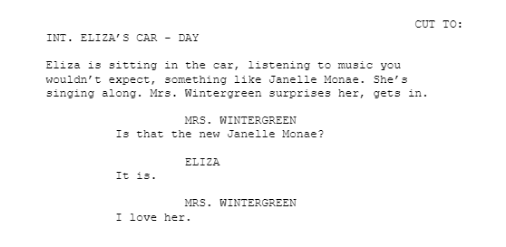
I recently talked on the podcast about my dear friend Ana Reyes’s astounding and well-deserved success surrounding her first novel, The House in the Pines (still #2 on the NYT bestseller list for hardback fiction as of this writing!). When we were all having drinks after the launch party back on January 3, her husband, who is also a writer and friend, mentioned to me that he and Ana had recently been talking about how ahead of the “cozy mystery” curve I was when I put together my pitch document/series bible for the as-yet-undiscovered project Mrs. Wintergreen. As I smiled a toothless grin that belied my bitterness that fate has not seen fit to bring Mrs. Wintergreen to life, I didn’t even point out that not only was that the case, but also that I had even included a scene in which my protagonist, 108-year-old semi-pro sleuth Constance Wintergreen, expressed an appreciation for Glass Onion star Janelle Monae:
Anyway.
Agatha Christie is very in vogue, as evidenced by not only the aforementioned Christe-adjacent 2022 release Glass Onion, but also the Christie-containing See How They Run, a confident first feature from director Tom George penned by Mark Chappell, who is perhaps best known for his writing for the David Cross vehicle The Increasingly Poor Decisions of Todd Margaret. A period piece, the film begins on the night of the hundredth performance of The Mousetrap, a Christie-authored play which is infamous for two things: first, that there is a twist ending that the audience is encouraged not to reveal to others, resulting in the play’s ending remaining largely unknown to this day, and second, that the contract for the play forbids any adaptation of the source material to film (or the short story on which it was based from being published) until at least six months have passed since its final performance at London’s West End. This was a particularly long-sighted bit of legal play, as the show has run continuously (other than a COVID-caused pause) since its opening night in October of 1952, seventy years ago. In fact, I have some suspicion that this film exists solely for that reason, as it is the closest we can get to a Mousetrap adaptation for the foreseeable future.
Leo Köpernick (Adrien Brody) is a sleazy slimeball of an American film director (redundant, I know) who has his sights set on turning The Mousetrap into a hit motion picture. That previously noted clause about the show being forced to close before this can even be a possibility is at the forefront of the minds of many involved, but theatre producer Petula Spencer (Ruth Wilson) assures him that the play has already reached its 100th performance and surely it will run out of steam soon, espousing the idea that a narrative with a whodunit at its core will, by its nature, see few repeat visitors and will necessitate closure sooner than later. Although we the viewers are sufficiently distant from this event that this is an historical irony for us, the contemporary American studio system is so confident that they already have Mervyn Cocker-Norris (David Oyelowo) working on a screenplay. Cocker-Norris’s English sensibilities and sense of adaptational faithfulness brings him into conflict with the flashy Köpernick, although the former is not alone in his distaste for the latter: British film producer John Woolf (Reece Shearsmith) is also protecting a scandalous secret about which Köpernick is blackmailing him; Köpernick is rude to all members of waitstaff everywhere, which includes the put-upon usher Dennis Corrigan (Charlie Cooper); and, mere moments before his murder at the ten minute mark, he is decked by Richard “John ‘Spared no expense’ Hammond” Attenborough (Harris Dickinson), who portrays the lead in The Mousetrap, for flirting with his co-star and wife Ann Saville (Pippa Bennett-Warner). The investigation of his death necessitates the appearance of Inspector Stoppard (Sam Rockwell), the archetype of the drunken detective who plays fast and loose with the rules; due to a shortage of available partners, he is paired with Constable Stalker (Saoirse Ronan), a plucky, energetic up-and-comer who is mere months away from being the first woman to take the sergeant’s exams.
This is a neat little movie that makes sense in and of itself but also functions as a love letter to Christie and to her longtime fans, a body of which I consider myself to be a member. For instance: a scene in which the excitable Stalker asks a hotelier what part of France he is from based on the fact that he speaks French only to receive a deadpan response that he is Belgian is a fun comic bit in and of itself, but it’s also a nod to fans of Christie’s Belgian detective Hercule Poirot, who often finds himself on the receiving end of this exact misunderstanding. There’s also a good running gag about Hamlet: Early on, Attenborough says of The Mousetrap “It’s not exactly Hamlet.” Later, Stoppard half-quotes Act II Scene II’s famous ending line “The play’s the thing” [“Wherein I’ll catch the conscience of the King”], spoken when Hamlet commits himself to obtaining evidence of his uncle Claudius’s guilt through an elicitation of a confession upon seeing a fictionalization of Hamlet’s father’s murder. This is itself a circular reference, as not only does it reveal that Stoddard has realized that the connection between the murder of Köpernick may actually have to do with the play’s content, not its performance as initially suspected, but the word “mousetrap” likely comes from Hamlet in the first place as Hamlet refers to the play as a mousetrap in Act III Scene II (line 2131), in what may be the invention of the term. Your mileage is likely to vary on certain comic elements, of course; whether or not you find it clever that Cocker-Norris disdains screenplays that include flashbacks as crass and artless moments before one occurs in his narration is going to be left up to the individual viewer. I find his asking of “Whatever next? A caption that says, ‘Three weeks later’?” juxtaposed with that very caption to be charming and fun, but I know that others will find it to be more of a moment of bathos.
My favorite gag, however, cribs neither from Shakespeare or Christie, but Adaptation: in a flashback, much to the chagrin of Cocker-Norris, we get to see a little bit of how Köpernick’s mind works as he shows a series of storyboards that he put together for the climax of the film version of The Mousetrap. The images are quick cuts between detailed insets: gloved hands at a power box, a revolver being cocked by an unknown person, a fire breaking out in the middle of a tense standoff with a hostage—all of it very un-Christie and extremely Hollywood. This is Köpernick’s attempt to “jazz up” the very un-Hollywood and extremely Christie ending of the play, which uses one of her most well-known and genre-defining tropes: the end-of-the-story summation gathering, in which the detective gets everyone together in a parlor to explain their investigation and conclusion. In fact, not that it matters, but it’s so very much part of the genre that a parody of this type of scene is the very first thing that happens in the script for the Mrs. Wintergreen pilot, “Mrs. Wintergreen and the Thorny Dilemma”
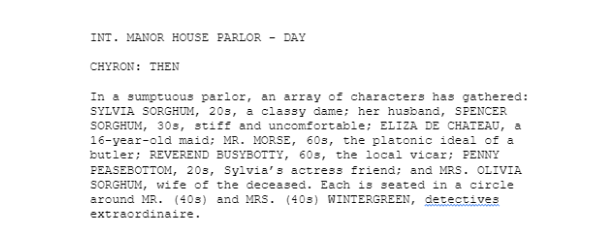
See How They Run turns this on its ear by playing both sides in the same way that Adaptation does, by mocking the hand that feeds it via denigrating comments about the formulaic nature of Hollywood adaptations, and then doing each and every one of the things that it mocks. The climax of the film takes place in a parlor that has the exact same layout, dimension, and decorations as the final set of the play, although this is obscured until the last possible moment to reveal it. The revolver, the fire, the standoff, the power box—the whole thing plays out in exactly the same way that Köpernick’s storyboard does. It’s a lot of fun to watch. (So would Mrs. Wintergreen be, I think, but I digress.)
I was engaging with some essay or other this week and was taken aback when the author noted that, for all of his extremely large body of literary work, Isaac Asimov’s oeuvre rarely sees film adaptations, with only a handful ever being produced: Konets Vechnosti from 1987, based on The End of Eternity, which I assume must have had a subtitled release in the U.S. at some point but I can find no evidence of; the Robin Williams vehicle Bicentennial Man; two separate adaptations of the 1941 short story “Nightfall;” and, theoretically at least, I, Robot. In general, the world does not lack for Christie adaptations; they are so numerous that films based on And Then They Were None alone have their own Wikipedia subpage. The Mirror Crack’d from Side to Side was adapted as an episode of Miss Marple and Agatha Christie’s Marple, which are two separate television shows, as well as a film version in 1980 starring Angela Lansbury as Marple. When it comes to Christie media, we are the lilies of the field, neither toiling nor spinning, nevertheless arrayed in splendor. But we don’t have an adaptation of The Mousetrap, and we likely never will. Even if that day comes, there’s a risk it will be as dull and uninteresting as 2017’s Crooked House, which even Glenn Close and Gillian Anderson couldn’t save. What we do have is See How They Run, which is more than good enough; it’s great.
-Mark “Boomer” Redmond

 Swampflix