The Exorcist Steps at Georgetown

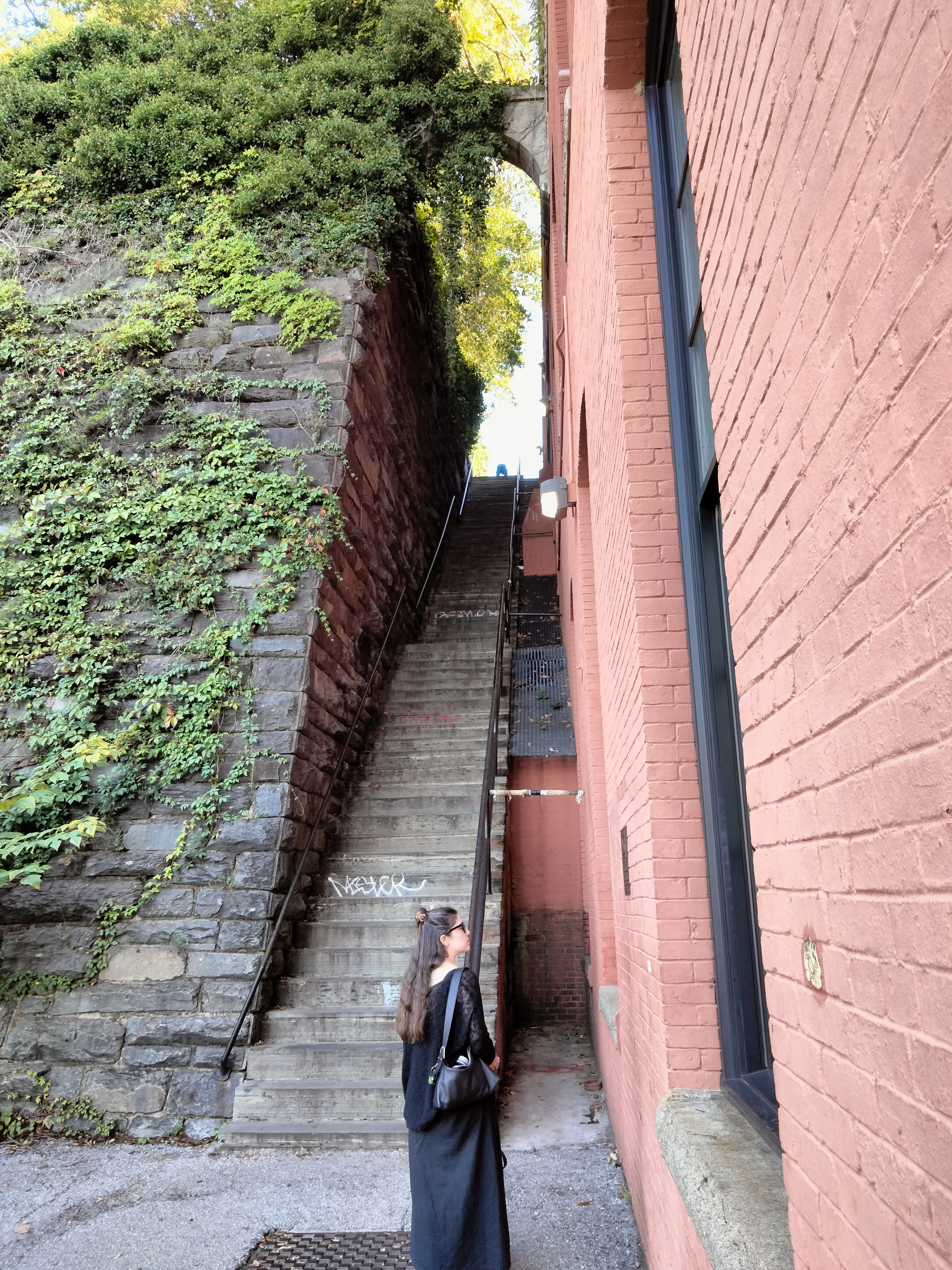
When you search for cinematic tourist attractions in Washington D.C., all signs point you towards Georgetown University – the setting and filming location for William Friedkin’s 1973 adaptation of the William Peter Blatty novel The Exorcist.  Specifically, they route you to the bottom of “The Exorcist Steps”: the death site of the fictional composite character Father Karras, who launches himself down those horrifically steep steps as a heroic act of suicide at the film’s climax.  Given Friedkin’s determination to make the supernatural terror of Blatty’s novel feel as believably authentic as possible, it’s not surprising to learn that the steps are a real location.  Referred to as “The Hitchcock Steps” at the time of filming (either in reference to their 19th Century designer, according to Friedkin’s memoir or, more credibly, in reference to the famous 20th Century director, according to locals), they’re a vertigo-inducing connection point between two busy streets at the edge of Georgetown’s campus. The extreme concrete flight burned a hole in Blatty’s mind while he was a student there, as did a local news report about a legitimate, certified exorcism performed in the Washington, D.C. area.  The only facts Friedkin had to fudge were minor geographical quibbles that allowed Karras to reach the steps from a nearby window, something that bothered the detail-obsessed filmmaker who wanted to keep his visualization of the novel as accurate as possible.  It seems that time has since corrected that adaptational inaccuracy, since there are now several windows facing the concrete staircase that could easily accommodate Karras’s leap.  I know this, of course, because I recently visited The Exorcist Steps on a trip to Washington, D.C., despite not being an especially big fan of The Exorcist.

I just find Friedkin’s grounded, real-world approach to supernatural horror to be a little too dry to deliver the genre goods.  A lot of people highly regard The Exorcist as one of the all-time greats precisely because it’s “accurate” to the real-world events that inspired it, finding terror in the idea that what it depicts could really happen.  I appreciate the tortured domestic drama that results from that approach, especially as a story about two lost adults (Ellen Burstyn as a semi-fictionalized stand-in for Shirley MacLaine and Jason Miller as the doomed Father Karras) desperately looking for a lifeline in a world that no longer makes sense.  It’s only after they’ve thoroughly exhausted the scientific, atheistic explanations that could debunk the possibility of demonic possession that Friedkin fully gives in to the supernatural mania of the premise, allowing Linda Blair to literally spew pure evil into the world.  Personally, I much prefer the ecstatic mania of The Exorcist‘s two direct sequels, The Exorcist II: The Heretic and The Exorcist III: Legion.  That’s where the dark magic of the demonic-possession premise really comes to life, unconcerned with duty to real-world reporting or to Blatty’s writing (despite his continued creative participation in the series).  The kinds of audiences who value tasteful restraint over uninhibited entertainment are likely to dismiss the Exorcist sequels outright as silly dilutions of an important, respectable piece of art.  Those sequels are exactly what attracted me to visiting The Exorcist Steps in Georgetown, though, since they speak more loudly to my tastes as a horror fanatic who prefers his horror to be fantastic rather than realistic.

So, what most D.C. travel guides tend to gloss over is that The Exorcist Steps are not only significant to the events of the original Exorcist film.  They are a constant, chilling presence throughout the initial trilogy, even more iconic to the series than Linda Blair’s spinning head.  In The Exorcist, the steps are largely used as an ominous mood-setter, repeatedly presaging Karras’s fall in establishing shots that beckon the in-over-his-head, faith-questioning priest to meet an early end.  The Exorcist II also uses them as an establishing exterior to signal that the story has returned to Georgetown.  While most of The Heretic is spent detailing young Regan’s life in New York City therapists’ offices—attempting to heal from her demonic episode through radical dream-state hypnosis sessions—it can’t help but drag the audience back to Georgetown at regular intervals, afraid to stray too far away from the familiar details of the original.  Each return to Georgetown is established by a shot of the infamous concrete steps . . . except, not really.  The Exorcist II was shot on a studio lot in Los Angeles as a cost-saving measure, so all onscreen appearances of The Exorcist Steps are an artificial substitute for the real thing.  The genuine, real-life steps reappear in the series’ crown jewel The Exorcist III, though, and without the continued participation of Linda Blair as a now-adult Reagan, the series has no choice but to treat them with total reverence.  They’re lovingly framed with music-video smoke machines at exaggerated angles, including several action shots of the camera rolling down each step in a dizzying spectacle from Karras’s tumbling POV.  The inciting beheadings at the start of The Exorcist III occur on the 15th anniversary of Karras’s fall down those steps, which get their own reverent shout-out during Brad Dourif’s show-stopping speech as the Devil incarnate.  It isn’t until The Exorcist III that The Exorcist Steps truly got their full due as a horror nerd fetish object; it was a slow upward climb to get there.

The Exorcist Steps were officially designated as a Washington, D.C. landmark in 2015 with the installation of an informative plaque marking Karras’s death site.  Shamefully, there are no mentions of The Exorcist II or The Exorcist III on that plaque, despite their significant contributions to those steps’ legacy.  When I visited them on an clammy Monday morning, I was greeted by the exact two kinds of frequent visitors you’d expect to see: a fellow gothy tourist who, like me, was there to take pictures and an annoyed local jogger who was impatient for us to get out of the way of his workout routine zipping up & down the steps.  I will share my pictures of the steps and their accompanying plaque below as documentation of the state they’re in as of this posting, in hopes that more joggers will be annoyed by horror movie nerds who happen to read this and will be visiting D.C. in the near future.  More importantly, though, I’d like to highlight that The Exorcist Steps’ significance to The Exorcist are thunderously amplified by that film’s own sequels, which are just as much worth rewatching before your visit as the original.  There’s even an added bonus to rewatching The Exorcist II before visiting D.C. in that the film also features a lengthy visit to the Natural History Museum, which is one of the city’s other must-visit tourist destinations.  Of course, Linda Blair’s tour of the Natural History Museum appears to be the one in New York City, not the one in D.C., but the effect is largely the same, much like how that film’s version of The Exorcist Steps aren’t actually The Exorcist Steps.  Let’s take a lesson from Friedkin’s folly and not get too wrapped up in the pursuit of accuracy at the expense of pleasure.
-Brandon Ledet
Sex Demon (1975)

These days, rip-offs & retreads of The Exorcist are all the same grim-grey trudges through tired Catholic iconography.  They’re so dutifully routine that I can close my eyes and picture the entirety of titles like The Exorcism, The Last Exorcism, The Pope’s Exorcist, and The Exorcism of Emily Rose without having seen so much as a trailer; the only novelty left in the genre is Russell Crowe occasionally doing an outrageous Italian accent.  That wasn’t always the case.  While William Friedkin’s original Exorcist was a relatively reserved, grounded horror film that tried to make a supernatural phenomenon feel like a genuine real-world threat, a lot of its immediate echoes were bonkers, wildly unpredictable novelties (not least of all its own sequel The Exorcist III).  We used to live in a world where an Exorcist riff could be a Blacksploitation sex romp like Abby, a Turkish copyright violator like Şeytan or, apparently, a hardcore gay porno like 1975’s Sex Demon.  To be clear, Sex Demon is not a porno parody of The Exorcist.  It’s a strangely serious, sinister knockoff of the original – a psychedelic story about a cursed medallion, nightmare-realm Satanic orgies, and a couple who’s normal, milquetoast life together is violently disrupted by demonic possession . . . and ejaculating erections.  It would take a lot of footage of Russell Crowe riding a Vespa to match that kind of novelty.

To celebrate their anniversary, a gay male couple have morning sex and then venture out of the apartment to buy each other gifts.  Some misguiding antiquing leads to the purchase of a cursed medallion (helpfully accompanied by a note that explains “This medallion is cursed”), which the older man buys for his younger lover as an affectionate gesture.  Since there’s less than an hour’s worth of celluloid to fill, the medallion makes quick work of transforming the younger boyfriend from gentle lover to demonic rapist, sending him on a manic quest to fist, piss on, and cum inside as many men as he can before either the spell wears off or his body expires.  The movie skips all of the science vs. religion diagnoses of its source text and gets right to the bed-rattling goods, but it somehow doesn’t lose an ounce of the feel-bad domestic horror in the process.  By mirroring specific objects & moments from the original Exorcist, it invites a parent-child reading on the main couple’s age gap relationship, which is a kind of 40-something/20-something affair.  Having given his younger boyfriend a cursed anniversary present, the older man is worried that he’s psychologically fucked the kid up for life, and a lot of the same helpless exasperation Reagan’s mother feels in the original carries over here.  It’s a feel-bad porno where even the sex scenes are set to a somber, menacing orchestral score, leaving you to wonder exactly what audience this was intended to please. 

Sex Demon‘s specific allusions to moments & totems from The Exorcist are relatively sparse beyond a brief recreation of the Catholic, climactic bedside ritual meant to cast the demon out of its host body.  It might not have clearly been presented as an Exorcist knockoff at all if it weren’t for the final scene’s violent tumble down a flight of apartment stairs or the marketing tagline declaring “Not even an exorcist could help!”  It’s only in retrospect that some moments stand out as allusions to The Exorcist, like Reagan’s masturbation with a crucifix being reworked as the possessed man stabbing a hookup in the anus with a screwdriver.  A lot of Sex Demon‘s horror is of its own making, including a ritualistic Satanic orgy that signals halfway through the runtime that the demonic possession has begun (a move that feels more inspired by Rosemary’s Baby than anything Friedkin directed).  The real creative centerpiece is a concluding montage that chaotically remixes all of the preceding film’s imagery into a violent, dizzying meltdown.  Sex scenes, antiques, dive bar strippers, candles, skulls, kitchen cabinets, and wobbly lamps rapidly flash over a menacing orchestral soundtrack, as if every frame snipped onto the editing room floor was randomly stitched together in lieu of filming something new for the climax.  That nauseating montage feels legitimately evil by the time it reaches its fever pitch, and for the first time you almost forget you’re watching something otherwise dutifully derivative.

Sex Demon was a lost film for nearly four decades, recently rediscovered and restored through the archival diligence of Ask Any Buddy‘s Elizabeth Purchell.  This was a much more substantial preservation of a lost porno parody than the infamous Bat Pussy reels uncovered by Something Weird in the 1990s.  It’s a battered, seemingly incomplete print, but it gets across the film’s artistic significance as an independent queer cinema mutation of a now-canonized horror classic.  Bat Pussy is much too silly of a comparison point, since Sex Demon takes its dramatic, romantic tension seriously enough to match other vintage porno outliers like Both Ways, Equation to an Unknown, and Pandora’s Mirror.  If you’re looking for a goofy parody of The Exorcist, you’re looking for the 1990 Leslie Nielsen comedy RepossessedSex Demon is much more concerned with echoing the evil, supernatural horrors of the original, which is a pretty lofty goal for low-budget pornography.

-Brandon Ledet

Lagniappe Podcast: The Exorcist III (1990)

For this lagniappe episode of The Swampflix Podcast, Boomer and Brandon discuss the supernatural horror sequel The Exorcist III (1990), written & directed by the author of the original Exorcist‘s source novel.

00:00 Welcome

04:22 House on Haunted Hill (1999)
12:22 Jacob’s Ladder (1990)
14:47 Talk to Me (2023)
26:12 Aporia (2023)
27:59 Freejack (1992)
30:12 Buzzcut (2022)
31:56 Mission: Impossible – Fallout (2018)
34:02 No One Will Save You (2023)
39:36 Fire in the Sky (1993)
48:52 Cult of Chucky (2017)
56:50 The Craft (1996)
1:03:53 The Craft: Legacy (2020)

1:07:35 The Exorcist III (1990)

You can stay up to date with our podcast through SoundCloudSpotifyiTunesTuneIn, or by following the links on this page.

-The Lagniappe Podcast Crew

Abby (1974)

In Shock Value, author Jason Zinoman discusses the fact that The Exorcist was surprisingly popular with black audiences in 1973, so it was only natural that a blaxploitation follow up would appear relatively quickly. Appearing on screens for only a month in 1974, Abby, written and directed by William Girdler (who had previously scripted and helmed cult classics like Three on a Meathook and Asylum of Satan, and who would go on to direct Pam Grier in Sheba, Baby), raked in an astonishing four million dollars before attracting the attention of Warner Brothers. WB sued American International Pictures for copyright infringement and won, leading to virtually every extant copy of the film to be destroyed, with only the film negatives thought to still exist. Until a long-forgotten copy of the film was discovered at the bottom of a box of 35 mm trailer reels at the American Genre Film Archive, that is. It’s unclear what will happen with the film now and whether it will see a new home media release (a very low quality 16 mm print was converted for DVD release in 2004, but it’s just awful), but it definitely deserves one.

The narrative opens on Reverend Emmett Williams (Terry Carter), who is going to Nigeria to perform missionary and humanitarian work during a plague. On the other side of the world, his son Garnet (William Marshall) has ascended to the rank of Bishop and taken charge of a church in Louisville, with his faithful wife Abby (Carol Speed) at his side. She, too, is active in the church, having just been certified as a marriage counselor and organizing church activities seven days a week. The two have just moved into a new home near the church, with help from Abby’s mother “Momma” (Juanita Moore) and brother Cass, a police detective. When the elder Williams opens an ebony box in Nigeria and unleashes an evil orisha spirit named Eshu, Abby becomes possessed by it and begins behaving in bizarre and dangerous ways, prompting her loved ones to try and find a way to save her, body and soul, before it’s too late.

For all that Warner Brothers did to bury Abby, they certainly had no issue taking some elements from it when drafting a script for The Exorcist 2, including the connection to ancient African myths and legends. That aside, Abby is marvelous, aside from a little bit of drag in Act III. Speed’s performance as Abby is heart-wrenching, as she struggles to make sense of the actions taken while possessed during her moments of clarity. Of particular note is the scene that follows her first episode, in which Eshu forces her to slice her wrist; Abby awakes to find her wrist bandaged and her baffled cries and moans are enough to stir even the hardest of hearts. Speed, who had recently lost her lover to a random shooting in the street outside of their home, took the role to distract herself from the tragedy, and she pours that emotional vulnerability and intensity into every scene. Also of interest is the fact that Eshu is not solely expelled through the power of Catholic exorcist intervention, but by the elder Williams donning a dashiki and kufi hat over his priestly collar, combining western Catholic tradition and ancient African mythology to solve the crisis at hand. It’s a thoughtful way to handle the film’s denouement, and serves to differentiate it from many of the run-of-the-mill Exorcist clones that followed William Friedkin’s more famous film.

Tracking down a decent copy of Abby may be no small feat, but it is highly recommended.

-Mark “Boomer” Redmond