The Lodger: A Story of the London Fog (1927)

While attending a recent screening at my local arthouse, I pointed out to my companions that there was going to be several screenings of Rear Window the coming weekend and gave it my typical whole-hearted recommendation. These were two of my younger friends who mentioned that they’ve seen far too few of Alfred Hitchcock’s films, but one of them had been in a high school theater production of The Lodger, which was quite the coincidence as I had a library copy of the DVD at home at that very moment. It’s also available on the Criterion app and Tubi (at least at the time of this writing), which means it’s pretty accessible, for anyone who might be interested. I know that a silent film is a hard sell these days, but I liked this one quite a lot and loved its use of expressionistic composition and dark atmosphere and recommend checking it out. 

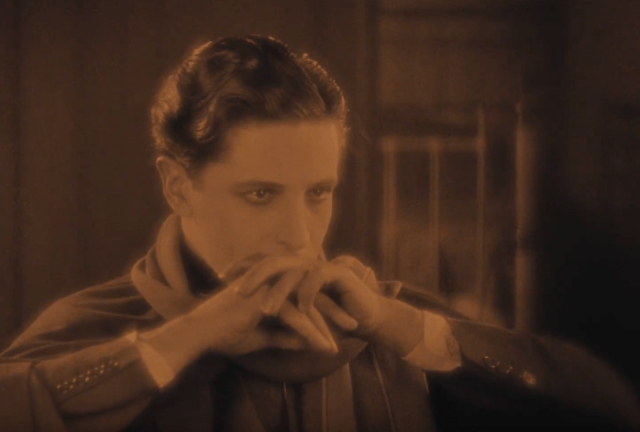
The Lodger (subtitled A Story of the London Fog) is a 1927 thriller from the Master of Suspense, his third film. It largely centers around one family’s experiences with a new lodger in their boarding house while the city at large quivers in fear at the actions of a serial killer leaving notes identifying themself as “The Avenger.” Mr. and Mrs. Bunting are caring and doting parents to their daughter, Daisy, a blonde young fashion model still living at home with them. Every Tuesday night for months, a blonde woman has been found murdered by the Avenger, and the police seem at a loss. The Buntings are friends with a detective named Joe Chandler, who is visiting them when news of the seventh victim arrives. That same night, a dark and imposing man appears at the Bunting home in response to their “room to let” sign. Joe is eventually put on the case to find the Avenger, and although he is able to discern a pattern from the location of the killings and estimate the general location of the next slaying, his jealousy over the growing attraction between the lodger and Daisy leads him to suspect the lodger of being the killer. When a search of the lodger’s, um, lodgings leads him to a map of the victims’ locations and clippings about the killings, the lodger is arrested, but Daisy helps him to escape, even though she (and we) still have no evidence of his innocence. 

There were moments during the course of the film that I was worried we were headed toward that easiest conclusion, but I should have known that even in this earliest part of his career, Hitchcock would already be working in a more subversive manner. In recent discussions on the podcast of Strangers on a Train, we talked about how Hitchcock never had much respect for the police, individually or institutionally, and there are already elements of this at play. Joe Chandler may manage to put together some clues about the real Avenger, but his personal failures of pettiness and jealousy lead him to pursue an innocent man, to the point that during his flight from the law the lodger is almost lynched by a mob while the real killer is elsewhere racking up yet another body. Hitchcock also loved to tell (and retell) the story of an innocent man being wrongly accused and pursued, from The 39 Steps to To Catch a Thief to North by Northwest to Frenzy, so it’s no surprise that it turned up as a plot point in this early work of his. I did expect there to be a bit more of a twist surrounding Joe, however. 

It’s never quite clear exactly what his relationship is to Daisy. Sometimes, she seems very receptive to his wooing, but at other times rejects his advances, although it’s a possible interpretation that her rejection largely occurs in scenes in which her parents are present. In their first scene together, he flirts with her by cutting a heart shape out of the dough that her mother is preparing and placing it in front of her, to which Daisy responds by tearing the heart in half and handing it back to him. To me, this established that his interest was unwelcome, but there are other scenes in which she welcomes his attention with enthusiasm. At the time of release, Joe’s actor Malcolm Keen was 40 years old, and he looks older. I’d probably attribute it to the technological limits of the time rather than to an intentional aesthetic choice, but Keen’s fair complexion and the make-up available at the time renders him, well, a bit ghastly-looking. In comparison, although Ivor Novello’s lodger character arrives at the Bunting house looking and behaving like a total weirdo, once he settles in, he reveals himself to be as beautiful as he is brooding. As a result, although I was willing to believe that the film was headed toward the revelation that the lodger was the Avenger as easily as it might have been headed toward his innocence, I also thought it might be revealed that Joe was the Avenger, but that might be my expectations being a little too close to modernity. The Avenger is apprehended entirely offscreen, his identity never revealed, but the audience of today looks at this rather small cast of characters and automatically assume that one of the characters has to be the killer. Through that lens, it could only be Joe, but that wasn’t really a trope of the medium yet.

-Mark “Boomer” Redmond
D.O.A. (1949)

D.O.A. is a tight little noir thriller (#89 in Douglas Brode’s list in Edge of Your Seat, for those of you playing along at home) that’s one of the most perfect encapsulations of the genre. At 82 minutes, there’s almost no fat to be trimmed, and since it lapsed into the public domain years ago because of failure to renew the copyright, it’s accessible pretty much anywhere. Director Rudolph Maté, who would go on to helm When Worlds Collide just a year later, had risen through the ranks as a cinematographer, having earned his stripes on films as varied and well-remembered as Carl Theodor Dreyer’s The Passion of Joan of Arc and Vampyr, Alfred Hitchcock’s The Foreign Correspondent, and the Rita Hayworth vehicle Gilda from director Charles Vidor. That eye for composition is striking in the film’s opening sequence, a minutes-long tracking shot that follows a man through a vast and echoey police station to find a particular detective so that he can report a murder: his own. 

Frank Bigelow (Edmond O’Brien) is an accountant and notary public in the desert town of Banning, California, population about seven thousand at the time. His secretary, Paula (Pamela Britton) is madly in love with him, a situation that he seems disinterested in either quashing or pursuing. He springs the news to her that he’s taking a solo weekend trip to San Francisco, much to her disappointment, but there’s nothing she can do to stop him, and away he goes. Arriving at his lodgings, he discovers that the place is full of salesmen who have just wrapped up an annual conference and are holding various parties all over the hotel. The place is lousy with pretty ladies in expensive fur coats, and Frank seems more than ready to sow some oats hither and yon, but not before he returns Paula’s messages. She’s not pleased to hear all the caterwauling in the background, but she nevertheless dutifully reports that a man named Eugene Philips, an importer-exporter, had been desperately trying to reach him all afternoon, ending with the cryptic statement that if he didn’t talk to Frank right away “it would be too late.” Frank goes out with the salesmen from the room across the hall to a jazz bar, where the host’s wife starts to get a little too handsy, and he excuses himself to make small talk with a pretty blonde at the bar. Distracted, he doesn’t notice the lurking figure with his back to the camera surreptitiously slipping something into his drink. The next morning, he feels extremely ill and gets a terminal diagnosis; he’s ingested the “luminous toxin,” a poison with no antidote, and now he has only days left to live, not much time to find out who his killer is.

There’s a lot that happens in the first act of this one, which is great, since it means that the second and third acts move at a breakneck speed as Frank works to pull at all of the threads of a decently convoluted conspiracy and solve his own murder before he drops dead. Paula is a fascinating character, as she initially comes off as slightly off-putting, pestering Frank to the point of workplace sexual harassment. She insists that he take her out for a drink and is notably upset that Frank made plans for a weekend trip that didn’t include her, but she also seems to realize that this is Frank taking an opportunity to give himself one last weekend as a swinging bachelor before settling into a life with her in Banning. Upon awakening in San Francisco on Saturday morning, he’s clearly ready to go back and marry Paula, even before he learns that he’s dying. Once he tells her that he needs her, she shows up to act as his sidekick for the rest of the film, and there’s real affection there. The great tragedy may be that if she hadn’t been suffocating him so, he might not have felt the need to spend a weekend away from her, and then he wouldn’t have been poisoned. Alas. Not that it would have helped save Eugene Phillips, who was going to “commit suicide” that Friday night one way or another. 

One of the other great tragedies in this has a major noir bent, which is the trope of the innocent man caught up in a dangerous web of lies and crime. For Frank, it comes down to a particular bill of sale that he notarized for Phillips months in the past, one that would have proved the dead man’s innocence. It’s not really spoiling much; the film’s electric energy all revolves around Frank going from place to place and getting answers that lead to more questions, all leading back to Phillips’s untimely demise. Who’s the real villain here? Is it Phillips’s brother, who was carrying on an affair with his sister-in-law? Is it Halliday, Eugene’s business partner? Is it the mysterious George Reynolds, whom no one seems to have ever seen and which may be no more than an alias? It’s a tight little mystery that’s completely streamlined. Just as Frank is running out of time, he grows increasingly frantic and desperate to find out who’s responsible for setting his death in motion and ensure that Paula is out of their reach, and the film feels similarly harried and headlong as it rushes toward the conclusion. 

Maté’s is a name that one doesn’t hear bandied about in cinephile circles all that much. It can’t help that, looking at his CV, his filmography is all over the place. There are several films noir listed there, many of which seem intriguing even if I’ve never heard of them, like Union Station starring William Holden, Paula starring Loretta Young, and Forbidden starring Tony Curtis. But in the midst of those are a motley assortment of historical adventures (The Prince Who Was a Thief, The Black Shield of Falworth, and The 300 Spartans), romantic comedies (It Had to Be You, Sally and Saint Anne), Oscar bait (No Sad Songs for Me), and far, far too many Westerns to name. The man worked, and his talent is clear here, and I’m excited to see if I can track down some of his other noir and crime thrillers, even if I have no interest in Siege at Red River, The Far Horizons, or The Rawhide Years. The performances here are great as well, as O’Brien perfectly embodies a man who’s clearly been spending too much time helping farmers file their taxes and fending off Paula’s pawing at him and just needs to know he could still get a city girl’s number, even if he can’t follow through with ringing her up. Britton also walks a narrow tightrope here, needing to play Paula as written while also making her someone we find likable enough to root for her and Frank to get together. With such a short time commitment and widespread availability (it’s even on Tubi), D.O.A. is worth checking out. 

-Mark “Boomer” Redmond

Her Vengeance (1988)

Golden Harvest’s 1988 rape revenge thriller Her Vengeance is reportedly a remake of fellow Hong Kong exploitation flick Kiss of Death, released by the rival Shaw Brothers studio in 1974. However, sometime between those two productions the most notorious American landmark of the genre, I Spit on Your Grave, left its permanent mark on the rape revenge template, so citing its primary influence becomes a little muddled. Her Vengeance does adhere to the exact plot structure of Kiss of Death, following the training-and-payback saga of a sexually assaulted woman who learns her martial arts skills from a physically disabled wheelchair user before getting her titular vengeance. Something about the continued violation of that initial assault following her well after the inciting incident screams I Spit on Your Grave to me, though. The frustrating, traumatizing thing about I Spit on Your Grave is that its vengeful antiheroine is assaulted multiple times before she flips the power dynamic of the film’s violence, restarting the 1st-act violation several times over without letting the audience move on to something less vile. In Her Vengeance, the initial assault continues in less literal ways, but persists nonetheless. Our assaulted antiheroine contracts gonorrhea, which exponentially worsens even as she trains her body for combat. She reveals her assault to her blind sister (and, by extension to the audience) by explaining that the gang who jumped her were also the same five scumbags who killed their father and left both the sister and the sister’s fiancée physically disabled. Then, her vengeful warpath accidentally puts the last few living people she cares about in their own mortal danger as innocent bystanders, so that she’s repeatedly traumatized every time the gang goes tit-for-tat with her assassinations. It’s relentlessly, exhaustingly bleak.

Thankfully, the dependably entertaining director Lam Nai-Chou lightens up the mood where he can, bringing some of the cartoonish hijinks from his better-known classics The Seventh Curse & Riki-Oh to a genre not typically known for its goofball amusements. As nightmarishly vicious as the gangsters are in every scene, they do initiate an armored truck heist by sticking a banana in the tailpipe, a classic gag. Frequent Sammo Hung collaborator Lam Ching-ying performs most of the more outlandish antics as our heroine’s wheelchair-using martial arts trainer, using his chair as a weapon and a constant inspiration for over-the-top stunts. Seemingly overwhelmed by the pure evil emanating from the worst of the surviving gangsters, he also rigs his nightclub with lethal boobytraps for a spectacularly violent climax, like a Home Alone precursor for convicted murderers. These outrageous “Triad Spring Cleaning” sequences are especially fun to watch due to the film’s Category III rating, which allows it to indulge in the most grotesque practical gore details imaginable. That freedom to indulge cuts both ways, though, making for an excruciating first-act assault as the gang members take turns abusing our antiheroine in a graveyard nightscape. Lam mercifully does not fixate on actor Pauline Wong Siu-Fung’s naked, abused body during that sequence, which helps diffuse any potential dirtbag eroticism seen elsewhere in this disreputable genre. Instead, he catalogs the cartoonishly evil Dick-Tracy-villain faces of her attackers, each with names like Salty, Long Legs, and Rooster. He also finds some sly humor in her eventual revenge on those C.H.U.D.s, having her cut off one of their ears with a pair of scissors, then later featuring a Vincent Van Gogh portrait as a background detail. Her Vengeance is not the Steel & Lace-level absurd escalation of the rape revenge template you’d expect from the director of The Seventh Curse, but Lam still finds a few occasions to have his usual fun, so it’s not a total dirge.

Curiously, the recent Vinegar Syndrome release includes a longer-running alternate Category IIB cut of the film that averts its lens from some of the more violent details but adds in additional scenes of dramatic context that overcorrects their lost length. Apparently, Golden Harvest produced five different cuts of the film in total, mostly as a preemptive measure to avoid its inevitable censorship by the Hong Kong government. If I were a more diligent cinema scholar I might’ve watched the IIB cut of the film for comparison’s sake before writing this review, or revisited I Spit on Your Grave, or sought out Kiss of Death. Since this is such a deeply, deliberately unpleasant genre, however, I can’t imagine wanting to suffer through this story a second time, no matter how softened or warped. The only reason I watched Her Vengeance in the first place is because it was packaged with my recent purchase of fellow Category III grotesquerie Devil Fetus, and I had some light familiarity with the director’s name. I do not regret the discomfort at all. Pauline Wong Siu-Fung gives a heartbreaking performance as a sweetheart nightclub employee who’s embittered & radicalized by her Triad gang-assault, emerging as a vicious killer herself on the other side. Lam Ching-ying makes spectacular use of his wheelchair prop, delivering some of the coolest, most badass disability representation I’ve ever seen in a martial arts film. Lam Nai-Chou crafts some memorably bizarre action-cinema payoffs typical to his most eccentric works. Still, I don’t think I’ll be making this particular journey into rape-revenge Hell again anytime soon. Once was plenty, thank you. I’ll stick to the relatively wholesome safety of Devil Fetus until these psychic wounds have healed.

-Brandon Ledet

Fight or Flight (2025)

Ironically, Fight or Flight seems to be flying under the radar. The new action comedy from first time feature director James Madigan is a lot of hyperactive, frenetic fun, even when some of the comedy thuds a bit. Some of that may fall on the writing duo of Brooks McLaren and D.J. Cotrona. McLaren’s only previous writing credit is for the 2018 direct-to-Netflix Theo James vehicle How it Ends, while this is Cotrona’s first credit in that category after several years as an actor, most notably as the lead in the From Dusk till Dawn TV series. Despite some weak jokes that fail to land (no pun intended), this is still a pretty fun ride (no pun intended). And hey, stars of both of the turn of the millennium Halloween sequels (Josh Hartnett from 1998’s H20 and Katee Sackhoff from 2002’s Resurrection) appear in a movie together, even if they never share the screen at the same time. That’s something, right? 

Hartnett is Lucas Reyes, who’s drinking himself to death in exile in Bangkok. Stateside, Katherine Brunt (Sackhoff) is busy leading a shadowy quasi-government agency/surveillance network. Her subordinate, Hunter (White Lotus’s Julian Kostov), informs her of a failed unauthorized action that resulted in an explosion in Asia, and that it appears that the incident involved “The Ghost,” a “black hat hacker” and terrorist about which no agency has ever been able to get any information. An overzealous lackey manages to find nearby footage that has been edited to remove the Ghost, Dead Reckoning style, and they extrapolate that they are headed for the Bangkok airport, with the nearest action team too far away to get there in time. Reluctantly, Brunt calls on Reyes, promising to clear up his legal status and allow him to come home. All he has to do is get on the plane, discover the identity of the Ghost and safely take them into custody, and deliver them to the agency alive when the plane lands in San Francisco. Should be simple, except that once they’re airborne, Brunt learns that this whole thing is a trap for the Ghost; an all points bounty has been put out for them, meaning that the plane is full of potential assassins. 

That’s a concept that’s both high and a little broey, and it’s no surprise that when the jokes don’t work it’s because it leans into the latter rather than the former. After I had already groaned at the hyperactive stagey performance of the high-strung air steward Royce (Danny Ashok), what really thudded for me was one of the scenes that revealed more about the conspiracy. Brunt and Hunter take a walk outside of the agency’s headquarters as they discuss who knew what and when and whether or not one of them has any involvement in the leaking of the Ghost’s location, and there’s a lot of hay made (tediously) about how life is all about being top dog, full of machismo from both characters. When they end the discussion, they’ve reached a nearby waterfront, where a yoga class is being conducted by a long-haired hippie type; after they express their mutual disgust at this display, Brunt shakes her head and utters “Pussies.” It’s such a strange little cul-de-sac that exists for no reason other than to show Brunt and Hunter as adversaries vying for the position of alpha, with the oh-so-funny comical turn that it’s a woman calling people pussies. It’s these kinds of things that make this film feel weirdly out of touch in certain places, where ten percent edgelordiness seeps over and cheapens the whole thing. 

Of course, the film is kind of a throwback in other ways. The “X on a plane” format is probably best remembered for giving us Snakes on a Plane, but this is more reminiscent of nineties skybound thrillers like Con Air and Air Force One, with a little bit of Final Destination-esque plane depressurization thrown in for good measure (this is not a spoiler; it’s the first scene). It’s got the shady government agency staffed by former CIA and other operatives but which now operates under a banner that remains undisclosed until fairly late in the game, and the conspiratorial actions that they perpetrate have a distinctly pre-War on Terror feel — more Enemy of the State than The Bourne Identity, although when the film shifts into fight sequences it utilizes the shaky cam effects canonized in that series before becoming the default in virtually every action thriller today. There’s also the presence of an inexplicably powerful supercomputer that the Ghost has created and which represents a threat to certain intelligence infrastructure, and the fact that this asset may be the reason that the Ghost was herded onto an airplane with assassins in the first place. Maybe because I was already in that headspace, this element felt very 90s to me as well, as the writing felt intentionally designed to imitate that “computers can do anything” optimism/fearmongering of the era, from uploading a virus to an alien mothership in Independence Day to deleting your entire identity in The Net. More depressingly, the film acts as if exposing governments and corporations for their exploitation of third world labor and participation in human trafficking would somehow have a negative effect on those entities. The reality that we all inhabit here in 2025 is one where people are still in the highest offices of power despite damning evidence of their involvement with Jeffrey Epstein and people still upgrade their phones every time there’s a new status symbol with full knowledge that they come from sweatshops that “employ” children. It’s cute that the film thinks that the Ghost’s wikileak might have some impact on anything at all; I wish I still had that kind of optimism. 

-Mark “Boomer” Redmond

The Surfer (2025)

As with any other workaholic auteur (Roger Corman, Steven Soderbergh, Quentin Dupieux, etc.), being a Nicolas Cage fan is a numbers game.  He simply makes too many movies for them all to be great—or even watchable—but it’s easy to find moments of greatness in each of them, and occasionally he’ll surprise you with a gem. It’s been a slow trickle of those gems among the typical flood of Cagian schlock so far this decade. At the end of the 2010s, the one-two punch of Mandy & Color Out of Space signaled a professional & artistic comeback that hasn’t really come together since. Instead, Cage has spent the 2020s putting his name & face on the exact middling trash you’d expect him in (The Unbearable Weight of Massive Talent, Willy’s Wonderland, Prisoners of the Ghostland, Arcadian, Renfield, DTV actioners too dull to watch or name) and only occasionally landing in a project that’s actually worthy of his presence: Pig, Dream Scenario, Longlegs and, now, the beach-bum thriller The Surfer. An official Cannes selection helmed by an up-and-coming director of note (Vivarium‘s Lorcan Finnegan), The Surfer commands just enough art-cinema prestige to earn the intensely, consistently committed screen presence of our greatest living movie star. As with all of Cage’s greatest hits, he takes all of the glory for himself through that intensity, while his director-of-note sits quietly in the passenger seat and watches him work. However fallible, he is both actor & auteur, the total package.

The titular surfer (Cage, naturally) is a workaholic yuppie who drives himself mad trying to prove his manliness to a beachful of muscly, Australian bullies. He arrives in a linen suit and a shiny new Lexus, hours away from buying back the million-dollar beachside home his family owned back when his father was still alive and he was still happy. His stubborn mission to surf his childhood beach once again is abruptly cut short by a small cult of Bay Boys who police the area’s unofficial “LOCALS ONLY” policy, shouting “Don’t live here, don’t surf here!” in his face until he retreats in cowardice, humiliated in front of his teenage son. The gang of bullies is led by an Andrew Tate-type manliness guru (Julian McMahon), who’s transformed the beach into a Church of Toxic Masculinity, mirroring the yuppie surfer’s own status-obsessed relationship with the property. Unwilling to back down, the ostensibly wealthy surfer becomes a beach bum to reestablish his locality, going mad with heat exhaustion in the public parking lot while the guru takes everything he’s earned away from him: his board, his car, his food, his water, his house and, inevitably, his son. From there, the surfer must choose from the same diverging paths as the conflicted protagonists of Kitty Green’s The Royal Hotel: either join in the old-fashioned Aussie masculinity or burn it all down. Disastrously, his indecision on which path to take leads him to do nothing, and the stasis starts to make the audience as crazed as our desperately dehydrated antihero.

For his part, director Lorcan Finnegan dresses up The Surfer as a vintage Ozploitation throwback, complete with crash zooms, wildlife B-roll, heatwave distortions, and dreamily laidback, chimes-heavy surf rock. As the Aussie sun wears the surfer down, however, that 70s Ozploitation aesthetic is gradually taken over by a distinct resemblance to Frank Perry’s The Swimmer; Cage retraces Burt Lancaster’s surreal heat-stroke journey into his own macho psyche, hating everything he sees. Finnegan cedes control of the project entirely to Cage, at times shooting him through a fisheye lens as he maniacally harasses all visitors to his parking lot prison and at times lingering on close-ups where his face fills the entire frame. Whereas Finnegan’s debut put the broad practice of Parenthood on trial in an intensely artificial environment, The Surfer interrogates Fatherhood in particular, with Cage acting as an avatar for Patriarchal Failure. Things get unexpectedly philosophical as the Bay Boys gang chants, “Suffer! Surfer! Suffer! Surfer!” while Cage whines in agony, seemingly unable to escape his concrete limbo under Exterminating Angel-style supernatural force. At first, that stasis feels like an excessive indulgence in exposition & foreshadowing, but the longer the audience rots there, the more memory, premonition, and hallucination mix until they’re indistinguishable and all that’s left is the surfer’s pathetic ego. If you need an actor to perform that kind of total psychological breakdown, Cage is obviously your guy. You just need to go in knowing that once cast, he claims authorship through sheer charismatic force.

-Brandon Ledet 

LifeHack (2025)

There was a moment during the local premiere of the cyber-heist thriller LifeHack at this year’s Overlook Film Festival when the Canal Place shopping mall’s fire alarm was pulled, disrupting the movie with flashing lights & wailing warnings of a non-existent emergency. In a touch of serendipity, this occurred just when the film’s teenage-gamers-turned-hardened-criminals have invaded the corporate offices of their target, seconds before triggering their own in-film fire alarm to avoid arrest. It wasn’t until that real-life intrusion on the preposterous third-act heist that I realized just how much tension I was feeling as the fictional heat closed in. So much of the movie is guided by teens goofing off online via innocent memes, insults, and flirtations that the audience hardly notices just how high the stakes have become until their crime scheme spectacularly falls apart — despite the story opening with their ringleader being interviewed from prison post-heist.

That carefree flippancy is exactly LifeHack‘s greatest strength as the latest addition to the “screenlife” subgenre (a term coined by its own producer, Timur Bekmambetov). It follows in the footsteps of larger scale screen-capture thrillers like the Unfriended & Missing series (both also produced by Bekmambetov), simulating the user interface of a laptop as its drama unfolds in the free-floating windows of various computer programs, and introducing the audience to a small friend group of video-chatting teens before putting them in peril. Only, most entries in the genre have been, understandably, miserable in tone. The teens in most screenlife thrillers have a nightmare of a time online, hounded by hackers, kidnappers, and ghosts through the screen’s glowing window into their bedrooms. In contrast, the teens of LifeHack are having a grand old time online, constantly joking & pranking their way through what turns out to be a fairly severe, high-profile crime. Even when reacting to the immense danger they find themselves in, their descriptors never escalate beyond inane phrases like “cringe” and “not chill.” It’s just not that serious to them, which in its own way is a unique source of tension for the genre.

It’s difficult to nail down exactly why LifeHack is set in 2018. The references to pop culture iconography like Salad Fingers and the OMC hit “How Bizarre” suggest that director Ronan Corrigan is a little too old to be nostalgic for the late 2010s as his teen years, so it’s possible that the hyperkinetic editing of the film’s dozens of whiz-bang computer programs just took that long to assemble into narrative coherence. The only reason its setting matters, really, is that the four amateur-hacker teens’ cyber-heist is committed against the personal Bitcoin fortune of a right-wing tech bro dipshit who starts to eerily resemble Elon Musk’s public persona the longer the movie dwells on his fake-press details. There are enough Andrew Tates, Peter Thiels, and Jordan Petersons out there that the resemblance to Musk’s real-life persona as the king of the dipshits doesn’t matter much, but the happenstance of the resemblance becomes unignorable by the time the movie’s villain is wielding a flamethrower in press photos with the exact juvenile carelessness that Musk recently wielded a chainsaw. It’s easy to root for the kids to rob him blind.

The mechanics of how they steal his blockchain money, how they get caught, and how they negotiate their way out of the direst consequences of the haywire heist are worth discovering in the film itself rather than in a review. It is a thriller, after all. The only thing you really need to know is that the kids are a delight and their online target is an Alpha Grifter avatar for all modern youth-culture evils, so we’re always rooting for them to wriggle their way out of handcuffs. Personally, I do miss when early screenlife thrillers leaned into the digital, intangible ambiguity of human existence online, so that full-on horror movies like Host & Unfriended could unashamedly deal in the supernatural without limiting themselves to real-world computer logic. However, it is refreshing to see a version of this genre that acknowledges that kids still have fun online, gaming & goofing off with friends they don’t always have the chance to share physical space with. LifeHack is the breeziest, least grim screenlife thriller I can name, and it still manages to spike your heartrate when it needs to.

-Brandon Ledet

Cloud (2025)

In the 2000s, Kiyoshi Kurosawa captured the sinister liminality of the early Internet in his online ghost story Pulse.  Two decades later, Kurosawa’s Cloud meets the Internet where it currently is in the 2020s: crassly capitalistic and decidedly non-mysterious.  Instead of promising a new digital frontier where humanity can diverge from its corporeal form into something new & vaguely defined (and, thus, horrific), the Internet is now just another point of sale for banal, capitalist trade. It’s all empty opportunism as far as the mouse can click, leaving us selfish, isolated, and misanthropic in a competitive market of products instead of ideas.  As a result, Kurosawa’s latest rumination on the Nature of the Internet is flatter & hollower that it is imaginative or atmospheric, but the implications of what living online has done to our souls are just as scary as they were in the temporal snapshot of aughts-era online culture in Pulse.

Premiering locally at the horror-leaning Overlook Film Festival, Cloud asks a truly scary question: What if online flamewars became physical, literal, and consequential?  It turns out they’d still be at least a little bit silly and a lotta bit pathetic.  Masaki Suda stars as a shameless online retailer who buys limited-supply products at wholesale prices en masse to deplete supplies so that he can resell them to desperate buyers at extortionist prices.  Think of the pricks who force concerts to immediately, artificially sell out on Ticketmaster for personal profit, and you get the gist.  It’s easy to screw his buyers over from the safety of online anonymity, but things turn violent when those buyers band together to get revenge on him in the meat space — threatening to live-stream his torture as retribution for his crimes.  Only, even that vigilante organization has been disjointed by the selfishness of online culture, causing them to squabble & fall apart instead of acting as a collective.  Deadly slapstick violence ensues.

The flat, digital cinematography of Cloud, combined with the slow escalation of its daylit absurdism, is more reminiscent of Kurosawa’s sci-fi satire Doppelganger than something as moody & menacing as Pulse.  As with several other Kurosawa stories, it all culminates in a warehouse shootout, leaving practically everyone dead on the concrete as victims of capitalist violence.  It isn’t until Kurosawa pushes past that banal, real-world violence into something more immensely, supernaturally evil in the final coda that the entire picture comes together.  Cloud is a slow build to a loud, buffoonish conclusion, followed by a moment of “What have we become?” existential crisis.  It’s the kind of movie that only becomes more thematically complex & darkly hilarious the longer you dwell on it after the credits roll.  Some of that dwelling is extratextual too, given that its current festival-circuit rollout has been compromised by the film being leaked in its entirety via a Twitter link for brief online clout — the exact kind of selfish, misanthropic behavior that the film satirizes.

-Brandon Ledet

Lagniappe Podcast: The Conversation (1974)

For this lagniappe episode of The Swampflix Podcast, Boomer & Brandon discuss Francis Ford Coppola’s 1974 surveillance paranoia thriller The Conversation, which recently screened at Prytania’s Classic Movie Series.

00:00 Welcome

05:08 George Dureau: New Orleans Artist (2023)
19:10 The Roommate (2011)
32:35 Crimes of Passion (1984)

45:08 The Conversation (1974)

You can stay up to date with our podcast through SoundCloudSpotifyiTunesTuneIn, or by following the links on this page.

– The Lagniappe Podcast Crew

The American Friend (1977)

Every year, social media posts come out during that period of time between Christmas and the beginning of the new year asking what they’re supposed to do with their idle hours. Most years, those days are filled with companionship and social engagements, but I found myself with a completely unoccupied Saturday this year. I went to the mall to get my calendar for the new year from the kiosk there, took a long bath, and then went to my local video store, where I wandered the aisles for over half an hour before finally settling on The Lady Vanishes; I grabbed dinner from the birria truck that’s on the same block and went home, settled in, and quite enjoyed it. It was still early in the evening, however, and I convinced myself to go back to the video store and get another movie, since they operate on a monthly subscription model and you can, essentially, rent as many movies as you want, simply one at a time. While walking past the bar next door to the video store, I ran into some neighbors that I rarely see, and one of them was vehemently excited to recommend the recent Ripley series starring Andrew Scott. This, along with a recent trip to the Austin Film Society to see Cinema Paradiso and thus once again seeing the poster for Der amerikanische Freund that hangs above one of the urinals there, I decided to check out the Wim Wenders adaptation of Patricia Highsmith’s third Ripley novel, Ripley’s Game

The first thing to note about this film is that, despite first billing, Tom Ripley is not the main character. Also, the image that is conjured in your mind when you think of Ripley as a character—successful in his ongoing criminal enterprises and sociopathic activities due to his suave sophistication and urbane, well-cultured manner—is not the Tom Ripley that is portrayed herein by Dennis Hopper. This Ripley is slovenly, neurotic, unsure of himself, and unkempt, a far cry from the character as portrayed in the novels and in most adaptations. As in the novel (based on the summaries I’ve consulted; I only ever read Talented, and that was many years ago), Ripley is living in Europe off of stashed funds while continuing to grift. These days, he’s got an American painter producing “newly discovered” works from a deceased artist, which he then takes to Germany and auctions off to great profit. During the auction of the newest “Derwatt” piece, Ripley overhears Jonathan Zimmerman (Bruno Ganz) attempting to convince his friend not to bid on the painting, citing that the colors are slightly off and that it may be a forgery. Ripley attempts to introduce himself to Zimmerman, but is rebuffed coldly, as Zimmerman does not shake his proffered hand and instead simply says “I’ve heard of you.” Ripley then learns from the manager of the auction house, Gantner, that Zimmerman was once a great restoration artist as well as a master frame-maker, but that his restoration work has suffered due to Zimmerman’s struggle with terminal leukemia, and Zimmerman’s wife Marianne (Lisa Kreuzer) has had to come to work at the auction house to help supplement their income for his ongoing treatment. 

When Ripley is approached by French mobster Raoul Minot (Gérard Blain) about a hit on one of his American competitors, Ripley sends him to Zimmerman out of spite over the latter man’s curtness, and even sends a forged telegram to Zimmerman that indicates his condition is worsening. Despite initial resistance, Zimmerman is lured to Paris by Minot with the promise of seeing a specialist there; documents are falsified that maintain the ruse that Zimmerman’s time is growing short, and he is eventually convinced to kill Minot’s rival. As Marianne grows suspicious of what is really going on, Ripley and Zimmerman meet again, and ZImmerman’s apology for his previous behavior leads to Ripley softening toward him, and when he learns that Minot intends to have Zimmerman perform a second murder (and one with a much higher risk of being caught), he tries to convince the gangster not to, unsuccessfully. Wracked with guilt but feeling the hand of death on his shoulder and desiring to ensure that his widow and their young son Daniel are cared for, Zimmerman agrees to the second hit. When he botches it, Ripley appears and saves Zimmerman’s life, and the two work together to get rid of the evidence. 

It took some time for me to get into this one. It’s not what you would think of when you imagine a Highsmith adaptation. As mentioned above, Hopper is not the platonic ideal of Tom Ripley, and adjusting to that difference takes some time. What salves this change is that our main character here is Zimmerman. In the plot description above, Ripley’s name comes up a lot, but a lot of his action is invisible and offscreen, while the film follows Zimmerman for most of its runtime. What we see of Ripley is minimal; he’s neurotic, self-obsessed, and does little to ingratiate himself with those around him. For the first half of the film, what we know of him is that he’s a con man with no real people skills, and he spends his lonely hours recording nonsensical self-pitying monologues on cassette (which were largely improvised by Hopper) and then listens back to them later while driving around aimlessly. Zimmerman, on the other hand, has very clear motivations and beliefs, and watching his descent from loving father and husband to secretive, tortured man is heartbreaking. 

At a NYE party, I mentioned having seen this one to a friend who I know to be a big Ripley appreciator, which led to a larger discussion about how Winders’s work (with which he is more familiar than I) is often quiet, solemn, and—depending upon the viewer—kind of boring, but with at least one magnificent sequence that makes it worthwhile. For Der amerikanische Freund, the standout sequence comes around the halfway mark, when Zimmerman, having just been given the (false) news that his health has taken a turn for the worst and opts to accept Minot’s offer in the hopes not of getting treatment but of making sure that his family is cared for after his death. There is a solid ten minute dialogue-free sequence in which Zimmerman slowly and purposely follows his victim as he transfers from one train platform to another and boards different metros, a reluctant stalker, before he finally works up the nerve to shoot the man. Once the deed is done, despite Minot’s instructions to simply walk away calmly and quietly and disappear into a crowd, Zimmerman flees the scene, sprinting like a madman, and we see this flight play out over closed circuit surveillance footage, at a remove. It’s fantastic, one of the greatest versions of this kind of scene that I have ever seen. It’s also a fun subversion of Zimmerman’s constant running throughout the film; virtually everywhere he goes, he’s never moving at a pace slower than a brisk jog, except when he’s with his family. This is a nice little bit of characterization, that he knows he has a finite amount of time left in his life and he wants to spend the quiet, slow moments with his wife and son, rushing through all of his other obligations to get to what’s important. Zimmerman never stops, and it helps propel the film forward, even in its quiet moments. It’s a strange chapter in the saga of Highsmith adaptations, but one that’s ultimately very compelling. 

-Mark “Boomer” Redmond

The Lady Vanishes (1938)

I really took my time picking out a movie at the video store last weekend. It was that Saturday between Christmas and the new year, and I had spent the day in solitude, which is not normally my way. I went to the mall to pick out my new sexy wall calendar for the year (you have to wait until after Christmas to buy one for yourself, otherwise someone may get one for you), idly wandered for a bit thinking about the lyrics of “Hard Candy Christmas,” and went to a coffee shop to see a friend who works there but who wasn’t there. I went to the home of a friend who had given me a very nice bath bomb for the holiday and offered up their modern, fancy bathtub for my use while they were out of town, and I sat on their balcony and stared into space. Then I wandered the aisles, trying to think of what I wanted to watch that night, with each DVD box that I picked up making me realize I would rather watch this or that with my friend once he got back to town. I spent a lot of time debating over the director wall and finally settled on a Hitchcock I had never seen. 

The Lady Vanishes is the last of the master’s works that he completed in England before he came to the states and engaged with the Hollywood system. Released in 1938, the film follows the misadventure of one Iris Henderson (Margaret Lockwood), a Londoner who has spent her last few weeks of being single skiing with her girlfriends at a town in the fictional country of Bandrika. On her final night, she meets the charming Mrs. Froy, a governess who is returning back to England now that her charges have outgrown their need for her tutelage, and she also encounters the ethnomusicologist Gilbert Redman (Michael Redgrave, father of Vanessa and Lynn, in his first film role), who is in the room above her and recording information about a local folk dance, which disturbs her rest. With the rail lines snowed in, two proper English snoots named Charters and Caldicott (Basil Radford and Naunton Wayne, two of the most English names I have ever seen) are also forced to stay at the same inn, where they fret over the dwindling menu and the increasing unlikelihood that they will make it to any of the cricket matches that are on their agenda. That night, unbeknownst to any of the travellers, a serenader below Mrs. Froy’s window is strangled. The next morning, an attempt is made on Mrs. Froy’s life by someone pushing a potted plant onto her head from an upper window, but Iris is struck instead. Mrs. Froy helps her onto the train and they find themselves in a compartment together. Ultimately, the two wind up having tea and getting to know each other a bit better before Iris takes a short rest. When she awakes, however, she finds Mrs. Froy missing and, worse, everyone in the compartment claims that there never was a Mrs. Froy. As she searches the train for the woman, she happens upon Gilbert again and reluctantly accepts his assistance. The two of them also encounter renowned surgeon Dr. Hartz (Paul Lukas), who attempts to persuade Iris that perhaps the whole thing is the result of her earlier blow to the head. Elsewhere, however, an English barrister named Todhunter orders his mistress (Linden Travers, cheekily credited as playing “Mrs.” Todhunter) not to admit that she saw Froy earlier, lest their involvement in an investigation reveal their affair. Who was Mrs. Froy? Where has she gone? Who is involved? 

As a longtime fan of the Alfred Hitchcock Presents TV series, I had long thought very little about this film, as I assumed it would follow the same plot as that program’s episode “Into Thin Air,” which was likewise about a young woman who is told that an older woman (in this case, her mother) was never present at the hotel in which the two are lodging. This turns out to have a completely different narrative, but according to some sources, the novel upon which The Lady Vanishes was based, Ethel Lina White’s The Wheel Spins, was partially inspired by the urban legend of The Vanishing Hotel Room, which was also more explicitly recapitulated in the aforementioned “Into Thin Air,” so it turns out I wasn’t pulling that connection out of, um, thin air. I would recommend that episode as a companion to this film; it’s one of the most cinematic, and makes great use of the minimal sets that the TV production would have had access to. Visually, this is one of Hitchcock’s most striking and sumptuous of his pre-Hollywood era. Although the modern eye can’t help but notice that the Bandrikan town in the film’s opening is a miniature, it’s a very high quality one that allows for some beautiful sweeping shots that move from the train yard to the inn. The rear projection work for the scenes set aboard the train are very effective at conveying a perfect closed loop of a narrative intertwined with a constant momentum, which is quite a lot of fun. 

Lockwood and Redgrave are fantastic together. When we first meet Iris, she comes off as a bit of a brat, being treated like royalty by the staff of the inn, who treat the milling crowd in the lobby as an afterthought. Gilbert, for this part, comes off as a cad from the outset as well, as it’s not unreasonable for Iris to request that his guests cease stomp-dancing on the floor directly above her bed. Their initial antipathy is the kind of electric interplay that the nostalgic crowd laments as lacking from contemporary film, and the way that it blossoms into a romance between them is what we go to the movies for, baby. Their interplay would be comic relief enough without the stuffy Caldicott and Charters, but the latter two are merely part of a truly iconic cast of supporting characters. I was particularly taken with “Mrs.” Todhunter, whose moral convictions and equivocations wield the power of life and death at points, even though she herself is unaware of the implications of both her silence and her admissions. Catherine Lacey, who comes into the film as the Nun late in the film, is also a world class addition, and I loved every moment we got to spend with her. The presentation is exciting, the cast is marvelous, and the mystery is wonderful. 

-Mark “Boomer” Redmond