The Marvels (2023)

It’s been a long time since one of these movies was good, hasn’t it? It’s been four and a half years since Endgame, and since then even I, longtime superhero movie proponent-turned-apathetic-turned-detractor, have grown tired of talking about how this franchise had degenerated into serviceable if dreary (Guardians 3), effective if propagandistically nostalgia-driven (No Way Home), and even ugly and miserable (The Eternals, which I/we never even bothered to review, and Quantumania). I couldn’t quite bring myself to finish Shang-Chi, never bothered with Love and Thunder, and only watched the Doctor Strange sequel because I will watch anything Sam Raimi does, but again, there’s no hyperlink for that because no one around these parts could be arsed to write one. Not even me! But sometimes you get an invitation that you can’t (or don’t want to) reject, and you find yourself drinking a milkshake and looking at Brie Larson’s face and really enjoying yourself. 

The big joke going around about this one is that, in order to understand it, you’ll have had to done a ton of homework, including not only watching all of the films but also the TV series Ms. Marvel and WandaVision (which, full disclosure, I did see), and perhaps the universally reviled Secret Invasion, which was so far from my radar that I initially typed out Secret Wars and then had to correct myself after a quick Google search. One of the great things about the Alamo Drafthouse is that, for these movies, they often edit together a quick homemade “previously on” segment to introduce the film for audience members who may not be trying to pass the MCU SATs (the voiceover of which is slowly sounding more and more acerbic, which I cannot object to). Even without that, however, I think this one is actually an easy entry point, with the only truly required “reading” is Captain Marvel, and I think it’s fair to say that if you care about this movie at all, you’re probably caught up. The character introductions to one another in this one serve as functional introductions for the audience as well, and they handle the “who’s who” as deftly as is possible for dialogue that is expository, both in and outside of the text. 

Brie Larson returns as Carol “Captain Marvel” Danvers, who is shown to be working for Nick Fury (Samuel L. Jackson) in checking out various disruptions that he’s now detecting from his satellite base. Also on said station—or technically just outside, as we first see her performing EVA—is Monica Rambeau (Teyonah Parris), who picked up some various light-based powers like being able to phase through matter and shoot light blasts in WandaVision. She and Carol have a past, specifically that “Aunt Carol” was like her second mother before disappearing in the 1990s with the (unfulfilled) promise to return; further, she was one of the people who disappeared during “the Blip,” and returned to learn that she was just a few months too late to be able to say goodbye to her mother before she succumbed to cancer. Meanwhile, planetside in Jersey City, teenaged Kamala Khan (Iman Vellani), Captain Marvel superfan who has styled her own superhero identity of “Ms. Marvel” after Carol’s, is drawing her fanfic of getting to team up with her hero, when she suddenly disappears. It seems that elsewhere, a woman named Dar-Benn (Zawe Ashton) from the resource-depleted planet of Hala has discovered the location of a seemingly magical gauntlet/bangle, which she plans to use to restore her world to its prior glory. Because of wibbly-wobbly spacey-wacey quantumbabble, this leads to Kamala, Carol, and Monica becoming “entangled,” such that any time two of them use their powers, they physically exchange places. 

This fairly absurd premise introduces a freshness and a spontaneity to the proceedings that makes it fun and frenetic in a way that this franchise hasn’t really managed to elicit in a while. When the MCU goes cosmic, that’s generally where it has the most room to play around and be weird and fun, as evidenced by the first two Guardians and Rangarok, and this one takes a page from the playbooks of those movies to visit some novel backdrops for interesting action sequences in vibrant color—and it’s been a while since you could say that about one of these. This includes a sequence of hand-drawn animation of Kamala’s comics that feature her fighting alongside Captain Marvel, complete with onomatopoeic “booms,” as well as an extended scene  in a palace on a world where the language is song, but the highlight for me comes at the climax. This is the kind of movie where there aren’t enough undamaged escape pods to flee a deteriorating space station, but there are a few dozen kitten-like aliens with secretly tentacled mouths and which have previously been demonstrated to be capable of swallowing people whole and spitting them back out again. As a last ditch effort, these “cats” are let loose to devour the remaining 150 people on board as they run in terror before adorable kittens, so that the cats can be put in the last escape pod and then vomit everyone up later once they’ve escaped. All of this literal cat herding is set to “Memory” from Webber’s Cats. It’s the kind of fun that these movies should be having/inducing, if they must continue to be made. 

What really makes the movie work, however, is the chemistry between its cast members. The three women, whom Kamala dubs “The Marvels” even though Monica claims no such moniker (in the movies, at least), play well against each other. Carol and Monica’s estrangement makes for easy relationship shorthand, but that’s not a criticism, since this film could (as its detractors have assumed) be too lore-dense for its own good. Kamala’s hero worship of Carol makes her fulfillment of that fantasy a lot of fun to watch, and although it would be very easy for a different performer to fail to stay on this side of the line between endearing and overbearing, Vellani is doing stellar work as the younger Marvel; she’s not even close to going out of bounds. Her energy is infectious, and her realistic reactions to things that the other characters (and we who have been watching these movies for fifteen years) have become jaded to make it all feel fresh and new again. 

I’m sure there is good faith criticism of this movie that doesn’t focus solely on the product so much as its perceived “wokeness” or its box office performance. This is a show that follows the maxim of MST3K: “repeat to yourself it’s just a show” (and at this point, this is more of a fun, not-too-serious episode of a long-runner show than it is a movie unto itself; it’s time we all stopped kidding ourselves about that), “and you should really just relax.” For a lot of extremely online people who have a hyperfixation on this franchise and experience no joy outside of taking it away from others, I’m sure they’ll also find no end of faults to complain about here. I can already sense them opening their microblogging platforms; I can already hear the deep inhale as they prepare to unleash an incogent rant about how Disney is trying to ram something down their throats (it’s always about throats with those guys). I’m not here to carry water for that monopoly, I assure you, and the company’s failure to invite the director to the premiere is outrageous. If anything, though, Thanksgiving season is a time when a lot of people end up cooped up with their families for extended periods of time, and sometimes the best way to get everyone to shut up for a while is to let the local Regal play babysitter for a while. There are worse things to do. 

-Mark “Boomer” Redmond

Thanksgiving (2023)

Thanksgiving is, unfortunately, unlikely to be remembered very fondly in the years to come. I was enticed to the theater after reading a review that compared it to Scream, which was like catnip to me. And while I suppose I can see what that critic was alluding to, I’m not as warm to its charms. 

The film starts off with a strong opening: Thomas Wright (Rick Hoffman), proprietor of Right Mart stores, is convinced by his new wife Kathleen (Karen Cliche) to open his store on Thanksgiving evening with Black Friday deals. This means that Mitch Collins (Ty Olsson) must leave his family Thanksgiving with his beloved wife Amanda (Gina Gershon) to open the store when another manager calls in sick. Over at the Right Mart, the crowd has gotten quite rowdy, and their agitation only increases when Thomas’s daughter Jessica (Nell Verlaque) succumbs to peer pressure and lets herself and her friends in through a side entrance. When dipshit jock Evan (Tomaso Sanelli) taunts a teen from a rival high school through the glass of the store, things reach a tipping point, and even the presence of local sheriff Eric Newlon (Patrick Dempsey) can’t prevent the shoppers from surmounting a barricade and pressing against the glass doors of the store until they break, causing a stampede that crushes and maims many people, with poor Amanda, who had come to the store to bring a late Thanksgiving dinner to her husband, being crushed to death. 

This opening sequence is the best thing about the movie, with frenetic action, rising tension, and spectacular violence, all in pursuit of a free waffle maker that is promised as a prize to the first hundred customers. From there the film becomes a little rote, and it’s not helped by the total non-presence of teen characters. Jessica is our viewpoint character and thus we never feel any real tension regarding whether she will make it out, and she’s the most undeveloped final girl that I think I have ever seen, just sleepwalking through this movie with only the thinnest of characterizations (a dead mom). Her best friend Gabby (Addison Rae) is virtually indistinguishable from her in motive and action, with the only real difference between them being that Gabby is dating the aforementioned Evan. Evan himself is sketched out more clearly, but he has not a single redeeming characteristic, as he filmed the Right Mart riot and posted it online for the viral fame while later denying that he had done so; he also bullies a smaller student into performing his classwork and then breaks his word to pay him for doing so, and he mocks Jessica’s new boyfriend Ryan (Milo Manheim) behind his back but accepts gifts from him without reservation. Rounding out our little gang of shits are two more likable members, Evan’s teammate Scuba (Gabriel Davenport) and his girlfriend, Yulia (Jenna Warren). The issue is that we never really care about any of these people; even Jessica, with whom we are supposed to sympathize as the lead, is completely forgettable. 

I’m not making the argument that we need to care about any of the characters in a slasher for it to be effective. Most slashers released in the wake of Halloween (which did have a relatable and likable main character in Jamie Lee Curtis’s Laurie Strode) didn’t realize that part of that film’s capturing of lightning in a bottle was in the fact that we cared about Laurie and her friends. A Nightmare on Elm Street also understood this, making Nancy Thompson (and to a lesser extent Kristen and Alice) very relatable; even Child’s Play and its sequel wouldn’t be as memorable without Andy or Kyle. The characters in the Friday the 13th series are largely indistinguishable and interchangeable, which is why any discussion of characters from that series takes the form of “the one played by Kevin Bacon” and “the one played by Crispin Glover,” with the only character name most people remember being “Tommy Jarvis.” Still, most slashers don’t bother with that level of character work and are still fun, but this overall shallow dimensionality of the players here is to the film’s detriment. I mean, we’re on to the second page of this review already, and I haven’t even mentioned the killer or his schtick, that’s how thinly this whole thing is drawn. 

The slasher here is called “The Pilgrim,” and wears a mask of John Carver, who is credited with the composition of the Mayflower Compact and who is a local hero in the Plymouth setting. I suppose that the Scream connection comes in that the killer is adept at using the phone (and by extension, social media) to scare the local teens and convince them to do what he wants as he seeks vengeance on those who participated in the Black Friday Massacre the year prior. The mask is almost too silly to be truly scary, and the inconsistency in the Pilgrim’s spree undermines what could push this into being a successful horror comedy. Several kills are clearly based on Thanksgiving traditions, like when he stabs one of the teens through their ears with corn-on-the-cob holders, or when he gruesomely cooks a person alive to serve as the turkey-like centerpiece of the final act unmasking. Other kills are consistent with the Pilgrim’s message, but don’t have much to do with the holiday. In fact, his first kill is of a waitress at the local diner who was one of the first in line at the store and was the one whose cart got caught on Gina Gershon’s hair and pulled away part of her scalp. The waitress runs for her life and almost makes it but is chased down and struck by her own car, which launches her into a dumpster, its swinging lid coming down so hard it severs her in half at the waist. The lower half of her body is left on a Right Mart sign that advertises “half off.” It’s not as funny as it thinks it is (not even getting into the fact that the killer couldn’t possibly have planned for that scenario to play out that way), but it feels like the movie should have chosen whether it was going to go all-in on Thanksgiving themed murders or excised them and instead just gone for puns. Failing that—and I thought this was where the film was going—there should be two killers. One of the great failings of the Scream franchise is that it has never made a film where the two Ghostfaces are operating at cross-purposes or are unaware of the other. Given that Spyglass is being spineless in their eviction of Melissa Barrera from the series over her comments regarding the Palestinian genocide (and that Jenna Ortega was announced to have left the project the following day, with most of the internet believing that she walked in support of Barrera, although we can’t know for sure), that series is effectively dead, and if it continues, it’s dead to me. There’s a scene here in Thanksgiving where it makes it almost obvious that there are two killers, with two separate murders that are too far apart from one another to have happened in the time that we are shown it to have occurred, and yet this isn’t part of the resolution.

Where the film does succeed, outside of the first act, is in the ingenuity of its kills and its variety of red herrings. With regards to the latter, there’s no shortage of potential killers; Ty Olsson’s bereaved widower with a grudge against the Wrights is a front-runner, joined by Jessica’s ex-boyfriend Bobby (Jalen Thomas Brooks), a promising baseball player whose career is waylaid when his pitching arm is broken during the Right Mart stampede, and there’s even a newly appointed deputy that some of the townsfolk are mysteriously hostile toward for never-explained reasons. The best kill in the film, however, isn’t even at the hands of the Pilgrim, at least not directly. Several characters are participants in the town’s local Thanksgiving parade, specifically riding a float in the shape of a boat. When the Pilgrim disrupts the parade, leading the truck towing the float to stop short, sending the bowsprit of the ship straight through his head, much to the horror of his two elementary-aged granddaughters who were in the vehicle with him. It’s the film’s best joke, too, and it needed to land several more in order to really pull off a sufficiently campy tone. I’m sure it’s no surprise to anyone, but director Eli Roth prioritizes shock value over comedic timing, and the film suffers for it. Stronger performances from the teen characters or characterization invested in making them more interesting, better and more frequent jabs at the genre and comedy in general, and a little more consistency throughout would have made this film more like a valid cinematic release and not like a misplaced episode of Hulu’s Into the Dark

-Mark “Boomer” Redmond

Podcast #200: Dolemite is My Name (2019) & Second Takes

Welcome to Episode #200 of The Swampflix Podcast. To celebrate a podcast milestone, Britnee, James, and Brandon break their own rules by revisiting films previously discussed on the show, starting with the Rudy Ray Moore biopic Dolemite is My Name (2019).

00:00 Welcome

05:40 Priscilla (2023)
08:47 The Silence of the Lambs (1991)
11:50 Sea of Love (1989)
17:11 Honeymoon in Vegas (1992)

23:46 Dolemite is My Name (2019)
40:36 Tampopo (1985)
58:16 Cat People (1982)

You can stay up to date with our podcast by subscribing on SoundCloudSpotifyiTunesor by following the links below.

– The Podcast Crew

The Cassandra Cat (1963) 

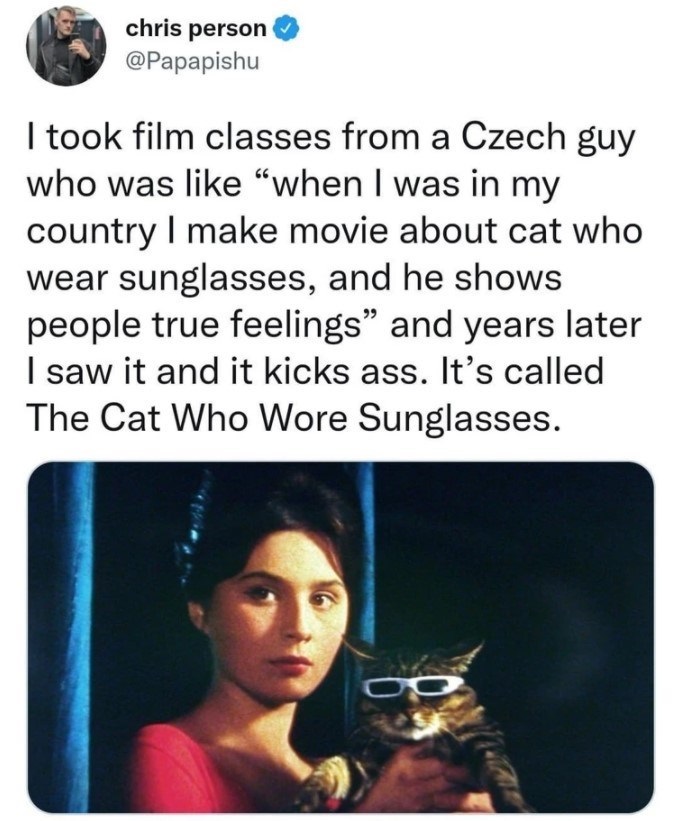
One of the sharpest reminders that the Internet is not real life that I’ve gotten recently was the sparse attendance at a local screening of The Cassandra Cat.  Also distributed under the English titles When the Cat Comes and That Cat, The Cassandra Cat is best known (to me) as the subject of a viral tweet, recommended by a film student whose Czech professor bragged about making a movie about a cat who wore sunglasses called The Cat Who Wore Sunglasses.  I certainly didn’t expect that one tweet would exalt The Cassandra Cat up to the level of household Czech New Wave standards like Daisies or Valerie and Her Week of Wonders, but it is one of those tweets that rattle around in the back of my mind the same way serious film scholars can quote lines of criticism by Kael, Sarris, and Godard.  So, when there were fewer than ten people in attendance for The Prytania’s afternoon screening of its recent restoration, I was shocked.  I could not believe so few people showed up to see a half-century-old Czech film about a magical cat that I’ve only ever heard about via Viral Tweet.  So weird.

Y’all missed out.  The Cassandra Cat is a wonderfully imaginative children’s film about collective action, holding adults accountable for being liars & cheats, and about how cats are excellent judges of character.  The titular cat is a trained circus performer who arrives to a small Czech village with an army of talented coworkers: a ringleader magician, a gorgeous trapeze artist, and a legion of faceless, supernatural puppeteers.  Their act initially goes over well with the townspeople until the final routine, in which the trapezist takes off the cat’s sunglasses so he can stare his naked cat eyes into the audience.  It turns out that the cat’s direct gaze has the magical power to expose people’s true nature by making them glow like mood rings (an effect achieved through body paint & gel lights).  Adulterers glow yellow, revealing secret affairs hidden from their spouses.  Selfish careerists glow violet, exposing their greed to higher-minded comrades.  Lovers glow red, revealing their pure, earnest hearts as artists & true friends among their careerist counterparts.  This, of course, causes a riot among the adults, who spend the rest of the film attempting to banish & discredit the cat in front of the children who witnessed their secret selves.

There is some political allegory to The Cassandra Cat that might not entirely translate to modern audiences unfamiliar with the day-to-day complexities of the Czech Republic pre-Prague Spring.  Mostly, though, it’s fairly easy to follow as the Czech New Wave version of “The Harper Valley PTA”.  That’s what makes it such a great children’s film, especially once the magical cat is weaponized by the town’s schoolchildren, who stage a mass classroom walkout until he’s surrendered to their care & use.  It’s also a great children’s film because of its vintage sense of magic & whimsy, recalling other psychedelic children’s media of bygone eras like H.R. Pufnstuf, The Peanut Butter Solution, and The 5,000 Fingers of Dr. T.  There were no actual children present at that afternoon screening at The Prytania, just a few stray adult weirdos who had nothing better to do in the breezy sunshine outside.  At this point, The Cassandra Cat is a film exclusively for weirdo shut-ins, the kid who file away hit tweets in the back of their minds in case the forgotten Czech films referenced therein happen to pop up on the local repertory schedule.  Maybe that makes us losers, but if like to think that if a cat stared at us that day we’d at least glow red.

– Brandon Ledet

Claudio Simonetti’s Demons

You might assume that the ideal way to watch the 1985 supernatural Italo horror Demons would be to see it projected in the oldest operating cinema in town, in our case the original location of The Prytania.  In the film, a group of strangers are gifted free tickets to a mysterious horror film at an ancient cinema that has materialized out of the urban void.  That movie turns out to be a gory cheapie about an ancient mask buried in Nostradamus’s tomb.  We watch this story unfold twice removed, where movie-within-a-movie victims try on the cursed mask, which transforms them into demonic, flesh-eating demons who torment their companions.  Meanwhile, the in-film audience of the movie squirms in their seats, noticing an alarming resemblance of the mysterious horror film’s violence to their own journeys to the screening.  Mainly, the promotional mask prop displayed in the cinema’s lobby has cut one of their cheeks the same way it cut & infected characters in the film they’re watching, which of course leads to a demon-zombie breakout in the theater that matches the chaos of the movie within the movie.  They’re all effectively Skinamarinked—unable to leave the theater thorough the doors they entered from—as they individually transform into cannibalistic monsters and tear each other to shreds.  Seeing Demons in a classic single-screener cinema could only add an extra layer of uncanny meta-horror to that gory practical-effects display, especially if the cinema in question could cover the insurance costs of blocking the exits and cutting their customer’s cheeks at the box office.

It turns out there’s an even better way to see Demons, though, one that trades in the layered meta-aesthetics of a haunted cinema for the open-aired joviality of a family barbeque.  Italian prog rock composer Claudio Simonetti recently toured one of the several undead mutations of his band Goblin to play live accompaniment for Demons in concert venues around the country, including The Broad’s outdoor extension The Broadside.  The show was rigidly timed to a Tim & Eric style video package that opens with a postcard from Simonetti & Demons director Lamberto Bava, then concludes with a greatest-hits medley of 70s & 80s horror scores, most of which Simonetti composed under the Goblin name.  In-between, the band played a reworked, bulked-up version of the Demons score to a full screening of the film, emphasizing both how few scenes prompted them to pause for dialogue and how frequently its now-anthemic theme is repeated for the gnarliest sequences of over-the-top gore.  As for Demons itself, it’s got one of the greatest opening acts in all of nonsense Italo horror cinema, capturing the feeling of collectively dreaming at the movies without distracting itself with minor concerns like plot & coherence.  Once the in-film movie projector and auditorium are torn apart there isn’t much glue to hold the whole thing together, though, save for the repetition in Simonetti’s synth riffs, so it was great to hear them cranked up to an obnoxious volume.  By the end, the familiarity of those riffs gave the screening a celebratory, communal air – the culmination of a once-in-a-lifetime Halloween season of great movies screening at The Broad (including several directed by Demons producer Dario Argento).

Years ago, the hot horror-nerd ticket would have been to see the full classic Goblin line-up play a live score for Suspriria, a tour that (to my knowledge) never came through New Orleans.  If you’re going to see “Claudio Simonetti’s Goblin” live instead (a variation of the band that only includes Simonetti from Goblin’s original membership), you might as well see them play a live score for Demons, since it’s a film that Simonetti scored after the legendary band had originally broken up.  He might primarily be a solo composer, but you can tell Simonetti loves having a full band behind him, playing rockstar in his denim jacket & wallet chain combo.  The encore set after Demons concluded touched on plenty of classic-Goblin staples, including themes from Dawn of the Dead, Suspriria, and (in my book, their finest work) Deep Red.  It also included some wonderfully bizarre choices that rivaled Bava’s shoddy surrealist filmmaking in Demons, most notably in the glitchy-GIF repetition of the classic New Line Cinema logo while performing the theme from Cut & Run and in their prog rock remix of John Carpenter’s Halloween score, transforming a notoriously sparse piano line into an overcomplicated monster.  I still would love to see Demons projected in an antique venue like The Prytania someday, just for the proper sense of ambiance.  I can’t imagine it’ll be a more memorable or endearing evening than that evening at The Broadside, though, where the stage lights twinkling off Simonetti’s absurdly long wallet chain were like stars twinkling in the night sky.

-Brandon Ledet

Lagniappe Podcast: Star Trek – First Contact (1996)

For this lagniappe episode of The Swampflix Podcast, Boomer, Brandon, and Alli discuss the Next Gen Star Trek time travel episode First Contact (1996).

00:00 Welcome

06:54 Anatomy of a Fall (2023)
16:46 L’immensità (2023)
19:17 Priscilla (2023)

23:11 Star Trek – First Contact (1996)

You can stay up to date with our podcast through SoundCloudSpotifyiTunesTuneIn, or by following the links on this page.

-The Lagniappe Podcast Crew

The Beauty in Boredom

Halloween’s over, and there’s a distinct chill in the air, which means it’s time to start watching Serious Dramas for Adults again, so we can all collectively decide which movies shy far away enough from traditional genre entertainment to deserve awards statues.  I do not do my best work as an audience during the Awards Season catch-up rush, both because I’m easily distracted by the buzziest titles’ extratextual discourses and because Serious Dramas for Adults aren’t my usual thing.  I like a little reality-breaking fantasy and high-style aesthetic beauty in my motion pictures, both of which are generally frowned upon this time of year, when subtlety & realism reign supreme.  The last quarter of the theatrical release calendar isn’t boring, exactly, but it can be challenging to my over-the-top artifice sensibilities as an audience.  Which is healthy!  It’s probably for the best that I’m asked to eat my cinematic vegetables at the end of my meal every year, since I spend so much time at the buffet table stuffing my face with dessert.  Besides, there is something beautiful & cozy about the boredom of binging restrained, underplayed dramas in these colder months, especially when I’m catching up with Awards Screeners and borrowed public library DVDs under a blanket on my couch.

And so, it’s great happenstance that I caught up with two aesthetically beautiful films about boredom this week.  The Italian family drama L’immensità has been on my catch-up list for months, but I couldn’t think of a cozier time to watch Penélope Cruz model vintage 70s fashions and dance to vintage Italo pop tunes than right now.  Of course, that kind of indulgence comes with a hefty price when you’re watching Serious Dramas for Adults, which means you also have to watch Cruz suffer an abusive husband and clumsily navigate how to raise a trans teen.  She plays a protective mother who acts as a human shield between her cruel businessman husband and their cowering children, but she struggles to adapt that protective instinct to her trans son’s burgeoning status as a social outsider.  It’s the kind of cultural farce where his gender is apparent to every stranger meeting him for the first time, but the family who’s known him forever refuses to adapt to his new name & pronouns because they’re resistant to change.  Thankfully, mother and son share a bond stronger than this Conservative prejudice: the bond of boredom.  Isolated for hours by the constraints of domestic housewife duties and teenage supervision while the abusive father figure disappears to his office, they’re both bored & lonely to the point of going mad.  To stave off cabin fever in herself and her kids, Cruz offers twee escapism from the movie’s general restrained realism by parodying famous TV performances of Italian pop hits (most notably “Prisencolinensinainciusol“), complete with the kind of little-kid bedroom choreography that you can only come up with in the deepest pits of childhood boredom. 

L’immensità hits on notes of Tomboy-era Sciamma and Cruz-era Almodóvar throughout without ever quite matching the poetry of either influence.  All of the movie’s poetry & wonder belongs to Cruz, who’s dependably exquisite as always, especially whenever tasked to model vintage glamour.  Otherwise, it left me wanting for the touch of a seasoned auteur, someone who truly gets the beautiful aesthetics of Boredom as a cinematic subject.  Luckily, there’s a new film from Sofia Coppola in theaters right now to satisfy that hunger.  Priscilla is Coppola’s adaptation of Priscilla Presley’s 1985 memoir Elvis and Me, which positions it with the exact kind of historical importance and celebrity impersonation that thrives in Awards Season publicity.  It’s also a movie about the boredom & isolation of feminine youth, which positions it with potential to resonate as one of Coppola’s career best.  Although Coppola’s Priscilla is the downers & cocktails antidote to Baz Luhrmann’s brain-poison uppers in last year’s Elvis, both directors are technically just playing the hits in their respective Graceland biopics.  Only one of them successfully recaptures the magic of their 1990s masterworks, though, and it’s the one where most of the scene-to-scene “drama” is centered on a teenage girl’s struggle to count away the hours she’s left alone at home.  Priscilla pinpoints the exact middle ground between the cloistered domestic tedium of The Virgin Suicides and the surreally empty opulence of Marie Antoinette, almost making it one of Coppola’s best by default.

As a collection of standalone images & moments, Priscilla is a work of cosmetic beauty – combining vintage 60s & 70s glamour with anachronistic pop hits that find Coppola at her most prankish (especially when a rowdy game of bumper cars is scored by Dan Deacon’s 2000s synthpop banger “The Crystal Cat”).  Again, that kind of indulgence comes with a hefty price when you’re watching Serious Dramas for Adults, which means you also have to watch Priscilla suffer an abusive husband in-between her sublime dress-up montages, an injustice punctuated by classic abuser catchphrases about how “she’s mature for her age” and how he “would never do anything that would really hurt her”.  As the story goes, she’s effectively purchased & groomed to be Elvis’s bride at age 14, a power imbalance Coppola accentuates in the 1-foot-4-inch height difference casting of her Elvis (Jacob Elordi) and her Priscila (Cailee Spaeny).  Elvis repeatedly refuses the sexual advances of his tiny teenage bride, choosing instead to dress her up like a doll to sit on his shelf, to be admired in pristine condition whenever he’s home from satisfying his more carnal urges with women he views more carnally.  The whole situation is deeply absurd and deeply alienating, which is exactly what makes it so perfect for Coppola’s eye.  Once she’s matured to a less eyebrow-raising age, Elvis marries Priscilla and allows her to work out her sexual frustration of being married to the sexiest man alive through the dirty lens of a Polaroid camera; otherwise, their sexual life together is purely procreative.  Her job is to sit still & look pretty while her husband travels doing his job of being Elvis, counting away the days of her youth on the isolated alien planet of Graceland.

Priscilla is a truly Great film, the kind of seductive, devastating stunner that makes me grateful that the Awards Season catch-up ritual lures me outside my usual genre-trash comfort zone.  In comparison, L’immensità is a much punier text, one that reminds me how much of the Serious Dramas for Adults end of the independent filmmaking spectrum is just as disposable as the genre schlock I usually seek out.  Both films reflect on the beauty & abuses of domestic boredom in a credible way, but only one achieves true cinematic transcendence in the process.  Maybe Sofia Coppola will direct Penélope Cruz in a future Awards Contender period piece about a despondent, dissatisfied housewife, combining the power of these two films into something even more substantial than either.  I look forward to watching it with a mug of tea under a warm blanket and a digital screener watermark.

-Brandon Ledet

Dicks: The Musical (2023) 

Dicks: The Musical opens with a title card joking that the film bravely breaks new ground by casting gay actors as straight characters.  In reality, it breaks ground by being the world’s first feature-length movie Rusical, hitting the exact same braying, sarcastic tone as the musical theatre challenges of RuPaul’s Drag Race.  In this case, we’re watching a Rusical parody of The Parent Trap (a step up from the Footloose/Dear Evan Hansen matchup from last season, at least), in which non-related writer-performers Joshua Sharp & Aaron Jackson discover they are “fucking identical twins” as adult Big City businessmen and plot to restore order in their family unit by getting their estranged parents back together.  Those estranged parents are the ringers in the cast (give or take an extended cameo from Megan Thee Stallion as the twins’ nonplussed dominatrix boss): Megan Mullally as a kooky Manhattan shut-in and Nathan Lane as a closeted Manhattan drunk.  The film’s humor recalls the offensive-on-purpose musical theatre of Trey Parker & Matt Stone, but the effort to underline every line of dialogue with an explicitly gay sense of camp is pure Drag Race kitsch.  The Fucking Identical Twins stage show that Dicks is adapted from started as a UCB revue in the 2010s and, although still funny, feels dated at least that far back in terms of its equal-opportunity-offender sensibilities.

Okay, now that the big-picture premise is out of the way, let’s talk about The Sewer Boys.  Dicks is mildly, low-key funny throughout, but it stumbles up on one truly Great joke in the unholy creation of the subhuman characters The Sewer Boys.  During Nathan Lane’s big musical number about why his marriage to the twins’ mother didn’t work out, he breaks down exactly what it means that he is a gay man: he appreciates fine things, he has sex with men, and he loves his Sewer Boys.  He is, of course, referring to the small, diapered goblins that he keeps caged in his living room, periodically feeding them with premasticated ham.  Every detail about the sewer boys’ underground origins, grotesque physiology, and hierarchy within Lane’s unconventional family structure is outrageously funny and earns most of the film’s biggest laughs.  The little grey goblin puppets are on-theme with the movie’s larger project of queering up gay-musical representation too, as Lane equates their role in his life to Gay Culture™, as if every adult gay man in America keeps a couple Sewer Boys as pets at home.  It’s obvious that Sharp & Jackson knew they struck gold when creating The Sewer Boys as a tossed-off joke, since they keep returning to the boys’ gilded cage to mine more visual punchlines out of their wretched image.  It’s disappointing, then, that they didn’t just abandon the initial Adult Men Parent Trap premise they used as an improv thought exercise to instead refine the one great idea they discovered in the process.  This should have been Sewer Boys: The Musical from start to end.

In that way, Dicks feels like a wish granted by a cursed Monkey’s Paw.  I’ve found myself wishing in recent years that partial-musical comedies like Barb & Star and Barbie would just fully commit to being proper musicals, and when I finally get one, I’m frustrated that it wasn’t a musical entirely about its one great joke.  If anything, this might have even changed my mind about wanting to force Barbie & Star into a musical theatre format, since that medium doesn’t always serve Sharp & Jackson’s humor well.  Each song in the book starts very funny, but they have nowhere to go once the audience gets the joke.  There’s a punchline up front in each song that earns a genuine laugh, and then there’s three more minutes of song left to play out in full, based on traditional stage musical structure.  Even my beloved Sewer Boys never stop being funny, but once they’re revealed it feels anticlimactic to return to the foretold Parent Trap story beats as if reality had not just been broken.  I appreciate that Mullally is eventually given her own flying pet monster to help balance that out, and Bowen Yang’s performance as God eventually builds to a joke meant to offend anyone left unshocked in the room — an ambitious last-minute gamble.  Mostly, though, Dicks: The Musical is a little too predictable in its adherence to musical theatre song & story structure, leaving very little room for surprise once the audience catches onto each telegraphed punchline.  Only The Sewer Boys continue to surprise & delight throughout, and the movie is most recommendable for their ghoulish presence.

-Brandon Ledet

Podcast #199: Sex and the City (1998 – 2010)

Welcome to Episode #199 of The Swampflix Podcast. For this episode, Brandon and Britnee discuss all things Sex and the City, from the groundbreaking television show to its bloated movie sequels and its streaming era follow-up And Just Like That. Enjoy!

00:00 Welcome

05:40 Demons (1985)
10:35 Totally Killer (2023)
13:20 Bell, Book and Candle (1958)

17:40 The show
54:30 The movies

You can stay up to date with our podcast by subscribing on SoundCloudSpotify, iTunes, or by following the links below.

– The Podcast Crew

Anatomy of a Fall (2023)

Anatomie d’une chute (Anatomy of a Fall) is this year’s Palme d’Or winner, and it recently came to theaters in the states. For the first twenty minutes, I kept flashing back to earlier this year, when I wrote a glowing review of Tár, a movie that Brandon was much less fond of; it seemed like, at last, I had finally come face to face with my own prestige boredom piece, as I found the opening scenes didn’t initially catch my attention, but once the plot gets going, I was very invested. 

Sandra Voyter (Sandra Hüller) is a German writer living in a snowy region of southern France with her husband Samuel Maleski (Samuel Theis) and their son Daniel (Milo Machado-Graner). The film opens with Sandra giving an interview to a young woman studying her work (Camille Rutherford) before the interview is first interrupted and then abruptly concluded by Samuel’s loud music from upstairs. Daniel, blinded at a young age as the result of a street accident that damaged his optical nerve, takes a walk with his faithful guide dog Snoop, only to discover the dead body of his father at the base of the house, near a wood shed and below both a second-floor balcony and a third-floor window into a room where his father had been recently working. The police are called, and when an autopsy reveals that his head wound was sustained prior to hitting the ground, suspicion falls on Sandra. She seeks help from an old friend and lawyer, Vincent (Swann Arlaud), and when they review the details together, he tells her that, if she is indicted, it will be almost impossible to convince a jury that the death was an accident, and that their best chance at acquittal would be to argue that Samuel had committed suicide. When further evidence compounds to further insinuate Sandra’s guilt, an indictment is inevitable, and we watch this play out as both a courtroom drama and a portrait of a family being torn apart by doubt. 

One of the oddest things about this movie is that, despite being a prestige picture, in the darkness before the film begins, projected against the screen was a URL: didshedoit.com. It’s one hell of a marketing technique, and even feels a little tacky when taken in combination with the cinematic quality and legacy within which the film is situated. After my screening, I checked out the site because I was curious as to whether it was real or not or was perhaps meant to be attached to another reel for a different movie or series of trailers but no, it’s a poll in which you can vote on whether you think Sandra killed Samuel. As of both the evening on which I saw the film and at the time of writing, the poll sits at almost perfectly ⅓ guilty, ⅔ not guilty, which was reflected in the feelings of my viewing trio. I’ll tip my hand now and say that I was among the two who do not believe that Sandra is guilty (or, at the very least, I cannot be convinced of it beyond the proverbial shadow of a doubt), but I also will adamantly state that her guilt or innocence is irrelevant, which is why this polling situation seems so bizarre. 

Information about Sandra and Samuel’s relationship is doled out slowly and with masterful intentionality. At first, we have no reason to believe that Sandra would be inclined to kill her husband, and as the prosecutor (Antoine Reinartz) paints a version of the events of the day leading up to Daniel’s discovery of his father’s body, he adds layers of intent. Could the bisexual Sandra have been upset about Daniel intentionally ruining her interview with a pretty young woman? Hasn’t she cheated on him in the past? Hadn’t they had an argument that turned physical just the previous day, which it turns out that Samuel surreptitiously recorded? But any one of these things could just as easily contribute to the narrative that Samuel took his own life—Samuel was the one who was ultimately responsible for leaving young Daniel with a babysitter, which lead to the accident that cost him his sight, and Samuel himself has never been able to get over it and has been rendered impotent by his guilt. Even though Sandra believes (or at least claims to believe) that Samuel would not have committed suicide and only accepts (or seems to accept) this potential explanation for events due to having no way to prove her stated innocence, she does admit that he attempted an overdose with aspirin earlier in the year. Daniel’s attempts to help his mother by establishing that he heard his parents speaking calmly with each other before he went on his walk cannot be corroborated when they test this possibility, which leads to his own doubts. However, the revelation of his father’s earlier attempts cause him to reframe his own understanding of the situation in a way that leads him to ask to be called to the witness stand a second time to talk about a conversation he had with his father that seems only now to make sense. 

Where the genius of the film lies is in that perpetual reframing, for the characters within it and within our own judgments as members of the audience, to whom pieces of evidence are presented over time. Where you stand on Sandra’s guilt or innocence can change very suddenly, as we learn more about her and her potential motives as well as Samuel and his own character and desires. A non-extensive, quick search of the internet tells me that the French legal system has adopted the same precept of presumed innocence as the U.S. (nominally) has, so one would assume the same or similar legal protections for Sandra as one would have in the states, but this is a trial that features an extremely antagonistic and far reaching prosecution and expert witnesses who seem more invested in securing a conviction than in honest testimony, not to mention that Sandra’s sexuality is frequently treated as if it means that she is inherently more suspicious than the “average” citizen. The prosecution offers up computer modeling of how Sandra “definitely” struck Samuel on the second floor balcony in order to leave behind three stray splashes of blood—the primary keystone for their accusations—while a physical model provided by a witness for the defense is presented only with the argument that their interpretation of the on-site evidence is equally consistent with their suicide theory. In what I hope is an exaggeration about the leniency of French court system with regards to what they will allow prosecution to put forth, the judge even allows a section of one of Sandra’s novels to be read in court, a sequence in which a first person character wishes for the death of their husband, and this is allowed to be entered into the record as evidence. 

Like most Americans, I grew up being propagandized by things like Law & Order into thinking that prosecutors are bastions of truth and justice, and unlearning that has admittedly been a long road; however, in no other piece of media have I ever felt so strongly about how ACAB includes prosecutors. Reinartz is doing stellar work here at creating a character that you have no choice but to despise, a sniveling, rat-faced little Grima Wormtongue of a man who, even when you are in one of the phases of the movie in which you’re convinced of Sandra’s innocence, you wish you could just pinch out of existence like a pimple. Also doing some extremely heavy lifting is Machado-Graner, who with this film alone deserves to be canonized as one of those exceedingly rare child actors whose presence improves a film rather than diminishing it. His sense of loss, first of his father and then over and over again with his mother in increasing amounts, is palpable, and that the film’s climax hangs upon his shoulders is a big gamble, but it not only works, it soars. As he gives his speech, in which he recounts a conversation with Samuel that they had months before—while returning from the vet when Daniel’s dog got sick, which unbeknownst to the boy was the result of the dog licking up his father’s suicide attempt-induced vomit—that he now believes (or is pretending to believe, or even simply willing to believe) was his father communicating with him honestly but subtly about his ideation and the need to be ready for when “he” goes, leaving it ambiguous as to whether “he” is Snoop or Samuel. 

I believed that the film would end there, and a part of me wanted it to. I know that the majority of general audiences now are very hung up on plot and resolution, and there would have been outcry if the film left two ambiguities to the viewer’s imagination; that is, whether Sandra was guilty or not and whether she would be convicted or acquitted. I won’t spoil the latter and I’ve already made my decision about the former, but I don’t want to make my case for it since I would rather allow those reading this who have not already seen it the opportunity to know only what I thought while being unburdened with why. I would have felt the film complete even without knowledge of the ruling, however, and there’s a part of me that wishes that version of the film existed, as it would leave even more topics open for discussion with others after the film was over, but I am also content with what we have. For instance, it’s fascinating that Daniel’s final testimony plays out on screen with him and his father as a flashback, as several previous scenes had, but we never hear his father’s voice, only him as he recounts Samuel’s words. What are we to make of that? In an earlier scene, when the court hears the recording of the argument between Samuel and Sandra on the day before his death, the playback begins and then we are transported into that moment to watch the argument play out, up to the point where violence is about to begin, at which point we are back in the courtroom hearing the recording. From there, we only have Sandra’s word as to what the sounds we hear are (although there is physical evidence to back up her claim that one of the sounds was Samuel punching the wall hard enough to leave a hole). When discussing the physical evidence and the, ahem, anatomy of the fall, the prosecutor’s witness’s version of events includes a flash-brief shot of Sandra striking Samuel just as he describes; no symmetrical shot appears during the defense’s expert witness’s testimony. This distinction between what we as audience members are presented with as “video” “evidence” and that which we only hear described is an integral part of the questions that the movie will leave you with, as the film has a distinctively documentarian feel (which it draws attention to near the end of the second act, as the camera “follows” the presiding judge offscreen and then returns to focus on the center of the dais, as if the camera operator had been taken aback by unexpected movement and attempted to keep it in frame). 

I’m usually hot or cold on prestige dramas like this, and Anatomy of a Fall is one that definitively falls into the former category. We don’t get many courtroom dramas on the big screen anymore, as the small screen world of copaganda has eaten up most of the general public’s allotment of attention for that genre, but this is one that’s well worth the time and the praise that it’s been receiving. 

-Mark “Boomer” Redmond