

While attending a recent screening at my local arthouse, I pointed out to my companions that there was going to be several screenings of Rear Window the coming weekend and gave it my typical whole-hearted recommendation. These were two of my younger friends who mentioned that they’ve seen far too few of Alfred Hitchcock’s films, but one of them had been in a high school theater production of The Lodger, which was quite the coincidence as I had a library copy of the DVD at home at that very moment. It’s also available on the Criterion app and Tubi (at least at the time of this writing), which means it’s pretty accessible, for anyone who might be interested. I know that a silent film is a hard sell these days, but I liked this one quite a lot and loved its use of expressionistic composition and dark atmosphere and recommend checking it out.
The Lodger (subtitled A Story of the London Fog) is a 1927 thriller from the Master of Suspense, his third film. It largely centers around one family’s experiences with a new lodger in their boarding house while the city at large quivers in fear at the actions of a serial killer leaving notes identifying themself as “The Avenger.” Mr. and Mrs. Bunting are caring and doting parents to their daughter, Daisy, a blonde young fashion model still living at home with them. Every Tuesday night for months, a blonde woman has been found murdered by the Avenger, and the police seem at a loss. The Buntings are friends with a detective named Joe Chandler, who is visiting them when news of the seventh victim arrives. That same night, a dark and imposing man appears at the Bunting home in response to their “room to let” sign. Joe is eventually put on the case to find the Avenger, and although he is able to discern a pattern from the location of the killings and estimate the general location of the next slaying, his jealousy over the growing attraction between the lodger and Daisy leads him to suspect the lodger of being the killer. When a search of the lodger’s, um, lodgings leads him to a map of the victims’ locations and clippings about the killings, the lodger is arrested, but Daisy helps him to escape, even though she (and we) still have no evidence of his innocence.
There were moments during the course of the film that I was worried we were headed toward that easiest conclusion, but I should have known that even in this earliest part of his career, Hitchcock would already be working in a more subversive manner. In recent discussions on the podcast of Strangers on a Train, we talked about how Hitchcock never had much respect for the police, individually or institutionally, and there are already elements of this at play. Joe Chandler may manage to put together some clues about the real Avenger, but his personal failures of pettiness and jealousy lead him to pursue an innocent man, to the point that during his flight from the law the lodger is almost lynched by a mob while the real killer is elsewhere racking up yet another body. Hitchcock also loved to tell (and retell) the story of an innocent man being wrongly accused and pursued, from The 39 Steps to To Catch a Thief to North by Northwest to Frenzy, so it’s no surprise that it turned up as a plot point in this early work of his. I did expect there to be a bit more of a twist surrounding Joe, however.
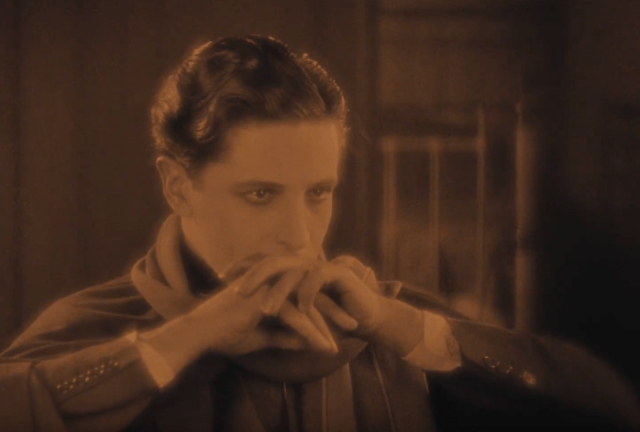
It’s never quite clear exactly what his relationship is to Daisy. Sometimes, she seems very receptive to his wooing, but at other times rejects his advances, although it’s a possible interpretation that her rejection largely occurs in scenes in which her parents are present. In their first scene together, he flirts with her by cutting a heart shape out of the dough that her mother is preparing and placing it in front of her, to which Daisy responds by tearing the heart in half and handing it back to him. To me, this established that his interest was unwelcome, but there are other scenes in which she welcomes his attention with enthusiasm. At the time of release, Joe’s actor Malcolm Keen was 40 years old, and he looks older. I’d probably attribute it to the technological limits of the time rather than to an intentional aesthetic choice, but Keen’s fair complexion and the make-up available at the time renders him, well, a bit ghastly-looking. In comparison, although Ivor Novello’s lodger character arrives at the Bunting house looking and behaving like a total weirdo, once he settles in, he reveals himself to be as beautiful as he is brooding. As a result, although I was willing to believe that the film was headed toward the revelation that the lodger was the Avenger as easily as it might have been headed toward his innocence, I also thought it might be revealed that Joe was the Avenger, but that might be my expectations being a little too close to modernity. The Avenger is apprehended entirely offscreen, his identity never revealed, but the audience of today looks at this rather small cast of characters and automatically assume that one of the characters has to be the killer. Through that lens, it could only be Joe, but that wasn’t really a trope of the medium yet.
-Mark “Boomer” Redmond
 Swampflix

Pingback: Lagniappe Podcast: Scenes from the Class Struggle in Beverly Hills (1989) | Swampflix
Pingback: Young and Innocent (1937) | Swampflix
Pingback: Murder! (1930) | Swampflix
Pingback: Blackmail (1929) | Swampflix