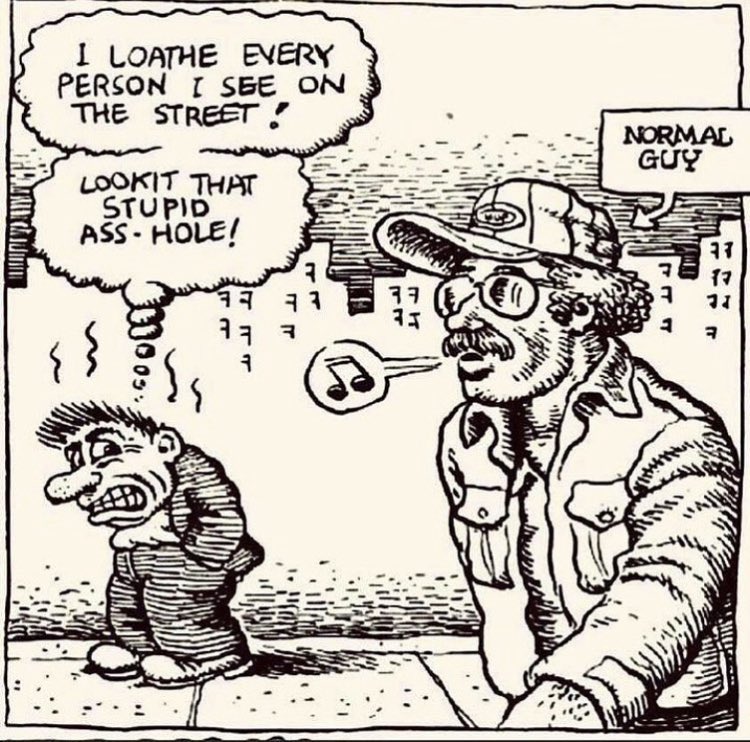
As much as I love the movies, I hate moviegoing audiences – at least en masse. Chatting with individual festival attendees at this year’s Overlook Film Fest was as warm & friendly as always, like meeting up with old friends who I’ve technically never met before. Then, watching Boorman and the Devil at that same fest reminded me just how rare of an experience it is to celebrate the artform with a like-minded crowd. David Kittredge’s documentary about the production & public perception of John Boorman’s Exorcist sequel The Heretic is an intensely alienating experience for true cinephiles, a reminder that most people who go to the movies don’t care at all about art. They are not open to being challenged; they demand satisfaction. It’s repugnant. Even when Kittredge gets cutesy about the mass-audience rejection of The Heretic, I could feel my blood boiling in general misanthropy, loathing every person I see on the street like that one Robert Crumb comic panel.
After the overwhelming financial success of William Friedkin’s The Exorcist, Warner Bros threw an obscene amount of money at Linda Blair to return for a cash-in sequel, alongside new-to-the-franchise costars Richard Burton & Louise Fletcher. They also gave free rein to New Hollywood auteur John Boorman to take the Exorcist story in any direction he wanted, an opportunity Boorman leveraged to deliver a hypnotic arthouse nightmare that recalls The Exorcist in name only. His vision was met with wide public derision, derailing his career until he could redeem himself with another hit in Excalibur a few years later. So, who are we supposed to side with here? The incurious audience who laughed The Heretic off the screen for taking chances instead of delivering more of the same? The studio executives who lost money or an artistic gamble? Or the artist himself, who improbably staged a literal fever dream on someone else’s dime? There is only one morally acceptable answer.
Boorman developed a life-threatening fever while filming The Heretic, a direct result of his own overly demanding ambition. That wasn’t the only on-set disaster. Burton struggled to stay sober enough to deliver his lines while standing still. Fletcher barely made it through the shoot before needing to have her gall bladder removed in emergency surgery. Blair spent long hours dangling off the roof of a skyscraper, unharnessed. Meanwhile, Boorman’s sick-leave absence opened a power vacuum for his screenwriting partner Rospo Pallenberg to run wild & unchecked on set, an off-putting presence that almost inspired open mutiny. The production was so troubled that the crew joked it was cursed by the demon Pazuzu himself, but none of that would’ve mattered if Boorman ultimately delivered a hit.
Kittredge relays these production-delay anecdotes from people who were actually there via tried-and-true documentary clichés that barely liven up the still set-photo imagery: first-person narration in his own voice, talking-head interviews with film critics & historians, cut & paste animation, and periodic chime-ins from fellow filmmakers with no direct association to the subject at hand (namely, Karyn Kusama, Mike Flanagan, and genre-doc mainstay Joe Dante). However, while Kittredge doesn’t match Boorman’s sense of poetic imagination, he is sincerely in awe of it, which goes a long way. This is not a movie about how Exorcist II: The Heretic was a laughable disaster; it is a story about how ambitious, risk-taking art isn’t always appreciated by the public, who’d rather laugh in mockery then get lost in cinematic poetry. Fuck ’em. They don’t know what they’re missing.
Looking back, it’s impossible to fully measure the impact that David Robert Mitchell’s indie horror phenomenon It Follows has had on the past decade of high-concept, mid-budget genre filmmaking. Predating Robert Eggers’s atmospheric folk horror The Witch by a full year, It Follows now registers as ground zero for the “elevated horror” trend of the 2010s (give or take The Babadook). Its supernatural stalker plot about a shapeshifting, sexually transmitted specter has directly influenced works as cerebral as Brea Grant’s feminist head-trip Lucky and as lizard-brained as Parker Finn’s suicide-virus thriller Smile. It’s a little silly, then, that Mitchell is currently working on a proper It Follows sequel titled They Follow, considering how many iterations there have already been on the original’s mood & conceit. I even saw a new one just this week at The Overlook Film Festival, which borrows the invisible-stalker device from It Follows for a story about an entirely different kind of sexual menace.
The rural horror story Leviticus shares some notable cast & crew with the recent Aussie hit Talk to Me, including actor Joe Bird (the cursed hand’s most brutally tormented victim) as its teen-in-peril lead. Leviticus plays more like a spiritual sequel to It Follows, though, shifting that seminal film’s focus from heterosexual desire to a wholly queer sensibility. Instead of the It Follows demon being sexually transmitted among careless hetero twentysomethings, it’s forced upon gay teenagers as a supernatural form of conversion therapy. The shapeshifting demon’s form is also no longer randomized the way it was in Mitchell’s film. It instead appears before its victims in the shape of the person they desire most, acting like the gay-conversion version of those Disulfiram pills that “cure” alcoholics by making them sick when they taste booze. The goal appears not to be curing teens of their homosexuality, exactly, but to frighten them too much to act on their desires, lest they be gaybashed by a demon that looks like their hottest crush.
Bird stars as a lonely teen who’s just moved to macho small-town Australia with his religious zealot mother (Mia Wasikowska, who not too long ago was playing youthful brats instead of their stern maternal figures). He quickly develops a mutual crush on a classmate (Stacy Clausen), who only expresses his desire in private – first through roughhousing, then through smooching. The boys’ timid love story would make for a cute indie rom-dram if it weren’t for all of the religious nuts in town, who have developed a hypnotic ritual involving a butane lighter that chains gay teens to the aforementioned variation on the It Follows demon. The rules of the curse are fairly simple. The demon looks like the person you desire most, and it only attacks when you are alone. The metaphor that first-time director Adrian Chiarella is getting at is a little vaguer, though, to the movie’s benefit. Much like It Follows, it finds a way to physicalize a form of sexual menace & repression without overly explaining what it represents in dialogue (a temptation later derivatives like Smile cannot resist).
That’s not to say that Chiarella doesn’t make a coherent point with this conceit. It’s clear that the real evil here is the isolation caused by small-town bigotry, forcing gay teens into the darkest of closets. The cure for not being destroyed by that desire is to never be alone, to be out in public instead of saving your romantic trysts to private hookups, locked away in dingy warehouses where you can never be sure if you’re making out with a boyfriend or his evil doppelganger. There’s some heartfelt, meaningful social commentary in there, but the basic rules and mechanisms of its central metaphor are just mysterious enough that it doesn’t feel overly schematic in the moment. If there’s anything Chiarella doesn’t handle especially well tonally, it’s in the overall bleakness of every last interaction. Leviticus is a dour film with little room for humor in its metaphysical exploration of the tyranny of the closet. That tonal severity is appropriate for its subject but a little grueling to trudge through at feature length. Even It Follows included a few sight gags between its slow-burn scares, and that’s clearly the template we’re working with here, as we so often are.
Is there a more dependable path to horror filmmaking success right now than getting your start in sketch comedy? Following in the recent footsteps of sketch-turned-horror comedians Jordan Peele, Zach Cregger, and the Philippou Brothers, up-and-coming director Curry Barker has graduated from YouTube prankster to buzzy horror auteur du jour. The connection between those two artforms feels obvious, at least in the way that they deal in high-concept premises that need to be quickly explained and then immediately punctuated with punchlines. There’s an overt, sadistic humor in the way Barker cyclically builds & relieves tension in his debut feature Obsession that feels like a natural progression from the sketch comedy format. More importantly, these post-YouTube sketch creators speak directly to a youthful audience, playing to the prankish sensibilities of teens & twentysomethings instead of dwelling in the overly patient rhythms of recent decades’ “elevated horror”, which is quickly becoming the genre equivalent of le cinéma de papa.
I mention the youth appeal of Obsession up-front because it’s a movie tailored for people whose greatest concern in life is still their unreciprocated romantic crush, or who’s fucking whom at that their go-nowhere retail job. There’s more cowardly, unreciprocated yearning in this gross-out gore film than you’ll find in even the wimpiest teen-romance anime. Yes, you will see skulls crushed, skin carved, and house pets desecrated, but the most discomfort you’ll feel is in watching a twentysomething coward fail to muster up enough courage to confess he has a crush on his coworker. Instead, he resorts to supernatural magic, making a wish on a cursed children’s toy that she will love him “more than anyone in the whole frickin’ world.” Of course, the wish quickly backfires, as our yearning anti-hero can’t handle the intensity of being desired instead of quietly doing the desiring himself, in private. Don’t worry, he’s also cosmically punished for the crime of using magic to coerce a peer into a nonconsensual sexual relationship, cruelly & usually.
Michael Johnston does a perfectly cromulent job playing that supernaturally tortured anti-hero, remaining a useless coward all the way to the very end. He’s frequently told by the more magic-savvy mystics in town and the One Wish Willow customer service reps that he can break the spell at any time by killing himself, but that would require action, while he is purely a creature of thought. Johnston convincingly contorts his brow with worry while considering his increasingly grim, shrinking options, never brave enough to act on any one of them. However, the real discovery here is his costar Inde Navarrette as his magically coerced crush, who’s tasked to deliver a much bigger, bolder performance. Through Navarrette, Obsession turns Quirky Movie Girlfriend behavioral tropes into a grotesque horror show, delivering cinema’s first truly scary Manic Pixie Nightmare Girl. It turns out, the Quicky Movie Girlfriend archetype is still a little cute even in that context, and Navarette performs some of the best uncanny smizing seen onscreen since Anna Kendrick first became a star. She does other tricks too, like strutting backwards, discovering culinarily unconventional sources of protein, and acting as her new boyfriend’s personal sleep paralysis demon – whatever it takes to keep them close.
In its broadest terms, Obsession is a classic “careful what you wish for” Monkey’s Paw story, and Barker has admitted in a recent Fangoria interview that he initially got the idea while watching the “Monkey’s Paw” vignette from the Simpsons‘ Treehouse of Horror specials. It’s probably notable that Jordan Peele named his own production studio Monkeypaw Productions after the same short story, just as it’s notable just how much Obsession‘s house party sequence recalls the ritualist peer-pressure magic of the Philippou Brothers’ Talk to Me. Barker clearly belongs in this new class of sketch-to-horror auteurs, unafraid to prank his audience with shamelessly unfair jump scares. All that matters, really, is getting the laugh or the gasp from the audience in the moment, which Obsession did remarkably well at its local premiere opening this year’s Overlook Film Fest. Leave the worry about good taste & artistic restraint to the elevated horror fuddy-duddies of the recent past.
Many longtime Scream fans were horrified by what happened to their beloved slasher franchise this year, after the brand chose to self-implode rather than to employ actors vocally opposed to the ongoing Palestinian genocide. Just a few months later, it turns out not to be such a big deal that Scream 7 was a morally & creatively bankrupt shit show after all. The producers got what they wanted in reliable name-recognition box office returns from the politically apathetic masses, and the more discerning audiences who boycotted can now get what they want in the new Faces of Death: a reboot of a legacy horror franchise that questions the ways the genre has changed in the decades since its start. 2026’s Faces of Death has a lot more to say about modern audiences’ relationship with violent entertainment media than any Scream movie has in at least fifteen years. Notably, it does so by tracking the ways horrifically violent imagery has moved from the cineplex to our smartphones, including news footage of the aforementioned genocide.
Euphoria‘s Barbie Ferreira stars as a content moderator for a TikTok-style social media platform called Kino. She spends long, demoralizing days approving or disapproving user-flagged content on the platform, flooding her brain with the most heinous imagery & behavior her fellow humans can conceive & shoot. Much like with the original 1970s mondo movie Faces of Death, it becomes increasingly difficult for her to differentiate what violent content is simulated vs. what is authentic, pressured by her corporate higher-ups to avoid being overly censorious. The plot gets meta when she stumbles across an anonymous account that’s recreating the most gruesome scenes from Faces of Death “for real,” and she struggles to convince anyone in her life that she’s uncovered an active serial killer. When she takes this discovery to online message boards, she is subsequently abducted by that killer to star in his next viral video. Many flame-war social media posts and real-life bludgeonings ensue.
If the new Faces of Death has any overt shortcomings, it’s that it’s not nearly scary nor upsetting enough to earn its title, at least not to the desensitized eyes of a social media addict such as myself. That largely appears to be the point. Technically, this is a bloody bodycount slasher, but all of its payoffs are purely intellectual. Longtime collaborators Daniel Goldhaber & Isa Mazzei (Cam, How to Blow Up a Pipeline) clearly took on the project as an opportunity to discuss the ways snuff-footage media akin to the original Faces of Death has become mundane thanks to the social media feeds that relentlessly overstuff our brains with real-life grotesqueries. There’s more meaning in the transition of its fictional news broadcast switching from vertical smartphone footage of a suicide to a fluff piece about a puppy shelter than there is in the cruelty of any particular kill. The movie isn’t especially scary, but it is remarkably thoughtful about the current corporate-sponsored hellscape we all willing enter every day through our phone screens.
That lack of genuine scares is no fault of its masked killer, played by Stranger Things‘s Dacre Montgomery. Covering both the ice-cold intellectualism of Hannibal Lecter and the perverse sensuality of Buffalo Bill, Montgomery’s Arthur is the total package. He’s converted his suburban McMansion into a makeshift movie studio, restaging scenes from Faces of Death because reboots are favored by the algorithm. He finds his own sense of style in the process too, murdering his victims via automaton contraptions constructed out of department store mannequins. He’s even transformed himself into a living mannequin of sorts, via skinsuits & masks, further removing himself from the violence he films for views. Everything is mediated through an artificial remove, to the point where his final showdown with Ferreira’s final girl mostly plays out on their individual laptop & phone screens even while they’re standing feet apart in the same blood-spattered room. It’s chilling to think about, even if it’s not especially scary to watch, unlike its namesake source of inspiration.
Faces of Death recently saw its local premiere at The Overlook Film Festival, where Goldhaber & crew gushed about how wonderful New Orleans is as a shooting location. Besides a brief throwaway scene set at a corporate crawfish boil on the lakefront, there isn’t much indicating that the story is set here, whereas most New Orleans movies make sure to toss in a few French Quarter scenes for local flavor. There’s probably some substantive commentary in there about the way screenlife has flattened all modern living to one locationless artificial world devoid of discernible local culture, as this is a movie entirely made of metatextual commentary about the current state of things. The Scream franchise used to think about these kinds of things too, before it devolved into cataloging the life & love soap opera milestones of Sidney Prescott, et al. Now you have to find your Slasher With Ideas kicks elsewhere, starting here.
In Kristoffer Borgli’s international breakout Sick of Myself, a woman becomes jealous of her boyfriend’s sudden art-world fame, so she fakes a disfiguring medical condition to one-up the attention he’s been getting online. In the funniest scene, she worries that her CT scan results at the hospital will expose this fraud, imagining an official medical diagnosis that she is “a liar” with “a bad personality,” which is legally punishable by death. Borgli’s first American film, Dream Scenario, follows the foibles of a schlubby college professor who becomes a living meme when he inexplicably starts appearing in people’s dreams across the world, a phenomenon that quickly sours once the novelty wears off and everyone’s sick of seeing his uninvited face. Borgli’s latest, The Drama, smartly continues the understated fantasy-sequence playfulness of those two previous pictures, often illustrating its characters’ intrusive thoughts as they occur in real time, then doubling back to show those characters as they actually are: unremarkable in their social anguish. Like Borgli’s previous films, The Drama also presents an absurd scenario that can easily be read as a moving think-piece on the nature of “cancel culture” but somehow never fully tips into reactionary apologia. His flippant engagement with hot-button topics in The Cancel Culture Era teeters dangerously close to a kind of online edgelord conservatism but, so far, he’s always landed somewhere on the safe side of good taste. His interest appears to be in exploring the ways that our internal thoughts—however momentary—might betray our external politics, and he finds an endless wealth of humor in that tension.
The Drama starts with a young couple’s fairy-tale love story, sprinting through the full romcom meet-cute, first-date, romantic-proposal cycle in rapid montage. Borgli very quickly maps out what a crowd-pleaser romance between stars Robert Pattinson & Zendaya might look like (if Hollywood was still interested in producing such a thing) before he announces the stakes of his latest prank. Days before the couple’s wedding, they engage in a dinner-party game where everyone at the table confesses the worst thing they’ve ever done. It’s an uneasy but revelatory ritual that pushes through some of the awkward shame of the “getting to know you” phase in a young romance, until Zendaya’s character gets her turn. Her confession crosses an invisible social boundary that she doesn’t realize exists until it’s too late, and everyone else present is so shocked that it threatens to derail the wedding they’re supposed to be celebrating. Notably, what she confesses is technically a thought crime, an ugly impulse that she did not ultimately act on but very seriously considered. It’s also something I won’t dare to spoil in this review, since it is the bait on the film’s proverbial hook, something that is meant to be discovered and digested in real time with the bride-to-be’s immediate social circle. All I can say, really, is that this first-act reveal positions The Drama as a throwback to a kind of classic water cooler romcom, however bleak, with certified movie stars on their worst behavior. You’re supposed to ask yourself how you would react to it while you watch Robert Pattinson go through the same hypothetical turmoil, and you’re supposed to find your own sense of morality lacking in the process.
There’s plenty of ammunition here for the offended to dismiss Borgli as a shock-value provocateur, but I don’t think that’s the case. Once it gets past the initial shock of its first-act confession, The Drama finds some genuinely productive provocation in asking how much modern outrage is personal, as opposed to communal. This is not a typical “How much can you truly know a person?” thought exercise. It instead asks whether modern moral outrage is driven less by the thought, “Am I okay with this?” than it is by the thought, “What would other people think of me if I were okay with this?” Very little of the central conflict is mediated through phone & computer screens like in Borgli’s previous pictures, but it still feels like it’s depicting a moral crisis specific to a post-social media world. Pattinson’s protagonist is not allowed time to internally process what he’s learned about his fiancée’s past; he’s pressured to immediately take a moral stance on it as a kind of performative social spectacle, causing great anxiety as he attempts to keep his shit together for the ultimate social spectacle: an expensive wedding. The pressure of publicly responding to this moral crisis makes for great comedic tension as the wedding deadline approaches, and it inspires anxious daydreams & nightmares that recall the low-level surrealism of Borgli’s previous works. It’s neither his meanest nor his most expressive film to date, but it does manage to throttle its audience with various social & moral crises while most of its imagery ultimately amounts to People Talking in Rooms — an increasingly rare feat at the American cineplex.
I thought I was too cynical to be charmed by the sci-fi adventure film Project Hail Mary, and with good reason. Just this week, I was looking at news reports about the progress of the real-life space adventures of Artemis II, which in its first few days produced photographic documentation of the dark side of the Moon while traveling further from Earth than any astronauts have previously gone, and my first thought was “Wow, what a waste of resources.” Why are we spending so much money on space travel and moon colonization research when those same funds could be used to immediately house, feed, and medicate people who are struggling on the planet we already inhabit? Basically, I had a full Gil Scott-Heron moment, too knee-jerk cynical to appreciate the wonders of “Whitey” orbiting the Moon. So, how could I hope to be charmed by the outer space adventurism of Project Hail Mary, which spends its entire 156min runtime forcibly cramming that same sense of wonder into its audience’s skulls? Well, it’s helpful that it’s a work fiction, one that can create immediate, dire stakes that make an exploratory mission into outer space immediately necessary to save human lives back on Earth. Even more helpfully, its heaping helping of Hollywood schmaltz is delivered via one of the most charming actors of our time, so that it doesn’t matter how cynical you are about the exorbitant expense of space travel; it just matters whether you personally find Ryan Gosling funny.
Gosling stars as an unassuming middle school science teacher who wakes up dazed & alone on a long-distance space mission, unsure how he became an astronaut. In a dual timeline structure, we learn the history of how he got there and the future of what he can achieve, both related to a mysterious substance that is threatening the continuation of life on Earth by dimming the Sun. In both timelines, he teams up with a hard-to-read scientific genius that he must learn how to communicate with in order to functionally collaborate: an Earthbound human played by Sandra Hüller and a fellow space-traveling alien creature played by a puppet, shaped like a collection of rocks. In both timelines, the plot is entirely constructed of problem-solving scientific experiments, breaking down the grand mission of returning home safely after saving the Sun into a series of simpler, less daunting puzzles. The scientific specifics of these sequential experiments seemingly don’t mean much to directors Phil Lord & Chris Miller, who find more inspiration in the source novel’s broader themes of the bravery that ordinary people can find in the grimmest of times, as long as they have a reason to hope & dream. If that sounds a little hokey, it’s because it is, and composer Daniel Pemberton frequently scores the film like he’s working on an allergy medicine commercial about a stuffed-up suburban mom who can finally enjoy life because she can breathe again. However, just because it’s hokey doesn’t mean it’s not worthwhile, which is something I should probably keep in mind the next time the world goes gaga over a rocket launch.
The space-exploration adventurism of Project Hail Mary is ultimately secondary to its person-to-person social interactions, charting Gosling’s transformation from an isolated misanthrope to humanity’s bravest soldier. He starts the film wary of people as an abstract idea, but he’s continually won over by his fellow scientists on a one-on-one basis, and it’s consistently charming to watch him warm up to the concept. He’s an overly chatty fella for someone who doesn’t like attention, and the movie essentially asks him to put on a one-man show against screen partners figuratively or literally made of stone. Gosling makes warmth & humor look effortless, getting so cozy in his oversized sweaters that his eyeglasses eventually hang entirely off his face as he pleads his case. Meanwhile, Sandra Hüller is expertly humorless, playing icy straight man to his charming schlub shenanigans. It’s a shame that the narrative’s dual timeline structure limits how much of their onscreen chemistry we get to see here; they’d kill in an Old Hollywood screwball throwback where their warm-and-icy dynamic clashed at feature length. Thankfully, though, Gosling also has a great rapport with the rock puppet, conveying a genuine enough sense of friendship that I was occasionally moved to tears by their mutual kindness (despite the fact that there’s technically only one actor onscreen during their scenes). In short, Ryan Gosling can charm anyone, no matter how tightly our arms are crossed at the start.
I should be clear that I don’t actually believe that exploratory space missions like Artemis II are a waste of public resources (at least not compared to even more egregious wastes on police & military weaponry). There are plenty of online articles around explaining how past space missions have led to scientific developments like solar power, water purification, prosthetic limbs, heart pumps, and various other technologies that benefit humans back on Earth. Even in Project Hail Mary‘s all-important mission to save our dying Sun, Gosling’s ship is equipped with smaller experiments in the background studying plant growth and other mundane processes. My initial animal-brain response to these far-reaching space missions just happens to be a cynical one, and then I have to be reminded why they matter in the bigger picture. Project Hail Mary‘s success is in the way it translates that bigger-picture space research through more intimate, humanist concerns. Ryan Gosling’s unremarkable schoolteacher protagonist is on a mission to save all of humanity, but all of the emotional beats in that story are narrowed down to how he interacts with the person immediately in front of him, whether they’re from Germany or from an alien planet. It’s practically a workplace comedy in that way, a sitcom where Gosling’s job is doing science and his favorite coworker is a talking pile of rocks.
Ready or Not 2: Here I Come, despite the seven years that have passed since the first Ready or Not was released, picks up right where it left off. Grace Le Domas née MacCaullay (Samara Weaving) has just survived until dawn while being hunted by her new husband’s family on her wedding night. As the paramedics and EMS arrive, she’s asked what happened, to which she just replies “in-laws.” While this was the punchline capper on the end of that film, here, an offscreen voice asks her what this means, moments before she faints from exhaustion and is taken to the hospital, complete with an ambulance ride that allows for her to have flashbacks to the first film each time she is defibrillated. When she awakens, she’s greeted by the local sheriff, who has handcuffed her to the bed so that he can explain clearly and plainly that she’s in a lot of trouble. Her sister, Faith (Kathryn Newton), arrives; despite their estrangement, Grace never bothered to remove Faith as her emergency contact. Grace also gets to recap the first film for the benefit of both her sister and the audience, which was, frankly, needed after such a long time between films. We witness some very basic signs of past conflict between them that the film will later belabor but, luckily, we move past that fairly quickly upon the arrival of Mr. Le Bail (aka Satan)’s lawyer (Elijah Wood).
From here, we get introduced to the overall plot of this sequel. Grace’s survival of the Le Domas’ game of hide and seek means that the current “high seat” of the council of families who rule the world is up for grabs. Grace, along with Faith, will now be hunted across the grounds of a resort owned by the Danforths, twins named Ursula (Sarah Michelle Gellar) and Titus (Shawn Hatosy), who are fighting to keep the Danforth family in the high chair. Also gathered for the occasion are Wan Chen Xing (Olivia Cheng), Viraj Rajan (Nadeem Umar-Khitab), and Ignacio (Néstor Carbonell) as well as his two children, the elder of whom was engaged to Grace’s late husband before he abandoned her for Grace. Ready, set, go.
It’s not uncommon for horror sequels to follow the past of least resistance when crafting a follow up to a film that was never intended to be more than a one-and-done. Ready or Not 2, for as enjoyable as it was, seems to have chosen the easiest option for all of its story beats. The basic premise—girl must survive the night while being hunted by rich assholes—is essentially the same, and the expansive resort on which the most dangerous game is being pursued is little more than the Le Domas mansion and its grounds magnified. Other than the presence of an industrial washing machine and a wedding-decorated ballroom that allows for a bride-on-bride brawl, it’s functionally identical to the previous film’s locale. When there’s nothing fresh in the setting or the logline, the only places where you can shake things up a little are in the characters and the mythology, and Here I Come takes a stab at each of these, with mixed results.
Character-wise, there’s nothing that Kathryn Newton’s Faith contributes to the narrative here. If you remove her from the film completely, you would have to come up with a different motivation for a couple of Grace’s choices, but nothing that would fundamentally change the narrative or the climax. Weaving carried Ready or Not with her performance, and I don’t buy that the sequel needed her to have a scene partner in order to make it work. It’s not that Newton’s a bad performer, but she’s completely superfluous here. Further, there’s a sense that this film wanted to, for lack of a better term, “go international,” but instead of taking that opportunity to shoot Here I Come in a substantially visually different location, it’s mostly just an excuse to gather a cast of actors of color to act as cannon fodder for the hunt before the finale focuses solely on the MacCaullays versus the Danforths. You’re not going to catch me complaining about getting to see Gellar for so much of this film (she looks great, by the way), but it is to its detriment that so many of its non-white characters read as caricatures who die hilariously while the white villains get more nuance and screen time. Other than Ursula and the lawyer, none of these new characters are particularly memorable.
That leaves the lore and the mythology to do most of the heavy lifting in the novelty department, and boy, there sure is a lot of it. Remember how the rules of the world of assassins in the John Wick films just kept getting bigger and more consequential, to the point where it was bogging down what we were all here for? Here I Come does much the same. Woods is very charming as Le Bail’s advocate, and the elaborate bylaws of the various Satanic covenants and their attendant loopholes do push us through to a visually dynamic conclusion that sees Grace get to don a cool, new, evil wedding dress. That doesn’t necessarily mean that the elaboration of Le Bail’s big scary book of infernal torts and nefarious estate dispersal regulations makes for exciting viewing, however. No one ever even seems to consider suggesting an alternative to Grace marrying Titus to save her and her sister’s life, namely, why don’t Grace and Ursula just get married? Does Mr. Le Bail not recognize marriage equality? This is the devil we’re talking about; are we supposed to believe that he has the same views on marriage that Kim Davis does? (Wait, actually, strike that; it actually does hold water that they would both be evil.) We do get to see a series of load-bearing evil statutes collapse in a series of dominos, but it starts to feel a bit like edutainment aimed at assisting the viewer in studying for the bar exam in hell.
All of those negatives having been said, this is still a fair bit of fun. It’s going to suffer in comparison to its spiritual sibling They Will Kill You, and that’s going to be warranted; that film does the whole “one woman fights evil cultists to save her sister” plot with more style and flair, even if the sister subplot in both is mere window dressing. But while that was primarily a film focused on its visual dynamism and elaborate fight choreography, this one is more interested in playing the hits from its predecessor, with an additional layer of familial conflict that gets run into the ground long before the film resolves it. In the meantime, though, the gore is still delightful and fun, and the script is peppered with some pretty good jokes. The best fight sequence finds Grace fighting Ignacio’s daughter in their dual wedding dresses, ineffectually flailing at one another after both are doused with pepper spray. Ignacio and his daughter’s incompetence with their weapons in comparison to his hypercompetent young son is a good bit, and it doesn’t wear out its welcome. An early use of the aforementioned industrial washer leads to one gruesome early kill of the MacCaullay women’s assailants, even if very few that follow are as inventive or funny. Weaving also continues to shine here, as she does in everything she appears in. If you’re going to choose only one movie about rich Satanists getting taken out by a girl from an abusive home who’s only involved in the events of the film because of a threat to her sister in theaters this month, They Will Kill You is the better choice, but if you’re going to do a double feature, these will pair well with one another . . . if you watch Here I Come first.
I had mixed feelings upon first seeing the trailer for They Will Kill You, the first English feature from Russian director Kirill Sokolov, who previously directed two Russian language films that, based on their trailers, appear to have a similar tone and style as this one. At first, I was very excited for the film, since it looked like a lot of fun, but I was also annoyed that its advertising felt like it gave away too much of the movie’s plot. Although that’s true to a certain extent, I was pleasantly surprised that there were still many more twists and turns to come in the feature itself than the promotional materials let on.
Ten years after nonfatally shooting their abusive father and failing to rescue her younger sister from his clutches, a woman calling herself Isabella (Zazie Beetz) appears at The Virgil, an extremely upscale Manhattan hotel, introducing herself as the new maid. After she’s given a brief tour of the maids’ floor by head of housekeeping Lily (Patricia Arquette), she’s ushered into her room, where she immediately barricades the door. In the night, several cloaked figures (including Heather Graham and Tom Felton) manage to enter her room a different way and attempt to kill her, alternately calling her a “sacrifice” and an “offering.” They quickly realize, however, that their latest lamb to be led to the slaughter is more than she appears, and that she’s not trapped in The Virgil with them; they’re trapped inside with her.
“Isabella,” who reveals her name is Asia, has a motivation that’s pretty straightforward. After being paroled from prison, where she was incarcerated for the attempted murder of her father, she went to the place where her younger sister was last seen, in the hopes of saving her from whatever shenanigans were happening in the place. Some of the set up is a little flimsy, but it’s all just window dressing to get to the film’s purpose: showing Zazie Beetz going utterly feral against hordes of cultists with axes, machetes, shotguns, and any and every weapon she can get her hands on. It’s a gory splatterfest of decapitations, crushed eyeballs, impaled hands, exploding heads, screwdriver stabbings, and flaming hatchets, and it’s an objective success in the glorious violence department.
The action choreography is extremely competent. After more than two decades of Bourne Identity-inspired shake cams and excessive editing, it’s refreshing to see that the dedication to craft that John Wick reminded everyone was possible continues to inspire successive action filmmakers. It’s that franchise that this film seems to draw a lot of inspiration from, especially with regards to the lead character’s virtually god-mode fighting prowess and the setting of a specialized hotel that comes preloaded with mythology, lore, and rules of engagement. Its other major inspiration seems to be the filmography of disgraced director Quentin Tarantino, most especially Pulp Fiction and Kill Bill; its order isn’t necessarily anachronic in the same way that those films are, but the chronology of the story often stops for a scene or two to reveal some past event that informs the current scene, and there are certain moments where Asia’s movements and poses seem to be styled directly on Uma Thurman’s The Bride.
Visually, the film has a lot of style. Although the film foregoes the Bourne Identity style, that doesn’t mean that the audience is watching these excellent action sequences play out statically. The camera is constantly moving, following characters around hotel corners and through crawlspaces and ducts on a moving track. There’s one really excellent oner that follows Asia and Lily facing off in a hallway that moves toward Lily, gives Arquette a moment to deliver one of her trademark bits of visceral vitriol, and then tracks back to the other end of the hallway to complete an orbital shot around battle-poised Asia before continuing back into the room she just exited. It’s really good stuff. The film also makes excellent use of empty/black space, as the film will sometimes “zoom out” to show only a hallway or a vertical tunnel so that we can track where every party is in The Virgil’s labyrinthine structure, and it looks fantastic.
I don’t want to reveal too much about the multiple directions that this one takes narratively. I thought that the trailer gave away too much, but unlike recent spoiled-by-the-trailer films that come to mind like Abigail and Speak No Evil, this one makes you think you know too much about it, before pulling the rug from under you. It’s not that this is a plot that you’ve never seen before; you almost certainly have, but it’s worth remembering that the reason you’re here is to see Zazie Beetz bludgeon some Satanists into pulp, not to get caught up on loopholes and infernal contract law. That having been said, there are some things that it’s really worth keeping a secret until one can see the film themselves. This one probably won’t be in theaters too much longer, based on its current box office performance, but it’s worth seeing with others in a group setting to get the maximum fun factor out of it. Then again, I don’t blame you if you’d rather wait til it hits streaming so you don’t have to see the same jokes from The Devil Wears Prada 2twice in both the film’s trailer and the “silence your phones” ad before the feature starts.
In 1987, Fisher Price introduced the PXL2000, a toy black and white camera that used audio cassettes to capture video images. It didn’t go over well initially, but 90s indie filmmakers apparently liked to futz about with them. After directing Twister—not the one that you’re thinking of, a movie released by Vestron and which I have seen the trailer for across dozens of their VHS tapes without ever stumbling across a cassette of the film itself—director Michael Almereyda made a fifty-six-minute feature using the PXL2000 in its entirety. For his third feature, Nadja, Almereyda decided to use the toy camera only intermittently. Theoretically, it was only for the shots that were supposed to represent the point of view of the title character, but in practice, I don’t think that’s the case.
Nadja is, naturally, the story of Nadja (Elina Löwensohn), Dracula’s daughter via a serf somewhere “in the shadow of the Carpathian mountains.” When her father dies, having been killed at long last by Van Helsing (Peter Fonda, with grey hair almost down to his waist), she, alongside her attendant, Renfield (Karl Geary), claims his body and ensures that he will not rise again. Van Helsing, inexplicably released from prison despite being caught in the act of murdering someone, impresses upon his disbelieving nephew Jim (longtime Hal Hartley collaborator Martin Donovan) that Dracula’s daughter may still be at large in their unnamed American city; meanwhile, Nadja is in the process of seducing Jim’s wife Lucy (Galaxy Craze) into joining her in the darkness. Nadja’s other primary goal is to reunite with her twin brother, Edgar (Jared Harris), who has seemingly allowed himself to slip into virtual catatonia as a result of refusing to feed on humans, leaving him bedridden and attended to by his beloved Cassandra (Suzy Amis), who also happens to be Van Helsing’s daughter.
Those parts of the film that are shot on film are gorgeous, and sumptuous. The periodic intrusion of “footage” from the PXL2000 is incredibly off-putting, even as a stylistic choice. It doesn’t hold weight conceptually, either, as it at first appears that it is supposed to be in use to indicate when a character is being affected by Nadja’s psychic powers, but it also seems to be used randomly at other points. In essence, the effect it creates is one that presages what it’s like to watch a high quality video online only for it to randomly buffer from 1080p to 120p for the duration of a scene, then cut back to crystal clarity. My neck was actually stiff from the contortions I made sitting in the arthouse theatre trying to clearly understand what was happening when Almereyda suddenly switched recording devices. It looked almost as bad as the version of Hitchcock’s Secret Agent that’s currently available on Hoopla, which is really saying something. When it would cut back to the actual film, it was a wave of relief, and I can only imagine that may have been the intention, but it did not make for a pleasant viewing experience.
Narratively, there’s not much to the film. Fonda’s Van Helsing is bizarrely fascinating as he wanders into scenes full of energy that his younger co-stars don’t really seem to match, either because this was too far outside of Donovan’s wheelhouse or because Craze’s character was simply in the midst of one of her many dull sequences of being a mindless thrall. For most of the film, characters simply stand around and deliver exposition to one another, and while it’s nice that the screen is full of pretty people (and Jared Harris) when that’s happening, there’s very little plot to speak of. I’d have been much more entertained if the film had been more full of deadpan humor, but the really fun bits of dialogue are few and far between. After a brief cameo from David Lynch as the morgue attendant who falls under Nadja’s spell, the laughs are hard to come by, and one can never be sure just how much of the film one is laughing with instead of at. This was a packed screening, and I still often found myself the only one chuckling during scenes which I was certain were being played for humor. Surely, the idea of calling the communication between Edgar and Nadja a “psychic fax” was a joke, right? This also sets up the biggest laugh of the film for me, when Edgar puts his fingertips to his temple and says “I’m getting a psychic fax… [Nadja’s] on a plane… she’s dying. For a cigarette.” This did manage to get a guffaw from most of the audience, but I’m not sure that we were all aware just what we were in for. I can see this one developing a cult audience in the 90s, especially when it has a soundtrack that features both The Verve and Portishead, but it’s also a puzzling little oddity that I’m not sure I’ll remember much about in the months to come.
A new contender for this generation’s Heathers has emerged, and it has the strongest claim to that championship belt of any movie that I’ve seen in the two decades since Mean Girls. We love Heathers around here (it claimed the #19 spot on the Swampflix top 100), and I have a fondness for it that is, perhaps, not entirely normal (I went to NYC in 2014 to see the off-Broadway musical adaptation in its original staging at a time when I was vehement that I hated musicals). We also reference it a lot; I used it as a plot reference when writing about 2022’s Do Revenge, Brandon discussed it in conversation with spiritual successor Jawbreaker, and both he and I have nominated a couple of potential options for the crown in recent years, with me throwing my weight behind Sophia Takal’s anthologized New Year, New You and Brandon offering up (the first half of) Spontaneous as a potential candidate. It’s time for all other nominees to pack their bags and go home, though, because Forbidden Fruits is here, and I think it’s here to stay. While we’re at it, we can knock off the search for this generation’s The Craft as well, since Fruits is just as suitable for that designation, too.
Apple (Lili Reinhart) is the most powerful person in all of the Dallas Highland Mall. She’s the highest ranking of the “forbidden fruits,” a trio of gorgeous women who run free eden, an Anthropologie-esque boutique, despite the shop nominally being managed by an unseen (until the epilogue) woman named Sharon. Under Apple’s perfectly manicured thumbs are Cherry (Victoria Pedretti), a beautiful blonde airhead who dresses like Sabrina Carpenter, and Fig (Alexandra Shipp), the more “alternative” one, which means that she’s just as supermodel-hot as the other two but dresses a little more glam-goth. Dallas newcomer Pumpkin (Lola Tung) initially finds herself completely beneath their notice, but Fig takes a liking to her and convinces Heather Chandler—um, I mean Apple—to give Pumpkin a chance. The three Free Eden employees bring her on board and invite her to join them for “Paradise,” which is what they call the coven meetings that they hold in the upstairs changing area of the store. After some light hazing, Pumpkin finds herself part of the inner circle, and from there she begins to work toward the ultimate goal of dethroning Apple for something she did in their past. Unfortunately, despite the new age hippery-dippery of their beliefs and “ceremonies,” there may be some actual magic afoot, as a former member of the Free Eden crew, Pickle, seems to be suffering actual effects from a “hex” that the others placed on her for breaking Apple’s sacred rules.
Forbidden Fruits wears its pop culture genealogy on its sleeves, just as openly and blatantly as it does its Biblical allegories. Pickle’s pre-breakdown beauty is described by calling her “Gorge-ina George.” During Pumpkin’s induction rite, each of the girls names the plant from which her fruit name grows (branch, vine, bush, etc.) and the season in which it ripens. With the addition of Pumpkin, whose fruit is harvested in autumn, they excitedly note that they now have all four seasons in their quartet, just as the witches of The Craft were delighted that the appearance of Robin Tunney’s Sarah meant that they finally had enough girls to “call the corners.” Although the Heathers influences are the strongest here, it’s not all a one-to-one comparison. Pumpkin is very much the Veronica of the narrative, but her being a member of the group with an ulterior motive to infiltrate and upend it is more like Lindsay Lohan’s Cady from Mean Girls. Apple is both Regina George and Heather Chandler, as the HBIC of the group who’s casually cruel and exerts undue influence over her underlings’ lives, but there’s no real analog to Heather Duke here, as neither of Apple’s flunkies is lying in wait to become the next queen bee should she be dethroned. Cherry is more like Amanda Seyfried’s Karen, although her ditziness is taken to such an extreme that Tara Reid’s Melody in Josie and the Pussycats is another clear, strong influence.
That almost makes it seem like the character dynamics are more rooted in emulating Mean Girls than Heathers, but we can also pretty closely align them with the characters from The Craft: Apple is the Nancy, the biggest believer and the one with the nastiest traits buried underneath; Pumpkin is the Sarah, as previously mentioned; and Fig is the Rochelle, in that she’s fully capable of having a rich, full, fulfilling life if she just stopped hanging out with these troublemaking white girls. There’s even a little bit of a reverse Wizard of Ozhappening here, as the film’s climax takes place in the mall while a tornado tears the building apart, and ironically it’s the wicked witch who survives that particular event (it’s not a spoiler if I don’t mention if anyone else was even around!). I won’t bother you with a complete recapitulation of the film’s use of Genesis-based iconography, as it’s pretty much all there on the surface: the store is Eden, Apple offers temptation, the coven’s enemies are “snakes,” etc., but the film keeps a light touch here as it does in its other homages, so it’s not distracting or heavy-handed.
All of this is to say that when I read that this was based on a play, I wasn’t surprised, as it had all of the telltale density of a story that was originally written for the stage. The play, which has the poetic and unwieldy title of Of the woman came the beginning of sin, and through her we all die (a slogan which is later emblazoned on a t-shirt that one of the characters wears throughout the third act), was penned by playwright Lily Houghton, who co-wrote the screenplay for Fruits with director Meredith Alloway. Both of them appear to be quite young, and I found the breathless wittiness of it all jubilant and refreshing, even when some of the darker elements start to intrude on this bubblegum world. Cinematographer Karim Hussain is doing great work here as well; a longtime collaborator of Brandon Cronenberg (serving as either D.P. or cinematographer on all three of his features), every shot here is perfectly composed and sumptuously photographed. Some of that energy can also be attributed to editor Hanna Park, who also worked on fellow Heathers descendent Bottoms. When it comes to the cast, everyone is a delight; I’m one of the dozens of people who saw Riverdale through to its conclusion, and although I was charmed enough by Reinhard’s brief appearance in Hustlers, her performance as Betty Cooper really undersold her potential to be the sexiest, scariest woman in her domain. Shipp’s Fig is the character we all wish we could be, the sweetheart in the bitter clique, and she’s warmly inviting and fun to be around. The person having the most fun, though, is Pedretti, who’s mostly developed a reputation as a scream queen following her leading roles in both of Mike Flanagan’s Haunting shows as well as the thriller series You. She really gets to let her hair down here and get into the flow of her character’s naive vapidity, and it’s such a delight that she essentially steals the show.
This will soon see its streaming premiere on Shudder, but I went and saw it in a theater, and I would recommend that experience over trying to watch it at home by yourself. This was a very responsive audience, the perfect strangers & companions that you want to watch a comedy with because the jokes land on different levels for different people. Failing that, invite your coven over, make up a little chant about pressed juice and cowboy boots, and have a good time.