Blue Heron (2026)

Art really is all one big continuum. However lazy the practice may be, it’s always tempting to review movies by breaking them down into lists of other works they recall. For instance, I spent the entirety of David Lowery’s haunted-dress popstar fable Mother Mary making a mental list of other recent (and, frankly, superior) titles it visually & thematically resembles: Vox Lux, In Fabric, Suspiria (2018), etc. I could write an entire review of that film just by listing titles, suggesting that most genre filmmaking is just simple recombinations of preexisting material, à la collage art. Often, though, a movie can really surprise you with its combinations of preexisting pop art, bringing together disparate influences that no one else would ever think to combine. Sophy Romvari’s debut feature Blue Heron is very likely the only movie I’ll see in my lifetime that prompts me to think about Pearl Jam & Jeanne Dielman at the same time, for whatever that combination is worth. On the Jeanne Dielman end, Romvari tracks the daily, lonely domestic labor performed by a young mother, at one point sitting down to peel a pile of potatoes in direct homage to Chantal Akerman’s slow-cinema classic. The Pearl Jam connection is much more direct, and yet, possibly unintentional. The reason that overworked, underslept mother (Iringó Réti) is so close to her wit’s end is because she’s struggling to raise an unruly, maladjusted teen (Edik Beddoes) who she’s convinced is capable of committing an act of violence that threatens the family home, with no systemic help to prevent it. The fact that the story is set in the 1990s and the violent teen shares the name “Jeremy” with the eponymous school-shooting subject of Pearl Jam’s melodramatic 90s hit likely means nothing to Romvari, but it’s a connection I can’t help but make as a viewer. Some homages are intentional; others are uncontrollable happenstance.

As long as I’m playing the movie-connections game, Blue Heron‘s two most obvious points of comparison are other recent critical favorites in which first-time directors confront uneasy childhood truths from their own Millennial past: Annie Baker’s Janet Planet and Charlotte Wells’s Aftersun. When Romvari restages the potato-peeling scene from Jeanne Dielman, she adds a second character to the frame in a fictionalized version of her childhood self (Eylul Guven). In that way, the observation of her mother’s labor becomes the film’s subject instead of the labor itself. The same goes for that child’s observation of Jeremy’s teen-in-crisis behavior, later diagnosed by social workers as “Oppositional Defiance Disorder.” Romvari never fully divulges to the audience what childhood tragedy Jeremy is responsible for, even though this is her second film on the subject, after her self-documentary short “Still Processing.” All she can muster the strength to do is observe it from a distance, mediated through the camera gadgetry her emotionally-checked-out father (Ádám Tompa) documented his family with in the 1990s and again through her own autofictional documentation in the 2020s. She observes Jeremy twice here, both as his younger sister who only understands that he’s putting unbearable stress on her parents and as an adult who’s presumably been through years of post-trauma therapy, and yet still struggles to understand why he acted the way he did. For a slightly clearer idea of what real-world harm the fictionalized “Jeremy” caused in Romvari’s family, it helps to have seen “Still Processing” before watching Blue Heron, but both films are left as intentionally incomplete as the short’s title suggests. Like Wells & Baker, Romvari can only convey these mysterious adult-world crises through her own childlike observations as she remembers them, now even further distorted by the passage of time and the limitations of narrative filmmaking.

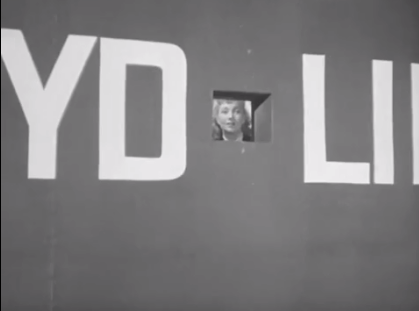
It’s not entirely fair to discuss Blue Heron through comparisons to preexisting works, at least not in its second half. After the familiar reexamination of her childhood confusion & trauma in the first half, Romvari then takes a much more direct approach with the project. She casts a second actor to play her current-day adult self (Amy Zimmer), who’s making her own movie about what went wrong with Jeremy and what, if anything, could’ve been done to prevent it. In the movie’s most excitingly original idea, Romvari literalizes her project by treating the past as a geographic place that can be traveled to and physically accessed, at least within cinema’s internal logic. Her adult avatar returns to her childhood home to directly interact with her family as they were in the 1990s (including her younger self), using the autofictional drama as a mundane form of time travel. All of the first half’s nostalgic immersion Windows ’95 user interface, Ron Popeil infomercials, and oversized cargo pants are ultimately just a method to distinguish the film’s two timelines, which impossibly crossover in the second half. While content to leave the audience unsure of exactly what tragedy Jeremy triggers in his family and how autobiographical that tragedy is to her real family’s story, Romvari appears to be clear-eyed in what she’s accomplishing here. She is confronting some half-remembered, semi-fictionalized version of her past through cinematic devices, so why not send her onscreen avatar directly to ground zero to assess the damage first-hand? I can’t say that I found that device to be as formally radical or as emotionally devastating as the film’s festival-circuit hype suggests, but I do at least appreciate its clarity in method & intent. I should’ve known going in that this wouldn’t hit especially hard with me, based on the similar public hype & personal response disparity of Janet Planet & Aftersun—two widely beloved films I also liked just fine—but I really do try to go into movies with no preconceived notions or comparisons clouding my view. I try, and I fail, because all of these things really are in conversation with each other, intentionally or not.

-Brandon Ledet

Erupcja (2026)

The Year of Charli continues, uninterrupted. There’s seemingly a new movie featuring Charli XCX out in theaters every week this year, ranging from soundtrack work (Mother Mary, “Wuthering Heights”) to minor acting roles (Faces of Death, The Gallerist, I Want Your Sex) to a full-on feature length self-portrait (The Moment). During the recent Brat Summer hype cycle, the British pop singer proclaimed herself a cinephile, sharing her personal Letterboxd account for wide public scrutiny and flashing the names of buzzy auteurs (David Cronenberg, Ari Aster, Joachim Trier, etc.) at her Coachella audience in her trademark nightclub font. It wasn’t until this year’s Charli Movie deluge that the attention flowed the other direction, though. Cinephiles are now confronted with the pop star’s screen & soundtrack presence on a weekly basis, whether we’re actively seeking it or not. All of her various 2026 projects were planned & produced at different times, but they’ve collected at the dam of film distribution to release all at once in one mighty flood. So, if this Charli onslaught is going to continue (for as long as it takes for the new Gregg Araki & Cathy Yan movies to come out, anyway), it is comforting to know that there’s at least one title in that flood that’s both stylishly cool & dramatically compelling, suggesting that she has a longer movie career ahead of her once this wave of post-Brat cinephilia naturally crests.

Erupcja stars Charli XCX as a Londoner on holiday, dragging her milquetoast boyfriend (Will Madden) to Warsaw, Poland after suspecting that he was planning to propose to her in Paris, France. The reason she chose Warsaw in particular is because she has a semi-sordid history of partying there, thanks to a long term on-again-off-again toxic friendship with a local slacker (Lena Góra), who works the counter at an inherited flower shop. Ever since they were teens, the two directionless women have felt a thrillingly volatile connection with each other, seemingly confirmed by news reports of a major volcanic eruption coinciding with every time they meet. So, whenever Charli’s immature party girl pops back into Warsaw to check in on her favorite ambitionless florist, it’s because she’s feeling the urge to blow up her entire life again, leaving only ash & rubble behind. They drink, they dance, they ghost the baffled boyfriend until he gets the picture and abandons his proposal plans. Despite all of its allusions to grand-scale natural disasters, Erupcja is intimately tiny in scope, trailing behind a clique of unimpressive thirtysomethings as they party through a series of romantic meltdowns while playing tourist in Warsaw. The overall mood is ecstatic, though, evoking big feelings through small gestures. It’s also the first instance I’ve seen where Charli XCX shows genuine dramatic chops as an indie-scene movie starlet, rather than just using The Movies as a multimedia brand extender. Whenever she’s offscreen, the audience deeply misses her.

For all of my Charli XCX blabbering here, I was most interested in Erupcja due to the growing name recognition of writer-director Pete Ohs, whose career in low-budget indies has been a constant, pleasant hum in recent years. I was first impressed with Ohs’s editing work in the Gen-Z gun violence drama Beast Beast, and his name has continued to pop up in exciting works like the supernatural stalker thriller Jethica (as a writer-director) and the video game fantasy adventure OBEX (as co-writer, editor, and cinematographer). Ohs’s background in music video work shows in each of his projects’ ability to find high style in cheap scenery, in this case searching for glimpses of laidback urban cool on every Warsaw street corner. The narration echoes that Eastern European setting by mimicking the cadence of a vintage propaganda film, reporting on the thirtysomething hangabouts’ emotional states by dryly stating how they’re feeling and what they’re dreaming between their petty arguments. Ohs also directly illustrates his characters’ emotions in flashes of muted, chalky pastels that serve both as mood-ring insights and as easy scene transitions. Like his work in Beast Beast, there’s also some thoughtful acknowledgement of how much of these young people’s lives are anchored to their phone screens, often flashing back to memories of absentminded late-night scrolling as if it were just as dramatically significant as any offline, real-world event.

It speaks well to Charli’s interest in cinema as an artform that she’s been taking the time to collaborate with up-and-coming filmmakers like Pete Ohs & Daniel Goldhaber instead of leveraging her pop star notoriety to exclusively work with more established names like Gregg Araki & David Lowery. Despite the explosive energy suggested by its title, Erupcja will mostly register as a quiet rumbling on the cinematic Richter scale, while more aggressively advertised projects like “Wuthering Heights” & The Moment will guide most of the loudest Year of Charli discourse. There’s something quietly extraordinary about Erupcja, though, like watching a volcanic eruption through news reel footage on your smartphone. It’s such a small container for such a big personality, and that contrast makes her presence all the more compelling.

-Brandon Ledet

Mother Mary (2026)

Mother Mary is a film that’s probably going to be a miss for a lot of people. It’s a bit messy, with a gossamer thin narrative that’s more gestural than structural, but it’s nonetheless very beautiful, a high concept two-hander that gives both of its leading ladies something to really sink their teeth into. The film takes place over the course of a single night when internationally famous pop diva Mother Mary (Anne Hathaway) goes to the fashion house of her former best friend and stylist, Sam Anselm (Michaela Coel). For the first act, the film seems like it’s going to be a fairly straightforward drama, a kind of stage play about a woman seeking out the one person in all the world who despises her more than any others but who also has the most unique perspective to understand her. Sam’s resentment for Mary is clearly deep, while Mary’s public image has been tarnished by a very public embarrassment that there’s some evidence might have been a suicide attempt, and the first thirty minutes set up the promise that these events will be teased out over the rest of the runtime. 

I was perfectly content to watch the film that I thought I was going to get, watching two powerhouses bare their souls and their grief to one another and to those of us in the audience. The film caught me off guard when it took a turn toward the spooky as the second act opens, as each woman reveals that in the wake of their schism, both had an experience with something inexplicable. The same night that Sam realized she had come to be on the outside of Mary’s life, looking in from a distance, she witnessed some kind of phantasm that seemed to have left her body via an open wound; later, when Mary hires an occultist to do some sleepover witchcraft on the night of her birthday, that same ephemeral thing makes contact with her, setting her literal and metaphorical fall in motion. Visually, the film was beautifully shot and sumptuous from the beginning, but as Mary and Sam relate these anecdotes, things get a little more surreal and we get to see the imagery thereof elevated and re-enacted in real time. Sam opens the doors of her “Mrs. Haversham” barn/studio, and the camera pushes in to follow her into the crowd at Mary’s show; Mary and Sam walk over to a lavish hotel room that has appeared like a giant set in Sam’s space, and then the fourth wall closes around the action. It’s wonderful stuff, very stylish in a way that feels theatrical but effortless. 

David Lowery, who wrote and directed the film, has proven to have a masterful hand at this kind of thing. The final act of A Ghost Story (as much as that film could be said to have “acts”) was similar; as the point of view ghost loses touch with all his earthly ties, time “skips” so that he moves from the house we’ve been haunting with him to a lonely office building that eventually rises on the same place. Brandon wasn’t a fan, but I was; it remains to be seen whether the implementation of this same transitional environmental storytelling technique will be more effective this time around for other viewers. At the very least, Mother Mary is a film about dwelling in a way that doesn’t try one’s patience the way A Ghost Story did (for others). Where I expect this film to lose most general audience members is in just how literal the metaphorical ghost becomes while the film itself leaves the metaphor itself rather ambiguous. No one gets up and gives a big speech about what trauma the amorphous ghost represents; no one names “grief” or “resentment” as monsters that can be overcome with forgiveness and reconciliation. The film’s choice to leave one with questions and different potential interpretations is going to raise the dander of people who can’t abide ambiguity in their art and need something concrete and easy to grasp. Some of the people for whom that element is a feature and not a flaw may find the way that the metaphor becomes explicit off-putting. 

I was on board for all of that, utterly caught up in the whole thing. The only thing that didn’t quite work for me was the music. Thrillers centering around major pop acts have become a bit of a trend lately (see: Smile 2, Trap, Lurker), and I often find the musical acts therein to be virtually indistinguishable from the radio pop hits that I hear at the club (or, more common at my old age, the grocery store). We get to hear a few of Mother Mary’s hits, and none of them really have any staying power; there’s a not-quite-fully realized bit of religiosity to her music, as her stage name evokes Catholicism (as does Sam’s surname), one of her songs is called “Holy Spirit,” and she has a stigmata-like wound at one point, but it never comes together in a meaningful way. The connection I found myself thinking of most while watching this wasn’t Madonna or Lady Gaga, but last year’s The Testament of Ann Lee, because Mother Mary’s body of work was as monotonous and repetitive as that film’s hymnal remixing. When we talked about Lurker on the podcast last year, there was some dismissal of the film’s bedroom lo-fi tracks as forgettable, but I’ve found myself returning to “Snakes in the Garden” quite a lot since last September, and I don’t think I’ll ever feel the need to revisit Mother Mary’s “Burial” or “Dark Cradle.” 

The songs were written by FKA Twigs (who also appears in the film) with some arrangements by celebrity producer Jack Antonoff. I’m ambivalent about FKA Twigs (if I’ve ever heard more than one of her songs to completion, I wasn’t aware of it) and generally positive about Antonoff’s work with his band Bleachers, and Hathaway has demonstrated a lovely singing voice in the past. Nevertheless, whatever their individual talents, what coalesced on screen was unremarkable. The scene in which Hathaway, in a modest space, performs the silent interpretive dance of her stage choreography for her newest song blows every one of the on-stage performances out of the water. What really makes this movie shine is Coel. She’s absolutely excellent here, delivering my favorite performance of the year so far. It’s nuanced and layered, and worth the price of admission alone. It won’t work for everyone, but will definitely resonate with some.

-Mark “Boomer” Redmond

Ruthie the Duck Girl (1999)

One of New Orleanians’ most treasured pastimes is to complain that the city ain’t what it used to be, waxing nostalgic about all the people & places that “ain’t dere no more” as time has marched on without them. I tend to roll my eyes at this hyper-local brand of cynicism, because it’s very obvious to me that the city’s greatest charm (and most glaring fault) is that it never really changes, so when people get romantic about “the New Orleans that used to be” I assume they’re mostly just personally nostalgic for being in their twenties. Every time I have an especially great day in the Quarter, at Jazz Fest, or watching a second line from my front porch, I find myself getting emotional about how the people & culture of New Orleans have remained the same for at least as long as I’ve been alive. The city is just as beautiful now as it’s always been. Sometimes, I can even get verklempt about that much-debated fact while watching locally produced documentaries, such as the gay Mardi Gras doc The Sons of Tennessee Williams, the year-in-the-life party doc Always for Pleasure and, most recently, the late-90s documentary profile Ruthie the Duck Girl, which the New Orleans Film Society recently screened at The Broad. Looking at the French Quarter through director Rick Dulaup’s camcorder lens, I was overwhelmed by the comforting feeling that it’s just the same now as I always remembered it, and seeing local legend Ruthie the Duck Lady on the screen felt like running into an old friend while day-drinking on Decatur Street — sublime.

I would have known & caught glimpses of Ruthie the Duck Lady exactly as she appears in this documentary, drinking & smoking away her 60s in the late 1990s & early 2000s. As this documentary’s title suggests, however, her history goes back much further back in New Orleans’s past, back to Ruthie’s girlhood. Ruthie started her lifelong performance-art project as a humble Duck Girl, purposefully attracting attention by wearing a garish Easter bonnet and shepherding ducks around the Quarter. She was an eccentric by nature, but she was also one by choice, making a modest living out of selling autographed postcards of her image. By the time I would’ve seen her, the ducks were long gone, and the bonnet had evolved into a much more elaborate fashionista ensemble, covered in promotional buttons and accessorized with a ratty fur coat, no matter how hot or humid. Ruthie no longer needed to sell postcards; she’d get by just fine on free Budweisers & Kools, generously provided by the fine folks of New Orleans who were just happy to see she’s still around. If you stepped into her orbit at that time, like I did, it might be unfathomable how she had developed her character over the decades, like jumping into the Dune series by reading God Emperor first. This documentary does its best to answer the basic questions you’d have about Ruthie’s life & art, which were one & the same, preserving it for posterity in the process. The city that made her story possible might’ve continued on unchanged, but she only held on for another decade. So, it’s a gift to see her frozen in time here, exactly the way the Ain’t Dere No More cynics wish everything could remain.

Aesthetically, Ruthie the Duck Girl is the kind of New Orleans culture documentation you’d expect to see on local PBS affiliate WYES. Even so, it’s the WYES equivalent of Grey Gardens, spending time getting to know a larger-than-life character while she was still alive to contribute to her own legend. Ruthie even occasionally waves around a miniature American flag like Little Edie, modeling her “costume for the day” with the full intent of making herself a fabulous spectacle. The biggest revelation of this profile was just how aware Ruthie was of her public perception, using it as both a modest source of income and a shield for some of her riskier behaviors (such as kicking tourists she found annoying in the shins with her roller skates). You’d expect a documentary profile of a local eccentric to go out of its way to humanize its subject, but Ruthie’s humanity was apparent to anyone who spent time talking to her instead of gawking at her. What’s much more compelling is puzzling through how much of her persona was a deliberately constructed character, to the point where she tests out new catchphrases like “That did it!” and “Can I get a beer for later?” on-camera, as if Delaup were shooting a sitcom pilot in front of a live studio audience. Revisiting Ruthie did feel like stumbling across an episode of some long-forgotten sitcom I haven’t seen since I was a child, a feeling amplified by the movie’s spotty distribution as an occasional cultural event outside the streaming market. Much like Ruthie herself, you can only see it by leaving your house and spending time around the city’s cultural hubs, occasionally catching a glimpse of the artist at work.

-Brandon Ledet

Crash (1996)

The first three scenes in David Cronenberg’s Crash are sex scenes. The fourth is a car crash. That, too, turns out to be a form of sex, but it takes a minute for the audience to catch up. We’re introduced to our central couple in peril as they’re having polyamorous sex with other partners, then meet to discuss their extramarital adventures while having sex with each other. In each case, they are in direct contact with heavy machinery, which adds to their excitement. In the first scene, a woman (Deborah Unger) has sex with her flight instructor while her cheek is pressed against the wing of the small airplane she’s learning to pilot. Next, we see her film-producer husband (James Spader) having sex with an assistant camera operator while using the tools of their trade as a makeshift mattress. Then, the married couple convenes on their high-rise balcony, overlooking a dozen lanes of endless traffic as they have semi-public sex in shameless view of the passing cars below, getting off on the exposure of their bodies and their recounted affairs. In the fourth scene and first car crash (of many), the machinery becomes more actively involved in the physical contact. The film producer drives head-on into another car, instantly killing its driver. That victim’s widow (Holly Hunter) then sensually reveals her naked breast to our battered & concussed protagonist, revealing that his highway accident was, indeed, another form of sex. He just doesn’t know it yet.

While its small cult of automotive fetishists has fixated on a highly specific turn on, Crash is the ultimate “Anything can be sex!” movie. Car crashes? That’s public sex. Kissing a freshly inked tattoo? Oral sex. Lighting a friend’s cigarette? That’s making love. Photographing a concussed hospital patient? Okay, that’s more akin to pornography & masturbation, but you get the point. James Spader’s car-horny protagonist awakes from his first crash half-alive in a hospital bed, where he’s already been scouted & recruited by the sex cult’s egomaniacal leader (Elias Koteas). The cult’s biggest outreach program appears to be a regular outdoor meeting where they recreate famous car crashes—like the one that killed James Dean—for bleachers packed with horny voyeurs. Their leader doesn’t restrict his sexual releases to those grand displays, however. His gigantic, beat-up car is both a battering ram and “a bed on wheels,” which he swerves up and down the streets of Toronto in search of the ultimate car-crash turn-on: death. His loyal followers all fuck & mutually masturbate each other in various pansexual pairings one car crash after another, until the movie arbitrarily ends during one such indulgence, no actual end to their nihilistic highway hedonism in sight. Functionally, every scene is a sex scene, and yet it seems as if the only players who achieve orgasm are the ones who die in their respective crashes, crushed under heavy metal.

It’s typical for David Cronenberg movies to be about sex, but Crash differs from his usual mode by actually depicting it. Usually, Cronenberg depicts the penetration and joining of the human body’s various orifices a kind of monstrous real-time mutation, something to fear rather than enjoy. Although a lot of Crash‘s sexual touch is mediated through heavy machinery, Cronenberg also includes plenty of direct skin-on-skin contact, embracing the erotic instead of recoiling from it. While he preserves the protagonist’s name as James Ballard—in reference to the sci-fi novelist who wrote the source material—he shifts the character’s occupation to Torontonian film producer, even depicting him slumped in a director’s chair on set. In this way, Spader plays both the author and the auteur, intertwining Cronenberg’s personal sexual hang-ups with Ballard’s cerebral perversion of daily highway driving. In the film’s best moments, he gets totally lost in the abstract hedonism of cars’ physical presence, such as the wet thudding sounds of an automated car wash or the philosophical meaning behind traffic’s ebb & flow currents. It’s all slyly funny, chillingly violent, incredibly sexy, and seemingly personal to how both of its respective authors think about sex & modernity. So, yes, anything can be sex, including a deadly car crash. How terribly exciting is that?

-Brandon Ledet

Miroirs No. 3 (2026)

What’s so wrong about a little parasocial bonding, as long as you keep it friendly? That’s the question at the heart of Christian Petzold’s latest understated arthouse thriller, which feels remarkably minor even by his standards. Miroirs No. 3 continues Petzold’s ongoing collaboration with actress Paula Beer, who’s been working as his go-to muse since Undine at the start of the decade. Beer stars as a lonely woman at the outskirts of the music industry, alienated by the careerist ambitions of her boyfriend and the sycophantic obligations of making connections with other go-getter urbanites. While on a weekend getaway in the German countryside, the uneasy couple get into a gnarly car accident, leaving Beer’s aspiring pianist concussed, alone, and presumably in mourning. She’s then taken in by a rural family who appear to be generous in providing her a bed to recover in but eventually prove to have their own selfish motivations in the supposed charity act. As she pieces her life back together in the days after the accident, it becomes clear that she’s being modeled to fulfil a domestic role in the home left vacant by another woman her own age, and she’s unwittingly become an integral part of a family unit she initially assumed she was just visiting. Whether that forced-family dynamic is menacing or comforting is up for interpretation, as everyone involved discovers in their own time.

Miroirs No. 3 might play with the themes & tensions of a classic Hitchcock thriller (most notably, Vertigo), but its scene-to-scene conflict is largely quiet, requiring an active patience from its audience that Hitchcock would never take for granted. On the genre scale, it’s more closely aligned with recent Euro thrillers like When Fall is Coming, Misericordia, and Sibyl than any of the classic Hitchcock titles they might individually recall. It’s cozier than it is thrilling. All action beats are heard offscreen, never seen. Even the dialogue is quiet & sparse, with most of the conflict between members of this makeshift family conveyed via meaningful stares. From the very start, Paula Beer’s concussed protagonist is characterized as a passenger, riding silently in cars and making passing eye contact with strangers so inhumanly stoic they practically function as specters of Death. The way she finds a place where she feels welcome & settled enough to call home might be morally perverse (given that her new foster family pressures her to unwittingly take the place of another missing woman), but there’s genuine temptation in continuing to play house there. The audience stews in the discomfort of figuring out who she’s replacing, whether she’ll accept the role, and what her new fake family will do if she rejects them. Petzold’s gamble is in hoping that discomfort is enough to sustain our attention without having to pacify us with onscreen acts of violence like, say, a car crash.

Petzold’s films are a little too deliberately understated to fully register as major movie events to the world at large, but previous titles like Phoenix, Transit, Afire, and the aforementioned Undine all mean a lot to a few. Miroirs No. 3 will undoubtedly be the Movie of the Year for a certain kind of movie nerd who’s dying to share a beer with Paula Beer, offering several memeable moments of her cracking open some cold ones for anyone who’d be interested in such a thing. For everyone previously unfamiliar with the Beer-and-Petzolds name brand, it’ll likely pass by like a gentle breeze — pleasant but hardly noticed.

-Brandon Ledet

Agon (2026)

During the 2024 Olympic Games in Paris, I caught a couple live TV broadcasts of women’s fencing matches, expecting to watch some good old-fashioned swordfighting from world-class athletes. It turns out, modern fencing looks a lot more like retro sci-fi B-movies than the Old Hollywood swashbucklers I was picturing. I expected the competitors to be protected by masks & padding, sure; I just didn’t expect them to be plugged into electronic sensors, with each of their scores marked by lights & beeps when they completed a circuit with their foils, seemingly making the on-site referees just as vestigial as they are in the WWE. The new Italo arthouse headscratcher Agon presents the first cinematic instance I know of where modern, computerized fencing is represented at length onscreen, no longer relegated to bi-annual Olympic sports broadcasts. In fact, the sci-fi futurism of modern sports is just about the only thing on first-time writer-director Giulio Bertelli’s mind, as he spends Agon‘s entire runtime pondering & cataloging the various machines that have transformed the Olympic Games into an uncanny, inhuman abstraction rather than a straightforward demonstration of pure athletic prowess. It’s a surprisingly alienating, dissociative approach to the sports-movie formula, boldly announcing that the techno future of the sports drama is here, and it is terrifying.

In a semi-documentary style, we watch three women train & compete in various combat sports for a fictionalized version of the Olympics called The Ludoj Games. One is a fencer, who is physically plugged into the various computer sensors that have gradually transformed the sport into a live-action video game. Another is a sharpshooter, who is convinced that her own sport will become a literal video game in the near future, replacing traditional firearms with laser rifles. The third is a judo fighter, who you’d think would be safe from the encroachment of computer electronics in her sport, except that every aspect of her training and bodily maintenance requires high-grade, cutting-edge medical tech. Watching these women work at their craft is both chilling & beautiful, literalizing the ways that athletes’ bodies are precisely calibrated machines by surrounding them with endlessly bizarre, precisely calibrated machines. They hone their skills in abstract video game simulations. They measure their lung performance on treadmills by wearing Darth Vader-style breath masks. They reveal hidden injuries through X-rays & MRIs. They relieve stress between matches by streaming hentai on their smartphones. The entire film plays like a high-end version of those brain-rot video compilations of “satisfying factory machines,” minimizing the athletes’ bodies to an organic product of highly coordinated industrial processing.

Beyond its pronounced fetishism for the modern tech of sports medicine, Agon seems particularly interested in the exact tipping point where the simulated violence of combat sports turns into actual, physical harm. Very early on, our buff judo fighter suffers a painful knee injury, and we watch surgeons reconstruct her newly bionic body in intense documentary gore before she attempts to rehab her way back to the top of her field. Soon after, the sharpshooter lands in hot water with her financial sponsors over amoral hunting practices she’s engaged in outside the games, effectively transgressing by using her instrument for the exact purpose it was initially designed for – give or take her choice of target. It’s initially unclear what the fencer’s personal crisis with unstimulated violence could possibly be, and then it turns out she’s got it the worst out of the trio (especially once it’s revealed in the end credits that her own tragedy is inspired by a real-life freak event in the sport’s recent past). When the sharpshooter complains to an official representative of the games that she’s being professionally punished for her private behavior, the rep shoots back that, “There’s no room for violence here.” That’s a little rich, considering that the only sports profiled here are all simulations of violence, more military exercise than wholesome pastime.

When our psuedo-violent, semi-computerized athletes finally compete in The Ludoj Games, there is no live audience on hand to witness their technical achievements & failures. The games are staged in an abstracted black-box void, only to be witnessed by on-site officials, expensive camera rigs, and the all-important digital sensors. Obviously, this choice is at least partially driven by budgetary restraints, but Bertelli finds a way to make that limitation emphasize the cold post-humanism of modern Olympic sports. His interest in the subject appears to be somewhat personal, too, considering his advertised background in offshore sailing and, subsequently, the production of offshore sailing equipment. Not for nothing, but Bertelli also has familial ties to the fashion-industry royalty of Prada & Miu Miu, which is a dynasty he has attempted to professionally distance himself from but still shows in his filmmaking style. There’s a couture streetwear coolness in the way his three athletes model their sports’ various far-out gadgets, even as Bertelli dwells on the uglier, grotesque aspects of modern Olympic physicality. The movie is overall just as hip & fashionable as it is alienating & disorienting. Even the title “Agon” reads like the name of a fictional fashion brand, despite its intended academia as the Greek word for “conflict,” once used to describe the ancient, pre-computerized Olympics, BC.

-Brandon Ledet

The Mummy (1999)

Recently, Brandon wrote a piece about the unfortunate position of The Mummy as Universal’s most side-lined classic horror character, and how the general public’s association of the title The Mummy with the 1999 action-adventure film directed by Stephen Sommers rather than the Karl Freund original cements The Mummy as a second-tier hanger-on. During the umpteenth viewing of the trailer for the upcoming release of Lee Cronin’s The Mummy, a friend of mine leaned over to me in the theater and asked me a question about the frequency of these remakes, and I mentioned my own framework of the understanding about why The Mummy (the character) rarely works. Namely, you can make a movie about Wolfmen, Invisible Men, reanimated Promethei, and Dracula (et al) without the text being, necessitated by its nature, inherently racist. The Northern Hemisphere positively plundered Egypt and its historical sites, and the ongoing behavior of the British Museum acting in miniature on behalf of the colonialist experiment demonstrates that they are pathologically unable to comprehend the extent of the evil and shame inherent in their “expeditions.” Mummies were ground up into powder and used for paint pigmentation, medicine, and countless other things, again with Britain nationally acting as the microcosm of colonialist enterprise by rushing headlong into turning other people’s ancestors, a finite resource indeed, into a monetized enterprise. That’s why no big-budget mummy movie in the 21st century has actually been about a mummy; they’ve been about death gods creating avatars for themselves (the 2017 Tom Cruise film) or a child being possessed by something after spending some time in a sarcophagus (the new Lee Cronin film, at least based on the trailer). 

The last time that a Mummy was about a mummy was in 1999, when Brendan Fraser and Rachel Weisz memetically lit the libidos of bisexuals worldwide ablaze. Fraser plays Rick O’Connell, an American in interbellum Egypt for unknown reasons, whom we meet making a final stand against presumed locals while defending(?) some ruins. It’s a big guns-blazing action sequence that doesn’t really want you to ask questions about why Rick’s there, whose territory is rightfully whose, or other questions about the “veiled protectorate” period. Meanwhile in Cairo, Weisz’s Evelyn clumsily destroys a lot of priceless texts before her gadabout brother Jonathan (John Hannah) presents her with an artifact he pickpocketed that supposedly came from the lost city of Hamunaptra, a legendary treasure repository as well as “the city of the dead.” Evelyn, Rick, and Jonathan set out to find the city again, and find themselves in a race to the lost city with Beni (Kevin J. O’Connor), a cowardly man who was previously at Hamunaptra at the same time as Rick, and the American cowboys he’s guiding along the same path. Upon arrival, the Americans almost immediately release the undead ancient Egyptian priest Imhotep (Arnold Vosloo), who was mummified alive as a punishment for touching the Pharaoh’s concubine, from his tomb, unleashing plagues and the potential to end the world. 

I used to love this movie. I was in middle school when both it and its sequel were released, and as a kid who had grown up obsessed with Indiana Jones and with an interest in Egyptology, this was an exciting mash-up of horror and action-adventure that really hit my sweet spot. It also didn’t hurt that there were large swathes of time when it was on cable almost constantly, so it really left a mark on me. Going back to it now, however, I can’t help but find it a little distasteful, and a product of its time. Perhaps nowhere is this more clear than in the person of Ardeth Bay (Oded Fehr), a character descended from a long line of secret defenders of the pharaonic order. Despite living a life that implies an ongoing belief in the Egyptian pantheon of old, Ardeth praises Allah, something that was uncommon but unremarkable among heroic characters in films of the period but would become contentious just a couple of years later during the era of kneejerk American Islamophobia. Ardeth is also not played by an Egyptian actor (Fehr was born in Tel Aviv), nor is Imhotep (Vosloo is white South African), nor are the pharaoh (Aharon Ipalé is Israeli) or his Anck-su-namun (Patricia Velásquez is Venezuelan). The casting of the roles in the film outside of our white leads is classic Hollywood “brown is brown” racism of a bygone era, and watching this as an adult who is fully conscious of all of the implications greatly dulls one’s enthusiasm for what is, otherwise, an adventurous romp. 

A lot of the CGI here will look dated to the modern eye, even to those of us who remember this as being an extravaganza of realist effects. A lot of it still works because its uncanniness can be excused as a matter of course for a horror flick, but the CGI Thebes stands out as particularly video game-esque. The rewatch of this was prompted by the upcoming release of the aforementioned Lee Cronin Mummy, but the timing happened to align with Passover having recently happened, and I realized I had always thought of this as a kind of Passover movie, a secular alternative to The Ten Commandments that also happened to contain the plagues. (Toads and frogs are one of the ones that are left out, presumably because every amphibian wrangler in Hollywood was working on Magnolia at the time.) Preteens, like I was when I first saw it, are really the best demographic for this film, as its overwritten corny dialogue and telegraphed acting choices read like a throwback to old-timey pictures, until you’ve watched as many of them as I have and realize it’s more shallow parody than homage. Weisz and Fraser are sexy, yes, and they have great chemistry together, but Rick is much more of an asshole than I remember, and Evey, with her clumsy awkwardness and frustration at Cambridge’s rejection of her despite her outsized genius, feels like a fanfiction character, right down to her being a nepo baby. 

I wish that I could love this one as much as I did when I was younger, but most of the enjoyment that can be derived from it now comes at the film’s expense. If you have fond memories of it, let that sleeping dog lie; don’t go disturbing the sarcophagus of your memory.

-Mark “Boomer” Redmond

The Furious (2026)

Every year at Overlook Film Fest, you’ll overhear some pedantic grumblings about what films do or do not technically qualify as horror, which is ostensibly the festival’s main programming hook. Personally, I love that the festival abides by loose genre definitions, since it’s allowed some of the more surreal, dreamlike titles to sneak into the line-up, like Kiyoshi Kurosawa’s Cloud, David Cronenberg’s The Shrouds, Jane Schoenbrun’s I Saw the TV Glow, and Jennifer Reeder’s Knives & Skin, which were each met with some audible festivalgoer confusion. That’s why it was such exciting news that Overlook introduced a new sidebar selection of titles for this year’s lineup that freed it from having to even pretend that every offering is strictly horror, avoiding the complaint entirely. That “Side Shows” sidebar was described in the program as “genre diversions from horror tailor made for the world of the Overlook,” and the very first title that screened in the sub-section delivered on the promise: a not-even-horror-adjacent action thriller that featured some of the most gruesome, fucked up gore gags you could find anywhere at this year’s festival. It was a raucous good time, and no one felt hoodwinked.

The Furious is a child-abduction martial arts revenger from longtime fight choreographer Kenji Tanigaki, who seems determined to leave no audience left unimpressed with his commitment to craft. Much like this year’s straight-to-streaming actioner The Forbidden City, The Furious takes great care in staging elaborately brutal fight choreography so that each blow is just as precise as it is inventive, recalling the 80s & 90s Hong Kong action heyday when Tanigaki would’ve gotten his start. This particular outing is way more ruthless & relentless than The Forbidden City, though, both in the extremity of its violence and the extremity of the real-world evils that violence aims to avenge. After his daughter is abducted by human traffickers in broad daylight, an ordinary tradesman with extraordinary martial arts skills (Mo Tse) teams up with a rogue investigative reporter (Joe Taslim) to systematically murder every scumbag involved, freeing the children they’re holding hostage in the process. It’s the kind of man-on-a-mission action thriller that sincerely believes all the evils of the world can be solved with the swing of a hammer, like You Were Never Really Here restaged as an action thriller.

The sizes & shapes of the hammers our heroes swing vary wildly, from ball-peen to sledge to bike peddle to concrete chunk on a pole. When Mo Tse gets the hammer-vengeance started by taking down an entire underground MMA nightclub with just the ball-peen in hand, his over-the-top ultraviolence is scored with Mortal Kombat-style techno, signaling that the party is getting started. The Overlook Side Show screening was near-riotous from those first few minutes of mayhem until the very end, with the crowd loudly groaning at every hammer-smashed skull and cheering on the swift justice against every ghoulish villain in our heroes’ path. The Furious takes a pro wrestling approach to morality, with very clear faces & heels on either side of the good vs. evil divide. Simplistic or not, it’s difficult to not get emotional watching children get put in peril for petty payouts by heartless goons, especially when those children start bonding and looking after each other in their dingy-dungeon captivity. Despite the severity of that subject, Tanigaki keeps the mood oddly light & fun, continuing the Hong Kong fight-choreo tradition of utilizing every single prop that appears onscreen during the fights: garbage bags, ladders, water cooler bottles, whatever’s hanging around. It’s shockingly grim, but it’s also a total blast.

Because of its predilection for hammers and its momentary indulgence in a sideway-scroller hallway fight, The Furious will likely inspire a lot of comparisons to Park Chan-wook’s breakout cult classic Oldboy, but I think that sets up a much narrower expectation of the action’s scope than what Tanigaki’s imagination for fight gags can deliver. Personally, I found myself thinking back to the wild tonal swings of RRR, which alternates from abject human misery and sublimely goofy genre payoffs at the same delirious pace. Speaking of which, The Furious is very likely the best action movie I’ve seen since RRR, give or take Furiosa. It also very likely means something that every action movie I’m likening it to in this review happens to be about some form of human trafficking, solving a complex international issue with simple acts of brute-force justice. That simplicity is a major strength here, especially in the way it invites genre-savvy audiences to cheer in unison one gory gag after another. I hope the Overlook programmers were encouraged by that loudly enthusiastic reception and will push the new Side Shows section to even further genre extremes next year. Let’s see how wild & fucked up this beautiful thing can get.

-Brandon Ledet

Exit 8 (2026)

I’ve been seeing a lot of advertising (or maybe just the same thumbnail from a singular YouTube video, over and over) for Exit 8 that refers to the film as “Cube meets Tokyo.” Despite the fact that we already had that, and it was bad, I was still intrigued enough by the trailer to want to give this one a shot. The premise is fairly simple. A lost man (Kazunari Ninomiya) finds himself caught in a repeating loop of the same few sections of corridor in an underground subway tunnel. Initially spooked at finding himself completely alone and unable to locate an exit, he encounters increasingly unsettling visions before realizing that there are a set of instructions on the wall that boil down to “continue walking until you encounter an anomaly, then turn around and keep walking.” Said anomalies surface as things as relatively mundane as misplaced doorknobs and distant voices of crying babies to mutant rat creatures that resemble the experiments he barely noticed while scrolling through social media on the train. The lost man is in a state of turmoil, having learned that his ex-girlfriend is pregnant mere moments after he failed to confront a salaryman on the train for screaming at a mother with a cranky infant, then immediately finding himself in the infinitely-looping corridor. When he encounters a little boy (Naru Asanuma) and realizes that he’s not part of whatever purgatorial situation within which he’s been entrapped, he and the child try to get out together. If they can get through all eight levels without being deceived or overlooking an anomaly, they’ll find their way out. 

I’m going to make three points of comparison here to horror movies past, and Cube is not going to be one of them. First, in what I intend to be the most flattering comparison, Exit 8 has a great deal of similarities to one of my favorite horror films, Jacob’s Ladder. The 1990 Adrian Lyne film features Tim Robbins as a man potentially trapped in a reality he can’t be sure is real while experiencing subliminal visions of horrors beyond his comprehension, with a few memorable sequences set in the NYC subway system. Exit 8 dilates those underground set pieces to encompass the entire purgatorial situation, which is a neat trick, and it plays with the hypnotic monotony of depersonalized commuting in a series of seemingly identical hallways. Jacob’s Ladder finds Robbins’s character interacting with an almost angelic version of the deceased son he lost (a pre-Home Alone Macaulay Culkin), who helps him in a way that I can’t really talk about without spoiling that film, other than to say that Jacob’s journey, like The Lost Man’s, requires a certain level of acceptance. 

Secondly, in what I intend to be an unflattering comparison, Exit 8 has the distinction of being the second horror film I’ve seen so far this year that also happens to be, intentionally or not, pro-life propaganda. Concerning! Arguably, this one’s the worse of the two. At least in Undertone, the choice of whether or not to keep her baby was a decision that the mother was making; here, one of her only lines of dialogue, repeated almost as often as we see the “Exit 8” sign is, “Which is it?” Still, this is mitigated by the third point of previous film similarity, which is a neutral comparison at best. Exit 8 reminds me most of Nightmare on Elm Street 5: The Dream Child, in that they have the same (mildly spoilery) conceit, which is that the protagonist is guided by a specter of their as-yet-unborn child. In Dream Child, that takes the form of Alice’s fetus appearing to her as a young child in her dreams and helping her fight Freddy Krueger; here it’s The Boy, who responds to an apparition of The Lost Man’s girlfriend by calling for her as his mother, revealing that he is, somehow, the man’s son. 

From what I can tell by perusing some reviews and summaries of the video game this film adapts, the player character therein is an utterly blank canvas, and there’s no real “plot” to speak of: no unplanned pregnancy woes, no encounters with a non-anomaly character like The Boy, no shameful cowardice at failing to confront a raging asshole. It doesn’t even seem like The Lost Man’s asthma, which I assumed had to be a gameplay mechanic, originated there. All of this is newly written for the film, and while I understand that the film, being based upon a game that is all about the mechanics and the tension rather than any real narrative, had to come up with some stakes. I’m not sure why it had to be this narrative, but the other way that this most evokes Dream Child is that its pro-”keeping the baby” messaging is also so bizarrely incoherent that it utterly falls apart; Madonna’s “Papa Don’t Preach” ends up being more effectively propagandistic in just a couple of minutes than Exit 8 and Dream Child combined. It’s not a defense of the film’s politics, but it’s so sloppy that it’s hard to grasp onto anything substantial enough to be annoyed by. 

I suppose, eventually, we do have to get around to examining this film in conversation with Cube. When we talked about that film on the podcast (as well as its sequel and prequel), Brandon’s primary complaint was that what Cube failed to deliver upon was the promise of cool death traps in the series of successive, identical, cubical rooms. As someone who saw those movies in earlier, more formative years, I already had an idea of the shape of the narrative, so I wasn’t set up to be underwhelmed by the ride in the same way that he was. I experienced my own great disappointment when we watched the 2021 version from Japan, which, among its many other faults, broke the cardinal rule of The Cube: we should never see what’s outside The Cube. I was very frustrated the first time that Exit 8 also showed us something that was happening outside of the liminal space in which our characters are trapped, as we see the woman on the other end of the phone call that The Lost Man receives while lost in the corridors. This does turn out to be an (obvious) misdirect, but there’s a sequence that comes later in which The Lost Man imagines himself on the beach with The Boy and his mother, and I can’t help but think that would feel more emotionally impactful if we didn’t have the earlier scene, and that conversation in itself would be more exciting if we only saw The Lost Man’s end of the line and stayed inside the spooky hallway. 

Further, the film’s decision to literalize the metaphor with The Boy, by making him actually be his future son rather than simply a reflection of what his future child could be. It’s a hat on a hat, lacking a subtle touch that would make the film more emotionally impactful. I’m grasping at straws trying to articulate it, but it’s almost as D.O.A. an idea as making Newt be Ripley’s actual daughter in Aliens rather than an objective correlative representing her guilt about outliving her actual child. Excise the scene in which The Boy recognizes The Lost Man’s ex as his mother and this is instantly a more thoughtful movie, even if you leave in the beach dream. That also lends more emotional heft to what we learn about The Walking Man (Yamato Kochi), who appears as part of the loop in The Lost Man’s journey, but whom we learn was himself a previous captive of the space who was trying to find his own way out. When he experiences frustration with having to start over after getting within spitting distance of level eight, he laments that he “was supposed to meet [his] son today.” As a manifestation of what The Lost Man could become, it’s admittedly a little on the nose, but it too would feel more nuanced if we just cut out the “mother” stuff. 

All of these quibbles having been laid out, it’s worth noting that this is a fun experiment and a masterful success on a technical level. The space itself is perfectly sterile and unsettlingly empty. The opening sequence, which is shot entirely in the first person, is an impressive feat, with the first shot we see of our main character being his reflection in the window of the subway car as he turns up his music to ignore the verbally abusive salaryman. I had a very immersive experience, as the only tickets still available were in the very front row, and I had a hell of a ride even as I found myself stumbling over the film’s slippery, amorphous thesis. I also appreciate that the film is open-ended; this is a mild spoiler, but after he manages to find Exit 8 and return to the real world, The Lost Man once again finds himself in a (presumably) metaphorical loop, as he experiences an identical situation as the one which opened the movie, as the same salaryman is screaming at the same young mother. The film cuts to credits with our lead once again staring into his own reflection. It seems that most reviewers infer that he will now confront this man and make up for his earlier bystander syndrome. I prefer to read the ambiguity of the ending from the other direction, and that for all he experienced in the liminal subway corridor he’s still essentially the same man, cowardice and all. It leaves some room for interpretation, that there may be some truth in his conviction that a person who stands idly by while someone is aggressively harassed may not be suited to parenthood. It’s not a mark in this film’s favor that I’ve spent so much time describing the film that I wish it was rather than the film that it is, but it’s still an excellently executed premise, and worth checking out for its design and camera movement if nothing else. 

-Mark “Boomer” Redmond