The Hellstrom Chronicle (1971)

The single-camera mockumentary has become such a common genre over the past couple decades through sitcoms like Arrested Development, The Office, and Modern Family that it’s hard to remember a time when it was more of an outlier than the norm.  We’re familiar enough with the mockumentary format now to immediately understand the way they play with our perceptions of authenticity, but there was a time (let’s clock it as pre-Best in Show) where the genre was more subversive.  There are a lot of urban legends about audiences taking early mockumentaries at face value, believing Spinal Tap to be a real band, the cannibals of Texas Chainsaw Massacre & Cannibal Holocaust to be real cannibals, the Blair Witch to be a real witch, etc.  I never really knew how sincerely to take those stories until I read that The Hellstrom Chronicle won the 1972 Oscar for “Best Documentary Feature” despite being an obvious parody of the documentary format instead of the real deal.  I assumed that factoid was a prank Wikipedia edit, but then I confirmed it on the Academy of Motion Pictures website.  A mockumentary indeed won the most prestigious industry award for documentary films, which has got to be some implication of how novel the genre used to be before Jim met Pam – novel enough, apparently, to make moviegoers believe in witchcraft & killer insects.

The Hellstrom Chronicle is a drive-in era exploitation horror about the inevitability of insects taking over the planet, recalling 1950s B-pictures like Them!, Tarantula, and The Deadly Mantis.  It just happens to be delivered in the style of a David Attenborough nature documentary, hosted by the fictitious Dr. Nils Hellstrom, PhD (credited as a performance by actor Lawrence Pressman in the final scroll).  Hellstrom lectures for the entire 90min runtime in deliriously overwritten, Ed Woodian dialogue about how bugs are “gruesome robots” and an “infectious virus” that will soon violently overthrow humanity for planetary dominance if we don’t act soon.  These rants are illustrated by hi-fi nature footage of insects eating, mating, and waging war in the wild, scored by arhythmic drums & winding strings to emphasize their gnarly brutality.  The opening credits thank well-respected universities and research institutions to feign an air of legitimacy, but by the time Hellstrom is opining about how termite mounds are primitive computers built to calculate our collective doom, it’s so outrageously over-the-top that it cannot be taken seriously.  Screenwriter David Seltzer (The Omen, Willy Wonka, Bird on a Wire) is obviously just amusing himself with how far he can push the film’s central conceit without fully tipping into comedic parody, and it’s a pure-trash joy to tag along for the indulgence.

To the Academy’s credit, The Hellstrom Chronicle did eventually prove to be prescient of where documentary filmmaking was heading, at least the version of documentary filmmaking you’ll find on basic cable.  It particularly recalls the ominous pseudoscience of Discovery Channel & History Channel programs, where facts are allowed to be fuzzy as long as they freak out the audience enough to keep them hanging on through commercial brakes.  Pair that basic-cable sensationalism with William Herzog’s deadpan rants about the cold cruelty of Nature, and you pretty much have The Hellstrom Chronicle‘s basic blueprint.  It’s not actually useful or even functional as an educational tool about the resiliency of insects, nor does it really pretend to be.  Halfway into the runtime, it gets bored with sticking to pure nature footage and takes self-amusing detours into classic horror movie clips and candid camera pranks.  It’s less appropriate for the classroom than it is for late-night “Bad Movie” parties, so you can have a laugh making your roommate paranoid about killer ants between bong rips.  Phase IV might as well have won the Oscar for Best Documentary Feature.  They’re working with about the same level of authentic, scientifically presented nature footage, and the one that was featured on Mystery Science Theatre 3000 is likely the one that’s more realistic about the collective killing power of ants as a species.  Not for nothing, they’re also both great films.

-Brandon Ledet

The Photocopied Mayhem of Monster Island Entertainment

I’ve been long-overdue for a nostalgia-check rewatch of the 1998 Godzilla film, directed by notorious Hollywood dingus Roland Emmerich.  Since it was the first fully American Godzilla production, the hype leading up to that film’s release was immense and—a child at the time—I bought into all of it: the tie-in Saturday morning cartoon, the rap-rock soundtrack CD, the Taco Bell-exclusive merchandise, all of it.  The film was a critical flop and a commercial disappointment, but I was young enough (and offline enough) to remain blissfully unaware of its reputation as the biggest embarrassment to-date in Godzilla’s 30+ film franchise.  That tainted rep has been difficult to ignore in recent years, though, as other 90s Kid™ nostalgia traps like Mortal Kombat, Space Jam, and Spice World have enjoyed retroactive critical appraisal from goofball Millennials (myself included, on all three counts) while Godzilla ’98 has maintained its cultural standing as one of the worst blockbuster misfires of all time.  I had to revisit the film to see for myself whether it was the monstrously entertaining creature feature I remembered watching as a kid or the putrid, bloated travesty everyone else reports it to be.  As per usual, the truth is that it falls somewhere between those two extremes.

The 1998 Godzilla isn’t especially horrendous nor especially great by any particular metric; it’s passably entertaining for a goofball blockbuster spectacle marketed almost exclusively to children.  I honestly believe that the film would’ve been remembered fondly if it had just been a dinosaurs-attacking-NYC movie instead of dragging Godzilla’s name into its CGI buffoonery, since the creature’s legendary run with Toho set an expectation it was never going to meet.  A $100mil Roland Emmerich production was never going to sincerely grapple with the post-nuclear emotional devastation of the original 1954 Godzilla, nor was it ever going to indulge in the wildly imaginative free-for-all of weirdo outliers like 1971’s Godzilla vs. Hedorah.  It basically just uses the Godzilla name as an excuse to stage one-off, city-crushing gags with a square-jawed T-Rex that has practically nothing to do with the creature’s post-War Japanese origins.  I can see how that half-hearted appropriation of the Godzilla legacy was insulting to adult fans of the original Toho series, but I can also personally report that it did not matter at all to the dipshit 12-year-olds the movie was marketed to, at least not while we enjoyed watching a CGI NYC get smashed up real good by a giant dino.  In retrospect, both sides of that level-headed critical divide were likely exaggerated responses to what the film could and did deliver.

The reason I’m suggesting that Godzilla ’98 might’ve fared better as a dino invasion movie is because that’s where it’s heart clearly was anyway.  It borrows practically all its ideas, images, and musical cues from the first two Jurassic Park movies, announcing its intention to outdo the iconic Spielberg series in an early teaser ad that showed Godzilla’s gigantic foot crushing the museum-residing skeleton of a T-Rex.  It recreates the first Jurassic Park‘s raptors-in-the-kitchen sequence, its street race T-Rex chase, and even its gender-reveal pregnancy twist – all ported over to the city-invasion context of The Lost World.  Tri-Star Pictures could’ve saved a lot of money and a lot of critical grief if it had just set gigantic dinosaurs loose in modern Manhattan instead of bothering to license the Godzilla name.  The film is basically an overly expensive mockbuster version of what Jurassic Park had already accomplished, except with a novelty urban setting that adds a fun new bubblegum flavor to the mayhem (like the gag where the central group of heroic New Yorkers drive a Yellow Taxi cab directly out of Godzilla’s mouth onto the Brooklyn Bridge).  What’s amusing about Godzilla‘s function as a shameless Jurassic Park knockoff is that it was a big enough production to inspire its own parasitic mockbusters – copies of a copy.

Enter notorious schlockteur Charles Band, whose long-running exploitation enterprise Full Moon Features was no stranger to producing straight-to-VHS, proto-Asylum mockbusters of legitimate Hollywood films.  Smelling chum in the water as soon as Godzilla‘s production was announced in the mid-90s, Full Moon rushed to establish a kaiju-themed sub-label called Monster Island Pictures, offering kid-friendly, straight-to-VHS alternatives to the incoming Roland Emmerich behemoth.  As the major-studio Godzilla film failed to produce its own sequels, Full Moon’s Monster Island Entertainment also failed to sustain itself long-term – throwing in the towel after just two films.  It’s safe to say that neither 1996’s Zarkorr! The Invader nor 1998’s Kraa! The Sea Monster had much of an impact of the pop culture landscape at large, only registering with the naive, kaiju-hungry children who happened to rent them from video stores at the height of Godzilla fever.  In retrospect, however, they hold a kind of vintage kitsch appeal as lost 90s Kids™ relics.  They’re the exact kind of real-deal VHS schlock ephemera that now gets ironically spoofed in retro throwbacks like PG: Psycho Goreman but rarely get revisited in earnest.  I couldn’t help but fall further down that Godzilla mockbuster rabbit hole myself, though, especially since they’re also the exact kind of cultural runoff that’s readily streaming for free on Tubi.

Although Kraa! The Sea Monster was the Monster Island Entertainment title released the same year as Roland Emmerich’s Godzilla, Zarkorr! The Invader is the one that feels like its direct knockoff.  The titular Zarkorr is a gigantic reptile with magical fire breath and metal-on-metal roars, which makes him pretty indistinct as a Godzilla alternative.  All the film’s city-crushing monster action is fairly limp as a result, despite the inherent cuteness of a rubber-suit dragon creature stomping down a dinky miniature of Newark, NJ.  Thankfully, the film does indulge in plenty of goofy Charles Bandian bullshit outside of those tedious monster attacks, even if it’s not quite enough to make up for the giant-reptile mediocrity.  Its on-the-ground humans plot involves a gone-postal mailman who’s selected by an invading alien race for a kaiju-themed experiment specifically because he’s the most Average man alive.  As a test of humanity’s collective wit & resolve, its most unremarkable specimen is alone tasked with the destruction of the dragonlike Zarkorr, who’s stomping his way to the man’s shitty New Jersey apartment for an inevitable showdown.  The Charles Band-specific novelty of that set-up is in the presentation of the aliens’ message, which is delivered by a doll-sized Valley Girl teenager on a set with jumbo-scaled prop kitchenware.  That familiar Full Moon obsession with dolls & miniatures doesn’t do much to jazz up Zarkorr’s mediocre kaiju mayhem, but it’s at least a momentary distraction from the tedium.

Monster Island Entertainment didn’t really go off the rails with its Godzilla mockbusters until 1998’s Kraa! The Sea Monster, which feels more like a pilot for a Power Rangers-style action series than it does a proper kaiju film.  Its plotting is deliciously, deliriously inane.  A space warmonger named Lord Doom (costumed to look like Marvel Comics’ Doctor Doom, naturally) sends the kaiju-scale fish monster “Kraa The Warbeast” to Earth to steal the planet’s warmth so his own homeworld doesn’t freeze into oblivion.  Earth’s only protectors are a small crew of Power Rangers-style space cops who lurk just outside of orbit but cannot reach the planet’s surface due to a malfunctioning spaceship.  They have no choice but to enlist on-the-ground help from a wisecracking crab creature with an obnoxious Italian accent, their only nearby agent who can pitch in to stop Kraa before it’s too late.  The kid-friendly punchlines and visual gags are just as eyeroll-worthy in Kraa! as they are in Zarkorr!, but the fanged-fish kaiju design and deranged Full Moonian plotting go much further in distinguishing it as a stand-alone novelty.  If it weren’t for its rushed-to-market 1998 release date and its Monster Island Entertainment production title, you might not even recognize it as a Godzilla mockbuster; it’s its own uniquely goofy thing, which is more than you can say about Emmerich’s extensively market-tested Jurassic Park knockoff.

The most sublime moment in this entire trio of photocopied kaiju novelties can, of course, be found in Kraa! The Sea Monster.  During the first monster attack, Kraa takes the time to destroy a building that prominently features a billboard advertisement for the 1998 Godzilla, starting with a close-up shot of the better-funded film’s iconic logo before it’s ripped to shreds by the rubber-suited fish monster.  In another meta-referential visual gag, Kraa! The Sea Monster spotlights a theatre marquee advertising a screening of Zarkorr! The Invader.  The best any of these three films could hope to accomplish is as a memorably goofy byproduct of corporate synergy.  I had fun revisiting a few individual gags in the 1998 Godzilla film, but none are as fun to think about or revisit as the film’s extratextual tie-in marketing, where Godzilla squares off against the likes of Puff Daddy, Charles Barkley, or the Taco Bell chihuahua to cash in on the momentary kaiju craze it stirred up in American pop culture.  As a shameless exploitation filmmaker of the lowest order, Charles Band inherently understood the novelty value of that kind of pop culture cross-over synergy, something his Monster Island Entertainment sub-label pushed to its goofiest extreme with Kraa! The Sea Monster.  None of these movies are essential viewing, but Kraa! is the one that’s the most honest & playful with its kaiju mockbuster appeal.  To match those dubious creative heights, Godzilla ’98 would’ve had to fully commit to a Jurassic Central Park premise it was too timid to openly indulge.

-Brandon Ledet

Streets of Fire (1984)

I’m sure there are plenty of real-life biker gangs that have been a terrifying menace in whatever communities they rumble through, but I feel like most of my exposure to that culture has been sanitized & defanged to the point where I don’t see them as a threat.  From Marlon Brando in The Wild Ones to Vanilla Ice in Cool as Ice, there’s a long history of retro biker gangs that look tough on the screen but never actually follow through on their threats.  Likewise, most bikers I see in the streets these days appear to be bored men in midlife crisis, trying to muster up some Leather Daddy fashionability instead of just plain Dad Vibes.  Apparently, that de-emphasized biker menace bothered notorious genre filmmaker Walter Hill as well, presumably after growing up in the Marlon Brando era of biker-with-a-heart-of-gold dramas as a teenager.  Hill seemingly made an entire feature film just to make bikers feel genuinely dangerous again, terrorizing a 1980s audience with revamped black-leather bullies from his 1950s youth.

Streets of Fire is a 50s teen-delinquent throwback sleazed up with 80s music video neons.  Self-described as “a rock & roll fable” set in “another time and another place,” it exists in a make-believe limbo that covers both decades at once – the same neon-noir aesthetic as Alan Rudolph’s Trouble in Mind.  It’s basically The Wild Ones sped up for MTV sensibilities, with music-video crosscutting and a constant, aggressive drumbeat keeping the audience’s blood pumping like mad while its rabid biker gangs raise Hell up & down the streets of the fictional city of “Richmond” (read: Chicago).  Bikers get away with stripping innocent citizens nude in the street and dragging them across the asphalt trailing behind their roaring bikes as they smash every storefront window in their vicious path, but they cross a line when they kidnap a famous rock ‘n roll singer in the middle of her sold-out concert.  The heist mission to rescue that singer from biker-gang territory nearly burns the entire city to the ground, and it’s legitimately terrifying in a way few—if any—1950s biker films were allowed to be.

The only thing that really slows Streets of Fire down is its dead-eyed lead, Michael Paré, which is bizarre since the rest of the cast is packed with exciting, charismatic people you always love to see.  Willem Dafoe is a gorgeous sex goblin as the main biker villain, recalling his leather-clad brute performance in Kathryn Bigelow’s The Loveless.  Likewise, Diane Lane’s performance as the kidnapped rock ‘n roll singer feels like an MTV-era update to her persona in The Fabulous Stains, right down to the red & black color story of her wardrobe.  Rick Moranis is maybe the only main player who’s cast against type as the tough-guy music manager who hires a vigilante to rescue his missing talent, playing the part of a macho bully that’s usually reserved for men three times his size.  Paré does not bring much to the table as the mercenary hero in contrast.  He’s generically handsome, but he’s got no personality to speak of.  Walter Hill directs every single character to deliver action hero one-liners in amphetamine-rattled noir speak, and Paré’s the only one who mumbles his way through them like a long-lost Stallone brother.

While Paré is a major liability as the narrative center of attention, Hill’s high-style visual theatrics more than compensate for his lack of screen presence.  Flaming motorcycles, S&M butcher outfits, neon crosslighting, and a music video performance of the soft-rock hit “I Can Dream About You” all violently combine to make a singular genre picture – one that revitalizes a long-subdued subculture that’s rarely as tough as it looks.  For the record, Cool as Ice is also a high-style delight; I just wouldn’t say that Vanilla Ice was exactly “scary” in it.  Meanwhile, Willem Dafoe is a goddamn nightmare.

-Brandon Ledet

Lagniappe Podcast: Wise Blood (1979)

For this lagniappe episode of the podcast, Boomer, Brandon, and Alli discuss John Huston’s 1979 adaptation of the Flannery O’Connor novel Wise Blood, starring Brad Dourif as an atheist street preacher.

00:00 The Top 10 Films of 2021

08:35 The X-Files: I Want to Believe (2008)
15:30 The House (2022)
19:13 Encanto (2021)
22:05 Ratatouille (2007)
22:40 Code 8 (2019)
24:12 Aftermath (2021)
25:30 Paradise Hills (2019)
30:40 Eternals (2021)
38:16 The Faculty (1998)
42:15 Scream 5 (2022)
45:20 Plan B (2021)
48:22 Language Lessons (2021)
52:50 Kung-Fu Master! (1988)
56:12 Barking Dogs Never Bite (2000)

1:01:35 Wise Blood (1979)

You can stay up to date with our podcast through SoundCloudSpotifyiTunesStitcherTuneIn, or by following the links on this page.

– The Lagniappe Podcast Crew

A Cat in the Brain (1990)

Both of Wes Craven’s mid-90s meta horrors—Scream & New Nightmare—are modern classics, but I personally find the philosophical crisis of his return to the Nightmare on Elm Street series to be the more rewarding of the pair.  While Scream amuses itself with cataloging & emulating the tropes of horror as a pop-art medium, New Nightmare genuinely grapples with the havoc horror wreaks on our minds & souls, digging much deeper than Scream‘s surface-level jolts of recognition & nostalgia.  For all of their slashings & bloodshed, the scariest moment in either film is when Craven appears onscreen as himself, tormented by the real-world evil he’s unleashed by creating the fictional character of Freddy Krueger.  It’s a jarring moment of self-reflection that helped spark an entire wave of self-aware slashers that defined mainstream horror that decade (most of them penned by Kevin Williamson, screenwriter for Scream).  Craven wasn’t the first master of horror to arrive attempt that particular hard stare into the mirror, though.  He was beaten to the punch by the much trashier & flashier schlockteur Lucio Fulci in his own 1990 meta-horror, A Cat in the Brain.

With A Cat in the Brain, Lucio Fulci stars in a Lucio Fulci film as “Lucio Fulci” — a horror director who’s tormented by the violence he’s depicted onscreen throughout his career, hallucinating flashes of gore while preparing meals and performing mundane household chores.  This torment only worsens once his therapist begins to use those gruesome images as inspiration for his own murders, intending to frame Fulci for real-life reenactments of fictional crimes.  A rare moment of introspection from the aging giallo legend, A Cat in the Brain is a really fun, chaotic self-reflection on how the brutality of the horror genre is often flippantly overlooked by cheap-thrill seekers but still takes a toll on our psyches (of which I’m just as guilty as Fulci).  We can’t fill our brains with images of chainsaw maniacs, squished eyeballs, cannibals, mutant ghouls, and decapitated children without them having some effect on our mental health.  Their immediate effect is an easy trigger for cathartic release, usually through laughter or disgust.  Here, Fulci frets over the possibility that there may be a morally, spiritually corrosive effect that lingers after that initial amusement . . . or at least he pretends to.

As much as A Cat in the Brain feels like a crude precursor to the philosophy-of-horror crisis Wes Craven would soon be working through in New Nightmare, it’s also just a convenient excuse for Fulci to let his bad taste run wild on a shoestring budget.  Firstly, he gets to indulge in the very thing he’s supposedly condemning, padding out the runtime between obligatory dialogue exchanges with as many gory vignettes as he can get away with while maintaining the vaguest outline of a plot.  He also comes up with a pretty great excuse not to go to therapy for his horrific preoccupations, positioning his therapist as the real sicko pervert and his own art as a safer, fantastic form of cathartic release.  Mostly, he’s engineered an even greater excuse to recycle gnarly gore gags from his own back catalog, “hallucinating” violent scenes from better-loved, better-funded Lucio Fulci movies as if they were specially produced for this late-career meta crisis.  A Cat in the Brain isn’t just Fulci’s rough prototype for Wes Craven’s meta-horror; it also doubles as a Greatest Hits montage of his own past triumphs.

If nothing else, you’ve gotta love Fulci for immediately delivering the violence promised by this film’s title in its opening credits, illustrating his thought process at his screenwriting desk with footage of the black cat inside his skull gnawing on the hamburger meat he calls a brain.  You also gotta love that he calls himself out for being an absolute freak, even if the resulting self-critique portrait of the maestro at work is entirely insincere.  When Wes Craven toyed with “the boundaries between reality & fantasy” in his 1990s meta-horrors, you could really tell he was taking the philosophy & cultural impact of his own work seriously as a subject.  By contrast, Fulci is just having self-indulgent fun, even outdoing Scream‘s nostalgic callbacks to classic horror tropes by showing actual clips from better movies of his own heyday.  His approach may not be as heartfelt or meaningful, but it’s still a sickly delight.

-Brandon Ledet

5cream (2022)

Every time there’s news about a new Batman, there’s a new wave of “[Actor] is my Batman” discourse (Kevin Conroy is mine, for the record). For me, a more important question is: Who’s your Final Girl? There are a lot of good contenders, but mine has always been Sidney Prescott, followed very closely by Nancy Thompson. I was so excited to hear about 5cream after it had been so long since Scream 4, and was eagerly looking forward to seeing it as if Sidney were actually an old friend of mine with whom I would be getting the chance to catch up. So, it’s a bit of a disappointment that it takes so long for her to show up here, which is further underlined by the fact that we never get to see the three main characters of this franchise reunite for, well, one last time. Gale Weathers (Courteney Cox) gets scenes with both Dewey (David Arquette) and Sidney (Neve Campbell), and Sidney and Dewey talk briefly on the phone, but the three of them are never on screen together. That’s kind of weird, right? 

It’s been twenty-five years since Stu Macher (Matthew Lillard) and Billy Loomis (Skeet Ulrich) killed seven people within a series of peculiar homicides that were modeled after murders in slasher films. In the decade and a half that followed, there were three copycat sprees: one based around the “rules” of sequels, another those rules pertaining to trilogies, and in 2011 at the height of remake mania, a murder bender pertaining to sequels, reboots, and the like. But it’s been a quiet ten years, and all of our favorite characters aren’t where we left them. Dewey and Gale split up and he’s living in a Woodsboro trailer park, mooning over Gale still as she hosts a NY-based morning show. Sidney’s as far as she can be from Colorado, living her best life, presumably, since she has no trouble going for a healthy jog without fear of being watched; and she even answers her phone when she gets a call from an unfamiliar number (I can tell you one thing, if I were Sidney Prescott, I would never have owned or answered a telephone any time after 2002). All of that changes when a young girl named Tara (Jenna Ortega) is attacked in her home by Ghostface, and we’re introduced to our conceit for this time around. 

You see, Tara likes scary movies, but only “elevated horror”: things like It Follows, The VVitch, and Hereditary (her favorite, she says, as it’s a “meditation on grief and motherhood”). But Ghostface doesn’t want to talk about that; he’s more interested in what she knows about Stab, the film series within the film series that began life as a “ripped from the headlines” horror flick about the killings in the 1996 original, and which had, by Scream 4, bloated to a seven-movie franchise which had long ago stopped pretending to be based on true stories. Aligning with tradition, Tara is forced to participate under threat of violence to someone she cares about, and she gets through the first couple of questions but gets tripped up by the third. Just as Barrymore’s Casey Becker fumbled and said that Jason was the killer in Friday the 13th (it’s actually Mrs. Voorhees), Tara says that the killer in the original Stab was Billy Loomis, as it’s a trick question—she forgot about Stu. In a break with tradition, Tara actually survives this attack, if barely; this leads to the return of her older sister Sam (Melissa Barrera) to Woodsboro, but as it turns out, that might have been the point. As it turns out, Tara and Sam have a connection to previous killings, and they’re not the only ones. Several people in Tara’s tight-knit group of friends are, as it turns out, with Heather Matarazzo returning for a cameo as Martha Meeks, Randy’s younger sister from Scream 3, now the mother of twins Chad (Mason Gooding) and Mindy (Jasmin Savoy Brown) with whom Tara is friends, as well as a reappearance of Judy Hicks (the always-welcome Marley Shelton), now sheriff of the town after having previously served as Dewey’s deputy in Scream 4, and her son Wes (Dylan Minnette) is also among their group. That’s not all, though, as we also have Amber (Mikey Madison), Tara’s best friend, as well as Chad’s girlfriend Liv (Sonia Ben Ammar). 

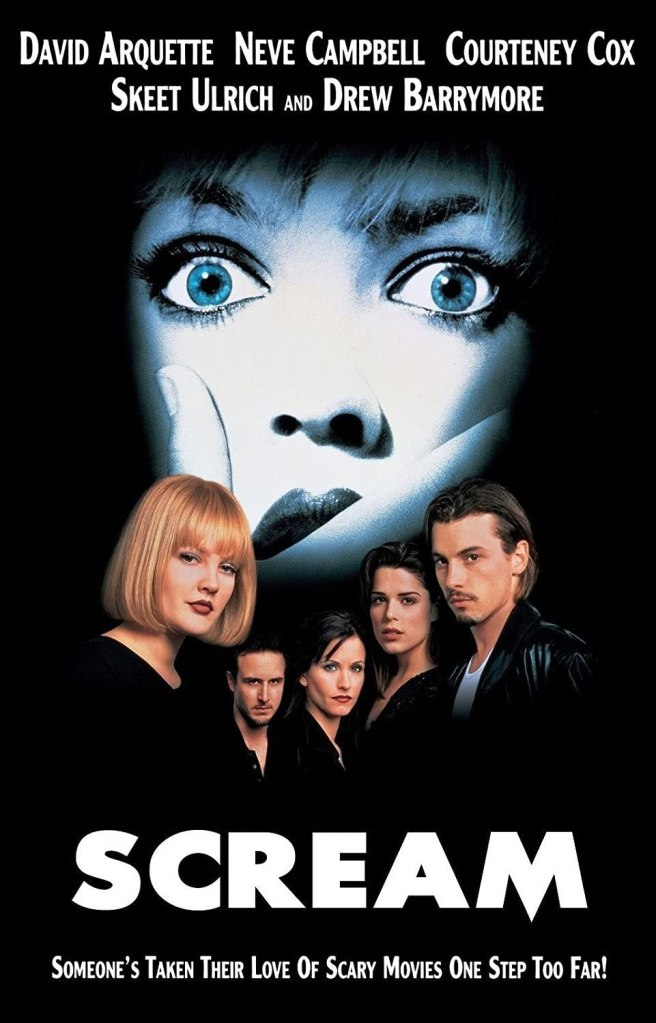
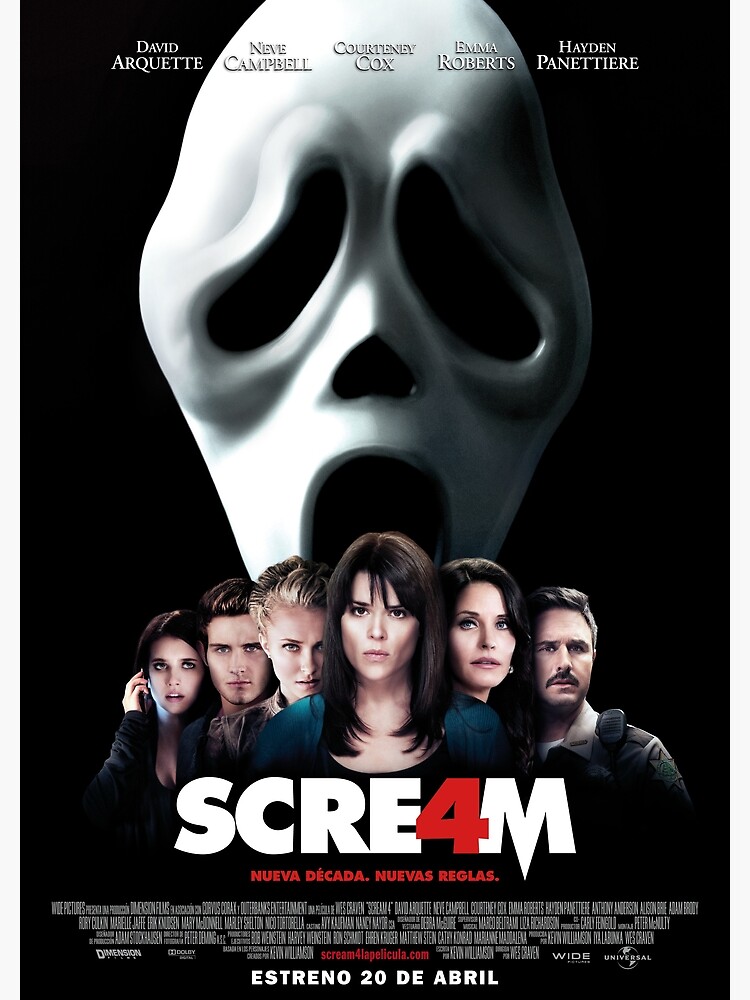
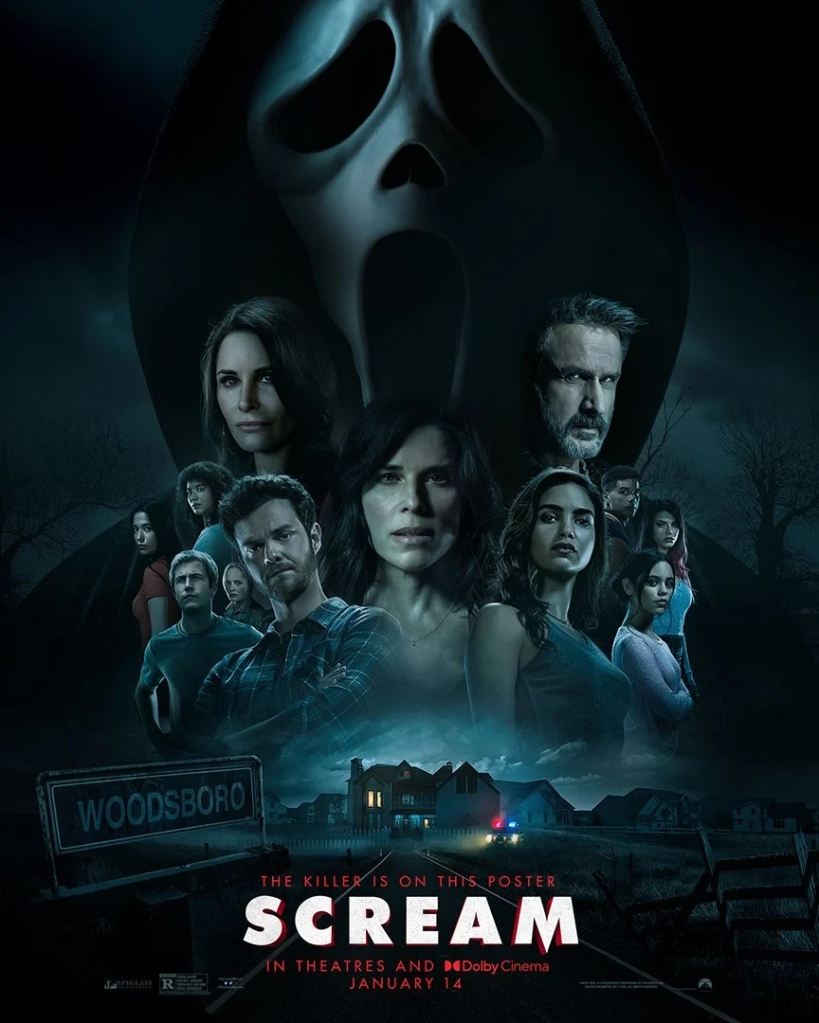
The biggest of the film’s flaws—beyond how little our legacy characters get to do and how late some of them appear in the screenplay (Gale doesn’t appear in person until nearly an hour in)—is that there are simply too many characters, and you can even see it in the poster. Consider the poster for the first Scream, which had five characters in total, including the three we would come to know as our principal characters in this series, but hyping up the appearance of Drew Barrymore, whose pre-titles murder is still the franchise’s defining moment. Then came Scream 2, which likewise limited its poster to five characters: the core three, Sidney’s new boyfriend, and (once again) the decoy lead who is killed off in the film’s opening. Scream 3‘s poster followed this trend with five characters, and then Scream 4 featured the first cast expansion to feature six: the three leads, and the would-be new Sidney, her boyfriend, and the new Randy Meeks. But the poster for this one has a full dozen people on it, and it’s just too many. 

I don’t want to be the one to complain that Kyle Gallner is here, since he was in both one of the most original horrors of the aughts and the most derivative remake of the same relevant time period (Jennifer’s Body and the remake of Nightmare on Elm Street, respectively), so he feels like a genre acknowledgement that belongs here; but he’s also the most frivolous presence, existing only to provide cannon fodder for Ghostface and cement the theory that the killers are targeting people connected to the original killings when it’s revealed that he’s the son of Stu’s (I believe) heretofore unmentioned sister. When Dewey recounts “three attacks” at the 30-minute mark, I legitimately turned to my friend and asked if there was an assault I was forgetting other than Tara’s attack and “the one at the hospital,” and had to be reminded that he had been there at all. Liv’s also the worst kind of red herring, in that though it’s true that she always seems to be conveniently elsewhere when a killing occurs, she also is such a non-presence that when she’s not on screen; you forget that she exists. It is a bit of a narrative catch-22, though, since there need to be killings of people outside of this friend group to provide clues about the killer’s selection process, but if you change the story a bit and have, for instance, Dewey gathering potential victims who aren’t as familiar with one another to protect them from Ghostface, then you kinda lose the friend group Screamness of it all. And, despite all of that, the first two people I first and most immediately suspected, which is both satisfying and a little deflating. 

It may seem like I have a lot of complaints, but I actually thoroughly enjoyed this one. It vaults over Scream 3 handily and lands just behind Scream 4 in the rankings. The reinvention here may actually be mpre clever, but it doesn’t feel as clever. The opening of Scream 4 alone was a fun, bizarre ride that really shook things up to the point where you weren’t really sure what the rules were anymore. The motive of the killings is fantastic; we learn early on that the previous year saw the release of Stab, which is actually Stab 8 (get it?), and that fans hated it—and from what little of it we see, with good reason. Stab has become a cultural phenomenon in Scream‘s world, and that world has now entered the era of The Snyder Cut, wherein groups of fanboys feel that the media belongs to them, so they want to course correct back to the “original concept” by enacting a new series of murders in Woodsboro to inspire the Stab franchise to return to its roots. It’s not as clever as “movies made us do it,” but it’s just as cohesive, and allows for one of the killers to deliver great lines like “How can fandom be toxic?” while holding a bloody knife.

-Mark “Boomer” Redmond

Barking Dogs Never Bite (2000)

I was a late joiner to the Bong Joon-ho fan club. I didn’t see any of his films prior to the US release of Snowpiercer (which ended up being Swampflix’s very first pick for Movie of the Year), and I shamefully still—all these years later—have not doubled back to catch up with his early catalog.  Now that the runaway success of Parasite has made him an Oscar-certified sweetheart of the industry, Bong’s early films are easier to access than ever, so I have few remaining excuses to cover those blind spots.  It took nine long years for his debut feature, Barking Dogs Never Bite, to land proper American distribution, but now it’s just sitting right there on Hulu waiting to make you laugh & squirm along with the director’s other darkly funny genre pranks.  It obviously doesn’t match the budgetary scale of the eye-popping spectacles Bong would later deliver in films like Okja, Snowpiercer, and The Host, but it’s just as worthy of a post-Oscars re-evaluation of his decades-long career.  If nothing else, it’s good to be reminded that the adorable man who became a meme by making his Oscars statues kiss also has a deeply fucked up, vicious sense of humor.

Barking Dogs Never Bite feels like Bong Joon-ho’s version of the post-Clerks slacker comedy, complete with a couple of listless corner store clerks among its cast of downtrodden losers.  Gen-X apathy & ennui weighs heavy on its central players, a loose collection of near-destitute tenants of a multi-tiered apartment complex, barely earning enough through their entry-level jobs to feed themselves.  The title refers to the violent hijinks of an out-of-work academic whose peaceful days lounging around the apartment (which his pregnant wife pays for) are interrupted by a neighbor’s small, yipping dog.  The absolute worm of a man takes his frustrations over his stalled career out on various small dogs throughout the building, murdering them in an effort to quiet his own mind.  These outbursts of animal cruelty catch the eye of an anonymous notary who lives nearby, daydreaming about earning celebrity through heroic acts of vigilantism.  As the would-be vigilante tracks down the pathetic dog killer, the small minds & embarrassments of their daily routines pile up in an increasingly absurd tangling of their lives, somehow amounting to a pitch-black hangout comedy instead of a low-budget crime thriller.  It’s the exact kind of ironic slice-of-life slacker tale you’d expect to see at a film festival in the 1990s, except with a much sharper eye for visual gags & splendor than what you’d typically expect from movies on its budget level.

Bong’s debut is hilarious but vicious, which feels consistent with everything he’s done since.  Even so, violence against dogs is one of the few remaining taboos that make audiences squeamish, so it still cuts deep. It’s the kind of movie that’s almost pointless to log on the content-warning database Does the Dog Die?, as its entire purpose is to mash that exact taboo button.  The dogs that are killed are cute & pathetic.  Their murderer waits maybe a scene & a half before deciding to violently shut them up, not even suffering the expected montage where they annoy him for days on end until he snaps.  Even as someone with a high tolerance for shocking art, I was thankful that the film opened with an obligatory “No animals were harmed” title card instead of saving it for the end credits.  Still, I don’t know that I ever fully believed it, as whatever puppetry, camera trickery, or hidden harness support they used to depict the pups in peril was impressively convincing.  I was in love with Bong’s playful camera set-ups, non sequitur ghost stories, sped-up Benny Hill chase sequences, and onslaughts of discordant jazz, but I can’t claim that the puppy violence didn’t upset me.  It’s supposed to be upsetting, because Bong Joon-ho is a sick fuck, which is easy to forget as he’s become something of a Film Twitter mascot.

I remember there being a lot of memes at the expense of Chris Evans delivering the teary line “Babies taste best” in Snowpiercer, as if it were funny by accident.  I always found that mockery to be odd, as that moment didn’t feel especially over-the-top to me, at least not relative to every other batshit crazy thing that happens in that movie.  Having now seen Bong Joon-ho’s debut feature—a feel-bad hangout comedy about a series of dog murders—I’m even more convinced that the Snowpiercer memesters (likely just hungry to dunk on the limitations of Captain America’s acting talents) got it wrong.  Given Bong’s larger body of work, I believe that line was both intentionally funny and sincere.  It’s both a discomforting moment where a man deals with the guilt of surviving on the nourishment of baby-meat and a darkly humorous punchline that underlines just how depraved the film’s trainbound universe has gotten.  I’ve now seen Bong apply that exact discomforting humor to the onscreen death of puppies, so why not the off-screen death of babies? Lots to think about there, lots to consider.

-Brandon Ledet

Doppelgänger (2003)

There’s something bittersweet about the early-2000s boom of Japanese & Korean horror films that were imported to the United States through home video labels like Tartan Asia Extreme.  On the one hand, it’s wonderful that daring, genre-blurring films like Suicide Club & A Tale of Two Sisters were able to find an audience outside of their respective home countries.  On the other hand, those films’ American marketing often perpetuated a reductive, borderline-Orientalist perception of that era in East Asian genre filmmaking as the most “extreme, “fucked-up”, “incredibly strange” movies ever made – as if every film were a variation on the torturous Guinea Pig series.  It was a very profitable perception for Tartan, I bet, but I’m not convinced it was an entirely healthy one for the filmmakers they were platforming (not to mention other filmmakers from the region who were working in entirely different modes of cinematic storytelling at the time).  I don’t want to complain too much about the way those home video releases were marketed to Americans, though, since those vintage DVD scans are still the only commercially available copies of a lot of those films in the US two decades later.  At least they found a path to our eyeballs, imperfect as it was.

I wonder how much the commercial pressures of “extreme J-horror” marketability influenced the production of the 2003 sci-fi comedy Doppelgänger.  Director Kiyoshi Kurosawa earned international acclaim among genre fans making that exact kind of Ringu-era J-horror exports (Cure, Pulse, Seance, etc.), but with Doppelgänger you can feel him striving to branch out into other modes of storytelling.  He sets the film up as a J-horror update to Jekyll & Hyde in its first act (which landed it an American DVD release on the Tartan Asia Extreme label), but it’s a much sillier film than that early tone implies.  Doppelgänger delivers the vicious violence that contemporary American audiences had come to expect from “extreme” Japanese horror cinema, but the further it goes along the more it strays into broad slapstick comedy, gradually escalating to ZAZ-level buffoonery in its final act (including an Indiana Jones spoof involving a boulder-sized disco ball).  It’s a darkly funny film, where most of the punchlines are people’s skulls being cracked with the anticlimactic thud of a hammer.  Still, it feels like Kurosawa only establishes an eerie sci-fi mood in the opening stretch so he could get away with goofing off once all the usual J-horror boxes were checked.  

One reason it’s so tempting to speculate about Kiyoshi Kurosawa’s frustrations with market expectations is that the protagonist of Doppelgänger is also intensely frustrated by his corporate overlords.  Kōji Yakusho stars as a meek research scientist who’s developing a kind of mech-suit wheelchair for the physically disabled, providing mechanical arms for paralytics.  The profit-obsessed higher-ups at his lab’s parent company continually undermine his careful research, forcing him to conform to unrealistic deadlines that threaten to corrupt the project.  This immense corporate pressure coincides with the arrival of the scientist’s doppelgänger (also played by Kōji Yakusho), whose brash, macho confidence creates an exponentially violent competition with the kinder, original scientist.  This is the story of a creative genius driven insane by small-minded money men, eventually abandoning his scientific pursuits altogether to instead engage in a pointless war with his own psyche.  It concludes with a go-nowhere road trip into total delirium, chasing down a deliberately pointless flavor of comedic absurdism rarely seen outside a Quentin Dupieux film.  By the end, Kurosawa is basically just goofing off, whether or not horror-hungry audiences were still along for the ride.

Two decades after its initial release, the biggest hurdle to enjoying Doppelgänger isn’t so much its reluctance to deliver the “extreme” J-horror goods; it’s the film’s early-2000s digi cinematography, which makes it look like cheap TV instead of proper cinema.  Even when it’s playing with spooky sci-fi ideas in its early stretch, the film lacks any of the throat-hold atmospheric dread that makes Kurosawa’s actual horror films so intense.  That disinterest in establishing an eerie mood is only amplified by the outdated SD scans of the film that are available on DVD & streaming services, to the point where even its indulgences in De Palma-style split screens feel like music video fuckery instead of genuine experiments in form.  All that flatness in tone stops mattering once the film reveals its true nature as a farcical comedy, though, starting with the macho doppelgänger copying his source-human’s café order one table over just to fuck with him and quickly escalating to a series of deadpan murders with a hastily wielded hammer.  I could see a lot of Western audiences having the exact opposite experience in the aughts, though, popping in a Tartan Asia Extreme DVD and enjoying the early spooky goings-on, only to be baffled by the goofball pranks that followed. 

-Brandon Ledet

I’m Your Man (2021)

I’m not convinced that Dan Stevens ever fully achieved the movie star dream career he abruptly left Downton Abbey to pursue.  Between his career-defining run on that glorified soap opera and the Disney Prince paycheck he cashed after the live-action Beauty and the Beast remake, he’s probably financially set for life.  I get the sense that he’s still not creatively fulfilled, though.  After a strong start in the weirdo action thrillers The Guest and Legion, he’s mostly been doing anonymous, supporting work that doesn’t draw much attention to his movie-star potential as a leading man.  The German sci-fi romcom I’m Your Man is a welcome corrective step in that treadmill career trajectory.  In the film, Stevens stars as a perfectly calibrated robot boyfriend, a role that emphasizes both his generic handsomeness and his eerie, inhuman coldness.  Instead of running away from his default perception as a dime-a-dozen Ken Doll hunk (the exact reason Stevens fled from Downton Abbey as soon as he could), I’m Your Man leans hard into that quality, pressing both on its charms and its limitations.  It’s a perfect encapsulation of what makes him unique as a screen presence, which is something he doesn’t always get to showcase.

In I’m Your Man, robo-Dan Stevens is beta-tested by a recently divorced research scientist (Maren Eggert), who is reluctant to treat him like a potential A.I. life partner instead of a household appliance.  She reluctantly agrees to the study in a bargain that will land her own academic research future funding opportunities but finds the implication that a robot boyfriend would fulfill an emotional need in her life insulting.  Initially annoyed by his machinelike perfection and his servantile attention to her every need, she gradually learns to love the walking, talking dildo despite herself.  Their dynamic feels like a broadcast from a slightly brighter world where heartfelt romcoms get to tackle heady subjects usually reserved for eerie sci-fi chillers like Ex Machina.  It’s a very familiar Turing Test story structure that’s not usually played with such a lightness in its doomed human-robot romance.  It balances its romcom cuteness with just enough melancholy & heartbreak to feel sophisticated, but not enough to match the dramatic despair of much drearier sci-fi romances like Her and Never Let Me Go.  Like robo-Dan Stevens, it’s perfectly calibrated for what it is, with all the charms & limitations implied.

If there’s some larger topical or philosophical statement I’m Your Man is trying to make about humanity’s evolving relationship with technology, I’m not able to fully pinpoint it.  It romanticizes the shortcomings & imperfections that distinguish humans from machinery (most starkly in a slow-motion montage of “Epic Fail” YouTube clips).  At the same time, it’s also honest about how comforting & safe it feels to interact with machines instead of our fellow fuck-ups (maybe as subtle commentary on the distinctly modern isolation of smartphone addiction).  I don’t know that it makes any grand, definitive statements about human nature or technological comforts, though.  It instead gently pokes at the boundaries between the natural & the artificial, finding odd moments of peace & romance in their overlap.  For me, the movie’s clearest purpose is in highlighting the eerie charms of Dan Stevens as a screen presence, finding his exact sweet spot as a potential leading man.  Otherwise, it’s just an above-average romcom with a fun sci-fi spin.

-Brandon Ledet