
R100 (2015)

EPSON MFP image

threehalfstar

campstamp
Late in the run time of the surreally campy BDSM comedy R100, the film addresses the audience directly by suggesting that, “People won’t understand this film until they’re 100 years old.” Even that timeline may be a little too optimistic. Directed by Hitoshi Matsumoto, the juvenile prankster who brought the world the cartoonish excess of Big Man Japan & Symbol, R100 initially pretends to be something it most definitely is not: understated. The first forty minutes of the film are a visually muted, noir-like erotic thriller with a dully comic sadness to its protagonists’ depression & persecution. It’s around the halfway mark where the film goes entirely off the rails genre-wise, dabbling in tones that range from spy movies to mockumentaries to old-school ZAZ spoofs. It’s doubtful that even 100 years on Earth will give you enough information to make sense out of that mess.

Although the first half of R100 is more toned down than the second, it’s still off to a fairly bizarre start. The film’s protagonist, a mild-mannered mattress salesman grieving over his comatose wife, seeks solace in an unusual BDSM club. Instead of subbing for a dominatrix on the club’s parameters, he signs a contract that allows its stable of dominant women to appear in his personal life, beating him mercilessly in public without warning. He initially gets off on the tension of not knowing when a dominatrix will appear to beat him, but as they begin to surface at his job, his home, and (worst of all) his wife’s hospital room, he attempts to desperately cancel the contract. Of course, the club is not interested in cancellations. This is a world without safe words, a world where a dominatrix believes, “When perverts beg for mercy that means they’re begging for more.” In other words, it initially plays like an erotic novel, not far from the plot machinations of Gary Marshall’s BDSM comedy Exit to Eden. It’s far more akin to fantasy than real life and the incongruity of the public beatings with the mundanity of the modern world is played for a subtly comic effect (and, eventually, for an effect that is anything but subtle).

There’s plenty of bizarre visual touches to this first half that suggest the weirdness that comes later: a carousel of dominatrix women floating in a void, brain wave halos of pleasure, leather clad doms galloping like gazelles, etc. There’s also the more surreal ways the protagonist submits, like when a dominatrix violently, repetitively smashes his sushi flat with her palm while he eats or when another covers him in gallons of saliva (which has got to be one of the most disgusting scenes I’ve ever encountered, or at least since Wetlands). At one point a character astutely compares the over-the-top theatricality of pro wrestling to kink play and in the ways kink is portrayed in R100 it feels more truthful than ever. However, even those cartoonish play sessions are ill preparation to the unhinged silliness that follows.

In some ways, the first half of R100 is an objectively better film, as it reins in its more absurd tendencies for the narrative’s benefit. Its premise would most likely fall flat as a straightforward film, though, so it’s not particularly a problem that it abandons its tone & genre for more outlandish territory. As long as you’re prepared to roll with the sharp left turn the film takes halfway through (especially if you’ve seen a Hitoshi Matsumoto film before), you’re likely to have fun with R100. It’s an oddball film that refuses to behave in a traditionally oddball way, seemingly shifting gears at a whim with no concern for the audience. When you sign up to watch R100, it’s like signing a contract that for the next two hours you’ll be in its capable, dominant hands, ready to submit to every command & goofy impulse it can muster before the contract runs out. As long as you don’t mind handing that freedom over and don’t become too attached to the early tone, you might experience some pleasure halos of your own.

-Brandon Ledet

Fan Art: Giallo Poetry

EPSON MFP image

As I mentioned in last week’s article on April’s Movie of the Month, Mario Bava’s Blood and Black Lace, there’s a finesse to gaillo movie titles that was somewhat lacking in the genre’s Bollywood equivalent Veerana (a title that roughly translates to “Creepy Forrest”). The giallo title is a beautiful, needlessly complicated art form that requires at least six or seven syllables to properly breathe. As the genre’s pioneer, Mario Bava was prescient in many ways and the beauty of his films’ titles is certainly among them. There’s no denying the inherent draw of movies with names like Blood and Black Lace, The Body and the Whip, Planet of the Vampires, and Knives of the Avenger. That’s not to say that longer, more complicated titles always indicate higher quality giallo movies. My favorite films by Dario Argento are Opera & Suspiria, not Four Flies on Grey Velvet & The Bird with the Crystal Plumage. There’s just an undeniable poetry & sense of one-upsmanship with the more complicated titles that feel unique to the genre.

Keeping the poetry of these titles in mind, I attempted compile a poem composed almost entirely of titles of giallo films I have never seen, but admire for their names alone. I have added a few words here or there to make some sort of sense out of madness, but most of the words are drawn directly from the titles in the sequence they appear. Enjoy!

Giallo Poetry

Your vice is a locked room
and only I have the key. We kill
the fatted calf and roast it in the black
belly of the tarantula, my sweet. So perverse, my lizard
in a woman’s skin. Strip nude for your killer. Bring
a hatchet for the honeymoon, a dragonfly
for each corpse, a black veil for Lisa.

The bloodsucker leads the dance
in the house of the yellow carpet. Death walks
on high heels in the house with laughing
windows. The Devil has seven faces, seven blood
stained orchids. The flower with the petals of steel, the twitch
of the death nerve, forbidden photos of a lady above suspicion.

The night Evelyn came out of the grave, the young,
the evil and the savage committed the crimes of the black
cat. It was on the short night of the glass dolls, five dolls
for an august moon. The weapon, the hour, and the motive
cast a bloodstained shadow on all the colors of the dark.
The case of the bloody iris was cracked by the perfume
of the lady in black, who asked that we don’t torture

a duckling. Can I get you anything, my nine
guests for a crime, my iguana with the tongue
of fire, my man with icy eyes? No thanks,
coffee makes me nervous. Now smile
before death & watch me when I kill. Naked,
you die, reflections in black, nothing
underneath. The killer reserved nine seats.

For more on April’s Movie of the Month, 1964’s Blood and Black Lace, visit our Swampchat on the film & last week’s article on its Bollywood brethren, Veerana (1988).

-Brandon Ledet

The Devil’s Rain (1975)

EPSON MFP image

three star
campstamp

I was lead to The Devil’s Rain by a peculiar image featured in the recent Scientology documentary Going Clear: John Travolta’s young, eyeless, melting, goop-hemorrhaging face. The film was cited there as an example of Travolta’s immediate success in landing roles as a young actor, his earliest minor part in a feature-length film. It turns out that Travolta is not actually in The Devil’s Rain for all that long. Bleeding green goop out of his eyeless skull is essentially the extent of Travolta’s role, but there were plenty of other names of interest attached to the project as well: William Shatner, Ernest Borgnine, Tom Skerritt, and the director of The Abominable Dr. Phibes, Robert Feust. Despite all these recognizable Hollywood personalities, however, the most notable contributor to the film was an occultist author & musician Anton LaVey.

Anton LaVey is credited in The Devil’s Rain as the Technical Advisor, a job he landed through his real life credentials as High Priest of the Church of Satan. As briefly mentioned in our Swampchat on former Movie of the Month The Masque of the Red Death, LaVey had achieved a sort of celebrity status by marketing Satanism (which more celebrates materialism & individualism than it does The Devil proper) to California hippies in the 1960s. He is credited as a “technical adviser” in The Devil’s Rain to give the film a sense of credibility, but the film’s Satanic rituals feel way more cartoonishly “Satanic” than what idealistic hippies were most likely up to in reality. The film features such clichéd (but totally rad looking) Satanic cultural markers as red hooded robes, voodoo dolls, stained glass pentagrams, and high priests with magically transformed goat heads. Its most ludicrous stab at credibility, however, is its insistence on saying “Satanus” instead of “Satan”, because I guess it sounds more authentic in Latin. I was lead to The Devil’s Rain by a documentary profiling one cult (of which to this day Travolta is still a member) and instead found the phony beginner’s version of another.

The Devil’s Rain’s most punishing flaw is in its glacially slow pacing. a fault mostly due to a downplayed score and a meandering plot. Although the Satanic imagery is fun to gawk at, the movie does get frustrating in its refusal to be in a rush to entertain you. However, if you yourself are not in a particular rush, it’s an interesting lazy afternoon viewing experience in which goat people worship Satanus and get their heads melted (a young Travolta included), their bubbling skin oozing a disgusting green. The Devil’s Rain is a memorable film through the campy virtue of its oddball cast and the legitimate strengths of its Satanic imagery alone. Anton LaVey may not have provided the film with a feel of Satanic authenticity or saved it from its own miserable pacing, but he did afford it enough memorable images to make it worthwhile for a casual cult film fan who isn’t in any particular rush to be wowed.

-Brandon Ledet

Alien Outpost (2015)

EPSON MFP image

onehalfstar

campstamp

There’s a pretty significant lie in the title of Alien Outpost. It’s the false promise that there might actually be some aliens in the film from time to time. If you wanted to attempt some truth in advertising a more appropriate title would be Dickhole Soldier Outpost or Operation: Naptime. Posed as a sub-Blomkamp “documentary” about the militaristic consequences of a near-future alien invasion, Alien Outpost has the feel of a warfare video game that features way too many thoroughly unlikeable soldier bullies idling their time and not nearly enough aliens brutally murdering them. It’s what I imagine Battlefield Earth would be like if you spent most of the runtime with the rat-brained man animals and Travolta only had a small cameo.

The aliens in question (known as “heavies” here), aren’t particularly interesting (especially in light of that Battlefield Earth Psychlo comparison), but they’re far and away the most entertaining element in a film where entertainment is in short supply. They’re tall, grey, humanoids who are running desperately low on laser “ammo” and are being hunted by American soldiers in a Middle Eastern outpost that I’m sure is supposed to call up metaphorical comparisons to the Iraqi occupation or something along those lines. Both that metaphor and the general nature of “the heavies” remain frustratingly undefined as the film focuses on the endangered, yet trivial lives of the soldiers stationed at Outpost 37. As the movie puts it, “This is the story of the men fighting a war the world has chosen to forget.” Unfortunately, the men mentioned there (and, by extension, the movie that surrounds them) is just as forgettable as the war. More of the grey, ill-defined “heavies” would be a blessing compared to what’s actually delivered.

The Blomkamp documentary format is a lot of what’s wrong with the film on a structural level, as it tends to tell instead of show (like showing more aliens for instance). However, its main fault is that none of its ideas are well-developed enough to be memorable. The only moment that suggests an intricate exploration of its world is when a soldier is temporarily paralyzed by a bite from a “numb bug”, an invasive species of insect that infested Earth after hitching a ride here with the “heavies”. More original ideas specific to this world like the numb bugs would be appreciated, but are few & far between. The film instead focuses on far-from-compelling soldier dicks when it should find more of a fascination with the alien beasts that are trying to kill them. There’s nothing particularly new about the soldiers or the heavies compared to other sci-fi action flicks, but at least a movie focusing on the heavies would have a much better chance of being entertaining.

-Brandon Ledet

Going Clear: Scientology and the Prison of Belief (2015)

EPSON MFP image

threehalfstar

The only reason the likes of the recent HBO documentary Going Clear have not been released before (or at least not with this large of a budget) is because it’s an endeavor that requires a certain amount of bravery. Its subject, the (secretive, abusive, and dare I say cult-like) “religious” organization The Church of Scientology, is infamous for its bullying tactics when counteracting its vocal critics, almost to the point where I’m nervous to praise a film that attacks it even on this site, the most inconsequential of all blogs. Almost. Going Clear took a lot of guts to make, just like it took a lot of guts to write the book it was based on and it took a lot of guts for former church members to speak out in its interviews. It has the feeling of a long time coming for a subject so flagrantly nefarious in the public eye, but it’s also completely understandable why it took so long for a major outlet to speak out against it in this way.

Directed by prolific documentarian Alex Gibney, Going Clear does an excellent job of gradually introducing the audience to the insane world of Scientology’s beliefs & practices the same way the organization is known to gradually accustom its own members. The film mimics the form of an “audit” (a combination of a therapy session & a taped confession), a practice that plays a major role in Scientology’s recruitment process. At first the ideas of discharging hurtful memories and basic meditation through audits sound like reasonable forms of therapy and personal improvement. Also, the organization’s basic goals of freeing the Earth from insanity & criminality seem fairly admirable on the surface. As the film digs deeper, however, it starts to reveal a much stranger set of promises: superpowers that allow members to “transcend all perameters” & “achieve godspeed”, scientific instruments that can weigh the mass of your thoughts, billion year contracts to “save the world” (through indentured servitude, of course), and the quest to “unhypnotize” man. That’s not even getting into the more out-there concepts of prison planets & galactic overlords. If Gibney had introduced these details in the opening minutes (much like if Scientology introduced them in their initial recruitment efforts) they’d feel somewhat unbelievable, but by the time you get to them in the film they feel both very real and very much terrifying.

One of the tactics Going Clear employs very well is allowing the founder of it subject, deceased sci-fi writer L. Ron Hubbard, to speak for himself. Hubbard spent a large part of his adult life avoiding charges of tax fraud, so it is rare that you actually get to hear him talk about the monster he created. Footage from at least two separate interviews are assembled here to allow him to speak directly on Scientology’s core beliefs (as well as less savory topics like “the primitive races, including the white race”). As portrayed here, Hubbard was an abusive husband, a former Satanic occultist, a paranoid dissenter of traditional modes of mental health, and a prolific writer of pulp fiction. Initially, he conceived Scientology as a means of making money, quoted here telling his wife “The only way to make any real money is to have a religion”. A religion, of course, would afford Hubbard a tax exempt status that would allow him to hoard his earnings. As his personal health deteriorated, however, he began to believe his own teachings (concepts mostly cobbled together from the plots of pulp sci-fi novels he had written before his religious pursuit). To Hubbard’s credit, the modern monster that Scientology has become does not seem exactly like a devious, well-thought-out exploitation scheme, but rather the musings of a very sick man that were twisted even further after his death by power-hungry members of the church, especially the current leader David Miscavige.

This history lesson in this first half of Going Clear was much more interesting than what I would describe as the celebrity gossip second half. While explaining the basic teachings of the church, the film employs a fascinating type of visual collage that feels transcendent of its basic documentary format. Once the film delves into the modern era, which is mostly contingent on the involvement of Hollywood celebrities Tom Cruise & John Travolta, it loses a little steam as an unique work, depending mostly upon the church’s Dianetics recruitment videos for much of its visual charms. That’s not to say Tavolta & Cruise’s involvement are not inherently fascinating. When they first appear on the screen Travolta is dressed in soldier’s fatigues (on a movie set) and Cruise is wearing an oversized medallion (the “Freedom Medal of Valor”, as it were), two costume choices with enough bizarre energy on their own to make the millionaire weirdos’ presence interesting. It’s just that the back half of the film feels less special than the first, like it is something that anyone curious enough to watch a Scientology profile on YouTube could’ve encountered before.

As a whole, however, Going Clear is a fascinating look into the lives of people who have left the church as they look back upon the thetans, e-meters, out of body experiences, and Xenus that populated their troubled pasts. It may lose a little visual flair as it narrows its focus on Travolta & Cruise, but their inclusion is necessary as it calls into question the idea that as long as you give the church all of your money they can make anything possible. Is there an element of blackmail that maintains their involvement in Scientology or is does that “Next stop: infinity” slogan hold more weight than you would expect? Given the abusive, conniving practices of the church laid out here (not to mention basic laws of science & physics), it feels a lot more likely that it’s the former rather than the latter, but Scientology is such a strange, insular, shrouded entity that anything feels possible . . . as long as you give them all of your money.

-Brandon Ledet

Lost River (2015)

EPSON MFP image

threehalfstar

Sometimes it’s gotta suck to be Ryan Gosling. Not often, but sometimes. Everything sucks sometimes, right? I’m sure being a talented actor & a beautiful human specimen is mostly all perks, but what if no one takes you seriously when you try to let loose the weirdo artist lurking under your perfect skin? Finalizing his gradual transition from pint-sized Mouseketeer to big boy artist, Gosling recently stepped behind the camera to write & direct his debut feature, Lost River. Critically-speaking, it didn’t go well. The film was panned on the festival circuit as “derivative” “poverty porn” and lost its wide distribution detail in the process, eventually being damned to direct-to-VOD status. Gosling’s first outing as a creator instead of a performer failed to secure accolades and the talented sex beast was left having an uncharacteristically bad day in the sun. The dirty secret is that Lost River is actually pretty damn good for a debut feature. It’s far from flawless, but there’s very little justification for the vicious critical beating it received on the festival circuit. If the film were directed by a fresh-out-of-film-school nobody it most likely would’ve had a better chance in the critical eye. For once it didn’t pay to be for Ryan Gosling to be a wealthy, well-known pretty boy.

Both the “derivative” & “poverty porn” complaints feel somewhat like they were aimed specifically at Gosling’s pretty boy swag instead of his final product. The claim that the film is “derivative” is technically true, but not really a problem considering the sources Gosling pulls from here. Names like Lynch, Bava, Korine, Mallick, and Refn are sure to be conjured by any discerning audience, but what film buff wouldn’t love pieces of those five aesthetics gathered in one neon-soaked, dilapidated package? Speaking of dilapidated, the film may also technically substantiate that “poverty porn” critique, as it pulls beautiful images out of economic despair, turning what remains of Detroit into a ludicrous dream world. I also see this complaint as more of an asset than a problem, especially considering how the images tie into the film’s thematic details (foreclosed houses, stealing copper from blighted properties, etc.). Also, it’s an aesthetic that’s worked wonders before in titles like George Washington, Gummo, and Beasts of the Southern Wild.

The one legitimate qualm I found with Lost River is that it is poorly paced. There’s a calm, unrushed progression to the movie that plays right into the stereotype that art films have to be boring to be taken seriously. At least while the run time is glacially gliding along, there are plenty of worthwhile images to chew on: flaming bicycles, pink neon lights, glistening Casio keyboards, underwater dinosaur statues, slow-motion house fires, and so on. That’s not even getting into horror legend Barbara Steele’s hermetic mourning or fellow-perfect-specimen Christina Hendricks’ Tree of Life cosplay & blood-soaked burlesque. These images appear slowly, but each with great individual impact, backed by the sleek nightmare sounds of Chromatics genius Johnny Jewel. They’re definitely a sight to behold and it’s a sight I expect to revisit often, even if they do work better as still images than as a feature film. Gosling most certainly has an eye and once he tightens aspects like pacing & narrative, he has untold potential to make something truly great. I just hope that he hasn’t been discouraged from making more films by the negative reception his debut garnered. Lost River may not be a perfect work, but it does demonstrate a wealth of promise and it’d be a shame if that promise were snuffed out in its infancy by sourpuss critics.

-Brandon Ledet

French Quarter (Film) Festival 2015

EPSON MFP image

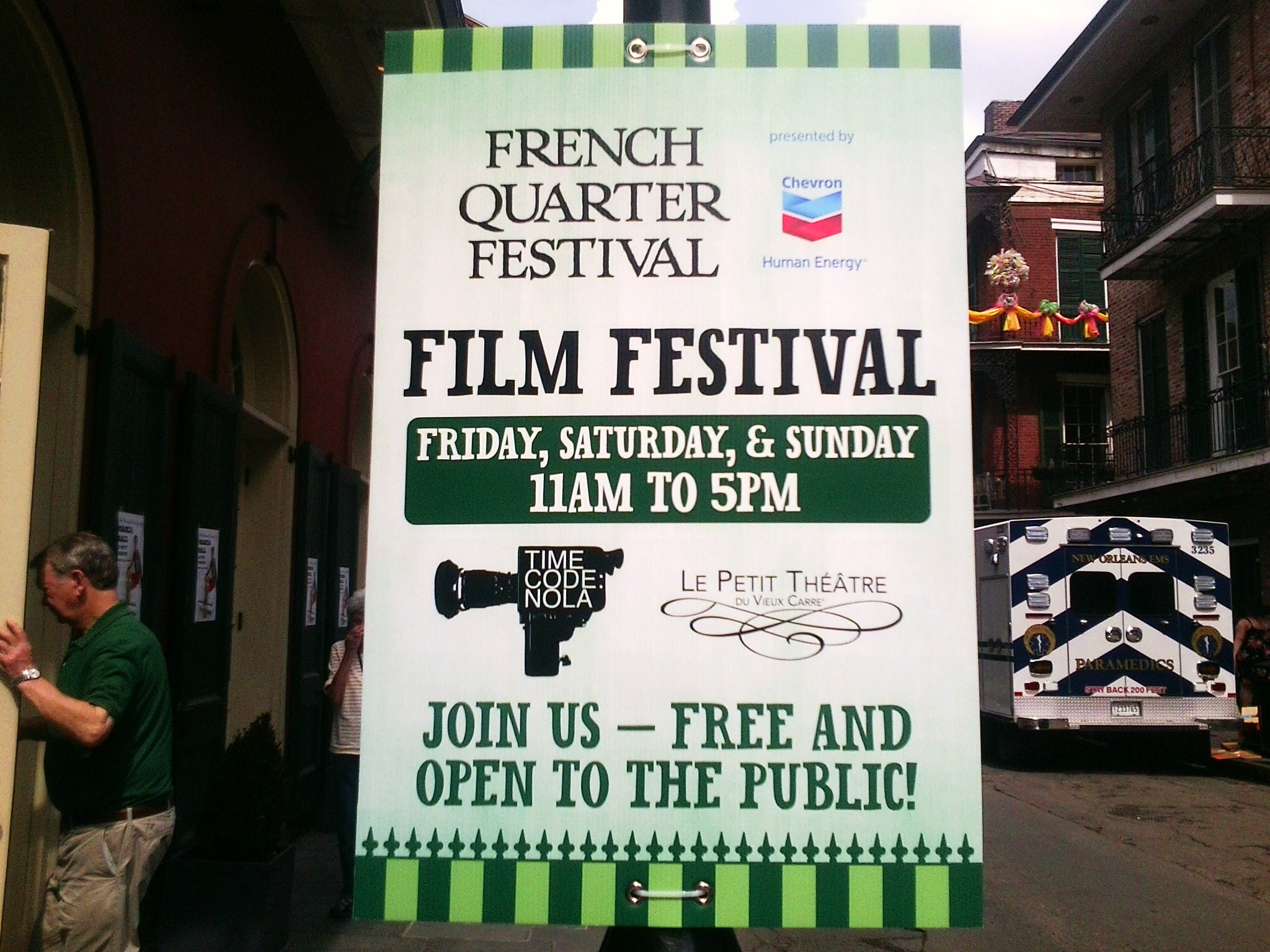
It’s usually around Mardi Gras when the city wakes up from its winter slumber, suddenly coming to life after months of hibernation. Tourists start to arrive in town to drink in the streets & enjoy the sunshine while their friends & loved ones freeze in the snow back home. Locals stop acting like total babies about what passes for “the cold” down here and venture at least as far as their front porches to enjoy the second lines & boiled crawfish. Mardi Gras is only the start to this Spring awakening, however, and the spirit to excess rolls right on into our festival season, which stretches on as long as it can before it’s too hot too drink gallons of beer in the daylight and visitors abandon us for the summer. Jazz Fest stands tall as the most obvious pinnacle of the season, but French Quarter Fest has recently been giving that juggernaut a run for its money. What used to essentially be “Jazz Fest for Locals” is now ballooning to be its own feature attraction, drawing thousands downtown for deliciously cheap local food & free music. To my recent discovery & surprise, it also features a free film festival.

I’ve been to French Quarter Fest a few times over the years, but this year was the first I’d ever heard of a film festival accompanying the better advertised attractions of food, drink, and local brass. Located just outside Jacskon Square at Le Petit Theatre, a venue that traditionally stages live drama, the film festival is a cocoon-like respite in the center of madness, the eye of a drunken storm. After wandering from stage to stage, drinking like a madman & downing hot sauce-soaked poboys in the heat (and unfortunately this year, the rain) it’s difficult to describe just how much of a relief it was to sit in a darkened, air conditioned room and watch movies. Presented by the folks behind Timecode: NOLA, the offerings at the French Quarter Film Fest are a well-curated group of documentaries seemingly selected to make the city look good for visitors. It featured several documentaries I had never seen before as well as ones I already know intimately, essentially upper crust of the kind of New Orleans-praising fare you’d expect to catch on late night PBS.

0410151108

I attempted to catch one film a day at the festival to get a decent sampling of its offerings, but my Friday afternoon plans got derailed when I coincidentally ran into a friend at a live performance on Royal Street and ended up missing the classic, doc Always for Pleasure. There pretty much is no substitution for the all-encompassing sampling of New Orleans culture in Always for Pleasure, but it’s a film I already know well (and one that’s currently available on Hulu), so I had no qualms with missing it for a chance to enjoy French Quarter Fest’s more traditional offerings of booze & live music. Actually, I feel like it was even more in the spirit of the movie to miss it. Filmed in the 1970s, the Criterion-approved Les Blank documentary truly is the best introduction to local culture that I could possibly imagine. Where else are you going to find soul legend Irma Thomas sharing her red beans & rice recipe and Allen Toussaint explaining the significance of jazz funerals & second lines. There’s also glimpses of crawfish boils, Mardi Gras Indians, St. Patty’s Day celebrations in the Irish Channel, and what essentially amounts to music videos for Wild Thcopitoulas & Professor Longhair. An interviewee in Always for Pleasure describes New Orleans as “The City that Care Forgot” & “The last city in American where you can feel free to live,” and the supporting images that surround those claims make it feel like he might be onto something.

On Saturday, I not only made it to the screening I wanted to catch; I desperately needed to. After sweating it out in the drunken, downtown masses, it was a life-saving sensation to watch the documentary He’s the Prettiest: A Salute to Big Chief Allison “Tootie” Montana’s 50 Years of Mardi Gras Indian Suiting. He’s the Prettiest obviously has a much more focused subject than Always for Pleasure, choosing to narrow in solely on a profile of Mardi Gras Indian Chief Tootie as he dressed for his final outing. Tootie is not only a significant chief because of his 50 consecutive years of suiting, but in the innovative artistry he brought to the practice. Instead of merely continuing the traditional Mardi Gras Indian beading he inherited, Tootie introduced the concept of 3-D designs to his suits, elevating the painstaking bead work to unparalleled levels of intricate design. He’s the Prettiest is less interested in the history of Mardi Gras Indian culture than it is providing a platform for Tootie’s work to shine. It’s essentially a moving art gallery for beautiful designs, a constant tribal soundtrack of thumping tambourines & rhythmic chants providing a rich texture for bead work that would already be dazzling in a silent, still image. It’s an important profile of a brilliant, unfortunately deceased artist whose work doesn’t receive as much formal fine art praise as it should.

On Sunday afternoon, once the rain died off, we caught the final film of the festival, Faubourg Tremé: The Untold Story of Black New Orleans. Initially conceived as a history lesson reviving a forgotten storyline in which New Orleans was a historical forerunner in racial equality & integration, providing then unheard of freedoms for people of color long before the 1960s Civil Rights movement (freedoms sadly poisoned by the years of Jim Crow), the documentary about the historic district of Faubourg Tremé was derailed by a little storm called Hurricane Katrina. The final third of the film captured a time I rarely care to revisit, a time in which most people couldn’t afford to return to the city they knew & loved and the ones that could struggled to piece their lives (and families) back together from the wreckage. It was an emotionally crippling note to end the festival on, but once I stepped back onto the city streets and watched a nameless group of ten-to-fifteen year olds playing traditional brass music draw a lively crowd outside the French Market (most likely the best set I saw all festival) I realized that Faubourg Tremé was for the most part a depressing story because it was an incomplete one. It captured the city’s incomprehensible lows (right down to the storm’s irrevocable psychological damage & a beyond troubled history of race relations), but did not have the time to capture the resiliency that brought the city back to life in the years following the broken levees. We all went through Hell to get here, but there’s plenty of our culture left to make the struggle worthwhile.

The couple of screenings I successfully made it to at this year’s French Quarter Film Festival were surprisingly well-attended, but also decidedly low-key. It seemed to be mostly older couples who, like my lame-ass self, needed a break from the external madness of drunken tourists and admittedly overpriced drinks (hey, at least they pay for the music). More importantly, the films selected had the kind of celebratory quality that gets you genuinely excited about your own city & culture in a heartfelt way, especially in the last minute acknowledgment that we’ve been through Hell together. There were plenty of opportunities for me to fall in love with New Orleans all over again at this year’s French Quarter Festival, like trying my first ever alcoholic snowball (which honestly wasn’t all that different from a daiquiri) or listening to any brass band you can name jamming outside the US Mint or overhearing a cop explain to a couple of passed out crust punks, “Look, if you want to sleep out here, you gotta do it by the river.” That sense of civic & cultural pride was surprisingly just as potent in the mid-afternoon darkness of Le Petit Theater as it was on the busy streets surrounding it; and it was just as simple as watching a couple of movies in the dark with a few strangers/neighbors.

-Brandon Ledet

What We Do in the Shadows (2015)

EPSON MFP image

fivestar

I had previously written on this site that the New Zealand vampire mockumentary What We Do in the Shadows was looking to crowdfund an American theatrical release, a campaign that was ultimately a success. I wrote that the movie “promises to take the same ennui employed by Only Lovers Left Alive into the satiric comedy territory of Vamps. Posed as a Christopher Guest-style mockumentary, the film follows modern day vampires as they navigate mundane activities like nightlife, dealing with roommates, and searching for a bite to eat. They clash with the likes of witches, zombies, werewolves, and plain-old humans in a loosely-plotted slice of (undead) life comedy. From the looks of the trailer, it could be quite funny as well as a fresh take on a genre I once thought hopelessly stale.” Having now actually seen What We Do in the Shadows, I am happy to report that the film not only met those expectations, but even greatly exceeded them. The most essential success of the film, however, was not what it had to add to the vampire genre, but just that it was simply riotously funny from start to finish.

Most of my favorite mockumentaries, titles like Best in Show & Drop Dead Gorgeous, aren’t necessarily well-told stories about personal growth and lessons learned. Instead, they’re more or less glimpses into the lives of already well-established characters as they prepare for a major life event, for instance a dog show or a beauty pageant. Staying true to that format, What We Do in the Shadows follows the lives of a small group of vampire roommates in the months leading up to their biggest annual celebration: The Unholy Masquerade, a grand party for the local undead. The Unholy Masquerade mostly serves as a climactic device that brings the film’s slowly boiling conflicts to a head, but what’s much more important is the characters that the “documentary” crew (who wear crucifixes for protection) follow in the months leading up to the event.

The film’s central vampire coven is a small crew consisting of an 18th century dandy, a torture-obsessed pervert, a 183 year old “young bad boy”, and an 8000 year old Nosferatu type named “Petyr”, who terrifies even his own undead flatmates. The group is mostly a collection of goofs, very much delusional in their outsized egos (a common trope in these Guest-style comedies), but also a true, formidable treat who fly, hypnotize, transform into bats & other creatures, and frequently murder unsuspecting victims with their incredibly sharp fangs. It’s a brilliant subject for an awkward comedy mostly concerned with trivial conflicts like a flatmate who doesn’t pull his weight on the chore wheel, the struggles of an active nightlife when you have to be formally invited into bars, meekly asking Petyr to sweep up the skeletons in his room, and struggling to adapt to the addition of a boisterous 5th roommate who shouts “I’m a vampire!” in public even more liberally than Nic Cage in Vampire’s Kiss. There’s some strange, ambitious concepts allowed by the film’s subject, like the existence of Hitler’s secret vampire army or depressed vampires wistfully watching footage of the sunrise on YouTube. It’s the clash of these ideas with the mundanity of modern life that make the film something special, like when one flatmate angrily shouts, “Just leave me to do my dark bidding on the internet!”

Co-writers/directors Jemaine Clement & Taika Waititi (of Flight of the Conchords fame) have crafted a thoroughly funny film here that I expect to revisit often. They have added a few updates to the mockumentary format, like the inclusion of some reality show beats, but for the most part the film is a very straightforward genre execution. It just also happens to be a very funny one. What We Do in the Shadows is as great as a vampire mockumentary could possibly be. An exceptionally funny comedy overstuffed with loveable, but deeply flawed characters (they are bloodthirsty murderers after all) and endlessly quotable zingers, it’s hard to imagine a more perfect, more rewatchable execution of its basic concept. In other words, it’s an instant classic.

-Brandon Ledet

Bava Goes Bollywood: Veerana (1988)

EPSON MFP image

There’s no denying the widespread influence Mari Bava has had on cinema, especially horror. Bava’s masterful 1964 crime thriller Blood & Black Lace, April’s Movie of the Month, has been credited as ground zero for not only giallo as a film gene, but also body count slasher films at large. Its influence can also be detected in unexpected places, such as William Friedkin’s controversial Cruising and essentially any film ever directed by Brian DePalma. Even these connections are less surprising to me, however, than the influence Blood & Black Lace had on the 1988 Bollywood horror film Veerana.

Admittedly, I have a limited knowledge of Bollywood films as a genre, having only seen a couple titles here or there, so there was plenty of room for Veerana to surprise me. It was most certainly the very first Bollywood horror film I had ever seen, so there was an almost complete lack of genre expectations I may have had if I’d seen, say, any other film produced by the infamous Ramsay Brothers before. What I found the most surprising was how easily the film gets easily distracted. At a whopping 145 minutes, Veerana is undeniably overstuffed, having no qualms with putting its horror movie plot on hold for extended song & dance sequences, underwhelming martial arts, and painfully corny stabs at humor. However, if you re-cut the film with about 45 min less of the dillydallying (about a third of the run-time), I honestly believe you’d have a verifiable masterpiece on your hands.

The horror movie at the heart of Veerana is a beautiful work of art. Smoke, bats, black magic, Satanic statues, cartoon lightning, humanoid rocks, telepathy, ghosts, witches & warlocks all haunt the screen in a dazzling display. The film wastes no time getting there either. The opening scene & credits plunder the Mario Bava aesthetic immediately, attacking the viewer with strangely colored lights, intense sound design, and ludicrous camera angles. The synths that accompany these images sound like they could be an experimental side-project from giallo soundtrack legends Goblin where they tried to incorporate more Eastern influences in their work. The film is downright overwhelming in these stretches, but in an admirably eccentric way. The juxtaposition with the horror segments with the more traditional Bollywood tropes in the humor & dance numbers is fascinating (and somewhat of a relief), but it’s in the depictions of black magic & evil deeds that the film truly shines as a unique work.

Produced over two decades after Blood & Black Lace, Veerana helps to solidify Bava’s classic whodunit as a seminal work with a stylistic influence that was felt literally across the world. There are some basic genre tropes that the Bollywood version gets wrong about giallo, especially in its tendency to over-explain why everything looks & sounds the way it does. An opening warning urges the audience to “watch this film only for entertainment,” explaining, “This film has no connection to reality,” but is instead “influenced by old folklores.” There’s also the push to blame the visual witchcraft on straight-forward Satan worship (or “evil god” worship), which leads to truly beautiful imagery like a towering demon statue on fire, but feels oddly old-fashioned when compared to more eccentric, detached-from-reality giallo like Argento’s Phenomena or the much more recent The Strange Color of Your Body’s Tears.

It’s interesting what Veerana did & did not pick up from the genre Bava inadvertently birthed with Blood & Black Lace. In addition to the stylistic tropes mentioned above, it also borrowed ideas like site-specific kills (in this case a lumber yard) and a general air of mysticism. However, it also missed the mark a bit on where that mysticism originates as well as an opportunity to give itself the obnoxiously long, complicated titles that accompany giallo movies (“Veerana” is translated as “Creepy Forrest”; not all that awe-inspiring when other genre titles include Black Belly of the Tarantula & The Devil Has Seven Faces). Veerana is an interesting film for giallo fans to see where it lines up with its Bava ancestry as well as where it deviates. It 100% delivers on the premise of Bava Meets Bollywood, displaying a healthy dose of both seemingly irreconcilable genres. Sometimes they mix perfectly and other times they sit side by side, confusing the audience thoroughly, but it’s a fascinating clash even when it doesn’t work.

For more on April’s Movie of the Month, 1964’s Blood & Black Lace, visit our Swampchat discussion of the film.

-Brandon Ledet

The Sheik (2014)

wrasslin

three star

Much like with hip-hop or viral content, professional wrestling is all about self-promotion. In pro wrestling, you don’t necessarily have to be the best, you just have to convince your audience that you’re the best. Just ask Hulk Hogan. As the 80s era’s choice for the face of the company (that company being the WWE, of course), Hogan seemingly tore through every formidable opponent tossed his way, from Andre the Giant to “Macho Man” Randy Savage to Zeus. His rapid rise in popularity caused a version of mild cultural hysteria that was even afforded its own name. The Hulkster was smartly branded as not only a single wrestler, but an entire movement. Hulkamania was an 80s phenomenon that gave birth to both the annual cultural juggernaut WrestleMania and the lesser, round-the-year spectacle of WWE as a household sport. Hulk Hogan’s shameless self-promotion in the 1980s built that empire, supported with major backing from the multi-million dollar company pulling the strings, of course.

Last year’s profile documentary The Sheik’s most ambitious (and yet still believable) claim is that the success of Hulkamania (and, by extension, WrestleMania) was largely dependent on the appeal of Hogan’s main opponent, The Iron Sheik. Playing off of Americans’ Islamophobic prejudices during the Carter era Iranian hostage crisis, The Iron Sheik is credited here for being the ideal heel for Hogan, essentially single-handedly putting him over with the crowd. Born in Iran in the 1940s, Hossein Khosrow “The Sheik” Ali Vaziri was raised in a culture where traditional wrestling was a national obsession, where a healthy body meant a healthy state. Describing his teenage life in The Sheik, Ali Vaziri says “I was married to the wrestling mat. I didn’t care about girls; I cared about wrestling.” It was this dedication that landed him the position as bodyguard for the Iranian shah and, after emigration, an all-American coach for the Olympic wrestling team. The Iron Sheik was a mild-mannered American hero with an exceedingly sweet Midwestern wife & three adorable daughters before he found his true calling as a pro wrestling heel (a “bad guy”) that perfectly counteracted The Hulkster’s “I am a real American” persona simply by being a foreigner (nevermind that he has a depthless love for the country that he adopted).

The Sheik is not only credited in this flattering profile as contributing to the success of Hulkamania, but also for creating the priceless term “jabroni” (later popularized by Dwayne “The Rock” Johnson, of course) as well as the arguably-more-important public revelation that pro wrestling is, in fact, rigged. Once upon a time the ultra-macho ballet known as pro wrestling was assumed to be a true-to-life physical competition until (as this doc tells it) The Iron Sheik & supposed opponent “Hacksaw” Jim Duggan were arrested together on a beer & drug binge. It was the first time a face & a heel were ever proven to be hanging out as buds outside the squared circle. This “revelation” eventually lead to WWE magnate Vince McMahon seeking (and achieving) the tax breaks that come with being classified as a form of entertainment and not a professional sport.

If The Sheik is to be believed its subject would be credited as the sole launching pad for the very existence of modern pro wrestling itself and not just as the highly effective, very much timely heel that’s most likely closer to the truth. However, it isn’t until the film relaxes on the revisionist history lesson and profiles The Sheik’s more recent transition from drug addict with a broken body & a heart of gold to reformed family man that it loses a good deal of its credibility. It’s true that The Iron Sheik has a truly fascinating Twitter, YouTube and Howard Stern presence, but the movie conveniently sidesteps the racist & homophobic tendencies of his statements in those forums. As a journalistic, documentary endeavor, The Sheik fails to uncover answers that doesn’t support its central thesis that The Iron Sheik is 100% awesome, no faults. As a rose-colored profile of a very storied man who calls everyone “Bubba”, never says anything offensive about minorities, and most definitely quit mountains of crack cocaine, it’s much more effective. Supporting interviews with pro wrestling staples like Jim Ross, The Rock (who was apparently babysat by The Sheik’s wife as a child), Jake “The Snake” Roberts, Mick “Mankind” Foley, Brett “The Hitman” Hart, Jimmy Hart, and King Kong Bundy are sure to please any “sports entertainment” fan who are looking for a collection of anecdotes and not a controversial expose. The Sheik may be an exercise in shameless self-promotion, but that’s far from a new concept in the world of pro wrestling and (much like with the “sport” it covers) it’s a much more satisfactory proposition if you know what you’re in for before you arrive.

-Brandon Ledet