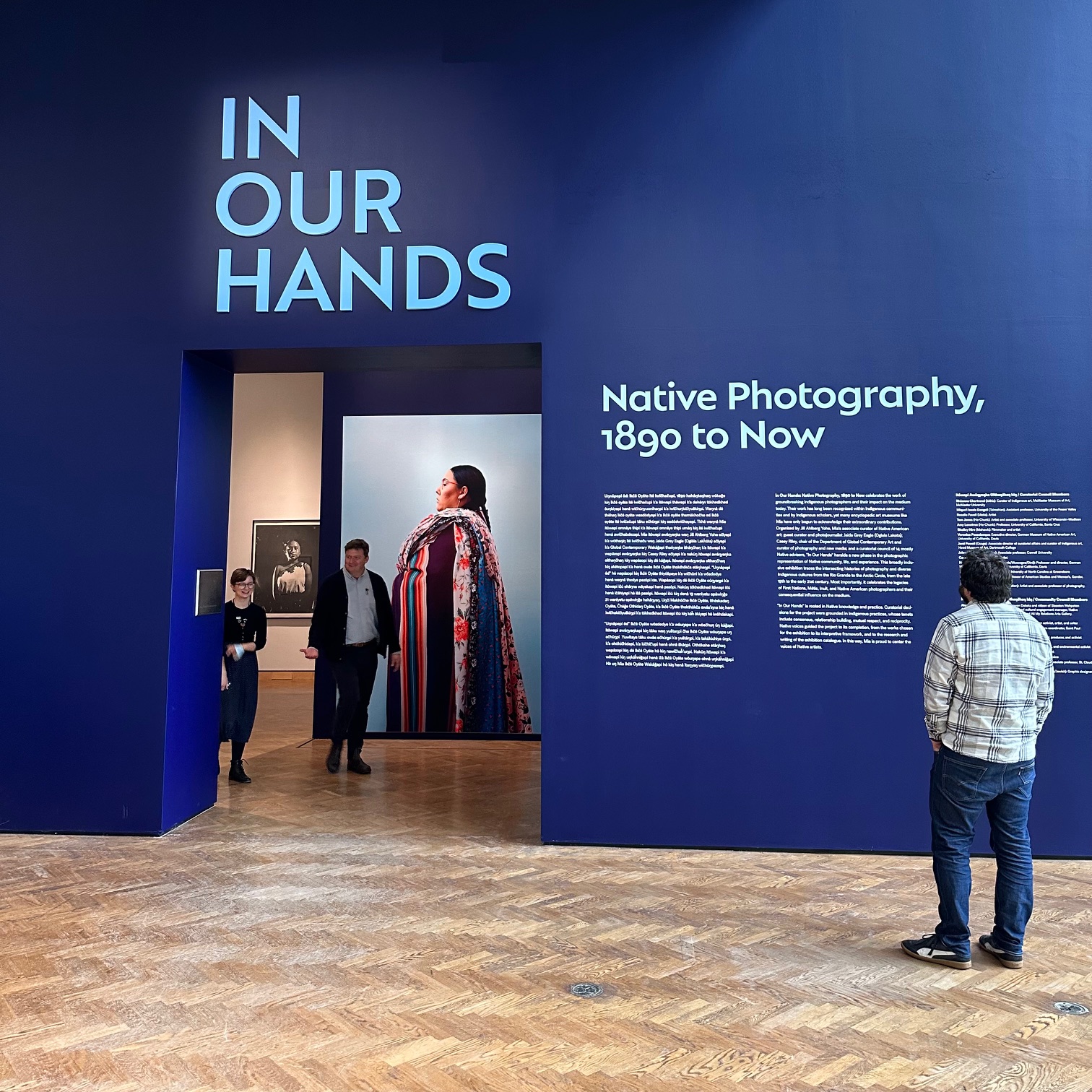
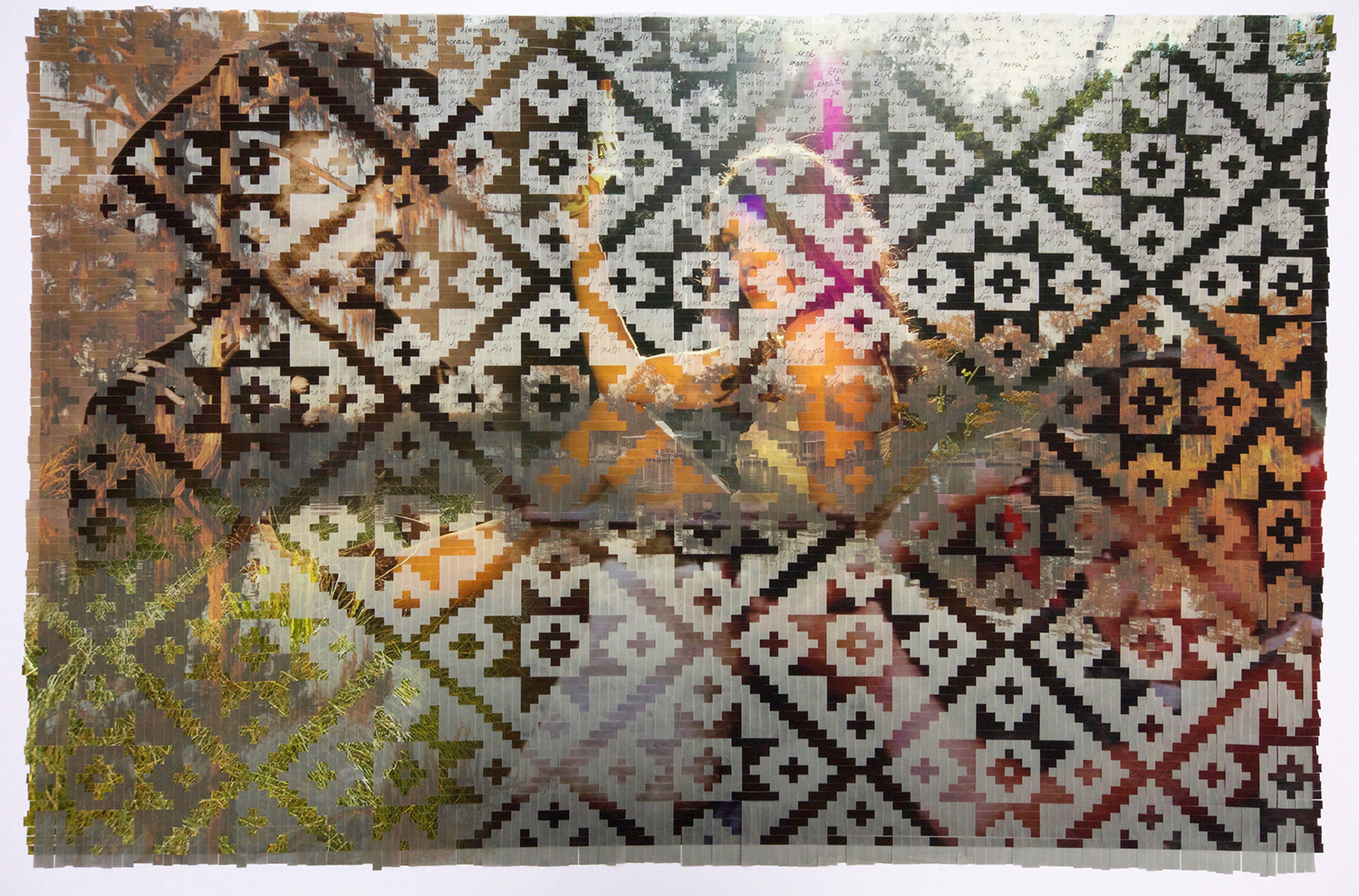
On a recent vacation in the Twin Cities, I spent an afternoon at the Minneapolis Institute of Art, which is currently exhibiting “150 photographs of, by, and for Indigenous people” in a photography collection titled “In Our Hands”. It was during that same vacation when I watched Martin Scorsese’s Indigenous genocide drama Killers of the Flower Moon, which is also a series of photographs grappling with the medium’s representation & othering of Indigenous peoples. Because I’m a movie obsessive, the photographs featured in “In Our Hands” that spoke to me loudest were the ones about misrepresentations of “American Indians” in American pop media. Cara Romero’s 2017 photograph “TV Indians” pairs living Indigenous figures with vintage images of fictional Indigenous stereotypes, displayed on cathode-ray televisions in the colonized & decimated landscape of New Mexico. Sarah Sense’s 2018 mixed-media piece “Custer and the Cowgirl with Her Gun” combines images of vintage Indigenous stereotypes in media with personal photographs & historical writing from her Chitimacha & Choctaw homeland through a traditional basket weaving technique that transforms & reclaims the medium of photography for a culture it has been historically weaponized against. Killers of the Flower Moon also addresses the fraught history of Indigenous representation in American media, to the point where its theatrical exhibition opens with Scorsese explaining his “authentic” behind-the-scenes collaboration with the Osage communities the story depicts. The film also concludes with a second onscreen appearance from the director effectively apologizing for his participation in the tradition of speaking for & about Indigenous people from a white American perspective.
To his credit, Scorsese does limit the amount of time & space he spends speaking for the Osage tribe, smartly focusing instead on the people he’s built an entire artistic career around understanding: white thugs. Killers of the Flower Moon is a typical Scorsese crime picture in that it details the step-by-step villainy of greedy American brutes who commit heinous, organized acts of violence in order to squeeze a few petty dollars out of their neighbors. He acknowledges this continuation of his pet themes by casting his two go-to muses in central roles: Leonardo DiCaprio as a slack-jawed goon and Robert De Niro as the criminal mastermind who puppeteers him. The dastardly duo conspires to become friends, family, heirs, and murderers to the Osage people, who have stumbled upon immense wealth when their government-assigned strip of land proves to be a viable source of crude oil. DiCaprio’s assigned mark is a lonely but stoic young woman played by Lily Gladstone, whom he seduces, marries, creates children with, and then slowly poisons while murdering members of her family under the direction of De Niro’s whims & schemes. Gladstone’s performance is formidable within that central trio, and she stands to benefit the most from this collaboration with Old Uncle Marty. Still, it’s the slimy, bottomless cruelty of De Niro & DiCaprio’s characters that drives most of the scene-to-scene drama, so that Scorsese is telling his own people’s story more than he is speaking for the Osage. Watching the movie in conjunction with visiting the M.I.A.’s “In Our Hands” exhibit raises questions of why these same film production resources can’t be put in the hands of Indigenous artists as well, but that question does little to unravel the specific story Scorsese chose to tell here.
Where the question of authenticity & representation really comes into play is in the film’s coda, delivered after De Niro & DiCaprio’s thugs have already been arrested for their crimes by the Baby’s First Steps version of the FBI. Where lesser Awards Season historical dramas will fill the audience in on how their characters’ lives resolved via onscreen text before the end credits, Scorsese delivers that information via dramatic radio play — complete with the outdat foley sound effects and outdated racist stereotypes that would’ve been contemporary in that pre-cinematic medium. The director then shambles onscreen himself as a radio announcer to read Gladstone’s character’s real-life obituary to the audience with humble solemnity. This is a jarring stylistic swing for a film that often finds Scorsese working in Boardwalk Empire mode more than Goodfellas mode (more dramatic than cinematic), but it’s at least one that seeks artistic purpose beyond reciting this history to a wide audience who needs to hear it. Here we have a quintessentially American story told by a quintessential American storyteller, and yet there’s no way for Scorsese to recite that history without in some way participating in its ongoing genocidal erasure of Indigenous voices. The opening doorway image to the “In Our Hands” exhibit is a portrait of an Osage woman taken by photographer Ryan Redcorn, purposefully representing his subject in a proud, dignified pose. In Scorsese’s picture, Osage women are sickly victims of white American greed, because that’s true to white American history. It’s worth pushing for a better world where both of those images are offered equally accessible platforms, and this film’s coda feels like an uneasy acknowledgement of the current imbalance. Still, this is a story worth reciting, and there are certainly less noble things Scorsese could be doing with $treaming $ervice money than turbocharging Lily Gladstone’s career.
For this lagniappe episode of The Swampflix Podcast, Boomer, Brandon, and Alli discuss the lesbian period drama Desert Hearts (1985), set in the ranches & casinos of 1950s Reno.
We do not have an Alamo Drafthouse in New Orleans and, to be honest, I’m totally okay with that. I appreciate the chain’s consistent enthusiasm for programming retro genre schlock, but there’s just something off-putting about watching any movie while underplayed teenagers scurry like peasants in the dark, delivering little treats & trinkets to the royal customers on our pleather thrones. Canal Place’s worst era was the brief period when it attempted to mimic the Alamo dine-in experience, which I’m saying as someone who worked in the theater’s kitchen during those long, dark years. I mean, why pay for a $20 salad when you can simply wait an hour and then literally walk to several of the greatest restaurants in the world? It was a baffling novelty in our local context. I was recently invited to an Alamo Drafthouse while vacationing in the Twin Cities, though, and I feel like I got introduced to the chain’s whole deal in the one context where it does make sense. For one thing, the Twin Cities Alamo is not located in the Twin Cities at all, but rather way out in the strip mall suburbs where there’s nothing better to do or eat within walking distance. In fact, there’s hardly anything within walking distance at all. “Public transportation” instructions on Google led me to take a train ride from downtown Minneapolis to downtown St. Paul, then a bus ride from St Paul to the side of a featureless suburban highway, and then a cheap Uber ride for the final stretch to the theater. That’s hardly equivalent to wedging a combo restaurant-cinema onto the busiest corner of the French Quarter. Also, I traveled there specifically to attend an all-day horror movie marathon, where mid-film snack & drink deliveries were necessary for my hourly survival. That overpriced pizza saved my life.
The annual “Dismember the Alamo” event is a Halloween Season tradition where the theater chain programs four-to-five “surprise” horror films, typically selected from the AGFA library. The program varies theater to theater, so I can only report on what screened this year at the Twin Cities location (which is, again, not located in either of the Twin Cities). It opened with two movies I’ve already reviewed for this site in Octobers past: Messiah of Evil (which I love) and The Changeling (which I tolerate) – two artistically minded, leisurely paced horrors of relative respectability. The plan was then to screen two more slower paced, fussily styled horrors Swampflix has already covered in Ringu and Blood & Black Lace, but technical difficulties intervened. While the staff scrambled to get the second half of the program running, I was happy to have time to chat with a long-distance friend in a venue notorious for not tolerating mid-film chatter of any kind. Then, when the show got back on the rails, they had thrown out the planned program to instead play two oddball 80s novelties I had personally never seen. The pacing picked up, the movies got weirder, and the room took on more of a horror nerd party vibe than the horror nerd sleepover feel of the opening half. I got treated to the full surprise lineup experience of the Dismember the Alamo ritual, to the point where even the marathon’s programmers were surprised by the titles they ended up playing when the DCPs for Ringu & Black Lace refused to cooperate. The Great Pumpkin smiled warmly upon me that day, which I very much needed after traveling alone in the Minnesota cold.
The third film in this year’s Dismember the Twin Cities Alamo lineup was the 1988 haunted house horror Night of the Demons. It was perfect Halloween Season programming, regardless of its function as a much-needed energy boost within the marathon. In the film, the absolute worst dipshit teens to ever disgrace the screen spend Halloween night getting torn to shreds by demons whenever they get too horny to live. In the audience, the awed seriousness that met The Changeling gave way to chortles & cheers, especially as the Reaganite jocks onscreen received their demonic comeuppance from the monstrously transformed goths they bully in the first act. That vocal response continued into the opening credits of 1981’s The Burning, which is credited as the brainchild of a young Harvey Weinstein. Weinstein’s name lingered in the air as the film’s horndog teen boy protagonists pressured their coed summer camp cohorts for sex in nearly every scene, only to be violently interrupted by a disfigured slasher villain named Cropsy. The Burning proved to be a fascinating bridge between the urban, gloved-killer grime of Italo proto-slashers and the sickly summer camp hedonism of the standard American brand. I imagine it would’ve inspired multiple bodycount slasher sequels if it were simply retitled Cropsy instead of the much more generic The Burning, since the horrifically disfigured villain on a revenge mission has an interesting enough look & signature weapon (gigantic gardening shears) to justify his own long-running franchise. He at least deserves it as much as Jason Voorhees, since The Burning is a major improvement on a template established by early entries in the Friday the 13th series. Likewise, I wonder why Linnea Quigley’s hot-pink harlequin bimbo look from Night of the Demons hasn’t inspired decades of Halloween costumes among the horror savvy. It might be her at her most iconic, give or take her graveyard punk look from Return of the Living Dead or her chainsaw-bikini combo from the cover of the Linnea Quigley’s Horror Workout VHS.
If there are any lessons in horror marathon programming here, it might just be in the attention paid to pacing. I love giallo & J-horror just as much as the next schlock junkie, but I was excited to watch objectively worse movies than Ringu & Black Lace just to make sure I didn’t end up using my pizza as a greasy pillow. Also, if you have to improvise your lineup on the fly, you might be surprised by the connections that arise from the last-minute entries. All four movies in this particular lineup were about cursed spaces haunted by the sins of the past — violence that lingers in the landscape where it took place, to the point of supernatural phenomena. In Messiah of Evil & Night of the Demons, that violence is perpetuated by otherworldly embodiments of pure Evil. In The Changeling & The Burning, it’s perpetuated in acts of revenge for personal wrongs of the recent past. All four films are connected by the tropes & traditions of horror as a storytelling medium & communal practice, a connection strengthened by a well-informed, horror savvy audience who stays immersed in that milieu year-round. More practically, though, what I learned is that the Alamo Drafthouse experience makes total sense in that movie marathon context. I cannot imagine a more comfortable venue where I could binge four horror movies in a row, save for my living room. And since I’m unlikely to invite 200 strangers to my house to watch a surprise horror movie lineup, even that caveat is moot. If there were a New Orleans branch of the Alamo Drafthouse, I’d attend the Dismember the Alamo marathon every year with religious devotion. I’d just hope that they’d stick it way out in the suburbs of Metairie or St. Bernard so that it’s competing with AMC instead of our humble indie spots like The Prytania, who’ve done a great job restoring Canal Place to its former glory.
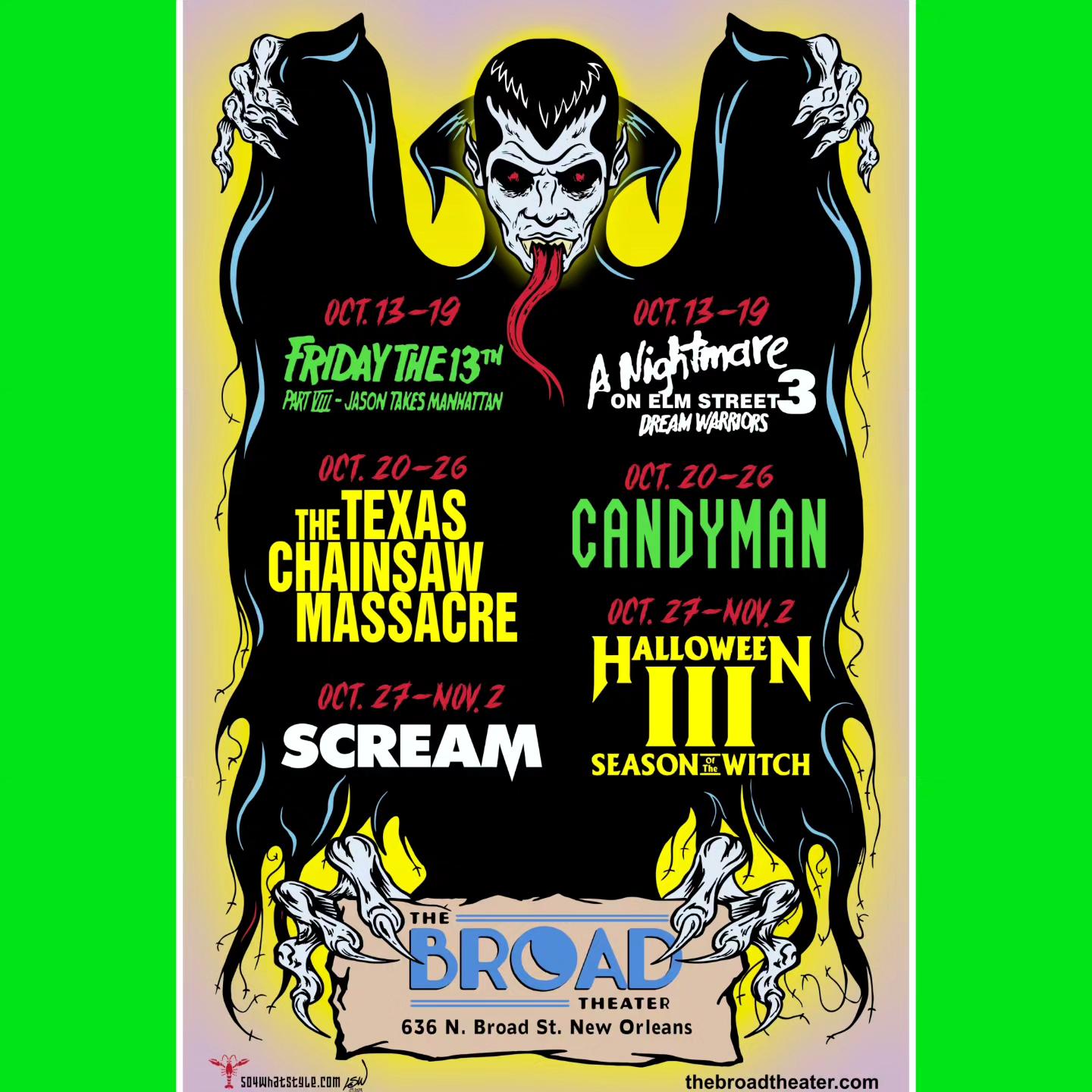
The early-Fall lull between the Summer Blockbuster schlock dump and Awards Season prestige rollouts is always somewhat of a cinematic dead zone, but this year’s has been especially harsh. The ongoing SAG/AFTRA strikes have scared major studios into delaying some of their biggest Fall releases for fear that their marketing would fail without the star power of a Zendaya or a Timmy Chalamet doing traditional promo, leaving very little of note on the new release calendar (until the Studios cave on those actors’ reasonable demands for fair compensation). I’m sure it’s been a strain on movie theaters in the meantime, and I hope that they squirrelled away enough of that sweet Barbenheimer money this summer to survive the drought. Speaking selfishly, though, it’s been awesome for me as a regular moviegoer. Stumbling into this new-release wasteland during Halloween Season inspired local indie theaters to get creative in their respective repertory programming, resulting in what has got to be the greatest month of local film listings I can remember in my lifetime (with the caveat that I grew up in the era when suburban AMC multiplexes strangled the life out of what used to be a much more robust New Orleans indie cinema scene). I spent most of October bouncing and forth between The Broad and The Prytania on the same #9 Broad bus line, frantically catching as many never-seen-on-the-big-screen horror titles as I could while the getting was good. And there were still plenty more I missed that I would’ve loved to see properly projected, including the early Universal Horror all-timer The Black Cat. What a time to be unalive!
If I were to parse out the two distinct flavors of these theaters’ dueling Spooktober line-ups, I’d say The Prytania offered an older, dustier variety of venerated genre classics while The Broad offered slightly warped cult favorites of the video store era. I personally trekked out to The Prytania to see odds-and-ends obscurities I’d never seen before at all, let alone on the big screen (Dracula’s Daughter, Bell, Book and Candle, The Creeping Flesh), but they also programmed a long list of definitive Hall of Fame horror classics that should be checked off of any genre fan’s personal watchlist (Don’t Look Now, Psycho, The Wicker Man, The Shining, The Exorcist, etc.). Meanwhile, The Broad’s lineup made a few more surprising, left-of-field choices, mostly in straying from the classics to instead screen their most chaotic, divisive sequels. While The Prytania screened the John Carpenter slasher-definer Halloween, The Broad screened its Michael Meyersless sequel Halloween III: Season of the Witch. While The Prytania screened fellow slasher-definer Friday the 13th on Friday the 13th, The Broad screened Friday the 13th, Part VIII: Jason Takes Manhattan, its most over-complained-about sequel. The Prytania’s schedule was so plentiful with exciting horror titles this October that I hardly had time to watch movies anywhere else, but I pushed myself to catch the most esoteric selections in the “Nightmares on Broad Street” program anyway, just to support the iconoclasm, as detailed below. And while I’m comparing the two theaters’ programs here, I should note that the one film they both played last month was Wes Craven’s teen meta-slasher Scream, which I suppose makes it their consensus pick for the greatest horror film of all time.
A Nightmare on Elm Street 3: Dream Warriors (1987)
The most rewarding trip I had to The Broad this October was to revisit Dream Warriors, a movie I mostly remember from late-night cable broadcasts and oft-repeated Blockbuster VHS rentals. The film marks Heather Langenkamps’s return (and shockingly morbid departure) as the series’ Final Girl figurehead, now a young medical student researching violent sleep disorders in order to help suffering teens survive nightly dreamworld visits from Freddy Kreuger. The film’s limited setting in a mental hospital narrows its focus to a small group of traumatized teen insomniacs and their befuddled doctors who can’t quite figure out how they all suffer from the same group delusion that causes them to self-harm; spoiler: it’s because Freddy is real. Dream Warriors has long been a favorite of mine in the series due to the novelty of its imaginative kill scenes, which include Freddy puppeteering one of his victims using their exposed veins as marionette strings and Freddy transforming his finger-knives into hypodermic needles to feed the hungry mouths of another victims’ pulsating track marks. It’s pretty fucked up, especially since it’s combined with Freddy’s early stirrings as a stand-up comedian – crushing one victim’s head with a television while quipping “Welcome to primetime!,” declaring another victim “tongue-tied” after literally tying them to a bedframe with his detachable tongue, and punctuating every misogynist kill with the punchline “Bitch!”.
What will always stick with me about Dream Warriorsnow, though, is that it’s the only Nightmare on Elm Street movie that has managed to make me cry. Maybe I’m getting too soft in my old age, or maybe it was just the theatrical atmosphere replacing the film’s usual brewskies-on-the-couch presentation, but I got unexpectedly emotional watching these kids get disbelieved and blamed for their own illness for so long before finding unexpected strength in solidarity. Every authority-figure adult in their lives is dismissive of their nightly suffering except the one who happened to go through their exact supernatural torture in her own youth, and then she teaches them how to fight against their isolating threats as a collective group through lucid dreaming. It’s oddly sweet, even as it is hideously gruesome. It’s probably no coincidence that the three best-remembered Elm Street movies are the ones Wes Craven had a direct creative hand in—the original, Dream Warriors, and New Nightmare—and, while I might personally prefer New Nightmare in that trio, they’re certainly all worthy of standalone repertory programming. Not many theaters would take a chance on the sequels outside a marathon context, though, so Dream Warriors immediately registered as mandatory viewing, even in such a crowded month.
Friday the 13th Part VIII: Jason Takes Manhattan (1989)
Speaking of slasher sequels no one would usually take a chance on, holy shit. Dream Warriors has plenty of long-running goodwill among horror addicts as one of the best of its franchise, but Jason Takes Manhattan has a long-running reputation of is own as one of its franchise’s worst. Wrongly. The standard-issue complaint about this much-mocked slasher sequel is that it’s flagrantly mistitled, promising that Jason Voorhees will take a grand budget-burning tour of New York City, when in reality he spends most of the runtime killing teens on a boat trip to the city. Given that marketing department disappointment, I wish the film had simply been retitled Jason Takes a Cruise to calm the horror nerds’ nerves. Complaining about the locale of Jason’s tireless teen slayings in this outing three decades after the first-weekend jeers is idiotically shortsighted & petty, since Jason Takes Manhattan is scene-to-scene the most memorably entertaining entry in its franchise, give or take Jason X (which is mostly set on a ship of sorts itself). En route to Manhattan, Jason punishes high school seniors for celebrating graduation with the old-fashioned teen sex, drugs, and rock ‘n’ roll that he loathes so deeply: filming amateur rock videos in the engine room, snorting coke off mirrors in the supply closet, and seducing the uptight principal to get out of completing their science fair projects. It’s a random assemblage of quirky slasher-teen behavior that even on land would be more entertaining than the snoozy cabin-in-the-woods doldrums of earlier Friday the 13th sequels, and then the Manhattan-themed rampage promised in the title is delivered as a sweet novelty dessert.
If anything, there’s something immensely satisfying about the way Jason’s whirlwind Manhattan tourism is delayed for a condensed, climactic payoff instead of being drawn out into urban slasher tedium. An opening credits sequence details the grimy back-alleys of 1980s NYC, particularly focusing on a barrel of toxic sludge that serves as the bathtub for a gigantic rat. We do not return to that alley until the third act, when Jason drowns the film’s most detestable character headfirst in that exact barrel, the rat now dead beside him to emphasize just how gross the sludge truly is. There’s also some great metaphysical character at work here as well, where Jason now appears to be made entirely of toxic sludge himself, having been submerged in the murky waters of Crystal Lake for so long that he’s essentially a hulking collection of sentient goo. His younger, drowned self appears to the film’s Final Girl in frequent, psychedelic hallucinations during the boat trip to Manhattan – underlining the killer’s supernatural constitution, connecting his qualities as an aquatic zombie to the waters that connect Crystal Lake to the Hudson Bay and, frankly, killing time between his actual kills. Mostly, though, his gooey, goopy body is just an extension of the way the movie associates New York City with sludge & grime, painting it as a landscape made entirely of rats, rape, street punks, and shared hypodermics. In a way, you get a little taste of Manhattan on the ride to its shores in Jason himself. More importantly, it’s one of the precious few entries in his franchise where he isn’t a total bore. Too bad so few people get past the misleading title to see that; it was the least well-attended horror screening I saw all month.
Now here’s where things get interesting. The Broad had already filled its schedule with classic horror films at the start of the month, and then Taylor Swift dropped a rushed-to-market concert film that cleared even more room on local marquees, since film studios were scared to compete with the most famous woman alive. I’ve never been a bigger Swiftie. Because Swift’s Eras Tour cleared the weekly release schedule, The Broad added three additional classic horrors to its line-up, all digital restorations of vintage gialli by Dario Argento. And so, I got to see my personal favorite Argento film on the big screen with my friends instead of the way I’ve watched it previously: alone as a fuzzy YouTube rip. Like with my appreciation for Jason Takes Manhattan, Opera is far from the wider consensus pick for Argento’s best; I was genuinely shocked to see it theatrically listed alongside his better respected works Deep Red & The Bird with the Crystal Plumage on The Broad’s marquee. At this point in the month, it was starting to feel like someone was programming a mini horror festival just for me, and it was delightful to see plenty likeminded freaks in the audience instead of the empty seats I was met with at the screening of my favorite Friday the 13th.
Opera finds Argento working in his Inferno mode, putting far more effort into crafting individual images than weaving them into a cohesive story. After being hired to direct a real-life opera of Macbeth and abandoning the project before production, Argento salvaged his scrapbook of ideas for its staging in this loose mystery crime thriller about a gloved killer’s obsession with an opera singer. The killer’s mechanism for torturing his muse is tying her up with pins pointed at her open eyelids so she cannot look away from his violent slayings of her friends, lovers, and collaborators. It’s a double-contrivance of Hitchcockian voyeurism, where the killer obsessively watches the singer from the anonymous crowds of her opera house and, in turn, makes her watch him perform his art backstage. It’s also just an excuse for Argento to indulge in a glorious clash of high & low sensibilities, alternating between operatic vocal performances in the theatre and thrash-metal slashings on the streets. Opera might feature his most overactive, over-stylized camerawork to date, too, most notably in scenes where the camera adopts the POV of the trained ravens on his Macbeth set to directly attack his own audience in murderous swoops & dives. Opera may not be as beautiful as Suspriria, nor as horrifying as Tenebrae, but it’s Argento’s mostly wildly impulsive vision – both his most invigorating and his most incompressible. I loved seeing it get the proper theatrical setting it deserves.
Halloween III: Season of the Witch (1982)
YWhile there may still be some novelty in exalting Opera & Jason Takes Manhattan as the top of their respective classes, I’d say Halloween III: Season of the Witch has been thoroughly reclaimed in the modern discourse to the point where calling it The Best Halloween Movie is almost an online Film Bro cliche. Hell, that thought even occurred to me back when we covered it on the podcast in 2016, when I called it the best Halloween movie. There’s some necessary semantic clarification to make there, though, because I’m not only saying that its infamous Michael Meyersless deviation from the John Carpenter slasher franchise makes it the most interesting movie of its series. I’m saying that it’s the best horror movie in any context that’s specifically about Halloween as a holiday, from the roots of its pagan Samhain traditions to its modern Trick or Treat rituals in the American suburbs. The only films I skipped on the Nightmare on Broad Street roster were the widely beloved horror classics The Texas Chainsaw Massacre, Candyman, and Scream, and I believe the horror nerd community has gotten over Season of the Witch‘s disregard for Michael Meyers slashings well enough that it now registers among that verified pantheon of seasonal greats (in a way they still haven’t gotten over the title of Jason Takes Manhattan). The reason I didn’t skip Season of the Witch, though, is that The Broad happened to screen it on Halloween Night, and I couldn’t fathom a better way to cap off this exquisite month of local repertory moviegoing. It was a hoot, and I’m already excited to see what they pull out of the haunted vault next year.
I first became aware of Cobweb through a rare positive modern horror review from the boys (well, no longer “boys” I guess) of Red Letter Media. Like them, I am shocked by the distributor’s decision to drop this film into theaters in late July, right at the height of Barb–enheimer madness; we often treat this spooky time of the year as the default season for horror movies, but this is a Halloween movie if ever there was one, taking place in the lead up to and on Halloween Night. It’s the perfect little quiet piece of nasty work to end the season, if you haven’t already decided what the last stop on your horror train will be this year.
Mark (Antony Starr, of The Boys) and Carol (Lizzy Caplan) are bad parents, the kind of bad parents that you’ve met before. Mark is charming in a way that wears off very quickly, as his facade of joviality is as paper-thin as his rictus grin is reptilian. Carol seems to live in constant fear of the potential for Mark to become violent, but despite that she withers beneath her husband’s cold fury, she is capable of cruelty all on her own, and her constant fretting over the locking of doors implies deeply rooted issues. As a result, elementary-aged Peter (Woody Norman) is a shy, withdrawn, and bullied child, a fact that is accentuated by how much smaller he appears to be in comparison to his classmates. He gets a new substitute teacher in the form of Miss Devine (Cleopatra Coleman) just in time for a series of Halloween related projects, including fear-related drawing projects and decorating pumpkins. She quickly notices Peter’s isolation from his peers and what appear to be other signs of abuse; for one thing, the boy seems to be perpetually tired. What she doesn’t know is that Peter never gets a full night’s sleep because he is awakened every night by tapping coming from within the walls of his bedroom, a knocking that his parents deny the existence of and which is soon accompanied by the soft, whispering voice of a little girl begging for help.
My viewing companion for the film noted that he had previously seen child actor Norman in the Joaquin Phoenix vehicle C’mon C’mon, and noted that he was a talented performer in that one as well, and he gives a very strong performance here. Caplan has a panicked, nervous energy here that I haven’t seen from her before, as it lacks the sardonic sense of humor of her more customary roles; she manically moves from room to room locking doors behind her like Nicole Kidman in The Others. Carol’s moments of genuine kindness toward her son always have a bitter aftertaste of guilt that will be terribly familiar to anyone who’s ever known a parent who is unable to stand up to their partner regarding the treatment of their child, and it’s potent, given how little other characterization she gets. Putting Starr in this role of Stepfather-adjacent pathological paternalism is the casting equivalent of shorthand that carries over the barely-contained psychopathy of his Homelander character on Amazon’s The Boys. He never commits any acts of physical violence, but his presence alone is menacing, and his hot-and-cold affection for his son is distressing. That Norman is holding his own in these scenes against the performers playing his parents is astonishing; I’ve rarely seen such a talented child actor, and I genuinely can’t remember the last one I saw whose last name wasn’t Fanning.
The constant danger that poor Peter is in is palpable as the walls close in around him and his lifelines are clipped. His father is clearly dangerous, but he can’t rely on his mother for help as she is Mark’s collaborator as much as she is his prisoner, and Peter loses access to the only sympathetic person in his life, Miss Devine, when he is expelled from school after striking back at his bully at the suggestion of the voice behind the walls. The voice claims that she is Peter’s sister, locked away in the walls for being born “wrong” somehow, and that she has been waiting for Peter to grow strong enough to move the grandfather clock in their parents’ bedroom that hides the door to her prison, so that they can escape together before Mom and Dad decide to lock Peter away, too. Although the audience is naturally distrustful of the voice, we have no reason to think that the parents are innocent either, and Peter has no one else he can turn to anyway, so he commits to the plan to help her escape.
It would be incorrect to say that Cobweb “loses steam” as it enters its third act; if anything, the film picks up the pace from there. It does, however, lose some of its atmosphere and tension once it crosses that threshold. If you’re the kind of person who’s hypervigilant now as a result of growing up with a parent whose hair-trigger temper was like a second language, this will be familiar to you. The film inevitably takes a sharp turn into a different kind of horror once we get more answers about what’s in the walls (if anything) and what the parents know (or don’t). When Coleman re-enters the plot, things pick up a bit, and the film’s final chilling moments make up for some of the more conventional horror turns that occur. Still, this one is a real overlooked gem from this year, especially if you’re looking for something that puts atmosphere first.
Welcome to Episode #198 of The Swampflix Podcast. For this episode, Brandon is joined by Aaron Armstrong of the We Love to Watch podcast to discuss the eight classic Universal horrors that feature Frankenstein’s monster.
My favorite of the original Child’s Play trilogy, and thus my favorite Chucky movie overall. I love the way it trades in the grimy cruelty of the original for the visual sensibilities of a children’s film, from its exaggerated cartoon framing to its primary color palette to its bookend trips to the toy factory. Speaking of which, the climactic spectacle on the factory floor is some A+ mayhem, really leaning into the novelty of killer-doll gore at its purest. It’s one of those R-rated horrors that feels like it was specifically made for an audience of children sneaking the TV remote past their sleeping parents.
Child’s Play (1988)
The original Child’s Play hits all the exact story beats you’d expect from its Killer Doll: The Movie premise, but its in-the-moment execution is often exquisite. The animatronic puppetry is mind-boggling, the patter of little doll feet in the Evil Dead POV shots is somehow genuinely chilling, and the gradual transformation of Chucky’s head from generic My Buddy Doll knockoff to Baby Brad Dourif really sells the dark Movie Magic of it all. It’s also really funny to imagine the excruciating boredom a serial strangler would feel having to hang out with the world’s sweetest child until it’s time to smite his enemies; not to mention the frustration of having little plastic hands you can’t even properly wrap around a throat – horrifying.
An in-name-only “remake” that exploits the Chucky name to make its own evil-doll horror comedy for the A.I. era, functioning more as a prototype for M3GAN than a direct mutation of the 1988 original. While a drastic deviation from the Original Flavor™ Child’s Play in terms of plot & tone, though, it does ultimately amount to a similar effect. It plays like the exact kind of nasty, ludicrous horror flicks kids fall in love with when they happen to catch them at too young of an age on cable. It’s too violent for children but far too silly for adults, the exact formula that made early Child’s Play movies cult classics in the first place.
Bride of Chucky (1998)
Chucky is resurrected for the post-Scream era, complete with a nü-metal soundtrack, mall goth costuming, and postmodern references to competing horror villains like Freddy, Jason, Michael, and Pinhead. Thankfully, this comedic rebrand also pairs him with a totally committed Jennifer Tilly, who counterbalances the killer’s trademark misogyny as a bimbo-dominatrix-turned-fellow-doll who gleefully pushes all his psychosexual buttons just to watch him squirm. It’s not all that tense or upsetting as a horror film, but it’s highly amusing as a “The straights are not okay” anti-romcom, and it’s fun to finally see Chucky mastermind Don Mancini queer up the franchise that pays his bills.
Seed of Chucky (2004)
Don Mancini’s New Nightmare, riding the final ripples of the post-Scream meta horror trend as far as it had left to go (not very). It’s a mixed bag from start to end, but enough of the jokes land and the Glen-Or-Glenda doll is a novel enough intrusion for it to mostly make up for the eyerolls. Also very cute to see John Waters nerding out as an obvious fan as if he won a “Be in a Chucky movie!” contest, even if he just missed the series’ glory days
Child’s Play 3(1991)
Things would get worse down the line, but this has always been my least favorite of the original Chucky trio. It’s fun to see Chucky fully come into his own as a mainstay slasher villain, since this is late enough in the series for him to start quipping his way through every kill with catchphrases & cheap one-liners. Having to spend even 90 breezy minutes in its drab military school setting is a chore, though, and I always feel like I’m being punished alongside Andy for crimes I didn’t commit. That boredom is rewarded with a last-minute trip to an amusement park, but the killer finale makes me slightly resentful that we don’t spend the whole movie there.
Curse of Chucky (2013)
Considering how much flak the 2019 Child’s Play remake got for straying from Mancini’s original vision, it’s incredible that Mancini had made his own in-house, in-name-only Chucky knockoff just a few years earlier. In this case, Chucky’s more of a haunted house catalyst than of an A.I. cautionary tale, so he’s more Annabelle than M3GAN. Unlike Annabelle, though, this evil doll actually moves; his kills are brutal enough to make up for a lot of the usual trappings of a purposeless, tropey reboot.
Cult of Chucky (2017)
With Curse of Chucky, it felt like Don Mancini wanted to make a generic haunted house movie and the only way to land funding was to put a Chucky in it. Here, he does the same with the spooky mental asylum genre, except he puts many Chuckies in it. It’s the cheapest and least substantial of the bunch, but the gore gags are gnarly enough to make it worthwhile, and it’s delightful to see how convoluted the series lore has gotten to keep the story going. This has to be the all-time silliest ten hours of prerequisite homework to fully appreciate a TV show in the history of the medium, but if you’ve made it this far, you’re doomed to keep tuning in.
One distinctly American subgenre is the backwoods family horror, which shocks the audience simply by introducing them to a family of reclusive weirdos who live in the rural South. Defined by such low-budget, high-visibility titles as The Texas Chainsaw Massacre, Spider-Baby, and Mudhoney, the backwoods family horror tradition continued in an increasingly goofy fashion in The Texas Chainsaw Massacre Part 2, the later Basket Case sequels, Nothing but Trouble, and in pretty much every movie directed by Rob Zombie. And since the intersection of unrestrained goofiness & unoriginal genre filmmaking is the exact sweet spot of the American home video label Full Moon Features, they of course made a backwoods family horror of their own for the mid-90s video market. Head of the Family is a variation on the Texas Chainsaw weirdo-family subgenre, reconfigured to fit into Full Moon Features’ house specialty: R-rated movies for children. It has everything an unsupervised child could possibly want out of a late-night movie snuck past their sleeping parents: cussing, sex, and a house full of weirdo freaks. Adults might not be as impressed with those goofball transgressions, but Full Moon doesn’t really make horror movies for adults anyway. That ground was already well covered by Tobe Hooper.
Head of the Family is built entirely on one visual pun. The “Head” in question is just that: an oversized human head. He pilots his wheelchair around his family home with the tiny limbs that extend from the liminal space where his neck and torso should be. The other three members of The Head’s family make up a set of telepathically-linked quadruplets. Naturally, The Head is the brains of the operation, and his similarly mutated siblings help make up the rest of his deconstructed body: The Eyes (a spy with hyperactive senses), The Muscle (a towering brute enforcer), and The Body (a buxom bimbo honeypot). They all share thoughts & senses as a collective, but The Head makes all of their decisions – until The Muscle eventually rebels. Not much is done with the disembodied body horror of this premise, which is a little disappointing when it comes to the three brothers vicariously experiencing sexual pleasure through the dalliances of The Body. Mostly, the movie coasts on the initial shock of introducing the audience to the horrid little monster inspired by its titular pun, and then letting us get to know his fucked up family as they go about their busy routine (of collecting & torturing local, unsuspecting citizens in the dungeon under their Grey Gardens mansion).
One thing this entry in the backwoods family horror canon gets exactly right is the genre’s inherent Southerness. The Head is a bitchy Southern dandy, constantly rolling his eyes at the comparative unintelligence of his fellow conversationalists as if he’s constantly four martinis deep. To be fair, the dialogue offered by his intellectually inferior foes is remarkably vapid, including such astute observations as “This is some kind of weird bullshit” and “Sometimes I feel like a big ol’ turd in a small toilet”. The audience is forced to spend a half-hour with these low-life dolts before we’re graced with the refined Southern gent presence of The Head, patience that it is only somewhat helped along by most of their lines being delivered mid-coitus. Once The Head arrives, though, the Full Moon dream factory makes the most of his hideous visage, dwelling on the horror of watching him accomplish simple tasks in confrontationally tight close-ups: slurping soups, wetting lips, licking nips, etc. When the novelty of that image wears off, the movie mostly just kills time in order to achieve feature length. At one point, The Head forces his dungeon captives to put on little stage plays for his amusement, as if to make fun of how bad of an actor everyone else is except him.
In case you were unaware you had stumbled into a Full Moon Feature, the label’s house composer Richard Band opens the production with the most acrobatically goofy score of his career – employing violins, harps, glockenspiels, vibraslaps and percussive cheek pops to achieve the Fullest Moon sound ever recorded on VHS. Head of the Family also promises to deliver on another definitive Full Moon Features trope: the sequel no one asked for. Just a couple years ago, Full Moon teased promotional art for a decades late follow-up titled Bride of the Head of the Family, coming soon to a Tubi app near you. It makes sense that a sequel to this picture would have to expand the size of the Family with new, hideous members, since there isn’t much to this genre beyond getting to know the insular, often incestuous little freaks who populate it.
“When an electrical accident disfigures the face of Cronin Mitchell (Tony McCabe), he also acquires strange psychic powers. He promptly makes a bargain with a witch who restores his looks if he will become her lover. However, though the world sees her as a sexy cutie named Ellen (Elizabeth Lee), Mitchell’s new girlfriend is actually an ugly old crone. After expelling a ghost from a funeral home, MItchell next tries to discover the identity of a small-town maniac. However, the feds have also asked karate-chopping playboy Alex Jordan (William Brooker) to oversee the case, and Jordan schemes to have Ellen all for himself . . . but not before MItchell boosts his ESP with LSD, and Jordan is attacked by killer bed sheets. Honest.”
Like every other Hershell Gordon Lewis cheapie I’ve had the mild misfortune of stumbling upon, Something Weird is impossible to describe without making it sound way more exciting than it actually is to watch. I couldn’t personally craft a more accurate, concise summary of its plot events than the paragraph above, which I’ve copied from the back of the dusty DVD I recently picked up at my neighborhood Goodwill. It’s the next paragraph where that ad copy goes off the rails, describing Something Weird as a “crackpot gem” and “one of the most bizarre and outrageous horror flicks ever made.” If only it could live up to that hype. Despite recalling genuinely mesmerizing vintage schlock of its ilk like Death Bed: The Bed that Eats and X: The Man with the X-Ray Eyes, there’s nothing especially exciting about Something Weird beyond the promise of its title, poster, and premise. That’s been consistent with all of my previous run-ins with Lewis, who seems to have come from the David Friedman school of carnival-barker movie promotion, where it doesn’t matter if the finished film is any good; it just matters if it’s marketable enough to sell tickets. Not every old school B-movie producer was as creatively savvy as Roger Corman, who could actually churn out a decent picture while chasing an easy dollar; some were just straight-up hucksters.
I hope it’s apparent to seasoned schlock enthusiasts why I would pick up a used copy of Something Weird even though I’m so dismissive of Hershell Wizard of Gordon Lewis. I was, of course, enticed by the film’s significance to the video store days of cult cinema, when it inspired the namesake of the distribution label Something Weird Video. It’s difficult to articulate right now just how essential Something Weird Video was to schlock gobblers in decades past, since there are now dozens of boutique genre film Blu-ray labels that distribute the exact kind of subterranean cinema they specialized in. I may not be grateful to Something Weird Video for exposing me to so many disappointing Lewis & Friedman titles back then, but I am extremely grateful to their similar platforming of much more earnestly enjoyable genre freaks like Ed Wood, Doris Wishman, and whatever Tennessee weirdos made Bat Pussy. The DVD jacket ad copy quoted above is not only in line with Lewis & Friedman’s drive-in era style of overhyping shoddy product, but it’s also typical to the home video label’s continuation of the practice decades later. They had a fun, flippant approach to cult cinema marketing, as indicated by this DVD’s menu choices of “Start Weirdness,” “Weird Scene Index”, “Weird Audio”, and “Weird Special Features.”
In all honesty, I’m a lot warmer to Hershell Gordon Lewis’s low-effort, low-energy charms now that I was when I first plucked titles like Blood Feast & Two Thousand Maniacs off the Cult Section shelves of Major Video in the aughts. I’ve always been on the hook for Something Weird‘s making-it-up-as-we-go-along approach to story, wherein a witch’s reluctant gigolo boosts his own psychic powers by experimenting with LSD so he can bring a Free Love serial killer to justice. A couple decades ago, I just would have found it unforgivable that a film with that premise didn’t live up to its full potential as a Grade-A hippiesploitation freak show. Watching it now, I’m more open to its merits as adorably quaint community theatre, with the laughably unconvincing karate demos and gratingly annoying witch’s spells now registering as a document of weirdos with limited talents attempting to put on a show instead of an opportunistic producer attempting to sell a flashy poster without a finished movie attached. Lewis’s half-assed, monochrome imitation of a Saul Bass acid trip lays limp on the screen, but there’s something almost accidentally psychedelic about his sloppy, unenthused editing style. It’s also fun to ponder “What was he thinking?” as he points a dirty camera lens at a cloudy sky while playing a classroom lecture about the science behind ESP or as a swanky cocktail party devolves into an out-of-focus living room seance. Still, I can’t hold back my frustrations that the basic components of a much better B-picture are on full display onscreen but nobody cared enough to arrange them in a satisfying configuration.
I’m sure there are plenty of old-school genre nerds who appreciate Something Weird as a Hershell Gordon Lewis experiment in combining social unease around The Sexual Revolution with traditional “The World of the Unearthly” horror tropes. I’m also sure that I’ll end up seeing its drive-in double bill partner The Gruesome Twosome sometime before I die, despite knowing I cannot match that enthusiasm. I fully understand Something Weird‘s value in the Something Weird Video catalog, though, since it’s the exact kind of title & logline that moves units off the shelves. Hell, I just picked it up off a DVD shelf myself, even though it’s currently streaming free on Tubi, the rightful home of many Something Weird Video castoffs.
Two of my childhood-favorite horror classics from the year of our Dark Lord 1996 screened at The Prytania Theatre this month: Wes Craven’s teen-slasher renaissance sparker Scream and Andrew Fleming’s teen-witchcraft charmer The Craft. Of the two, I only made time to revisit the latter, where I had the pleasure of sitting behind a row of giggling college students who were enjoying it for the very first time. Repertory screenings of The Craft are a much rarer treat than screenings of Scream (as evidenced by only one of those titles also playing at The Broad this month), which makes sense given the stature of Scream‘s director within horror nerdom and given that it is still being kept alive by endless discourse & rebootquels well into the 2020s. Both movies meant a lot to me as a wannabe goth young’n who never earned his eyeliner wings, if not only because I was the perfect age to look up to their much cooler, slightly older teen protagonists when the movies were fresh arrivals on the shelves of my local Blockbuster Video. My anecdotal research (scrolling through my Letterboxd follows’ flippant one-liner reviews) suggests that The Craft is considered the much lesser of the two works, especially in recent years, which is the exact opposite opinion that dawned on me while watching it on the big screen for the very first time. As a kid, Scream was a great reference text for a laundry list of horror classics I needed to catch up with in future video store rentals, while The Craft was the full witchy power fantasy I desperately needed in my miserable Catholic school years – a substantial, self-contained work that required no extratextual viewing. Among the two slick ’96 teen studio horrors currently enjoying victory laps around the city, my heart clearly belongs to coven; praise be to Manon.
Pitting these two enduring sleepover classics against each other is mostly a game of 1-on-1 performance match-ups. Fairuza Balk is just as chaotically charismatic in The Craft as Matthew Lillard is in Scream, but she’s much better dressed – sporting mega-goth bondage gear instead of oversized sweaters from The Gap. Neve Campbell is dependably lovely & solid in both, playing the genre’s most sensible Final Girl in Scream and the coven’s most vulnerable pushover in The Craft, where she cedes power to Balk, Rachel True, and Robin Tunney. Skeet Ulrich is the deciding factor, then, putting in the performance of his career as a dopey puppy dog under a love spell in The Craft, which comes slightly ahead of his performance as a dirtbag psycho boyfriend with a horrid secret in Scream. It’s unlikely that these names mean anything to anyone born outside the Millennial age range of 1981 – 1996, but I can confirm from first-hand observation that Skeet Ulrich’s performance in The Craft still kills with the modern teenage crowd. The row ahead of me was explosive with giggles every time he showed up at Tunney’s feet, adorably perplexed over why he was so magnetically attracted to her despite his usual aloof bad-boy demeanor. Of course, a lot of the film’s current entertainment value is rooted in nostalgia for 90s pop culture aesthetics, whether it’s the extremely dated teen cast or the tie-in CD soundtrack that includes artist like Jewell, Julianna Hatfield, Letters to Cleo, Portishead, Elastica, and Our Lady Peace. Even on that end, I’d say The Craft has Scream beat, since it’s only invested in setting a traditional witchcraft story within that 90s pop arena instead of simultaneously cataloging & restaging tropes from previous missteps & triumphs in its genre.
When I say that The Craft doesn’t require extratextual viewing the way Scream does, that doesn’t mean I didn’t immediately go home to watch all of the Special Features on my ancient DVD copy as soon as I left The Prytania, so I could prolong the pleasure of the experience. There were some fun insights in its promotional behind the scenes “interviews”, mostly in the cast’s recollections of Fairuza Balk’s contributions as a true-believer Wiccan bringing authenticity to the production (along with hired outside Wicca consultants) and in Rachel True’s observation that as the coven’s magical powers grow stronger & stronger, their skirts are hemmed shorter & shorter. Mostly, my extratextual journey outside The Craft was a horrified scroll down Letterboxd lane, where I found a lot of complaints from cinephiles I usually trust about a movie I’ve always loved. Most reviews among mutuals range from 1-to-3 star ratings, with a particular disdain for the third-act dissolution of the central teen coven. It’s true that the “Fuck around” section of the movie is a lot more fun than its “Find out” counterpart, as that’s when we watch goth teen witches confidently strut down their Catholic high school hallways to 90s pop tunes in defiance of their school’s usual social power rankings. Once all four witches have solved their very simplistic personal issues at home (racism, body dysmorphia, the powerlessness of poverty and, least significantly, crushing on a bully) through dabbling in dark magic, there’s nothing left for the movie to do than to show what happens when they take their magic powers too far. It’s a political blow to idealists looking to The Craft for depictions of feminist solidarity (who would be best served skipping the ending entirely), but it at least opens the movie up to other themes besides the allure of power to teen-girl outsiders: addiction, fear of losing social stature, the willingness to cower behind an overly bossy leader for convenience, etc.
Speaking of extratextual viewing, what’s interesting to me about the complaints over The Craft‘s third act is that someone did attempt to correct its political issues in a modern revision of the film. Zoe Lister-Jones’s recent soft reboot The Craft: New Legacy smooths out a lot of the original film’s rough spots in representation, feminist solidarity, and third-act resolution, mostly by giving its own coven an outside enemy to fight instead of each other (David Duchovny as an MRA warlock) and by putting their hunk-bully stand-in for Skeet Ulrich under a “woke” spell instead of a love spell. It might be a more politically sound film, but it’s also a thoroughly dull one, mostly because its poorly lit, dialogue-heavy teen drama registers more like a backdoor pilot for a CW series than a legitimate Movie. Say what you want about the original, but it at least has a sense of style, something the recent remake only approaches when copying the exact occultist-imagery graphics of the original’s opening credits as lazy homage. The Craft‘s style happens to be tied to a very specific era in commercial filmmaking that I happen to be susceptible to nostalgia for, but it still looks fantastic. It probably serves me right, then, to see this same story warped into an extremely dated generational touchstone for a different era of potential horror nerds, so I can see how generic one of my childhood favorites looks to people who it didn’t hit at the exact right time. To me, The Craft: Legacy is cute but inconsequential, which is seemingly what most audiences also think of the original, even among my peers. So, maybe I should shelve my argument that there’s more overt queer sexuality in the suggestive wagging of Fairuza Balk’s fingers during the original’s iconic light-as-a-feather-stiff-as-a-board scene than there is in the entirety of the deliberately inclusive Queer Representation remake. I’m already risking sounding like an out-of-touch whiner about the good old days here, exalting the pop culture residue of my youth as if it were a sacred text.





















 Swampflix