The Outwaters (2023)

You’d think that after a half-decade of horror’s outer limits being defined by A24’s emphasis on atmosphere & metaphor, the genre would overcorrect by snapping back to surface-level cheap thrills, just for the sake of variety.  And I guess in some ways it has.  Recent breakout successes like M3GAN, Barbarian, Smile, and Malignant have signaled a wide audience appetite for high-concept gimmick premises with traditional jump-scare payoffs & haunted house decor.  At the same time, though, some of the buzziest horror titles in recent memory have dug their heels even further into arty atmospherics, carving out a new horror of patience & subliminals.  I’m thinking particularly of Skinamarink—which simulates childhood nightmares by applying eerie digital filters to public domain cartoons & shots of empty hallways—and We’re All Going to the World’s Fair – which borrows heavily from online creepypasta lore & imagery without ever directly participating in the horror genre.  These are low-fi, low-budget works that distort the atmospheric horror aesthetic of recent years into D.I.Y. bedroom art, removing even more of the genre’s crowd-pleasing tropes & payoffs so that it feels entirely abstracted & unfamiliar.  And now the arrival of the found-footage cosmic horror The Outwaters makes that doubling-down feel like a legitimate trend.

For anyone curious to dip their toe into this (loosely defined) low-fi horror trend, The Outwaters may be the most accessible entry point.  It will test your patience just as much as its sister chiller Skinamarink, but it rewards that effort with a much more pronounced, traditional payoff.  It’s my personal favorite among these recent low-key creepouts, anyway, since I tend to prefer bloody catharsis over eerie atmospherics.  The Outwaters effectively splits the difference between horror’s current trends towards both moody abstraction & on-the-surface cheap thrills.  It starts as a low-key, mildly spooky drama about parental grief, but eventually ditches any tidy metaphorical readings for a lengthy, bloody, freewheeling freakout in the Mojave Desert.  As trippy as it can be in its Skinamarinkian disorientation, it’s anchored to a concise, recognizable premise that could neatly be categorized as The Blair Witch Project Part IV: Blair Witch Goes to Hanging Rock.  It strikes a nice balance between the slow-moving quiet of its bedroom art brethren and mainstream horror’s return to big, bold, bloody haunted house scares.  Maybe that makes it a less artistically daring film than World’s Fair or Skinamarink, but it also makes it a more overtly entertaining one.

I’m likely overselling the relative accessibility of The Outwaters here.  By design, the first 2/3rds of the runtime are kind of a monotonous bore.  The film is presented as the raw, unedited footage of three memory cards recovered in the desert, revealing the final days of four twentysomethings who went missing in 2017.  The switch between memory cards provides natural chapter breaks as the four friends leave their urban comfort zone to shoot a music video in the sun-bleached wasteland.  They reminisce about dead parents, wake up to deafening booms in the night sky, and become increasingly distracted from the art project they originally ventured to shoot.  Otherwise, though, there isn’t much in the way of horror on this road trip into the abyss – just good buds being buds.  Then we get to Card 3.  The Outwaters saves all of its go-for-broke haunted house freakouts for its final chapter, where it unleashes an axe-wielding maniac, intestinal snake monsters, genital gore, and enough cyclical time-loop mindfuckery to make Benson & Moorhead seem like timid cowards in comparison.  By the end of the third memory card, I was desperate to return to the aimless hangouts of the first hour.  The finale is a relentless, disorienting assault on the senses, and I loved every squirmy minute of it.

You can tell The Outwaters was made cheaply just by glancing at the credits, where Robbie Banfitch’s name repeats as writer, director, actor, producer, cinematographer, editor, sound designer, and special effects artist.  The most encouraging thing about this recent crop of low-fi horror freakouts is how far & wide they’re being distributed. In decades past, they would’ve been left to rot at local film festivals & VHS swaps.  In that context, I greatly admire Banfitch’s attempts to offer his audience the same startling scare gags they’d find in much less artistically ambitious horror-of-the-week products from major studios.  The Cronenbergian flesh snakes who screech and lunge at the film’s small cast are some of the most disturbing onscreen monsters I’ve encountered in a while, regardless of budget level.  Meanwhile, Skinamarink has a more novel approach to D.I.Y. nightmare imagery, but its visual language is limited to recognizable, everyday objects: popcorn ceilings, vintage toys, cathode ray TVs, etc.  I still don’t think The Outwaters could be honestly marketed as an accessible, mainstream horror flick; most audiences will feel alienated by it.  It does reward your attention & patience a little more than its easiest comparison points, though; maybe even more so than the original Blair Witch.

-Brandon Ledet

Bonus Features: Peyton Place (1957)

Our current Movie of the Month, 1957’s Peyton Place, is a sprawling epic of small-town scandal & melodrama.  It’s essentially Douglas Sirk’s “Harper Valley PTA”, an exquisite illustration of lowly gossip & pulp.  Since its source-material novel was essentially the Fifty Shades of its time, its major-studio adaptation had to put on an air of arty prestige & high-minded sexual education to justify the indulgence.  The sex education aspect is loudly pronounced, advocating for healthy sexual habits to be openly discussed and taught in schools, since the small-town sex shaming of all “dirty talk” is what causes heartbreak & tragedy in its doomed characters’ lives.  Prestige is a much trickier quality to signal to the audience, something the film prompts in its sweeping shots of artificial woodland vistas and soaring melodramatic strings.  It also signals prestige in the casting of Lana Turner as its biggest-name star, prominently advertising her performance over much meatier roles for the teens-in-crisis beneath her.  When Peyton Place hit theaters, Turner was a glamorous movie star that afforded the film an air of legitimacy. A year later, an act of domestic violence in which her daughter stabbed a mobster boyfriend in her family home would make her a magnet for tabloid scandal, dragging Turner down to the movie’s true gossipy nature.

Getting a sense of where Peyton Place fits within the restrictions & subversions of Old Hollywood’s final hours means getting familiar with how Lana Turner was understood & adored as an Old Hollywood movie star.  So, here are a few recommended titles if you enjoyed our Movie of the Month and want to bask in more of her Studio Era glamour.

The Postman Always Rings Twice (1946)

Since every other title on this list casts Lana Turner for her star power but doesn’t actually center her as its star, it’s imperative to include her iconic, spotlight-commanding role in this classic studio noir.  Turner plays the world’s most pragmatic femme fatale in The Postman Always Rings Twice, using her smoky sexual charisma to inspire a lovelorn drifter to kill her husband so she can run her own roadside diner, to both her and her lover’s eventual peril.  Despite a couple mid-film courtroom battles that ice their wayward momentum, it’s a great story about two lost souls who are so rottenly horny for each other that they don’t know what to do except destroy everything.  If nothing else, it’s easily 1000x sexier than its 80s erotic thriller remake, a movie that Turner dismissed as “pornographic trash” without ever actually watching it.

The Bad and the Beautiful (1952)

The only reason the mean little Hollywood tabloid The Bad and the Beautiful can’t claim to be a proper Lana Turner showcase is that she’s outshined by an incredibly unrelenting Kirk Douglas performance that leaves no scenery in his path unchewed.  The movie itself is also somewhat outshined by its own overperforming peers in the same way, as it boldly, brashly recalls Citizen Kane & Sunset Boulevard without having any of the necessary virtuosity to back it up.  Luckily it’s bitchy & cynical enough to stand on its own as a self-hating Hollywood mythmaker, and it props Turner up as a mildly fictionalized version of herself – a powerhouse Studio System starlet with a troubled life offscreen.  She’s unusually vulnerable in the role too, plunging to rock bottom before towering over Douglas’s frantic anti-hero as his romantic foil.

Imitation of Life (1959)

Turner also plays a struggling actress who eventually makes it big in Douglas Sirk’s classic melodrama Imitation of Life, and I’d say she’s also outshined as a secondary attraction there, despite her prominence on the poster.  Like in Peyton Place, Turner’s name is used as a box office draw, but the most compelling melodrama in the film is reserved for the teens running circles at her feet.  She looks absolutely fabulous in the role as the matriarch Broadway star, though, modeling a million-dollar wardrobe that broke records for Old Hollywood productions at the time. 

By pretending to position Turner center stage, Sirk was able to get away with telling a subversive story about racial discrimination, passing, and self-hatred with Juanita Moore’s character in a way that would’ve frightened off studio execs without blinding them with Turner’s gowns & jewels.  The boldly political sex education messaging of Peyton Place is hidden behind Turner’s star wattage in a similar way, even if it’s not nearly as tasteful nor exquisitely staged as its Douglas Sirk equivalent.  By the time she “starred” in Imitation of Life, the real-life tragedy in Turner’s family had already made tabloid headlines, but she was still useful to Sirk as a signal of class & prestige, which I think says something about the inherent strength & respectability of her screen presence.

-Brandon Ledet
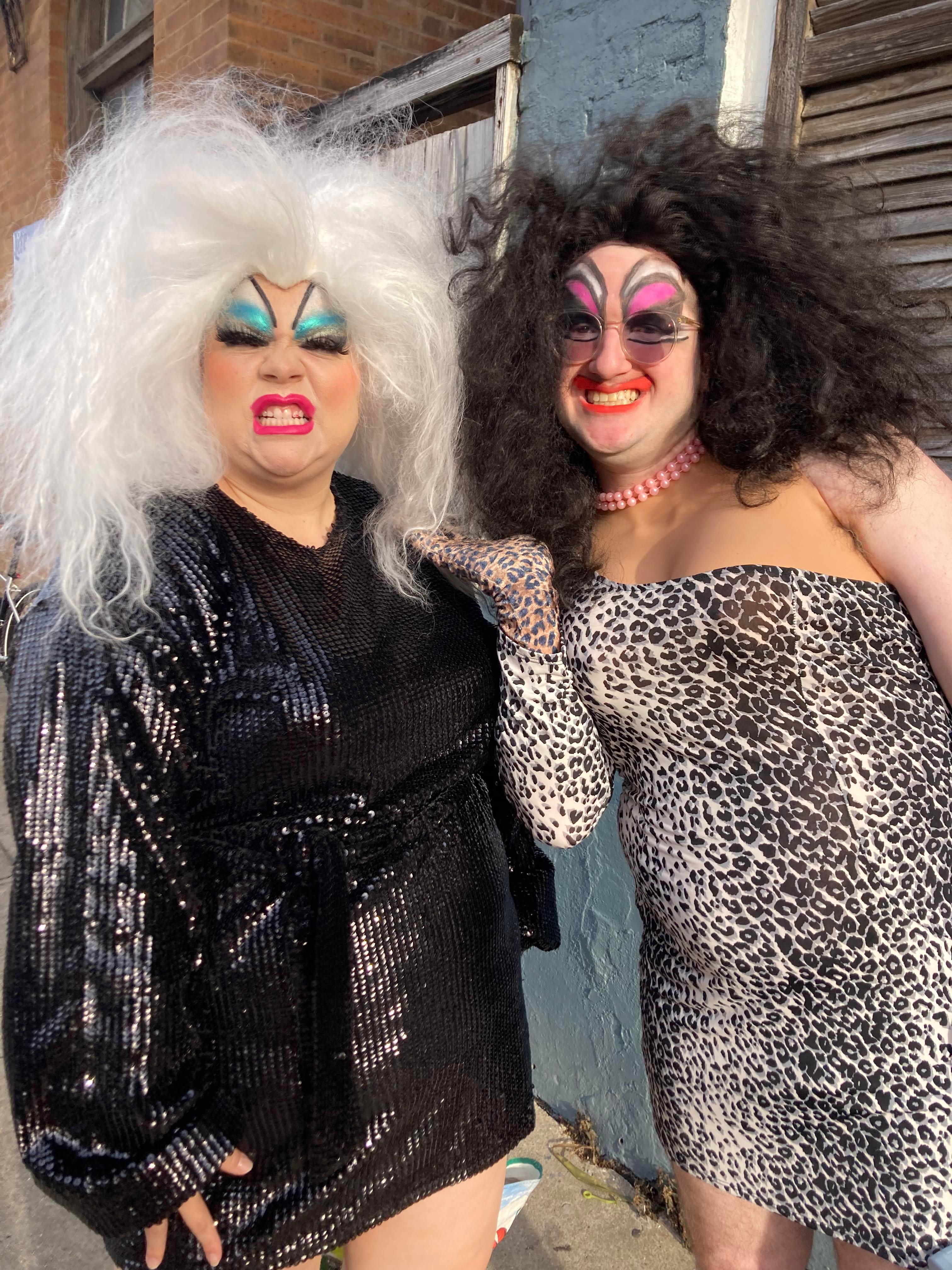
Krewe Divine 2023

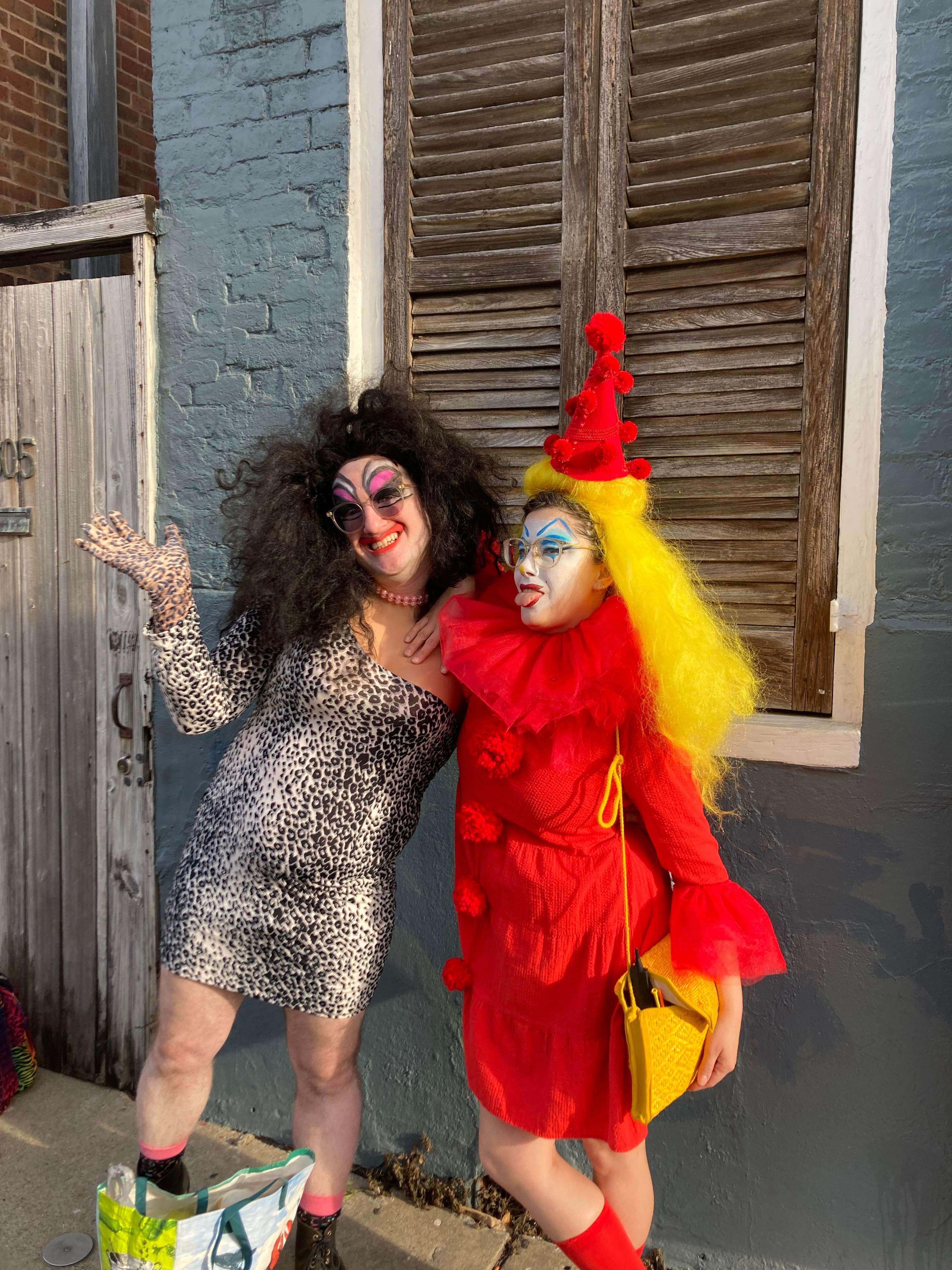
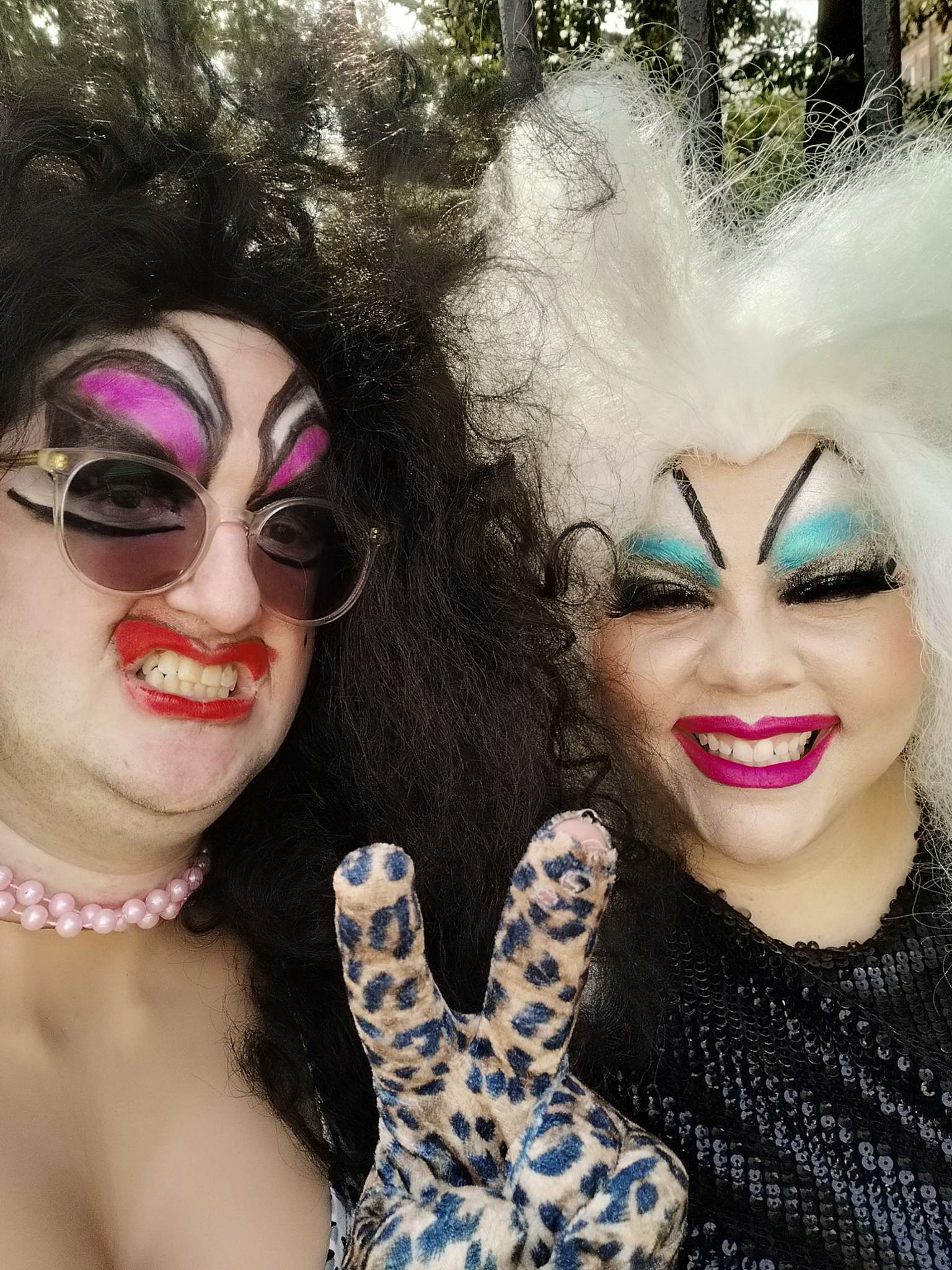
For Carnival 2017, a few members of the Swampflix crew joined forces to pray at the altar of the almighty Divine. The greatest drag queen of all time, Divine was the frequent collaborator & long-time muse of our favorite filmmaker, John Waters. Her influence on the pop culture landscape extends far beyond the Pope of Trash’s Dreamlanders era, however, emanating to as far-reaching places as the San Franciscan performers The Cockettes, the punkification of disco, and Disney’s The Little Mermaid. Our intent was to honor the Queen of Filth in all her fabulously fucked-up glory by maintaining a new Mardi Gras tradition in Krewe Divine, a costuming krewe meant to masquerade in the French Quarter on every Fat Tuesday into perpetuity.

Our initial krewe was a small group of Swampflix contributors: site co-founders Brandon Ledet & Britnee Lombas, regular contributor CC Chapman, and repeat podcast guest Virginia Ruth. We were later joined by local drag performer Ce Ce V DeMenthe, who frequently pays tribute to Divine in her performances. There’s no telling how Krewe Divine will expand or evolve from here as we do our best to honor the Queen of Filth in the future, but for now, enjoy some pictures from our 2023 excursion, our fifth year in operation as Swampflix’s official Mardi Gras krewe (and our first year returning after the COVID-19 outbreak of 2020):

Eat Shit!

❤ Krewe Divine ❤

Podcast #180: Gentlemen Prefer Gentlemen Prefer Blondes (1953) to Blonde (2022)

Welcome to Episode #180 of The Swampflix Podcast.  For this episode, Brandon, James, Britnee, and Hanna discuss the classic films and lasting legacy of Marilyn Monroe, from her beloved comedies like Gentlemen Prefer Blondes (1953) to her post-modern post mortem Blonde (2022).

00:00 Welcome

2:00 Krewe Divine
3:30 Divine Trash (1998)
4:36 Attachment (2023)
8:35 SexWorld (1978)
12:15 Bijou (1972)
15:58 The Red Shoes (1948)
18:10 A Matter of Life and Death (1946)
20:35 Chan is Missing (1982)
21:51 Caravaggio (1986)

26:04 Blonde (2022)
44:30 Gentlemen Prefer Blondes (1953)
58:56 Some Like It Hot (1959)
1:16:23 Niagara (1953)
12:25:25 Don’t Bother to Knock (1952)

You can stay up to date with our podcast through SoundCloudSpotifyiTunesStitcherTuneIn, or by following the links on this page.

-The Podcast Crew

Lost Junction (2003)

I don’t know about you, but when I find an aughts-era Neve Campbell thriller set in the hot, sticky depths of the American South, I expect it to be a knockoff Wild Things. A real trashy one. It turns out Lost Junction is more a knockoff of the Melanie Griffith matricide dramedy Crazy in Alabama, so it’s an entirely different kind of trashy. Instead of echoing Wild Things‘s audience-trolling triple crossings and poolside threesomes, Lost Junction offers trashy delights of a much weaker flavor: Neve Campbell struggling to master a Southern accent; an emotional plot-stopping monologue from acting powerhouse Jake Busey; a touristy road trip to pre-Katrina N’awlins; vintage CW visual aesthetics, etc. It’s rated R, but it’s Rated R for “Language,” since Campbell’s genteel Southern belle can’t stand to hear the gruff men in her life do a cuss, so they tease her with those cusses incessantly. I expected Lost Junction to be a Bad Movie; that’s fine. I just wasn’t prepared for it to be such a chaste one.

You’ll have to excuse my unusual lack of contextual bearings here. Lost Junction apparently did not exist prior to my stumbling across it at a local Bridge House thrift store, and only the thinnest of Wikipedia pages has had time to populate since that fateful purchase. To borrow some inane language from people who like to chat Avatar online, this film has no cultural footprint. It’s not even streaming on its obvious, destined home platform Tubi. The only reason a bad-taste loser would ever pick up a physical copy in the wild is whatever residual affection for Campbell as a screen presence still lingers so many decades after her Golden Age titles like Wild Things, Scream, The Craft, and Party of Five. There’s some small pleasure in seeing her do a half-speed Kristin Chenowith impersonation as the world’s most chipper femme fatale, but it’s not a good sign that Jake freakin’ Busey steals the show from under her with only a fraction of the screentime. By her tragic damsel’s own admission, she can’t cook, she can’t sing, she’s not that bright, and she’s kind of a prude. There’s not much to her at all outside her “Southern” accent and her off-screen history of domestic abuse. As a result, there isn’t much to the movie either.

Billy Burke costars as a generic Drifter With a Past who hitches a ride with the wrong dame, climbing into the Manic Pixie Murder Suspect’s car not knowing that her husband’s dead body is cooking in the trunk. Our star-crossed lovers meet in the first few frames, and although the film basically functions as a sunlit neo-noir, there isn’t much actual criminal behavior in their subsequent Bonnie & Clyde crime spree. The dead husband clearly deserved it, it’s frequently questioned whether Campbell actually did it, and most of the movie is a getting-to-know-you first date that happens to involve his rotting corpse (give or take a third-wheel intrusion from Busey). At least in Crazy in Alabama, Melanie Griffith took great transgressive delight in carrying around her husband’s head in a hatbox. Here, Campbell would rather just pretend that her husband never existed, which isn’t much fun for the (nonexistent) audience following along at home. The most incongruous cheeriness we get is in the impromptu road trip to New Orleans, where Campbell refers to our cemeteries as “neat little buildings” and the doomed couple dance at a bar called Gator Blues. It’s cute, but it’s not worth the commute.

While perusing her IMDb page to confirm that Lost Junction does indeed exist, I was shocked by how many films Neve Campbell headlined in the aughts. She basically disappeared from my radar at the close of the 1990s, outside occasional resurfacings as Sidney Prescott or as one of Don Draper’s anonymous hookups. It turns out there are plenty of post-Wild Things titles out there waiting to offer the sleazy Neve Campbell thriller that’s apparently missing in my life, titles like Intimate Affairs, Last Call, and When Will I Be Loved. Or, those are just more dusty DVDs waiting to prank me with eye-catching, tantalizing covers at the thrift store, only to reveal their overly demure nature once I take them home. I hope Jake Busey will be there as a third wheel to keep the mood light & chaotic, because there’s no way I’m going to avoid taking the bait a second or third time.

-Brandon Ledet

Lost Highway (1997)

I’ve been thinking a lot lately about how noir antiheroes are mostly just sad sack losers who make their own shit luck by feeling sorry for themselves, by which I mean I recently rewatched Edward G. Ulmer’s Detour.  Noir always looks different after watching Detour.  The Poverty Row production values look dreamlike & otherworldly instead of limited & cheap; the femmes fatales seem more deliberately, deliciously vicious in their misandry; and, most glaringly, the tough-guy alcoholics at the genre’s center start looking like whiny babies instead of macho lone wolves. Apparently, David Lynch sees the genre through those same grubby Detour lenses.  At the very least, his 1990s neo-noir Lost Highway turns the interchangeability of the genre’s drunken mopes into a kind of existential crisis. A Lynchian nightmare, if you will.  He tells two loosely connected noir stories about two unremarkable, pouty men, then gradually makes it clear they’re just same story repeated.  They’re all the same story, with the same miserable sad sacks circling the same drains.

Bill Pullman stars as a mopey saxophonist frustrated by his loosening grip on his straying LA hipster girlfriend (not unlike the down-and-out pianist who loses his girlfriend to her own Hollywood starlet ambitions in Detour).  Until he doesn’t.  Pullman disappears after the first act, inexplicably transforming into a young-dumb-and-full-of-cum teen mechanic played by Balthazar Getty, who quickly gets into his own girlfriend troubles when he falls for a gangster’s moll.  With Lost Highway, Lynch twists himself in knots trying to make the James from Twin Peaks archetype genuinely compelling in a second draft . . . and he eventually gets there, even if the slack-jawed, leather-jacketed drip needs a little supernatural help from a legit movie star like Pullman to pull it off.  Of course, neither of these parallel losers are as compelling as the femmes fatales that get them in lethal, cosmic trouble—both played by Patricia Arquette—but then again they never are. 

Because this is a David Lynch film, I’m zapping some of its magic just by “explaining” what happens and how it relates to larger genre filmmaking traditions.  So much of Lost Highway is composed of hypnotizing highway lines, Skinimarinkian hallways, and UFO-landing strobe lights that reducing it to a loose collection of noir tropes is somewhat insulting and very much beside the point.  Still, you don’t really need to hear that Lynch uses red velvet drapes to mark the boundary between reality & the dream world, or that the dream-logic procession of the plot(s) defies rational explanation; you’ve seen a David Lynch movie, you get it.  The only vivid deviations from his go-to formula are the temporal markers of when it was made: a Trent Reznor-supervised soundtrack, a Marilyn Manson cameo in a stag night porno, a mid-film spoof of road safety PSAs, etc.  On that front, real-life monster Robert Blake might outshine Arquette as the film’s MVP, dressed in the usual ghoulish make-up as one of Lynch’s trademark specters of Death, except this time armed with a menacing camcorder that updates the usual formula with some weirdo 90s video art.  It’s all very eerie, off-putting, frustrating, and strangely compelling, which is to say that it is a David Lynch film.

I do find it helpful to have some kind of a contextual anchor to help appreciate Lynch’s work.  I don’t want to be the guy who “maps out” the identity shifts, time loops, and dreamworld symbolism of Lost Highway as if it were a puzzle to be solved, but I also find very little enjoyment in the late-career formlessness of projects like Inland Empire and Twin Peaks: The Return, so it helps to seek a little guiding structure under the heavy layers of nightmare logic.  It’s the Philistine position to take, but I truly believe Lynch was at his best in his early career, when his most far-out, for-their-own-sake impulses were still somewhat tempered by Hollywood storytelling conventions.  With Wild at Heart and Lost Highway in the 90s, there was still just enough recognizable genre structure beneath Lynch’s loopy surface aesthetics that he hadn’t yet completely lost me. Hell, I’d even rank Wild at Heart high among his very best.  He was already pushing his subliminal anti-logic to its late-career extremes, but I detect enough familiar noir DNA in Lost Highway‘s bones to not feel totally abandoned.  And a lot of that has to do with how mopey & ineffectual its two parallel leads are at center stage, and how much fun Patricia Arquette has crushing them under her heels (when she’s not getting crushed herself by even more vicious bullies further up the Hollywood food chain).

-Brandon Ledet

Lagniappe Podcast: Antiviral (2012)

For this lagniappe episode of the podcast, Boomer, Brandon, and Alli discuss Brandon Cronenberg’s debut sci-fi horror grossout Antiviral (2012), a dystopian satire about the commodity of celebrity illness.

00:00 Welcome

06:30 Web of Death
08:50 The Man Who Wasn’t There (2001)
12:15 Magic Mike’s Last Dance (2023)
21:29 Infinity Pool (2023)
28:24 Knock at the Cabin (2023)
36:43 Missing (2023)
42:55 Lost Junction (2003)

44:57 Antiviral (2012)

You can stay up to date with our podcast through SoundCloudSpotifyiTunesStitcherTuneIn, or by following the links on this page.

-The Lagniappe Podcast Crew

Magic Mike’s Last Dance (2023)

Ten years ago, my friend Alicia and I walked into the Cinemark at Citiplace in Baton Rouge with a lot of excited middle-aged women to see Magic Mike, the then-new film directed by beloved (by us anyway) BR film icon Steven Soderbergh. Magic Mike had largely been marketed as an upbeat romcom about a hot dude raising money to start his own business by working as a male stripper. In the trailer, which starts out pretending that the film is about Channing Tatum as a cop before revealing his true profession, there’s a very 2012 needle-drop of Rihanna’s “We Found Love” and some romantic tension with romantic lead Cody Horn that would lead you to assume that you’re in for a much different kind of film than the one that hit theaters lo these many years ago. The advertising focused on star power — not so much of Tatum himself but of his taut body and the promise of a tantalizing thrill ride that still featured a traditional “Guy wants more from life, girl wants him but doesn’t know if she can handle his past” plot structure. You know, like a Nicholas Sparks adaptation but with a lot more dry humping.

That wasn’t the movie that we got that day. Instead, Magic Mike was kind of Diet Cola Boogie Nights, which is strange considering that we already had 54. The 2012 movie is one that spends most of its first half focused on Alex Pettyfer’s newcomer character and his introduction to the world of male stripping, and his narratively inevitable fall into the sex/drugs/rock’n’roll dark side of that lifestyle, while Tatum’s Mike is very focused on finding a way to grind—pun intended—-at whatever comes his way until he manages to rise above his current economic class. There are plenty of sexy dances, but they’re shot with a bit of a remove, and so what we’re left with is a tonal mishmash of cheesy rom-com dialogue, writhing torsos, and a storyline about drugs that doesn’t moralize further than “Some people can handle them better than others.” I can’t speak for everyone, but I can say that it wasn’t what I was expecting or what I wanted, and that the deluge of Baton Rouge moms who walked out of that screening also seemed to think that something different was supposed to have happened in that multiplex that day. 

Brandon is a big fan of the first follow-up, Magic Mike XXL, which eschews the first film’s director and direction, subbing in Gregory Jacobs for Soderbergh and, as Brandon wrote, “ditching its predecessor’s despondent character study in favor of an aging-boy-band-goes-on-a-road-trip slapstick comedy.” I understand the appeal, and I don’t think it was a bad idea to make a sequel that followed through on the unfulfilled promise of the first film’s marketing and also give it a lighter, fluffier narrative, and I find Donald Glover to be a welcome addition in anything that I’m watching, but it still didn’t connect with me. The first film purposely contrasted the dour realities of living under a broken economic system and the ways that people learn to cope inside of them with the larger-than-life stagebound fantasies that the boys got to portray. In XXL, the plot gets tiny little conflict injections as infrequently as narrative requirements allow while mostly taking the form of a goofy picaresque that mostly existed to hang strip sequences upon, and while I certainly understand the appeal, I just don’t connect. 

There was a moment in the screening of Magic Mike’s Last Dance when I turned to my friend who had accompanied me and asked: “How is this the best one?” And it’s not just better than the others (in my opinion), it’s actually great. 

This time around, we’ve got a narrator, and for reasons that don’t come into focus until the end of the first act, she’s young and has a British accent, and she’s telling the story of our old friend Mike Lane to catch us up on what’s happened in the intervening years. Mike’s furniture store folded during COVID, and he broke up with the woman he was presumed to have a happy ending with at the conclusion of XXL. Now he’s back to doing gig catering work, and he still hasn’t managed to claw his way out of his economic situation. While bartending at a charity event hosted by Maxandra “Max” Mendoza (Salma Hayek), who is recently separated from her media empire heir husband due to his infidelity, Mike is recognized by one of Max’s lawyers, who also happened to be one of the sorority girls from the party in the first film. To cheer up her boss, she recommends that Max invite Mike to give her a private dance, which he does after very little convincing. When the two wake up together the next morning, Max offers Mike a mysterious job, but he has to fly with her to London immediately. Once there, he meets her daughter—and our narrator—Zadie (Jemelia George) and their butler Victor (Ayub Khan Din), neither of whom approve of what Max is up to or, by extension, Mike’s presence. 

Max tasks Mike with a challenge: she owns a theater that was in her husband’s family for generations, and she’ll give him $60,000 for one month’s work of “redeveloping” the play that is currently being performed there. It’s a dreary-looking love triangle Victorian-era period piece called Isabel Ascendant that is considered old-fashioned and misogynistic even in-universe, and Max wants Mike to use his supposed knowledge of how to give women what they want to turn the play into an erotic, hip-thrusting masterpiece. This means firing the play’s director and, as a quirk of actors’ union labor laws, keeping on the actress playing the titular Isabel, Hannah (Juliette Motamed), who turns out to be as free of spirit as Isabel was repressed. With only three weeks until the curtain rises, Max and Mike have to recruit sexy dancers from all over Europe to fill out the ensemble while also dodging the various obstacles thrown in their way by Max’s soon-to-be-ex-husband. 

When I texted Brandon about doing coverage for this movie after I walked out of the theater, I was shocked to learn from him that it has such mixed reviews, but I think I have to chalk that up to … let’s politely call it “demographics.” Magic Mike wasn’t what it purported to be, sure, but it also wasn’t much of a fantasy either. Cody Horn is a gorgeous woman, but she’s not one with whom the presumed target audience of this kind of movie can readily identify. She’s hot, she looks great in her bikini, and she’s effortlessly cool. The same could be said of Amber Heard in XXL, and in neither movie is there ever any doubt about how the film will end and thus there are no stakes in those relationships, rendering them flat. Salma Hayek is also a gorgeous woman, and although she doesn’t look it, she’s 56, a full 14 years older than Tatum, and here she’s playing a woman with an ungodly amount of capital. I’m sure it’s not very common for someone’s wildest dreams to be about their partner cheating with their assistant, but there’s a lot to be said for the power fantasy of being a powerful older woman who can hire a maturing stud to create the ultimate sexy stage experience. Last Dance understands that better than the other two, and even though we know that the show will eventually have to go on, even if Max is rolling around in her overstuffed down comforters in a state of depression because it seems like her ex-husband has “won.” It’s called “Magic Mike’s Last Dance.” We know there’s going to be a big sexy revue at the end (and boy howdy is there). 

There’s a lot to really enjoy here. No one is more surprised than I am at how much I was won over by the ongoing subplot of Zadie and Victor. It would be so easy that it would almost be cheating to have Victor secretly be in love with his employer like something out of a Merchant-Ivory production, but there’s none of that nonsense here. I normally find precocious children to be grating and cloying in these movies, but it’s actually rather fun to watch Zadie have to occasionally step up and parent her mother as she goes through hard times, and for Victor to act in an unofficial grandfatherly capacity to get her back up to snuff. It’s not the stuff of Man Booker prizes—Zadie gets her mother out of the house and to the theatre for the finale of the film by finally addressing her as “Mum” instead of using her first name, which is a device that’s older than the hills—but it’s engaging in a way that I wasn’t really expecting for the third trip to this particular well. Hannah’s emceeing of the event is a hell of a lot of fun, and Motamed is a magnetic presence who leaves an impression on the viewer, standing out in a parade of male flesh that could easily wash her out of the mind completely, but she remains firmly rooted. 

In another way of fulfilling the fantasy, we the audience get to sit in on and attend the auditions for the revamped Isabel Ascendant and see all of the dancers get selected for their various individual talents: breakdancing, contortion, modern dance, ballet, and, of course, good ol’ fashioned stripping. It’s a fun montage, but also because it’s a montage, we never have to learn any names or have to try and keep track of them and their individual narratives as we were expected to in the previous films. As Peter, Bjorn, and John sang so long ago, “Flesh is flesh,” and that’s all that there is to it. All we need to worry about is having a good time, and although I’m sure that theatre reeked just as much of creatine farts as the back of the van in XXL, there’s something very classy and fun about it. As promised, the film does end with Magic Mike’s last dance, and it’s truly stunning, a demonstration that as much as mainstream critics like to tease Tatum, he is an amazing dancer who’s lithe and fluid in a way that belies his athletic build and his himbo public persona. The stakes are never too high or too low in the narrative, and the film rides that sweet spot for all that it’s worth, ensuring that this series goes out on a high note. 

-Mark “Boomer” Redmond

Missing (2023)

When I think of movie sequels that best their originals, what come to mind are the ones that go bigger, broader, and cartoonishly extreme, exploding the comparatively timid premises of their source texts – titles like Gremlins 2, Ghoulies 2, Child’s Play 2, Paddington 2, Batman Returns, and Magic Mike XXL.  In all of those examples, though, I still like the original films that preceded them, which is more than I can say for the volatile, twisty screenlife thriller MissingMissing is a spin-off sequel to one of my least favorite entries in the screenlife genre, Searching (a film that I should note Britnee reviewed very positively for this site back in 2018).  Searching wasn’t embarrassing in the way that lower-budget screenlife schlock like Safer at Home and Untitled Horror Movie can be, but I still resented it for cleaning up a trashy genre I love for its illogical technophobic fearmongering by turning it into safe, This Is Us-style melodrama.  Laptop-POV thrillers should prey on the eeriness of life on the internet, not act as tech-friendly advertisements that constantly reassure parents their terminally online children are actually doing okay.  It was basically Unfriended for the corniest of suburbanites, a perspective I was happy to see dropped in its much meaner, trashier sequel.

Missing improves on the Searching formula in practically every way, most of all in how it maintains a healthy paranoia around modern tech even while explaining why it’s useful (and in how it’s willing to put its characters in actual, sustained danger instead of just pretending to).  Storm Reid stars as the mouse-clicking, keyboard clacking internet detective du jour, a teenager who investigates the sudden disappearance of her mother—lost while vacationing in Colombia—from her laptop control room in California.  Missing‘s tone echoes the hokey schmaltz of Searching‘s parent-child melodrama, scoring its petty mother-daughter tensions with heart-tugging piano flourishes you’d expect to hear in an engagement ring jewelry store commercial.  Only, while Reid clicks away at the Ring cameras, location trackers, search histories, password workarounds, and username paper trails at her fingertips to solve the mystery of her mother’s disappearance, she’s revealing more than just the speedbumps & heartbreaks of modern familial bonds; she’s also cataloging the tools of the modern surveillance state.  The surface-level text of the film details the twists & turns of a Dateline-style “true” crime mystery and subsequent familial grief, while the glaring subtext is all about how deep privacy-invading technology has already seeped into our daily lives in ways we’ve learned to ignore, simply because it’s convenient.

One of the major things I love about screenlife thrillers (and one of the major reasons they’re dismissed as frivolous novelties) is their nimble ability to document of-the-moment trends in modern life online.  It’s something most other genres are scared to touch for fear of looking gimmicky or dated, despite computer screens accounting for so much of the visual data most audiences absorb on a daily basis.  There’s something fearlessly honest about engaging with that supposedly uncinematic imagery, but I also just like to imagine how incomprehensible screenlife aesthetics would be to earliest cinemagoers who were astounded by The Arrival of a Train at La Ciotat Station in 1896.  For its part, Missing doesn’t have many updates in modern screenlife to document, except maybe the frustrating ambiguity of Captcha challenges and the low-key hostility of a thumbs-up emoji.  It does have plenty notes about life outside of the computer, though, marking our cultural obsession with turning real life tragedies into true crime #content; zoomer teens’ uncanny savvy in navigating the back roads of social media; and our casual, collective acceptance of privacy invasion from vampiric tech-world capitalists.  On a more practical, immediate level, it’s most useful as a showcase for Reid’s skills as a young actor and editors-turned-directors Will Merrick & Nick Johnson’s understanding of screenlife’s unique visual language, since those three collaborators account for almost everything we see onscreen.  It’s a fun, well-staged mainstream thriller with just the right balance between social commentary, shameless sentimentality, and trashy what-the-fuck twists, when Searching only hit one of those three metrics.

-Brandon Ledet

Bijou (1972)

I’ve been trying out a new strategy when purchasing Blu-rays & DVDs lately, and it’s resulted in my modest collection quickly filling up with smut.  Instead of prioritizing tried-and-true personal favorites I know I’ll revisit in the future, I’ve pivoted to blind-buying movies I assume will never be accessible on streaming.  The plan was to finally see some independent, arthouse obscurities that fall through mainstream distribution gaps and, thus, eternally gather dust of my watchlist, but in practice it’s only prompted me to purchase more & more vintage pornography.  I can pretty safely assume that titles like Bat Pussy, SexWorld, and Fleshpot on 42nd Street will never populate on Hulu or Netflix, so I figure the best (legal) chance I have to see them is to own them.  That’s not to say there’s no overlap between high-brow experimental art and vintage porno.  In my casual, sporadic splurges on discounted discs, I’ve found plenty of artsy-fartsy filth to help refine my porno palate, including heavy-hitter titles like Equation to an Unknown, Pink Narcissus, Luminous Procuress, and, most recently, Wakefield Poole’s seminal classic Bijou.  There is a three-way intersection between D.I.Y. independent filmmaking, pretentious arthouse mindfuckery, and prurient perversion in these films that you can’t find anywhere else in cinema, which somehow makes owning them feel like an academic pursuit rather than a masturbatory one.

In that arthouse porno context, Bijou is considered by many connoisseurs to be the best of the best.  There’s a girthy stretch at its warped, misshapen center where I totally understand that claim.  I can’t fully vouch for its most stunning sequence’s lengthy bookends, though, which occasionally tested my patience despite their flagrant obscenity, as if I were watching Apichatpongian slow cinema instead of vintage smut.  The opening sequence is effectively a non-sequitur, featuring our main POV stud (Bill Harrison) leaving his construction site job, witnessing a deadly car accident, and snatching the purse of the woman who was run over.  He shakes off the guilt of that petty theft by masturbating in the shower, attempting to focus on the porno mag centerfolds hanging on his apartment walls instead of the tragedy he got himself needlessly involved in.  It takes 20 languid minutes for our well-endowed construction hunk to give into his obsession with the mysterious woman, following an invitation in her purse to the titular Bijou theatre, when the movie finally comes (and comes and comes and comes) alive.  The Bijou turns out to be less of a secret sex club than it is a phantasmagorical otherworld.  After following a few Alice in Wonderland instructions (signs flashing “Remove shoes” & “Remove clothes” instead of “Eat me” or “Drink me”), our main man finds himself in an endless black void decorated only with smoke, mirrors, tinsel, and nightclub lighting rigs.  His descent into the subliminal bowels of the Bijou is a gorgeous, disorienting display, recalling the funhouse mirror freakout at the climax of Orson Welles’s The Lady from Shanghai.  Then, a 30-minute orgy ensues among the “all-male cast,” gradually overpowering the D.I.Y. psychedelia with the monotony of a nonstop sex scene.

Wakefield Poole directed Bijou the same year that the Golden Age of Porno was supposedly kicked off by the mainstream success of Deep Throat, a film with much less pronounced artistic ambitions, to say the least.  His previous film The Boys in the Sand was a similar cultural landmark, covered like a Real Film by the trades in a way no previous gay porno could have hoped for, despite its weirdly muted legacy as a porno-chic landmark lurking in Deep Throat‘s shadow.  As a follow-up to that early critical success, Bijou seems less interested in mainstream attention than it is in academic pursuits.  The way Poole transforms his tiny NYC apartment into an endless liminal pleasure realm can’t help but recall the arthouse porno sensibilities of James Bidgood’s Pink Narcissus, which was filmed on the same kind of D.I.Y. “studio” set (although much less efficiently).  In its best moments, Bijou plays like the scrappier, more brutish kid brother of Narcissus, doubling down on the abstraction & obscenity of Bidgood’s work instead of the sub-Technicolor beauty.  Poole includes self-portrait camera tests and screen-test cast interviews as side-by-side slideshow projections, the kind of visual experimentation that was making waves in that era’s art galleries, not its porno theatres.  The classical soundtrack makes even the orgy sequence play like a perverse parody of Disney’s Fantasia, the closest that studio has ever gotten to genuine pomp & prestige.  In its most transcendent moments, Poole’s version of pornography can only be compared to art film experimentation, more often recalling Kenneth Anger than Gregory Dark (although all three directors likely had major influence on the music video as an artform).  Unlike Pink Narcissus, though, Bijou isn’t entirely comprised of transcendent moments, and it takes a little patience to get to the core down-the-rabbit-hole sequence that makes it such a well-regarded all-timer.

I don’t know that I have the passion nor the stamina to make it as a full-on, well-versed porno sommelier (for that, I will defer to Ask Any Buddy‘s Elizabeth Purchell, longtime Bijou advocate), but I do think it’s a genre I owe more time & attention, so it’s one I’m likely to continue collecting.  Swampflix doesn’t have much of a guiding ethos beyond promoting appreciation for low-budget, high-art genre filmmaking, and there is plenty pornography that deserves to be discussed & exalted in that context, alongside more frequently cited genres like action, sci-fi, and horror.  In that canon, Bijou is clearly a central, definitive text, even if its loopy, unrushed entirety can’t live up to the psychedelic transcendence of its best stretch.

-Brandon Ledet