See How They Run (2022)

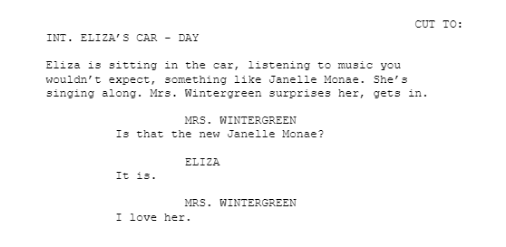
I recently talked on the podcast about my dear friend Ana Reyes’s astounding and well-deserved success surrounding her first novel, The House in the Pines (still #2 on the NYT bestseller list for hardback fiction as of this writing!). When we were all having drinks after the launch party back on January 3, her husband, who is also a writer and friend, mentioned to me that he and Ana had recently been talking about how ahead of the “cozy mystery” curve I was when I put together my pitch document/series bible for the as-yet-undiscovered project Mrs. Wintergreen. As I smiled a toothless grin that belied my bitterness that fate has not seen fit to bring Mrs. Wintergreen to life, I didn’t even point out that not only was that the case, but also that I had even included a scene in which my protagonist, 108-year-old semi-pro sleuth Constance Wintergreen, expressed an appreciation for Glass Onion star Janelle Monae:
Anyway. 

Agatha Christie is very in vogue, as evidenced by not only the aforementioned Christe-adjacent 2022 release Glass Onion, but also the Christie-containing See How They Run, a confident first feature from director Tom George penned by Mark Chappell, who is perhaps best known for his writing for the David Cross vehicle The Increasingly Poor Decisions of Todd Margaret. A period piece, the film begins on the night of the hundredth performance of The Mousetrap, a Christie-authored play which is infamous for two things: first, that there is a twist ending that the audience is encouraged not to reveal to others, resulting in the play’s ending remaining largely unknown to this day, and second, that the contract for the play forbids any adaptation of the source material to film (or the short story on which it was based from being published) until at least six months have passed since its final performance at London’s West End. This was a particularly long-sighted bit of legal play, as the show has run continuously (other than a COVID-caused pause) since its opening night in October of 1952, seventy years ago. In fact, I have some suspicion that this film exists solely for that reason, as it is the closest we can get to a Mousetrap adaptation for the foreseeable future. 

Leo Köpernick (Adrien Brody) is a sleazy slimeball of an American film director (redundant, I know) who has his sights set on turning The Mousetrap into a hit motion picture. That previously noted clause about the show being forced to close before this can even be a possibility is at the forefront of the minds of many involved, but theatre producer Petula Spencer (Ruth Wilson) assures him that the play has already reached its 100th performance and surely it will run out of steam soon, espousing the idea that a narrative with a whodunit at its core will, by its nature, see few repeat visitors and will necessitate closure sooner than later. Although we the viewers are sufficiently distant from this event that this is an historical irony for us, the contemporary American studio system is so confident that they already have Mervyn Cocker-Norris (David Oyelowo) working on a screenplay. Cocker-Norris’s English sensibilities and sense of adaptational faithfulness brings him into conflict with the flashy Köpernick, although the former is not alone in his distaste for the latter: British film producer John Woolf (Reece Shearsmith) is also protecting a scandalous secret about which Köpernick is blackmailing him; Köpernick is rude to all members of waitstaff everywhere, which includes the put-upon usher Dennis Corrigan (Charlie Cooper); and, mere moments before his murder at the ten minute mark, he is decked by Richard “John ‘Spared no expense’ Hammond” Attenborough (Harris Dickinson), who portrays the lead in The Mousetrap, for flirting with his co-star and wife Ann Saville (Pippa Bennett-Warner). The investigation of his death necessitates the appearance of Inspector Stoppard (Sam Rockwell), the archetype of the drunken detective who plays fast and loose with the rules; due to a shortage of available partners, he is paired with Constable Stalker (Saoirse Ronan), a plucky, energetic up-and-comer who is mere months away from being the first woman to take the sergeant’s exams. 

This is a neat little movie that makes sense in and of itself but also functions as a love letter to Christie and to her longtime fans, a body of which I consider myself to be a member. For instance: a scene in which the excitable Stalker asks a hotelier what part of France he is from based on the fact that he speaks French only to receive a deadpan response that he is Belgian is a fun comic bit in and of itself, but it’s also a nod to fans of Christie’s Belgian detective Hercule Poirot, who often finds himself on the receiving end of this exact misunderstanding. There’s also a good running gag about Hamlet: Early on, Attenborough says of The Mousetrap “It’s not exactly Hamlet.” Later, Stoppard half-quotes Act II Scene II’s famous ending line “The play’s the thing” [“Wherein I’ll catch the conscience of the King”], spoken when Hamlet commits himself to obtaining evidence of his uncle Claudius’s guilt through an elicitation of a confession upon seeing a fictionalization of Hamlet’s father’s murder. This is itself a circular reference, as not only does it reveal that Stoddard has realized that the connection between the murder of Köpernick may actually have to do with the play’s content, not its performance as initially suspected, but the word “mousetrap” likely comes from Hamlet in the first place as Hamlet refers to the play as a mousetrap in Act III Scene II (line 2131), in what may be the invention of the term. Your mileage is likely to vary on certain comic elements, of course; whether or not you find it clever that Cocker-Norris disdains screenplays that include flashbacks as crass and artless moments before one occurs in his narration is going to be left up to the individual viewer. I find his asking of “Whatever next? A caption that says, ‘Three weeks later’?” juxtaposed with that very caption to be charming and fun, but I know that others will find it to be more of a moment of bathos. 

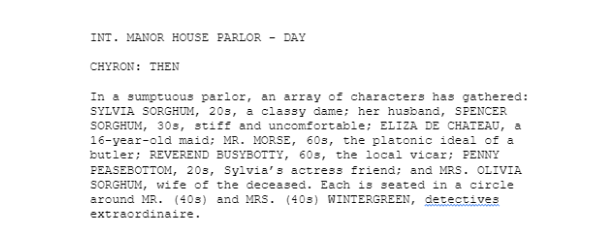
My favorite gag, however, cribs neither from Shakespeare or Christie, but Adaptation: in a flashback, much to the chagrin of Cocker-Norris, we get to see a little bit of how Köpernick’s mind works as he shows a series of storyboards that he put together for the climax of the film version of The Mousetrap. The images are quick cuts between detailed insets: gloved hands at a power box, a revolver being cocked by an unknown person, a fire breaking out in the middle of a tense standoff with a hostage—all of it very un-Christie and extremely Hollywood. This is Köpernick’s attempt to “jazz up” the very un-Hollywood and extremely Christie ending of the play, which uses one of her most well-known and genre-defining tropes: the end-of-the-story summation gathering, in which the detective gets everyone together in a parlor to explain their investigation and conclusion. In fact, not that it matters, but it’s so very much part of the genre that a parody of this type of scene is the very first thing that happens in the script for the Mrs. Wintergreen pilot, “Mrs. Wintergreen and the Thorny Dilemma” 
See How They Run turns this on its ear by playing both sides in the same way that Adaptation does, by mocking the hand that feeds it via denigrating comments about the formulaic nature of Hollywood adaptations, and then doing each and every one of the things that it mocks. The climax of the film takes place in a parlor that has the exact same layout, dimension, and decorations as the final set of the play, although this is obscured until the last possible moment to reveal it. The revolver, the fire, the standoff, the power box—the whole thing plays out in exactly the same way that Köpernick’s storyboard does. It’s a lot of fun to watch. (So would Mrs. Wintergreen be, I think, but I digress.) 

I was engaging with some essay or other this week and was taken aback when the author noted that, for all of his extremely large body of literary work, Isaac Asimov’s oeuvre rarely sees film adaptations, with only a handful ever being produced: Konets Vechnosti from 1987, based on The End of Eternity, which I assume must have had a subtitled release in the U.S. at some point but I can find no evidence of; the Robin Williams vehicle Bicentennial Man; two separate adaptations of the 1941 short story “Nightfall;” and, theoretically at least, I, Robot. In general, the world does not lack for Christie adaptations; they are so numerous that films based on And Then They Were None alone have their own Wikipedia subpage. The Mirror Crack’d from Side to Side was adapted as an episode of Miss Marple and Agatha Christie’s Marple, which are two separate television shows, as well as a film version in 1980 starring Angela Lansbury as Marple. When it comes to Christie media, we are the lilies of the field, neither toiling nor spinning, nevertheless arrayed in splendor. But we don’t have an adaptation of The Mousetrap, and we likely never will. Even if that day comes, there’s a risk it will be as dull and uninteresting as 2017’s Crooked House, which even Glenn Close and Gillian Anderson couldn’t save. What we do have is See How They Run, which is more than good enough; it’s great. 

-Mark “Boomer” Redmond

Podcast #178: On the Count of Three & 2022’s Honorable Mentions

Welcome to Episode #178 of The Swampflix Podcast. For this episode, Brandon, James, Britnee, and Hanna continue our discussion of the Top Films of 2022 with some honorable mentions, starting with the Jerrod Carmichael suicide comedy On the Count of Three.

00:00 Welcome

02:00 M3GAN (2023)
03:20 Shin Ultraman (2023)
05:25 Sick (2023)
07:25 Skinamarink (2023)

16:05 On the Count of Three (2022)
35:53 Aline (2022)
55:40 Lux Æterna (2022)
1:10:13 We Met in Virtual Reality (2022)

You can stay up to date with our podcast by subscribing on SoundCloudSpotifyiTunesStitcher, or TuneIn.

– The Podcast Crew

Swampflix’s Top 10 Films of 2022

1. Everything Everywhere All at Once Maybe we’re living in the worst possible timeline, but maybe we’re just living in the one where Michel Gondry directed The Matrix.  It’s nice here.  The absurdism, creativity, and all-out maximalism of Everything Everywhere has made it the most talked-about movie of the year, and with good reason.  Films about intergenerational trauma and poor parental relationships often come across as schmaltzy and reductive, but this one is complex in ways that you can’t predict or imagine.  You’ll even find yourself empathizing with a googly-eyed rock.

2. Marcel the Shell With Shoes OnIn the tradition of Honey, I Shrunk the Kids, the Borrowers books, and the half-remembered TV show The Littles, Marcel the Shell shrinks itself down to the level of a tiny being to view the world from their perspective.  Like the original stop-motion YouTube shorts, it’s a rapid-fire joke delivery system where every punchline is “So small!”  It also has a big heart, though, acting as an emotional defibrillator to shock us back into the great wide world of familial & communal joy after a few years of intense isolation. 

3. Mad GodBoth a for-its-own sake immersion in scatological mayhem and an oddly touching reflection on the creative process, the indifference of time, and the cruelty of everything.  Phil Tippet’s stop-motion descent into Hell is meticulously designed to either delight or irritate, so count us among the awed freaks who never wanted the nightmare to end.

4. RRR An anti-colonialist epic about the power of friendship (and the power of bullets, and the power of wolves, and the power of grenades, and the power of dynamite, and the power of tigers, and the power of bears, oh my).  A real skull-cracker of a good time.

5. Neptune FrostA post-gender Afrofuturist musical that triangulates unlikely holy ground between Space is the Place, Black Orpheus, and Hackers.  This movie is gorgeous, even if it takes more than one viewing to piece together a thorough understanding of its plot, since it phrases its protests against colonialism & strip-mining in the language of dreams & poetry.

6. Men If it weren’t for the tabloidization of Don’t Worry Darling, this would easily be the most over-complained about movie of 2022.  The Discourse was not kind to Alex Garland’s shift from chilly sci-fi to atmospheric folk horror, but the spectacular MPreg climax & Rory Kinnear’s terrifying face will haunt us forever anyway.

7. Triangle of Sadness A delightfully cruel, unsettling comedy that invites you to laugh at the grotesquely rich as they slide around in their own piss, shit, and vomit on a swaying luxury cruise ship.  It’s incredibly satisfyingand maybe even Östlund’s bestas long as you prefer catharsis & entertainment over subtlety & nuance.

8. Funny Pages Proudly wears its 2000s indie nostalgia as a grimy badge of dishonor, questioning why Ghost World and The Safdies can’t share the same marquee.  You might wonder where its alt-comics slackerdom fits in the modern world, but any dipshit suburbanite poser who’s ever romanticized suffering an “authentic” life as a starving artist in The City should be able to relate.

9. Nope After examining the horror of suburbia and neoliberalism in Get Out (our #1 film of 2017) and the horror of self and manifest destiny in Us (our #7 film of 2019), Jordan Peele’s latest is an oddly laidback, immensely scaled sci-fi thriller about a brother & sister’s fight to understand, outsmart, document, and monetize an extraterrestrial being beyond our comprehension.  Consider it a Signs of the times. 

10. Hatching A great entry in the Puberty as Monstrous Transformation canon, alongside titles like Ginger Snaps, Jennifer’s Body, Teeth, and CarrieHatching stands out in that crowd by adding an extra layer about mothers living through their daughters in unhealthy ways. In fact, we recommend all mothers and daughters watch this twisted Finnish fairy tale together; it’s gross-out fun for the whole family.

Read Alli’s list here.
Read Boomer’s list here.
Read Brandon’s list here.
Read Britnee’s list here.
See Hanna’s list here.
Hear James’s list here.

-The Swampflix Crew

Sick (2023)

Besides maybe the horny-old-biddies football comedy 80 For Brady being inexplicably set in 2017, the new straight-to-Peacock slasher Sick is likely to be the most conceptually bizarre period piece of the season.  The COVID-19 pandemic might be waning, but it is still ongoing, which makes screenwriter Kevin Williamson’s decision to set Sick in the early-pandemic days of Spring 2020 a little confusing, if not outright immoral.  COVID-themed horror that takes advantage of the pandemic’s of-the-moment novelty and finance-forgiving social isolation is now a three-year-old gimmick at this point, with early standouts like the excellent screenlife ghost story Host getting produced & released in the same timeframe when Sick is set.  So, why would Williamson bother stepping outside his highly successful slasher franchise Scream to dial the clock back to those early COVID days, when that’s already such an overcrowded market?  Apparently, it’s because he’s been itching to complain about people who are a little too zealous & militant about mask-wearing, social-distancing safety measures in public life, and he couldn’t be satisfied venting about it in a Facebook rant like every other Gen-X crank, so he made a feature film instead.

In its opening hour, Sick appears to take the ambient terror of COVID very seriously, likening it to the intangible menace of horrors like Final Destination, The Happening, and Skinamarink.  Again, this is a period piece set in the early wiping-down-your-groceries era of the pandemic, when coherent public understanding of how COVID spreads—let alone vaccines—had yet to formulate.  There’s an oppressive paranoia in all public life that’s distinct to that era, illustrated by how a single cough in a grocery store has all other shoppers shooting daggers in your direction.  The tension is instantly high, and the vibes are instantly bad, which is a great start for a lean, low-budget slasher with only 80 minutes of playtime.  It’s also a great excuse to isolate a slasher’s teens-in-peril victims, who plan to ride the pandemic out by self-quarantining in a cabin in the woods.  The knife-wielding killer who stalks them also comes pre-masked, as was the fashion (and legitimate safety precaution) of the time.  All of this COVID-based terror is cleverly considered, but once the killer’s face & motives are revealed, Williamson’s screenplay devolves from we’re-all-in-this-together societal camaraderie into bitchy “Some of you are taking this pandemic stuff a little too seriously” apathy, and all of the tension gives way to eyerolls & jerk-off motions.

As often as Williams is determined to step on rakes in the last few pages of his screenplay, a lot of Sick‘s faults are smoothed over by DTV action director John Hyams’s knack for bone-crunching impact & small-scale visual spectacle.  The novelty of COVID horror is fading, and the basic tropes of the home-invasion slasher are so familiar that Williamson made a name for himself mocking them in a meta-horror franchise nearly three decades ago, but Hyams manages to make Sick feel consistently thrilling & surprising from moment to moment.  Yes, we have already seen Jason Voorhees emerge from Crystal Lake as an unkillable ghoul, but have we ever seen him thrust his blade at victims from under the water, like a deadly-sharp Jaws fin?  Yes, we’ve already seen teens chased around a remote cabin after enjoying a few hand-rolled joints, but rarely with such creative, dynamic blocking & fight choreography – since most independent first-wave slashers of that ilk were made by youngsters who enjoyed a few beers & joints on-set themselves.  Honestly, Sick has all the hallmarks of a classic slasher: style, efficiency, brutality, novelty, and boneheaded reactionary politics that sour nearly all of those merits.  According to that scorecard, Hyams has acquitted himself, Williamson has embarrassed everyone and, as is always true, Jane Adams (whose role I won’t spoil) deserves better.

-Brandon Ledet

Britnee’s Top 15 Films of 2022

1. Barbarian This is the ultimate midnight movie of 2022, which is exactly what makes it the best movie of 2022. I tried my best to guess the next big plot twist over and over again, and I was wrong every single time. Nothing could have prepared me for what happens. It brought back the same feelings that I had when I first got into B-movies in my pre-teen years, but more importantly, it gave me faith that the art of trashy, ridiculous big-budget horror films is not dead. I rate this 5 full baby bottles.

2. Mrs. Harris Goes to Paris I adore charming, feel-good British movies, so it’s no surprise that Mrs. Harris Goes to Paris is ranked so high on my personal list. I laughed, I cried, I cheered, and I even screamed from pure joy. Mrs. Harris has become my role model, and I strive to be more like her every day.

3. After Blue (Dirty Paradise) Bertrand Mandico has a knack for creating some of the most beautiful atmospheres in modern film. More movies should be set in a sandy, post-apocalyptic paradise full of glitter, phallic plants, and hairy lesbians. I loved every second, even the 5,000+ times the characters said “Kate Bush”.

4. Hatching All mothers and daughters need to watch this twisted Finnish fairy tale. Its story is engaging, its body horror is haunting, and the practical puppeteering of the main monster completely blew me away. Everything about it is wonderfully unsettling.

5. The Northman Watching a bunch of tall, ripped Viking men commit brutal acts of violence for 2+ hours made me feel like such a pervert. Robert Eggers somehow managed to turn a Viking revenge film with a lot of heart and a couple of farts into a cinematic masterpiece.

6. Triangle of Sadness Rich people getting flung around a luxury cruise ship while covered in their own shit, piss, and vomit for a solid 20 minutes was the most satisfying thing I’ve seen all year.

7. The Eternal DaughterA wonderful Gothic ghost tale that I strangely connected with on a personal level. The film has a very small cast (half of it portrayed by Tilda Swinton) and takes place in a cozy, spooky English manor with not much going on, but it’s somehow riveting.

8. Mad God This is a pure nightmare that explores the depths of Hell within Hell through the best stop-motion animation I’ve ever seen. It’s so disturbing and even made me physically ill from time to time. How metal is that?

9. Fresh This starts off as a cute romcom but turns into something sinister while still maintaining its dark humor. I’ve never seen anything quite like it before, but I hope it starts a trend, because I really enjoyed it.

10. Resurrection Rebecca Hall gives the best performance that I’ve seen all year in a gut-wrenching monologue that’s about 10 minutes long. It’s also the best MPreg movie of 2022.

11. Aline This was such a goofy, heartfelt film that made me truly appreciate the legendary Celine Dion. I still don’t quite understand how or why it was made and got so much recognition, but I love that this weird little movie about a counterfeit “Celine Dion” made its way into my life.

12. Crimes of the Future The king of body horror does it again. I honestly was a little bored with the plot, but I was so mesmerized by all of the grotesque spectacle that I didn’t care.  

13. Men Rory Kinnear’s face will forever terrify me. This maintains an eerie atmosphere from beginning to end (very A24) that kept me engaged and creeped out throughout. Also, it’s the second best MPreg film of 2022.

14. Nope I’m not really a big fan of horror that crosses into the sci-fi realm, so I didn’t make watching Nope a priority. I’m ashamed I didn’t watch it sooner. This is such a badass movie that completely freaked me out in every way possible.

15. Deadstream I was not expecting this found footage horror to be equally terrifying and hilarious. It’s a blast, with loads of fun jump scares and unexpected turns.

-Britnee Lombas

Skinamarink (2023)

For anyone disappointed that Jane Schoenbrun’s microbudget darling We’re All Going to the World’s Fair was a somber teen-crisis drama instead of the low-fi creepypasta horror it was mismarketed as, Kyle Edward Ball’s Skinamarink might be the salve for your year-old wounds.  Curiously, the next project on Schoenbrun’s docket is titled I Saw the TV Glow, which is the closest thing to a coherent plot synopsis you could apply to Ball’s narrative-light experiment in digital-grained dread.  Skinamarink is crowdsourced Internet Age horror, both in funding and in conception.  After honing his craft by adapting user-submitted dream journals into horror shorts on his YouTube channel Bitesized Nightmares, Ball crowdfunded a feature-length amalgamation of those comment-section submissions’ most common themes & images for his official, theatrical debut.  Skinamarink was essentially conceived by the internet hivemind.  It was marketed by it too, illegally leaked out of online film festival platforms and spread around as a slumber party-style dare among TikTok Zoomers, as if it were vintage found footage instead of an upcoming theatrical release.  Whereas We’re All Going to the World’s Fair is about creepypasta, Skinamarink is a genuine example of it, which makes the two films an unlikely, unholy pair (and possibly just the start of a larger, not-yet-defined Internet Age film movement).

It’s easy to forget Skinamarink‘s Internet Age DNA in the moment, though, since it’s aesthetically nostalgic for an earlier era.  While the look & feel of Skinamarink conjures memories of impossibly late nights spent online in my teen years, its 1995 setting dials the clock back even further to a time before when it was affordable to bring the internet home.  Ball shot the film in his own childhood home, perfectly preserved with popcorn ceilings and unstylish lighting fixtures that recall a bland childhood everyhome.  In its one overtly nightmarish conceit, two young siblings—Kevin and Kaylee—wake to discover that not only are their parents missing, but the doors & windows to the outside world are missing too, with the remaining smoothed-out walls forming an endless, featureless labyrinth.  Ball creates a first-person-POV childhood nightmare experience by removing all possible distinguishing features from both the setting and his characters, ensuring there are no framed art pieces, family portraits, or even characters’ faces to differentiate this eerie childhood memory from your own (presuming you’re old enough to remember a pre-internet world).  The exact vintage toys, cartoons, and drab carpeting of a 90s childhood immerse the audience in an uneasy familiarity with this forgotten psychic space.  Even the title—a reference to an ancient novelty song best remembered as the repurposed theme for The Elephant Show in the 1980s—feels eerily familiar, but initially difficult to place.

That dual familiarity to 1990s suburban homes and 2000s internet subdungeons is an important sensory anchor in a film with very little narrative structure to speak of.  Kevin and Kaylee are young children with malleable minds, so they take the sudden disappearance of their parents & escape paths as a simple matter of fact, choosing to ride out the nightmare by playing with their off-brand Legos in front of public-domain Fleischman cartoons looping on the basement TV.  On their occasional excursions up the stairs and down the hallways it becomes increasingly apparent that something is in the house with them, an evil presence that’s destined to be colloquially known as The Skinamarink as this film’s legacy stretches into the future.  To explain how The Skinamarink torments these faceless children in this featureless suburban prison would spoil the three or four identifiable events in the otherwise sparse 100 minutes of film grain & room tone.  It’s a work mostly made of textures, not narrative.  The heavily distorted tape hiss & digital grain invite you to lean in, searching for something tangibly evil in the undulating darkness.  You do eventually find it, usually in loud flashes that interrupt long stretches of wooshy quiet with the arthouse equivalent of a jump scare.  What’s much more important is the dread you feel looking for something that isn’t there, though, which leaves a much starker, more memorable impression than the spooky shapes The Skinamarink eventually takes.

Skinamarink is simultaneously a familiar experience and an alien one, mixing generic horror tropes with an experimental sensibility – like a Poltergeist remake guided by the spirit of Un Chien Andalou.  It’s the kind of loosely plotted, bad-vibes-only, liminal-space horror that requires the audience to meet it halfway both in emotional impact and in logical interpretation.  In the best-case scenario, audiences will find traces of their own childhood nightmares in its darkened hallways & Lego-piece art instillations.  Personally, I was more hung up on the way it evokes two entirely separate eras of my youth: my alone-time online as a sleep-starved teen and my alone-time in front of cathode TVs as a sleep-starved tyke a decade earlier.  There’s some dark magic in the way it buries its analog horror tropes under a heavy digital shroud, and the looping, undulating patterns of the digital film grain were often just as mesmerizing as the search for the monster they obscure.  Even if the film doesn’t ignite your brain on that digital-psychedelia level or stir a more sinister, subliminal reaction in your chest, its immediate financial & cultural success is still a victory worth celebrating.  It isn’t often that a film this strange breaks out of the straight-to-Shudder release model, much less one shot in a single week for $15,000.  Skinamarink is a good omen for the continued theatrical distribution of Weird Art in our sanitized corporate hell-future, even if it plays like a cursed internet broadcast from a post-theatrical world.

-Brandon Ledet

Alli’s Top 5 Films of 2022

1. Marcel the Shell with Shoes On

I have loved Marcel since my husband showed me the first stop-motion short on YouTube a decade ago. It sparked a love for Jenny Slate that makes me excited to watch anything she’s in. When this movie was first announced, I was squealing in excitement throughout my house, so I was pretty hyped up. Despite going in with extremely high expectations, I absolutely loved it. 

Marcel is as charming as ever, rolling around in his tennis ball “rover” and showing off his “breadroom”. Isabella Rossellini is amazing as Grandma Connie, dispensing tough love and working in her little garden with her little bug friends. All the wonderful tiny details are just beautiful. And that’s part of what this movie is about: appreciating the small day-to-day details and the processes we use to get through life, not taking anything for granted, and keeping your head up through the tough times. It’s also a look at what family and community truly mean. 

I’ve mentioned it on the podcast, but my grandma died this past year. We were far apart at the end of her life, but I was very close and lived with her off and on as a child. Watching Marcel’s relationship with Connie was really nice and beautiful. I cried so hard, but there’s so much hope and warmth to this movie that it doesn’t leave you sad. You keep your head up and appreciate what you’ve got, because the world can be a nice place.

2. Fire of Love

There was no world in which I wouldn’t love this documentary.

#1. I am absolutely fascinated with volcanoes! (Brandon and I actually met in a geology class that spent a good amount of time on volcanoes! He borrowed my notes! Look at us now!)

 #2. I love love, and this movie is absolutely a love story.

With captivating narration by Miranda July, this documentary tells the story of Katia and Maurice Krafft: two vulcanologists who fell in love, got married, and lived & died by the volcanoes they also loved. They filmed countless hours of footage of volcanoes and themselves studying them and not just in straightforward ways. The videos they made were purposeful, cinematic art. Their obsession with these destructive and creative forces is contagious, even as you learn that they lost their lives to it in to the eruption of Mount Unzen in 1991. They took risks, lived passionately, and loved each other, flaws and all.

Once again, I cried even knowing the ending was coming.

3. Everything Everywhere All at Once

The absurdism, the creativity, and the all-out maximalism of this movie blows my mind. Who hasn’t pondered in recent years the multiverse and whether we’re living in “the worst timeline?” (To me, the answer is no, but we’re not living in the best one either.) Where are the best or weirdest versions of ourselves? Maybe these questions aren’t directly answered in this film, but they’re seriously considered. 

Michelle Yeoh and Ke Huy Quan are both incredible. I also love Jamie Lee Curtis looking like a regular person! The choreography of the fight scenes is fantastic. Hot dog fingers! Googly eyes! EVERYTHING bagel! This movie has it all and a heart of gold.

4. Neptune Frost

A psychedelic, non-linear, romantic Afrofuturism musical that questions gender, colonialism, capitalism, technology, and the intersections thereof. This movie is a beautiful experience, and there’s nothing like it. Go in with an open mind and enjoy the ride.

5. Guillermo del Toro’s Pinocchio 

I’m the #basiccinemabitch of Swampflix in that I pretty much love everything del Toro has ever done. I’m not fanatical enough to seek out something just because his name is on it, but everything I see with his name on it is something I at least appreciate. Despite that, I still went into this movie skeptical. There are Disney remakes and “live action” adaptations of Pinocchio coming out practically every hour, so did we really need another one? Well, when the moral of the story is to be yourself even if that means being an annoying agent of chaos, then yes, we did need another. 

Yes, this is del Toro, so of course there’s fascism afoot. No, not all of the songs are good. Yes, it has the familiar del Toro motives and goth sensibilities. No, you will not appreciate it if you never liked his shtick or are over it.

The stop-motion animation is absolutely gorgeous. Every character design is just so good. The story, despite being familiar, is also wonderful. I love that this movie manages to capture how hyper and wild kids can be, and that it celebrates those qualities. Plus, there’s biblically accurate angels, mockery of the crucifix, and a song about poop sung directly to Mussolini. Who cares about being a real boy? Become ungovernable. 

-Alli Hobbs

Lagniappe Podcast: The Tree of Wooden Clogs (1978)

For this lagniappe episode of the podcast, Boomer, Brandon, and Alli discuss the neorealist Italian poverty drama The Tree of Wooden Clogs (1978).

0:00 Welcome

03:58 Marcel the Shell with Shoes On (2022)
08:22 Queen of Versailles Reigns Again
15:52 Blue Lagoon: The Awakening (2012)
19:10 Rosaline (2022)
22:40 Blue Hawaii (1961)
26:40 M3GAN (2023)
33:50 The Woman in Black (2012)
37:59 The Best Little Whorehouse in Texas (1982)

41:47 The Tree of Wooden Clogs (1978)

You can stay up to date with our podcast through SoundCloudSpotifyiTunesStitcherTuneIn, or by following the links on this page.

-The Lagniappe Podcast Crew

Shin Ultraman (2023)

Just as the original Godzilla series quickly backslid from heartbreaking political allegory to novelty children’s fluff, Hideaki Anno’s Shin Godzilla franchise starter has already made way for quirky kitsch in its immediate follow-up – Shin Ultraman.  I could not be happier about it.  While Shin Godzilla is the smarter, more thematically purposeful film, Shin Ultraman is the more fun, breezy, rewatchable one.  It continues Shin Godzilla’s satirical illustration of the ineffectiveness of bureaucracy in the face of a kaiju-scale threat, but that governmental buffoonery is more of a background hum here than it is the main show.  Anno’s Ultraman film—which the Neon Genesis Evangelion mastermind wrote, produced, edited and, most surprisingly, mo-capped—is more of an upbeat celebration of both sides of the human/monster divide.  It crams in tons more of the skyscraper CG monsters than Godzilla’s solo outing could manage (although the individual designs of Godzilla’s Pokémon evolutions were a major highlight in the earlier film), and it also celebrates the humans below as adorable dorks who are just trying their best in a world stacked high against them.

If Shin Ultraman echoes any of Shin Godzilla’s high-minded artistic merit (beyond a main-cast performance from Drive My Car’s Hidetoshi Nishijima), it’s in its look & pacing.  Director Shinji Higuchi shoots governmental office scenes like he’s competing with Soderbergh in full showoff mode, finding the most improbable camera angles possible to accentuate the absurdism of modern office work’s fluorescent-lit mundanity.  Anno matches that overachiever energy in the editing room, cutting between Higuchi’s off-kilter shot compositions with a distinct anime sensibility – always going 10,000% hard no matter the occasion, even when depicting paperwork.  That dynamic attention to detail makes this a formidable contender for one of the most visually impressive comedies in decades; it’s just also one of the goofiest.  Instead of trying to conjure realistic-looking CG monsters (which was never a concern in the genre’s early rubber-suit days anyway), Shin Ultraman’s kaiju creatures lean into the uncanny end of the medium. That means it will be taken less seriously than aggressively dour competitors like Gareth Edwards’s American Godzilla film from 2014, but also means it’s a lot more fun to watch.  If it resembles any big-name kaiju movie from the past couple decades, it’s the goofball free-for-all Big Man Japan, which is at least a comparison that does it a lot of favors.

Story-wise, Shin Ultraman returns its titular space alien superhero to his children’s TV roots, pitting him against a series of skyscraper monsters in a consistent episodic rhythm.  Ultraman walks among us in a barely concealed Clark Kent disguise, powering up to kaiju scale whenever another post-Godzilla CG monster emerges to tear up Japanese cities & countryside.  His Earth-saving superheroics are even scored by a tin-canny mix of 60s throwback stock music presumably lifted from the original Ultraman series.  It’s a familiar formula for anyone old enough to remember a pre-MCU media landscape, but in the 2020s its vintage earnestness feels remarkably refreshing.  Ultraman is genuinely fascinated with the go-getter exuberance of the human spirit—especially when threatened by impossible odds—and, by extension, so is the film.  The hook of seeing Shin Ultraman big & loud at the theater is in the promise of weird-looking CG monsters doing battle over miniature cities while shooting laser beams out of their eyes, hands, and mouths.  Once your butt is in the seat, though, the real show is in its celebration of humanity’s adorable perseverance & naivete.  It can’t help but feel a little frivolous in comparison to the political cynicism of Shin Godzilla, then, but that unashamed frivolity is incredibly endearing.

Maybe I’m making Shin Ultraman sound like disposable kids’ fluff here, and in some ways maybe it is.  Its plot machinations surrounding intergalactic superweapons that can transform human beings into kaiju-scale war drones and Ultraman’s superheroic sacrifice in merging his alien DNA with a human’s are all old-hat comic book nonsense.  I’d much rather watch earnest nonsense like this than its ironic callbacks in post-modern works like Big Man Japan & Psycho Goreman, though, which borrow from the pop art beauty of its vintage kitsch but are too embarrassed to be mistaken for the genuine thing.  There’s plenty “adult” material lurking under this film’s Saturday Morning Cartoon surface too – from the governmental bureaucracy satire to the CG psychedelia to the momentary indulgences in sexual fetishism (including some especially shameless pandering to the giantess community).  They’re just not the main draw.  Shin Ultraman is a delight precisely because of its childlike exuberance, which is just as fitting to its titular alien hero’s television origins as Shin Godzilla’s political cynicism is to the original Gojira.

-Brandon Ledet