The Nightmares on Broad Street

The early-Fall lull between the Summer Blockbuster schlock dump and Awards Season prestige rollouts is always somewhat of a cinematic dead zone, but this year’s has been especially harsh.  The ongoing SAG/AFTRA strikes have scared major studios into delaying some of their biggest Fall releases for fear that their marketing would fail without the star power of a Zendaya or a Timmy Chalamet doing traditional promo, leaving very little of note on the new release calendar (until the Studios cave on those actors’ reasonable demands for fair compensation).  I’m sure it’s been a strain on movie theaters in the meantime, and I hope that they squirrelled away enough of that sweet Barbenheimer money this summer to survive the drought.  Speaking selfishly, though, it’s been awesome for me as a regular moviegoer.  Stumbling into this new-release wasteland during Halloween Season inspired local indie theaters to get creative in their respective repertory programming, resulting in what has got to be the greatest month of local film listings I can remember in my lifetime (with the caveat that I grew up in the era when suburban AMC multiplexes strangled the life out of what used to be a much more robust New Orleans indie cinema scene).  I spent most of October bouncing and forth between The Broad and The Prytania on the same #9 Broad bus line, frantically catching as many never-seen-on-the-big-screen horror titles as I could while the getting was good.  And there were still plenty more I missed that I would’ve loved to see properly projected, including the early Universal Horror all-timer The Black Cat.  What a time to be unalive!

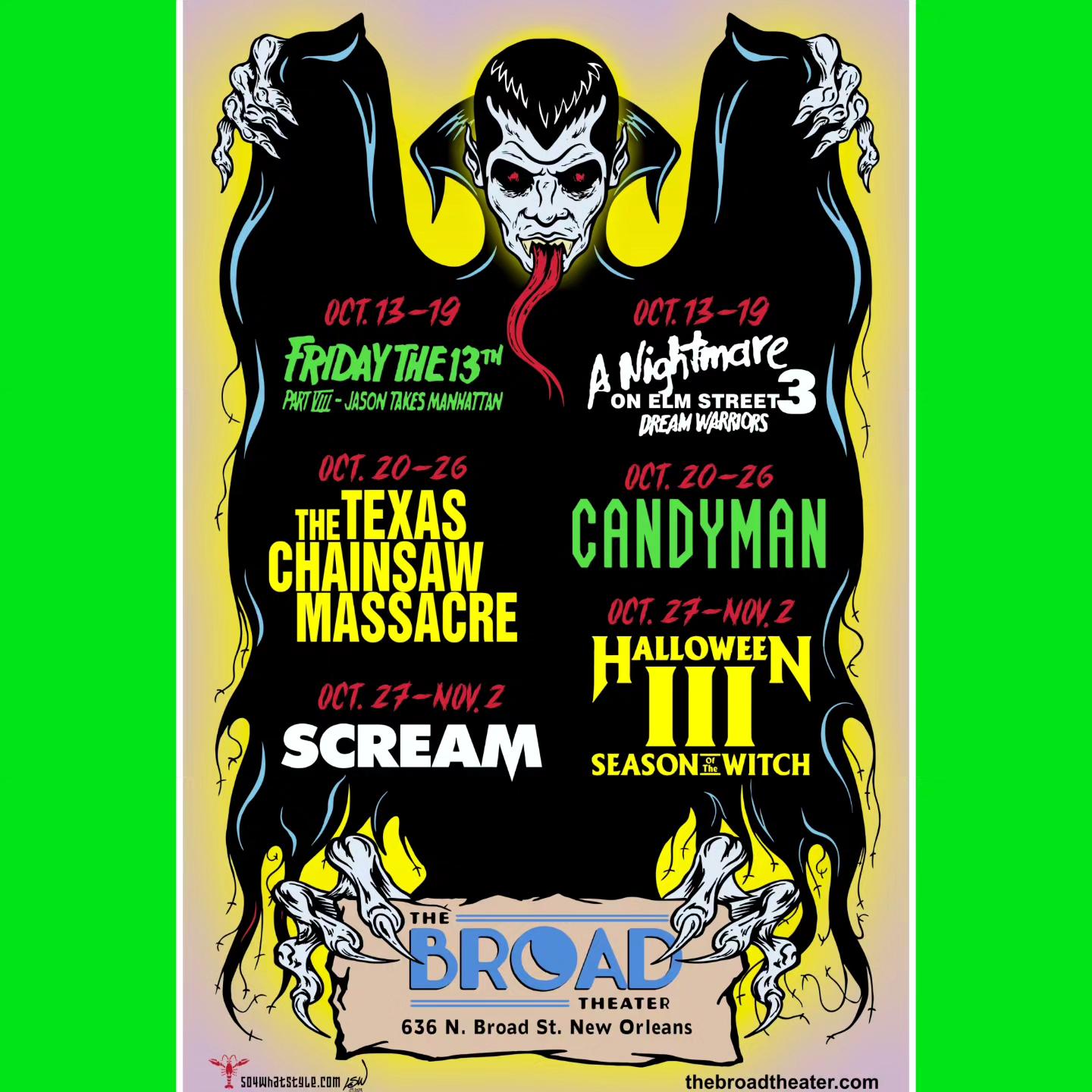
If I were to parse out the two distinct flavors of these theaters’ dueling Spooktober line-ups, I’d say The Prytania offered an older, dustier variety of venerated genre classics while The Broad offered slightly warped cult favorites of the video store era.  I personally trekked out to The Prytania to see odds-and-ends obscurities I’d never seen before at all, let alone on the big screen (Dracula’s Daughter, Bell, Book and Candle, The Creeping Flesh), but they also programmed a long list of definitive Hall of Fame horror classics that should be checked off of any genre fan’s personal watchlist (Don’t Look Now, Psycho, The Wicker Man, The Shining, The Exorcist, etc.).  Meanwhile, The Broad’s lineup made a few more surprising, left-of-field choices, mostly in straying from the classics to instead screen their most chaotic, divisive sequels.  While The Prytania screened the John Carpenter slasher-definer Halloween, The Broad screened its Michael Meyersless sequel Halloween III: Season of the Witch.  While The Prytania screened fellow slasher-definer Friday the 13th on Friday the 13th, The Broad screened Friday the 13th, Part VIII: Jason Takes Manhattan, its most over-complained-about sequel.  The Prytania’s schedule was so plentiful with exciting horror titles this October that I hardly had time to watch movies anywhere else, but I pushed myself to catch the most esoteric selections in the “Nightmares on Broad Street” program anyway, just to support the iconoclasm, as detailed below.  And while I’m comparing the two theaters’ programs here, I should note that the one film they both played last month was Wes Craven’s teen meta-slasher Scream, which I suppose makes it their consensus pick for the greatest horror film of all time.

A Nightmare on Elm Street 3: Dream Warriors (1987)

The most rewarding trip I had to The Broad this October was to revisit Dream Warriors, a movie I mostly remember from late-night cable broadcasts and oft-repeated Blockbuster VHS rentals.  The film marks Heather Langenkamps’s return (and shockingly morbid departure) as the series’ Final Girl figurehead, now a young medical student researching violent sleep disorders in order to help suffering teens survive nightly dreamworld visits from Freddy Kreuger.  The film’s limited setting in a mental hospital narrows its focus to a small group of traumatized teen insomniacs and their befuddled doctors who can’t quite figure out how they all suffer from the same group delusion that causes them to self-harm; spoiler: it’s because Freddy is real.  Dream Warriors has long been a favorite of mine in the series due to the novelty of its imaginative kill scenes, which include Freddy puppeteering one of his victims using their exposed veins as marionette strings and Freddy transforming his finger-knives into hypodermic needles to feed the hungry mouths of another victims’ pulsating track marks.  It’s pretty fucked up, especially since it’s combined with Freddy’s early stirrings as a stand-up comedian – crushing one victim’s head with a television while quipping “Welcome to primetime!,” declaring another victim “tongue-tied” after literally tying them to a bedframe with his detachable tongue, and punctuating every misogynist kill with the punchline “Bitch!”.

What will always stick with me about Dream Warriors now, though, is that it’s the only Nightmare on Elm Street movie that has managed to make me cry.  Maybe I’m getting too soft in my old age, or maybe it was just the theatrical atmosphere replacing the film’s usual brewskies-on-the-couch presentation, but I got unexpectedly emotional watching these kids get disbelieved and blamed for their own illness for so long before finding unexpected strength in solidarity.  Every authority-figure adult in their lives is dismissive of their nightly suffering except the one who happened to go through their exact supernatural torture in her own youth, and then she teaches them how to fight against their isolating threats as a collective group through lucid dreaming.  It’s oddly sweet, even as it is hideously gruesome.  It’s probably no coincidence that the three best-remembered Elm Street movies are the ones Wes Craven had a direct creative hand in—the original, Dream Warriors, and New Nightmare—and, while I might personally prefer New Nightmare in that trio, they’re certainly all worthy of standalone repertory programming.  Not many theaters would take a chance on the sequels outside a marathon context, though, so Dream Warriors immediately registered as mandatory viewing, even in such a crowded month.

Friday the 13th Part VIII: Jason Takes Manhattan (1989)

Speaking of slasher sequels no one would usually take a chance on, holy shit.  Dream Warriors has plenty of long-running goodwill among horror addicts as one of the best of its franchise, but Jason Takes Manhattan has a long-running reputation of is own as one of its franchise’s worst.  Wrongly.  The standard-issue complaint about this much-mocked slasher sequel is that it’s flagrantly mistitled, promising that Jason Voorhees will take a grand budget-burning tour of New York City, when in reality he spends most of the runtime killing teens on a boat trip to the city.  Given that marketing department disappointment, I wish the film had simply been retitled Jason Takes a Cruise to calm the horror nerds’ nerves.  Complaining about the locale of Jason’s tireless teen slayings in this outing three decades after the first-weekend jeers is idiotically shortsighted & petty, since Jason Takes Manhattan is scene-to-scene the most memorably entertaining entry in its franchise, give or take Jason X (which is mostly set on a ship of sorts itself).  En route to Manhattan, Jason punishes high school seniors for celebrating graduation with the old-fashioned teen sex, drugs, and rock ‘n’ roll that he loathes so deeply: filming amateur rock videos in the engine room, snorting coke off mirrors in the supply closet, and seducing the uptight principal to get out of completing their science fair projects.  It’s a random assemblage of quirky slasher-teen behavior that even on land would be more entertaining than the snoozy cabin-in-the-woods doldrums of earlier Friday the 13th sequels, and then the Manhattan-themed rampage promised in the title is delivered as a sweet novelty dessert.

If anything, there’s something immensely satisfying about the way Jason’s whirlwind Manhattan tourism is delayed for a condensed, climactic payoff instead of being drawn out into urban slasher tedium.  An opening credits sequence details the grimy back-alleys of 1980s NYC, particularly focusing on a barrel of toxic sludge that serves as the bathtub for a gigantic rat.  We do not return to that alley until the third act, when Jason drowns the film’s most detestable character headfirst in that exact barrel, the rat now dead beside him to emphasize just how gross the sludge truly is.  There’s also some great metaphysical character at work here as well, where Jason now appears to be made entirely of toxic sludge himself, having been submerged in the murky waters of Crystal Lake for so long that he’s essentially a hulking collection of sentient goo.  His younger, drowned self appears to the film’s Final Girl in frequent, psychedelic hallucinations during the boat trip to Manhattan – underlining the killer’s supernatural constitution, connecting his qualities as an aquatic zombie to the waters that connect Crystal Lake to the Hudson Bay and, frankly, killing time between his actual kills.  Mostly, though, his gooey, goopy body is just an extension of the way the movie associates New York City with sludge & grime, painting it as a landscape made entirely of rats, rape, street punks, and shared hypodermics. In a way, you get a little taste of Manhattan on the ride to its shores in Jason himself.  More importantly, it’s one of the precious few entries in his franchise where he isn’t a total bore.  Too bad so few people get past the misleading title to see that; it was the least well-attended horror screening I saw all month.

Opera (1987)

Now here’s where things get interesting.  The Broad had already filled its schedule with classic horror films at the start of the month, and then Taylor Swift dropped a rushed-to-market concert film that cleared even more room on local marquees, since film studios were scared to compete with the most famous woman alive.  I’ve never been a bigger Swiftie.  Because Swift’s Eras Tour cleared the weekly release schedule, The Broad added three additional classic horrors to its line-up, all digital restorations of vintage gialli by Dario Argento.  And so, I got to see my personal favorite Argento film on the big screen with my friends instead of the way I’ve watched it previously: alone as a fuzzy YouTube rip.  Like with my appreciation for Jason Takes Manhattan, Opera is far from the wider consensus pick for Argento’s best; I was genuinely shocked to see it theatrically listed alongside his better respected works Deep Red & The Bird with the Crystal Plumage on The Broad’s marquee.  At this point in the month, it was starting to feel like someone was programming a mini horror festival just for me, and it was delightful to see plenty likeminded freaks in the audience instead of the empty seats I was met with at the screening of my favorite Friday the 13th.

Opera finds Argento working in his Inferno mode, putting far more effort into crafting individual images than weaving them into a cohesive story.  After being hired to direct a real-life opera of Macbeth and abandoning the project before production, Argento salvaged his scrapbook of ideas for its staging in this loose mystery crime thriller about a gloved killer’s obsession with an opera singer.  The killer’s mechanism for torturing his muse is tying her up with pins pointed at her open eyelids so she cannot look away from his violent slayings of her friends, lovers, and collaborators.  It’s a double-contrivance of Hitchcockian voyeurism, where the killer obsessively watches the singer from the anonymous crowds of her opera house and, in turn, makes her watch him perform his art backstage.  It’s also just an excuse for Argento to indulge in a glorious clash of high & low sensibilities, alternating between operatic vocal performances in the theatre and thrash-metal slashings on the streets.  Opera might feature his most overactive, over-stylized camerawork to date, too, most notably in scenes where the camera adopts the POV of the trained ravens on his Macbeth set to directly attack his own audience in murderous swoops & dives.  Opera may not be as beautiful as Suspriria, nor as horrifying as Tenebrae, but it’s Argento’s mostly wildly impulsive vision – both his most invigorating and his most incompressible.  I loved seeing it get the proper theatrical setting it deserves.

Halloween III: Season of the Witch (1982)

YWhile there may still be some novelty in exalting Opera & Jason Takes Manhattan as the top of their respective classes, I’d say Halloween III: Season of the Witch has been thoroughly reclaimed in the modern discourse to the point where calling it The Best Halloween Movie is almost an online Film Bro cliche.  Hell, that thought even occurred to me back when we covered it on the podcast in 2016, when I called it the best Halloween movie.  There’s some necessary semantic clarification to make there, though, because I’m not only saying that its infamous Michael Meyersless deviation from the John Carpenter slasher franchise makes it the most interesting movie of its series.  I’m saying that it’s the best horror movie in any context that’s specifically about Halloween as a holiday, from the roots of its pagan Samhain traditions to its modern Trick or Treat rituals in the American suburbs.  The only films I skipped on the Nightmare on Broad Street roster were the widely beloved horror classics The Texas Chainsaw Massacre, Candyman, and Scream, and I believe the horror nerd community has gotten over Season of the Witch‘s disregard for Michael Meyers slashings well enough that it now registers among that verified pantheon of seasonal greats (in a way they still haven’t gotten over the title of Jason Takes Manhattan).  The reason I didn’t skip Season of the Witch, though, is that The Broad happened to screen it on Halloween Night, and I couldn’t fathom a better way to cap off this exquisite month of local repertory moviegoing. It was a hoot, and I’m already excited to see what they pull out of the haunted vault next year.
-Brandon Ledet


Episode #113 of The Swampflix Podcast: Scream, Queen! (2020) & Mark Patton’s Nightmare on Elm Street

Welcome to Episode #113 of The Swampflix Podcast. For this episode, Brandon, James, and Britnee revisit the most hotly debated outlier in the Nightmare on Elm Street franchise: Freddy’s Revenge (1985), with a particular focus on its homophobic & homoerotic subtext as detailed in the documentaries Scream, Queen! (2020) & Never Sleep Again (2010). Enjoy!

You can stay up to date with our podcast through SoundCloud, Spotify, iTunes, Stitcher, YouTube, TuneIn, or by following the links below.

– Britnee Lombas, James Cohn, and Brandon Ledet

Scream (1996) is a Modern Horror Classic, but It’s Not Wes Craven’s Meta Masterpiece

When Wes Craven passed away in 2015, I commemorated the loss by revisiting what I’ve long thought to be his crown jewel, New Nightmare. The late-in-the-game Nightmare on Elm Street sequel is a meta reflection on the philosophical conundrums of the director’s own work. By creating the evil of Freddy Krueger in his fiction, what exactly was Craven unleashing into the world and what power did he hold over that evil once it seeped into public consciousness? This intellectual launching pad allowed the director, who appears as himself within the film, to not only lament & poke fun at the way his vision had been bastardized by the Elm Street series’ diminished returns sequels, but also to engage with the nature of Art & Horror as ancient societal traditions & metaphysical lifeforms all unto their own. It continues to surprise me that the Scream series that followed the trail of these meta-critical inquiries is generally held in higher regard than New Nightmare, despite their much shallower mode of self-aware criticism. 1996’s Scream is a modern classic that completely rejuvenated the teen slasher genre, altering the trajectory of mainstream horror as an art form for many years to come. Scream is a great film. However, its meta-commentary on the nature of horror isn’t nearly as philosophical or as ambitious as New Nightmare‘s, as it shifted Craven’s focus away from self-examination & towards the deconstruction of tropes.

I was very young when Scream hit theaters in the mid-90s, so the film served as my Rosetta Stone for a genre I didn’t know much about at the time, outside titles like Killer Klowns from Outer Space & The Monster Squad. Its hook is that it’s a slasher film where every character is highly aware that they’re living in a slasher film. Before setting in motion its A-plot hybrid of Prom Night & John Carpenter’s Halloween, Scream opens with a vignette homage to When a Stranger Calls. A (supposedly) teenage Drew Barrymore is harassed over her parents’ cordless phone by a masked, off-screen killer who grills her over the line about her favorite scary movies. Their verbal cat & mouse game escalates to real life violence in a trivia game about horror classics like Halloween & Friday the 13th. When Barrymore gets enough answers wrong, she’s brutally murdered. This opener has become more infamous than the film’s main plot in some ways, if not only for the shock that Barrymore is so easily discarded after featuring prominently in the advertising (which might in itself be a nod to Vivian Leigh’s role in the first act of Psycho). Scream’s main plot follows (a conspicuously twenty-something) Neve Campbell as she attempts to survive her final year of high school despite being stalked by the same serial killer from that opening vignette. As the killer’s catchphrase is “What’s your favorite scary movie?” and most of Campbell’s friends appear to be horror nerds (including a video store clerk played by Jamie Kennedy), Scream allows itself to name check nearly every classic horror title it apes in its own dialogue: Psycho, Carrie, Friday the 13th, Candyman, Basic Instinct, Prom Night, The Silence of the Lambs, the list goes on. The film even openly jokes about the declining quality in Nightmare on Elm Street sequels and features a brief cameo from Wes Craven himself as the high schools’ janitor, wearing Freddy Krueger’s exact sweater & fedora costume. Having since caught up with virtually all of these reference points in the two decades since I first saw this film as a child, these namedrops now play like adorably clever winks to the camera. In the mid-90s, however, that list was a doorway to a world of horrors I would take mental note of for future trips to the video store. It was essential.

As a more seasoned horror nerd, my appreciation for Scream has shifted away from its direct horror references to its broader deconstruction of slasher genre tropes. As fun as it is to hear characters reference The Howling as “the werewolf movie that has E.T.’s mom in it,” it’s much more rewarding to pick apart the mechanics of the genre while still delivering on their basic chills & thrills. Neve Campbell is immediately introduced to us as a virginal Final Girl archetype, wearing the girliest white cotton nightgown costume imaginable for a “high school senior.” Despite her self-awareness about that archetypal role in horror films, she lives out her Final Girl duties in a textbook manner. In one breath she’ll deride how it’s insulting that female horror victims are idiotic enough to run up the stairs instead of out the front door, then in the next breath she’ll allow herself to be chased up the stairs instead of running out the front door. Characters seem totally aware of the mistakes that get victims killed in slashers, warning each other not to drink, fuck, or say things like “Who’s there?” or “I’ll be right back.” Despite a verbal assurance that “This is life. This isn’t a movie,” the soon-to-be-victim teens make all of these exact mistakes anyway and immediately suffer the consequences. The movie is so aware of its own participation in well-worn slasher tropes that even decisions like casting twenty-somethings to play high school students feels like an intentional choice of self-parody when it could just as easily be a genuine participation in a Hollywood cliché.

Scream’s meta-commentary on the slasher genre is much more clever & trope-aware than New Nightmare’s earnest, philosophical stares into the metaphorical mirror. This may be a symptom of the Scream screenplay being written by Kevin Williamson instead of Craven himself, who was certainly doing a bit of career-spanning navel gazing with his New Nightmare script. As intricate & delightful as Scream’s self-awareness of its participation in horror tropes is for a lifelong fan of the genre, the film’s not nearly as impressive in its thematic depth as New Nightmare’s more metaphysical interests. The closest the film gets to reaching those New Nightmare heights is in a sequence where a newscaster van is watching hidden camera surveillance footage of a teen party on a 30 second delay, helpless to save victims who are unaware of the killer behind them, despite shouting “Turn around! Turn around!” at the screen. It’s as if the characters themselves are watching a copy of Scream in that moment, which is an interesting logical thought loop the movie creates within itself. Since Scream’s release, I do feel like I have seen a trope-deconstruction meta-horror that does approach New Nightmare’s philosophical ponderings; Drew Goddard & Joss Whedon’s The Cabin in the Woods does a phenomenal job of satisfying both ends of that divide. What’s interesting now is that in the decades since its release Scream itself has become a kind of cultural object worthy of nostalgia like the countless slasher titles it namedrops in its dialogue. It not only has been spoofed by the (godawful) Scary Movie series (as if a self-aware meta horror needed spoofing) & was followed by four of its own sequels, but its 90s-specific details have amounted to a kind of cultural time capsule. 90s telephone technology & fashion choices, along with callbacks to a time when Neve Campbell was the star of Party of Five and Courtney Cox & David Arquette were America’s goofball power couple/punching bag have all aged the film in a way that’s ripe for its own nostalgia. Even the mask design of the film’s killer, colloquially known as Ghostface, has become just as iconic as the killer visages of Jason, Freddy, Michael Meyers, and any other fictional slasher villain mentioned in the film. Scream may not be as philosophically curious or thematically ambitious as New Nightmare is in its own self-examination, but it has proven to be one of Wes Craven’s most iconic works in its own right instead of getting by as just an empty callback to the titles that inspired it.

-Brandon Ledet

Wes Craven’s Crown Jewel: New Nightmare (1994)

EPSON MFP image

Just two weeks ago, we lost a cinematic great who was often overlooked for his accomplishments as an auteur, perhaps due to his extensive work in genre films. Wes Craven may have made an occasional goofy trifle like a Shocker or a Swamp Thing, but his more accomplished films have unmistakably reshaped the horror landscape in a significant way. I don’t have much of a stomach for them myself, but his early works The Hills Have Eyes & The Last House on the Left rang out like the enraged, too-believable battle cries of a deeply disturbed mind eager to unleash its violent cravings upon the world at large. Honing in that anger for something more purposeful & universally palatable, Craven later scared the every living shit out of mainstream audiences with A Nightmare on Elm Street, which did for the simple act of falling asleep what Jaws did for nightswimming. Craven’s instantly infamous Freddy Krueger creation, brought to disturbingly vivid life by actor Robert Englund, would’ve been enough to coast on for the rest of the director’s life, but instead Craven broke out into more surreal territory with The Serpent & The Rainbow, political satire in The People Under the Stairs, and the very nature of horror as a genre in the meta franchise Scream, among other projects. Craven was an inventive fella, to put it mildly. He was enthusiastic about exploring new, strange ideas that would allow his demented id to escape from his mild-mannered exterior, scaring his audience while simultaneously challenging them in unexpectedly intellectual ways, the latter being something a lot of horror peddlers don’t bother with often enough.

My personal favorite Wes Craven film is 1994’s New Nightmare. It’s not his scariest, nor his most tightly-controlled work, but it is an incredibly smart picture that manages to bridge the gap between the dream-logic horror of A Nightmare on Elm Street with the meta genre reflection of the soon-to-come Scream franchise. Wes Craven’s New Nightmare is a perfect way to remember the filmmaker for all he accomplished, not only because it marries those two defining moments of his career in a single picture, but also because he plays a role in the film as a fictionalized version of himself. The Scream franchise introduces its meta context by having the typical bonehead slasher victims be atypically self-aware of classic horror film tropes that usually lead to violent deaths, allowing for them to make commentary on the very film that they populate (eventually with their lifeless bodies). However, thanks to the dream logic of A Nightmare on Elm Street, New Nightmare allows itself even more free rein with its meta context. The movie itself is about the making of another Freddy Kruger picture, a cursed production that blurs the lines between reality & nightmare and free will & scripted fiction to the point where it’s near impossible to tell the difference between a character being awake, getting trapped in Freddy’s playground of the subconscious, or, worse yet, living out one of Wes Craven’s screenplays.

Set on the 10th anniversary of the original Freddy Krueger picture, New Nightmare stars Heather Langenkamp, who played the protagonist Nancy in the original Nightmare on Elm Street, as Heather Langenkamp, who played the protagonist Nancy in the original Nightmare on Elm Street. As the anniversary of the film draws near, threatening phonecalls (often accompanied by Earthquakes) that impossibly seem to be from Freddy Krueger himself torment the poor actress, establishing a mood of dread very early in the picture. The strange thing is that Langenkamp is good friends with Robert Englund, her colleague who portrays Krueger in the movies. Englund, playing himself (and Freddy, of course), is portrayed as a genteel dude here, spending his days idly painting in the sun room of a mansion undoubtedly funded by the success of the Elm Street films, a far cry from the undead homicidal maniac he embodies with Freddy. As mentioned above, Wes Craven also plays himself in New Nightmare. He explains to Heather that he’s been working on a script (or a “nightmare in progress” as he calls it) for a new Elm Street picture as a means to stop Krueger from becoming “real”. According to Craven, because Freddy was killed off in the 6th installment of the franchise (Freddy’s Dead: The “Final” Nightmare), he has been set free like a genie from a bottle, now able to manifest in real life, causing real havoc. The only way to stop Freddy, Craven explains, is to make another picture, an ordeal Heather is very reluctant to suffer.

There is so much to enjoy in New Nightmare & the film really does at times feel like all of the best elements of Wes Craven’s aesthetic conveniently gathered in one package. Striking an unnerving artificiality from the get go, the whole film feels like a constant dream state, a feeling that’s only amplified as the walls between the conscious & the subconscious, as well as the walls between the movie & the movie within the movie, begin to break down into a mess of Freddy Krueger themed chaos. As for Krueger himself, he actually doesn’t appear in his full form for much of the film. He’s more of a disembodied idea than a physical threat, often appearing solely as a clawed glove & at one point literally becoming larger than life by appearing in the clouds above a freeway. Heather’s horrified reaction to Krueger’s new, true-life form & his adoring fans’ gushing at his publicity appearances call into question Craven’s own thoughts on his creations & their fandom, particularly with the rougher work of films like The Last House on the Left. Otherworldly landscapes of bedsheets & subconscious dungeons recall the POV of a child’s imagination Craven so well captured in The People Under the Stairs. Although the dream state reflections of The Serpent & The Rainbow and the original Elm Street as well as the meta reflections of the Scream movies may have been more thoroughly solidfied in his other pictures, it’s nice to see those two worlds bounce off each other in such a satisfying way here.

Wes Craven’s New Nightmare might not be his most technically accomplished film & it’s doubtful that it’ll be the one he’s most remembered for, but it holds a special place in my heart as a sum of the accomplishments of a director I grew up loving & fearing. When I heard the recent news that the incredibly gifted director had died, it was the first film I thought to revisit as a means of remembrance. It only helps that the director himself makes an appearance in the film to weigh in on the magical nature of filmmaking, directly referencing his personal compulsions to create, the often hellish compulsions that drive anyone to create, and the ways art can take on a life of its own outside its creator’s will or control. Besides being a great film as well as a reflection on the nature of horror as a genre & art as an enterprise, New Nightmare is a solid means to commemorating the accomplishments of a great director who is unfortunately no longer with us. He will undoubtedly be missed, but we’ll always have great films like New Nightmare to remember him by. Much like his creation Freddy Krueger, Craven lives on.

-Brandon Ledet