Deadwood: The Movie (2019)

There are certain TV series that are hailed as extremely prestigious or otherwise laudable in their time, and which ultimately fade from public consciousness. For most of my life, I often read about how Moonlighting was one of the most unconventional TV series ever made and was extremely ahead of its time, only for the show to be all but inaccessible due to music licensing issues until very recently, when it came to Tubi, the people’s streaming service. Around Y2K, thinkpieces popped up all over talking about the three contemporary television shows that were ushering in a new era of respectability for TV as a medium: The Sopranos (which remains in the public consciousness), The X-Files (which remains a strong brand in some ways but which was unable to maintain excitement enough to support a reboot/sequel series for very long), and Buffy the Vampire Slayer (which was so powerful that it created TV Tropes but which went largely underdiscussed in wider culture until recent news of a potential reboot). HBO was the primary place where you could find ongoing series which were stylistic, cinematic, and profound, as made clear in their slogan “It’s not TV; it’s HBO,” and that remained the case for a long time. In addition to The Sopranos, other series like Six Feet Under and The Wire are also strong contenders for the “greatest TV series ever made” epithet. I also remember a strong contingent of people, mostly on the Television Without Pity (R.I.P.)’s message boards, arguing that Deadwood, which ran for three seasons between 2004 and 2006, was the heir apparent to this designation. After finally watching The Sopranos for the first time last year, I’ve spent a few months of this one finally watching Deadwood, and I have to say that those folks have a pretty decent case. 

As a series, Deadwood revolves mostly around Al Swearengen (Ian McShane), who runs a saloon and brothel known as The Gem, in the mining encampment of Deadwood, a settlement in the then-unincorporated Dakota Territory. Nominally, the lead was Seth Bullock (Timothy Olyphant), a former lawman who came to Deadwood seeking a new start co-running a hardware store with his friend Sol Star (John Hawkes). As a series that would play with the tropes and conventions of the western genre, it makes sense that the just Bullock and the conniving, clever Swearengen would have an antagonistic relationship with Bullock as the main character (just as lawmen usually were in these pieces; Gunsmoke is about Matt Dillon, Gunslinger is about secret agent Cord, and Bat Masterson is about, well, Bat Masterson) and Swearengen as the thorn in his side. The show quickly realized that examining the complex compartmentalization of Swearengen’s morality was a much more dramatically rich vein to mine, with Swearengen becoming the most dynamic character while Bullock remains the more static one. Bullock’s first season arc largely deals with his slow realization that Deadwood’s lawlessness demands that he take on the role of sheriff despite his reluctance, as well as his burgeoning romance with wealthy widow Alma Garret (Molly Parker). Bullock has a wife back in Montana, but it’s not a marriage of love but of responsibility, as he married his brother’s widow after the elder Bullock was killed as a member of the Union Army. He is torn between his and Alma’s love and the knowledge that his wife will have to join him eventually (which she does, along with Bullock’s nephew/adopted son at the beginning of the second season, played by Anna Gunn). 

Bullock’s partner Sol never gets as much character exploration, but he serves as the motivator for a wonderful character arc for prostitute Trixie (Paula Malcomson), who starts out as the de facto captain of the leg spreading team at The Gem. She’s initially suicidal but comes to recognize her importance to the community with fits and starts, first by defying Swearengen’s orders to help kill a child who is the lone survivor of an attack by highwaymen who are in his employ, and then later by helping Alma through withdrawals from laudanum (Al had ordered her to supply Alma with the stuff to ensure her compliance when he low-balled her on an offer for her land). She finds herself drawn to the awkward Sol and the two slowly fall for one another, although her loyalty remains split between Sol and Swearengen. There’s also “Calamity” Jane Canary (Robin Weigert), who is frequently the best part of the show, as she pontificates in a state of extreme inebriation about how lost she is in life without the direction that she got from her loose partnership with “Wild Bill” Hickok. (Keith Carradine played Wild Bill during the series, but if you’ve ever heard the name “Deadwood” outside of the context of this series, it’s probably because it’s known as the place where Wild Bill was murdered, so no surprises that he’s not back for the reunion film.) The only person from whom Weigert can’t steal the scene is America’s darling Brad Dourif, whose Doc Cochran finds himself on the frontier on the run from warrants for grave robbing while also being haunted by the sheer amount of death that he witnessed and was powerless to stop during the Civil War. There are dozens of other characters, but you’d be much better served by watching the show (it’s less than 40 episodes) than by my recital of their names and attributes, but these are the ones to know for the purposes of the movie.

The only remaining character of high plot importance not yet mentioned is George Hearst (played by Mr. Delta Burke, Gerald McRainey). The show slowly builds to his arrival; the first season’s central conflict revolves around Swearengen and Bullock’s rivalry, while in the second season Hearst becomes a spectral figure whose impending arrival is heralded by the appearance of Francis Wolcott (Garret Dillahunt), his “scout” whose sociopathic malevolence overshadows Swearengen’s. The man himself arrives in the flesh in the third season, and he is a figure of such pure, unadulterated evil that his present looms over the encampment. All the while, Deadwood itself becomes less and less of a “frontier” and more connected to the U.S., geographically and legislatively, as the future is always coming. Famously, Deadwood ended without an “ending,” as the series was renewed for two additional seasons after season two, only to have the fourth season pulled from under them. As such, the end of that season deals with Hearst—having already demonstrated how little he values human life by having his army of Pinkertons murder the miners in his employ who talk about collective action and possibly arranging the killing of the beloved only son of his lifetime servant—arranging for the murder of one of the show’s most kind-hearted and beloved characters. This action prompts Trixie to attempt to kill him, which fails, and Swearengen chooses to kill an innocent prostitute in his employ and submit her body to Hearst as that of his attempted assassin in order to prevent retaliatory action and protect Trixie’s life. Then Hearst just rides out of town, hands technically clean, free of consequence. Hearst is such a monstrous character that, with only a few episodes left in the series, I told my friend that I hoped the show would pull a full on Once Upon a Time in Hollywood and straight up kill the bastard, historical accuracy be damned. Alas. 

But then! In 2019, HBO commissioned a reunion movie to wrap things up. I’m generally wary of these kinds of things. Even when I was a kid I could tell that the Growing Pains reunion movie wasn’t very good, I still remember the gut-punching disappointment of the Arrested Development continuation, and one late night during quarantine I saw Family Ties Vacation and thought I might have already been dead and in hell. Then again, well, you know how much I talk about this. As it turns out, I needn’t have been so concerned, as Deadwood: The Movie is an absolute delight. 

As the film opens, Alma Garret arrives in Deadwood, now officially a part of the U.S. (South Dakota specifically) and connected to the wider world not just by the telegraph that was newly installed at the beginning of season three, but also telephone and even railroad. She is accompanied by her ward, the adopted Sophia (the little girl whose family was murdered in the series premiere), and she is reunited first with Charlie Utter (Dayton Callie) and then with Bullock; the former recommends that Alma stay in the latter’s hotel, Bullock and Star having expanded from hardware sales to hoteliers. Trixie is pregnant with Sol’s child, and she insists upon waiting until the child is safely born before she will marry him. Despite the fact that when we last saw him Doc seemed to be in the throes of consumption, he’s still alive and kicking, and he tends to both Trixie and Swearengen, whose lifetime of drinking is threatening to catch up with him, fatally, any day now. As part of the statehood celebrations, Hearst returns to Deadwood to give a speech as a visiting senator from California; he understands that he’s unwelcome when faced with so many people who have not forgotten what he did a decade prior, but he nonetheless has a minor parade through the thoroughfare. Trixie, still furious about the murder of [redacted], refuses to hide as everyone recommends and instead bursts out onto her balcony to call the murderer a coward to his face. Hearst, incensed upon realizing that he was deceived by a decoy corpse before, demands that the nearly infirm Swearengen help him acquire Charlie Utter’s land, as that tract is vital to his plans to expand upon and profit from completing telephone lines. Then, Utter turns up dead. 

I am of two minds about the way that flashbacks are used throughout this film to make connections to the narrative that came before. For the most part, they play out in brief flashes of moments, almost like stylized memories interjecting into the present. These feel organic, and they’re so short that they’re almost subliminal. On the other hand, there are several that play out for a little too long, all of them concerning Trixie’s failed killing of Hearst ten years ago and Swearengen’s offering up of a different woman’s body to cover for her. Admittedly, this is a moderately complicated narrative development to have to recap for the audience, and I understand that I don’t need this repeated back to me because I just watched the final few episodes a couple of weeks ago, rather than the thirteen years that had passed for those who had watched the series in its original run and were now back just for this movie. Sometimes, the little snatches of the past are beautiful; Al lies in bed with one in a long line of women under his employ who have given him comfort over the years, and as she curls her head to his chest, so too does Trixie curl up next to him, all that time ago but also here and now, and the moments like this were the ones where my breath caught in my chest. For all the ways that I had been impressed by Deadwood, I had rarely ever been moved by it. I liked the way that the relationships developed, and I was shocked by the deaths of certain characters, and I may have rooted for Bullock’s wife to be disposed of so that he and Alma could be together. Six Feet Under, The Wire, and—yes—Buffy had moved me in their time, but Deadwood was something that was a technical marvel to me, a masterpiece of dialogue and dovetailing plotting, a solid and remarkable genre deconstruction. And then, in this reunion movie, they managed to make me not just enjoy it, but find some meaning in it. 

Of course, some of that can be attributed to the fact that all our friends are here! Why, it’s Tom Nuttall, who runs the No. 10 Saloon, and he’s alive! Swearengen’s minions Dan Dority and Johnny are still standing around at the bar at The Gem, waiting for Al to come down and dish out orders that are an order of magnitude above their own cleverness. Samuel Fields is fishing in the stream at Charlie Utter’s property, and Aunty Lou is there to help Trixie with her difficult childbirth! Con Stapleton’s given up on being a goon (or perhaps merely had to find new work since the death of actor Powers Boothe meant that the character of Cy Tolliver had likewise passed) and become a minister! Joanie’s running the Bella Union now and she and Calamity Jane are shacked up together. Bullock and wife have a family of three kids now, and Harry Manning finally, finally got that fire wagon that he was always droning on about. In fairness, Manning’s frequent raising of the issue in the series seems to have been intended to foreshadow the eventual destruction of the original Deadwood encampment by fire, as it was in real life, and would likely have been the series finale if the show had continued. Ironically, Deadwood actually does pull a OUATIH-style historical revision, as the town is still standing in 1889 in this film despite the fact that historically, Deadwood was destroyed in a blaze in 1879. And! At the end of this film, even though we don’t get to see Hearst get everything that’s coming to him, we do get to bear witness to him being arrested for Utter’s killing, and as Bullock carts him off to a cell the people of Deadwood get to kick him around a little (Bullock even considers letting them finish Hearst off!). It’s a very satisfying ending, especially as we also get to see Trixie and Sol married, with Swearengen walking her down the aisle in his final days. It feels complete. It feels whole. 

… Except for one thing. There is simply not enough of E.B. Farnum (William Sanderson) in this movie. That makes some sense, as his role in the show proper had declined quite a bit toward the end. Early on, Farnum’s ownership of the only hotel in town granted him access to characters whose activities he could then report to Swearengen and assist in the barkeeper’s machinations, not to mention that it allowed an endless parade of transient characters to meet and comment upon Farnum and their hilarious disgust for him. Farnum’s weaselly nature, his perpetual dampness of the hand, and his wheedling voice made him the butt of every joke, with his appointment as mayor of the town by a committee allowing him nominal authority and no real power being the ultimate pinnacle of his ridiculousness. As a result of being involved in fewer shenanigans, the show gave Farnum an even more lowly worm for him to belittle and mock, but the audience often found him alone, delivering soliloquies about his social impotence and his anger at his position, and they were always comedic showstoppers. Here, we get to see a little bit of him, as he plays a crucial role in the resolution of Charlie Utter’s murder; he has apparently fashioned a crawlspace in his hotel that allows him to spy on rooms Norman Bates style, and his eavesdropping on Hearst reveals the plan for two of his goons to kill the only witness to Utter’s slaying. Despite the seriousness of the situation, it’s still hysterical to watch Farnum try to get himself out of his latest predicament, and I simply wish there was more of him in this. At least for now we have YouTube compilations.

-Mark “Boomer” Redmond

Urban Legend (1998)

The 1998 college-campus horror Urban Legend resides at the crossroads of two major 1990s cultural projects, both involving the legacy of Wes Craven. First & foremost, it’s a post-Scream third wave slasher, coasting on a deluge of self-aware meta horrors starring young, hot teen actors who are conscious they are in a horror movie and provide live commentary on the tropes of the genre as they’re systematically killed. In this case, the famous-at-the-time teenyboppers in question (Alicia Witt, Jared Leto, Tara Reid, Joshua Jackson, etc.) attempt to guess the next patterned kill of a serial murderer who’s recreating long-debunked urban legends rather than recreating famous movie scenes—like in Scream—but the effect is the same. The secondary project of Urban Legend was part of a larger 1990s effort to reclaim the public reputation of Robert Englund as more than just the creep who played Freddy Kreuger, presenting him instead as a kind of effete academic. His late-80s turn as the Phantom of the Opera transported his Freddy Kreuger persona to the more refined cultural space of a period-piece opera house.  He later turned up as himself in Craven’s proto-Scream meta slasher A New Nightmare, appearing out of Kreuger drag as a thoughtful, classically trained actor haunted by the grotesqueries he was typecast as post-Elm Street fame. In Urban Legend, Englund’s past professional triumphs as Freddy Kreuger still linger in the audience’s mind as his character is floated as the most obvious suspect in the serial-killer investigations, but he’s quickly cleared of guilt and presented as something much more respectable: a bespectacled, leather-patched college professor and the leading expert in his field, which conveniently happens to be urban legends.

Of course, the only reason to return to Urban Legend all these decades past its expiration date is to pinpoint what, exactly, is the most 1990s-specific detail about it. There are plenty of late-90s time capsule contributions competing for that honor: frustrations with dial-up internet connections tying up a shared phone line, Joshua Jackson’s frosted-tips Peroxide hairdo, a meta joke at the expense of Jackson’s Dawson’s Creek fame, “Goth 4 Goth” campus hookup message boards, needle drops from Stabbing Westward and Cherry Poppin’ Daddies. When I saw the film was screening on a Monday evening down the street from my house, I didn’t attend in hopes that it would hold up as a wrongly dismissed 90s classic, à la The Rage, The Craft, or Cherry Falls. I attended out of nostalgia for the film’s value as a retro Blockbuster Video rental, watched alone on my bedroom VCR when I was old enough to crave teenage transgressions but too young to experience them first-hand. It was a pleasant time to return to, if not only to reminisce about a moment when teen slashers were slickly produced, hot commodities. Every exterior scene involves a completely unnecessary crane shot, and every nighttime slashing sequence is set during a music video-style thunderstorm for atmospheric effect, flaunting money most modern slashers couldn’t afford to scrape together. The only embarrassing thing about the movie, really, is watching the adults in the room have to play archetypes for mouthbreathing teens’ entertainment: Brad Dourif as a creepy gas station attendant, Loretta Devine as a Coffy-obsessed campus cop and, of course, Robert Englund as a learned professor of the macabre.

As for the urban-legends-obsessed serial killer conceit, even the teenage victims point out that the premise is “a bit of a stretch.” There are a few obvious go-to urban legends that map well to the teen slasher format. There’s the classic “The call’s coming from inside the house” story of the babysitter being killed by a home invader, restaged here in a frat house much like how the foundational 70s slasher Black Christmas restaged it in a sorority house. The first kill involves an axe murderer hiding in the backseat of a woman’s car, played for ironic humor as she sings along to the “Turn around” refrain of Bonnie Tyler’s “Total Eclipse of the Heart,” painfully off-key. The killer’s motivation being a disastrous prank version of the “flashing headlights gang initiation” legend is similarly effective. Three or four clever kills are not enough to fill the 100-minute runtime, though, which inspires the movie to reach for urban legends that don’t fully map to the genre. In the most egregious example, one character is force-fed a combo of Pop Rocks & Drano in a violent escalation of the schoolyard myth that combining Pop Rocks & soda will explode your stomach. Otherwise, things get exceedingly silly when the legends are updated with modern twists, like switching phone calls for online chatrooms or creating new teen slang in which victims-to-be each share their “favorite U.L.” at the campus coffee shop. With the gnarly exception of a microwaved dog, the violence of the film is never especially gruesome, but it does find plenty of novelty in its post-Scream meta slasher premise. It’s a wonder there were any legends left for its two less-remembered sequels; it seems like this one ran through all the standards.

If you want a smart, level-headed version of this movie, you’re much better off revisiting the 1992 classic Candyman, which starts with a grad student recording a broad range of urban legends before settling on one specific, hyperlocal one that destroys her life. The modern folklore academia of Urban Legend is much broader, and it only serves two cynical purposes: cashing in on the popularity of Scream and making Robert Englund appear intellectual. A couple decades later, the only cultural significance the movie has gained is as a reminder that Jared Leto was once passable as a normal, functional human being, albeit a strikingly pretty one. Everything else is pure late-90s nostalgia, the cinematic equivalent of binging Stabbing Westward & Cherry Poppin’ Daddies music videos on YouTube.

-Brandon Ledet

The Chucky Movies, Rated and Ranked

Child’s Play 2 (1990)

My favorite of the original Child’s Play trilogy, and thus my favorite Chucky movie overall. I love the way it trades in the grimy cruelty of the original for the visual sensibilities of a children’s film, from its exaggerated cartoon framing to its primary color palette to its bookend trips to the toy factory. Speaking of which, the climactic spectacle on the factory floor is some A+ mayhem, really leaning into the novelty of killer-doll gore at its purest. It’s one of those R-rated horrors that feels like it was specifically made for an audience of children sneaking the TV remote past their sleeping parents.

Child’s Play (1988)

The original Child’s Play hits all the exact story beats you’d expect from its Killer Doll: The Movie premise, but its in-the-moment execution is often exquisite.  The animatronic puppetry is mind-boggling, the patter of little doll feet in the Evil Dead POV shots is somehow genuinely chilling, and the gradual transformation of Chucky’s head from generic My Buddy Doll knockoff to Baby Brad Dourif really sells the dark Movie Magic of it all.  It’s also really funny to imagine the excruciating boredom a serial strangler would feel having to hang out with the world’s sweetest child until it’s time to smite his enemies; not to mention the frustration of having little plastic hands you can’t even properly wrap around a throat – horrifying.

Child’s Play (2019)

An in-name-only “remake” that exploits the Chucky name to make its own evil-doll horror comedy for the A.I. era, functioning more as a prototype for M3GAN than a direct mutation of the 1988 original. While a drastic deviation from the Original Flavor™ Child’s Play in terms of plot & tone, though, it does ultimately amount to a similar effect. It plays like the exact kind of nasty, ludicrous horror flicks kids fall in love with when they happen to catch them at too young of an age on cable. It’s too violent for children but far too silly for adults, the exact formula that made early Child’s Play movies cult classics in the first place.

Bride of Chucky (1998)

Chucky is resurrected for the post-Scream era, complete with a nü-metal soundtrack, mall goth costuming, and postmodern references to competing horror villains like Freddy, Jason, Michael, and Pinhead. Thankfully, this comedic rebrand also pairs him with a totally committed Jennifer Tilly, who counterbalances the killer’s trademark misogyny as a bimbo-dominatrix-turned-fellow-doll who gleefully pushes all his psychosexual buttons just to watch him squirm. It’s not all that tense or upsetting as a horror film, but it’s highly amusing as a “The straights are not okay” anti-romcom, and it’s fun to finally see Chucky mastermind Don Mancini queer up the franchise that pays his bills.

Seed of Chucky (2004)

Don Mancini’s New Nightmare, riding the final ripples of the post-Scream meta horror trend as far as it had left to go (not very). It’s a mixed bag from start to end, but enough of the jokes land and the Glen-Or-Glenda doll is a novel enough intrusion for it to mostly make up for the eyerolls. Also very cute to see John Waters nerding out as an obvious fan as if he won a “Be in a Chucky movie!” contest, even if he just missed the series’ glory days

Child’s Play 3 (1991)

Things would get worse down the line, but this has always been my least favorite of the original Chucky trio. It’s fun to see Chucky fully come into his own as a mainstay slasher villain, since this is late enough in the series for him to start quipping his way through every kill with catchphrases & cheap one-liners. Having to spend even 90 breezy minutes in its drab military school setting is a chore, though, and I always feel like I’m being punished alongside Andy for crimes I didn’t commit. That boredom is rewarded with a last-minute trip to an amusement park, but the killer finale makes me slightly resentful that we don’t spend the whole movie there.

Curse of Chucky (2013)

Considering how much flak the 2019 Child’s Play remake got for straying from Mancini’s original vision, it’s incredible that Mancini had made his own in-house, in-name-only Chucky knockoff just a few years earlier. In this case, Chucky’s more of a haunted house catalyst than of an A.I. cautionary tale, so he’s more Annabelle than M3GAN. Unlike Annabelle, though, this evil doll actually moves; his kills are brutal enough to make up for a lot of the usual trappings of a purposeless, tropey reboot.

Cult of Chucky (2017)

With Curse of Chucky, it felt like Don Mancini wanted to make a generic haunted house movie and the only way to land funding was to put a Chucky in it.  Here, he does the same with the spooky mental asylum genre, except he puts many Chuckies in it.  It’s the cheapest and least substantial of the bunch, but the gore gags are gnarly enough to make it worthwhile, and it’s delightful to see how convoluted the series lore has gotten to keep the story going.  This has to be the all-time silliest ten hours of prerequisite homework to fully appreciate a TV show in the history of the medium, but if you’ve made it this far, you’re doomed to keep tuning in.

-Brandon Ledet

The Eyes of Virginia Ducci: The Psychic (1977) and Laura Mars (1978)

When The Psychic was released in the U.S. in 1979, there were immediate accusations of plagiarism, citing elements that the film supposedly stole from 1978’s Eyes of Laura Mars, directed by Irvin Kershner and based on the first mainstream Hollywood screenplay by up-and-comer John Carpenter, whose Halloween debuted later that year. What most audiences didn’t realize was that The Psychic actually came first, having been released in Italy in 1977. One can hardly blame them for this mistake, however, given the notable plot points that both films share.

Faye Dunaway stars as the title character, a controversial fashion photographer whose violent, erotic, and violently eroticized work over the past two years has caught the attention of Lieutenant John Neville, a detective in pursuit of a serial killer; some of Laura’s tableaux are virtually identical to unpublished crime scene photos, which raises suspicions. Further heightening the issue at hand is that the night before the release of a book of her photos, Laura experiences a psychic vision of the murder of one of her friends from the point of view of the killer; at the launch, she learns from Neville that said friend has really been killed.

Laura, like Virginia in The Psychic, is aided in her endeavors by a chaste male companion, her friend and agent Donald Phelps (a pre-Deep Space Nine Rene Auberjonois); unlike Luca, however, Donald is explicitly coded gay both in his profession and his affinity for effeminate bathrobes. But who could be the killer? Is it Donald, or perhaps Tommy Ludlow (Brad Dourif), Laura’s driver with a criminal past? Could it be Laura’s ex-husband Michael (Raúl Juliá), an unrepentant drunk and serial abuser, who does nothing to hide his jealousy over Laura’s successful artistic career in comparison to his failures as a writer? Or someone else altogether?

Above and beyond the nominal connections that arise from having a woman experience psychic visions of death, Eyes of Laura Mars is also notable in that it is often considered to be the first (and perhaps only) successful attempt at making a giallo film in the U.S. All the trappings are there: the bleakness of the city, the untrustworthy associates of the lead, the brutality of the violence and the P.O.V. shots of the killer. Like many Dario Argento protagonists, Laura is an artist who happens to get caught up in a killing spree outside of her control, and like many of his antagonists, the killer (once unmasked) has a tragic and traumatic backstory that is used as self-justification for homicidal violence. There are even elements of Argento’s work that are pre-saged here; the sudden reappearance of Laura’s ex-husband as a mysterious figure and suspect is like the reappearance of the lead’s wife in Tenebrae, which came out four years later; Brad Dourif appears as a red herring, just as he did in 1993’s Trauma; even the overt campiness of Auberjonois’s character recalls the appearance of Carlo’s lover in Profondo rosso (although that film appeared a few years before Laura Mars or The Psychic).

All in all, however, The Psychic is by far the better film. Although Faye Dunaway’s magnetic performance outpaces Jennifer O’Neill’s, and there’s a vitality to other performances, like Dourif’s and Auberjonois’s, that Fulci’s film lacks, Eyes of Laura Mars simply fails to hold interest all the way to the end. On a sequence-by-sequence basis, Mars is simply too uneven, varying broadly from the impressive and delightful scene of Laura’s Times Square photo shoot to the banal, vaseline-lensed blossoming love story between Dunaway and Jones. It has a strong start, what with Laura attending her book party and being harassed by a reporter about whether she feels her work is exploitative and damaging to women, and there are more scenes that stand out for their cinematic eloquence than in The Psychic, but I rarely felt like Laura was in any real danger. Both she and Virginia are forced into an observational role relative to their psychic visions, but Virginia never stops seeking the truth, while Laura drags her feet. She’s simply not the psychic detective we deserve.

For more on August’s Movie of the Month, the Lucio Fulci giallo picture The Psychic, check out our Swampchat discussion of the film.

-Mark “Boomer” Redmond
Double Feature Disaster: Spontaneous Combustion (1990) & Society (1992)

EPSON MFP image

When I first set out to track down a copy of Society, I turned to my old pal, the Vulcan Video catalog search, which showed that there was a copy at the location nearest me. When I went to locate it, however, it was nowhere to be found on the shelf, and the kind woman working the counter that day noted that their copy had actually been sold several years back and that the catalog listing was an oversight (an unusual lapse for the fine folk of Vulcan). We did eventually track down a copy of the film in their stacks, one of those early double-sided DVDs with Society on one side and Spontaneous Combustion on the reverse. I was pretty pleased by this, because a double feature usually means an easy instant follow up article (just add water).

I was wrong. I was so, so wrong. There’s nothing easy about Spontaneous Combustion.

The film stars America’s non-darling Brad Dourif as Sam, the adult son of a husband-and- wife team who were given an experimental anti-radiation injection during a propagandistic Cold War exercise. Following his birth, both parents spontaneously combust after contact with their new infant, leaving him to be raised by the mysterious Lew Orlander (William Prince), a wealthy industrialist who acts as the face of the original experiment when his company takes over from the government.

Some reviews identify Sam as a would-be actor, apparently based on his first scene in the film, in which he recites some lines of Shakespeare on stage with a student, but I think he’s supposed to be a teacher, as is his love interest Lisa (Cynthia Bain). One can hardly blame the audience for being unclear as to who Sam is, what his motivations are, or for failing to follow the so-called plot of the film. From what I can understand, Sam was once married to Rachel (Dey Young), Orlander’s granddaughter, who was always pushing Sam to visit Dr. Marsh (Jon Cypher), who is secretly in Orlander’s employ. Since their divorce, Sam has struck up a relationship with fellow anti-nuclear activist Lisa, but this relationship is also the result of Orlander’s manipulations, and the supposed homeopathic medication she has been sharing with him is actually from Dr. Marsh. These treatments are provided in order to encourage the growth of Sam’s supernatural power to start fires.

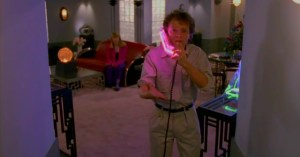
All of this seems pretty straightforward, but there’s also the mysterious reappearance of Sam’s childhood toy that sends him off searching for the truth of his origins, Sam’s budding powers and the ensuing accidental deaths thereof (including a couple of police officers and John Landis in a cameo as a radio . . .  technician, maybe?), a radio evangelist/medium who seems to be speaking to Sam directly for reasons that are utterly unclear, the sudden reappearance of a woman (Melinda Dillon) involved in the original experiment and her just-as- sudden murder, the murder of another woman who was investigating the soon-to- be-activated nuclear plant nearby, Lisa’s own pyrogenetic powers, and an inordinate number of conversations held on neon telephones.

combustion-espontanea-spontaneous-combustion-tobe-hooper-eeuu_-1990_avi_002513600

The composition and plotting of this movie are bafflingly inelegant, and even two viewings left me unable to accurately gauge just what in the hell was happening at any given time. This was a frustrating viewing experience, both times, and not in the sense that some deeply philosophical films are hard to parse. Instead, Spontaneous Combustion feels like a unauthorized, non-union sequel to Firestarter that was hastily edited together by someone trying to recreate the experience of watching that film with a 104° fever. It’s a movie that actively tries to discourage you from watching it even as the story (such as it is) unfolds, challenging the viewer to a test of wills.

Despite the incohesiveness of the overall plot, I was able to discern two similarities that would reasonably connect this film to Society and, to the inebriated mind of some marketing exec, warrant putting the two films on a single disc. First, the actor playing Sam’s father, Brian Bremer, also portrayed Petrie, Billy’s rival for student body president, in Society. More thematically, both Billy Whitney and Sam are the children of working class people raised by wealthy elites for their own nefarious purposes. It’s a bit of a stretch, but there it is.

Even if you find yourself with a copy of this double DVD in your pursuit of watching Society, don’t flip that disc. It’s not worth it.

For more on February’s Movie of the Month, the satirical class politics body horror Society, check out our Swampchat discussion of the film.

-Mark “Boomer” Redmond
Trauma (1993)

EPSON MFP image

three star

Well, here we are, folks. I wrote in my review of Opera that many considered that film to be Dario Argento’s last good movie, although I had also read that Trauma had its fans as well. I was pleasantly surprised by the director’s “Black Cat” segment of Two Evil Eyes, so I was looking forward to Trauma with some reservations but an open mind. On the whole, this 1993 film (released just a year after the director’s cameo in Innocent Blood) has a lot of meritorious elements in its favor and is a decent movie, but throughout the run time I kept thinking to myself, “Oh, so this is where we’re going now.” Although the giallo elements work, for the most part, the movie’s most memorably quality is blandness, although how much of that is intentional or not is unclear.

The film follows Aura (Asia Argento, in one of her earliest film roles and her first time being directed by her father), a sixteen year old girl who has escaped from a psychiatric hospital where she was undergoing treatment for anorexia. She meets David (Christopher Rydell), a TV news graphic artist and former heroin addict, and he befriends her after assuming that her IV feeding tube scars are track marks. Aura is soon recaptured by social services, however, and returned to the home of her parents, renowned mystics who are hosting a séance. Aura’s mother Adriana (Piper Laurie) claims that a spirit named Nicholas has hijacked the ceremony and is claiming that the serial decapitator The Headhunter is present. Aura watches from an upstairs window as her mother and father flee into the rainy night and runs after them, only to discover that The Headhunter has killed them both. She finds David and asks for his help, placing a strain on his relationship with news anchor Grace (Laura Johnson), who eventually calls the hospital and reports Aura so that she is forced to return there. Meanwhile, David’s investigation leads him to learn that (spoilers through the end of this paragraph) The Headhunter’s victims were all medical professionals in attendance on the night that Adriana was giving birth to her second child, a son to be named Nicholas; the doctor (Brad Dourif in what amounts to an extended cameo) insisted on pushing ahead with inducing labor despite inclement weather and intermittent power outages, and when he is startled by a lightning strike with a scalpel in his hand, he accidentally decapitated the baby. The nurses present convince him to use ECT on Adriana to erase her memory of the event, and her husband is complicit in their cover up. Of course, as in so many of Dario Argento’s movies, this repressed memory eventually resurfaces and the murderer seeks out vengeance.

In an interview on the DVD of La Terza madre, Asia Argento discussed the fact that working as a director had given her new insights as an actress, and it shows in the difference between her presence here and there. She is the weak performative link in this movie, but the film’s flaws are not restricted solely to her amateur abilities. Piper Laurie goes over the top here, as she often does, but Adriana Petrescu lacks the grounding that made Margaret White function so well as a sinister mother figure. Brad Dourif’s barely present on screen (and kudos to the editor of the film’s trailer for excising any reference to him, although the fact that his name appears at the top of the DVD box ruins that reveal), and his appearance ends with one of the worst uses of chroma-key effects I’ve seen in my life. That sequence stands out as particularly terrible, especially given how effective the rest of the movie’s decapitated heads, created by effects genius Tom Savini, are. It’s also strange to me that no one in the film seems to have a problem with the adult David’s romantic and ultimately sexual relationship with teenaged Aura is, other than Grace, whose issues are painted as being the result of jealousy rather than concern for the fact that a sixteen year old may be being taken advantage of by a much older beau. The film’s score also leaves much to be desired, especially in the sequences in which the young boy who lives next door to the killer’s home (Cory Garvin) sneaks into the murder house while chasing a butterfly; they feel more like unused tracks from Dennis the Menace than something created with the intent of increasing tension. The killer’s weapon of choice, a kind of bladed garrote, is a neat invention, but there’s too much tonal inconsistency present throughout, and the homages to Argento’s earlier work (especially Profondo rosso) only serve to demonstrate how much this film pales in comparison. I’m also unclear as to why Argento chose to shoot this picture in what he called “featureless Minnesota,” given that it adds to the overall banality of the film’s cinematography, especially given his masterful use of classic architecture and depth of field in his earlier work.

Having said that, this is not a bad movie, just an unmemorable one. For an Argento completist, it’s a movie that I would recommend over Inferno or Four Flies on Grey Velvet, and the mystery, despite being at times incoherent, works well in spite of its implausibility and absurdity. There are some great visual flourishes as well, especially in Aura’s hallucinatory sequence and in the discovery of the creepy nursery filled with gauzy screens. There’s a laudable attempt to trace the relationships between media, family, and psychological disorders here; it’s misguided and dated in its discussion, but I appreciate that there was an attempt to address this issue, even if the conceptualizations of the root cause of eating disorders is somewhat facile. The scenes set in the mental hospital are also effectively unnerving, even if that trope smacks of ableism when viewed through a modern lens. More than anything, I can tell that this is a movie that suggests a sharp downturn in the director’s work from here on out, even if it is decent within itself.

-Mark “Boomer” Redmond